Research Article
a
April
2018
Computer Science and Software Engineering
ISSN: 2277-128X (Volume-8, Issue-4)
Designing an Energy Efficient Scheme in MANET using
Reconfigurable Directional (RDA) Algorithm
Er. Rinkle
M.Tech Scholar, CSE Deptt., SIET, Aliyaspur Ambala, Haryana, India
Er. Anuradha Saini
A.P., CSE Deptt., SIET, Aliyaspur Ambala, Haryana, India
Abstract: Mobile Ad Hoc Networks (MANET) are autonomous, infrastructure less and self-configuring networks. MANETs has gained lots of popularity due to on the fly deployment i.e. small network setup time and ability to provide communication in obstreperous terrains. Major challenges in MANETs include routing, energy efficiency, network topology control, security etc. Primary focus in this article is to provide method and algorithm to ensure significant energy savings using re-configurable directional antennas. Significant energy gains can be clinched using directional antenna. Key challenges while using directional antenna are to find destination location, antenna focusing, signal power and distance calculations. Re-configurable directional antenna can ensure significant energy gains if used intelligently. This article provides a brief insight into improved energy savings using re-configurable directional antennas and an associated algorithm
Keywords: Directional Antennas; Energy Efficiency; Antenna Re-configuration; Mobile Ad hoc Networks; Genetic Algorithms
I. INTRODUCTION
Mobile ad hoc networks (MANET) are versatile kind of network and are able to work in numerous situations and places where provision of fixed infrastructure is not feasible. MANETs are amenable to topology change as the topology changes over time. The participating nodes are mobile and support unrestricted movement in a limited geographic area [1]. MANET works over wireless communication medium and wireless medium is susceptible to- high interference and connection failure. Due to this the participating nodes should be able to heal themselves and reconstruct the network state. MANETs usually operates using mesh topology and a conventional mobile node uses Omni-directional antenna (which emanates isotopic radiations) for communication. Using these antennas mobile nodes cannot easily find the location and distance of the destination nodes and suffer huge energy losses. Reconfigurable directional antennas are panacea for these problems. These kinds of antennas are highly adaptive to topology change and provides other numerous advantages. Reconfigurable directional antennas (RDA) are able to reduce collisions in the communication and second major advantage is the antenna gain. The increased gain improves the transmission range of nodes and significantly reduces the number of hops required to reach the destination [5]. Reconfigurable antennas offer following explicit advantages over conventional directional antennas [9, 14].
• Frequency reconfiguration
• Radiation pattern reconfiguration • Polarization reconfiguration
• Compound reconfiguration
When the directional antennas are combined with reconfiguration capability it further improves the energy efficiency and improves the network lifetime. Nodes equipped with RDA’s can be used in varied dimension across different networks. Genetic algorithms (GA) can be used further to make a smart MANET. This article shortly describes how GA can be used with RDA to improve the energy efficiency of the MANET [6]. GA uses selection, crossover, and mutation to reach an optimum solution and here they are used for observing node behavior and making smart routing decisions
II. RELATED WORK
ISSN(E): 2277-128X, ISSN(P): 2277-6451, pp. 92-100 omnidirectionalantenna and one such improvement is directional antenna. Author J Zilberfarb [1] worked on B-CDMA and focused on its improvements using the concept of multi-ray propagation model, multi-ray DOA distribution and directional antenna. The author improved SNR (signal to noise ratio) and reduced fading (6.5 to 7.5). In late nineties work was done on directional beams and ascending search power algorithms were developed [2]. One such algorithms focused on optimal link called Direction Beams and range of beams for interrogation for searching the receiver and finding its location [3]. One another author [4] mentioned key problems in the use of directional antenna and especially in medium access control (MAC) layer such as hidden terminal problem, deafness and interference etc. In response to these problems authors [5, 6] has mentioned multi-channel MAC (MMAC). This setup can remove all major problems of ad hoc networks and further improves the Quality of Service(QoS) of MANETs and wireless sensor networks (WSN). More improvements are possible using directional antenna. Multicasting routing protocols were also improved by [7] to garner more energy savings. Both topologies, mesh and tree were improved for multicasting in ad hoc networks. Further improvements have been obtained by the use of directional antenna (DA). In [8] work has been done on finding the direction and methods to perform directional communication between nodes. The concept of Beam Switch has been used while implementing such type of network. Beam Switched network and nodes employ multiple antennas per node and each antenna supports directional as well as conventional Omni-directional mode of communication. Beam power and directional requirements are discovered and communication proceeds. Beam selection and assessment are integral part of Beam Switched. Using beam switching energy efficiency is improved up to 20 percent than that of conventional directional antenna [8, 15].
To be more successful, the enemy tries to put itself on the genuine information stream way between the two conveying nodes as this will get more movement. In light of the constrained transmissiongo, sensor arranges advances the nodes to the base station in multihop way and keeping in mind that being directed to the base station bundles might be dropped due to crash, clog or other system issues.
III. RESULT MEASUREMENT
In this section results of the proposed algorithm are presented briefly. Number of comparative parameters like, number of phases, Omni-directional Vs. Directional antenna, and Number of current direction etc. are used. Performance evaluation contrast Omni and directional antennas and comparison results are presented in graphical and tabular form.
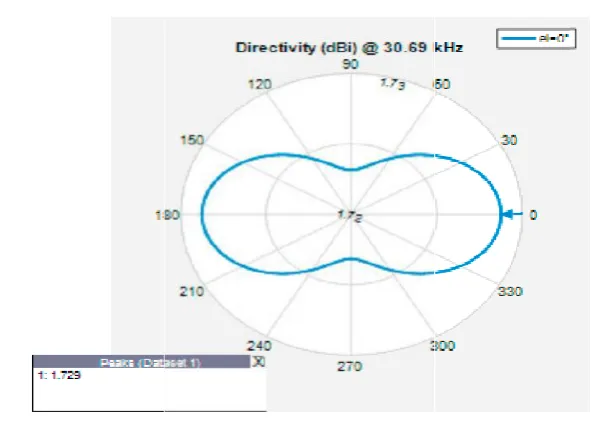
Fig. 1. Omni-directional Antenna
3.1 Radiation Pattern of Omni-Directional Antenna
Radiation pattern of Omni-directional antenna resembles a balloon and they emanate energy equally in all directions. Radiations and radiation pattern also presents waves strength form source where the transmission starts. Figure 1 also presents pattern of radiation in four quadrants using polar coordinate representation. Difference of power discharged is defined by transmission source and is used for the purpose of directional information.
3.2 Simulation Parameters Used
ISSN(E): 2277-128X, ISSN(P): 2277-6451, pp. 92-100
Table 1. Specification Table (Simulation Parameters).
Parameters Values
Network Length Network Width Bits Per Second
Number of End Devices/Nodes Coverage Distance
1000 m 1000 m 1000 bits 8 0-5000m
Number of Packets 100
3.3 Rendezvous Phase
Energy outcomes of conventional Rendezvous (Using Omni-Directional Antenna) phase are depicted in figure 2 and corresponding energy consumptions are also presented. Y axis represents the energy consumption in milli joules and X axis denotes the number of average directions utilized/available at a particular moment in simulation. The number of directions is dynamic and changes as the network topology changes. This conventional approach is inefficient and consumed lots of energy. So lots of improvements can be done in conventional setup to garner more energy gains.
3.4 Full Scanning Phase
Full scanning is an important phase when participating nodes discovers neighbor nodes. Figure 3 presents energy consumption in full scanning phase. It is evident that large amount of energy is wasted in full scanning phase and this energy wastage must be curbed to improve network lifetime and other network parameters.
Figure 2 Energy Consumption in Rendezvous Phase Figure 3 Energy Consumption
3.5 Collision Rate over Omni Directional Antenna
Due to high interference in wireless medium collisions occurs and degrades system performance. Collisions impact the energy consumption significantly and should be reduced. Figure 4 represents the data collisions rate over Omni directional antenna operated system. Form the figure it can be easily guessed that simple antenna configuration amounts to higher rate of collisions and adversely impacts the system performance. The energy wastage must be tapped to make an effective system.
3.6 Performance Evaluation of Proposed Protocol
The proposed system uses re-configurable directional antennas and an effective genetic algorithm to improve system performance. Network efficiency increases significantly using this approach and following paragraphs presents the improved results. For more detailed information on algorithm refer [9].
3.7 Energy Consumption in Full Scanning Phase:
Due to smart use of GA energy consumed in full scanning phase is reduced due to improved intelligent calculations and other optimizations over time. Neighbor information is intelligently updated and exhaustive network is not scanned unnecessarily. Figure 5 represents energy savings in full scanning phase using proposed approach and can be compared with the tradition approach.
3.8 Result Comparisons
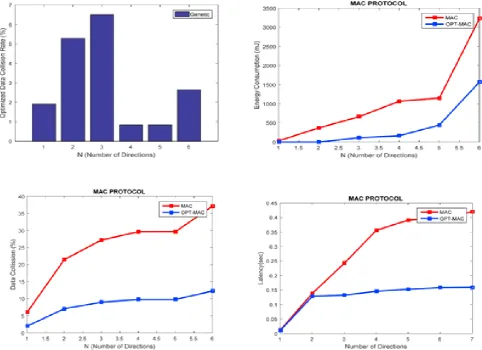
ISSN(E): 2277-128X, ISSN(P): 2277-6451, pp. 92-100 reduced collisions. Figure 7 compares energy consumption in full scanning phase for conventional and proposed method. Conventional approach is consuming 3000 mJ and the proposed method (Blue line) consumes only 1700 mJ resulting in significant energy savings.
In this Figure 3 shows Optimized Data Collision Rate and Fig 4 shows Energy Consumption &Fig. 5. Optimized Data Collision Rate (%) Fig. 6. Latency (sec)
Data collision rate is notably reduced in the proposed system. Figure 5 compares the conventional method with the proposed method. It is obvious from the figure that the proposed system significantly improves the data/packet collision rate. This reduction bears positive impact on system performance. Table 2 also presents different parameters and improvements in the proposed system.
Table 2 clearly establishes that the proposed system outperforms the conventional Omni-directional antenna based systems and positively impacts the system performance.
Parameters Existing Proposed (With
Optimizations)
Energy Consumption 3000 mJ 1700 mJ
Collision Rate 37 % 11 %
Latency 0.42 0.19
Latency of conventional and proposed system is also compared. Latency represents the delay in end to end delivery of packets. Figure 6 presents the comparison of latency for both the approaches. Average latency comes out to be 0.19 sec with the proposed approach though it is 0.42 seconds for the conventional approach. It’s evident that the proposed system improves latency to a notable level.
IV. LITERATURE REVIEW
ISSN(E): 2277-128X, ISSN(P): 2277-6451, pp. 92-100 in impromptu systems had as of late gotten much consideration. Vital initial step was Neighbor disclosure for those self-arranged systems. it make conceivable to recognize the dynamic hubs among every one of the hubs in environment and this information was essential for other propelled layer conventions like medium get to control, steering and topology control conventions. To take full favorable position of the capacities of shrewd reception apparatuses, creator displayed two calculations. The primary calculation intend to enhance the quantity of uncovered hubs. The second calculation tries to lessen the quantity of jumps in a course among source and goal hubs by utilizing the extended territory that could be accomplished when the hubs were outfitted with directional receiving wires. As an aftereffects of the entertainments, decrease at last to-end postpone and an expanded in the system sum when the plan was contrasted and other responsive steering conventions.
2. Gankhuyag, Ganbayar et.al, 2017 [23] described that day by day-expanding requests of versatile and adaptable correspondences had prompted fast development in systems administration among unmanned airborne vehicles (UAVs) much of the time alluded to as flying specially appointed systems (FANETs). Display specially appointed steering conventions were not reasonable for FANETs because of fast, natural conditions and ground structures. The creator proposed a consolidated omnidirectional and directional transmission plan to defeat such obstacles, together with vivacious edge alteration. Utilizing area and direction data, the creator proposed highlights cross breed utilization of unicasting and geo casting steering. The desire of middle of the road hub area utilizing three-dimensional estimation and directional transmission just before the anticipated area, empowering a more extended transmission go, permitted monitoring an evolving topology, which guarantees the strength of our convention. Impersonation comes about approved that the creator proposed plan could essentially expand the execution of flying impromptu systems.
3. Chung-Ming Huang et.al, 2016 [24] defined that since advanced mobile phones were constantly furnished with cell and Wi-Fi interfaces, the creator deeds the practicality of the Wi-Fi based Gadget to-Gadget (D2D) emptying system to diminish cell activity. The creator purposed LBS situation. In this situation a Swarm of purchasers travel outside and use their PDAs to shape a versatile united system, which was made out of cell and Wi-Fi systems, to download and share the neighbor LBS information. Because of the wide-extend scope of the cell organize, one of these advanced cells was chosen to assume the part of portable intermediary to download the mutual LBS information utilizing its cell interface. Different individuals utilizing multicast over the Wi-Fi organize, after this dissemination. Further, a client straightforward Machine-to-Machine (M2M) based versatile intermediary handoff system was contrived. The proposed emptying instrument empties the cell organize movement and furthermore diminished the power utilization.
4. Kai Lin et.al, 2016 [27] defined that, the observing quality and vitality effectiveness; both had awesome importance, for interruption recognition in 3D remote sensor systems. An exceptional globoid display created by creator .it guaranteed the all-directional identification quality while sparing the system vitality practically. It isolated the detecting territory into two sections .these were furthest case and inside locale. The creator initially proposed a furthest case scope calculation to ensure the thankfulness nature of prominent activities. At that point a Markov conjecture show was intended to estimate the movement probability in the neighboring zone in view of the verifiable directions of assailants. As per the assessed comes about, various working frequencies would be apportioned to the secured hubs by utilizing the innovation, named SDR. In addition, a direction rectification plot was proposed to rearrange the missing gatecrashers amid the operation. The execution estimations demonstrated the profitability of the creator conspire as far as the system life time, direction gauge exactness and achievement rate of correction technique.
5. Iyad Lahsen Cherif et.al, 2016 [18] depicted that the Vitality Profitability was a critical element in poor secured ranges where the entrance to a cell arrange was rare. Vitality sources were likewise restricted in these territories. Represent made nearby back pull system to cover country and remote towns, the creator measured a remote work organize. The deficiency of vitality in these settlements rouses to improve the vitality utilization of the remote backhaul arrange. So, the creator proposed to utilize Directional Receiving wires (DAs) to expand the yield and the system vitality utilization. The RF signals accentuation by DAs to the coveted goal, to diminish the accidents. The quantity of outings between the source and the goal additionally accentuation by Das itself. Creator accommodated both OAs and DAs organizes, the quantity of connections (jumps) that a bundle passed closed to achieve the goal. The creator assess the system execution as far as bundle misfortune, mean amount, mean vitality utilization and vitality proficiency for the chain and network topologies by utilizing broad impersonation. The outcomes results by Reenactments, demonstrated that utilizing DAs enhanced the sum and the vitality proficiency, and diminish the mean misfortune proportion.
ISSN(E): 2277-128X, ISSN(P): 2277-6451, pp. 92-100 system 2). The MANET directing could be legitimately adjusted as far as vitality proficiency, vitality exhaustion for steering, Steering finds, End-to-End delay, bundle estimate Versus Conveyance - Proportion, bundle measure.
7. Trong Nhan Le et.al, 2016 [17] characterized that to for lessen information crash in remote sensor systems (WSN), the Reconfigurable directional reception apparatuses (RDA) bring new open doors. Creator purposed another reconfigurable directional reception apparatus based beneficiary. This recipient Started cycled collector (RDA-RICER) medium get to control (Macintosh) convention was proposed for WSN hubs arranged with exchanged radio wires. A low many-sided quality filtering process was implanted in RDA-RICER to distinguish the bearing giving the most elevated got flag quality Pointer between two hubs. Vitality productive sweep was additionally installed in hubs for same reason. OMNeT++ reproduction result for a solitary jump organize demonstrated that information crash rate could be definitely decreased contrasted and related Macintosh conventions.
8. Vinod Kulathumani et.al, 2016 [26] author defined that the failure of Portable Specially appointed System (MANET)arrangements to scale past around 100 hubs by and by had generally been faulted for sparse system limit with respect to supporting directing related control activity. The creator watched however that system limit remains altogether under used by standard MANET directing calculations at this size of dispersion. In this way, rather than describing as far as possible for MANET steering as far as limit, the creator portrays it as far as the communication among the progression of way disappointment and of way repair. This shows to the disclosure of the repair time scaling divider. This scaling divider was utilized to clarify the watched scaling limits in MANETs. It recognized the effect of repair time scaling divider on MANETs and portrayed strategies to broaden as far as possible.
9. Rabin Bhusal et.al, 2015 [22] defined that because of transmission capacity restrictions on the 2.4/5 GHz mechanical, logical, and medicinal band, the 60 GHz millimeter wave range with an enormous transfer speed of 7 GHz had been step by step utilized in light of the fact that it was equipped for accomplishing high information rate of up to 7gbps. The creator purposed, a power facilitated multiband medium get to control (ECM-Macintosh) hone for multi-gbps remote neighborhood was proposed. On the premise of required data transmission for various applications, it was fit for picking the radio band. In ECM-Macintosh, the 2.4 GHz band with omnidirectional reception apparatus was utilized for transmitting control the 60 GHz band related with directional receiving wires was utilized to transmit information at a multi-gbps speed. The entertainment of this demonstrated ECM-Macintosh spared vitality by no less than 28% and diminished correspondence delay by no less than 14% when contrasted with the sound convention.
10. Vinay Rishiwal et.al, 2015 [29]characterized that by expanding the scope go, a directional receiving wire could give a more steady way the quantity of steps were additionally lessened for this. It tackled part of issues, for example, channel obstruction and spatial reuse. In Portable Adhoc Systems (MANETs), the directional reception apparatus' examination had been limited every now and again to medium get to control. it is important to Survey the effect of directional receiving wires on the execution of steering conventions to decide the capacity of the MANET steering conventions with directional radio wires. The creator characterized, an endeavor had been set up to cross couple the Macintosh and steering layer to allow the DSR convention with directional reception apparatus. it had been contrasted and the conventional DSR with Omni-directional radio wire to check the distinction and extent of this approach. Reproduction comes about had been produced with NS-2 rendition 2.29. Reenactment comes about happened which demonstrated that it could convey more number of bundles with less emphases and deferral on end to end were likewise less when contrasted with old approach of DSR. Vitality misfortune was likewise less by this approach as contrast with DSR with Omni-directional reception apparatus bolster.
11. M. Nandini 2013 [28] defined that the principle point was to give vitality proficiency by utilizing DISH (Distributed Data Sharing) techniques to agreeable multi-channel Macintosh conventions. Conveyed Data Sharing was another helpful approach utilized for outlining multichannel Macintosh conventions. It underpins hubs in their basic leadership forms by adjusting for their missing information by means of data sharing through neighboring hubs. This approach was utilized to help the yield of multichannel Macintosh conventions. Be that as it may, a basic issue for specially appointed specialized gadgets, viz. vitality effectiveness, still couldn't seem to be tended to. In this venture, decrease the vitality utilization to take care of this issue without collaborating the yield execution yet amplify cost efficiency.
ISSN(E): 2277-128X, ISSN(P): 2277-6451, pp. 92-100
13. Baoli Zhang et.al, 2010 [16] characterized that for a remote sensor organize, the precision of area estimation of specially appointed sent sensor hubs within the sight of boisterous circumstance. Considering three things in this, for example, estimation exactness, vitality productivity, and range independency, the creator proposed a limitation plot utilizing a portable grapple hub furnished with a directional radio wire in light of the geometry method, called Confinement Plan for Remote Sensor Systems utilizing Directional Receiving wire (LSWD), With high pick up and limit covering zone, this plan utilized directional reception apparatus focuses vitality on a specific heading. Without expanding any sort of intricacy and equipment, sensor hubs evaluate their positions. For this reason hubs utilized the base number of reference point data. System recreation programming checked the restriction plot. The outcome demonstrated that the given limitation calculation was superior to anything other restriction conspires in the way of vitality productivity and furthermore had higher precision.
14. Emad Felemban et.al, 2010 [13]characterized that for gathered information in numerous various application settings, the remote sensor systems had been utilized. The limit of such systems remains a principal snag towards the adjustment of sensor organize frameworks for cutting edge applications, required higher information rates and amount. The conceivable guides of coordinating directional radio wires into remote sensor systems were found by the creator. For specially appointed systems, the use of directional reception apparatuses had been contemplated previously, their use in sensor systems bring the two prospects and additionally challenges. Creator characterized that the sectored Receiving wire Medium Get to Control was presented. Fundamentally it was a cross layer convention that gave the correspondence systems to sensor system to completely use sectored radio wires. SAMAC conveyed high vitality productivity and unsurprising postpone execution with smooth corruption in execution with expanded load.
15. Xueli An et.al, 2009 [20]defined that to expedite directing and information spread in unplanned and sensor systems, tattling was a validity approach. Creator proposed an extensive estimation of talk based conventions utilizing directional reception apparatuses. Creator assessed three sorts of different periods of the directional tattling conventions: directional tattling component, arrange chart sort, handset reception apparatus mode. By utilizing distinctive receiving wire modes ,the creator investigated the tattling execution: directional-transmitting with omnidirectional-receiving(D-O) and directional-transmitting with directional-getting (DD).the creator demonstrated the reasonable reception apparatus shaft width run for utilizing different methods of radio wire. Creator additionally gave the thought and looked at part of directional tattling expansion calculations. For utilizing directional radio wires in impromptu and sensor organizes, the creator work gave distinctive and significant observations.
16. Julien Iguchi-Cartigny et.al, 2009 [15] characterized that to accomplish vitality productive telecom in remote multi bounce systems utilizing directional receiving wires, there were various recommendations. These depended on the unified calculations. The brought together calculations required worldwide information of the topology of the system, as a result of the high number of control messages required to accumulate such worldwide information, these conventions were not appropriate for specially appointed systems. The creator proposed part of confined calculations. Every hub of these calculations has to know just geographic purpose of hub itself and its neighbors. Another vitality utilization display for directional reception apparatuses additionally presented by creator. Creator first convention was called DRBOP. This convention took after the coordinated correspondence model to reach to all hubs following the relative neighborhood diagram (RNG). With no message traded, RNG rationed availability and could be privately figured by every hub. One of its RNG neighbors would rebroadcast it to each of its continuing RNG neighbors independently, when any hub got a message for first time. Transmission vitality balanced for each transmission for achieve the correct neighbor. Since the normal level of RNG is around 2.5, roughly 1.5 rebroadcasts are finished by every hub to its neighbors. Next, the creator portrayed DLBOP, the neighborhood least spreading over tree (LMST) chart utilized which a kept topology was taking after the MST. The creator at that point portrayed efficient limited convention, which adaptively shifts among the two sorts of interchanges, for example, coordinated and one-to-numerous reenactments and was productive for both meager and thick systems.
V. CONCLUSION
ISSN(E): 2277-128X, ISSN(P): 2277-6451, pp. 92-100
REFERENCES
[1] Astudillo, Gabriel, and Michel Kadoch. "Neighbor discovery and routing schemes for mobile ad-hoc networks
with beamwidth adaptive smart antennas." Telecommunication Systems (2017): 1-11
[2] Gankhuyag, Ganbayar, Anish Prasad Shrestha, and Sang-Jo Yoo. "Robust and Reliable Predictive Routing Strategy for Flying Ad-Hoc Networks." IEEE Access 5 (2017): 643-654.
[3] Chung-Ming, Chao-Hsien Lee, and Hsin-Yi Lai. "Energy-Aware Group LBS Using D2D Offloading and
M2M-Based Mobile Proxy Handoff Mechanisms Over the Mobile Converged Networks." IEEE Transactions on Emerging Topics in Computing 4, no. 4 (2016): 528-540.
[4] Lin, Kai, Tian lang Xu, Jeungeun Song, Yongfeng Qian, and Yanming Sun. "Node scheduling for all-directional
intrusion detection in SDR-based 3D WSNs." IEEE Sensors Journal 16, no. 20 (2016): 7332-7341.
[5] Cherif, Iyad Lahsen, Lynda Zitoune, and Véronique Vèque. "Throughput and energy consumption evaluation in
directional antennas mesh networks." In Wireless and Mobile Computing, Networking and Communications (WiMob), 2016 IEEE 12th International Conference on, pp. 1-8. IEEE, 2016.
[6] Mohapatra, Sasmita, and M. Siddappa. "Improvised routing using Border Cluster Node for Bee-AdHoc-C: An
energy-efficient and systematic routing protocol for MANETs." In Advances in Computer Applications (ICACA), IEEE International Conference on, pp. 175-180. IEEE, 2016.
[7] Le, Trong Nhan, Alain Pegatoquet, Trinh Le Huy, Leonardo Lizzi, and Fabien Ferrero. "Improving Energy Efficiency of Mobile WSN Using Reconfigurable Directional Antennas." IEEE Communications 6 (2016): 1243-1246.
[8] Kulathumani, Vinod, Anish Arora, Mukundan Sridharan, Kenneth Parker, and Bryan Lemon. "On the repair time scaling wall for MANETs." IEEE Communications Letters 20, no. 8 (2016): 1623-1626.
[9] Bhusal, Rabin, and Sangman Moh. "A coordinated multiband MAC protocol for energy-efficient multi-Gbps wireless LANs." In Multimedia and Broadcasting (APMediaCast), 2015 Asia Pacific Conference on, pp. 1-5. IEEE, 2015.
[10] Rishiwal, Vinay, Sonu Lamba, Mitul Yadav, and Mano Yadav. "Dynamic Source Routing Using Directional Antenna." In Advances in Computing and Communication Engineering (ICACCE), 2015 Second International Conference on, pp. 392-395. IEEE, 2015.
[11] Nandini, M., and J. Sathya Priya. "Energy conservation and DDOS detection using intelligent node in mobile adhoc network." In Information Communication and Embedded Systems (ICICES), 2013 International Conference on, pp. 713-717. IEEE, 2013.
[12] Sharma, Komal M., and Archana Raut. "Improving the performance of Mobile Adhoc networks using dynamic
group data caching scheme." In Engineering and Systems (SCES), 2013 Students Conference on, pp. 1-4. IEEE, 2013.
[13] Zhang, Baoli, and Fengqi Yu. "LSWD: Localization scheme for wireless sensor networks using directional antenna." IEEE Transactions on Consumer Electronics 56, no. 4 (2010).
[14] Felemban, Emad, Serdar Vural, Robert Murawski, Eylem Ekici, Kangwoo Lee, Youngbag Moon, and Sangjoon
Park. "Samac: A cross-layer communication protocol for sensor networks with sectored antennas." IEEE Transactions on Mobile Computing 9, no. 8 (2010): 1072-1088.
[15] Xueli, and Ramin Hekmat. "Probabilistic-based message dissemination in ad-hoc and sensor networks using directional antennas." In Mobile Adhoc and Sensor Systems, 2009. MASS'09. IEEE 6th International Conference on, pp. 432-438. IEEE, 2009.
[16] Iguchi-Cartigny, Julien, Pedro M. Ruiz, David Simplot-Ryl, Ivan Stojmenovic, and Carmen M. Yago.
"Localized minimum-energy broadcasting for wireless multihop networks with directional antennas." IEEE Transactions on Computers 58, no. 1 (2009): 120-131.
[17] Sharma, Anupam Kumar, and Munesh Chandra Trivedi. "Performance Comparison of AODV, ZRP and
AODVDR Routing Protocols in MANET." In Computational Intelligence & Communication Technology (CICT), 2016 Second International Conference on, pp. 231-236. IEEE, 2016.
[18] Singh, Gurpinder, and Jaswinder Singh. "MANET: Issues and behavior analysis of routing protocols." International journal of advanced research in computer science and software engineering 2, no. 4 (2012).
[19] Yuteng Guo, Beizeng Wang, Xing xing Zhao, Xiaobiao Xie, Lida lin and Qinda Zhou,“Feature Selection based
on Rough Set and modified Genetic programming for Intrusion Detection”, In 33 ICRTIT-2012 proceedings of 5th International Conference of Computer Science and Education, IEEE, August 2010, China
[20] Yuteng Guo, Beizeng Wang, Xingxing Zhao, Xiaobiao Xie, Lida lin and Qinda Zhou,“Feature Selection based
ISSN(E): 2277-128X, ISSN(P): 2277-6451, pp. 92-100
[21] Crosbie, Mark, and Gene Spafford. 1995. “Applying Genetic Programming to Intrusion Detection.” In
Proceedings of 1995 AAAI Fall Symposium on Genetic Programming, pp. 1-8. Cambridge, Massachusetts, 2001