© 2019 by the Serbian Biological Society How to cite this article: Xie Y, Wang Z, Lin H, Pan Y, Wang L, Yan Z, Qiao Z, 551 Han Z. Resveratrol blocks atherosclerosis development by inhibiting IL-1β in
macrophages induced by cholesterol. Arch Biol Sci. 2019;71(3):551-9
Resveratrol blocks atherosclerosis development by inhibiting IL-1β in macrophages
induced by cholesterol
Yilin Xie1, Zhaoxia Wang1, Haiyun Lin1, Yajun Pan1, Lianyun Wang1, Zhiqiang Yan2, Zhongdong Qiao1,* and
Zhihua Han3,#
1School of Life Science and Biotechnology, Shanghai Key Laboratory for Reproductive Medicine, Shanghai Jiao Tong
University, Shanghai 200240, P.R. China
2Central Laboratory, Shanghai Jiao Tong University Affiliated Sixth Peoples’ Hospital South Campus Shanghai, Shanghai
201400, P.R. China
3Department of Cardiology, Ninth People's Hospital, Shanghai Jiaotong University School of Medicine, 639 Zhizaoju Road,
Shanghai 200011, P.R. China
Corresponding authors: *[email protected]; #[email protected]
Received: November 29, 2018; Revised: April 2, 2019; Accepted: April 3, 2019; Published online: July 10, 2019
Abstract: Resveratrol is a polyphenolic compound that exhibits antiinflammatory and cardioprotective properties. In this study we investigated the protective role of resveratrol on the inflammatory activation of macrophages during pathogenesis of atherosclerosis. Macrophage Ana-1 cells were stimulated by cholesterol and resveratrol, and the cell culture supernatant was collected to treat human umbilical vein endothelial cells (HUVECs). The release of IL-1β into the Ana-1 cell superna-tant was quantified by ELISA. Expression of the adhesion molecule ICAM-1 and E-selectin in HUVECs were examined by Western-blotting. Additionally, the adhesion of monocytes in HUVECs under different conditions was tested by cell adhesion analyses. The results indicated that the high cholesterol treatment increased the expression level of IL-1β, while pretreatment with resveratrol inhibited this induction of IL-1β in Ana-1 cells. Resveratrol inhibited the adhesion of mono-cytes to the endothelium at least partly through inhibition of IL-1β expression in macrophages. Moreover, the expression level of caveolin-1 significantly increased after the pretreatment with resveratrol, indicating that resveratrol enhances reverse cholesterol transport (RCT) in macrophages. Our study indicated that resveratrol has significant antiinflammatory effects and can be considered as a candidate molecule to prevent atherosclerosis.
Keywords: resveratrol; IL-1β; atherosclerosis; cholesterol; HUVEC
Abbreviations: human umbilical vein endothelial cells (HUVECs); interleukin-1β (IL-1β); intercellular cell adhesion mol-ecule-1 (ICAM-1); endothelial selectin (E-selectin); reverse cholesterol transport (RCT)
INTRODUCTION
Atherosclerosis is a chronic pathological process closely related to proinflammatory cytokines and cholesterol accumulation. Atherosclerosis is responsible for a large proportion of cardiovascular mortalities in developed and developing countries [1].
Activation of the macrophage inflammasome is the key point in the initiation of atherosclerosis. Many studies have shown that IL-1β is a latent proatherogenic cytokine, and the severity of the atherosclerotic lesions in coronary arteries is associated with IL-1β levels
[2]. IL-1β knock-out in atherosclerosis-susceptible ApoE-/- mice results in regression of atherosclerosis
development [3]. Moreover, the secretion of many other cytokines and chemokines are also induced by IL-1β, and IL-1β promotes the expression of inducible nitric oxide synthase (iNOS), cell adhesion molecules (CAMs) and endothelin-1 in endothelial cells [4-6] In this study we focused on the IL-1β release in mac-rophages under different treatments.
recruitment, adherence and migration of immuno-competent cells into vascular intima [7]. Many studies have shown that the intracellular adhesion molecule-1 (ICAM-1) and endothelial selectin (E-selectin) are regulated by cytokine stimulation in endothelial cells [8, 9], and that they also act as ligands for the attach-ment of monocytes [10, 11]. Their expression levels are regarded as the markers of endothelial activation [11]. Moreover, increased expression (ICAM-1) was observed in patients with extensive atherosclerosis [12].
Cholesterol is an indispensable lipid in vertebrates that is insoluble in aqueous environments, and a com-plicated mechanism maintains cholesterol balance in vertebrates [13]. Many diseases are the result of cholesterol imbalance. It was reported that germ-free animals are more susceptible to atherosclerosis, sug-gesting that the inflammation during atherosclerosis may arise from the endogenous substances [14]. Given that atherosclerosis is intimately related to cholesterol imbalance, we investigated the role of cholesterol ac-cumulation in the development of atherosclerosis.
Resveratrol is a polyphenolic compound found in grapes and some traditional Chinese medicinal plants such as Polygonum cuspidatum. [15]. While many stud-ies suggest that resveratrol exhibits cardioprotective and antiinflammatory properties [16-22], the molecular mechanisms underlying the protective role of resvera-trol on atherosclerosis are not fully understood. In this study we examined the antiinflammatory role of resveratrol on cholesterol-treated macrophage Ana-1 cells and found that resveratrol pretreatment inhibited the cholesterol-induced IL-1β production in the cells. We also found that resveratrol inhibited the adhesion of monocytes to the endothelium partly through its inhibition of IL-1β expression in macrophages. Our study indicates that resveratrol has significant anti-inflammatory effects and could be used to prevent atherosclerosis.
MATERIALS AND METHODS Ethics statement
All procedures performed in studies involving hu-man participants were in accordance with the ethical standards of the institutional and/or national research
committee and with the 1964 Helsinki declaration and its later amendments or comparable ethical standards. The studies have been approved by the Bioethics Com-mittee of Shanghai Jiao Tong University, China. We obtained a written informed consent from all partici-pants and guarantee there was no harm to their health.
Reagents
Resveratrol and cholesterol were purchased from Sigma (St. Louis, MO, USA). Mouse and rabbit monoclo-nal antibody to endothelial cell surface marker was purchased from Proteintech (Illinois, USA). Mouse monoclonal antibody to ICAM-1 and rabbit polyclonal antibody to E-selectin and Cav-1 were purchased from Proteintech (Illinois, USA). The enzyme-link immu-nosorbent assay (ELISA) kit for IL-1β was obtained from Boster (Hubei, P.R. China). Dulbecco’s modified eagle’s medium (DMEM) was purchased from Gibco BRL (Life Technique, NY, USA). L-glutamine, HEPES, penicillin, and streptomycin were purchased from Sino-American Biotec (Henan, P.R. China). Fetal calf serum (FCS) was purchased from the Institute of He-matology of the Chinese Academy of Medical Science (Tianjin, P.R. China). The neutralizing anti-mouse antibodies (against IL-1β) were purchased from Santa Cruz Biotechnology (California, USA). Collagenase IV was obtained from Sangon (Shanghai P.R. China). Endothelial cell growth factor was purchased from ScienCell (San Diego, USA).
Ana-1 cell culture and treatment
The macrophage cell line Ana-1 was purchased from the Shanghai Institute of Cell Biology, Chinese Academy of Science. Cells were cultured in DMEM containing 10% FCS, 100 μg/mL streptomycin, 100 U/mL penicillin and 2 mM L-glutamine in 100 cm2 flasks (37°C, 95%
air, 5% CO2). To investigate the role of resveratrol or cholesterol, Ana-1 cells were divided into four groups as follows: the control group (C group), the resveratrol group (R group), the cholesterol group (D group) and the resveratrol+cholesterol group (R+D group). Ana-1 cells were implanted onto four Ana-100-cm2 flasks at a
density of 105 cells/mL. After 24 h serum-free culture,
group and D group were separately incubated with 10 μM resveratrol or 200 μg/mL cholesterol in the culture medium (the resveratrol content used in the experiment was determined by the pre-experiment and related references [23] while the cholesterol content mainly simulated the cholesterol levels in patients with hypercholesterolemia [16-19, 22, 24, 25]). In the R+D group, the Ana-1 cells were pretreated with resveratrol for 4 h, and cholesterol was added to the culture medium for 24 h. After incubation, Ana-1 cells as well as the supernatant of each group were collected, centrifuged and filtered until later use.
HUVEC culture and treatment
Human umbilical cords were collected in sterile D-Hanks (pH 7.4) solution (KCl 5 mM, NaCl 137 mM, KH2PO4 0.4 mM, D-glucose 5.6 mM, and Na2HPO4 0.6 mM). The cords were stored at 4°C and used within 6 h after delivery. HUVECs were harvested using the universal method with modifications [26]. The en-dothelial cells were sedimented once and resuspended in DMEM containing 20% FCS and supplemented with 100 mg/mL streptomycin, 100 U/mL penicil-lin, 2 mM L-glutamine, 15 mM HEPES and 50 mg/ mL endothelial cell growth factor. Endothelial cell identity was verified by the characteristic cobblestone morphology and positive testing for the endothelial surface marker with monoclonal antibodies. The cells were analyzed with a FACSCaliburTM Flow Cytometer
(Becton Dickinson, NJ, USA). The isolated endothelial cells had a high purity of 88.73±3.1% that met the requirements of the experiments.
The HUVECs were divided into four groups as fol-lows: C group, R group, D group, R+D group. During treatment, the HUVEC culture medium of each group was removed, followed respectively by the addition of the corresponding Ana-1 cell supernatants collected above (i.e. C group HUVECs were incubated with the C group Ana-1 cell supernatant, and so on), and incubation for 24 h. To investigate the effect of IL-1β on HUVECs, two groups of HUVECs were added, the IL-1β neutralized cholesterol group (abbrevi-ated as the D+Ab group) and the IL-1β neutralized resveratrol+cholesterol group (abbreviated as the R+D+Ab group). Neutralizing anti-mouse antibodies (against IL-1β) were used to neutralize the IL-1β in the
D and R+D group Ana-1 supernatants for 2 h before addition to the HUVECs. The D+Ab and R+D+Ab groups of HUVECs were coincubated with the cor-responding post-neutralization supernatants for 24 h as well. Finally, the activated HUVECs were collected for protein extraction using RIPA lysis buffer or for the adhesion assay.
Monocyte-HUVEC adhesion assay
Monocytes were donated by healthy volunteers. The cells were purified by density centrifugation of heparin-ized whole blood on sodium metrizoate and dextran 500 (Polymophprep TM, Nycomed Pharma As) and used within 6 h. The adhesion assay of the monocytes to the activated endothelial cells was conducted as follows: the endothelial cells were incubated for 24 h at 37°C as described above; the C group HUVECs were used as the blank control; after incubation, we removed the supernatant and the HUVEC monolay-ers were then washed twice with phosphate buffered saline (PBS) before each adhesion assay. The mono-cytes (5x10⁵) were then immediately added to the
HUVECs, as stated above, and cell attachment assays were performed for 4 h at 37°C. No adherent cells were washed away. Plates were placed in PBS containing 4% glutaraldehyde. After washing, the adherent cells were counted in 6 to 8 microscopic high power fields (400×), and the Ri (the number of monocytes adhering to 100 HUVECs) was used as the marker to evaluate the monocyte-HUVEC adhesion.
Western blotting
HRP-labeled goat anti-rabbit IgG (H+L) at 37°C for 1 h. Millipore Immobile Western Chemiluminescent horseradish peroxidase (HRP) substrate was used, and the final blot was exposed to X-ray film in the darkroom. In each group, three parallel tests were performed. The expression levels of the target genes were normalized against the internal control GAPDH.
Statistical analysis
Group comparison was analyzed using an unpaired t-test. Differences of three or more groups were evalu-ated by one-way analysis of variance (ANOVA); p<0.05 was considered significant; the data are shown as the mean±SE.
RESULTS
Resveratrol inhibits the cholesterol-induced expression of cytokine IL-1β in Ana-1 cells
The levels of released IL-1β in the Ana-1 cell culture supernatant were measured using ELISA. Fig. 1 shows that the high cholesterol level significantly enhanced the expression of cytokine IL-1β in Ana-1 cells by 61.05% (P<0.01), while resveratrol pretreatment for 4 h decreased the cholesterol-induced expression of
IL-1β in Ana-1 cells by 31.43% (P<0.01). These results suggested that the high contents of cholesterol induced the expression of IL-1β, while resveratrol treatment inhibited this induction in Ana-1 cells.
The culture supernatant from Ana-1 cells regulates the expression of adhesion molecules in HUVECs
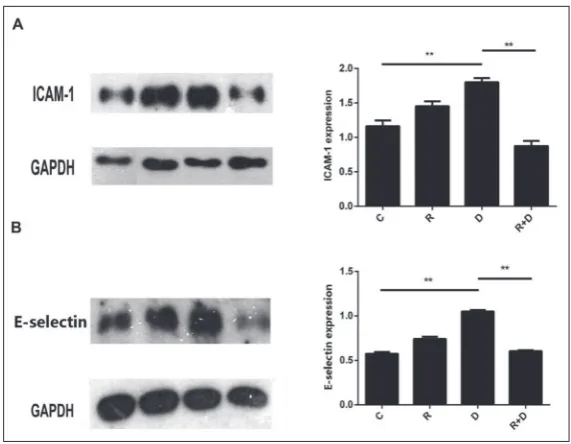
Adhesion molecules play key roles in atherogenesis and allergies by regulating the recruitment, adherence and migration of the immunocompetent cells into the vas-cular intima [7]. We conducted Western-blot analyses to measure the expression of adhesion molecules in 4 different groups of HUVECs. The Western-blot results (Fig. 2A and B) show that both adhesion molecules, ICAM-1 and E-selectin, were upregulated in the D group HUVECs by 55.17% and 82.56% respectively, compared with the C group HUVECs (P<0.01). Moreo-ver, both ICAM-1 and E-selectin were downregulated in the R+D group HUVECs by 51.46% and 42.49%, respectively, compared with the D group HUVECs (P<0.01) (Fig. 2A and B). These results suggest that the Ana-1 cell supernatants regulated the expression of adhesion proteins in the HUVECs.
IL-1β upregulates the expression of adhesion molecules in HUVECs
Based on the results shown above, we hypothesized that IL-1β in the Ana-1 cell supernatants affected the expression of adhesion molecules in HUVECs. Hence, we designed the following experiment to verify this hypothesis. In this experiment we divided the HUVECs into 6 groups, and performed Western-blot analysis to verify the expression of adhesion molecules in these 6 groups of HUVECs. The Western-blot results (Fig. 3A and B) revealed that the IL-1β neutralizing antibody significantly downregulated the expression of both ICAM-1 and E-selectin (p<0.01) in the D group Ana-1 cell supernatant. However, in the R+D group Ana-1 cell supernatant, the neutralizing antibodies (against IL-1β) failed to result in a significant difference in the expression of adhesion molecules ICAM-1 and E-selectin (Fig. 3A and B).
The adherence of circulating monocytes to the endothelium and their migration into inflammation sites are key events in various inflammation processes.
Thus, we also measured the adhesion of monocytes to HUVECs by non-static cell-binding assays using Ri (the number of monocytes adhering to 100 HUVECs) as the marker. Fig. 4A-F shows the representative areas of monocytes adhering to different groups of HUVECs,
and the Ri are shown in Fig. 4G as the mean±SE. Exposure of HUVECs to the cell supernatants of cholesterol-stimulated Ana-1 for 24 h significantly increased cell adhesion, while the pretreatment with resveratrol or treatment with neutralizing antibodies against IL-1β inhibited this increase in cell adhesion as shown in Fig. 4C, D and E. Taken together, these results indicate that IL-1β is one of the main fac-tors regulating the expression of ICAM-1 and E-selectin in HUVECs.
Effect of cholesterol and/or
resveratrol on the expression of the main constitutive protein of caveolae, caveolin-1
Caveolin-1 is widely expressed in mac-rophage membranes and is considered to be the center of reverse cholesterol trans-port (RCT) [27]. To investigate whether cholesterol and/or resveratrol regulate RCT, we conducted Western-blot analyses to verify the changes in caveolin-1 expres-sion. As shown in Fig. 5, the expression of caveolin-1 was significantly increased after the treatment with resveratrol, indi-cating that resveratrol treatment enhances RCT in Ana-1 cells. Furthermore, the treatment that increased the cholesterol content also increased the expression of caveolin-1. This result pointed to a self-regulatory mechanism in Ana-1 cells that stimulated RCT under conditions of high cholesterol content. Taken together, our results indicate that resveratrol plays an antiinflammatory role by stimulating RCT in macrophages.
DISCUSSION
Hypercholesterolemia is a major independent risk factor for cardiovascular disease, and it is one of the earliest lesions of atherosclerosis that involves the progressive accumulation of lipids on the vascular wall [28, 29]. Elevated cholesterol levels have long been known to be
Fig. 2. Effects of the culture supernatant from different groups of Ana-1 cells on ICAM-1 and E-selectin expression in HUVECs. Different groups of HUVECs were treated with the corresponding culture supernatant of Ana-1 cells for 24 h. The relative expression levels of ICAM-1 (A) and E-selectin (B) were detected by Western-blot analysis. Data are expressed as the mean±SE of independent experi-ments performed in triplicate. ** indicates P<0.01 between the two rank groups.
associated with hypercholesterolemia [25]. Numerous epidemiological and experimental studies have linked the development of atherosclerosis and its complica-tions to hypercholesterolemia and high serum levels of low density lipoprotein (LDL) [28, 29]. Moreover, another study showed that one of the major risk fac-tors for the development of endothelial dysfunction and the progression of atherosclerosis is dyslipidemia [30]. Resveratrol is a known antioxidant and dietary polyphenol. Previous studies indicated that resveratrol
inhibited the development of atheroscle-rotic disease through its antiinflammatory activity or other unknown activities [16-22, 31]. Thus, the specific mechanism underlying the effects of resveratrol is not fully understood and still warrants further investigations.
Atherosclerosis is a chronic inflam-matory disease of the arterial vessel wall characterized by a gradually thickening of the intima. This process is mainly due to the subendothelial accumulation of mac-rophages. The macrophages play crucial roles in the initiation and progression of atherosclerotic lesion development [1, 32]. In atherosclerotic lesions, macrophages ex-hibit a chronic proinflammatory state that continuously stimulates the endothelial cells and initiates atherosclerosis by secret-ing proinflammatory cytokines [33]. In the initial stages of atherosclerosis, endothelial cells are activated by proinflammatory cytokines, followed by adhesion of blood leukocytes to the activated endothelial monolayer. The adherent leukocytes di-rectly migrate into the intima and the monocytes (the most numerous of the recruited leukocytes) differentiate into macrophages that uptake lipids, finally yielding foam cells [34, 35]. By releas-ing related proinflammatory cytokines, macrophages accelerate monocyte recruit-ment and differentiation, which ultimately promotes the atherosclerosis [36].
Several studies have suggested that resveratrol exhibits antiinflammatory properties. However, little is known about its antiinflammatory effects on macrophages in the hy-percholesterolemic environment. Mouse macrophages are a useful model for research as they exhibit a similar response to stimuli compared to human macrophages [37]. In this respect, the main results of the present work involve measurement of the cytokine IL-1β in the supernatant of Ana-1 treated with cholesterol or/ and resveratrol using ELISA. Other researchers have shown that increased levels of ICAM-1 and E-selectin are related to further progression of atherosclerosis and
Fig. 4. Adhesion experiments of monocytes to HUVECs. Photomicrographs of
representative areas of monocyte adhesion to HUVECs mediated by the supernatant of C group Ana-1 (A), R group Ana-1 (B), D group Ana-1 (C), R+D group Ana-1 (D), D+Ab group – after neutralization (against IL-1β) of the D group with Ana-1 supernatant (E), R+D+Ab group – after neutralization (against IL-1β) of the R+D group with Ana-1 supernatant (F). The adhesion of monocytes to HUVECs was expressed as the Ri (the number of monocytes adhering to 100 HUVECs) (G). Data are expressed as the mean±SE. ** indicates P<0.01 between the two rank groups.
are also regarded as markers of endothelial activation [38, 39]. Therefore, we then used Ana-1 culture su-pernatants to co-culture HUVECs and to investigate the effects of cytokines in the Ana-1 supernatant on the expression of ICAM-1 and E-selectin in HUVECs. The cholesterol concentrations used in this experiment mimicked the blood cholesterol levels of patients with hypercholesterolemia. The obtained findings indicate that hypercholesterolemia is a risk factor for many inflammation-related diseases in vitro.
We showed that resveratrol inhibited the high cholesterol content-induced high IL-1β level in Ana-1 cells. This result indicated that resveratrol inhib-ited cholesterol-induced inflammation in vitro. The HUVECs cultured in the supernatant of cholesterol-treated Ana-1 showed increased expression of surface adhesion molecule proteins, indicating increased production and/or recruitment of adhesion molecules to the HUVECs. In contrast, the HUVECs cultured in the supernatant of resveratrol+cholesterol-treated Ana-1 showed lower expression of surface adhesion molecule protein. Combined with the previous ELISA results and other studies [2-5], we reasoned that these changes are related to inflammatory factors such as IL-1β in the supernatant of Ana-1 cells. Therefore, to fully demonstrate the effects of the cytokine IL-1β in HUVECs, neutralizing antibodies against IL-1β were also used. In accordance with our hypothesis, the supernatant-mediated changes in the expression of ICAM-1 and E-selectin were eliminated by the neutralizing antibodies against IL-1β, indicating that these processes are mediated at least in part by IL-1β. In addition, to detect the expression levels of ICAM-1 and E-selectin, we also measured the adhesion of monocytes to HUVECs using a non-static cell-binding assay. This assay also showed that the adhesion of monocytes to HUVECs was mediated at least in part by IL-1β. However, the types of cytokines that exert an effect on the adhesion of monocytes to HUVECs are not yet fully known and many other cytokines may also affect this process [34, 35]. Therefore, other related cytokines still warrant further studies.
Resveratrol supplementation has been shown to significantly decrease plasma total cholesterol, triglyc-eride and low-density lipoprotein (LDL) contents and to significantly increase HDL levels in ApoE-/- mice
fed an atherogenic diet [31]. The deposition of
choles-terol in macrophages may stimulate activation of the inflammation process [40]. Some researchers showed that resveratrol enhanced the cholesterol efflux from macrophages [41, 42]. The narrower concept of RCT involves cholesterol efflux from cells, and it is believed to be the mechanism responsible for the inhibition of cholesterol deposition in macrophages [27]. Caveolin-1 plays an important role in RCT [27]. We also showed that the expression of caveolin-1 was significantly increased by the pretreatment with resveratrol, indi-cating that resveratrol treatment enhances the RCT in Ana-1 cells. Moreover, ABCA1 and ABCG1 are important proteins participating in RCT and are also upregulated by treatment with resveratrol [41-43]. Thus, we hypothesize that resveratrol may exert its antiinflammatory effects by stimulating RCT and by inhibiting the deposition of cholesterol in macrophages.
According to recent studies, resveratrol mainly im-proves three important characteristics of macrophages that are related to atherosclerosis, including the ability to efflux cholesterol, formation of foam cells and release of proinflammatory mediators [31, 35, 41, 42, 44-46]. Our results suggest that resveratrol inhibits monocyte recruitment at least in part by inhibition of IL-1β release in macrophages, with the lower IL-1β release likely the result of enhanced RCT. The present study describes an inner link between the different protective effects of resveratrol on proinflammatory macrophages dur-ing atherosclerosis and points to the potential value of resveratrol in the prevention of atherosclerosis.
Acknowledgments: This work was supported by the Shanghai
Health Development Planning Commission (Grant NO.ZY3-CCCX-3-3006), the National Natural Science Foundation of China (Grant No. 81500392), the National Natural Science Foundation of China (Grant No. 81300087) and the National Natural Science Foundation of China (Grant No. 31570949).
REFERENCES
1. Lusis AJ. Atherosclerosis. Nature. 2000;407(6801):233-41. 2. Galea J, Armstrong J, Gadsdon P, Holden H, Francis SE,
Holt CM. Interleukin-1 beta in coronary arteries of patients with ischemic heart disease. Arterioscler Thromb Vasc Biol. 1996;16(8):1000-6.
3. Kirii H, Niwa T, Yamada Y, Wada H, Saito K, Iwakura Y, Asano M, Moriwaki H, Seishima M. Lack of interleukin-1beta decreases the severity of atherosclerosis in ApoE-deficient mice. Arterioscler Thromb Vasc Biol. 2003;23(4):656-60. 4. Herman WH, Holcomb JM, Hricik DE, Simonson MS.
Inter-leukin-1 beta induces endothelin-1 gene by multiple mecha-nisms. Transplant Proc. 1999;31(1-2):1412-3.
5. Kanno K, Hirata Y, Imai T, Marumo F. Induction of nitric oxide synthase gene by interleukin in vascular smooth muscle cells. Hypertension. 1993;22(1):34-9.
6. Wang X, Feuerstein GZ, Gu JL, Lysko PG, Yue TL. Inter-leukin-1 beta induces expression of adhesion molecules in human vascular smooth muscle cells and enhances adhe-sion of leukocytes to smooth muscle cells. Atherosclerosis. 1995;115(1):89-98.
7. Zarbock A, Kempf T, Wollert KC, Vestweber D. Leukocyte integrin activation and deactivation: novel mechanisms of balancing inflammation. J Mol Med (Berl). 2012;90(4):353-9. 8. Diamond MS, Staunton DE, Marlin SD, Springer TA. Binding
of the integrin Mac-1 (CD11b/CD18) to the third immuno-globulin-like domain of ICAM-1 (CD54) and its regulation by glycosylation. Cell. 1991;65(6):961-71.
9. Lawrence MB. Threshold levels of fluid shear promote leu-kocyte adhesion through selectins (CD62L,P,E). J Cell Biol. 1997;136(3):717-27.
10. Carlos T, Kovach N, Schwartz B, Rosa M, Newman B, Wayner E, Benjamin C, Osborn L, Lobb R, Harlan J. Human monocytes bind to two cytokine-induced adhesive ligands on cultured human endothelial cells: endothelial-leukocyte adhesion molecule-1 and vascular cell adhesion molecule-1. Blood. 1991;77(10):2266-71.
11. De Caterina R, Basta G, Lazzerini G, Dell’Omo G, Petrucci R, Morale M, Carmassi F, Pedrinelli R. Soluble vascular cell adhesion molecule-1 as a biohumoral correlate of atheroscle-rosis. Arterioscler Thromb Vasc Biol. 1997;17(11):2646-54. 12. Peter K, Nawroth P, Conradt C, Nordt T, Weiss T, Boehme
M, Wunsch A, Allenberg J, Kubler W, Bode C. Circulating vascular cell adhesion molecule-1 correlates with the extent of human atherosclerosis in contrast to circulating intercellular adhesion molecule-1, E-selectin, P-selectin, and thrombo-modulin. Arterioscl Throm Vas. 1997;17(3):505-12. 13. Chang TY, Chang CC, Ohgami N, Yamauchi Y. Cholesterol
sensing, trafficking, and esterification. Annu Rev Cell Dev Biol. 2006;22:129-57.
14. Metzkor-Cotter E, Cotter G, Krakover R, Boldur I, Ben-Yakov M, Lazarovitch T, Chen-Levi Z, Fyltovich S, Kaluski E, Zaidenstein R, Vered Z, Golik A. Are infectious agents truly independent risk factors for coronary atherosclerotic heart disease? Circulation. 2000;102(18):53-.
15. Shrikanta A, Kumar A, Govindaswamy V. Resveratrol content and antioxidant properties of underutilized fruits. J Food Sci Technol. 2015;52(1):383-90.
16. Tung BT, Rodriguez-Bies E, Talero E, Gamero-Estevez E, Motilva V, Navas P, Lopez-Lluch G. Anti-inflammatory effect of resveratrol in old mice liver. Exp Gerontol. 2015;64:1-7. 17. Sebai H, Ristorcelli E, Sbarra V, Hovsepian S, Fayet G, Aouani
E, Lombardo D. Protective effect of resveratrol against LPS-induced extracellular lipoperoxidation in AR42J cells partly via a Myd88-dependent signaling pathway. Arch Biochem Biophys. 2010;495(1):56-61.
18. Panaro MA, Carofiglio V, Acquafredda A, Cavallo P, Cian-ciulli A. Anti-inflammatory effects of resveratrol occur via inhibition of lipopolysaccharide-induced NF-kappaB activa-tion in Caco-2 and SW480 human colon cancer cells. Br J Nutr. 2012;108(9):1623-32.
19. Palmieri D, Pane B, Barisione C, Spinella G, Garibaldi S, Ghigliotti G, Brunelli C, Fulcheri E, Palombo D. Resveratrol counteracts systemic and local inflammation involved in early abdominal aortic aneurysm development. J Surg Res. 2011;171(2):e237-46.
20. Lai X, Pei Q, Song X, Zhou X, Yin Z, Jia R, Zou Y, Li L, Yue G, Liang X, Yin L, Lv C, Jing B. The enhancement of immune function and activation of NF-kappaB by resveratrol-treat-ment in immunosuppressive mice. Int Immunopharmacol. 2016;33:42-7.
21. Fan E, Zhang L, Jiang S, Bai Y. Beneficial effects of resveratrol on atherosclerosis. J Med Food. 2008;11(4):610-4.
22. Bellaver B, Souza DG, Souza DO, Quincozes-Santos A. Res-veratrol increases antioxidant defenses and decreases pro-inflammatory cytokines in hippocampal astrocyte cultures from newborn, adult and aged Wistar rats. Toxicol In Vitro. 2014;28(4):479-84.
23. Guo H, Chen Y, Liao L, Wu W. Resveratrol protects HUVECs from oxidized-LDL induced oxidative damage by autophagy upregulation via the AMPK/SIRT1 pathway. Cardiovasc Drugs Ther. 2013;27(3):189-98.
24. Ma C, Wang Y, Shen A, Cai W. Resveratrol upregulates SOCS1 production by lipopolysaccharide-stimulated RAW264.7 macrophages by inhibiting miR-155. Int J of Mol Med. 2017;39(1):231-7.
25. Buettner R, Parhofer KG, Woenckhaus M, Wrede CE, Kunz-Schughart LA, Scholmerich J, Bollheimer LC. Defining high-fat-diet rat models: metabolic and molecular effects of differ-ent fat types. Int J Mol Med. 2006;36(3):485-501.
26. Jaffe EA, Nachman RL, Becker CG, Minick CR. Culture of human endothelial cells derived from umbilical veins. Iden-tification by morphologic and immunologic criteria. J Clin Invest. 1973;52(11):2745-56.
27. Luo DX, Cao DL, Xiong Y, Peng XH, Liao DF. A novel model of cholesterol efflux from lipid-loaded cells. Acta Pharmacol Sin. 2010;31(10):1243-57.
28. de Sauvage Nolting PR, Defesche JC, Buirma RJ, Hut-ten BA, Lansberg PJ, Kastelein JJ. Prevalence and signifi-cance of cardiovascular risk factors in a large cohort of patients with familial hypercholesterolaemia. J Intern Med. 2003;253(2):161-8.
coun-terpart of familial hypercholesterolemia. N Engl J Med. 1983;309(5):288-96.
30. Murphy AJ, Akhtari M, Tolani S, Pagler T, Bijl N, Kuo CL, Wang M, Sanson M, Abramowicz S, Welch C, Bochem AE, Kuivenhoven JA, Yvan-Charvet L, Tall AR. ApoE regulates hematopoietic stem cell proliferation, monocytosis, and monocyte accumulation in atherosclerotic lesions in mice. J Clin Invest. 2011;121(10):4138-49.
31. Jeon SM, Lee SA, Choi MS. Antiobesity and vasoprotective effects of resveratrol in apoE-deficient mice. J Med Food. 2014;17(3):310-6.
32. Williams KJ, Tabas I. Atherosclerosis - An inflammatory dis-ease. New Engl J Med. 1999;340(24):1928-.
33. Libby P, Ridker PM, Hansson GK. Progress and chal-lenges in translating the biology of atherosclerosis. Nature. 2011;473(7347):317-25.
34. Ross R. The pathogenesis of atherosclerosis: a perspective for the 1990s. Nature. 1993;362(6423):801-9.
35. Vasamsetti SB, Karnewar S, Gopoju R, Gollavilli PN, Narra SR, Kumar JM, Kotamraju S. Resveratrol attenuates monocyte-to-macrophage differentiation and associated inflammation via modulation of intracellular GSH homeo-stasis: Relevance in atherosclerosis. Free Radic Biol Med. 2016;96:392-405.
36. Yvan-Charvet L, Welch C, Pagler TA, Ranalletta M, Lamkanfi M, Han S, Ishibashi M, Li R, Wang N, Tall AR. Increased inflammatory gene expression in ABC transporter-deficient macrophages: free cholesterol accumulation, increased sig-naling via toll-like receptors, and neutrophil infiltration of atherosclerotic lesions. Circulation. 2008;118(18):1837-47. 37. Obot CJ, Morandi MT, Hamilton RF, Holian A. A
compari-son of murine and human alveolar macrophage responses to urban particulate matter. Inhal Toxicol. 2004;16(2):69-76. 38. Blankenberg S, Rupprecht HJ, Bickel C, Peetz D, Hafner G,
Tiret L, Meyer J. Circulating cell adhesion molecules and death in patients with coronary artery disease. Circulation. 2001;104(12):1336-42.
39. Hwang SJ, Ballantyne CM, Sharrett AR, Smith LC, Davis CE, Gotto AM, Jr., Meyer J. Circulating adhesion molecules VCAM-1, ICAM-1, and E-selectin in carotid atherosclero-sis and incident coronary heart disease cases: the Athero-sclerosis Risk In Communities (ARIC) study. Circulation. 1997;96(12):4219-25.
40. Duewell P, Kono H, Rayner KJ, Sirois CM, Vladimer G, Bau-ernfeind FG, Abela GS, Franchi L, Nunez G, Schnurr M, Espevik T, Lien E, Fitzgerald KA, Rock KL, Moore KJ, Wright SD, Hornung V, Latz E. NLRP3 inflammasomes are required for atherogenesis and activated by cholesterol crystals. Nature. 2010;464(7293):1357-61.
41. Voloshyna I, Hai O, Littlefield MJ, Carsons S, Reiss AB. Res-veratrol mediates anti-atherogenic effects on cholesterol flux in human macrophages and endothelium via PPARgamma and adenosine. Eur J Pharmacol. 2013;698(1-3):299-309. 42. Sevov M, Elfineh L, Cavelier LB. Resveratrol regulates the
expression of LXR-alpha in human macrophages. Biochem Biophys Res Commun. 2006;348(3):1047-54.
43. Escher G, Krozowski Z, Croft KD, Sviridov D. Expression of sterol 27-hydroxylase (CYP27A1) enhances cholesterol efflux. J Biol Chem. 2003;278(13):11015-9.
44. Berbee JF, Wong MC, Wang Y, van der Hoorn JW, Khedoe PP, van Klinken JB, Mol IM, Hiemstra PS, Tsikas D, Romijn JA, Havekes LM, Princen HM, Rensen PC. Resveratrol protects against atherosclerosis, but does not add to the antiathero-genic effect of atorvastatin, in APOE*3-Leiden.CETP mice. J Nutr Biochem. 2013;24(8):1423-30.
45. Chassot LN, Scolaro B, Roschel GG, Cogliati B, Cavalcanti MF, Abdalla DSP, Castro IA. Comparison between red wine and isolated trans-resveratrol on the prevention and regres-sion of atherosclerosis in LDLr ((-/-)) mice. J Nutr Biochem. 2018;61:48-55.