Available online through www.ijma.info
ISSN 2229 – 5046
MULTIPLICATIVE ABC, GA, AG, AUGMENTED AND HARMONIC STATUS INDICES
OF GRAPHS
V. R. KULLI*
Department of Mathematics,
Gulbarga University, Gulbarga - 585106, India.
(Received On: 07-12-19; Revised & Accepted On: 04-01-20)
ABSTRACT
I
n this study, we introduce the multiplicative atom bond connectivity status index, multiplicative geometric-arithmetic status index, multiplicative arithmetic-geometric status index, multiplicative augmented status index and multiplicative harmonic status index of a graph. We compute these multiplicative status indices for complete graphs, cycles, complete bipartite graphs, wheel graphs and friendship graphs.Key words: Multiplicative ABC status index, multiplicative GA status index, multiplicative augmented status index, multiplicative harmonic status index, graph.
Mathematics Subjects Classification: 05C05, 05C07, 05C35, 05C90.
1. INTRODUCTION
Let G= (V(G), E(G)) be a simple, finite, connected graph. The degree dG(u) of a vertex u is the number of vertices
adjacent to u. The distance between two vertices u and v, denoted by d(u, v), is the length of the shortest u -v path in a graph G. The status of a vertex u in G is defined as the sum of its distance from every other vertex in G and is denoted by (u). For graph theoretic terminology, we refer [1].
A graph index is a numerical parameter mathematically derived from the graph structure. Several graph indices have their applications in various disciplines of Science and Technology, see [2, 3]. Many status indices ofagraph such as harmonic status index [4], first and second status connectivity indices [5], first and second hyper status indices [6], multiplicative first and second status indices [7], multiplicative F-status index [8], multiplicative (a, b)-status index [9], first and second status coincides [10], geometric- arithmetic status index [11] studied in the literate of graph indices.
We introduce the multiplicative atom bond connectivity status index, multiplicative geometric- arithmetic status index, multiplicative arithmetic-geometric status index, multiplicative augmented status index, multiplicative harmonic status index of a graph as follows:
The multiplicative atom bond connectivity status index of a graph G is defined as
2
.
uv E Gu
v
ABCSII G
u
v
The multiplicative geometric-arithmetic status index of a graph G is defined as
2
.
uv E Gu
v
GASII G
u
v
The multiplicative arithmetic-geometric status index of a graph G is defined as
.
2
uv E G
u
v
AGSII G
u
v
Corresponding Author: V. R. Kulli*
V. R. Kulli*/ MULTIPLICATIVE ABC, GA, AG, AUGMENTED AND HARMONIC STATUS INDICES OF GRAPHS / IJMA- 11(1), Jan.-2020.
The multiplicative augmented status index of a graph G is defined as
3.
2
uv E Gu
v
ASIII G
u
v
The multiplicative harmonic status index of a graph G is defined as
2
.
uv E GHSII G
u
v
Recently, some new multiplicative indices were studied, for example, in [12, 13, 14, 15, 16, 17, 18, 19, 20, 21, 22, 23, 24, 25, 26, 27, 28, 29, 30. 31, 32]. In this paper, some new multiplicative status indices of complete graphs, wheel graphs friendship graphs are determined.
2. RESULTS FOR COMPLETE GRAPHS
Theorem 1: Let Kn be a complete graph with n vertices and
1
2
n n
edges. Then
(1) ABCSII(Kn) =
1 1 4 22
4
1
n nn
n
.(2) GASII(Kn) = 1.
(3) AGSII(Kn) = 1.
(4) ASIII(Kn) =
3 1 2 21
.
2
4
n nn
n
(5) HSII(Kn) =
1 1 2
1
1
n nn
.Proof: For any vertex u in Kn, (u) = n – 1. Therefore
(1) ABCSII(Kn)
1 1 2 22
1
1 2
1
1
n
n n
uv E K
u
v
n
n
u
v
n
n
=
1 1 4 22
4
1
n nn
n
.(2) GASII(Kn)
1
2
1
1
2
2
1
1
n
n n
uv E K
u
v
n
n
u
v
n
n
= 1.(3) AGSII(Kn)
1
2
2
2
1
1
1
1
n
n n
uv E K
u
v
n
n
u
v
n
n
= 1.(4) ASIII(Kn)
3 3 1 21
1
2
1
1 2
n
n n
uv E K
u
v
n
n
u
v
n
n
=
3 1 2 21
2
4
n nn
n
(5) HSII(Kn)
1 1 22
2
1
1
n n nuv E K
u
v
n
n
= 1 1 21
1
n nn
.3. RESULTS FOR COMPLETE BIPARTITE GRAPHS
Theorem 2: Let Kp, q be a complete bipartite graph with p+q vertices and pq edges. Then
(1) ABCSII(Kp, q)
1 2 2 23
6
.
2
6
5
4
pq
p
q
p
q
p
q
pq
(2) GASII(Kp, q)
2 2
2 2
6
5
4
.
3
4
pq
p
q
p
q
pq
(3)
,
2 2
3
4
.
2 2
6
5
4
p q
p
q
AGHII K
p
q
p
q
pq
(4) ASIII(Kp, q)
3 2 2
2
6
5
4
.
3
6
pq
p
q
p
q
pq
p
q
(5) HSII(Kp, q)
2
.
3
4
pq
p
q
Proof: The vertex set of Kp,q can be partitioned into two independent sets V1 and V2 such that u V1 and v V2 for
every edge uv in Kp,q. Thus dG(u) = q, dG(v) = p. Then (u) = q + 2(p – 1) and (v) = p+2(q – 1). Therefore
(1)
ABCSII K
p q,
2
u
v
u
v
1 2
2
2
2
2
2
2
2
2
2
pq
q
p
p
q
q
p
p
q
1 2 2 2
3
6
.
2
6
5
4
pq
p
q
p
q
p
q
pq
(2) GASII(Kp,q)
,
2
p q
uv E K
u
v
u
v
2
2
2
2
2
2
2
2
2
pq
q
p
p
q
q
p
p
q
2 2
2 2
6
5
4
.
3
4
pq
p
q
p
q
pq
p
q
(3) AGSII(Kp,q)
p q,
2
uv E K
u
v
u
v
2
2
2
2
2
2
2
2
2
pq
q
p
p
q
q
p
p
q
2 2
3
4
.
2 2
6
5
4
pq
p
q
p
q
p
q
pq
(4) ASIII(Kp,q)
,
3
2
p q
uv E K
u
v
u
v
2
2
2
2
32
2
2
2
2
pq
q
p
q
p
q
p
p
q
3 2 2
2
6
5
4
.
3
6
pq
p
q
p
q
pq
p
q
(5) HSII(Kp,q)
,
2
p q
uv E K
u
v
2
2
2
2
2
pq
q
p
p
q
2
.
3
4
pq
p
q
V. R. Kulli*/ MULTIPLICATIVE ABC, GA, AG, AUGMENTED AND HARMONIC STATUS INDICES OF GRAPHS / IJMA- 11(1), Jan.-2020.
4. RESULTS FOR CYCLES
Theorem 3: Let Cn be a cycle with n vertices and n edges. Then
(1) ABCSII(Cn)
2
24
8
4
,
nn
n
if n is even,
2 2
2 2
8
5
,
1
n
n
n
if n is odd.
(2) GASII(Cn) = 1 , if n is even,
= 1 , if n is odd.
(3) AGSII(Cn) = 1 , if n is even,
= 1 , if n is odd.
(4) ASIII(Cn)
3 4
2
,
8
4
n
n
n
if n is even,
3 2 2
2
1
,
8
5
n
n
n
if n is odd.
(5) HSII(Cn) 2
4
,
nn
if n is even,2
4
,
1
n
n
if n is odd.Proof:
Case-1: Suppose n is even. Then
2
4
n
u
for any vertex u in Cn. Thus(1) ABCSII (Cn)
2
n
uv E C
u
v
u
v
2 2 2
2 2
2 2 4
2
8
4
4
4
.
4
4
nn
n
n
n
n
n
n
(2) GASII (Cn)
2
n
uv E C
u
v
u
v
2 2
2 2
2
4
4
1.
4
4
nn
n
n
n
(3) AGSII (Cn)
n2
uv E C
u
v
u
v
2 2
2 2
4
4
1.
2
4
4
nn
n
n
n
(4) ASIII (Cn)
3
2
n
uv E C
u
v
u
v
3 2 2
3 4
2 2 2
4
4
.
8
4
2
4
4
n
n
n
n
n
n
n
n
(5) HSII (Cn)
2
n
uv E C
u
v
2 2 22
4
.
4
4
n n
n
n
n
Case-2: Suppose n is odd. Then
2
1
4
n
u
for any vertex u in Cn. Therefore(1) ABCSII (Cn)
2
n
uv E C
u
v
u
v
2 2 2
2 2
2 2 2
2
1
1
2
8
5
4
4
.
1
1
1
4
4
n
n
n
n
n
n
n
n
(2)
GASII (Cn)
2
n
uv E C
u
v
u
v
2 2
2 2
1
1
2
4
4
1lim
1
1
4
4
n
x
n
n
n
n
(3) AGSII (Cn)
n
2
uv E C
u
v
u
v
2 2
2 2
1
1
4
4
1
1
1
2
4
4
n
n
n
n
n
(4) ASIII (Cn)
3
2
n
uv E C
u
v
u
v
3
2 2
3 2 2
2 2 2
1
1
1
4
4
.
1
1
8
5
2
4
4
n
n
n
n
n
n
n
n
(5) HSII (Cn)
2
n
uv E C
u
v
2 2 22
4
.
1
1
1
4
4
n n
n
n
n
5. RESULT FOR WHEEL GRAPHS
A wheel graph Wn is the join of Cn and K1. A graph Wn has n+1 vertices and 2n edges. A graph Wn is presented in
Figure 1.
Figure-1: Wheel graph Wn
In Wn, there are two types of edges as given in Table 1.
nw
d
u
,
nw
d
v
\ uv E(Wn) (3, 3) (3, n)Number of edges n n
Table-1: Edge partition of Wn
Therefore , there are two types of status edges in Wn as given in Table 2.
u
,
v
\ uv E(Wn) (2n – 3, 2n – 3) (n, 2n – 3)Number of edges n n
V. R. Kulli*/ MULTIPLICATIVE ABC, GA, AG, AUGMENTED AND HARMONIC STATUS INDICES OF GRAPHS / IJMA- 11(1), Jan.-2020.
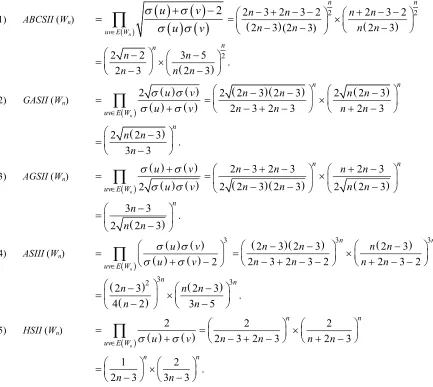
Theorem 4: Let Wn be a wheel graph with n+1 vertices and 2n edges. Then
(1) ABCSII (Wn)
2
2
2
3
5
.
2
3
2
3
n n
n
n
n
n
n
(2)
GASII W
n
2 2
2
3
3
n
a
b
n
(3)
3
3
2
2
3
n
n
n
AGSII W
n
n
(4)
3 3
2
2
3
2
3
=
.
4
2
3
5
n n
n
n
n
n
ASIII W
n
n
(5) HSII (Wn)
1
2
.
2
3
3
3
n n
n
n
Proof: By definitions and by using Table 2, we obtain
(1) ABCSII (Wn)
2
n
uv E W
u
v
u
v
2 2
2
3 2
3 2
2
3 2
2
3 (2
3)
2
3
n n
n
n
n
n
n
n
n
n
2
2
2
3
5
.
2
3
2
3
n n
n
n
n
n
n
(2) GASII (Wn)
2
n
uv E W
u
v
u
v
2
2
2
3
3 2
2
3
3
2
2
2
3
3
n n
n
n
n
n
n
n
n
n
2
2
3
.
3
3
n
n
n
n
(3) AGSII (Wn)
n2
uv E W
u
v
u
v
2
3
2
3
2
3
2
2
3 2
3
2
2
3
n n
n
n
n
n
n
n
n
n
3
3
.
2
2
3
n
n
n
n
(4) ASIII (Wn)
3
2
n
uv E W
u
v
u
v
3 3
2
3 2
3
2
3
2
3
2
3
2
2
3
2
n n
n
n
n
n
n
n
n
n
3 3
2
2
3
2
3
.
4
2
3
5
n n
n
n
n
n
n
(5) HSII (Wn)
2
n
uv E W
u
v
2
3
2
2
3
2
2
3
n n
n
n
n
n
1
2
.
2
3
3
3
n n
n
n
4. RESULTS FOR FRIENDSHIP GRAPHS
A friendship graph Fn is the graph obtained by taken n2 copies of C3 with vertex in common. A graph F4 is shown in
Figure-2: Friendship graph F4
A graph Fn has 2n+1 vertices and 3n edges. In Fn, there are two types of edges as follows:
E1 = {uv (Fn) |
2
n n
F F
d
u
d
v
}, | E1 | = n. E2 = {uv (Fn) |
2,
2
n n
F F
d
u
d
v
n
}, | E1 | = 2n.Therefore, there are two types of status edges in Fn as given in Table 3.
(u), (v) \ uvE (Fn) (4n – 2, 4n – 2) (2n, 4n – 2)
Number of edges n 2n
Table-3: Status edge partition of Fn
Theorem 5: Let Fn be a friendship graph with 2n+1 vertices and 3n edges. Then
(1) ABCSII (Fn)
2 2
8
6
3
2
.
4
2
4
2
n
n
n
n
n
n
n
(2) GASII (Fn)
22
4
2
.
3
1
n
n
n
n
(3) AGSII (Fn)
2
3
1
.
2
4
2
n
n
n
n
(4) ASIII (Fn)
4
2
2 3
4
2
6.
8
6
3
2
n n
n
n
n
n
n
(5) HSII (Fn)
2
1
1
.
4
2
3
1
n n
n
n
Proof: by using definitions and Table 3, we deduce
(1) ABCSII (Fn)
2
n
uv E F
u
v
u
v
1 1
2
2 2
4
2
4
2
2
2
4
2
2
4
2 4
2
2
4
2
n n
n
n
n
n
n
n
n
n
2 2
8
6
3
2
.
4
2
4
2
n
n
n
n
n
n
n
(2) GASII (Fn)
2
n
uv E F
u
v
u
v
2
2
4
2 4
2
2 2
4
2
4
2
4
2
2
4
2
n n
n
n
n
n
n
n
n
n
22
4
2
.
3
1
n
n
n
n
(3) AGSII (Fn)
n2
uv E F
u
v
u
v
2
4
2
4
2
2
4
2
2
4
2 4
2
2 2
4
2
n n
n
n
n
n
n
n
n
n
2
3
1
.
2
4
2
n
n
n
n
V. R. Kulli*/ MULTIPLICATIVE ABC, GA, AG, AUGMENTED AND HARMONIC STATUS INDICES OF GRAPHS / IJMA- 11(1), Jan.-2020.
(4) ASIII (Fn)
3
2
n
uv E F
u
v
u
v
3 6
4
2 4
2
2
4
2
4
2
4
2
2
2
4
2
2
n n
n
n
n
n
n
n
n
n
4
2
2 3
4
2
6.
8
6
3
2
n n
n
n
n
n
n
(5) HSII (Fn)
2
n
uv E F
u
v
2
2
2
4
2
4
2
2
4
2
n n
n
n
n
n
2
1
1
.
4
2
3
1
n n
n
n
REFERENCES
1. V.R. Kulli, College Graph Theory, Vishwa International Publications, Gulbarga, India (2012).
2. V.R.Kulli, Multiplicative Connectivity Indices of Nanostructures, LAP LEMBERT Academic Publishing,
(2018).
3. R. Todeschini and V. Consonni, Handbook of Molecular Descriptors for Chemoinformatics, Wiley-VCH,
Weinheim, (2009).
4. H.S. Ramane, B. Basavagoud and A.S. Yalnaik, Harmonic status index of graphs, Bulletin of Mathematical Sciences and Applications, 17 (2016) 24-32.
5. H.S. Ramane and A.S. Yalnaik, Status connectivity indices graphs and its applications to the boiling point of
benzenoid hydrocarbons, Journal of Applied Mathematics and Computing, 55 (2017) 607-627.
6. V.R.Kulli, Some new status indices of graphs, International Journal of Mathematics Trends and Technology,
10(10) (2019) 70-76.
7. V.R.Kulli, Some new multiplicative status indices of graphs, International Journal of Recent Scientific Research, 10(10) (2019) 35568-35573.
8. V.R.Kulli, Computation of multiplicative status indices of graphs, submitted.
9. V.R.Kulli, Computation of multiplicative (a, b)-status index of certain graphs, submitted.
10. H.S. Ramane, A.S. Yalnaik and R. Sharafdini, Status connectivity indices and coindices of graphs and its computation to some distance balanced graphs, AKCE International Journal of Graphs and Combinatorics, (2018) https://doi.org/10.1016j.2018.09.002.
11. K.P. Narayankar and D.Selvan, Geometric-arithmetic index of graphs, International Journal of Mathematical
Archive, 8(7) (2017) 230-233.
12. V.R.Kulli, General multiplicative Revan indices of polycyclic aromatic hydrocarbons and benzenoid systems,
International Journal of Recent Scientific Research, 9, 2(J) (2018) 24452-24455.
13. V.R.Kulli, On fifth multiplicative Zagreb indices of tetrathiafulvalene and POPAM dendrimers, International
Journal of Engineering Sciences and Research Technology, 7(3) (2018) 471-479.
14. V.R.Kulli, Multiplicative atom bond connectivity and multiplicative geometric-arithmetic indices of chemical
structures in drugs, International Journal of Mathematical Archive, 9(6) (2018) 155-163.
15. V.R.Kulli, Computation of multiplicative connectivity indices of H-Naphtalenic nanotubes and TUC4[m,n]
nanotubes, Journal of Computer and Mathematical Sciences, 9(8) (2018) 1047-1056.
16. V.R.Kulli, Some multiplicative reduced indices of certain nanostructures, International Journal of
Mathematical Archive 9(11) (2018) 1-5.
17. V.R.Kulli, Multiplicative Dakshayani indices, International Journal of Engineering Sciences and Research Technology, 7(10) (2018) 75-81.
18. V.R.Kulli, On multiplicative minus indices of titania nanotubes, International Journal of Fuzzy Mathematical Archive, 16(1) (2018) 75-79.
19. V.R.Kulli, Multiplicative connectivity KV indices of dendrimers, Journal of Mathematics and Informatics, 15 (2019) 1-7.
20. V.R.Kulli, Multiplicative neighborhood, indices, Annals of Pure and Applied Mathematics, 19(2) (2019), 175-181.
21. V.R.Kulli, Multiplicative KV and multiplicative hyper KV indices of certain dendrimers, International Journal of Fuzzy Mathematical Archive, 17(1) (2019) 13-19.
22. V.R. Kulli, Multiplicative Kulli-Basava indices, International Journal of Fuzzy Mathematical Archive, 17(1) (2019) 61-67.
23. V.R. Kulli Some new Multiplicative connectivity Kulli-Basava indices, International Journal of Mathematics
Trends and Technology, 65(9) (2019) 18-23.
24. V.R.Kulli, Multiplicative Gourava indices of armchair and zigzag polyhex nanotubes, Journal of Mathematics
and Informatics, 17 (2019) 107-112.
25. V.R.Kulli, Multiplicative Kulli-Basava and multiplicative hyper Kulli-Basava indices some graphs,
26. V.R.Kulli, Multiplicative ABC, GA and AG neighborhood Dakshayani indices dendrimers, International Journal of Fuzzy Mathematical Archive, 17(2) (2019) 77-82.
27. V.R.Kulli, On multiplicative leap Gourava indices of graphs, International Journal of Engineering Sciences and Research Technology, 8(10) (2019) 22-30.
28. V.R.Kulli, Some new multiplicative status indices of graphs, International Journal of Recent Scientific Research, 10(10) (2019) 35568-35573.
29. V.R.Kulli, Some multiplicative neighborhood Dakshayani indices of certain nanostructures, International Journal of Current Research in Science and Technology, 5(10) (2019).
30. V.R.Kulli, Multiplicative (a,b)-KA indices of certain dendrimer nanostars, International Journal of Recent Scientific Research, 10, 11(E) (2019) 36010-36014.
31. V.R.Kulli, Some multiplicative temperature indices of HC5C7[m,n] nanotubes, International Journal of Fuzzy
Mathematical Archive, 17(2) (2019) 91-98.
32. V.R.Kulli, B.Chaluvaraju and T.V.Asha, Multiplicative product connectivity and sum connectivity indices of
chemical structures in drugs, Research Review International Journal of Multidisciplinary, 4(2) (2019), 949-953.
Source of support: Nil, Conflict of interest: None Declared.