Volume 12 (2008)
Formal Modeling of
Adaptive and Mobile Processes
Analysis of Mobile Agents using Invariants of Object Nets
Michael K¨ohler and Daniel Moldt18 pages
Guest Editors: Julia Padberg, Kathrin Hoffmann
Analysis of Mobile Agents using Invariants of Object Nets
Michael K¨ohler and Daniel Moldt
University of Hamburg, Department for Informatics Vogt-K¨olln-Straße 30, D-22527 Hamburg
Abstract:Mobility induces new challenges for dynamic systems, which need a new conceptional treatment: systems, that deal for example with mobile agents, need extended security concepts to handle the risks, induced by foreign, untrusted agents. In this contribution we use object nets to model mobile systems. Object nets are Petri nets which have Petri nets as tokens – an approach known as the nets-within-nets paradigm. Object nets-within-nets are called elementary if the net system has a two levelled structure. In this work we apply structural analysis methods for object nets – namely place invariants – to a simple case study modelling mobile agents.
Keywords:linear invariants, mobility, nets-within-nets, object nets
1 Introduction
Object nets are Petri nets which have Petri nets as tokens – an approach which is called the
nets-within-nets paradigm, proposed by Valk [Val91, Val03] for a two levelled structure and generalised in [KR03,KR04,KB09] for arbitrary nesting structures. The Petri nets that are used as tokens are called net-tokens. Net-tokens are tokens with internal structure and inner activity. This is different from place refinement, since tokens are transported while a place refinement is static. Net-tokens are some kind ofdynamic refinement of states. Figure 1shows an example object net with four net-tokens: two on place p1and one on p2 and p3each. The net-tokens on
p1and p2share the same net structure, but have independent markings. Object nets are useful to model the mobility of active objects or agents (cf. [KMR01] and [KMR03]).
It is quite natural to use object nets to model mobility and mobile agents. Each place of the system net describes a location that hosts agents, which are net tokens. Mobility can be modelled by moving the net token from one place to another. This hierarchy forms a useful abstraction of the system: on a high level the agent system and on a lower level of the hierarchy the agent itself. Without the viewpoint of nets as tokens, the modeller would have to encode the agent differ-ently, e.g. as a data-type. This has the disadvantage, that the inner actions cannot be modelled directly, so, they have to be lifted to the system net, which seems quite unnatural. By using nets-within-nets we can investigate the concurrency of the system and the agent in one model without loosing the abstraction needed.
Following [KMR03], we distinguish four different kinds of mobility, which are know as spon-taneous, subjective, objective and consensual moves of the mobile agent (cf. Figure 2, whereA
is the agent net as a net token):
move-t
p1
p2
p5
p6
p3
b1
t1
t1
t2 a1
a1
a2
b2 c2
b1
p4
a1 t1
b1
< t1, t2 >
Figure 1: An Elementary Object Net
ment can take place, but it is not enforced. No coupling of the environment and the agent is needed.
• Subjective Move: The agent itself initiates the movement, so agent and environment have to be coupled. This is described by the channelmove, which has to be enabled in the agent. The movement takes places if the environment is able to execute it.
• Objective Move: The environment initiates the movement of the agent. The agent is forced to be transported. The initiative of the environment is modelled by the placetravel ticket.
• Consensual move: Both the environment and the agent come to an agreement on the move-ment. This is modelled by a combination of the channelmove, which has to be enabled in the agent, and the external condition modelled by thetravel ticket.
a a a a a a
[]
location Y location Y
location X
travel ticket
location X a:move() location Y location X
A A A
consensual move
a a
[]
location Y travel
ticket
location X
A
a:move()
subjective move
objective move spontaneous
move
Figure 2: Types of mobility
The multi-agent architecture MULAN [KMR01] provides facilities for subjective moves as
well as for objective moves.
The paper has the following structure. Section 2 recalls basic definitions. Section 3defines elementary object systems (EOS) and presents some expressivity results. The section 4presents
the reference semantics for EOS, defined as a P/T net, and investigates the structural subclass of
Generalised State Machines. Section5investigates the invariance calculus for EOSand
demon-strates its compositionality. The paper ends with a conclusion.
2 Preliminaries
The definition of Petri nets relies on the notion of multisets. A multiset m on the set Dis a mappingm:D→N. Multisets are generalisations of sets in the sense that every subset of D
corresponds to a multisetmwithm(d)≤1 for alld∈D. The notation is used for sets as well as for multisets. The meaning will be apparent from its use. Multiset additionm1,m2:D→Nis
defined component-wise: (m1+m2)(d):=m1(d) +m2(d). The empty multiset0is defined as 0(d) =0 for alld∈D. Multiset-differencem1−m2is defined by(m1−m2)(d):=max(m1(d)− m2(d),0). We use common notations for the cardinality of a multiset |m|:= ∑d∈Dm(d) and
multiset ordering m1≤m2 where the partial order ≤is defined bym1≤m2 ⇐⇒ ∀d∈D: m1(d)≤m2(d). A multiset m is finite if |m| <∞. The set of all finite multisets over the
set D is denoted MS(D). The set MS(D) naturally forms a monoid with multiset addition +
and the empty multiset 0. Multisets can be identified with the commutative monoid structure
(MS(D),+,0). Multisets are the free commutative monoid overDsince every multiset has the
unique representation in the formm=∑d∈Dm(d)·d wherem(d)denotes the multiplicity ofd.
Multisets can be represented as a formal sum in the formm=∑|i=1m|xi wherexi∈D.
Any mapping f :D→D0 can be extended to a homomorphism f]:MS(D)→ MS(D0) on
multisets: f](∑n
i=1xi) =∑ni=1f(xi). This includes the special case f](0) =0. We simply write f to denote the mapping f]. The notation is in accordance with the set-theoretic notation f(A) =
{f(a)|a∈A}.
Definition 1 Ap/t net N is a tuple N= (P,T,pre,post), such thatPis a set of places,T is a
set of transitions, withP∩T = /0, and pre,post:T →MS(P) are the pre- and post-condition functions. A marking ofNis a multiset of places: m∈MS(P). A p/t net with initial markingm
is denotedN= (P,T,pre,post,m).
We use the usual notations for nets like •xfor the set of predecessors and x• for the set of
successors for a nodex∈(P∪T).
A transition t ∈T of a p/t net N is enabled in marking m iff ∀p∈P:m(p) ≥pre(t)(p)
holds. The successor marking when firingt ism0(p) =m(p)−pre(t)(p) +post(t)(p) for all
p∈P. Using multiset notation enabling is expressed bym≥pre(t)and the successor marking
ism0=m−pre(t) +post(t). We denote the enabling oft in markingmbym−→t
N . Firing oftis denoted bym−→t
N m
0. The netNis omitted if it is clear from the context.
Firing is extended to sequences w∈T∗in the obvious way: (i) m→−ε m; (ii) Ifm−→w m0 and
m0−→t m00hold, then we havem−→wt m00.
We writem ∗
−
The set of reachable markings isRS(m0):{m| ∃w∈T∗:m0−→w m}.
3 Elementary Object Systems
An elementary object system (EOS) is composed of a system net, which is a p/t net given as
b
N= (Pb,Tb,pre,post) and a set of object nets N ={N1, . . . ,Nn}, which are p/t nets given as
N= (PN,TN,preN,postN). W.l.o.g. we assume that all nodes (places and transitions) are disjoint. The system net places are typed by the mappingd:Pb→ {•} ∪N with the meaning, that the place pbof the system net contains black tokens only ifd(bp) =•or net-tokens of the object net typeNifd(bp) =N. No place of the is mapped to the system net itself.
Since the tokens of an EOSare instances of object nets a markingµ ∈M of OSis a nested multiset. The set of all markings which are syntactically consistent with the typingdis denoted M (Hered−1(N)⊆Pbdescribes the set of system net places of the typeN):
M :=MS d−1(•)× {0}∪ [ N∈N
d−1(N)×MS(P N)
!
(1)
A marking of an EOS OSis denoted µ=∑|k=1µ| (bpk,Mk)where pbk is a place in the system net and Mk is the marking of the net-token of typed(pbk). To emphasise the nesting markings are also denoted asµ =∑|k=1µ| pbk[Mk]. Tokens of the form pb[0]andd(bp) =•are abbreviated as pb[].
The EOS firing rule is defined for three cases: system-autonomous firing (only a transition
of the system net fires), object-autonomous firing (only a transition of an object net fires), and synchronised firing (a transition of the system net fires together with object net transitions). For the sake of uniformity of the firing rule we add the idle-transitions εN for each object netN wherepreN(εN) =postN(εN) =0and the set of idle transitions{εbp|pb∈Pb}wherepre(εbp) = post(εpb) =pbfor the system net. Using the idle transitions the firing rule can be reduced to the case of synchronisation (see below).
The transition labelling functions blN:Tb→C∪ {ε}andlN :TN →C∪ {ε}define a synchro-nisation relation between system and object net transitions: Whenever the system net transi-tionbt is labelled with a channel inscription, i.e. blN(bt)∈C for the object net N, then bt must fire synchronously with an object net transition t of this object netN with the same label, i.e.
lN(t) =blN(bt). Whenever blN(bt) =ε for all N∈N , then the system net transition fires system-autonomously. Analogously, the object net transition t fires object-autonomously whenever
lN(t) =ε. In the graphical representation the synchronisation labelling (lbN,lN)N∈N is defined
by transition inscriptions andε is omitted.
Definition 2 (EOS) An elementary object system (EOS) is a tupleOS= (N,b N ,d,l)such that: 1. Nbis a p/t net, called thesystem net.
2. N is a finite set of disjoint p/t nets, calledobject nets.
3. d:Pb→ {•} ∪N \ {Nb}is a typing of the system net places.
An EOS with initial marking is a tuple OS= (Nb,N,d,l,µ0) where µ0∈M is the initial marking of the system net.
We name special properties of EOS:
• An EOSisminimaliff it has exactly one type of object nets:|N|=1.
• An EOSispureiff it has no places for black tokens: d−1(•) =/0.
• An EOSisp/t-likeiff it has only places for black tokens: d(Pb) ={•}.
• An EOSisunaryiff it is pure and minimal.
• An EOSismonotonousiff its typingdis. A typing is calledmonotonousiff for each place
in the preset ofbt typed with an object net there is place in the postset typed with the same net:(d(•bt)∩N)⊆(d(bt•)∩N ).
The synchronisation labelling(blN,lN)N∈N generates the set of system eventsΘ. An event is a
pair(τb,θ)– also denotedτb[θ]in the following – wherebτis a transition of the system net orεpbfor somepbandθ:N →SN
∈N(TN∪ {εN})maps object netsN∈N to its transitionsTNincluding
the idle transitionεN, i.e.θ(N)∈(TN∪ {εN}). The idle mapεN is definedεN(N) =εN for all
N∈N . We extend the labelling to idle transitions bylN(ε
b
p) =lN(εN) =ε for all bp∈Pband
N∈N.
Θ := bt[θ]| ∀N∈N :blN(bt) =lN(θ(N))
∪εbp[θ]| ∃t ∈Td(bp):(θ(N )\εN) ={t} ∧lN(t) =ε (2)
An event bτ[θ] has the meaning that τbfires synchronously with all the object net transitions
θ(N),N∈N. Note, that(εbp,εN)is excluded because it has no effect. By the construction of
Θeach system net transition has exactly one synchronisation partner in each object netN∈N. This partner might be an idle-transition. System-autonomous events have the form(bt,εN). For
a single object-autonomous event at the location bpwe have bτ=εbpand for all except one object netNwe haveτN=εN, i.e.|θ(N )\εN|=1.
Example1 Figure 1shows an EOS with the system netNb and the object netsN ={N1,N2}.
The nets are given asNb= (Pb,Tb,pre,post)withPb={p1, . . . ,p6}andTb={t}.
The object nets areN1= (P1,T1,pre1,post1)withP1={a1,b1}andT1={t1}
andN2= (P2,T2,pre2,post2)withP2={a2,b2,c2}andT2={t2}.
The typing is d(p1) =d(p2) =d(p4) =N1andd(p3) =d(p5) =d(p6) =N2. The typing is
illustrated in Figure1by different colours for the places.
There is only one synchronous event: Θ={t[N1 7→t1,N27→t2]}. If there is at most one
transition for each labelc∈Cthen we can simply denote the corresponding transitions, like in
the inscriptionht1,t2iat transitiont in Figure1.
The initial marking has two net-tokens on p1, one onp2, and one onp3:
µ =p1[a1+b1] +p1[0] +p2[a1] +p3[a2+b2]
Note, that for Figure 1 the structure is the same for the three net-tokens on p1 and p2 but the
3.1 Projections and Firing Rule
Letµ =∑|k=1µ| (pbk,Mk) be a marking of an EOS. The projection Π1 on the first component ab-stracts away the substructure of all net-tokens:
Π1
∑
|µ|k=1pbk[Mk]
:=
∑
|k=1µ| bpk (3)The projection Π2
N on the second component is the abstract marking of all net-tokens of the typeN∈N ignoring their local distribution within the system net.
Π2 N
∑
|µ|k=1bpk[Mk]
:=
∑
|k=1µ| 1N(pbk)·Mk (4)where the indicator function1N:Pb→ {0,1}is1N(pb) =1 iffd(pb) =N. Note, thatΠ2N(µ)results
in an marking of the object netN.
A system eventbτ[θ]removes net-tokens together with their individual internal markings.
Fir-ing the event replaces a nested multisetλ ∈M that is part of the current markingµ, i.e.λ ≤µ, by the nested multisetρ. The enabling condition is expressed by theenabling predicateφOS(or justφ wheneverOSis clear from the context):
φ(bτ[θ],λ,ρ) ⇐⇒ Π1(λ) =pre(bτ)∧Π1(ρ) =post(τb)∧ ∀N∈N :Π2N(λ)≥preN(θ(N))∧
∀N∈N :Π2N(ρ) =Π2N(λ)−preN(θ(N)) +postN(θ(N))
(5)
WithMb=Π1(λ)andMb0=Π1(ρ)as well asM
N=Π2N(λ)andMN0 =Π2N(ρ)for allN∈N the predicateφ has the following meaning:
1. The first conjunct expresses that the system net multisetMbcorresponds to the pre-condition of the system net transitionbt, i.e. Mb=pre(bt).
2. In turn, a multisetMb0is produced, that corresponds with the post-set ofbt.
3. An object net transition τN is enabled if the combination MN of the markings net-tokens of typeNenable it, i.e.MN≥preN(θ(N)).
4. The firing ofτb[θ]must also obey the object marking distribution condition M0
N =MN− preN(θ(N)) +postN(θ(N))wherepostN(θ(N))−preN(θ(N))is the effect of the object net’s transition on the net-tokens.
Note, that (1) and (2) assures that only net-tokens relevant for the firing are included inλ and
ρ. Conditions (3) and (4) allows for additonal tokens in the net-tokens.
For system-autonomous eventsbt[εN]the enabling predicate φ can be simplified further. We
havepreN(εN) =postN(εN) =0. This ensuresΠ2N(λ) =Π2N(ρ), i.e. the sum of markings in the copies of a net-token is preserved w.r.t. each type N. This condition ensures the existence of linear invariance properties (cf. Theorem5).
Definition 3 (Firing Rule) LetOS be an EOS and µ,µ0 ∈M markings. The event τb[θ] is enabled inµ for the mode(λ,ρ)∈M2iffλ ≤µ∧φ(bτ[θ],λ,ρ)holds.
An eventτb[θ]that is enabled inµ for the mode(λ,ρ)can fire: µ −−−−−→bτ[θ](λ,ρ) OS µ
0. The resulting
successor marking is defined asµ0=µ−λ+ρ.
We writeµ−−→bτ[θ] OS µ
0wheneverµ −−−−−→bτ[θ](λ,ρ)
OS µ
0for some mode(λ,ρ).
Example2 Consider the EOS of Figure 1again. The current marking µ of the EOS enables
t[N17→t1,N27→t2]in the mode(λ,ρ)where
λ = p1[a1+b1] +p2[a1] +p3[a2+b2]
ρ = p4[a1+b1+b1] +p5[0] +p6[c2]
t
p1
p2
p5
p6
p3
a2 b1 a1 b1 c2 b2 b2 c2 t2 t1 t2 t1 t1 t2 a1 a1 a2 b2 c2 b1p4
a1 t1 t1 a1 b1 t1 a1 b1 t2 a2 b2 c2 t2 a2 b2 c2 b1 a2< t1, t2 >
Figure 3: The EOS of Figure1after the firing oft[N17→t1,N27→t2]
The selected net-tokens ofλ are highlighted in Figure3(Ignore the tokens on p4, p5, and p6
for the moment.). We have the current marking:
µ = p1[0] +p1[a1+b1] +p2[a1] +p3[a2+b2]
| {z }
λ
=p1[0] +λ
The net-tokens’ markings are added. The sub-synchronisation are shown above and below the transition t. After the synchronisation we obtain the successor marking on p4, p5, and p6 as
shown in the Figure3:
µ0 = (µ−λ) +ρ=p
1[0] +ρ
= p1[0] +p4[a1+b1+b1] +p5[0] +p6[c2]
EOS are a canonical extension of p/t nets in two ways: The behaviour of the system net in the
EOSwhen ignoring the net-tokens structure cannot be distinguished from the system net as a p/t
EOSare a canonical extension of p/t nets, since the behaviour of an EOSwhen considering only
the system net’s perspective is in accordance with the behaviour of the system net considered as a p/t net, i.e. if an eventbt is disabled in the p/t net then for allθ the eventbt[θ]is disabled in the
EOS.
Lemma 1 For OS= (Nb,N,d,l,µ0)defineΠ1(OS) =N. For eachb EOSOS we have:
µ −−→bt[θ] OS µ
0=⇒Π1(µ) bt −−−−→
Π1(OS) Π
1(µ0)
Proof. First, we have that Π1(µ)is a marking of the p/t net Nb. Wheneverµ enablesbt[θ]for a mode (λ,ρ)then φ(bt[θ],λ,ρ) holds which impliesΠ1(λ) =pre(bt) and Π1(ρ) =post(bt) and µ0=µ−λ+ρ.
Sinceµ≥λ we haveΠ1(λ)≥Π1(λ) =pre(bt), i.e.btis enabled inΠ1(λ). For the system net projection follows:
Π1(µ0) =Π1(µ−λ+ρ) =Π1(µ)−Π1(λ) +Π1(ρ) =Π1(µ)−pre(bt) +post(bt) This is the successor marking when firingbt inΠ1(µ)for the p/t netNb.
For a p/t-like EOSwe have no object nets:N =/0, synchronisation given asΘ={bt[/0]|bt∈Tb}, and the typing is the constant functiond =• with•(pb) =•for all bp∈Pb. The initial marking contains no submarking: µ0∈Pb× {0} ⊆M. So, p/t-like EOShave the form:
OS= (N,b /0,•,{bt[/0]|bt∈Tb},µ0)
Lemma 2 A p/t-likeEOSOS= (Nb,/0,•,l,µ0)is isomorphic to the p/t net(Nb,Π1(µ0)):
µ −−−−−−→(bτ,/0)(λ,ρ) OS µ
0 ⇐⇒ Π1(µ) bτ
−→
b
N Π 1(µ0)
Proof. For a p/t-like EOS the predicate φ(bτ[θ],λ,ρ) reduces to Π1(λ) =pre(τb)∧Π1(ρ) =
post(τb)sinceN =/0. ThereforeΠ2(µ) =0holds for all reachable markingsµ.
Sinceλ≤µ we haveΠ1(λ)≤Π1(µ)whereΠ1(µ)is the marking in the p/t netNb. The
suc-cessor marking when firingτb[/0](λ,ρ)inOSis defined asµ0=µ−λ+ρ. Obviously,Π2N(µ0) =0
and Π1(µ0) =Π1(µ)−pre(τb) +post(bτ) which equals the successor marking when firingbt in
b
N.
3.2 Mobile EOS and Marking Equivalence
We define the relation ∼= ⊆M2on nested multisets, that relates nested markings which coincide in their projections. Theprojection equivalence∼=is a relation onM defined by:
α∼=β :⇐⇒ Π1(α) =Π1(β)∧ ∀N∈N :Π2
N(α) =Π2N(β) (6) Obviously, there are several markingsµ with the same projection, i.e. µ is not uniquely defined byΠ(µ). Defining the projection of a markingµ as
Projection equivalence α ∼=β holds if and only if Π(α) =Π(β). The projection Π(µ) is an representant of the equivalence class[µ]∼=.
The relation α ∼=β abstracts from the location, i.e. the concrete net-token, in which a object net’s place p is marked as long as it is present inα andβ. For example, ford(bp) =d(bp0) we
have
b
p[p1+p2] +bp0[p3]=∼pb[p3+p2] +pb0[p1]
which means that ∼=allows the tokens p1 and p3 to change their locations (i.e. between pband
b
p0).
Lemma 3 The enabling predicate is invariant with respect to the relation∼=:
φ(τb[θ],λ,ρ) ⇐⇒ (∀λ0,ρ0:λ0=∼λ∧ρ0∼=ρ=⇒φ(bτ[θ],λ0,ρ0))
Proof. From the definition of φ one can see that the firing mode (λ,ρ) is used only via its
projection by Π. Since λ0∼=λ,ρ0 ∼=ρ expresses equality modulo projection the predicate φ cannot distinguish betweenλ0andλ, resp. ρ0andρ.
A note on the monotonicity of the typing d: A transition bt ∈Tb with an object netN that is present in the postset, but not in the preset (i.e.N6∈d(•bt) andN∈d(bt•)) generates net-tokens
of typeN. The firing rule ensures that these net-tokens carry the empty marking since in this case(τb,C)is enabled in mode (λ,ρ)only if all object nets inρ of this typeN carry the empty
marking.
The symmetric case, i.e. N∈d(•bt) and N 6∈d(bt•), which destroys net-tokens of type N, is
forbidden by the monotonous typing, since it is problematic: In this case (τb,C) is enabled in
mode(λ,ρ)only if all object nets inλ of this typeNcarry the empty marking:Π2
N(λ) =0. So, not all pairs(λ0,ρ0)withλ λ0 (i.e. more tokens in the net-tokens) are also firing modes, i.e. the firing rule wouldnotbe monotonous.
In [KR04] we have shown that the nesting structure of object net markings (which allow an arbitrary deep nesting) can be used to encode counter automatons. This technique cannot applied to elementary object nets, because they are restricted to a two levelled structure. Nevertheless, elementary object nets are very powerful. The interesting part in the firing rule of EOSis the fact
that moving an object net token in the system net has the power to modify the state of an un-bounded number of tokens, i.e. all the tokens of the object net tokens (including the case of zero tokens). In [K¨oh07, Theorem 3.1] we have investigated the consequences for the reachability problem.
Theorem 1 Reachability is undecidable for non-minimal, pureEOSand for minimal, non-pure
EOS.
Due to the monotonos assumption for the typingdof EOSboundedness remains decidable for
3.3 Mobile Object Nets
Projection equivalence∼=abstracts from the concrete place in the preset of an event. In [KF07] we replaced the condition ∀N∈N :Π2N(α) =Π2N(β)of (6) by the more general one using an equivalence↔on the object nets’ places:
α↔β ⇐⇒ Π1(α) =Π1(β)∧ ∀N∈N :Π2N(α) =ΠN2(β) (mod ↔) (8) Iff we modify the firing rule given in Definition 3 using the equivalence ↔ instead of ∼=
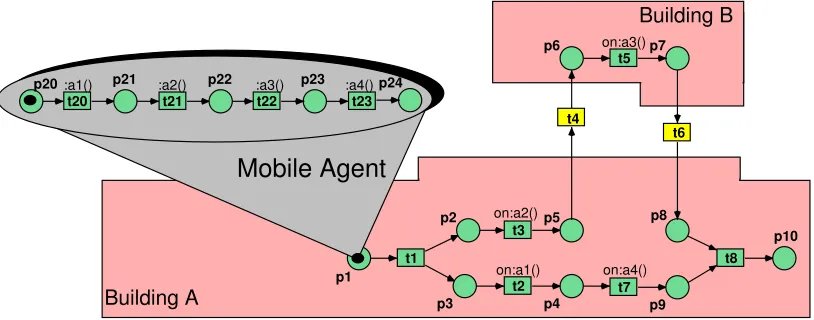
we obtain the formalism of mobile object nets (cf. [KF07]) In Figure 4 the infrastructure is composed of the two buildings Aand Brepresented in the system net. Buildings can be seen as a metaphor for namespaces, e.g., for different hosts on a distributed network or different WLAN areas. The two buildings are connected via the mobility transfer transitions t4 andt6. One mobile agent is present inside buildingAas a net token. Inside the building the agent has access to a workflow describing how the agent is allowed to use services, i.e. the building’s infrastructure. The agent can decide to use the building’s infrastructure by synchronising with the access workflow’s transitions.
:a3() :a1()
p2
p4
p6 p7
p9 t1
t2 t3
t5
t7
t8 p24
t20 t21 t22
p3
p21 p22 p23
t4
t6
p1
p5 p8
p20
t23
Building A
p10
Building B
Mobile Agent
on:a2()
on:a1()
on:a3()
on:a4()
:a2() :a4()
Figure 4: A mobile agent’s environment
The formalism of mobile object nets is well suited to this finer granularity of namespaces while elementary objects are not since for object nets each place is one single namespace. The expressibility of mobile object nets leads to the fact that mobile object net can simulate Petri nets with inhibitor arcs (cf. Theorem 6 in [KF07]) which proves that mobile EOSare more powerful
than EOSsince boundedness is undecidable for inhibitor nets, but decidable for EOS.
4 Reference Semantics and Generalised State Machines
For each EOS there is an obvious construction of a p/t net, called the reference net, which is
constructed by taking as the set of places the disjoint union of all places and as the set of tran-sitions the synchronisations. Since the places of all nets inN are disjoint by definition, the decomposition(Π1(µ),(Π2N(µ))N∈N)can be identified with the mixed multiset:
Π1(µ) +
∑
N∈NΠ2 N(µ)
This sum is another representant of the equivalence class[µ]∼=.
Definition 4 LetOS= (Nb,N,d,l,µ0)be an EOS. Thereference netRN(OS)is defined as the p/t net:
RN(OS) =Pb∪[N
∈N PN
,Θ,preRN,postRN,RN(µ0)
wherepreRN(and analogouslypostRN) is defined by:
preRN(τb[θ]) =pre(τb) +
∑N
∈N preN(θ(N))
and for markings we define: RN(µ):=Π1(µ) +
∑
N∈N
Π2 N(µ)
The net is called reference net because it behaves as if each object net would have been ac-cessed via pointers and not like a value: A black token on a system net place pbis interpreted
as a pointer to the objectNb=d(bp)where each object net has exactly one instance but several
pointers referring to it.
Theorem 2 Let OS be an EOS. Every event bτ[θ] that is activated in OS for (λ,ρ) is so in
RN(OS):
µ −−−−−→τb[θ](λ,ρ) OS µ
0 =⇒ RN(µ)−−−−→bτ[θ]
RN(OS) RN(µ 0)
Proof. Wheneverτb[θ]is activated inµthe enabling condition φ holds. This implies thatΠ1(µ)
enables τband Π2
N(µ)enables θ(N) for eachN∈N. Since all the places are disjoint RN(µ) is isomorphic to the projections Π(µ) and this implies that the multiset sum bτ+∑N∈N θ(N)
is enabled which is equivalent to the enabling in RN(OS). Analogously one can observe that
the effect onΠ1(µ) an on theΠ2
s11
t1
t2
t11 t12
s12 s13
:ch2() :ch1()
on:ch1()
s1
t3
on:ch2()
s6 t4
s5 s4 s2
s3 net token
system net
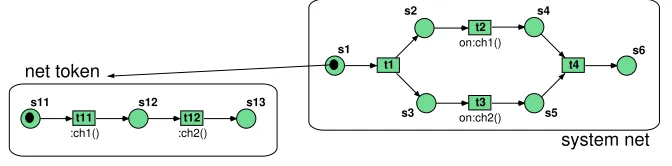
Figure 5: A sample EOS
The converse is not true in general, which can be demonstrated using the EOSin Fig.5known
as theα-centauri example, cf. [Val98]. Initially we haveµ0=sb1[s11]. In the reference net we have the initial marking RN(µ0) =bs1+s11which activates the firing sequence:
(bs1+s11)−−→bt1[ε] (sb2+sb3+s11)−−−→bt2[t11] (sb4+bs3+s12)−−−→bt3[t12] (sb4+bs5+s13)
It is easy to see that in the EOSwe can fire only a prefix, depending on the choice of the modes.
The first mode assigns the token ons11to the net-token onbs3:
b
s1[s11]−−→bt1[ε] bs2[0] +sb3[s11]
The second mode assigns the token ons11to the net-token onbs2:
b
s1[s11]−−→bt1[ε] bs2[s11] +sb3[0]−−−→bt2[t11] bs4[s12] +sb3[0]
Since the effect in the object net is only local,bt3[t12]is not activated. Sow=bt1[ε]·bt2[t11]·bt3[t12] is a possible firing sequence for the reference net, but not for the object net system.
From Theorem2and the above the following property follows.
Corollary 1 Let OS be an EOS. If µ is reachable from µ0, then RN(µ) is reachable from RN(µ0). The reverse does not hold in general.
So, we obtain only a sufficient condition for non-reachability: The markingµis not reachable fromµ0whenever RN(µ)is not reachable from RN(µ0).
Fortunately, many practical models areGeneralised State Machinesand this sufficient condi-tion can be strengthened to a necessary one for these. An EOSOSis a generalised state machine
iff for allbt there is either exactly one place in the preset and one in the postset typed with the object netNor there are no such places:
∀N∈N :∀bt∈Tb:{bp∈•bt |d(pb) =N}={pb∈bt•|d(pb) =N}≤1 (9) and the inital marking has at most one net-token of each type:
∀N∈N :|{pb∈Pb|Π1(µ)(bp)>0∧d(bp) =N}| ≤1 (10)
Obviously every p/t like EOSis a generalised state machine sinced(pb) =•for all bp. In addition generalised state machines are monotonous.
Theorem 3 Let OS be anEOSwith the generalised state machine property.
A transitionbτ[θ]is activated in OS for(λ,ρ)iff it is inRN(OS): µ −−−−−→τb[θ](λ,ρ)
OS µ
0 ⇐⇒ RN(µ)−−−−→bτ[θ]
RN(OS) RN(µ
0)
Proof. Define the propertyψ as follows:
ψgsm(µ) = ∀N∈N :|{pb∈Pb|Π1(µ)(pb)>0∧d(bp) =N}| ≤1
By (10) the property holds initially, i.e. ψgsm(µ0) is true. It is easy to observe that that the property ψgsm(µ) remains true in all reachable markings, since whenever there is at most one net-token for each object net in markingµ, then (9) implies that there are equally many in the successor markingµ0.
Therefore in each reachable marking µ we have for each object net N that is present in the initial marking exactly one marked system net placepbN which contains the net-token of typeN.
In this case all tokens in the projection Π2
N(µ)belong to the marking of the net-token onpbN. The net-token can be reconstructed aspbN[Π2N(µ)].
Therefor, we can uniquely reconstruct µ from RN(µ)and reachability in the net RN(OS)is a
necessary and sufficient condition for reachability.
A generalised state machineOSis therefor isomorphic with its reference net RN(OS).
Note that the formalism defined in [BBPP04] is restricted to generalised state machines – the general case is not considered which simplifies notations considerably but limits the expressive-ness.
5 The Invariance Calculus for Object Nets
There is a well elaborated connection of Petri nets and linear algebra (cf. [Lau87,STC98]). Let
∆:T→(P→Z)be the function defined by:
∆(t)(p) =post(t)(p)−pre(t)(p)
∆(t)denotes theeffectof firingt. The function∆is linear, in the sense that the effect∆(t1+t2) of a transition multiset is their cumulated effect:
∆(t1+t2) =∆(t1) +∆(t2)
If 0<|P|,|T|<∞then ∆ can be expressed as a |P| · |T| matrix (called incidence matrix) defined by∆(p,t) =post(t)(p)−pre(t)(p). Using∆(t)the firing stepm−→t m0 of a p/t net can be expressed as:
m0=m−pre(t) +post(t) =m+∆(t)
It is well known that all solutionsi∈Z|P|\ {0}of the equation
∆>i=0
Theorem 4 (Lautenbach) Leti∈Z|P|be a P-invariant of the p/t net N. Then we have:
∀m∈RS(N,m0):i·m=i·m0
This invariance calculus for p/t nets can be extended to EOSin a compositional way, i.e.
in-variance equations can be obtained from the inin-variance equations of the constituting components separately.
Theorem 5 Let OS= (N,b N,d,l,µ0) be anEOS,bi a P-invariant of the system net N andb iN
one for each object net N∈N . For all reachable markingsµ it holds:
bi·Π1(µ) = bi·Π1(µ0) ∀N∈N :iN·Π2N(µ) = iN·Π2N(µ0)
Proof. Proof by induction on the length of the firing sequence. Induction base: For the empty sequence we haveµ=µ0and the property is obvious.
Induction step: Assume we have µ0−→∗ OS µ
b
t[θ](λ,ρ) −−−−−→
OS µ
0. Sincebiis an invariant of the system
net we havebi·(post−pre) =0. It follows:
bi·Π1(µ0) = bi·Π1(µ−λ+ρ) =bi·(Π1(µ)−Π1(λ) +Π1(ρ))
= bi·Π1(µ)−bi·pre(bt) +bi·post(bt) =bi·Π1(µ)
For allN∈N we haveiN·(postN−preN) =0. It follows:
iN·Π2N(ρ) =iN· Π2N(λ)−preN(θ(N)) +postN(θ(N))=iN·Π2N(λ)
This proves the property.
This extension of linear invariants to EOSshows that safety properties of object nets – when
considered as p/t nets – are conservatively embedded. Of course, this embedding does not extend to liveness properties, since e.g. a deadlock-free system net may block when embedded into an EOS, simply because it may be synchronised with a deadlocked object net.
Example3 As mentioned in the introduction structural analysis is useful for the system’s as well as for the mobile agent’s side. The mobility infrastructure given in Fig. 6 consists of the three localities pool,public, and private. The net itself is a variant of the reader/writer problem. The parametern∈Ndenotes the capacity of the public location.
In the first step only the agent system (i.e. the system netNb) is shown, since an agent (i.e. the object netN) cannot be restricted by a platform in advance. The synchronisation relation is also omitted for the same reason.
We show how invariants of the system net extend towards properties of the whole EOS. The
following analysis holds for arbitrarily structured agents.
move pool -> private
move public -> pool
pool
move pool -> public
n
n n
public prvivate
move private -> pool
n
semaphor t1
t2
t3
t4
∆=
t1 t2 t3 t4
pool −1 1 −1 1
public 1 −1
semaphor −1 1 −n n
private 1 −1
Figure 6: The Multi-Agent System NetNb
one agent in the private location. This prevents agents from being spied out. The transitions between the locations model movement, which are either objective or consensual (depending on the synchronisation relation).
In the following the system netNbis analysed using invariants.
We obtainbi= (0,1,1,n)0 as a solution of the equationbi·∆=0. Using Theorem5 we have bi1·Π1(µ) =bi1·Π1(µ0)for all reachable markingsµ:
bi1·Π1(µ) =Π1(µ)(public) +Π1(µ)(semaphor) +n·Π1(µ)(private) =bi1·Π1(µ0) =n
ThereforeΠ1(µ)(private)>0impliesΠ1(µ)(private) =1andΠ1(µ)(public) =0.
public prvivate
move pool -> public
flag 1
flag 2
move pool -> private move
public -> pool private -> poolmove
[]
[] []
ready for public
ready for private
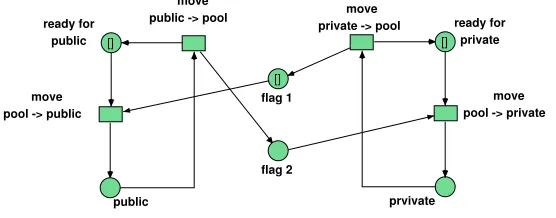
Figure 7: The Agent
In the following we analyse the agent netNbgiven in Fig.7. The two placesflag1andflag2are
is given as (with slight abbreviations):
∆=
pool→pub pub→pool pool→prv prv→pool
ready public −1 1
public 1 −1
ready private −1 1
private 1 −1
flag1 −1 1
flag2 1 −1
Solving the equation i·∆=0 we obtaini= (0,1,0,1,1,1)0 as an invariant of the agent-net.
Using Theorem5we havei2·Π2(µ) =i1·Π2(µ0)for all reachable markingsµ:
i·Π2(µ) = Π2(µ)(public) +Π2(µ)(private) +Π2(µ)(flag1) +Π2(µ)(flag2) = i·Π2(µ0) =1
This implies:
Π2(µ)(public) +Π2(µ)(private)≤1
So, the agent proves that it does not attempt to enter the private and the public place at the same time.
6 Conclusion
In this presentation we have introduced the formalism of elemntary object nets and its invari-ant calculus, which has the compositionality property, i.e. invariinvari-ants of the whole system are deducible from the components. The usefulness of structural analysis combined with composi-tionality of multi-agent systems is obvious in the context of mobility, since the system is open and only parts of the systems are known in advance. Using this approach we could establish a correctness proof for our example scenario without any knowledge about the structure of the mobile agents in the system.
Bibliography
[BBPP04] M. A. Bednarczyk, L. Bernardinello, W. Pawlowski, L. Pomello. Modelling mobility with Petri hypernets. In Fiadeiro et al. (eds.), Recent Trends in Algebraic Develop-ment Techniques (WADT 2004). Lecture Notes in Computer Science 3423, pp. 28–44. Springer-Verlag, 2004.
[Bus99] N. Busi. Mobile nets. In Ciancarini et al. (eds.), Formal Methods for Open Object-Based Distributed Systems. Volume 139, pp. 51–66. Kluwer, 1999.
[HEM05] K. Hoffmann, H. Ehrig, T. Mossakowski. High-Level Nets with Nets and Rules as Tokens. InApplication and Theory of Petri Nets and Other Models of Concurrency. Lecture Notes in Computer Science 3536, pp. 268 – 288. Springer-Verlag, 2005.
[Hir02] K. Hiraishi. PN2: An Elementary Model for Design and Analysis of Multi-agent Systems. In Arbab and Talcott (eds.),Coordination Models and Languages, COOR-DINATION 2002. Lecture Notes in Computer Science 2315, pp. 220–235. Springer-Verlag, 2002.
[KF06] M. K¨ohler, B. Farwer. Modelling Global and Local Name Spaces for Mobile Agents Using Object Nets.Fundamenta Informaticae72(1-3):109–122, 2006.
[KF07] M. K¨ohler, B. Farwer. Object Nets for Mobility. In Kleijn and Yakovlev (eds.), Inter-national Conference on Application and Theory of Petri Nets 2007. Lecture Notes in Computer Science 4546, pp. 244–262. Springer-Verlag, 2007.
[KMR01] M. K¨ohler, D. Moldt, H. R¨olke. Modeling the Behaviour of Petri Net Agents. In Colom and Koutny (eds.), International Conference on Application and Theory of Petri Nets. Lecture Notes in Computer Science 2075, pp. 224–241. Springer-Verlag, 2001.
[KMR03] M. K¨ohler, D. Moldt, H. R¨olke. Modelling Mobility and Mobile Agents using Nets within Nets. In Aalst and Best (eds.), International Conference on Application and Theory of Petri Nets 2003. Lecture Notes in Computer Science 2679, pp. 121–140. Springer-Verlag, 2003.
[K¨oh06] M. K¨ohler. The Reachability Problem for Object Nets. In Moldt (ed.),Proceedings of the Workshop on Modelling, object, components, and agents (MOCA’06). University of Hamburg, Department for Computer Science, 2006.
[K¨oh07] M. K¨ohler. Reachable Markings of Object Petri Nets. Fundamenta Informaticae
79(3-4):401 – 413, 2007.
[KB09] M. K¨ohler-Bußmeier. Hornets: Nets within Nets combined with Net Algebra. In Wolf and Franceschinis (eds.),International Conference on Application and Theory of Petri Nets (ICATPN’2009). Lecture Notes in Computer Science. Springer-Verlag, 2009.
[KR03] M. K¨ohler, H. R¨olke. Concurrency for Mobile Object-Net Systems.Fundamenta In-formaticae54(2-3), 2003.
[KR04] M. K¨ohler, H. R¨olke. Properties of Object Petri Nets. In Cortadella and Reisig (eds.),
International Conference on Application and Theory of Petri Nets 2004. Lecture Notes in Computer Science 3099, pp. 278–297. Springer-Verlag, 2004.
[Lau87] K. Lautenbach. Linear algebraic techniques for place/transition nets. In Brauer et al. (eds.),Petri Nets: Central Models and their Properties. Advances in Petri Nets 1986. Lecture Notes in Computer Science 254, pp. 142–167. Springer-Verlag, 1987.
[Lom00] I. A. Lomazova. Nested Petri Nets – a Formalism for Specification of Multi-agent distributed systems.Fundamenta Informaticae43(1-4):195–214, 2000.
[MPW92] R. Milner, J. Parrow, D. Walker. A calculus of mobile processes, parts 1-2. Informa-tion and computaInforma-tion100(1):1–77, 1992.
[STC98] M. Silva, E. Teruel, J. M. Colom. Linear Algebraic and Linear Programming Tech-niques for the Analysis of Place/Transition Net Systems. In Reisig and Rozenberg (eds.),Lecture Notes in Computer Science: Lectures on Petri Nets I: Basic Models. Advances in Petri Nets 1491, pp. 309–373. Springer-Verlag, 1998.
[Val91] R. Valk. Modelling Concurrency by Task/Flow EN Systems. In 3rd Workshop on Concurrency and Compositionality. GMD-Studien 191. Gesellschaft f¨ur Mathematik und Datenverarbeitung, St. Augustin, Bonn, 1991.
[Val98] R. Valk. Petri Nets as Token Objects: An Introduction to Elementary Object Nets. In Desel and Silva (eds.), Application and Theory of Petri Nets. Lecture Notes in Computer Science 1420, pp. 1–25. 1998.
[Val03] R. Valk. Object Petri nets: Using the nets-within-nets paradigm. In Desel et al. (eds.),
Advanced Course on Petri Nets 2003. Lecture Notes in Computer Science 3098, pp. 819–848. Springer-Verlag, 2003.
[VC98] J. Vitek, G. Castagna. Seal: A Framework for Secure Mobile Computations. InICCL Workshop: Internet Programming Languages. Pp. 47–77. 1998.
[XD00] D. Xu, Y. Deng. Modeling Mobile Agent Systems with High Level Petri Nets. In

![Figure 3: The EOS of Figure 1 after the firing of t[N �→1 t1,N �→2 t2]](https://thumb-us.123doks.com/thumbv2/123dok_us/7818062.2087117/8.595.89.509.342.502/figure-the-eos-figure-after-the-ring-n.webp)