ARTIGO ORIGINAL
A Brief Course on Clinical Communication Skills: A
Multi-Centered Study
Curso Breve de Competências de Comunicação Clínica:
Estudo Multicêntrico
1. School of Medicine. Pontifical Catholic University of Paraná. Curitiba. Brazil.
2. Department of Medical Education and Simulation. Faculty of Medicine. University of Porto. Porto. Portugal. 3. Department of Epidemiology, Predictive Medicine and Public Health. Faculty of Medicine. Porto. Portugal.
Autor correspondente: Camila Franco. [email protected]
Recebido: 31 de outubro de 2016 - Aceite: 03 de dezembro de 2016 | Copyright © Ordem dos Médicos 2016
Camila FRANCO1,2, Renato FRANCO1,2, Milton SEVERO2,3, Maria Amélia FERREIRA2
Acta Med Port 2016 Dec;29(12):809-818 ▪ http://dx.doi.org/10.20344/amp.8393
RESUMO
Introdução: O presente artigo descreve e analisa os resultados de um curso multicêntrico de comunicação clínica em pequenos
gru-pos com recurso a doentes simulados (atores) e feedback. O objetivo do curso foi estimular o desenvolvimento de competências de
comunicação clínica e ainda, reconhecer as diferentes formas de manifestação de uma mesma doença em doentes diferentes (doença versus dolência).
Material e Métodos: O curso foi aplicado a estudantes do terceiro e quarto ano do curso de medicina em três universidades brasileiras e uma portuguesa. A avaliação foi realizada através de escalas de apreciação dos participantes, teste de escolha múltipla e autoeficá-cia.
Resultados: Tivemos 69 participantes nas quatro universidades. A avaliação geral do curso (1 - 5) foi de 4,70 (DP 0,494), a autoava-liação sobre a participação foi de 4,07 (DP 0,671); e a avaautoava-liação sobre o uso dos doentes simulados 4,51 (DP 0,501). O teste de escolha múltipla, a escala de autoeficácia e a escala de atitudes quanto a aprendizagem dessas competências apresentaram melhoria significativa após a realização do curso.
Discussão: O método utilizado teve uma excelente avaliação pelos estudantes independentemente do contexto onde o curso foi ministrado. Além disso, possibilitou ganhos quanto ao conhecimento e atitudes quanto a comunicação clínica.
Conclusão: A partir de uma universidade portuguesa em colaboração com docentes e universidades brasileiras foi possível desen-volver uma estratégia de ensino-aprendizagem multicêntrica para comunicação clínica altamente valorizada pelos participantes e com resultados de aprendizagem adequados.
Palavras-chave: Avaliação Educacional; Avaliação de Programas; Competência Clínica; Comunicação; Educação Médica Pré--Graduada; Relações Médico-Doente.
ABSTRACT
Introduction: This paper describes and analyses the results of a multicenter course on clinical communication skills with the use of the learning in small groups, patient actors and feedback. The aim of the course was to encourage participants to develop a more effective
clinical communication to recognize the different manifestations of the same disease in different patients (disease versus illness).
Material and Methods: The course was applied to third and fourth year medical students in three Brazilian universities and one university in Portugal. The evaluation was performed using scales regarding the participants’ point of view, multiple choice questionnaire, a self-efficacy and attitudinal questionnaire.
Results: The study was conducted in 69 participants at the four universities. The overall evaluation of the course (from 1 - 5) was 4.70 (SD 0.494), the self-evaluation on participation was 4.07 (SD 0.671); and the evaluation about the use of simulated patients 4.51 (SD 0.501). The multiple choice questionnaire and self-efficacy scale showed significant improvement.
Discussion: The course methods had an excellent evaluation by students regardless of the context in which the course has been applied. Furthermore, it allowed an improvement on the knowledge and attitude of students regarding clinical communication. Conclusion: It was possible to develop a multi-centric learning strategy for clinical communication with a high evaluation by students who came from a Portuguese university in a cooperation project with teachers from Brazilian universities.
Keywords: Clinical Competence; Communication; Education, Medical, Undergraduate; Educational Measurement; Physician-Patient Relations; Program Evaluation.
INTRODUCTION
Developing communication competencies is essential for medical students to be able to fulfill all of their clinical duties, by doing so, assist the patient with excellence.1–5
Physicians that have good communication skills develop better relationships with their patients, make less mistakes, ensure better patient safety, get into less legal complications (such as malpractice suits) and furthermore, appear to be more personally satisfied, thus guaranteeing a more satisfied patient.6,7
As medical schools in many different countries realize the importance of teaching clinical communication,8–13
they are beginning to integrate new curricular activities to better develop these competencies.14–16 Within the various
educational and training methodologies available for clinical communication, the role-play,17,18 the use of simulated
patients,19 group discussions,20 and practical activities with
real patients21 have being highlighted.
ARTIGO ORIGINAL have appeared to be fundamental in the development of these competencies.22–25 In the process of learning clinical
communication, the chosen teaching method should allow the student to associate concepts, such as ‘disease’ and ‘illness’, as well as technical (clinical) skills to his/her humanistic skills.7 Because of this, these competencies
should not be taught apart from their practical context. A strategy that is too theoretical might not show the student how relevant clinical communication is. It’s a basic essential for a physician because it is crucial in the diagnosis process, elaborating a therapeutic plan, and breaking bad news to a patient and/or his/her family.26–28
Scenarios and activities focused on learning these skills with specific strategies, teaching methods and well-defined assessment criteria contribute to the development of clinical communication skills.29,30 Loureiro et al (2011), at
the Faculty of Medicine of the University of Porto (FMUP), demonstrated that the clinical and academic context to which the students are exposed highly impacts their attitudes towards clinical communication. Students who were taught by professors or in environments that were heterogeneous31
assessed, with significant difference, the importance of communication competencies. Because of this, it is crucial that students are exposed to teaching-learning conditions and more standardized assessments so that all of them can be stimulated enough to develop their competencies. The consensus on clinical communication32–34
highlights the fundamental competencies that health professionals should have to adequately deal with a patient. Universities must promote the inclusion, in the curriculum, methods permitting the integration of these fundamental competencies with others areas of medical knowledge. In the past years, some Portuguese and Brazilian universities have adapted their programs by highlighting communication as a fundamental competency. Even so, the students of these schools still feel as though they are only partially competent in clinical communication by the end of the sixth year of their programs. Others feel as though these skills are their most fragile and that they need to improve them through a postgraduate program.37,38
While teaching clinical communication, the teacher should allow students to reflect on their feelings, actions, and reactions; and also help the students integrate their technical knowledge about various pathologies according to patients’ personalities, beliefs, expectations, literacy and values.23,29
The same clinical situation or condition can have a different outcome depending on factors such as environment and patient personality, among others. Thus, it is important that the student recognizes that these particularities exist, not just because of the disease or situation, but also because of various personal characteristics of the patients. This complexity increases when a medical school sets out to enable a physician to care for patients from diverse cultures and contexts.39 Education has become more
universal over time and the sharing of experiences amongst different universities in different countries, or even in the
same country, create constant challenges.
Thus, this study aims to describe and analyse a brief clinical communication course performed in four universities in two countries that speak the Portuguese language (Brazil and Portugal).
MATERIAL AND METHODS
The participants in this study were volunteer medical students in the third and fourth year of the course from three different Brazilian universities and one Portuguese university. The first university (University 1) was chosen because it was among the five best schools in the country (State University of Campinas - UNICAMP). The second university (University 2) was chosen because one of the authors of this study is part of its teaching staff and because it is one of the best medical universities in the southern region of Brazil (Pontifical Catholic University of Paraná - PUCPR). To facilitate the author’s transportation, the third university was chosen because it is located in the southeast region of Brazil. (University of Mogi das Cruzes - UMC; University 3). The Portuguese university (Faculty of Medicine of the University of the Porto - FMUP; University 4) was chosen because it is where the authors work and because it is a respected school of medicine by national and international standards.
For the sample recruitment, we got in touch with the participants online or through a class representative. Each institution presented its conditions to allow the authors to invite the students to take part of the course. Participation in the course was voluntary since there was no direct correlation with each university’s academic credits or activities.
At universities 1 and 2, invitations were emailed to all of the fourth-year students. At university 3, the invitation was made to the fourth-year students through a class representative. However, since third-year students were also interested, we extended the invitation to their class as well. The classes at universities 1, 2, and 3 were made of 90 students, thus facilitating our contact with the students. Although at university 4, with groups of up to 300 students in each year of the course, it was not possible to get in touch with all of them, especially the fourth-year students, because of their upcoming clinical rotations. Because of this, we disseminated our invitation with posters and online ads through the student councils of the third and fourth year classes of the medical program.
Statistical analyses
ARTIGO ORIGINAL We analysed the variables that could influence the
differences between the students’ scores and universities (academic year, age, gender, previous academic history and previous extracurricular involvement with clinical communication). We used a Chi-square test and Fisher’s exact test to analyse the association between the categorical variables. We evaluated the dimensionality of the applied scales and its accuracy with the principal components analysis and the Cronbach’s Alpha.
This investigation was approved by Ethical Commission at Centro Hospitalar de São João/FMUP under the file number 288-14. In Brazil, the research was approved by the Committee of Education and Research at Pontifical Catholic University of Paraná - PUCPR (protocol - CAEE 45776715700000020) and it was given permission by the universities.
RESULTS
Course description
We elaborated the course, its learning tools, and its cases with the collaboration of two Portuguese professionals with medical education experience and two Brazilian professionals so that it could be adequately understood and meaningful to students from different contexts. The chosen approach was to teach students in small groups encouraging their active participation.40,41
The course was 25 hours long and based on the Calgary-Cambridge Guide32 and the Patient-Centred Clinical
Method.7 It was organized into five modules: initiating the
session, gathering information, explanation and planning,
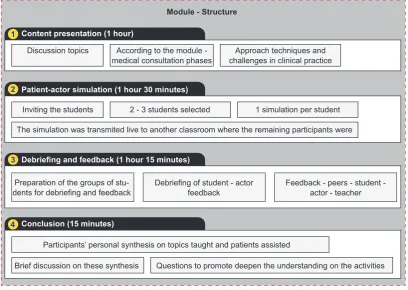
closing the session - a total of four modules; along with a module about communicating bad news (module 5). These five modules were distributed into five different encounter days, which happened every fifteen days, finishing the course in two months. In the first module, the pre-tests were given, the course and the methods that would be utilized were presented, the initial conversations about the theoretical references were and the module about initiating the session was given. In this first encounter, there was no simulation. From the second to the fifth modules, the activities followed the flow presented in Fig. 1.
The simulations were carried out between the students and the simulated patients - actors who were trained specifically for this clinical encounter and for the debriefing. We planned for the simulations to show the students how one disease can present itself in many different ways (illness). The same actor portrayed the same disease and medical history through various types’ contexts and characters. (For example, a shy, anxious, irritated or an ‘know-it-all’ patient). The teacher responsible for the course was the same in all four universities. However, each university counted on the participation of a different group of actors. University 1 was the only school to have the participation of professional actors with high expertise in clinical simulation and for the debriefing. The necessary time for the training, marking, and debriefing of all the cases was about four hours in one meeting. At the other universities, three hours were spent with each module with actors’ participations (a total of 12 hours of training).
We asked the students about their points of view on the
Figure 1 – Structure of the modules (from 2 to 5) Discussion topics
Inviting the students
Brief discussion on these synthesis Questions to promote deepen the understanding on the activities
Preparation of the groups of
stu-dents for debriefing and feedback Debriefing of student - actor feedback Feedback - peers - student - actor - teacher
2 - 3 students selected 1 simulation per student
The simulation was transmited live to another classroom where the remaining participants were
Participants’ personal synthesis on topics taught and patients assisted According to the module -
medical consultation phases challenges in clinical practiceApproach techniques and
Module - Structure
1
2
3
4
Content presentation (1 hour)
Patient-actor simulation (1 hour 30 minutes)
Conclusion (15 minutes)
ARTIGO ORIGINAL teaching-learning method used: 92.8% said the approach was reflective and focused on the students’ development
of skills, going beyond the knowledge development; 1.4% said it was focused on content with further development in thematic details and that it stimulated knowledge acquisition; and 5.4% said it was reflective, focused on further development of content and knowledge.
Course and activities: a student’s point of view, a quantitative analysis
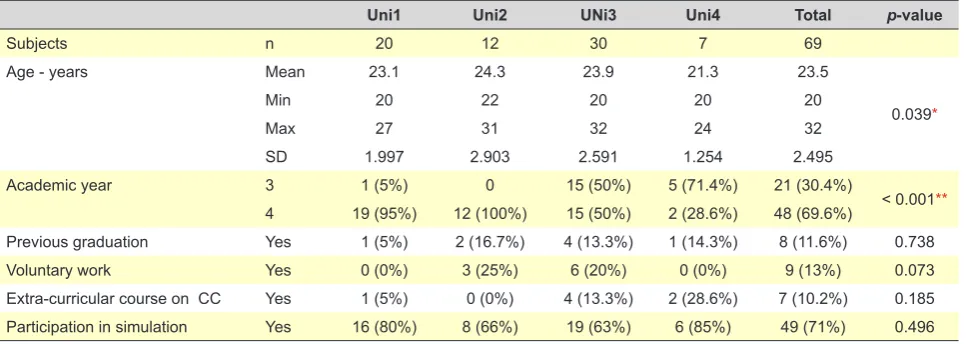
The characteristics of the participants are presented in Table 1. The number of students in each group ranged between 7 and 15. University 1 had two groups with 10 students each; at University 2, one group of 12 students; at University 3, two groups of 15 students, and at University 4, one group of seven students. Ideally, the groups were supposed to have between 8 - 10 participants, but because of each university’s particularities and context (classroom availability, students’ available hours and actors), the number had to be adapted accordingly. Most of the participants did the simulated medical consultation during the course (71%). Of these 49 participants, four students did two simulations. Thus, there were 49 participants in 53 simulations, an average of 2.2 simulations per encounter. At the end of the course, we passed out a questionnaire to evaluate the course, the students’ participation, and the appreciation of the simulation.
The evaluation of the course was held in two phases. In one, the participants filled out a ‘general evaluation’ (1-5), reaching a result of an average 4.70 (SD 0.494); and in the other (‘course appreciation’), the participants answered fourteen questions about the quality of the course on a Likert scale of 1 to 5, reaching an average score of 4.61 (SD 0.385). Despite containing fourteen questions (Appendix 1) [http://www.actamedicaportuguesa.com/revista/index.php/ amp/article/view/8393/4853], the analyses of the main components identified one component that explained 47.79% of the total variance. The standardized factor loads varied from 0.532 to 0.763. Other than that, the average
accuracy measure through Cronbach’s Alpha was 0.904 utilizing the fourteen questions. Thus, we treated the data in this scale as one total score. The self-evaluation of each student’s participation had an average score of 4.07 (SD 0.671) on a Likert scale of 1 to 5.
The use of simulated patients involved questions about the likeness of the simulated situation to real life (fidelity), the relevance and applicability of the situations, among other questions. The average score of the use of the simulated patients was 4.51 (SD 0.501). The scale that evaluates the use of simulated patients (Appendix 1) has 51.17% of its variance explained by one component. The standardized factor loads were between 0.565 and 0.867, with a Cronbach’s Alpha of 0.862 with 9 items.
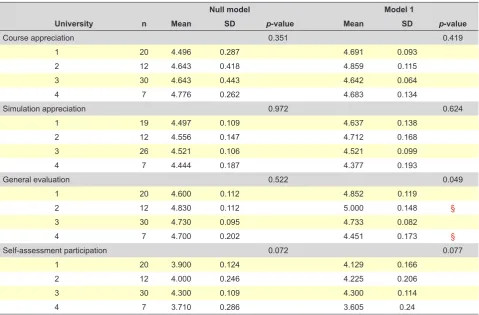
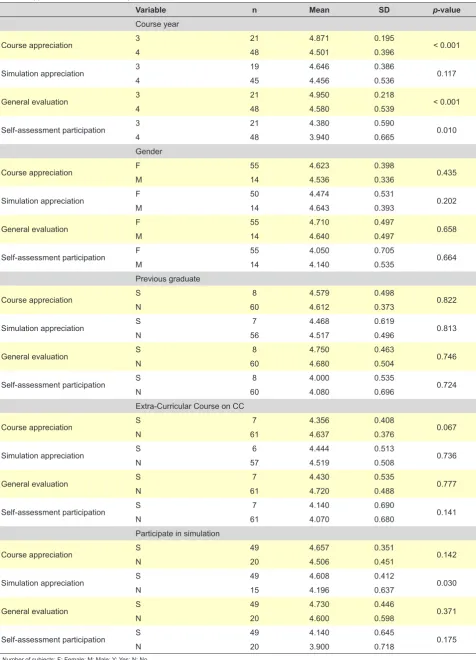
On Table 2, two models were presented: one with adjustments according to the academic year (Model 1) and one without (Null Model). It was the only assessed confounding variable that presented any effect on the appreciation and distribution among the universities. The evaluation averages about the course regarding the demographic and academic variables of the students are shown on Table 3.
Students’ point-of-view on course and activities The following excerpts were written on post-tests where the students were able to describe the learning results of the course:
E152 - “I learned how to better evaluate the patient’s’ context and his/her real needs in the appointment.”
E206 - “My biggest lesson in the course was that clinical communication depends on many factors to be effective and that only when the physician is aligned with the patient can he/she reach the best results. Other than that, “I know that this is something I’ll have to study again since I continually find myself in situations that reflect on how I communicate outside of the doctor’s office.”
E210- “I learned to listen to what the patient has to tell me and not only what I want him/her to tell me”
E335 - “I learned to pay more attention to my attitudes,
Table 1 - Demographic characteristics of the sample and the participation in simulation
Uni1 Uni2 UNi3 Uni4 Total p-value
Subjects n 20 12 30 7 69
Age - years Mean 23.1 24.3 23.9 21.3 23.5
0.039*
Min 20 22 20 20 20
Max 27 31 32 24 32
SD 1.997 2.903 2.591 1.254 2.495
Academic year 3 1 (5%) 0 15 (50%) 5 (71.4%) 21 (30.4%)
< 0.001**
4 19 (95%) 12 (100%) 15 (50%) 2 (28.6%) 48 (69.6%)
Previous graduation Yes 1 (5%) 2 (16.7%) 4 (13.3%) 1 (14.3%) 8 (11.6%) 0.738
Voluntary work Yes 0 (0%) 3 (25%) 6 (20%) 0 (0%) 9 (13%) 0.073
Extra-curricular course on CC Yes 1 (5%) 0 (0%) 4 (13.3%) 2 (28.6%) 7 (10.2%) 0.185
Participation in simulation Yes 16 (80%) 8 (66%) 19 (63%) 6 (85%) 49 (71%) 0.496
ARTIGO ORIGINAL
even with basic thing such as introducing myself to the patient.”
E405 - “More than knowing the steps of a medical consultation interview or the different communication techniques, in my point my view, it’s extremely important to put yourself in contact with different types of patients that present different needs… It was extremely enriching to get feedback from the actors because it allowed me to adapt my behavior to the needs of the patient.”
Student assessment and performance
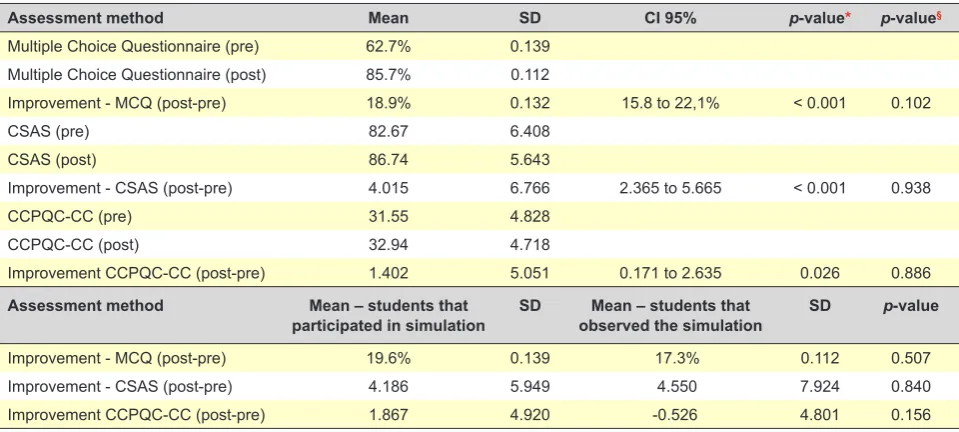
The students’ assessments were described through three indicators: a multiple-choice questionnaire (MCQ) (pre and post-test), a self-efficacy scale about clinical communication competencies, Clinical Communication and Professionalism Questionnaire of Capability – Communication Competencies (CCPQC-CC) (Appendix 1) and through the Communication Skills Attitude Scale (CSAS) for learning attitudes.38 In order to show each participant’s
progress, the differences between the post and pre-tests were assessed by a pairing method average and not by an overall average (Table 4). The CCPQC-CC is composed by 12 questions (Appendix 1) and the principal component analysis showed one component explaining 39.2% of the total variance and the standardized factor loads ranged from 0.313 to 0.909, with a Cronbach’s Alpha of 0.845. The results showed a significant increase in the three indicators
that were analyzed (MCQ, CSAS and self-efficacy) between the pre-test (before the course) and the post-test (after the course). Despite the differences in relation to the initial test scores (data not shown), the difference between the gains (improvement) was not significant among the universities (last column in Table 4 – the p-value§ is the difference
between the universities). Since the goal was to describe the impact of the course, instead grading or comparing the scores of the universities we focused on the gains.
The students that did the simulation had a higher gain in self-efficacy (CCPQC-CC). However, this gain was not significant when compared with those who only observed.
DISCUSSION
It was possible to conduct a communication course using the same educational material (classes, cases and simulations) and apply it to a different context, even without being part of the same teaching staff at universities 1 and 3. Beyond that, there was a positive student appreciation of the course and its teaching strategies. In all, the learning outcomes were very satisfying.
Even in different contexts, the participants of all four universities presented improvement in the analysed parameters, indicating that the utilized method could have allowed an adequate adaptation of participants’ needs and expectations. Both, the students that participated in the simulations, and those who observed through live video Table 2 - Appreciation and course evaluation by the students
Null model Model 1
University n Mean SD p-value Mean SD p-value
Course appreciation 0.351 0.419
1 20 4.496 0.287 4.691 0.093
2 12 4.643 0.418 4.859 0.115
3 30 4.643 0.443 4.642 0.064
4 7 4.776 0.262 4.683 0.134
Simulation appreciation 0.972 0.624
1 19 4.497 0.109 4.637 0.138
2 12 4.556 0.147 4.712 0.168
3 26 4.521 0.106 4.521 0.099
4 7 4.444 0.187 4.377 0.193
General evaluation 0.522 0.049
1 20 4.600 0.112 4.852 0.119
2 12 4.830 0.112 5.000 0.148 §
3 30 4.730 0.095 4.733 0.082
4 7 4.700 0.202 4.451 0.173 §
Self-assessment participation 0.072 0.077
1 20 3.900 0.124 4.129 0.166
2 12 4.000 0.246 4.225 0.206
3 30 4.300 0.109 4.300 0.114
4 7 3.710 0.286 3.605 0.24
ARTIGO ORIGINAL
Table 3 - Appreciation of the course by variables
Variable n Mean SD p-value
Course year
Course appreciation 3 21 4.871 0.195 < 0.001
4 48 4.501 0.396
Simulation appreciation 3 19 4.646 0.386 0.117
4 45 4.456 0.536
General evaluation 3 21 4.950 0.218 < 0.001
4 48 4.580 0.539
Self-assessment participation 3 21 4.380 0.590 0.010
4 48 3.940 0.665
Gender
Course appreciation F 55 4.623 0.398 0.435
M 14 4.536 0.336
Simulation appreciation F 50 4.474 0.531 0.202
M 14 4.643 0.393
General evaluation F 55 4.710 0.497 0.658
M 14 4.640 0.497
Self-assessment participation F 55 4.050 0.705 0.664
M 14 4.140 0.535
Previous graduate
Course appreciation S 8 4.579 0.498 0.822
N 60 4.612 0.373
Simulation appreciation S 7 4.468 0.619 0.813
N 56 4.517 0.496
General evaluation S 8 4.750 0.463 0.746
N 60 4.680 0.504
Self-assessment participation S 8 4.000 0.535 0.724
N 60 4.080 0.696
Extra-Curricular Course on CC
Course appreciation S 7 4.356 0.408 0.067
N 61 4.637 0.376
Simulation appreciation S 6 4.444 0.513 0.736
N 57 4.519 0.508
General evaluation S 7 4.430 0.535 0.777
N 61 4.720 0.488
Self-assessment participation S 7 4.140 0.690 0.141
N 61 4.070 0.680
Participate in simulation
Course appreciation S 49 4.657 0.351 0.142
N 20 4.506 0.451
Simulation appreciation S 49 4.608 0.412 0.030
N 15 4.196 0.637
General evaluation S 49 4.730 0.446 0.371
N 20 4.600 0.598
Self-assessment participation S 49 4.140 0.645 0.175
N 20 3.900 0.718
ARTIGO ORIGINAL
showed improvements in the analysed scores.
Teaching strategies: teacher-actor-student in small groups
Integrating the teaching of systematic communication skills to medical school education curriculums is a challenge.42 Stimulating competency development
(knowledge, skills and attitude) is essential so that learning outcomes can be achieved. Despite the university, almost all students identified that the course used a methodology that goes beyond content acquisition and involves the development of skills.
The students’ active participation is essential, especially in the development of skills and attitudes such as communication and empathy.43 Some studies involve
communication training in a stage after a problematizing session in order to stimulate knowledge and skills acquisition.44 In this present investigation, the practice
with the actors was inserted immediately following the presentation of the theme, discussion and the cognitive formulation of the hypotheses. The presence of actors brought important advances not only to elements such as active listening, clear communication and the obtaining of historical data, but also to empathic communication.45 The
improvement in the scores of the students who participated in the simulations was greater than that of the observers. However, it was not significantly different than it could have been, due to sample limitations. Thus, reflection and discussion can also be potential agents for the development of communication skills. Although, it is also possible that participation brings an increase to that improvement. In addition to the simulation itself, feedback seems to be an essential element in skill development46 which may
have contributed to the course’s outcomes and to the high evaluation of the actors and the teacher.
The method used to present the theoretical discussion, simulation, debriefing, feedback and synthesis (personal and in groups), integrating the actor and the teacher in the teaching of communication competencies, had an excellent appreciation by the students who felt motivated and involved enough to participate in the teaching activities. It is possible that the benefit of this strategy is found in associating the discussion and deepening of the concept with the training of skills and reflection. According to the students, the teacher-actor-student trinomial and the methods used had a good impact on the learning process.
A standardized strategy adapted to different contexts An academic study carried out in Brazil, the Netherlands and in Spain pointed out that it’s crucial that the systematic teaching of communication skills be included in a medical school’s education curriculum.47 When researching the
evaluation of teaching and learning strategies of clinical communication in Portuguese-speaking countries, especially in Brazil and Portugal, there is a lack of original articles that present these types of activities and their evaluations and results. Although there are some articles describing strategies, they do not involve multicenter teaching strategies.
In the second year of its medical course, FMUP has in its Curricular Unit of Medical Psychology curriculum, classes on doctor-patient relationships.48 Even with a
previous curricular course in this area, the participants felt satisfied with the learning process and course content. They presented significant improve in the assessed parameters. The other participating universities have well-structured courses in their curriculum, though they follow a more traditional model of anamnesis teaching. Despite the diversity of curricular teaching scenarios, the progress found in knowledge tests, self-efficacy, course appreciation Table 4 - Student’s assessment performance
Assessment method Mean SD CI 95% p-value* p-value§
Multiple Choice Questionnaire (pre) 62.7% 0.139
Multiple Choice Questionnaire (post) 85.7% 0.112
Improvement - MCQ (post-pre) 18.9% 0.132 15.8 to 22,1% < 0.001 0.102
CSAS (pre) 82.67 6.408
CSAS (post) 86.74 5.643
Improvement - CSAS (post-pre) 4.015 6.766 2.365 to 5.665 < 0.001 0.938
CCPQC-CC (pre) 31.55 4.828
CCPQC-CC (post) 32.94 4.718
Improvement CCPQC-CC (post-pre) 1.402 5.051 0.171 to 2.635 0.026 0.886
Assessment method Mean – students that
participated in simulation SD observed the simulationMean – students that SD p-value
Improvement - MCQ (post-pre) 19.6% 0.139 17.3% 0.112 0.507
Improvement - CSAS (post-pre) 4.186 5.949 4.550 7.924 0.840
Improvement CCPQC-CC (post-pre) 1.867 4.920 -0.526 4.801 0.156
ARTIGO ORIGINAL and simulations may indicate that this model of education effectively addresses the needs of students with different
backgrounds.
The academic year did not seem to influence performance improvement. However, the appreciation was higher in third-year students than in fourth-year students, possibly suggesting that in the earlier stages of a medical program students are more eager to learn clinical communication, or even that these earlier students’ standards may be lower. The quotes of the students’ texts emphasize the importance of adapting the interview to the particularities and needs of patients. These findings are in line with the theoretical references used in this study, as well as with the centered clinical approach that focused on the physician-patient relationship and on the physician’s perception of this process.49,50 The context, especially the characteristics of
the patient may induce reactions that are not always aware to the student or doctor.51 Therefore, it is fundamental that
the training during medical programs develops skills in the students that allow them to be aware and attentive to their actions and reactions when dealing with patients.52
Performance of the student in evaluations of the course The summative assessment tool used in the research was the multiple-choice test (MCQ) as it is a method commonly performed by medical schools.53 Preferentially,
this method evaluates knowledge. However, if it is well elaborated, it can also present applicability to the evaluation of abilities and attitudes.54,55 All universities involved have
demonstrated improvement on the performance in MCQ, pointing to a gain of knowledge regarding previous levels or course curriculum.
The self-efficacy perception of the students on their communication skills and attitudes on communication learning can be considered a reasonable evaluative parameter,56 since the self-efficacy has been correlated to
the practice of a certain skill57 and has shown to improve
clinical outcomes.58 During their investigation, Liddell
and Davidson (2004)59 also encountered the association
between medical students’ academic performance and their attitudes. Thus, it is possible that the participants have developed, beyond academic content, abilities and attitudes that lead to possible better results in their clinical approach. At least, after the course, they felt more qualified in relation to their communication competencies and were stimulated to continue learning, as it was described by the student E206. “I know that this is something I’ll have to study again since I continually find myself in situations that reflect on how I communicate outside of the doctor’s office.”
Limitations
The small quantity of samples could limit its power to identify relevant factors. Other than that, the groups variability, the sample recruitment, the short duration of the course, and the results of the assessment of the course taken solely after its completion are the main limiting aspects of the study. Therefore, results, discussions, and
conclusions from the study must be understood in the light of these factors. On one hand - as all the participants were volunteers - there is the perspective of counting on motivated students only, which must be taken into consideration in the analysis of results. On the other hand, because the students are motivated, they can also be more demanding.
The groups varied between seven and 15 participants, which could have possibly influenced the obtained results. It is possible that the different-sized groups presented particularities regarding learning stimulus. In this study, the size of the group is directly related to the university. However, even though universities 1 and 4 had smaller groups, they did not have superior scores when compared to universities 2 and 3 which had larger groups. Of the 69 participants: 20 participants, 45 participants and 4 participants did, in respective order: 0, 1 and 2 simulations. But, this reduced number of students with two participations in the simulations did not allow us to verify if the improvement is different according to the increase of the amount of simulations done.
The OSCE (Objective Structured Clinical Examination) is a summative assessment methodology that is commonly used for clinical communication skills; the complement of an OSCE should reinforce the results.
Further studies must provide the analysis of results in larger samples. Apart from that, it is also important to perform posterior evaluation in order to assess the content fixation. The sample in Portugal was a selective group of students located in only one university, which makes it more difficult to apply the results to the whole medical course and country.
CONCLUSION
The course structure presenting discussions of theoretical contents, skills training with an actor, debriefing, feedback and synthesis indicated a framework highly appreciated by the students in all four universities that composed the study. Even though it was a short-duration course, it was possible to improve knowledge, attitude and self-efficacy in clinical communication. The course presented a format possible to be adopted in different contexts providing appropriate results, and a structured method for teaching-learning clinical communication for Medicine students - especially for those who are found in the third or fourth years of study. The project emphasizes the benefits of the partnership among universities. In this case, the association between Portugal and Brazil is not only beneficial to the exchange, but also to the development of courses or activities that could be conducted and validated in both countries. It is important that further studies with more solid and homogeneous samples are performed, improving the results and promoting the discussion regarding clinical communication teaching.
ACKNOWLEDGEMENTS
ARTIGO ORIGINAL George Naufel (UMC) and Emilton Lima Junior (PUCPR)
for all the support given in their institutions for project development; to the group Ó Positivo Paciente Simulado (Simulated Patient Group) for participating and helping in the simulations arrangement. Special acknowledgement to all the actors involved in the simulated practices; to Conselho Nacional de Desenvolvimento Científico e Tecnológico (CNPq) and to Coordenação de Aperfeiçoamento de Pessoal de Nível Superior (CAPES) for the full scholarship offered to authors CAGSF and RSF, which allowed them to conduct their doctoral studies at FMUP.
PROTECTION OF HUMANS AND ANIMALS
This investigation was approved by Ethical Commission at Centro Hospitalar de São João/FMUP under the file number 288-14. In Brazil, the research was approved by the Committee of Education and Research at Pontifical
Catholic University of Paraná - PUCPR (protocol - CAEE 45776715700000020) and it was given permission by the universities. The authors declare that the procedures followed the Helsinki Declaration of the World Medical Association.
DATA CONFIDENTIALITY
The authors declare having followed the protocols in use at their working center regarding patients’ data publication.
CONFLICTS OF INTEREST
The authors declare that there are no conflicts of interest.
FUNDING SOURCES
There was no financial support directly to this research.
REFERENCES
1. Benson BJ. Domain of competence: Interpersonal and communication skills. Acad Pediatr. 2014;14:S55-65.
2. Hobma S, Ram P, Muijtjens A, van der Vleuten C, Grol R. Effective improvement of doctor-patient communication: a randomised controlled trial. Br J Gen Pr. 2006;56:580-6.
3. Teutsch C. Patient-doctor communication. Med Clin North Am. 2003;87:1115-45.
4. Moore P, Gómez G, Kurtz S. Doctor-patient communication: one of the basic competencies, but different. Aten Primaria. 2012;44:358-65. 5. Cegala DJ, Lenzmeier Broz S. Physician communication skills training:
a review of theoretical backgrounds, objectives and skills. Med Educ. 2002;36:1004-16.
6. M van Es J, Wieringa-de Waard M, Visser MR. Differential growth in doctor-patient communications skills. Med Educ. 2013;47:691-700. 7. Stewart M, Belle BJ, Weston WW, McWhinney IR, McWilliam CL.
Patient-centered medicine: transforming the clinical method (patient-centered care series.). 3rd ed. Boca Raton: CRC Press; 2014.
8. Frank JR, Snell LS, Sherbino J editors. The Draft CanMEDS 2015 Milestones Guide. Ottawa: The Royal College of Physicians and Surgeons of Canada; 2015.
9. General Medical Council. Tomorrow’s Doctors: outcomes and standards for undergraduate medical education. London: GMC; 2009.
10. Graham IS, Gleason AJ, Keogh GW, Paltridge D, Rogers IR, Walton M, et al. Australian Curriculum Framework for Junior Doctors. Med J Aust. 2007;186:S14-9.
11. Victorino R, Jollie C, McKim J. Licenciado médico em Portugal. Lisboa: Faculdade de Medicina de Lisboa; 2005.
12. Comissão da Câmara de Educação Superior. Graduação em medicina. Brasília: CNE;2014.
13. Kiessling C, Dieterich A, Fabry G, Hölzer H, Langewitz W, Mühlinghaus I, et al. Communication and social competencies in medical education in German-speaking countries: the Basel consensus statement. Results of a Delphi survey. Patient Educ Couns. 2010;81:259-66.
14. Brown J. How clinical communication has become a core part of medical education in the UK. Med Educ. 2008;42:271-8.
15. Ozan S, Gursel Y, Timbil S, Demiral Y, Emiroglu N, Sari Ã, et al. Basic communication skills program for first-year medical students: Assessment of the effectiveness of the program. Turkiye Klin J Med Sci. 2009;29:618-24.
16. van Dalen J, Kerkhofs E, van Knippenberg-Van Den Berg B, van Den Hout H, Scherpbier A, van der Vleuten C. Longitudinal and concentrated communication skills programmes: two dutch medical schools compared. Adv Heal Sci Educ Theory Pr. 2002;7:29-40.
17. Jackson VA, Back AL. Teaching communication skills using role-play: an experience-based guide for educators. J Palliat Med. 2011;14:775-80. 18. Lane C, Rollnick S. The use of simulated patients and role-play in
communication skills training: A review of the literature to August 2005. Patient Educ Couns. 2007;67:13-20.
19. Jabeen D. Use of simulated patients for assessment of communication
skills in undergraduate medical education in obstetrics and gynaecology. J Coll Physicians Surg Pak. 2013;23:16-19.
20. Day H, Meyer S. A comparative teaching strategy for inter professional communication. J Gen Intern Med. 2012;27:S545-6.
21. Schaufelberger M, Frey P, Woermann U, Schnabel K, Barth J. Benefits of communication skills training after real patient exposure. Clin Teach. 2012;9:85-8.
22. Rodriguez-Diez MC, Beunza JJ, Burgo CL, Hyder O, Civeira-Murillo MP, Díez N. Learning to take medical histories through patients simulation in undergraduate medical school students. Educ Med. 2012;15:47-52. 23. González MA, Hernández IR, Alonso OR. Habilidades comun para la
relación médico paciente en Estud Med desde la percepción profesores. Educ Med Super. 2012;26:74-82.
24. Wittich CM, Reed DA, Mcdonald FS, Varkey P, Beckman TJ. Perspective: transformative learning: a framework using critical reflection to link the improvement competencies in graduate medical education. Acad Med. 2010;85:1790-3.
25. Jarris YS, Saunders P, Gatti M, Weissinger P. Critical reflection: lessons learned from a communication skills assessment. Med Educ. 2012;46:504.
26. Alelwani SM, Ahmed YA. Medical training for communication of bad news: A literature review. J Educ Health Promot. 2014;3:1-5.
27. Dunning R, Laidlaw A. The application of the practitioners in applied practice model during breaking bad news communication training for medical students: a case study. Scott Med J. 2015;60170-5.
28. Wouda JC, van de Wiel HB. The communication competency of medical students, residents and consultants. Patient Educ Couns. 2012;86:57-62.
29. Baig LA, Violato C, Crutcher RA. Assessing clinical communication skills in physicians: Are the skills context specific or generalizable. BMC Med Educ. 2009;15:9-22.
30. van Dalen J. Communication skills in context: trends and perspectives. Patient Educ Couns. 2013;92:292-5.
31. Loureiro E, Severo M, Bettencourt P, Ferreira MA. Third year medical students perceptions towards learning communication skills: implications for medical education. Patient Educ Couns. 2011;85:e265-71. 32. Kurtz S, Silverman J, Draper J. Calgary - Cambridge Guide To The
Medical Interview – communication process. Med Educ. 1998;30:83–9. 33. Makoul G. Essential elements of communication in medical encounters:
the Kalamazoo consensus statement. Acad Med. 2001;76:390-3. 34. Bachmann C, Abramovitch H, Barbu CG, Cavaco AM, Elorza RD,
Haak R, et al. A European consensus on learning objectives for a core communication curriculum in health care professions. Patient Educ Couns. 2013;93:18-26.
35. Diogo PG, Barbosa J, Ferreira MA. A pilot tuning project-based national study on recently graduated medical students’ self-assessment of competences - the TEST study. BMC Med Educ. 2015:1-12.
ARTIGO ORIGINAL
e Profissionalismo: Relato de Experiência e Meta-Avaliação. Rev Bras Educ Med. 2015;39:433-41.
37. Barbosa J, Severo M, Fresta M, Ismail M, Ferreira MA. How students perceive medical competences : a cross-cultural study between the medical course in Portugal and African Portuguese Speaking Countries. BMC Med Educ. 2011;11:24.
38. Loureiro E, Severo M, Amé M, Ferreira L. Attitudes of Portuguese medical residents’ towards clinical communication skills. Patient Educ Couns. 2015;98:1039-43.
39. Carney PA, Palmer RT, Fuqua Miller M, Thayer EK, Estroff SE, Litzelman DK, et al. Tools to assess behavioral and social science competencies in medical education. Acad Med. 2016;91:730-42.
40. Crosby J. Learning in small groups. Med Teach. 1996;18:189-202. 41. Ilic D, Maloney S. Methods of teaching medical trainees evidence-based
medicine: A systematic review. Med Educ. 2014;48:124-35.
42. Loureiro E, Cavaco AM, Ferreira MA. Competências de comunicação clínica: objetivos de ensino-aprendizagem para um currículo nuclear nas áreas da saúde. Rev Bras Educ Med. 2015;39:491-5.
43. Baile WF, Blatner A. Teaching communication skills. Simul Healthc. 2014;9:220-7.
44. Ustũn B. Communication skills training as part of a problem-based learning curriculum. J Nurs Educ. 2006;45:421-4.
45. Eisenberg A, Rosenthal S, Schlussel YR. Medicine as a performing art. Acad Med. 2015;90:272-6.
46. Perrig M, Berendonk C, Rogausch A, Beyeler C. Sustained impact of a short small group course with systematic feedback in addition to regular clinical clerkship activities on musculoskeletal examination skills-a controlled study. BMC Med Educ. 2016;16:35.
47. Dohms M, Tesser CD, Grosseman S. Potencialidades no ensino-aprendizagem da comunicação médico-paciente em três escolas brasileira, espanhola e holandesa. Rev Bras Educ Med. 2013;37:311-9. 48. Carvalho IP, Ribeiro-Silva R, Pais VG, Figueiredo-Braga M, Castro-Vale
I, Teles A, et al. O ensino da comunicação na relação médico-doente. Acta Med Port. 2010;23:527-32.
49. Epstein RM, Street RL. The values and value of patient-centered care. Ann Fam Med. 2011;9:100-3.
50. Levit L, Balogh E, Nass S, Ganz P. Delivering high-quality cancer care: charting a new course for a system in crisis. Washington: The National Academies Press; 2013.
51. Johnson B. Promoting patient - and family-centered care through personal stories. Acad Med. 2016;91:1-4.
52. Chapman BP, Duberstein PR, Epstein R, Fiscella K, Kravitz RL. Patient centered communication during primary care visits for depressive symptoms: what is the role of physician personality? Med Care. 2008;46:1134-9.
53. Collins J. Writing multiple-choice questions for continuing medical education activities and self-assessment modules. RadioGraphics. 2006;26:543-51.
54. Kim S, Spielberg F, Mauksch L, Farber S, Duong C, Fitch W, et al. Comparing narrative and multiple-choice formats in online communication skill assessment. Med Educ. 2009;43:533-41. 55. Roos M, Kadmon M, Kirschfink M, Koch E, Jünger J, Strittmatter-Haubold
V, et al. Developing medical educators - a mixed method evaluation of a teaching education program. Med Educ Online. 2014;19:23868. 56. Colthart I, Bagnall G, Evans A, Allbutt H, Haig A, Illing J, et al. The
effectiveness of self-assessment on the identification of learner needs , learner activity , and impact on clinical practice : BEME Guide no 10. Med Teach. 2008;30:124-45.
57. Bandura A. Social cognitive theory: an agentic perspective. Annu Rev Psychol. 2001;52:1-26.
58. Lauder W, Holland K, Roxburgh M, Topping K, Watson R, Johnson M, et al. Measuring competence , self-reported competence and self-efficacy in pre-registration students. Nurs Stand. 2008;22:35-43.
59. Liddell MJ, Davidson SK. Student attitudes and their academic performance: is there any relationship? Med Teach. 2004;26:52-6. 60. Chan A, Purcell A, Power E. A systematic review of assessment and