© 2019 by the Serbian Biological Society How to cite this article: Fang Z, Wan H, Xu Y, Liu Q, Liang J, Shi X, Chen F. 677 Indole-acyl esters improve the effect of nitrogen and phosphorous fertilization by mitigating the phytotoxicity and concentrations of cadmium and lead in Jatropha curcas L. in contaminated soils. Arch Biol Sci. 2019;71(4):677-86.
Indole-acyl esters improve the effect of nitrogen and phosphorous fertilization by
mitigating the phytotoxicity and concentrations of cadmium and lead in
Jatropha curcas
L. in contaminated soils
Zhirong Fang1,2,3, Hongshen Wan4, Ying Xu1, Qin Liu2, Jiang Liang3, Xiaodong Shi1 and Fang Chen1,*
1College of Life Sciences, Sichuan University, Chengdu 610064, China
2Chengdu Institute of Biology, Chinese Academy of Sciences, Chengdu, 610041, China
3Xichang College, Xichang 615013, China
4Research Institute of Crop Science, Sichuan Academy of Agricultural Sciences, Chengdu 610066, China
*Corresponding author: [email protected]
Received: February 16, 2019; Revised: August 17, 2019; Accepted: August 19, 2019; Published online: August 30, 2019
Abstract: The effects of indole-acyl esters (ID), NH4NO3 (N), and KH2PO4 (P), on the mitigation of the toxic effects of Cd and Pb and their concentration in Jatropha curcas L. from contaminated soils was investigated. The concentrations of ID, N, and P were optimized (0.1 mL·L-1, 7 mM, and 2.5 mM, respectively) and they were applied in various combinations
to the contaminated soils of potted plants of J. curcas. The results showed that ID together with the N and P fertilizers, increased plant biomass and improved the mitigating effects of the N-P treatments on Cd and Pb toxicity. Plants growing under ID-N-IP treatments had high whole plant biomasses, high concentrations of P, N, Pb and Cd in whole plants, as well as enhanced activities of superoxide dismutase (SOD) and peroxidase (POD). These results point to the phytoremediation ability of J. curcas. We propose a new methodology that can be utilized to study the effects and interactions of multiple factors on plant growth.
Keywords: Jatropha curcas L.; Pb/Cd stress; indole-acyl esters; nitrogen; phosphorus
INTRODUCTION
Cadmium (Cd) and lead (Pb) can be detrimental to soil, plants and human health. These metals are re-leased worldwide into the environment via industrial processes and agricultural practices, which makes them a global problem [1,2]. Their uptake by plants can lead to successive accumulation in human tissues and biomagnification throughout the food chain [1]. Several applicable and cost-effective methods have been proposed for the remediation of contaminated soils. Phytoremediation represents a cost-effective, environ-mentally friendly, and in situ applicable technology for cleaning metal-polluted soils. Plants that are utilized for the phytoremediation of heavy metal-polluted soils should have rapid growth, high biomass and high con-centrations of heavy metals in their tissues [3,4].
Jatropha curcas L. (Euphorbiaceae), commonly known as the physic nut, is a deciduous perennial
shrub distributed in the tropical and subtropical re-gions of America, Africa and Asia. Its seeds contain an oil (30-35%) that can be converted into a good quality and eco-friendly biofuel [5-7]. J. curcas is also a very adaptive plant, as it is tolerant of drought and can be grown in arid and semi-arid regions (rock gaps, degraded lands, etc.); it is a pest-tolerant plant, and unpalatable by animals [8]. In addition, J. curcas can be used as a phytoremediator of heavy metals in contaminated soils [8-11]. However, about 70~150 mg·kg-1 total Cd and about 500~1000 mg·kg-1 total Pb
had toxic effect on plant growth, even for those plants used for phytoremediation [12]. For J. curcas, high concentrations of Cd and Pb in soils, such as 50 mg Cd kg-1 (Cd50) and 500 mg Pb kg-1 (Pb500),
Cd and Pb can induce oxidative stress by gener-ating free radicals and reactive oxygen species (ROS) that can damage major cell macromolecules (proteins, lipids, and DNA) in plants [14,15]. Malondialdehyde (MDA) is the final product of the peroxidation of poly-unsaturated fatty acids in the cells, and is commonly used as an indicator of oxidative damage of cell plas-ma membranes [16]. The tolerance of plants to heavy metals depends on the presence of strong antioxidant defense systems [17,18] that are mainly composed of metabolites and antioxidant enzymes, i.e., superox-ide dismutase (SOD), peroxidase (POD) and catalase (CAT), which are capable of scavenging free radicals in order to protect cells from oxidative stress [19-23].
The exogenous applications of nitrogen (N) [24,25], phosphorus (P)[26], low doses of indole ace-tic acid (IAA) [27,28] or acyl esters (DA-6) [29,30] could mitigate Pb and Cd toxicity to plants. Response surface methodology is a tool for modeling and ana-lyzing problems in which the response of interest is influenced by several variables [31]. The Box-Behnken partial factorial design for three factors and three levels for each factor produces 10 runs to be tested, meaning that a three-factor analysis can feasibly be investigated with real plants grown in pots. The runs from other factorial designs would be too large to in-vestigate using real plants grown in pots. In our study, Box-Behnken three-variable partial factorial designs were used to obtain the optimum ratio of indole-acyl esters IAA+DA-6 (ID), NH4NO3 (N) and KH2PO4 (P) on whole plant biomass of J. curcas under Cd50-Pb500 stress. The growth and some biochemical parameters were evaluated in J. curcas in order to explore the ef-fects of their combinations on its phytoremediation ability and mitigating the Cd and Pb toxicity.
MATERIALS AND METHODS Soil collection and treatment
The soil used for this study was collected from the surface layer (0-15 cm) of a forest at Xichang College in Liangshan Prefecture, Sichuan Province, China. All soil samples were semi-dried and the stones and coarse plant roots or residues were removed. The soil samples were transported to the laboratory and air-dried until they could be crumbled to pass through a
2-mm-mesh sieve for the pot experiments. The phys-ical and chemphys-ical properties of the soil were: pH
wa-ter=6.10; available P=6.29 mg·kg-1 soil; hydrolysable
N=170.84 mg·kg-1; available K=787.16 mg·kg-1;
organ-ic matter=12.34 mg·kg-1; Pb=49.7 mg·kg-1; Cd=0.94
mg·kg-1. Pb and Cd were added to the sieved soil as
aqueous mixtures at a rate of 500 mg kg-1 soil and 50
mg kg-1 soil using Pb (NO
2)2 and CdCl2·2.5H2O,
re-spectively. The prepared soil samples were incubated for a minimum of two weeks at room temperature prior to being transferred to plastic pots.
Pot experiments
Seeds of J. curcas were obtained from native habitats at Liangshan Prefecture, Sichuan Province, China. They were surface sterilized with 1% potassium permanga-nate for 30 min, and then thoroughly washed with dis-tilled water and soaked in water at a room temperature for 2 h. Then the seeds were sown in plastic pots filled with nursery substrate (peat, perlite, and vermiculite according to 5:1:1, v/v). Seed germination, seedling growth and pot experiments were performed in growth chambers under conditions of 16 h daylight at 30°C, 8 h night at 25°C and relative humidity of 50%. Uniform seedlings with 4-5 leaves were selected and transplanted into pots filled with treated soil. Each treatment con-sisted of 6 replicates and each replicate had 3 seedlings. Pots were arranged randomly, and each pot was irri-gated weekly with 200 mL of the designed solution.
Response surface methodology for optimizing the concentrations of ID, N, and P
The effects of three independent variables (ID (x1, 0.1-1.1 mL·L-1), N (x
2, 2-12 mM) and P (x3, 0.5-2.5 mM))
on whole plant dry biomass (y) were investigated. Ten runs (9 runs+1 center point) per block were gener-ated using Box-Behnken 3**(3-1) fractional factorial designs [31]. Seedlings of J. curcas were transplanted into Pb- and Cd-contaminated soils that were irri-gated weekly using ten different solutions in ten differ-ent runs, respectively:(i) 0.1 mL·L-1 ID+2 mM N+0.5
mM P; (ii) 0.1 mL·L-1 ID+7 mM N+2.5 mM P; (iii)
0.1 mL·L-1 ID+12 mM N+1.5 mM P; (iv) 0.6 mL·L -1+2 mM+2.5 mM P; (v) 0.6 mL·L-1 ID+7 mM N+1.5
mM P; (vi) 0.6 mL·L-1 ID+12 mM N+0.5 mM P; (vii)
ID+7 mM N+0.5 mM P; (ix) 1.1 mL·L-1 ID+12 mM-1
N+2.5 mM P; (x) 0.6 mL·L-1 ID+7 mM N+1.5 mM P.
Plants were harvested after 42 days of growth, and five uniform plants from each treatment were thoroughly washed with distilled water and used to investigate the whole plant dry biomass (y). A multiple regres-sion equation was used to predict whole plant biomass with the proc glm and proc rereg functions of SAS 8.0. The figure for the response surface was plotted using g3grid and g3d SAS 8.0. The calculations for the optimized ratios of ID, N, and P were executed with the ridge max function of SAS 8.0. The optimized ratios of ID, N and P were selected for the following experiments in this investigation.
Single factor experiments with different combinations of ID, N, and P
Single factor experiments of six treatments using different combinations of N, P and ID were con-ducted. Seedlings of J. curcas that were transplanted into Pb- and Cd-contaminated soils were irrigated weekly using five different solutions as five different treatments: (i) CK1 (only H2O), (ii) N-P (NH4NO3 and KH2PO4), (iii) N-ID (NH4NO3 and ID), (iv) P-ID (KH2PO4 and ID), and (v) N-P-ID (NH4NO3, KH2PO4 and ID). Soil samples that added no extra Pb(NO2)2 and CdCl2·2.5H2O were used for the control (CK2) and were irrigated weekly with H2O only. Plants were harvested after 30 days of growth, the plants were thoroughly washed with distilled water and separated into roots, leaves and stems. The following parameters were investigated: leaf, stem and root fresh weight, and leaf, stem and root dry weight. Six plants in each treat-ment were randomly selected and divided into three groups to determine the parameters. The dried roots, leaves and stems of the six plants from each treat-ment were pulverized into powder to pass through a 0.25-mm-mesh sieve for the analysis of N, P, Pb and Cd concentrations. The remaining 12 plants in each treatment were used to analyze the concentration of MDA and antioxidant activity.
Determination of the concentrations of N, P, Pb and Cd in plants
Dried and ground plant samples were digested with a mixture of H2SO4 and H2O2, and the digests were
used to determine the concentrations of N and P in the plants. The total P in the digests was reacted with Mo-Sb reagent solution to obtain a phosphoantimo-nylmolybdenum complex that was detected at 880 nm according to Li [32]. The total N concentrations in the digests were reacted with the Nessler’s reagent in an alkaline solution to obtain a yellowish-brown colloidal compound that was detected at 425 nm according to McDonald [33].
For estimation of Pb and Cd, approximately 0.2 g of dry ground samples was digested with a concen-trated HNO3-HClO4 mixture. The digested material was washed into a 15-mL flask that was made up to a volume of 15 mL using distilled water. The total Pb and Cd concentrations were analyzed using the atomic absorption spectrum (AAS)[34].
Determination of lipid peroxidation and antioxidant activity
MDA as a lipid peroxidation marker, was determined by using the methods of Li [35] with the following formula:
MDA concentration=
(6.45(A532-A600)-0.56A450)xV/m (1) where the MDA concentration was nmol·g-1, A
532, A600
and A450 were absorbance values at 532, 600 and 450 nm, respectively, M was the fresh biomass of leaf, V was the volume of the extraction.
Statistical analysis
All values reported were the means of three independ-ent replications. The data were analyzed by using the statistical software package SPSS 19.0, and differences among the treatments were separated using the least significant difference (LSD) test at P≤0.05.
RESULTS
The effect of ID (x1), N (x2) and P (x3) on plant
biomass (y)
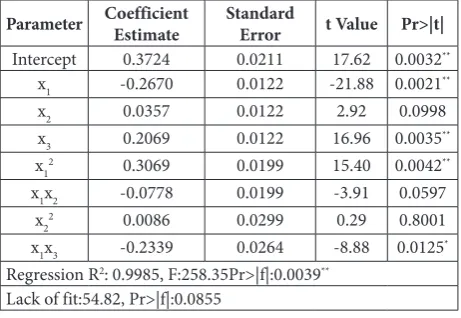
The results for the Box-Behnken three variable fractional factorial designs are shown in Table 1. A multiple regression analysis was performed with the experimental data and the results were incorporated into a 2nd order polynomial equation; the regression
model predictions of the whole plant biomasses are shown in Table 2, and the corresponding equation is:
y=0.372-0.266x1+0.035x2+0.206x3+0.306x12
+0.009x22-0.077x
1x2-0.234x1x3 (2),
where y represents the whole plant dry biomass and x1, x2 and x3 were ID, N and P, respectively. Model adequa-cy was checked using regression R2 and the F-test. The
R2 and F-value of the regression model were 0.9985
and 258.35, respectively, Pr>|f|:0.0039(≤0.01) (Table 2), with the lack of fit 54.82, Pr>|f|:0.0855(>0.05), sug-gesting that the regression model was a significant fit. In the corresponding equation, the P-values of the intercept, two linear coefficients (x1,x3) and the quad-ratic coefficients (x12, x
1x3) were significant, and items
containing x2, such as the quadratic coefficients x2x3 and x22, were not significant (Table 2). The predicted
values for the optimal concentration ratios of ID, N, and P were obtained using the above equation. The predictive optimal concentration ratios of ID, N, and P were 0.1 mL·L-1,12 mM, and 2.5 mM, respectively.
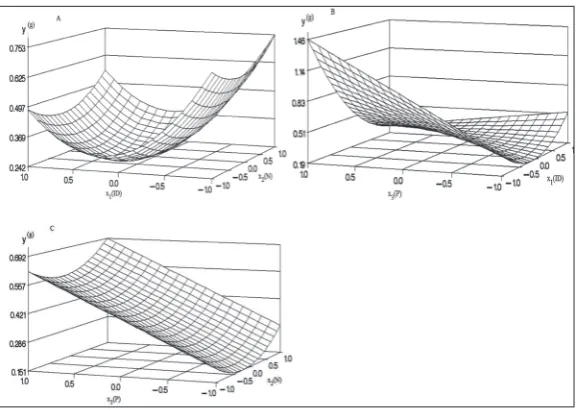
The effects of ID (x1), N (x2) and P (x3) on plant biomass (y) are shown in Fig. 1. The effect of x1(ID) and x2(N) on the dry biomass y of J. curcas when set-ting x3 =-0.5(p=1 mM ) are shown in Fig 1A. When x1≥0(ID≥0.6 mL·L-1), the increase in x
2(N) had little
effect on y. However, when x1<0(ID<0.6 mL·L-1), and
especially when it was less than -0.5(ID<0.35 mM),
x2(N) was significantly positively related to y and the lower the dosage of x1 (ID), the stronger the positive effect on x2 (N). This suggested that the low dosage of x1 (ID) and the high dosage of x2(N) promoted the growth of J. curcas. Similar results were found for x1(ID) and x3(P) (Fig. 1B); the lower dosage of x1(ID) had a stronger positive effect on x3(P). Fig. 1C points to the effect of x2(N) and x3(P) on the dry biomass of J. curcas plants when x1=0 (ID=0.6 mL·L-1). The increase
in x3(P) significantly linearly increased y, and x2(N) had a small effect on x3(P).
Table 1. Box-Behnken three-variable fractional factorial designs (N=5).
Ru
n
Bl
oc
k Natural variables Coded
variables Biomass
y(g) ID(mL·L-1) N(mM) P(mM) x
1 x2 x3
1 1 0.1 2 0.5 -1 -1 -1 0.4005
2 1 0.1 7 2.5 -1 0 1 1.4042
3 1 0.1 12 1.5 -1 1 0 1.0512
4 1 0.6 2 2.5 0 -1 1 0.5352
5 1 0.6 7 1.5 0 0 0 0.3764
6 1 0.6 12 0.5 0 1 -1 0.2268
7 1 1.1 2 1.5 1 -1 0 0.4802
8 1 1.1 7 0.5 1 0 -1 0.4222
9 1 1.1 12 2.5 1 1 1 0.3518
10 1 0.6 7 1.5 0 0 0 0.3684
Box-Behnken design 3**(3-1) fractional factorial designs, 1block, 9 runs+1 center point per block.
x1 – Indole-acyl esters (N) 0.1-1.1 mL·L-1; x2 – NH4NO3 (N) 2-12 mM;
x3 – KH2PO4 (P) 0.5-2.5 mM.
Factor levels were coded as 1 (low), 0 (central point) and 1 (high); y – the whole plant biomass (g).
Table 2. Regression model for the prediction of whole plant bio-mass.
Parameter Coefficient Estimate Standard Error t Value Pr>|t|
Intercept 0.3724 0.0211 17.62 0.0032**
x1 -0.2670 0.0122 -21.88 0.0021**
x2 0.0357 0.0122 2.92 0.0998
x3 0.2069 0.0122 16.96 0.0035**
x12 0.3069 0.0199 15.40 0.0042**
x1x2 -0.0778 0.0199 -3.91 0.0597
x22 0.0086 0.0299 0.29 0.8001
x1x3 -0.2339 0.0264 -8.88 0.0125*
Regression R2: 0.9985, F:258.35Pr>|f|:0.0039**
Lack of fit:54.82, Pr>|f|:0.0855
ANOVA *,** – correlation of significance values of P≤ 0.05 and 0.01, respectively;
J. curcas after 30 days of growth under Cd50-Pb500 stress
The fresh and dry biomass of the plants under different treatments are shown in Table 3. Compared with the CK2 treat-ment, the fresh and dry biomasses of the roots, stems and leaves from the CK1 treatment with the Cd50-Pb500 stress, were significantly lower (Table 3). The Cd50-Pb500 stress caused decreases in the root, stem and leaf dry (64.3, 37.5 and 50%, respectively) and fresh biomasses (67.1, 34.5 and 50.1%, respectively) in comparison with CK2. Compared with the stems and leaves, the fresh and dry biomasses of the roots showed a larger reduction, indicating that the highest phytotoxic effects were in the roots.
All four treatments had significant effects on the fresh and dry biomass of J. curcas in comparison to the CK1 treatment. The fresh and dry biomass of the whole plants increased significantly with N-P, N-ID, P-ID and N-P-ID treat-ments in comparison to CK1; the order of the four treatments based on their in-creases in dry biomass were as follows: N-P-ID>N-P>P-ID>N-ID (Table 3, Fig. 2). The N-P treatment recovered total plant fresh biomass to the normal levels in CK2, whereas ID improved the ef-fects of the N-P treatments (Table 3). ID combined with N-P enhanced the dry biomass to a normal level in the contaminated soils (Table 3).
The roots were more sensitive to Cd and Pb than the stems and leaves
Table 3. Biomass of J. curcas growing under different treatments after 30 days of growth (Cd50-Pb500 stress).
Parameters Tissue CK1 N-P N-ID P-ID N-P-ID CK2Treatment
Fresh biomass
Root (g) 0.54a 1.37c 0.69a 0.97b 2.06e 1.64d Stem (g) 5.52a 8.11cd 6.44b 7.44c 10.22e 8.40d Leaf (g) 1.77a 3.57b 1.92a 3.18b 4.80c 3.55b Whole plant (g) 7.80a 13.06cd 9.05b 11.60c 17.09e 13.59d
Dry biomass
Root (g) 0.10a 0.20c 0.13a 0.17b 0.32e 0.28d Stem (g) 0.54a 0.80c 0.68b 0.74bc 0.96d 0.88d Leaf (g) 0.29a 0.51cd 0.31a 0.48c 0.72e 0.58d Whole plant (g) 0.93a 1.51c 1.11a 1.37b 1.99e 1.74d
CK1 (only H2O), N-P (combination of NH4NO3 and KH2PO4), N-ID (combination of
NH4NO3 and indole-acyl esters), P-ID (combination of KH2PO4 and indole-acyl esters),
N-P-ID (combination of NH4NO3, KH2PO4, indole-acyl esters), CK2 (only H2O, no
contaminated soil).
Means with the same lowercase letters are not significantly different from each other in one row (LSD test, P≤0.05).
Fig. 1. The effect of x1 (ID), x2 (N), and x3 (P) on plant biomass (y). A – Effects of x1 (ID) and x2 (N) on plant biomass (y). B – Effects of x1 (ID) and x3 (P) on plant biomass (y). C – Effects of x2 (N) and x3 (P) on plant biomass (y). [x1 – indole-acyl esters (ID) 0.1-1.1 mL·L-1; x
2 – NH4NO3(N) 2-12 mM; x3
– KH2PO4(P) 0.5-2.5 mM]; the factor levels were coded as −1 (low), 0 (central point) and 1 (high); y indicates the whole plant biomass (g).
as they had direct contact with the soil. ID combined with the N-P treatments caused increases of 3.8- and 3.2-fold in the fresh and dry weights of the roots, com-pared to the CK1 treatment (Table 3). The fresh and dry weights of the roots from plants receiving the N-P-ID treatment were greater than the dry and fresh weights of the stems and leaves when compared to the CK1 treatment. Similar results were observed for the other treatments (Table 3). N-P-ID treatments stimu-lated lateral root production and increased the ability of J. curcas to grow in the contaminated soils (Fig. 2).
Concentrations of N and P in plants
The N and P concentrations in the different tissues with the different treatments are shown in Table 4; significant differences were observed between the dif-ferent treatments. The N concentration in the leaves decreased from 50.00 mg·g-1(CK2) to 31.77 mg·g -1(CK1) when exposed to the Cd and Pb stress; the
36.5% decrease in N concentrations in the leaves was
more than that found in the roots and stems. The con-centration of P in the stems under Pb and Cd stress in the CK1 treatment decreased by 43.3% in comparison to the CK2 treatment, and it was more than that found in the roots and leaves.
Compared to the CK2 treatment, the concentra-tion of N in the whole plant under Pb and Cd stress in the CK1 treatment decreased by 62.1%, and the concentration of P decreased by 64.9%. (Table 4). All four treatments significantly increased the concentra-tions of N and P in the whole plants exposed to Cd and Pb stress. Compared to the CK2 treatment, the concentration of N in the whole plant under Pb and Cd stress in the N-P-ID treatment decreased by 10.0%, whereas the concentration of P increased by 18.4% (Table 4). The concentrations of N and P in whole plants exposed to N-P and N-P-ID treatments were significantly higher than those exposed to N-ID and P-ID treatments. These results demonstrated that the simultaneous use of N and P fertilizers could improve
Table 4. N and P concentrations of Jatropha curcas growing under different treatments after 30 days of growth (Cd50-Pb500 stress).
Parameters Tissue CK1 N-P N-IDTreatmentP-ID N-P-ID CK2
N concentration
Root (mg·g-1) 20.93a 23.56b 22.33ab 20.62a 23.49b 25.72c
Stem (mg·g-1) 16.60a 18.38bc 17.70ab 17.42ab 18.42bc 19.40c
Leaf (mg·g-1) 31.77a 36.35c 34.00b 34.86b 40.33cd 50.00d
Whole plant (mg·plant-1) 18.79a 32.97c 25.30b 28.68bc 44.63d 49.58e
P concentration
Root (mg·g-1) 3.73a 5.42c 4.20b 4.22b 5.30c 4.44b
Stem (mg·g-1) 3.88a 6.74bc 6.24b 6.81c 6.83c 6.84c
Leaf (mg·g-1) 6.21a 8.78c 7.17b 7.10b 8.53c 8.30c
Whole plant (mg·plant-1) 4.25a 10.94d 6.94b 9.03c 14.33f 12.10e
CK1 (only H2O), N-P (combination of NH4NO3 and KH2PO4), N-ID (combination of NH4NO3 and indole-acyl esters), P-ID (combination
of KH2PO4 and Indole-acyl esters), N-P-ID (combination of NH4NO3, KH2PO4, indole-acyl esters), CK2 (only H2O, no contaminated soil).
Means with the same lowercase letters are not significantly different from each other in one row (LSD test, P≤0.05).
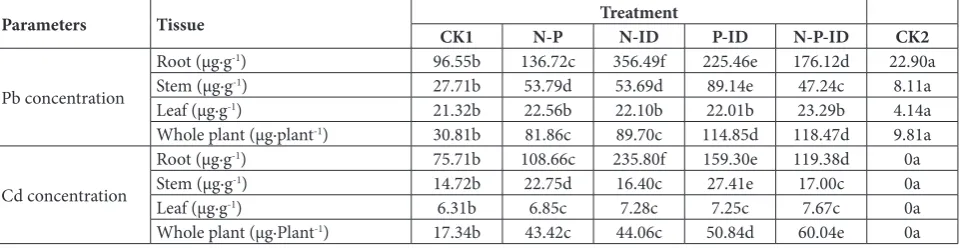
Table 5. Concentrations of Pb and Cd in J. curcas growing under different treatments after 30 days of growth (Cd50-Pb500 stress).
Parameters Tissue CK1 N-P TreatmentN-ID P-ID N-P-ID CK2
Pb concentration
Root (µg·g-1) 96.55b 136.72c 356.49f 225.46e 176.12d 22.90a
Stem (µg·g-1) 27.71b 53.79d 53.69d 89.14e 47.24c 8.11a
Leaf (µg·g-1) 21.32b 22.56b 22.10b 22.01b 23.29b 4.14a
Whole plant (µg·plant-1) 30.81b 81.86c 89.70c 114.85d 118.47d 9.81a
Cd concentration
Root (µg·g-1) 75.71b 108.66c 235.80f 159.30e 119.38d 0a
Stem (µg·g-1) 14.72b 22.75d 16.40c 27.41e 17.00c 0a
Leaf (µg·g-1) 6.31b 6.85c 7.28c 7.25c 7.67c 0a
Whole plant (µg·Plant-1) 17.34b 43.42c 44.06c 50.84d 60.04e 0a
CK1 (only H2O), N-P (combination of NH4NO3 and KH2PO4), N-ID (combination of NH4NO3 and indole-acyl esters), P-ID
(combina-tion of KH2PO4 and indole-acyl esters), N-P-ID (combination of NH4NO3, KH2PO4, Indole-acyl esters), CK2 (only H2O, no contaminated soil).
the uptake of N and P in Cd- and Pb-contaminated soils. The concentrations of N and P in whole plants exposed to N-P-ID treatment were significantly higher than those exposed to N-P treatment, demonstrating that ID improved the uptake of N and P.
Concentrations of Cd and Pb in plants
The concentrations of Cd and Pb in the roots, stems and leaves of plants under different treatments were significantly higher than those in CK2. The concen-trations of Cd and Pb in the roots were about 17-80- and 4-10-fold higher than those in the stems and leaves (except Cd in CK2), respectively (Table 5), meaning that the maximum phytotoxic effects were exerted on the roots (CK1 and CK2 in Table 3).The concentrations of Cd and Pb in different tissues were root>stem>leaf (Table 5). There were no significant differences between the concentrations of Cd and Pb in the leaves after N-P, N-ID, P-ID and N-P-ID treat-ments. In contrast, treatments N-ID, P-ID, N-P, and N-P-ID significantly increased the concentrations of Cd and Pb in the roots and stems as compared to the CK1 treatment. The largest increases in Cd and Pb concentrations in stems were recorded after the P-ID treatment, while the smallest were observed after the N-P-ID treatment (except for Cd under N-ID treat-ment) (Table 5). The concentrations of Cd and Pb in whole plants under different treatments were signifi-cantly higher than those after the CK2 treatment. The N-P-ID treatment resulted in the largest Pb and Cd concentrations in the whole plants (Table 5).
MDA concentrations and activity of
enzymatic antioxidants in J. curcas
The concentrations of MDA increased more than 2-fold when the plants were exposed to Cd50-Pb500 stress without any treatments (Ta-ble 6). The following treatments could be clas-sified into three groups according to the con-centration of MDA: (i) N-P-ID, (ii) N-P and P-ID, and (iii) N-ID. No significant difference was observed between group (ii) and group (iii). The N-P, N-ID, P-ID and N-P-ID treat-ments reduced MDA by 28.45, 14.40, 20.77 and 50.96%, respectively, when compared to the CK1 treatment. The N-P-ID treatment re-duced the concentration of MDA to the levels observed in the CK2 treatment (Table 6). MDA concentrations were negatively associated with enzymatic antioxidants such SOD, POD and CAT (Table 5). The activities of SO, POD and CAT increased significantly with P, ID, P-ID and N-P-ID treatments when compared to the CK1 treat-ment; the order of the four treatments based on their increased activities was: N-P-ID>N-P>P-ID>N-ID (Table 6). Compared to CK1, the N-P-ID, N-P, P-ID and N-ID treatments increased the activities of CAT by 92.42, 85.03, 48.00 and 14.43%, respectively; the activities of POD by 85.89, 50.27, 20.29 and 8.18%, respectively; and the activities of SOD by 83.03, 58.19, 34.49 and 16.33%, respectively.
DISCUSSION
In this study, a mixture of Cd and Pb in the soil (50 mg kg-1 soil and 500 mg kg-1, respectively) caused 34.3
and 67.1 % decreases in root, stem and leaf biomass when compared to the CK2 treatment. These findings are in agreement with the results of Li et al. [12] and Lianget al.[13]. High concentrations of Cd and Pb in the roots decreased their biomass, showing that it had stronger phytotoxic effects on the roots than on the stems in J. curcas, which is in accordance with previ-ous research [39-42].
Exogenous application of N [25], P [26] and low doses of IAA [27,28] or DA-6 [29,30] could mitigate Cd/Pb stress. The results of response surface
method-Table 6. Malondialdehyde (MDA) concentration and activities of superoxide dismutase (SOD), peroxidase (POD) and catalase (CAT) in J. curcas grow-ing under different treatments after 30 days of growth (Cd50-Pb500 stress).
Treatment (nmol·gMDA -1) (U·gSOD -1FW) (U·minPOD -1g-1FW) (U·minCAT -1g- FW)
CK1 49.92c 127.81b 425.05b 14.16b
N-P 35.71b 202.17e 638.71d 26.19e
N-ID 42.73bc 148.67c 459.83b 16.20c
P-ID 39.55b 171.88d 511.28c 20.95d
N-P-ID 24.48a 233.93f 790.12e 27.24e
CK2 22.54a 103.26a 377.90a 9.94a
ology analysis indicated that the order in which these three factors can improve the growth of J. curcas under Pb and Cd stress was: x1(ID)>x3(P)>>x2(N). The in-crease in ID concentration had a negative effect on the growth of J. curcas, especially when the concentration of ID was greater than 0.5 mL·L-1. The main
compo-nents of ID are IAA and DA-6, which can promote the growth of J. curcas at low concentrations and inhibit it at high concentrations. Bashri et al. (2015) confirmed that Cd alone and together with high concentrations of IAA can induce oxidative stress, while combina-tions of Cd and low doses of IAA can decrease it and attenuate Cd toxicity [28].The toxic effects of Pb and Cd on J. curcas can be increased with applications of high-concentration ID. Applications of low-concen-tration ID, N and P showed synergistic effects on J. curcas growth. The predicted optimal concentration ratios of ID, N and P were 0.1 mL·L-1, 12 mM and
2.5 mM, respectively. Combined treatments, such as N-P, N-ID, P-ID and N-P-ID, significantly mitigated Pb/Cd phytotoxicity, but the mitigation efficiencies significantly differed between the treatments.
Fresh and dry biomass from the N-P treatment significantly increased in comparison to the N-ID and P-ID treatments, showing that the simultaneous use of N and P fertilization was necessary to mitigate the Cd and Pb phytotoxicity on J. curcas. The optimum levels of both N and P can be used to improve seedling growth [43] due to the different roles N and P have in a plant’s energy metabolism, involving enzymes asso-ciated with ROS metabolism, such as CAT, SOD and POD [44]. In the present study, the N-P treatment produced much higher activity of SOD, POD and CAT when compared with single N or P treatments, even when these were combined with ID.
Only the N-P-ID treatment caused significant in-creases in both fresh and dry biomass compared to the CK2 treatment (the normal level), suggesting that ID improved the mitigating effects of the N and P ferti-lizers on Cd and Pb phytotoxicity. IAA can stimulate lateral root production with higher root dry biomass [27,45]. Compared to the N-P treatment, the N-P-ID-treated plants retained more Pb and Cd in their roots, as ID decreased the translocation of the metal to the leaves [30,46]. The higher activities of SOD and POD enzymes in the plants exposed to the N-P-ID treatment can be explained by the fact that ID is capable of
upreg-ulating their activity [47] and the ascorbate-glutathione cycle [48], alleviating oxidative stress [49,50].
Our results showed that the concentrations of N and P in the roots, stems, leaves and whole plants after the CK1 treatment were decreased as compared to the CK2 treatment. Cd and Pb can disturb the up-take and distribution of N and P, which agrees with the results of Ramon et al. [51], Kibria et al. [52] and Farouk et al. [53]. The N-P-ID and N-P treatments under Cd50-Pb500 stress can elevate N and P when compared with the CK1 treatment. A significant dif-ference was observed between the N-P and N-P-ID treatments, suggesting that ID could improve the up-take and translocation of N and P [54, 55].
J. curcas could accumulate Cd and Pb from con-taminated soils [8-11]. Phosphate [56,57], IAA and DA-6 increase the concentrations of metal in the roots and stems [27,30]. In the present study, the concentra-tions of Cd and Pb were significantly increased in the roots, stems and whole plants after the N-ID, P-ID, N-P and N-P-ID treatments when compared with the CK1 treatment. Plants after the N-P-ID treatment had higher Pb and Cd concentrations in the roots and whole plant when compared with the N-P treatment, which indicates that ID improved the phytoremedia-tion ability. ID can affect Pb and Cd concentraphytoremedia-tions in plants by depositing more metal in the cell walls [27], increasing Pb and Cd concentrations in the roots [46], increasing the root surface areas [30], promoting a higher transpiration rate, and by regulating the levels of nutrient elements [58]. Phosphate can increase Cd and Pb concentrations in plants by forming insoluble Cd/Pb phosphate complexes [56,57]. However, in this study, the applications of N and P were important for mitigating Cd and Pb toxicity in J. curcas by increasing the biomass and the activities of enzymatic antioxi-dants, which in turn can increase metal uptake and protect plants from oxidative stress. ID can improve the effect of the N-P treatments by enhancing the mitigation of toxic effects and concentrations of cad-mium and lead in J. curcas from contaminated soils.
CONCLUSIONS
in-creasing root biomass, inin-creasing the concentration of N and P, increasing the concentration of Cd and Pb in the roots, and by promoting the activities of SOD and POD in the plants. The Box-Behnken three-vari-able partial factorial design with the response surface methodology modeling technique was verified as a reliable methodology that can be used to study the effects and interactions of multiple factors on plants.
Funding: The work was financially supported by the National
12th Five-Year Science and Technology Support Project (No.
2011BAD22B08) of the Ministry of Science and Technology of China.
Author contributions: Z. Fang and F. Chen conceived and
de-signed the study; Z. Fang performed the experiments; Z. Fang, H. Wan, Y. Xu, Q. Liu, J. Liang and X. Shi analyzed the data; Z. Fang and H. Wan wrote the paper. All authors read and approved the final manuscript.
Conflict of interest disclosure: The authors declare that no con-flicts of interest exist.
REFERENCES
1. Wong JWC, Selvam A. Speciation of heavy metals during co-composting of sewage sludge with lime. Chemosphere. 2006,63:980-6.
2. Tchounwou PB, Yedjou CG, Pallolla AK, Sutton DJ. Heavy metal toxicity and the environment. Exp Suppl. 2012;101:133-64.
3. Bhargava A, Carmona FF, Bhargava M, Srivastava S. Approaches for enhanced phytoextraction of heavy metals. J Environ Manage. 2012;105:103-20.
4. Mahawar L, Kumar R, Shekhawat GS. Evaluation of heme oxy-genase 1 (HO1) in Cd and Ni induced cytotoxicity and cross-talk with ROS quenching enzymes in two to four leaf stage seedlings of Vigna radiata. Protoplasma. 2018;255:527-45. 5. Foidl N, Foidl G, Sanchez M, Mittelbach M, Hackel S.
Jat-ropha curcas L. as a source for the production of biofuel in Nicaragua. Bioresource Technol. 1996;58(1):77-82.
6. Divakara BN, Upadhyaya HD, Wani SP, Gowda CLL. Biol-ogy and genetic improvement of Jatropha curcas L.: A review. Appl Enegr. 2010;87(3):732-42.
7. Prasad MNV. Jatropha curcas L. cultivation on constrained land: exploring the potential for economic growth and envi-ronmental protection. In: Warra AA, Prasad MNV, editors. Bioremediation and Bioeconomy. Elsevier; 2016. p. 129-47. 8. Pandey VC, Bajpai O, Singh N. Energy crops in sustainable
phytoremediation. Renew Sust Enegr Rev. 2016;54:58-73. 9. Mangkoedihardjo S. Jatropha curcas L. for
phytoremedia-tion of lead and cadmium polluted soil. World Appl Sci J. 2008;4(4):519-22.
10. Yadav SK, Juwarkar AA, Kumar GP, Thawale PR, Singh SK, Chakrabarti T. Bioaccumulation and phyto-transloca-tion of arsenic, chromium and zinc by Jatropha curcas L.:
impact of dairy sludge and bio-fertilizer. Bioresour Technol. 2009;100(20):4616-22.
11. Jamil S, Abhilash PC, Singh N, Sharma PN. Jatropha curcas: a potential crop for phytoremediation of coal fly ash. J Hazard Mater . 2009;172(1):269-75.
12. Li MS, Luo YP, Su ZY. Heavy metal concentrations in soils and plant accumulation in a restored manganese mine land in Guangxi, South China. Environ Pollut. 2007;147(1):168-75. 13. Liang J, Yang Z, Tang L, Xu Y, Wang S, Chen F. Growth per-formance and tolerance responses of Jatropha (Jatropha cur-cas) seedling subjected to isolated or combined cadmium and lead stresses. Int J Agric Biol. 2012;14(6):861-9.
14. Fu J, Huang B. Involvement of antioxidants and lipid peroxi-dation in the adaptation of two cool-season grasses to local-ized drought stress. Environ Exp Bot. 2001;45:105-14 15. Cho UH, Seo NH. Oxidative stress in Arabidopsis thaliana
exposed to cadmium is due to hydrogen peroxide accumula-tion. Plant Sci. 2005;168:113-20.
16. Zhang SS, Zhang HM, Qin R, Jjiang WS, Liu DH. Cadmium induction of lipid peroxidation and effects on root tip cells and antioxidant enzyme activities in Vicia faba L.[J]. Ecotoxi-col. 2009;18(7):814-23.
17. Metwally A, Safronova VI, Belimov AA, Dietz KJ. Genotypic variation of the response to cadmium toxicity in Pisum sati-vum L. J Exp Bot. 2005;56:167-78
18. Pandey V, Dixit V, Shyam R. Antioxidative responses in rela-tion to growth of mustard (Brassica juncea cv. Pusa Jai Kisan) plants exposed to hexavalent chromium. Chemosphere. 2005;61:40-7.
19. Shaw BP. Effects of mercury and cadmium on the activities of antioxidative enzymes in the seedlings of Phaseolus aureus. Biol Plant.1995;37(4):587-96.
20. Sandalio L, Dalurzo H, Gomez M, Romero-Puertas M, del Rio LA. Cadmium-induced changes in the growth and oxida-tive metabolism of pea plants. J Exp Bot. 2001;52:2115-26. 21. Wu FB, Zhang GP, Dominy P. Four barley genotypes respond
differently to cadmium: lipid peroxidation and activities of antioxidant capacity. Environ Exp Bot. 2003;50:67-78. 22. Sharma SS, Kaul S, Metwally A, Goyal KC, Finkemeier I, Dietz
KJ. Cadmium toxicity to barley (Hordeum vulgare) as affected by varying Fe nutritional status. Plant Sci. 2004;166:1287-95. 23. Mohamed Bah A, Dai H, Zhao J, Sun H, Cao F, Zhang G, Wu F. Effects of cadmium, chromium and lead on growth, metal uptake and antioxidative capacity in Typha angustifolia. Biol Trace Elem Res. 2011;142:77-92.
24. Panković D, Plesničar M, Arsenijević-Maksimović I, Petrović N, Sakač Z, Kastori R. Effects of nitrogen nutrition on photosynthesis in Cd-treated sunflower plants. Ann Bot. 2000;86(4):841-7.
25. Zhang F, Wan X, Zhong Y. Nitrogen as an important detoxi-fication factor to cadmium stress in poplar plants. J Plant Interact. 2014;9(1):249-58.
26. Du J, Yan C, Li Z. Phosphorus and cadmium interactions in Kandelia obovata (S. L.) in relation to cadmium tolerance. Environ Sci Pollut R. 2014;21(1):355-65.
28. Bashri G, Prasad SM. Indole acetic acid modulates changes in growth, chlorophyll a fluorescence and antioxidant poten-tial of Trigonella foenum-graecum L. grown under cadmium stress. Acta Physiol Plant. 2015;37(3):37-49.
29. He S, Wu Q, He Z. Effect of DA-6 and EDTA alone or in combination on uptake, subcellular distribution and chemical form of Pb in Lolium perenne. Chemosphere. 2013;93(11):2782-8.
30. He S, Wu Q, He Z.Growth-promoting hormone DA-6 assists phytoextraction and detoxification of Cd by Rye grass. Int J Phytoremediat. 2015;17(6):597-603.
31. Bakku RK, Terli R, Somalanka SR, Palukurty MA. Optimi-zation of borassus flabellifer amylase extraction procedure using Box-Behnken design and development of simple affin-ity chromatographic technique for purification of amylases. Brit Biotechnol J. 2012;2(3):146-56.
32. Li HJ. Comparative Study on Determination of Phospho-rus Content in Two Kinds of Plants. Mod Agr Sci Technol. 2012;11:16-17
33. McDonald M. A simple and improved method for the deter-mination of microgram quantities of nitrogen in plant mate-rial. Ann Bot. 1978;42(2):363-6.
34. Zhang H, Tang J. Determination of Fe, Mn, Cu, Pb, and Cd in Vegetables by Atomic Absorption Spectrometry[J]. Chin J Spectrosc Lab. 2011;28(1):72-4
35. Li HS. The principle and measuring technique of plant physi-ology and chemistry. Beijing: Beijing Higher Education Press; 2000. 260-1 p.
36. Beauchamp C, Fridovich I. Superoxide dismutase: improved assays and an assay applicable to acrylamide gels. Anal Bio-chem. 1971;44(1):276-87.
37. Lagrimini LM. Wound-induced deposition of polyphenols in transgenic plants overexpressing peroxidase. Plant Physiol. 1991;96(2):577-83.
38. Aebi H. Catalase in vitro. Method Enzymol. 1984;105:121-6. 39. Michálková Z, Martínez-Fernández D, Komárek M. Inter-actions of two novel stabilizing amendments with sun-flower plants grown in a contaminated soil. Chemosphere. 2017;186:374-80.
40. Fargašová A. Phytotoxic effects of Cd, Zn, Pb, Cu and Fe on
Sinapis alba L. seedlings and their accumulation in roots and shoots. Biol Plantarum. 2001;44(3):471-3.
41. Verma S, Dubey R. Effect of cadmium on soluble sugars and enzymes of their metabolism in rice. Biol Plantarum. 2001;44(1):117-23.
42. Verma S, Dubey R. Lead toxicity induced lipid per-oxidation and alters the activities of antioxidant enzymes in growing rice plants. Plant Sci. 2003;164:645-55.
43. Razaq M, Zhang P, Shen H, Salahuddin. Influence of nitrogen and phosphorous on the growth and root morphology of Acer mono. Plos ONE. 2017;12(2):e0171321.
44. de Groot CC, Marcelis LFM, van den Boogaard R, Kai-ser WM, Lambers H. Interaction of nitrogen and phos-phorus nutrition in determining growth. Plant and Soil. 2003;248:257-68.
45. Lippmann B, Leinhos V, Bergmann H. Influence of auxin producing rhizobacteria on root morphology and nutrient accumulation of crops, Pt. 1: Changes in root morphology and nutrient accumulation in maize (Zea mays L.) caused by inoculation with indole-3-acetic acid (IAA) producing Pseudomonas and Acinetobacter strains or IAA applied exog-enously. J Appl Bot. 1995;69:31-6.
46. Wang HH, Shan XQ, Wen B, Owens G, Fang J, Zhang SZ. Effect of indole-3-acetic acid on lead accumulation in maize (Zea mays L.) seedlings and the relevant antioxidant response. Environ Exp Bot. 2007;61(3):246-53.
47. Tyburski J, Dunajska K, Mazurek P, Piotrowska B, Tretyn A. Exogenous auxin regulates H2O2 metabolism in roots of tomato (Lycopersicon esculentum Mill.) seedlings affecting the expression and activity of CuZn-superoxide dismutase, catalase, and peroxidase. Acta Physiol Plant. 2009;31:249-60. 48. Bashri G, Prasad SM. Exogenous IAA differentially affects
growth, oxidative stress and antioxidants system in Cd stressed Trigonella foenum-graecum L. seedlings: Toxicity alleviation by up-regulation of ascorbate-glutathione cycle. Ecotoxicol Environ Saf. 2016;132:329-38.
49. Lee DH, Lee CB. Chilling stress-induced changes of antioxi-dant enzymes in the leaves of cucumber: in gel enzyme activ-ity assays. Plant Sci. 2000;159(1):75-85.
50. Scandalios JG. Oxygen stress and superoxide dismutases. Plant Physiol. 1993;101(1):7-12.
51. Ramón OC, Saúl V, Esteban E, Mercedes FP, Mara RF, Zor-noza P. Cadmium-stress in white lupine: effect on nodule structure and function. Plant Physiol, 2003;161:911-9. 52. Kibria MG , Islam M, Osman KT . Effects of lead on growth
and mineral nutrition of Amaranthus gangeticus L. and Ama-ranthus oleracea L. Soil Environ. 2009;28(1):1-6.
53. Farouk S, Mosa AA, Taha AA, El-Gahmery AM. Protec-tive effect of humic acid and chitosan on radish (Raphanus sativus, L. var. sativus) plants subjected to cadmium stress. J Stress Physiol Biochem. 2011; 7(2):99-116.
54. Hussain K, Hussain M, Majeed A , Nawaz K, Nisar MF, Afghan S. Morphochemical Response of Chaksu (Cassia absus L.) to Different Concentrations of Indole Acetic Acid (IAA)[J]. Pakistan J Bot. 2010;7(3):1491-3.
55. Darra BL , Saxena SN. Role of IAA on the mineral composi-tion of maize (Zea mays) crop under various osmotic stressed conditions[J]. Plant Soil. 1973;38(3):657-61.
56. Scheckel KG, Ryan JA, Allen D, Lescano NV. Determining speciation of Pb in phosphate-amended soils: method limita-tions. Sci Total Environ. 2005;350(1):261-72.
57. Qiu Q, Wang Y, Yang Z, Yuan J. Effects of phosphorus sup-plied in soil on subcellular distribution and chemical forms of cadmium in two Chinese flowering cabbage (Brassica Pda-rachinensis L.) cultivars differing in cadmium accumulation. Food Chem Toxicol. 2011;49(9):2260-7.