
Journal of Electrical Engineering,
Electronics, Control and Computer Science –
JEEECCS, Volume 4, Issue 14, pages 7-16, 2018
Techniques and Equipment for Detection of
Prohibited Substances
A Brief Overview
Cristian Monea
Research & Development Department Mira Technologies Group
Otopeni, Romania [email protected]
Abstract – Security threats are increasing every year and
the demand for better detection techniques is higher. As a result, many techniques for detection of prohibited substances have been developed over the time. This paper presents a brief overview of existing commercial and laboratory techniques for detection of prohibited substances, such as explosives, drugs and toxic substances. Trace and bulk detection techniques are investigated by detailing the working principle, giving examples of equipment and performing a comparative analysis based on advantages and disadvantages of each technique.
Keywords-review; technique; equipment; screening; luggage; person; explosive; drug; toxic; bulk; trace; NQR
I. INTRODUCTION
The detection of prohibited substances has an important role in the field of security as one can see from the diversity of techniques and equipment developed for identification of explosives, drugs and toxic substances hidden in luggage or clothes. The detection of explosives has a higher priority among these techniques, because of the damage and harm these substances can cause by accident or when used for malicious purposes. Many techniques for explosives detection have been developed over time, which can also be used for identification of other prohibited substances. These vary from trace detection techniques, like ion mobility spectroscopy, chemiluminescence, color tests or mass spectrometry, to bulk detection techniques, like imaging techniques (X-rays, millimeter waves, computer tomography or terahertz waves) and nuclear techniques (thermal/fast neutron analysis, nuclear magnetic resonance or nuclear quadrupole resonance). As a result, the signal processing and analysis methods involved are diverse, according with the associated detection technique. These include statistical algorithms for signal detection and estimation, spectral domain processing, adaptive filtering, image processing algorithms or advanced analysis and pattern recognition techniques based on machine learning.
The challenges of this research field are related to the physical principles utilized and the requirements imposed by the operational environment of these equipment. E.g., the use of X-rays offers the advantages of visualizing the contents of a package
and non-invasive detection, but has the disadvantages of difficult separation of objects in the image, especially if they interact weakly with X-rays, and of using ionizing radiation. Generally, the goals of prohibited substances detection techniques are to provide identification in the least time possible, with minimum false alarm or incorrect detection rates, with maximum specificity and sensitivity, at the same time maintaining a low equipment cost. Therefore, a variety of techniques and equipment have been developed to reach these goals.
This paper proposes a brief overview of the techniques and equipment used for detection of prohibited substances (explosives, drugs and toxic substances). Several commercial and laboratory solutions are investigated, like vapor trace detection, imaging, nuclear and neutron-based techniques. The working principles are described and a comparative analysis is performed based on advantages and disadvantages of each technique.
II. TECHNIQUES FOR DETECTION OF PROHIBITED SUBSTANCES
The detection of explosive substances has a higher priority in the field of security because of the damage and harm these can cause if used inadequately or maliciously. Therefore, the overview focuses on describing the techniques used for explosives detection, mentioning the applicability in identification of other prohibited substances, where appropriate. The techniques used for explosives detection are classified based on their target in bulk and trace detection techniques.
identifying the chemical composition or dielectric properties of the explosive material.
Trace techniques aim to identify the presence of an explosive compound based on the vapors released by it or by the particles deposited on close surfaces [2]. The general approach involves searching for a compound in a library of targets, instead of a physical
property of the material. Compared to bulk detection, these techniques offer the advantage of lower false alarm probability, but do not provide information regarding the substance’s location and are limited to the substances present in the library. Figure 1. illustrates the existing techniques used for detection of explosive substances.
Figure 1. Explosive detection techniques
With red outline are marked the techniques that can be used for luggage and personnel screening from a sufficient distance to eliminate the risk of equipment damage or operator harm in case of an explosion (standoff detection). With green outline are marked the techniques utilized for remote detection, that are based on sensors which can easily be replaced in case of damage and that transmit the detection result to a safe, remote location. Also, with purple outline are represented the techniques or research directions that can significantly improve the detection of explosives.
The following describes the working principles of the principal detection techniques of prohibited substances and presents a comparative analysis in terms of advantages and disadvantages. Also, examples of commercial and laboratory equipment are given.
III. TRACE DETECTION TECHNIQUES Trace techniques detect the presence of an explosive based on the vapors released by it or by the particles deposited on close surfaces, and include chemical, optical and biological sensors.
A. Ion Mobility Spectroscopy
One of the most used trace detection techniques is ion mobility spectroscopy (IMS), that measures the speed, in an electric field, at which ionized vapors of the sample move toward the detector [4].
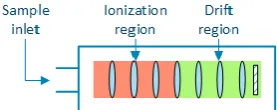
The working principle consists in collecting the particles by drawing in the air around the target or by swiping it with another surface. As presented in Figure 2. , the sample is inserted in the detector’s ionization region, where the electrons interact with the substance’s molecules, creating negative ions which
move in the drift region. The drift time depends on the ions’ electric charge, mass and size, and is in the order of milliseconds. The substance can be precisely identified by measuring this time.
Figure 2. Ionization and drift regions of an IMS detector. Adapted from [3].
IMS can be used in ambient conditions. The detectors can have many forms: hand-held, benchtop and portal systems. The hand-held types offer the advantage of portability, while the other types are used for scanning larger volumes, including persons. Detection is performed in a few seconds, for quantities down to picograms, and detector recycling is done in minutes [2]. They are not difficult to operate and the operator training requires a few hours. The costs are relatively moderate, depending on the type of detector.
chromatography (GC) for separating the molecules before being analyzed by using IMS.
Figure 3. illustrates IMS detectors produced by GE Security.
Figure 3. IMS detectors developed by GE Security [3]
In the top left is the hand-held detector VaporTracer, in the right is the EntryScan portal and in the bottom left is the benchtop detector Itemiser. E.g., VaporTracer can identify military and commercial explosives (TNT, RDX, PETN, nitroglycerine, ammonium nitrate, TATP, HMX, tetryl, C-4, Detasheet and Semtex-H) and narcotics (cocaine, heroin, THC, methamphetamine, EDME, amphetamine, MDMA, MDA, PCP, LSD, MAM and morphine).
B. Chemiluminescence
Chemiluminescence represents the generation of electromagnetic radiation (ultraviolet, visible or infrared) during a chemical reaction [4]. The majority of explosive substances contain nitrogen in the form of NO2 and NO3 groups. As a result, the most used
reaction for producing chemiluminescence for explosives detection implies the emission of infrared radiation by excited nitrogen compounds. The quantity of emitted radiation is proportional with the quantity of NO groups contained in the sample, thus indicating the quantity of explosive.
Similar to IMS detectors, these collect particles by drawing in the air around the target or by swiping it with another surface. Their form can be hand-held or portable. Personnel training requires a few hours. Their advantages are portability and the fact that they do not require ionization using radioactive sources. The costs are relatively moderate, depending on the detector type.
Their major disadvantage is that they cannot detect explosives that do not contain NO groups. Since they indicate if the NO group is present, which also exists in fertilizers, perfumes and other common substances, there is the need to complement the detection with gas chromatography. Also, the scan rate is low, usually 2-3 samples per minute.
Figure 4. shows the chemiluminescence detector E3500, produced by Scintrex Trace Corporation. The scan time is 16 seconds, the sensitivity is in the order of nanograms and the list of detected substances
contains commercial, military and homemade explosives: PETN, RDX, TNT, dynamite, Semtex, C-4, black powder, ammonium nitrate, urea nitrate, nitroglycerin, EGDN, DMNB, TATP, peroxides, chlorates and others.
Figure 4. Trace detector E3500 produced by Scintrex Trace Corporation [5]
C. Thermo-Redox
Thermo-redox is an electrochemical technique based on thermal decomposition of explosive substances’ molecules and reduction of NO2 groups.
The working principle implies passing the sample through a concentrator tube which selectively captures the explosive materials. Then, the sample is quickly heated in order to release NO2 molecules which are
detected afterwards.
The advantages of these detectors are the fact that they do not require a special carrier gas, using instead ambient air, and that they are portable. The disadvantage of this technique is that it cannot indicate the type of explosive. Also, detection is limited to substances that contain NO2 groups. Sensitivity is low
and harmless substances containing these groups often cause false alarms [3].
E.g., EVD-3000+, produced by Scintrex Trace Corporation, can self-calibrate and allows detection in 10 seconds of the following substances: C-4, PETN, RDX, nitroglycerin and others.
D. Surface Acoustic Wave
Surface acoustic wave detectors (SAW) measure the frequency differences that appear when explosive materials are deposited on the surface of the crystal. Often, SAW detectors are used in combination with gas chromatography.
Similar to IMS, the vapors that leave the chromatograph are selectively captured on the SAW detector’s surface. The frequency deviation is correlated with the explosive material’s concentration. This shift depends on the properties of the material (mass, elastic constant) and crystal (temperature, surface chemical nature).
The disadvantage of this technique is non-specificity of detection, because it is also sensitive to non-explosive substances. Their operation requires a carrier gas container [3].
An example of SAW detector is zNose Model 4200, produced by Electronic Sensor Technology. It uses helium as a carrier gas and can detect in maximum 60 seconds, with 30 seconds minimum recycling time.
E. Chemical Reagent
Explosives detection based on chemical reagents implies observing the color change of the sample after applying some reagents (color change tests). These are added in series by the operator, which observes the color change after each addition. The reagents can be liquid or aerosol and are available as a kit, as shown in Figure 5.
Figure 5. Expray reagent kit and application [11]
The working principle implies swiping the target’s surface with a special test paper. Then the operator applies the first reagent. If no color change is observed, then it applies the next reagent and so on. Based on the color change, he can identify the explosive group of the substance.
The advantages of this technique are the low cost and ease of use. The disadvantages are given by the fact that it depends on the operator’s capability to interpret colors and that the order in which the reagents are applied is critical.
E.g., the chemical reagent kit Expray, produced by Mistral Security, contains aerosol that allow identification of ammonium nitrate, urea nitrate, peroxides and others.
F. Mass Spectrometry
Mass spectrometry (MS) separates and analyzes substances based on the mass of the atoms and molecules it is composed of. The principle of mass analysis is based on the fact that the time and space parameters of the path an electrically charged particle takes inside a force field, in vacuum, are dependent on its charge-to-mass ratio. Thus, the molecules are first ionized and the ions are separated based on the time they require to pass through the field (time-of-flight MS) or the geometric position at the collecting spot (geometric separation MS) [4].
Mass spectrometry allows unique identification of substances, including complex combinations, when it
is complemented by a gas chromatograph [2]. This increases the specificity of detection based on retention times, which are specific to different molecules.
The advantage of these detectors is that they offer high specificity. They are used mainly in laboratory. Also, they exist in portable forms. The disadvantages are the high cost, requirement of trained personnel, long initialization time and low scan rate. Also, they require a gas source or vacuum pump.
E.g., the mass spectrometer 4500 MiD, developed by Microsaic Systems, can measure ions with charge-to-mass ratio up to 1400.
G. Ultraviolet Fluorescence
Another explosive trace detection technique is ultraviolet (UV) fluorescence. The working principle implies illuminating the target material with UV radiation and measuring its fluorescence. The particles absorb the radiation and decompose into fluorescent fragments [2]. The disadvantages of this technique are the low sensitivity and the fact that fluorescence can be reduced by ambient contaminants. According to [2], an UV fluorescence portable trace detector for explosives, named Personnel Security Screening System (PS3), was researched and developed by the company CDEX.
H. Biological Methods
Probably the most utilized detection method of prohibited substances is the use of dogs, considered to be one of the most sensitive detection instruments [1]. The olfactory sense of dogs is very developed. In this sense, detection limits of 500 ppt for DMNB and 10 ppb for nitroglycerin have been reported [1]. Usually, dogs focus on one of the following: the explosive, a contaminant or substance composing the explosive, or a product resulting from decomposition of the explosive. The advantages of using dogs are high mobility, the ability to identify the trace source, high sensitivity and specificity. The disadvantage of dogs is that they have behavior variations which are hard to predict and make it harder to work with them [12, 13].
I. Electron Capture Detector
This represents an equipment that allows measuring atoms and molecules in a gas by the attachment of electrons via electron capture ionization. It records the current changes due to the electron absorption by some groups, like NO2 (present in most
explosives).
The advantages of this detector are the high sensitivity and selectivity, reaching a detection limit of less than 1 picogram. Its disadvantages are the fact that it is usable only for a few substances and contains a radioactive detector.
J. Infrared Absorption Spectroscopy
This technique is based on the fact that molecular vibrations have characteristic frequencies in the infrared (IR) spectrum. Light absorption by molecules at resonance is observed when the molecule dipole moment changes. The usage of this technique for explosive identification is limited, because the infrared spectrum of large molecules can give components with broad spectral widths, leading to a hard to interpret spectrum. Also, the majority of explosives decompose at the high temperatures used to reach the vapor pressure required for detection.
E.g., the IR absorption spectroscopy detector, Target-ID, produced by Smiths Detection, can identify up to 2500 narcotics and other prohibited substances in the form of powders, liquids, gels, pastes and solids. The maximum detection time is 60 seconds.
K. Opto-Acoustic Spectroscopy
This laboratory technique is based on the fact that the optical energy absorbed by the molecules is partially transformed into thermal energy by relaxation processes. By using radiation pulses to excite the sample, pressure pulses are produced which are detected by sensitive microphones. The result is an opto-acoustic spectrum [21].
L. Raman Spectroscopy
This technique is based on Raman scattering by molecules and atoms, of the light emitted by a visible, near infrared or ultraviolet laser. The light interacts with the molecular vibrations and a lower energy quantum of light is emitted. However, the Raman effect has very low intensity.
The Raman spectroscopy detector ACE-ID, produced by Smiths Detection, offers the possibility to measure approximately 500 substances, including explosives, drugs, toxic substances, in a maximum time of 20 seconds.
M. Electronic Nose
This represents a combination of several sensors and integrates pattern recognition algorithms, forming an artificial olfactory system. These types of equipment integrate less-sensitive sensors and are mostly based on the algorithms to identify the sample [23]. The sensors used are usually: fluorescent polymers, optical fiber, piezoelectric materials, MEMS [24] and others.
IV. BULK DETECTION TECHNIQUES
Bulk detection techniques aim to detect a macroscopic mass of substance which shows some properties that identifies it as prohibited. They are separated in two categories: imagining techniques, used to visualize the prohibited substances, and nuclear techniques, that aim to identify the substances based on atomic nuclei interaction with different forms of radiation.
A. Imaging Techniques 1) Single-Energy X-Ray
X-ray techniques are among the first utilized for detection of prohibited substances inside luggage or containers. Basically, they do not detect the substances directly, instead they identify the materials with properties similar to them (atomic number, density).
The working principle is to use a radiation source which illuminates the target (person, luggage, container) and a detector. If the latter is placed in the opposite direction of the source, the it measures the rays transmitter through the target (transmission X-ray). If it is placed in the same location as the source, then it measures the X-rays reflected by the target (backscatter X-ray).
Single-energy X-ray techniques use one source of radiation and the image usually shows the absorption degree of X-rays. Their advantages, applicable to all X-ray equipment, are the possibility to discriminate the materials based on their shape, detection of metals and other materials with high atomic number, and relatively low cost. The disadvantages are that they do not provide sufficient information to detect explosives, they use an ionizing source and sometimes it is difficult to separate the objects in the image, especially when they interact weakly with the X-rays.
E.g., the HI-SCAN 6040C luggage and package scanner (shown in Figure 6. ), produced by Smiths Detection, is a single-energy equipment that uses a 160-kV generator.
Figure 6. HI-SCAN 6040C X-ray scanner [22]
2) Dual-Energy X-Ray
with low atomic number, are colored differently than inorganic objects, with high atomic number.
The limitation of dual-energy equipment is the fact that they cannot measure material thickness, thus being unable to precisely determine their atomic number. This limitation is reduced by making multi-axis scans, which offer two or three target images separated by 90 degrees. Thus, by using this additional information, the system can better estimate the atomic number.
An example of a dual-energy scanner is HI-SCAN 7555si, manufactured by Smiths Detection. It can penetrate 37 mm steel and can visualize 0.07 thick wires.
3) Computed Tomography
This is an X-ray technique that produces bidimensional images representing target sections, at different angles, which are then combined to form a tridimensional image. A method for obtaining the final image is by visualizing successive sections of the object. The source and detector are rotated around the target. The X-rays penetrate the object and are detected on the opposite side, thus obtaining the image at a specific angle. Afterwards, they are rotated and the process continues until usually 180 projections (images) are obtained at one-degree intervals. Another method to obtain the final image is to scan only the suspect area inside a luggage.
The advantages offered by computed tomography (CT) equipment are increased resolution and easier identification of hidden objects. The absorption coefficients can be measured directly on the target material, even if it is hidden by surrounding objects. Also, they allow detection of explosive materials and discrimination from other low atomic number materials, because of precise density measurement. Their disadvantages are increased cost and complexity. In addition, they generate more radiation at each scan and the scan rate is low.
E.g., HI-SCAN 6040 CTiX CT scanner, produced by Smiths Detection, allows scanning of hand luggage, including electronic devices, with a high conveyer belt speed of 0.2 m/s.
4) Low-Dose X-Ray
This technique is used for personnel screening in order to detect objects or substances hidden underneath clothing. The radiation dose received by the scanned person is low, comparable to the naturally occurring background environmental radioactivity. Scanning is a two-step process, because these systems can only scan on side of the person at a time. This equipment offers the advantages of avoiding direct contact during screening and displaying the shape, size and location of hidden objects, as illustrated in Figure 7.
Their disadvantage is the invasion of privacy of the screened person.
Rapiscan 1000, produced by Rapiscan Systems, is a low-dose X-ray person scanner, with a total scan time of 14 seconds, and a radiation dose lower than 0.1 µSv.
Figure 7. Low-dose X-ray scan results [3]
5) Fluoroscopy
Fluoroscopy is a low-energy X-ray imaging technique that measures the radiation transmitted through an object. A static or dynamic image of the target is viewed on a fluorescent monitor. This equipment is usually portable, and used for scanning mail and small packages for explosives. The advantages are given by portability, ease of use and the possibility to dynamically visualize the target. The disadvantages are reduced viewing area and low penetration depth.
E.g., MAILGUARD is a fluoroscopy scanner, manufactured by Control Screening. It uses a 90-kV source and allows scanning over 400 items per hour.
6) Dielectrometry
This is an imaging technique that uses low-energy microwaves to illuminate the target, measuring its dielectric properties and attenuation. These properties affect the phase and amplitude of the measured signal and are dependent on the target’s physical, chemical and structural properties. E.g., the human body has a unique dielectric response, different from that of explosives materials. This type of system compares the target’s response with known responses (i.e., human body) and can distinguish zones where the dielectric properties are different (anomalies).
The advantages are the possibility to simultaneously scan the entire volume without affecting personal privacy and the use of non-ionizing radiation. The disadvantage is non-specificity, because it detects anomalies, not only explosives.
7) Millimeter Waves
Another imaging technique currently used is millimeter wave (MMW) scanning. Two transmitter-receiver pairs are rotated around the screened person. The radiation utilized is in the frequency range 30-300 GHz. The transmitted energy is reflected by the person’s skin and the objects hidden underneath its clothes, and is captured by the receiver, revealing an image of the person. The advantage is the use of non-ionizing radiation.
8) Terahertz Waves
Terahertz waves imaging uses radiation in the frequency band 0.1-10 THz [27], allowing the acquisition of high-resolution images. At these frequencies, the waves can penetrate non-metallic materials and the radiation is non-ionizing. A resolution of 1 mm at a distance of 10 m has been reported [2]. Also, most explosives, chemical and biological agents have distinct spectra in the THz domain, which can be used to uniquely identify them. The challenges of this technique are given by the water absorption, limiting the scan distance, and interference caused by particles in the air.
B. Nuclear Techniques
1) Thermal Neutron Analysis
Also called thermal neutron activation, this technique is based on the specific emission of gamma rays by the investigated object. It implies exposing the target to a beam of low energy neutrons. This interacts with the atomic nuclei of the target, which absorb the neutrons and emit high energy gamma rays. E.g., nitrogen atoms nuclei strongly interact with thermal neutrons and emit 10.8 MeV gamma rays. Their detection reveals the presence of substances that contain nitrogen, among which are explosives, drugs and toxic substances.
The neutrons and gamma rays can easily pass through most objects (including metals), allowing the use of this technique for luggage, cargo scanning and mine detection. However, it cannot be used for personnel screening, because neutron exposure is harmful to humans. Also, large containers cannot be scanned, because a low energy beam is used. The cost of such systems is high and the sensitivity is limited [25].
2) Fast Neutron Analysis
Similar to the previous technique, this exploits the interaction between fast neutrons and atomic nuclei of interest. Specific gamma rays are emitted as a result of this interaction. This technique is sensitive to almost all chemical elements found in explosives, but requires complex and expensive equipment [26].
3) Pulsed Fast Neutron Analysis
This technique uses fast neutrons and is different from the previous one in the sense that it uses a pulsed beam. The response, in the form of gamma rays, is captured and analyzed. This technique offers information about many chemical elements, like carbon, hydrogen, nitrogen and oxygen. The detected material can be localized by using nanosecond pulses.
The advantages of this technique are the possibility to obtain information about many chemical elements, scan large containers and localize the target. Its disadvantages are high cost, increased complexity and special screening measures. It also needs large and expensive particle accelerators [6].
4) Pulsed Fast Thermal Neutron Analysis
This analysis uses both types of neutrons, transmitting them in the form of a pulsed beam towards the target. Similar to the previous techniques, information is achieved about carbon, hydrogen,
oxygen and nitrogen, based on the emitted gamma rays. Its advantages are increased reliability and portable/mobile structure [6]. Its disadvantage is the low sensitivity which does not allow detection of explosive quantities lower than 1 kg.
5) Gamma Backscatter
This technique uses gamma rays to illuminate the target. The reflected photons are received by a detector that generates flashes of visible light. These are captured by a photomultiplier tube which converts them to electrons and amplifies them. Its output is a pulse train with the amplitude proportional to the energy of the reflected photons and the frequency proportional to the target’s mass.
6) Nuclear magnetic resonance
Nuclear magnetic resonance (NMR) is based on the fact that when applying a static magnetic field on the investigated substance, the magnetic moments of the nuclei align with the magnetic field lines. By applying a second magnetic field, with frequency in the range of tens-hundreds MHz, these magnetic moments are shifted. When these return to the initial positions, a radio frequency (RF) signal is generated, which is then acquired, processed and interpreted. The response signal’s frequency is equal to that of the excitation signal (resonance frequency) and uniquely identifies the analyzed substance. This technique is used in laboratory analysis and in the medical field.
7) Nuclear quadrupole resonance
This technique is similar to nuclear magnetic resonance with the difference that it does not require an external static magnetic field. Nuclear quadrupole resonance (NQR) is manifested in powder or crystalline substances made out of atoms with quadrupolar nuclei, i.e. with spin number at least ½. Thus, they exhibit an electric quadrupole moment which measures the nucleus charge distribution deviation from spherical symmetry. While NMR exploits the interaction between the nuclear magnetic moment and external magnetic field, NQR uses the interaction between the quadrupole moment and the electric-field gradient surrounding the nucleus. When exciting the substance with an RF field with frequency in the range of hundreds kHz-hundreds MHz, the nuclei transition from equilibrium to a higher energy state. After the field is removed, they return to the equilibrium state, releasing the energy difference in the form of a RF signal which is acquired, processed and interpreted. The resonance frequencies are strongly dependent on the molecular structure (chemical environment) and can uniquely identify the substance, thus allowing for very precise measurements [28].
substance’s form or mass, but on its chemical structure.
The disadvantages of this technique are the low signal-to-noise ratio, which imposes special screening measures, innovative excitation sequences and signal processing methods. Also, the detection is influenced by metals presence. The resonance frequency depends on the substance’s temperature and the scan time varies from one substance to another.
There are many commercial NQR systems used for detection of prohibited substances. Figure 8. illustrates a few examples.
Figure 8. NQR scanners for luggage and personnel screening [8, 9, 10]
QXR1000 (top), developed by Rapiscan Systems, is a dual detector, using X-rays and NQR. The ShoeScanner detector (bottom left), created by Morpho Detection, integrates three techniques: NQR, IMS and metal detection. The SEEQR screening portal (bottom right), developed by SEEQR Security, allows NQR detection in 3 seconds of the following substances: TNT, HMX, PETN, RDX, ammonium nitrate and urea nitrate.
The Romanian company Mira Technologies Group has also developed two NQR scanners for detecting prohibited substances. These are shown in Figure 9.
The fixed NQR detector (top) is developed for scanning handheld luggage, which is placed by the operator inside the detection coil. The mobile NQR detector (bottom) is designed to scan envelopes and small parcels. It allows easy relocation to any security checkpoint where screening is necessary. The list of detected substances includes: RDX, C-4, tetryl, heroin, paracetamol and sodium nitrite. Low power detection has been achieved by identifying 50 g of sodium nitrate using an excitation power of 1 W [29]. The mobile detector was awarded the gold medal at the 46th International Exhibition of Inventions Geneva and the International Exhibition of Invention INNOVA 2017, where it has also received other awards.
Figure 9. NQR scanners developed by Mira Technologies Group
ACKNOWLEDGMENT
This work is realized under Ph.D. stage at the Doctoral School of Electronics, Telecommunications and Information Technology, Politehnica University of Bucharest (Romania), contract number SD04/45/2018. This research was partially supported by Mira Technologies Group in the project named The Use of the Nuclear Quadrupole Resonance Method for Production of Detection Equipment for Explosives and Drugs - DESMTEH, under a grant of the Ministry of Research and Innovation, National Authority for Scientific Research, within POSCCE 2.3.3.
CONCLUSION
A review of existing commercial and laboratory techniques for detection of prohibited substances has been made. The working principle and equipment examples have been described for the principal techniques, classified in two categories: bulk and trace detection.
The overall advantages that trace detection offers over bulk techniques are increased sensitivity and portability. Generally, they have lower false alarm probability, but do not provide information regarding the substance’s location and are limited to the substances present in the library. However, the invasive detection and longer detection times could be an issue in some operational environments. Also, they can depend on ambient conditions, which imposes periodic recalibration. Some techniques may contain ionizing sources and require special conditions to operate, i.e. carrier gas containers.
Both types of techniques can depend on the operator’s capability to interpret the results (e.g., chemical reagent and X-ray). Both can be applied for luggage and personnel screening for detecting prohibited substances as explosives, drugs and toxic substances.
Nuclear quadrupole resonance has been found to offer several advantages over other techniques, making it very promising for detecting prohibited substances. The high specificity, possibility to scan the entire volume using ionizing radiation, non-invasive detection, and the fact that detection precision does not depend on the substance’s form or mass, but on its chemical structure, make it a good option for luggage and personnel screening. As a result, several commercial and laboratory equipment have been developed for detection of prohibited substances based on nuclear quadrupole resonance.
REFERENCES
[1] M. Marshall, and J. Oxley, Aspects of Explosives Detection, First edition, Elsevier Science, 2008.
[2] J. L. Anderson, et. al., Existing and Potential Standoff Explosives Detection Techniques, The National Academies Press, 2004.
[3] L. Theisen, D. W. Hannum, D. W. Murray, and J. E. Parmeter, Survey of Commercially Available Explosives Detection Technologies and Equipment, 2004.
[4] J. Yinon, Counterterrorist Detection Techniques of Explosives, Elsevier, 2007.
[5] Autoclear, E3500 Trace Detector. Available at: http://a- clear.com/products-page/trace-detection-scintrex/e3500-trace-detector. Accessed: 12.10.2018.
[6] Z. Bielecki, et al., “Sensors and systems for the detection of explosive devices - An overview,” Metrology and Measurement Systems, XIX, pp. 3–28, 2012.
[7] H. Chihara, and N. Nakamura, Nuclear Quadrupole Resonance Spectroscopy Data, Applied Spectroscopy, Springer-Verlag Berlin Heidelberg, 1997.
[8] The Future of Things, TATP: Countering the Mother of Satan. Available at: http://thefutureofthings.com/3035-tatp-countering-the-mother-of-satan/. Accessed: 12.10.2018. [9] Morpho Detection, ShoeScanner. Available at:
http://www.omniware.us/_pdf/MDI_ShoeScanner_Overview_ 1_14_10.pdf. Accessed: 07.09.2018.
[10] SEEQR Security, SEEQR. Available at: https://jon-bell-742j.squarespace.com/seeqr. Accessed: 12.10.2018. [11] Mistral Security, Expray. Available at:
http://www.mistralsecurityinc.com/Our-Products/Explosive-Detection-and-Identification-Field-Test-Kits/Expray. Accessed: 13.10.2018.
[12] R. J. Sargisson, I. G. Mclean, J. Brown, and H. Bach, “Environmental determinants of landmine detection by dogs: findings from a large-scale study in Afghanistan,” The Journal of ERW and Mine Action, vol. 16, pp. 74-81, 2012.
[13] A. Williams, “The anomalies, perceptions and contradictions that exist in the use of dogs in demining,” International Symposium on Humanitarian Demining, Šibenik, Croatia, pp. 27–30, 2010.
[14] A. Poling, B. J. Weetjens, C. Cox, N. W. Beyene, and A. Sully, “Using giant African pouched rats (cricetomys gambianus) to detect landmines,” The Psychological Record, vol. 60, pp. 715-728, 2010.
[15] A. M. Mahoney, “Mine detection rats: effects of repeated extinction on detection rates,” PhD Thesis, Kalamazoo, Michigan, Western Michigan University, 2012.
[16] M. K. Habib, “Controlled biological and biomimetic systems for landmine detection,” Biosensors & Bioelectronics, vol. 23, pp. 1-18, 2007.
[17] G. C. Rains, J. K. Tomberlin, and D. Kulasiri, “Using insect sniffing devices for detection,” Trends in Biotechnology, vol. 26, pp. 288-294, 2008.
[18] S. Yagur-Kroll, et al., “Escherichia coli bioreporters for the detection of 2,4-dinitrotoluene and 2,4,6-trinitrotoluene,” Applied Microbiology and Biotechnology, pp. 1-11, 2013. [19] M. Deyholos, A. A. Faust, M. Minmin, R. Montoya, and D.
A. Donahue, “Feasibility of landmine detection using transgenic plants,” Proceedings of SPIE, 6217, pp. 62172B-1– 62172B-12, 2006.
[20] L. Cardona, J. Jiménez, and N. Vanegas, “Landmine detection technologies to face the demining problem in Antioquia,” Dyna, vol. 81, no. 183, pp. 115-125, 2014.
[21] X. Chen, et al., “Standoff photoacoustic detection of explosives using quantum cascade laser and an ultrasensitive microphone,” Applied Optics, vol. 52, pp. 26-32, 2013. [22] Smiths Detection, HI-SCAN 6040C. Available at:
https://www.smithsdetection.com/products/hi-scan-6040c-2/. Accessed: 13.10.2018.
[23] S. E. Stitzel, M. J. Aernecke, and D. R. Walt, “Artificial noses,” Annual Review of Biomedical Engineering, vol. 13, pp. 1-25, 2011.
[24] D. Kong, et al., “MEMS based sensors for explosive detection: development and discussion,” Proceedings of the 3rd IEEE International Conference on Nano/Micro Engineered and Molecular Systems, Sanya, China, pp. 265-269, 2008.
[25] J. E. Mcfee, A. A., Faust, H. R. Andrews, E. T. H. Clifford, and C. M. Mosquera, “Performance of an improved thermal neutron activation detector for buried bulk explosives,” Nuclear Instruments and Methods in Physics Research A, vol. 712, pp. 93-101, 2013.
[26] D. Sudac, et al., “Inspecting minefields and residual explosives by fast neutron activation method,” IEEE Transactions on Nuclear Science, vol. 59, pp. 1421-1425, 2012.
[27] J. S. Caygill, F. Davis, and S. P. J. Higson, “Current trends in explosive detection techniques,” Talanta, vol. 88, pp. 14-29, 2012.
[28] C. Monea, “Signal processing and analysis methods in nuclear quadrupole resonance spectroscopy,” Journal of Electrical Engineering, Electronics, Control and Computer Science, vol. 4, no. 12, pp. 1-8, 2018.
![Figure 4. Trace detector E3500 produced by Scintrex Trace Corporation [5]](https://thumb-us.123doks.com/thumbv2/123dok_us/7805985.2085081/3.595.99.304.152.281/figure-trace-detector-e-produced-scintrex-trace-corporation.webp)
![Figure 5. Expray reagent kit and application [11]](https://thumb-us.123doks.com/thumbv2/123dok_us/7805985.2085081/4.595.68.281.299.409/figure-expray-reagent-kit-application.webp)
![Figure 6. HI-SCAN 6040C X-ray scanner [22]](https://thumb-us.123doks.com/thumbv2/123dok_us/7805985.2085081/5.595.376.497.558.677/figure-hi-scan-c-x-ray-scanner.webp)
![Figure 7. Low-dose X-ray scan results [3]](https://thumb-us.123doks.com/thumbv2/123dok_us/7805985.2085081/6.595.342.459.76.244/figure-low-dose-x-ray-scan-results.webp)

