
J. Range Manage.
56: 39-46 January 2003
Changes in shrub fecundity in fourwing saltbush browsed by cattle
ANDRES F. CIBILS, DAVID M. SWIFT, AND RICHARD H. HART
Authors are Research Specialist, School of Renewable Natural Resources, The University of Arizona, Tucson, Ariz. 85721, email: [email protected] (on leave from INTA-EEA Santa Cruz and Universidad Nacional de la Patagonia Austral, Rio Gallegos, Argentina); Associate Professor, Rangeland Ecosystem Science Department, and senior Scientist, Natural Resource Ecology Laboratory, Colorado State University, Fort Collins, Colo. 80523; and range- land scientist, USDA-ARS High Plains Grasslands Research Station, Cheyenne, Wyo. 82009. At the time of the research, the senior author was PhD candidate, Rangeland Ecosystem Science Department and Natural Resource Ecology Laboratory, Colorado State University, Fort Collins, Colo.
Abstract
Shrub fecundity is critical to long term persistence of fourwing saltbush (Atriplex canescens (Pursh) Nutt.) populations at our research site on the shortgrass steppe in Colorado. We conducted a 2-year experiment to test hypotheses concerning the impact of cattle-browsing on fecundity-related variables in fourwing salt- bush. Protection from cattle browsing was significantly associat- ed with floral phenotype shifts toward femaleness, occurring mostly in monecious shrubs (1% and 13% of grazed and protect- ed shrubs, respectively). Sex shifts observed at the individual shrub level did not translate into detectable alterations of sex ratios at the pasture level. Shrubs exhibiting no flowers were considerably more abundant in browsed pastures (26.5%) than in exclosures (1.5%). Nonflowering occurred as frequently in female (3.6%) as it did in male (1.8%) phenotypes. Percent utri- cle fill was not related to previous year's cattle browsing regime (39% and 44% in protected and grazed shrubs, respectively) but rather to crown volume of the fruiting female and to the gender of and distance to the nearest neighboring shrub. The influence of cattle-browsing on reproductive output of fourwing saltbush occurred mainly through its inhibition of flowering.
Key Words: Atriplex canescens, sex change, nonflowering, utricle fill, cattle browsing
Resumen
La subsistencia de poblaciones de Atriplex canescens (Pursh) Nutt. en nuestro sitio de estudio en la estepa de pastos cortos de Colorado depende en gran medida de los indices de fecundidad de los individuos que las componen. Se condujo un experimento de 2 anos de duracion para poner a prueba hipotesis rela- cionadas con el impacto del ramoneo bovino sobre variables aso- ciadas a la fecundidad de arbustos de A. canescens. La exclusion del ramoneo bovino estuvo significativamente asociada a cam- bios de fenotipo floral de arbustos masculinos o monoicos que produjeron fibres femeninas (13% y 1% en clausuras y potreros pastoreados, respectivamente). Los cambios en el fenotipo sexual observados a nivel de individuos no se tradujeron en alteraciones detectables en las proporciones fenotioicas de sexos a nivel de potreros. La ausencia de floracion se observo en mayores pro- porciones en arbustos ramoneados (26,5%) que en arbustos en clausuras (1,5%). Dicho fenomeno ocurrio en frecuencias simi- lares en fenotipos femeninos (3,6%) y masculinos (1,8%). El porcentaje de frutos llenos en arbustos hembra no estuvo asocia- do al regimen de ramoneo del aiio anterior (39% y 44% en arbustos protegidos y ramoneados, respectivamente) sino al vol- umen de copa de la hembra evaluada y al sexo y la distancia del arbusto mas cercano. El ramoneo bovino afecto el desempeno reproductivo de arbustos de A. canescens principalmente inhibi- endo de la floracion.
Herbivores can affect plant fecundity (sensu Richards [1997]) in a number of ways. In most cases they reduce or suppress flow- ering and fruiting, yet they can also stimulate it by promoting compensatory fruiting responses (Paige and Whitham 1987, Hendrix 1988, Lowenberg 1994, Crawley 1997). Fourwing salt- bush (Atriplex canescens (Pursh) Nutt.) populations at our research site on the shortgrass steppe in Colorado appear to per- sist mainly through sexual reproduction, therefore, factors that reduce shrub fecundity can have significant effects on the long term persistence of this critical forage resource.
Research was funded by the Agricultural Research Service of the United States Department of Agriculture, High Plains Grasslands Research Station, Cheyenne, Wyo. The Instituto Nacional de Tecnologia Agropecuaria (Argentina) provided personal support for A. Cibils. Authors wish to express their thankfulness to Durant McArthur, Dave Steingraeber, Bill Lauenroth and 3 anonymous reviewers who provided helpful comments on earlier versions of this manuscript, and to Mary Ashby, Jeff Thomas, Stan Clapp, Dale Hill and Mike McArtor who provided valuable help in the field.
Manuscript accepted 27 Apr. 02.
Stresses such as severe winters, droughts, crowding (in trans- plant gardens), and heavy seed production in the previous grow- ing season may trigger sex shifts toward maleness in sexually labile fourwing saltbush shrubs (McArthur 1977, McArthur et al.1978, 1992, McArthur and Freeman 1982). Since fourwing saltbush has been described as being fairly sensitive to defoliation (Trlica et al. 1977, Pieper and Donart 1978, Price et al. 1989), herbivory may be a significant source of stress to this shrub. It is not known, however, whether cattle browsing can trigger floral phenotype shifts toward maleness in this species.
Besides inducing sex phenotype shifts, herbivory could have other equally important effects on shrub fecundity either by sup- pressing flowering or reducing fruit fill (Hendrix 1988, Milton 1995). Nonflowering occurs frequently in dioecious species of the genus Atriplex, and is considerably more common in male and female genotypes of fourwing saltbush than in monecious genotypes (Freeman and McArthur 1984), however, the relation
JOURNAL OF RANGE MANAGEMENT 56(1) January 2003 39
between nonflowering and cattle-browsing is largely ignored. Artificial defoliation is known to reduce seed set of fourwing salt- bush (Trlica et al. 1977), and while utricle
fill is generally low (40 to 60%
[Springfield 1970]), the direct effects of cattle-browsing on viable utricle produc- tion are unknown.
We conducted an experiment to test hypotheses related to the impacts of cattle- browsing on sex expression, suppression of flowering, and fruit fill (sensu Springfield 1970) of the subdioecious tetraploid shrub fourwing saltbush. We tested the hypothe- ses that: 1) cattle-browsing would produce sex shifts toward maleness in fourwing saltbush, and that release from browsing would promote shifts in the opposite direc- tion; 2) increasing levels of cattle-browsing would promote higher frequency of non- flowering shrubs; and 3) increasing levels of browsing by cattle would promote lower utricle fill percentages.
Materials and Methods
Experimental design and data collection
Our study site was located on the USDA-ARS Central Plains Experimental Range (CPER), approximately 60 km northeast of Fort Collins, Colo. (40°49' N 107° 47'W) at 1,650 m elevation. We con- ducted our research on a floodplain area, close to Owl Creek. Major soil types of our study site were Remmit loamy sands and Edgar loams. Fourwing saltbush, blue grama (Bouteloua gracilis [H.B.K.] Lag.
ex Griffiths) and western wheatgrass (Agropyron smithii Rydb.), are the domi- nant plant species at the site (Liang et al.
1989). Mean annual precipitation is 320 mm, 50 to 80% of which occurs between April and September (Hart and Ashby 1998). Rainfall during and immediately before our experiments was above the his- torical average, particularly in 1997 (559 mm). Late spring and summer rainfall (May-September) was also considerably higher in 1997 (436 mm) relative to 1996
(294 mm) and 1998 (275 mm).
We measured sex change, percent flow- ering and utricle fill on fourwing saltbush shrubs in 14, 0.5 ha experimental grazing pastures. The pastures were built in the fall of 1996 in 2 parallel blocks of 7 adja- cent units each, within a pasture that had been moderately browsed by cattle in win- ter for approximately 20 years. At the
beginning of the experiment, pastures within a block were assigned randomly to each treatment (3 seasons x 2 stocking densities + ungrazed control). Random- ization was performed within each block of experimental pastures, subject to the constraint that no 2 adjacent pastures were grazed on the same date. Four different pastures were browsed with cattle for peri- ods of 4 days in winter (January), early spring (April), and late summer (September) in 1997 and 1998. At each season, 2 pastures were browsed moder- ately with 4 heifers (weighing 400 to 520 kg) and 2 were browsed heavily with 12 heifers. Moderate stocking densities (32 heifer days ha-') simulated historical mod- erate grazing intensity used at the CPER (approximately 5.3 ha AUM-1 over a 6 month grazing season, 34 AU days ha').
Heavy stocking rates were set at 3 times (96 heifer days ha 1) the moderate rates to ensure levels of defoliation likely to pro- mote shrub fecundity alterations (Buwai and Trlica 1977, Trlica et al. 1977). Cattle used in the experiments were randomly assigned to the 0.5-ha pastures and were always taken from herds grazing pastures with abundant fourwing saltbush, to mini- mize dietary and social adjustment.
Twenty female and 20 male shrubs were randomly selected and labeled in each 0.5- ha grazing pasture prior to the grazing treatment. In the second year (1998), we marked 20 randomly selected monecious shrubs as well. We were prevented from identifying monecious shrubs in the first season (1997) because inflorescences were badly damaged by a hail storm that occurred while we were in the process of marking shrubs in 1996. Shrubs with pis- tillate flowers were classified as females, those with staminate flowers were classi- fied as males, and those with close-to- equal proportions of pistillate and stami- nate flowers were considered monecious.
Occasionally, at the end of the flowering phase, we found solitary utricles on shrubs that had been classified as males. These were possibly shrubs that had flowered as males, yet carried sexually labile geno- types. The identification of shrub geno- type, however, went beyond the scope of this study so our classification was quali- tative and made exclusively on the basis of the observed phenotype. On each shrub we measured utilization of marked leaders by cattle, greatest crown diameter, crown diameter perpendicular to the greatest diameter, crown height, and distance to closest shrub. In the late fall of 1997, we
collected utricles from 3 randomly select- ed female shrubs in each of the 14 grazing pastures. On each of the 42 female shrubs we measured crown dimensions (as described above), distance to closest and second closest shrub, and sexual pheno- type of the closest shrub. We examined 100 utricles per plant to estimate the per- centage of utricles containing embryos (utricle fill).
Utilization was determined by measur- ing differences in lengths (immediately before and after each 4-day browsing event) on 4 marked primary leaders on each labeled shrub. Base diameters and lengths of eaten secondary stems remain- ing on portions of utilized marked leaders were also measured. On female shrubs we marked both reproductive (with utricles) and non-reproductive leaders. Prior to each browsing event we harvested primary and secondary leaders from non-labeled female, male, and monecious (in 1998) shrubs in the experimental pastures. Each primary leader was labeled and sectioned into 6 cm long segments (approx) that were numbered sequentially from tip to base and placed in separate containers.
Sectioned primary leaders were oven- dried separately at 60°C for 48 to 72 hours. Secondary stems were also labeled, placed in separate containers, and oven- dried in the same manner as were primary stems. We then recorded weights and lengths of the oven-dried segments from each primary stem, and base diameter, weight and length of each oven-dried sec- ondary stem. Mean length-weight distribu- tions of stems were used to construct a
length-weight curve that was used to transform percent length measurements obtained in the field into percent biomass utilization estimates. A regression equa- tion, relating total length of pooled male, female, and monecious primary leaders (predictor) to their total biomass (response), was also developed to calcu- late biomass of marked primary stems when necessary. Secondary stem measure- ments were also pooled and used to devel- op 2 regression equations: one relating base diameter (predictor) to stem length (response), and another relating stem length (predictor) to stem biomass (response). The first equation was used to estimate original length of eaten secondary stems. The second was used to estimate biomass of the length removed from uti- lized secondary stems. Length removed from a particular browsed secondary stem was calculated by subtracting the residual
40 JOURNAL OF RANGE MANAGEMENT 56(1) January 2003
length measured in the field from the total estimated length (calculated using sec- ondary stem base diameters measured with a dial caliper). Finally, total biomass removed from browsed secondary stems on a given marked primary leader was expressed as a percentage of its total esti- mated biomass. Thus, we obtained an overall estimate of utilization for each marked leader expressed in terms of per- cent biomass removed by cattle.
Sex change
We studied sex change in fourwing salt- bush at the level of: a) experimental pas- tures; and b) individual marked shrubs. To evaluate sex change at the pasture level we set up 2 parallel transects in June of 1997 and 1998 in each grazing plot and deter- mined sexual phenotype of the closest shrub to each 3-m interval point along the transect. If the closest shrub at a given interval point was either a young shrub or a nonflowering adult, the second closest shrub was selected. The transects were not permanent, but were set up in the same general area in both years. Shrubs were classified as either females, males, or monecious. We examined a total of 100 shrubs per grazing plot each year, and obtained sex ratio estimates for each of the 14 grazing plots in 1997 and 1998. Sex change at the level of grazing plots was analyzed using contingency tables, to determine whether sex ratios were signifi- cantly related to grazing treatments. The
significance of the factors included in the experimental design (block, season, and stocking density) was assessed in a pre- liminary analysis using a 4-way contin- gency table. Since effects of none of the factors were significant, the data were pooled into 2 classes (grazed and ungrazed) and collapsed into 2-way con- tingency tables. A separate table was con- structed for 1997 and 1998, and then both of these were related using the Cochran- Mantel-Haenszel test of general associa- tion (Ott 1993). Sex ratios for grazed and ungrazed classes (in 1997 and 1998) were also compared to the 35 male:55 female: 10 monecious tetraploid fourwing saltbush sex ratio described by McArthur (1977). Data were analyzed using PROCS CATMOD and FREQ of SAS version 6.12 (1996) package. Statgraphics Plus (1994) was used to perform the x2 good- ness of fit tests.
At the individual plant level we utilized permanently marked plants in each pas- ture. The previous season's floral pheno- type of marked shrubs was compared to the floral phenotype of the current season.
If a shrub exhibited flowers it was placed into
1of 3 categories on the basis of its current season's floral phenotype, namely:
a) changing toward maleness; b) changing toward femaleness; and c) constant sexual phenotype expression. Nonflowering shrubs were not included in this analysis.
Once floral phenotype of marked shrubs was determined in June 1997, nonflower-
Table 1. Sex ratios and sex phenotype shifts in fourwing saltbush shrubs in relation to cattle grazing.
a) Pooled sex ratios
ing and labile shrubs were replaced by newly marked shrubs to maintain a bal- anced number of flowering individuals (n
= 20) in each sex phenotype class. Sex change at the individual shrub level was analyzed following 2 approaches. First, we analyzed counts of shrubs exhibiting either
constant or labile (changing toward femaleness or maleness) sex expression in relation to browsing regime, to determine whether sex change and grazing treat- ments were significantly associated.
Again, we used contingency tables and followed the same path of analysis described above for sex ratios. While the 1997 analysis included only shrubs that had been male or female in the previous year, in 1998 we analyzed counts from previously male, female and monecious individuals. The second analysis approach consisted of conducting discriminant analysis with data collected in 1998 to identify the variables that weighed most heavily on changes in shrub floral pheno- type. Shrubs were grouped a priori into 2 categories: 1) those exhibiting shifts in sexual phenotype; and 2) those exhibiting sex phenotype constancy. Crown volume (CV), crown height:width ratio (HWR), distance to closest shrub (Dl), percent uti-
lization by cattle (U), length of rest between browsing event and onset of flowering in June (R), and sexual pheno- type (S) were the variables used to con- struct the discriminant function. This set
Sexual phenotype Cochran-Mantel- Haenszel
Year Treatment Male Female Monecious
1997
1998
Overall
b) Sex phenotype shifts Grazed Ungrazed Grazed Ungrazed
Year Treatment
19971 Grazed
([d' 9
]excluded) Ungrazed
1998 Grazed
([d' 9
]included) Ungrazed Overall
--- (%) ---
41 45 14
36 54
1141 45
137 49 14
Phenotypic shift
Toward Toward
femaleness maleness Constant --- (%) ---
1
9 90
1 13
86
1
30 69
13 20 67
'in 1997 monecious shrubs ([ 0' ]) were not included in the analysis.
5.3
xz p
5.3 0.07
1.1 0.30
0.07
Cochran-Mantel- Haenszel
x2 p
0.80 0.670
60.93 0.001
48.43 0.001
JOURNAL OF RANGE MANAGEMENT 56(1) January 2003 41
of variables was chosen to assess the rela- tive impacts of shrub size (CV), shrub age (HWR), shrub density (Dl), cattle-brows- ing (U, R), and floral phenotype (S) on sex-change. The HWR of woody plants tends to decrease over the lifetime of an individual (Horn 1971) and was used as the best surrogate for shrub age. Length of rest period was expressed as a proportion of a year (days of rest/365). We construct- ed 2 discriminant functions, one for shrubs capable of shifting toward maleness and another for shrubs capable of shifting toward femaleness. The first function was developed using a subset of the data including flowering females and mon- ecious shrubs that exhibited either con- stancy or a shift toward male floral pheno- type. The second function was developed using a subset of data including flowering male shrubs, and monecious shrubs that exhibited either constancy or a shift toward female floral phenotype. Wilk's Lambda was used to test for significant differences between groups. Level of sig- nificance for all tests was set at P < 0.05.
We used PROCS CATMOD, FREQ, and DISCRIM of the SAS version 6.12 (1996) package to perform the statistical analyses.
Nonf lowering
Nonflowering was studied at the indi- vidual plant level only. Counts of labeled nonflowering shrubs were analyzed fol- lowing the same 2 approaches used for the analysis of sex-change at the individual plant level. Contingency tables were used to determine whether nonflowering was significantly related to grazing regime and to floral phenotype (male or female).
Discriminant analysis was used to deter- mine the variables weighing most heavily on shrub nonflowering. Contingency tables and discriminant functions were constructed in the same way as in the sex- change analysis, except that in this case contingency tables included only male and female shrubs. For the discriminant analy- sis, data were separated a priori into 2 groups: a) flowering shrubs; and b) non- flowering shrubs. Wilk's Lambda was used to test for significant differences between groups in the discriminant analy- sis. Level of significance for all tests was set at P < 0.05. We used PROCS CAT- MOD, FREQ, and DISCRIM, of the SAS version 6.12 package (1996) to perform the statistical analyses.
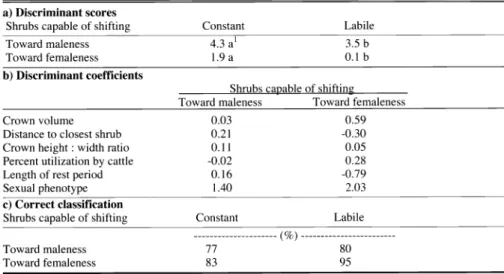
Table 2. Discriminant analysis for fourwing saltbush shrubs on the basis of sex phenotype lability.
a) Discriminant scores
Shrubs capable of shifting Constant
Toward maleness 4.3 al 3.5 b
Toward femaleness 1.9 a 0.1 b
b) Discriminant coefficients
Shrubs capable of shifting
Toward maleness Toward femaleness
Crown volume 0.03 0.59
Distance to closest shrub 0.21 -0.30
Crown height
:width ratio 0.11 0.05
Percent utilization by cattle -0.02 0.28
Length of rest period 0.16 -0.79
Sexual phenotype 1.40 2.03
c) Correct classification
Shrubs capable of shifting Constant
Toward maleness 77 80
Toward femaleness 83 95
rDifferent letters indicate significant differences at P = 0.05 between constant and labile groups in shrubs shifting toward maleness and shrubs shifting toward femaleness.
Utricle fill
Utricle fill was also analyzed at the indi- vidual plant level only. We conducted multiple regression analysis to determine which variables were significant predic- tors of fruit-fill at our experiment site. The predictors included in the model were: a) log crown volume (LCV); b) length of rest period between browsing event and onset of flowering in June (R); c) distance to closest shrub (Dl); d) distance to second closest shrub (D2); e) sexual phenotype of closest shrub (dummy variables expressed by 51=1 if male, else 0, and 52=
1if female, else 0). In addition to these, we also included 2 interactions of interest, namely: D
1*S 1, and LCV*S 1. Crown vol- ume was log- transformed in order to meet regression assumptions. Level of signifi- cance was set at P < 0.05. We used PROC GLM of the SAS version 6.12 (1996) package to perform the statistical analyses.
Results
Mean shrub utilization in moderately grazed pastures was 35% in January, 15%
in April, and 17% in September. In heavi- ly grazed pastures, mean utilization was 54% in January, 25% in April, and 50% in September.
Sex change Pasture level
Shrub sex ratios exhibited little annual variation in ungrazed exclosures or grazed pastures. Shrub sex-change and cattle-
browsing were only marginally related at the level of experimental grazing plots (Table l.a). Neither grazed nor ungrazed shrub sex ratios differed significantly (P <
0.05) from the 35 male:55 female:10 mon- ecious frequency described for tetraploid
fourwing saltbush (McArthur 1977).
Individual shrubs
Sex change on individual shrubs was not significantly associated with browsing in 1997 when monecious shrubs were excluded from the analysis (Table ib).
However, when monecious shrubs were included in 1998, the association was highly significant (Table 1b). Whereas sex shifts towards maleness were more fre- quent, only change toward femaleness was significantly associated with presence or absence of browsing; the shift toward femaleness occurred much more frequent- ly (P = 0.001) in exclosures than in the grazed plots (13% vs 1%; Table 1b).
Shrubs discriminated into the a priori defined classes on the basis of sexual phe- notype constancy produced groupings that were significantly different from each other (Table 2a). Mean discriminant
scores for shrubs exhibiting shifts in sexu- al phenotype were significantly lower (both in shrubs shifting toward maleness and femaleness) than mean scores of shrubs exhibiting constancy. Sex pheno- type was the variable that weighed most heavily on both discriminant functions (Table 2b). Monecious shrubs tended to have smaller discriminant scores and were more likely to be placed in the sex-chang- ing group. Distance to closest shrub, per-
42 JOURNAL OF RANGE MANAGEMENT 56(1) January 2003
Table 3. Effect of distance to closest shrub, length of rest period, and percent utilization on the classification of labile female, labile male, and monecious fourwing saltbush shrubs.
Variable Magnitude Labile female male
Distance to closest shrub Large constant
Small constant
Length of rest period Long constant
Short -+c constant
Percent utilization by cattle High -+cf
Low constant
iShifts
toward femaleness.
Shifts toward maleness.
cent utilization by cattle, and length of rest period exhibited opposite signs in the dis- criminant functions corresponding to shrubs capable of shifting toward male- ness and those capable of shifting toward femaleness (Table 2b). The discriminant functions correctly classified 80% of shrubs capable of shifting toward male-
ly different from each other (Table 5a).
Mean discriminant scores for flowering shrubs were significantly lower than mean scores of nonflowering ones. Percent uti- lization by cattle was the variable weigh- ing most heavily upon the discriminant function (Table 5b). High levels of utiliza- tion produced high discriminant
Table 4. Percentages of fourwing saltbush that flowered or did not flower.
scores,
Year Treatment Flowered
not
flower Haenszel p
1997 Grazed 82
Ungrazed 97 3
1998 Grazed 65
Ungrazed 100 0
Overall 21.07 0.01
ness and 95% of shrubs capable of shifting toward femaleness (Table 2c). Distance to closest shrub, percent utilization by cattle, and length of rest period had opposite effects on the sex phenotype status of labile females, labile males, and mon- ecious shrubs (Table 3).
causing an individual to be classified in the nonflowering group. The opposite occurred with individuals undergoing low levels of utilization. Crown volume was the second most influential variable.
Shrubs with large crowns tended to obtain
small discriminant scores and were, thus,
classified as flowering; the opposite occurred with shrubs exhibiting small crowns. The discriminant functions cor- rectly classified about 70% of both flower- ing and nonflowering shrubs (Table 5c).
Overall, increasing levels of utilization by cattle and/or decreasing crown sizes were associated with increasing levels of non- flowering in fourwing saltbush at our site.
Utricle fill
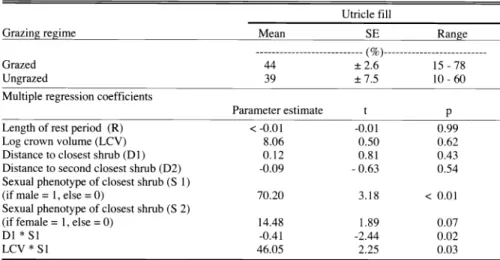
Mean utricle fill of protected and grazed shrubs was similar. In both cases there was a large amount of among-shrub varia- tion (Table 6). We found a significant relation between utricle fill and the overall set of variables included in our model (df
=39,F=2.41,P=0.04, R2=0.38 ).
However, sexual phenotype of closest shrub, and the interactions both with dis- tance to closest shrub and with log crown volume of the sampled female, were the only significant terms (P < 0.05) in the multiple regression model (Table 6). Since the interaction terms were significant, we conducted separate regression analyses for shrubs with female or male neighbors. As distance to closest shrub increased, utricle fill decreased significantly if the closest shrub was a male (1= -0.42; t=-2.2;P=
0.02)
,and increased if the closest shrub was a female ((31= 0.38; t = 2.30; P = 0.04). If the closest shrub was a male, utri- cle fill increased with increases in log crown volume (R1 = 66.9; t = 5.76; P <
0.01) but not if the closest shrub was a female (1= -2.84; t = -0.19; P = 0.85).
Discussion
Sex expression in tetraploid fourwing saltbush is genetically constrained (McArthur 1977, McArthur et al. 1992).
Table 5. Discriminant analysis for flowering and nonflowering fourwing saltbush shrubs.
Nonflowering
Nonflowering and cattle-grazing were significantly associated (Table 4). Almost all labeled shrubs in exclosures (all of them in 1998) flowered, but up to approxi- mately one third of labeled shrubs did not flower in browsed pastures (Table 4).
Nonflowering was not significantly asso- ciated with shrub floral phenotype, it occurred as often among female shrubs as it did among male shrubs.
Shrubs discriminated into the classes defined a priori by the presence of flowers produced groupings that were significant-
a) Discriminant scores
Flowering Nonflowering
1.62a' 1.93b
b) Discriminant coefficients
Crown volume -0.38
Distance to closest shrub 0.23
Crown height
:width ratio -0.30 Percent utilization by cattle 0.90
Length of rest period 0.13
c) Correct classification
Flowering Nonflowering
--- (%) ---
70 73
tDifferent letters indicate significant differences at P = 0.05.
JOURNAL OF RANGE MANAGEMENT 56(1) January 2003 43
Table 6. Utricle fill as affected by grazing
Utricle fill
Grazing regime Mean SE
Grazed 44 ±2.6
Ungrazed 39 ±7.5
Multiple regression coefficients
Parameter estimate t p
Length of rest period (R) <-0.01 -0.01
Log crown volume (LCV) 8.06 0.50
Distance to closest shrub (D1) 0.12 0.81
Distance to second closest shrub (D2) -0.09 -0.63 Sexual phenotype of closest shrub (S 1)
(if male = 1, else = 0) 70.20
Sexual phenotype of closest shrub (S 2)
(if female =1, else = 0) 14.48
D1 * S1 -0.41 -2.44
LCV * S
146.05 2.25
An estimated 55% of all shrubs carry sex- ually labile genotypes; the remaining 45%
exhibit genotypec sex constancy. Within a season, approximately 2/3 of shrubs with labile genotypes produce female flowers,
1


![13 Benzyl 3,10 bis(2,6 dichlorophenyl) 4,11 diphenyl 1,8 dioxa 2,9,13 triazadispiro[4 1 4 3]tetradeca 2,9 dien 6 one chloroform solvate](data:image/gif;base64,R0lGODlhAQABAIAAAP///wAAACH5BAEAAAAALAAAAAABAAEAAAICRAEAOw==)