ARTIGO ORIGINAL
ABSTRACT
Introduction: The knowledge of transmission, prevention and symptoms of malaria is essential for travellers’ safety. In real life, what do Portuguese travellers know about malaria before a Travel Medicine consultation? How can we, through this consultation, improve their knowledge?
Material and Methods: Before an appointment with a specialist in Travel Medicine, 80 adult travellers filled a questionnaire that included demographic aspects, characteristics of the trip and knowledge about malaria. Data were analysed using descriptive statistics and multifactorial variance analysis.
Results: The travellers’ ages fell in the range 20 - 80 years, 51% were male and 74% of the travellers had a university degree level of education. For 74% of the travellers, this was the first Travel Medicine consultation. Half of the travellers planed trips lasting no more than 14 days, mainly for tourism. The average percentage of correct answers about malaria given by a traveller was 63%. Travellers who had previously attended a Travel Medicine appointment exhibit a statistically significant difference in knowledge comparing to those who attend Travel Medicine appointment for the first time, and this was more evident in the sample composed of travellers without higher education. The clinical manifestations and prevention had the lowest number of correct answers among the travellers.
Discussion: These travellers appear to have good knowledge about malaria but some misconceptions prevail.
Conclusion: The Travel Medicine consultation seems important to raise awareness in the population about malaria, particularly for travellers without higher education. The prevention and the recognition of malaria symptoms must be prioritized during Travel Medicine consultations and the information given adapted to the traveller’s characteristics.
Keywords: Malaria; Portugal; Travel Medicine RESUMO
Introdução: O conhecimento das formas de transmissão, prevenção e clínica de malária é fundamental para a proteção dos viajantes nas deslocações para zonas endémicas. O que sabem os viajantes portugueses sobre malária previamente à consulta de Medicina de Viagem? Como poderemos através dessas consultas colmatar falhas nesse conhecimento?
Material e Métodos: A 80 viajantes adultos, foi solicitado, antes da entrada na consulta, o preenchimento de um questionário dividido em dados demográficos, características da viagem e questões sobre malária. Na análise estatística dos resultados usámos métodos de Estatística Descritiva e de Análise de Variância Multifatorial.
Resultados: Os viajantes tinham idades entre 20 - 80 anos, 51% eram do sexo masculino e 74% tinham escolaridade superior. Para 74% dos viajantes esta foi a primeira Consulta de Medicina de Viagem. Em metade dos viajantes a duração da viagem era inferior a 14 dias e maioritariamente viajaram por lazer. Em média cada viajante respondeu corretamente a 63% das questões. Viajantes com consultas prévias evidenciam uma diferença estatísticamente significativa nesse conhecimento relativamente aos que recorrem pela primeira vez, que, na nossa amostra, se observou sobretudo nos viajantes que não têm escolaridade superior. O reconhecimento de manifestações clínicas e formas de prevenção revelam menos respostas corretas.
Discussão: Nestes viajantes os conhecimentos sobre malária revelaram-se razoáveis mas persistem conceções erradas.
Conclusão: A consulta de Medicina de Viagem é importante para o conhecimento sobre malária, sobretudo nos viajantes sem escolaridade superior. Prevenção e sintomas de malária devem ser especialmente focados e a informação deve-se adequar às características do viajante.
Palavras-chave: Malária; Medicina de Viagem; Portugal
What do Portuguese Travellers Know About Malaria?
Pre-Travel Medicine Appointment Evaluation
O que Sabem os Viajantes Portugueses Sobre Malária?
Avaliação Pré-Consulta de Medicina de Viagem
1. Estudante. Faculdade de Medicina. Universidade do Porto. Porto. Portugal. 2. Faculdade de Engenharia. Universidade do Porto. Porto. Portugal. 3. Centro de Matemática. Universidade do Porto. Porto. Portugal.
4. Serviço de Doenças Infeciosas. Centro Hospitalar São João. Faculdade de Medicina. Universidade do Porto. Porto. Portugal. 5. Departamento de Medicina. Instituto de Inovação e Investigação em Saúde [I3S]. Porto. Portugal.
6. Instituto Nacional de Engenharia Biomédica [INEB]. Porto. Portugal.
Autor correspondente: Cândida Abreu. [email protected]
Recebido: 12 de abril de 2018 - Aceite: 08 de agosto de 2018 | Copyright © Ordem dos Médicos 2018
Joana CEPEDA1, Paula MILHEIRO-OLIVEIRA2,3, Cândida ABREU4,5,6
Acta Med Port 2018 Dec;31(12):714-723 ▪ https://doi.org/10.20344/amp.10656
INTRODUCTION
There are an estimated one billion people travelling the world each year and Europeans are those travelling more frequently to tropical and subtropical countries.1,2
Globali-sation, increasing urbaniGlobali-sation, climate change with an increasing global average temperature and ease of travel, mainly by air, have changed the paradigm of infectious dis-eases and had a major impact on its redistribution,3 mainly
vector-borne diseases and among these malaria.
Malaria is a parasitic disease with the highest impact on world population and is the leading cause of fever in return-ing travellers from Sub-Saharan Africa.4 An approximately
ARTIGO ORIGINAL
Figure 1 – Model of questionnaire delivered to travellers before attending a Travel Medicine consultation
All the investment made on preventive measures taken to reduce malaria is therefore crucial, meaning that travel-lers going and returning from malaria-endemic regions must have basic knowledge about the disease and its mode of transmission.
What do Portuguese travellers know about malaria? Dif-ferent international studies have been published on knowl-edge and attitude about malaria.6-16
Some of these studies were aimed at specific groups of travellers, such as those returning to their country of origin visiting friends / relatives,6,12 tourists13 or business
travel-lers.7,16 Studies on knowledge about malaria in experienced
travellers have been carried out6 as well as involving
trav-ellers going to malaria-endemic countries.11 Other studies
were aimed at pre-travel health advice [Travel Medicine consultation (TMC)], at the quality of the information pro-vided11,14,17-20 and at the influence of these consultations on
traveller’s knowledge about malaria.6,12,13
As far as we know, a Master’s thesis aimed at assessing traveller’s awareness and compliance to malaria chemo-prophylaxis21 as well as a study carried out at the
Tropi-cal Medicine Clinic of the Instituto de Higiene e Medicina
Tropical by R Teodósio et al.14 in which a questionnaire for
malaria awareness survey has been addressed to travel-lers over 15 years of age going to malaria-endemic regions have ever been published in Portugal. Responses from two groups were compared (one control group involving 207 respondents before attending a TMC and an experimental group of 202 respondents after having attended this
consul-tation). Higher correct response rate has been found in the experimental group, reaching almost 100% in some items (transmission by a mosquito bite, use of insect repellent as way of prevention, prophylactic regimen before, during and after travelling) and an increased basic knowledge of ma-laria has been found after attending a TMC even though not reaching a 100% rate and some myths and preconceptions persisted.
Due to the lack of information, this study was aimed at evaluating traveller’s awareness of malaria based on a sample of travellers attending a Travel Medicine clinic. The way certain factors have had an influence on malaria knowl-edge, including demographic and sociocultural factors, pre-vious TMC, prepre-vious travel outside Europe (focused on travelling to endemic regions) and travel-related aspects were also evaluated. The study was also aimed at providing adequate information about malaria and its prevention to travellers attending a TMC.
MATERIAL AND METHODS Participants
All adult travellers were required to anonymously fill in
a written questionnaire before attending a TMC at the
Cen-tro Hospitalar de São João during May and July 2017. Par-ticipant’s consent was orally obtained following an oral and written description of the study objective and none of the participants has received any kind of financial compensa-tion.
ARTIGO ORIGINAL Committee of the dade de Medicina da Universidade do PortoCentro Hospitalar de São João / Facul-.
Instruments
An anonymous and confidential three-section question-naire has been used (first section aimed at the characterisa-tion of travellers, second seccharacterisa-tion regarding the trip and third section aimed at assessing malaria knowledge) (Fig. 1).
Statistical analysis
Data were analysed by use of Microsoft Office Excel 2007 and SPSS (Statistical Package for the Social Scienc-es) version 24.0 software.
Methods of descriptive statistics were used for the char-acterisation of respondents, trip information and character-istics of responses given by travellers to items/statements about malaria. Countries were grouped according to the dif-ferent endemic regions and one additional category for non-endemic countries was used in order to make data analysis easier, both for previous and current trip.
Questions were grouped into four main categories, according to the domain in which these are included: epi-demiology (items 3;4;5;13), clinical presentation (items 1;2;6;7;8;9), prevention (item 12) and treatment (items 10;11;14). The number of correct responses has been obtained followed by the total of correct responses to the questionnaire within the four domains. Non-responses and ‘do not respond’ were considered as incorrect responses. Multifactorial analysis of variance has been carried out, considering the following as response variables (dependent variables): epidemiology, clinical presentation, prevention, treatment and final score (summarising all the previous vari-ables and subsequently analysed); traveller gender, educa-tion, occupaeduca-tion, initial TMC, previous trip outside Europe,
destination and nature of trip were considered as study fac-tors while patient’s age and length of trip as co-variables. Pillai’s trace and Roy’s largest root were used to assess the significance of factors’ effect on traveller responses.22 A
level of statistical significance of α = 0.05 was established. Non-parametric versions were used in inferential analy-sis, as there were doubts on the effects of non-validity of multi-normality requirements of dependent variables and co-variance homogeneity of each group (with quite different dimensions).
RESULTS
Two from the 82 delivered questionnaires were exclud-ed from the study due to missing responses regarding one of the three sections.
Section 1: Characterisation of respondents
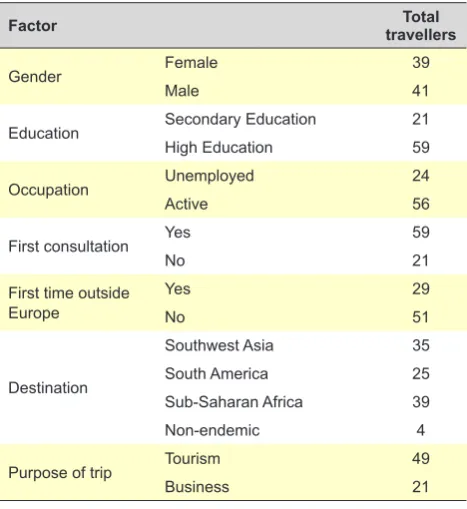
A general characterisation of respondents and their trips is shown in Table 1.
Respondent’s age (35.1 mean age) ranged between 20 and 80 years, with a 14.1 year standard deviation; 75% were aged 41 or under and the 28-32 age group was most frequently found; 41 male respondents were found (51%) and age distribution is shown in Fig. 2. Predominantly Cau-casian respondents participated in the study.
As regards respondent’s education, 74% (n = 59) had higher education and 26% (n = 21) had basic and second-ary education (Fig. 2) while 56 respondents (70%) had a professional occupation (Fig. 2).
Section 2: Trip information
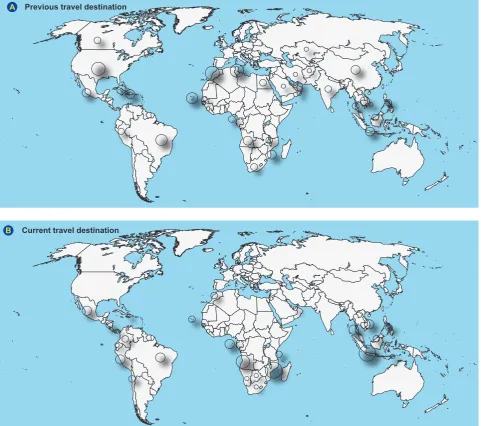
A total of 59 travellers (74% of the total) had never at-tended a TCM (Fig. 3) and 31% from these had already travelled to at least one malaria-endemic destination. A percentage of 64% (n = 51) respondents had already travelled outside Europe. The geographical distribution of previous trips is shown in Fig. 4.
When previous trips were grouped per geographical area (125 in total), Sub-Saharan Africa and tropical regions in South America were the most frequent destinations to en-demic regions.
When current trip destination justifying current attend-ance to TMC were considered, a sample of 103 destinations divided by 26 countries was obtained and Mozambique and Indonesia were the most frequent destinations, correspond-ing to 15% (n = 15) each. When destinations were consid-ered by region, malaria-endemic regions were mostly in-cluded 96% (n = 99), mainly from Sub-Saharan Africa [38% (n = 39)] and Tropical Asia [34% (n = 35)].
Eight responses were not considered for the analysis of length of trip due to the fact that invalid or no responses were given. Most respondents were travelling for not over 14-day length and 31% for over a four-week length of stay (Fig. 3).
‘Tourism’ was the main reason for travel [49 respond-ents (46%), while 21 respondrespond-ents (20%) were travelling for ’business’ (Fig. 3)].
Table 1 – Respondent characteristics
Factor travellersTotal
Gender Female 39
Male 41
Education Secondary Education 21
High Education 59
Occupation Unemployed 24
Active 56
First consultation Yes 59
No 21
First time outside Europe
Yes 29
No 51
Destination
Southwest Asia 35
South America 25
Sub-Saharan Africa 39
Non-endemic 4
Purpose of trip Tourism 49
ARTIGO ORIGINAL
A four-week average length of trip was described by the 12 respondents ‘visiting friends/relatives’ while a 2.8 week length was described by the 65 respondents who travelled for ‘tourism’, 5.1 weeks by 21 respondents who travelled for ‘business’ and 7.2 weeks by the nine respondents who travelled for ‘humanitarian aid actions’.
Section 3: Questionnaire about malaria
A 21.5 / 34 average correct response rate has been found, i.e. 63% of the questions were correctly responded (Table 2).
Highest correct answer rates were obtained with the
statement ‘É sintoma de malária… Febre’ (It is a
symp-tom of malaria … Fever), 97.5% (n = 78) and ‘A malária é
transmitida por…picada de mosquito’ (Malaria is transmit-ted by … a mosquito bite), 96.3% (n = 77). Lowest rates
were found with the statement ‘Vacinação como forma de
prevenção de malária’ (Vaccination as a way of malaria pre-vention), 20% (n = 16). Only one respondent has correctly answered to all the items (Table 3).
As regards the risk of malaria at destination, 19% of respondents were able to correctly describe it, while the remaining respondents have wrongly described it or were unaware (Fig. 3). By use of a multifactorial variance analy-sis, statistically significant differences were found when the total number of correct responses to the questionnaire was compared for different levels of education (TP = 0.336, χ2(4)
= 23.51, p = 0.000). When clinical presentation was
specifi-cally considered, a significant effect of the level of educa-tion on response quality has been found (TP = 0.085, χ2(1)
= 5.915, p = 0.015) (Fig. 5). Significant differences in the number of correct responses to the questionnaire about malaria were also found between respondents who were attending for the first time vs. those having previously at-tended to a TMC (TP = 0.192 χ2(4) = 13.41, p = 0.009). The
effect of interactions between ‘education’ and ‘gender’ on the variable ‘number of correct answers regarding clinical presentation’, which is shown in Fig. 5, is worth studying. No evidence has been found regarding a significant ef-fect of malaria knowledge on travellers having previously travelled outside the European continent (TP = 0.046, χ2(4)
= 3.21, p = 0.532), leading to 30 ≤ p ≤ 0.92 in the different dependent variables.
No other significant effects were found on the four major categories or between these effects.
DISCUSSION
Section 1: Respondent characterisation
Data regarding respondent characterisation were com-pared to the last Tourism statistics published by the Instituto Nacional de Estatística (INE) (Statistics Portugal) aimed at checking the representativeness of the sample.
According to the INE, 29.3% of the 2016 Portuguese travellers were aged 25-44 (52.6% were female).23
Pre-dominantly young travellers and gender ratios close to 50% were found in our group of respondents, showing similar
Figure 2 – Distribution chart of travellers according to gender and age (A), education (B) and occupation (C)
Distribution per gender and age Gender
Score
Age
Female
74
40 35
25
15
5
0 0 0 0
5 16
37
20
2 30
20
10
Illiterate Basic – st1 cycle Basic –
2
nd cycle Basic – rd3 cycle
Secondary High school Masters
PhD
Never worked Active Housewife Retired Unemployed 74
60 60
57 57
53 53
47 47
44 44
41 41
39 39
36 36
33 33
30 30
28 28
26 26
24 24
22 22
20
5 4 3 2 1 0 1 2 3 4 5
20 Male
Education
Occupation
A
C
B
ARTIGO ORIGINAL
gender and age characteristics to those wound in the 2016 Portuguese travellers.
Section 2: Travel information
In line with the trend already found in previous studies towards a low uptake of pre-travel health advice,7,8,15,20,24-26
most travellers in our sample had never attended a TMC, even though 31% of those having never attended a TMC had travelled at least once to an endemic region.
Short trip, travelling alone and coming from a malar-ia-endemic country seem to be predictors for low uptake of pre-travel health advice.24,27 This was not found in our
study, despite a short average length of trip. This may be explained by the fact that mostly high education and young respondents were found in our group and therefore more aware of the need for pre-travel health advice.
According to other authors, lack of concern with travel-related diseases,8,9,18,20 short time for travel planning8,10,15
and unawareness of the need to attend a TMC8 were the
main reasons for not seeking pre-travel health advice; this was a worrying conclusion, even though it was not among the study aims.
Previous studies have shown varying uptakes of pre-travel health advice according to the different pre-traveller groups and travel purpose. Only 11% of our respondents
were travelling ‘to visit friends and relatives’; the lowest up-take of pre-travel health advice has been found in these respondents 6,12,18,20,24 and, due to the fact that similar living
conditions to those living at the destination have been de-scribed by these respondents, these were the group with the highest risk of travel-related illness.
According to the 2016 INE information, ‘visiting friends/ relatives’ corresponded to 4.7% of trips abroad and was the second most frequent purpose.23 The low uptake of
pre-travel health advice found in this group is probably due to the fact that these are travellers returning to their country of origin and therefore considering themselves as immune and in no need for any advice, specifically regarding malaria prevention, awareness or chemoprophylaxis.
‘Tourism’ was described in our study by 46% of travel-lers, in line with the INE data describing this purpose as the most frequent purpose of travel in 2016 Portuguese travel-lers.23
Also according to the INE data, a 7.6 day mean length of trip has been described by Portuguese travellers, longer by those ‘visiting friends/relatives’ (11.5 days) and shorter by those travelling for ‘tourism’ (6.3 days).23
Higher mean lengths of trip have been found in our study, even though the shortest mean length of trip cor-responded to those travelling for ‘tourism’. Travellers
Figure 3 – Distribution according to (A) first attendance to Travel Medicine consultation, (B) length of trip, (C) purpose of travel and (D)
ranking of the risk of malaria at destination
First attendance to Travel Medicine consultation
80 Mean = 3.63
Standard deviation = 5.62 n = 80
60
0
0.0 10.0 20.0 30.0 40.0 50.0 40
20
Overvaluation Correct evaluation Unaware Undervaluation
Length of trip
Frequency
Weeks Histogram
Purpose of travel Risk of malaria
A
C D
B
74% 26%
15%
20% 11%
19% 46%
30% 20%
8%
31% Yes
Vacation Visiting friends / relatives Tourism Business Humanitarian aid actions
ARTIGO ORIGINAL
‘attending humanitarian aid actions’ (corresponding to the longest mean length of stay) were not included in the INE data and therefore could not be compared.
Most trip destinations were to malaria-endemic regions, mainly in Sub-Saharan Africa and Tropical Asia, in line with previous studies carried out in other countries, namely in Spain, with Sub-Saharan Africa as the leading destination,28
in Switzerland and Sweden, with Thailand as the most pop-ular destination26 and in France, with Senegal as the
lead-ing destination.29 Destinations may still be influenced by the
time of the year in which surveys were made (May to July), corresponding to the start of the main leisure travel season.
Section 3: Questionnaire about malaria
Awareness of malaria has been shown, in general, by the 80 respondents in our group and, on average, a 63% correct answer rate has been found, while most respond-ents are aware that malaria is potentially lethal, even though the etiological agent has been described as a parasite by
only slightly more than half of them.
Even though a mosquito bite has been described as the major mode of transmission by almost all respondents, some (31.2%) have considered water and contaminated food as a possible mode of transmission, in line with the conclusions obtained by other authors, with varying rates (5% – 43%).12-14,16
Major malaria-endemic regions were mostly identified by our respondents, although the risk of malaria in tem-perate climate regions has been described by around two thirds and a worldwide distribution of the disease by 57.2% of respondents. Higher access to information sources and higher disclosure of imported cases of malaria by the media may have generated some uncertainty in the population, who is unclear regarding the concepts of local and imported disease.
Awareness of the risk was correctly described by only a small percentage of respondents and full unawareness of the risk of exposure was also described by a small
Figure 4 – Geographical distribution of destinations of previous (A) and current travel destination (B)
Previous travel destination
Current travel destination
A
ARTIGO ORIGINAL percentage of respondents, in line with an European study. 8
It is worth mentioning that risk misjudgement was not only applied to risk undervaluation but also to overvaluation, in an almost similar way. These data were considered as quite worrying as they show that, despite a reasonable knowledge about malaria, this will be probably useless in a scenario in which people are unaware of their real risk of disease, which may lead to inappropriate behaviours, regarding an excessive as well as failed personal protection involving, in
this case, a higher risk of exposure to the disease.
Symptoms of the disease including fever, headache, shivering and vomiting were mostly identified by respond-ents. Other symptoms and signs were less frequently rec-ognised or mistakenly considered.
More than 90% of respondents have shown as knowing how to attend the Emergency department in case of suspi-cion of the disease, even though only a small percentage were able to identify malaria incubation period. Previous
Table 2 – Alternative answers to each item of the questionnaire about malaria (section 3), correct responses and distribution of the correct
response number, obtained through the application of the questionnaire to travellers before pre-travel healthcare advice (travel medicine consultation) (n = 80)
Item Statement Correct response frequency Absolute frequencyRelative (%)
Item 1 Disease 68 85
Item 2 Parasite 46 57.5
Item 3 Interpersonal No 77 96.3
Water and food No 55 68.8
Sexual life No 72 90.0
Mosquito bite Yes 77 96.3
Item 4 Temperate climate areas No 28 35.0
Sub-Saharan Africa Yes 59 73.8
Tropical regions in South America Yes 53 66.3
Tropical Asia Yes 55 68.8
Worldwide No 35 43.8
Item 5 Risk of malaria at destination 19 23.8
Item 6 Malaria is a potentially deadly disease Yes 62 90.0
Item 7 Fever Yes 78 97.5
Headache Yes 62 77.5
Vomiting Yes 56 70.0
Jaundice Yes 27 33.8
Joint pain Yes 33 41.3
Sneezing No 31 38.8
Shivering/chills Yes 51 63.8
Bleeding No 28 35.0
Item 8 8 to 25 days following the infective bite 28 35.0
Item 9 No 62 77.5
Item 10 Attend to Emergency 75 93.8
Item 11 No 60 75.0
Item 12 Drinking alcohol No 49 61.3
Mosquito net Yes 67 83.8
Insect repellent Yes 72 90.0
Avoiding contact with local population No 50 62.5
Avoiding spending time outdoors between dusk and dawn Yes 35 43.8
Avoiding sexual risk behaviour No 36 45.0
Vaccination No 16 20.0
Not sharing syringes Yes 33 41.3
Item 13 Yes 71 88.8
ARTIGO ORIGINAL
studies have reached the conclusion that awareness of the fact that symptoms may arise months after returning home is crucial, in addition to the need for seeking medical advice as soon as possible in case of any suspicion of disease in order to start treatment.16 An increased level of knowledge
regarding symptoms and incubation period is therefore cru-cial in order to allow for a timely diagnosis.
Anti-parasitic immunity and protection against future infection and reinfection is not granted by prior malaria episodes and relapse or recrudescence of infection with Plasmodium vivax or Plasmodium ovale may develop in case of inadequately treated infection.30,31 More than 70%
of respondents in our study seemed to know this informa-tion and recognised that symptom improvement does not necessarily means the cure and that the fact of already hav-ing had the disease does not grant any protection against future infections. The same occurs regarding prophylaxis; our respondents seemed aware that it does correspond to immunity and must be repeated every time there is a poten-tial exposure to human plasmodia.
The lowest knowledge was found regarding malaria prevention, with a small percentage of respondents not
knowing or considering that alcohol consumption and contact eviction with local population are ways of malaria prevention. Malaria transmission is directly affected by tem-perature and humidity and this was recognised by most of the respondents, even though the period between dusk and dawn and therefore requiring maximum protection, according to the night habit of Anopheles spp mosquitoes, was consid-ered as critical by less than half of the respondents. In line with what has been described in the previous Por-tuguese study carried out in 2006,14‘considerar que existe
vacina para evitar a malária’ (‘considering that there is a
malaria vaccine’) or ‘não saber se a vacina existe ou não’
(‘not knowing whether or not a vaccine exists’) were de-scribed by 80% of respondents.
According to a study carried out by the EuroTravNet, pa-tients attending pre-travel health advice are less frequently diagnosed with malaria and show a higher knowledge about the disease.32 Data collected by the present survey suggest
that previous health advice has significantly improved the average level of knowledge of respondents, with a higher impact on people with secondary education (Fig.5).
Figure 5 – Relationship between (A) first consultation and level of knowledge according to education and (B) between gender, education
and level of knowledge
Co-variables in the model are evaluated according to the following values: age = 34.95, time = 3.62
First consultation and level of knowledge Gender, education and level of knowledge
A B
Yes
First consultation Gender
Estimated marginal means Estimated marginal means
Estimated marginal means of clinical items Estimated marginal means of clinical items
5 6.5
6
7.0 7.5 7
8.0
8 8.5
9 9.0
No Female
Education: Secondary High school
Male
Table 3 – Summary about response quality
Mean correct
response rate Travellers with no correct response Travellers with 100% correct responses
Epidemiology 6.7/11 2 (2.5%) 11 (13.8%)
Prevention 4.5/8 4 (5.0%) 3 (3.8%)
Clinical presentation 8.0/13 0 (0.0%) 7 (8.8%)
Treatment 2.3/3 2 (2.5%) 44 (55.0%)
ARTIGO ORIGINAL Female respondents with higher education were associ-ated with higher response quality, namely regarding clinical
items (Fig.5).
It is worth mentioning that previous travels outside the European continent (mostly to malaria-endemic regions) did not seem as having a significant effect (Fig. 4) on respond-ent’s knowledge about malaria, in support of the relevance of attending pre-travel health advice.
It seems reasonable to assume that part of the infor-mation about malaria has been acquired from the internet. However, only 11% of travellers in a previous American
study logged on to CDC Traveler’s Health reference site27
and therefore incorrect underlying information could exist. In addition, the information provided by travel agents or other travellers may not be trustworthy and wrong concepts could have been perpetuated or under or overvaluation of the risk awareness could have existed.7,8,13,20,26
Preponderance of ‘tourism’ trips and a small sample that is not representative of the Portuguese common travel-ler, namely regarding education, which is quite high in this group of respondents, were the main limitations of the study that should be considered for further studies.
CONCLUSION
Our group of travellers, mostly with high education and travelling for ‘tourism’ have shown reasonable knowledge about malaria, even though some misconceptions remained and must be clarified, namely as regards malaria prevention and clinical presentation.
Poorer educated travellers seemed as those who can benefit the most from pre-travel health advice; female travel-lers combined with higher education and previous pre-travel health advice were associated with higher response qual-ity, namely regarding clinical items. Information should be tailored to travellers, in order to fill the gaps of knowledge about malaria. The presence of information leaflets about malaria at the waiting room may serve as an important
complement to medical advice. Easy-access, interactive IT platforms adapted to Portuguese travellers and reaching a wider number of travellers are crucial. Television, newspa-pers and magazines could also be important in disclosing knowledge about malaria, as long as accurate information is delivered. Travel medicine consultation is a privileged site to obtain information and clarification. A multifactorial approach is crucial for increasing knowledge about malaria, allowing for better prevention of the disease.
ACKNOWLEDGMENTS
The authors wish to acknowledge the reviewers for their skilful contributions to the improvement of statistical details of this manuscript.
HUMAN AND ANIMAL PROTECTION
The authors declare that the followed procedures were according to regulations established by the Ethics and Clini-cal Research Committee and according to the Helsinki Dec-laration of the World Medical Association.
DATA CONFIDENTIALITY
The authors declare that they have followed the proto-cols of their work centre on the publication of patient data.
CONFLICTS OF INTEREST
The authors declare that there were no conflicts of inter-est in writing this manuscript.
FINANCIAL SUPPORT
The author Paula Milheiro-Oliveira was in part support-ed by the CMUP (UID / MAT / 00144/2013), financsupport-ed by the FCT (Portugal) with national (MEC) and European funds (FEDER), within PT2020 partnership agreement.
The remaining authors declare that there was no finan-cial support in writing this manuscript.
REFERENCES
1. World Tourism Organization. 2017 International Tourism Results: the highest in seven years. UNWTO.2018. [Consultado 2018 abr 5]. Disponível em http://media.unwto.org/press-release/2018-01-15/2017-international-tourism-results-highest-seven-years.
2. World Tourism Organization. 2016 Annual Report. UNWTO.2017. [Consultado 2018 abr 5]. Disponível em: https://www.e-unwto.org/doi/ pdf/10.18111/9789284418725.
3. Pindola D, Garcia A, Wesolowsk A, Smith DL, Buckee CO, Noor AM, et al. Human movement data for malaria control and elimination strategic plannig. Malar J. 2012;11:205.
4. Leder K, Torresi J, Libman MB, Cramer JP, Castelli F, Schlagenhauf P, et al. Geosentinel surveillence of illness in returned travelers, 2007-2011. Ann Intern Med. 2013;6:456-68.
5. Santos LC, Abreu CF, Xerinda SM, Tavares M, Lucas R, Sarmento AC. Severe imported malaria in na intensive care unit: a review of 59 cases. Malar J. 2012;11:96.
6. Behrens R, Alexander N. Malaria knowledge and utilization of chemoprophylaxis in the UK population and in UK passengers departing to malaria-endemic areas. Malar J. 2013;12:461.
7. Selcuk EB, Kayabas U, Binbasioglu H, Otlu B, Bayindir Y, Boldogan B, et al. Travel health attitudes among Turkish business travellers to African countries. Travel Med Infect Dis. 2016;14:614-20.
8. Van Herck K, Castelli F, Zuckerman J, Nothdurft H, Van Damme P, Dahlgen AL, et al. Knowledge, attitudes and practices in travel-related infectious diseases: the European airport survey. J Travel Med. 2016;11:3-8.
9. Lopez-Velez R, Bayas JM. Spanish travelers to high-risk areas in the tropics: airport survey of travel health knowledge, attitudes, and practices in vaccination and malaria prevention. J Travel Med. 2007;14:297-305. 10. Van Genderen PJ, Mulder PG, Overbosch D. The knowledge, attitudes
and pratices of wintersun vacationers to the Gambia toward prevention of malaria: is it that bad?. Malar J. 2014;13:74
11. Van Genderen PJ, Van Thiel PP, Mulder PG, Overbosch D. Trends in the knowledge, attitudes and practices of travel risk groups towards prevention of malaria: results from the Dutch Schiphol Airport Survey 2002 to 2009. Malar J. 2012;11:179.
12. Pistone T, Guibert P, Gay F, Malvy D, Ezzedine K, Receveur MC, et al. Malaria risk perception, knowledge and prophylaxis among travellers of African ethnicity living in Paris and visiting their country of origin in sub-Saharan Africa. Trans R Soc Trop Med Hyg. 2007;101:990–5. 13. Piyaphanee W, Wattanagoon Y,Silachamroon U, Mansanguan C,
ARTIGO ORIGINAL 14. Teodósio R, Gonçalves L, Atouguia J, Imperatori E. Quality assessment
in a travel clinic: a study of travelers knowledge about malaria. J Travel Med. 2006;13:288–93.
15. Van Herck K, Zuckerman J, Castelli F, Van Damme P, Walker E, Steffen R. Travelers’ knowledge, attitudes, and practices on prevention of infectious diseases: results from a pilot study. J Travel Med. 2003;10:75-8.
16. Weber R, Schlagenhauf P, Amsler L, Steffen R. Knowledge, attitudes and practices of business travelers regarding malaria risk and prevention. J Travel Med. 2003;10:219-24.
17. Farquharson L, Noble L, Behrens R. Travel clinic communication and non-adherence to malaria chemoprophylaxis. Travel Med Infect Dis. 2011;9:278-83.
18. Lammert S, Rao SR, Jentes ES, Fairley JK, Erskine S, Walker AT, et al. Refusal of recommended travel related vaccines among U.S international travellers in global TravEpiNet. J Travel Med. 2016;1:7. 19. Vinnemeier CD, Rothe C, Krueuels B, Addo MM, Vygen-Bonnet
S, Cramer JP, et al. Response to fever and utilization of standby emergency treatment (SBET) for malaria in travellers to Southeast Asia: a questionnaire-based cohort study. Malar J. 2017;16:44.
20. Herman J, Patel D. Advising the traveller. Medicine. 2018;46:59-65. 21. Tavares I. Concepções do viajante e adesão à quimioprofilaxia da
malaria. Lisboa; 2011. Dissertação de Mestrado – Instituto de Higiene e Medicina Tropical (IHMT) Lisboa. [consultado 2018 jan 24]. Disponível em http://hdl.handle.net/10362/14030.
22. Marôco J. Análise estatística com o SPSS Statistics. 3ª ed. Lisboa:
Edições Sílabo; 2003.
23. Instituto Nacional de Estatística. Estatísticas do turismo 2016. INE.2017. [consultado 2018 jan 24]. Disponível em https://www.ine.pt/xportal/ xmain?xpid=INE&xpgid=in-e_publicacoes&PUBLICACOES.
24. Pavli A, Silvestros C, Patrinos S, Maltezou. Vaccination and malaria
prophylaxis among Greek international travelers to Asian destinations. J Infect Public Health. 2015;8:47-54.
25. Paudel P, Raina C, Zwar N, Seale H, Worth H, Sheikh M, et al. Risk activities and pretravel health seeking practices of notified cases of imported infectious diseases in Australia. J Travel Med. 2017;24:1-7. 26. Buhler S, Ruegg R, Steffen R, Hatz C, Jaeger VK. A profile of travelers
- an analysis from a large Swiss travel clinic. J Travel Med. 2014;21:324-331.
27. Herman J, Patel D. Advising the traveller. Medicine. 2018;46:59-65. 28. Valerio L, Martínez O, Sabrià M, Esteve M, Urbiztondo L, Roca C.
High-risk travel abroad overtook low-risk travel from 1999 to 2004: characterization and trends in 2,622 Spanish travelers. JTravel Med. 2005;12:327–331
29. Aubry C, Gaudart J, Gaillard C, Delmont J, Parola P, Brouqui P, et al. Demographics, health and travel characteristics of international travellers at a pre-travel clinic in Marseille, France. Travel Med Infect Dis. 2012;10:247-56.
30. Institute of Medicine. Saving lives, buying time: economics of Malaria drugs in an age of resistance. Washington: The National Academy Press; 2006.
31. Arguin PM, Tan KR. Infectious diseases related to travel – Malaria in centers for disease control and prevention. In: CDC yellow book 2018: health Information for international travel. New York: Oxford University Press; 2017.CDC. CDC yellow book. Atlanta: Oxford University Press; 2018.