Implications of a variable IMF for the interpretation of observations
of galaxy populations
Bart Clauwens,
1,2‹Joop Schaye
1and Marijn Franx
11Leiden Observatory, Leiden University, PO Box 9513, NL-2300 RA Leiden, The Netherlands 2Instituut-Lorentz for Theoretical Physics, Leiden University, NL-2333 CA Leiden, The Netherlands
Accepted 2016 July 21. Received 2016 July 21; in original form 2016 March 16
A B S T R A C T
We investigate the effect of a metallicity-dependent stellar initial mass function (IMF), as deduced observationally by Mart´ın-Navarro et al., on the inferred stellar masses and star formation rates (SFRs) of a representative sample of 186 886 SDSS galaxies. Relative to a Chabrier IMF, for which we show the implied masses to be close to minimal, the inferred masses increase in both the low- and high-metallicity regimes due to the addition of stellar remnants and dwarf stars, respectively. The resulting galaxy stellar mass function (GSMF) shifts towards higher masses by 0.5 dex, without affecting the high-mass slope (and thus the need for effective quenching). The implied low-redshift SFR density increases by an order of magnitude. However, these results depend strongly on the assumed IMF parametrization, which is not directly constrained by the observations. Varying the low-end IMF slope instead of the high-end IMF slope, while maintaining the same dwarf-to-giant ratio, results in a much more modest GSMF shift of 0.2 dex and a 10 per cent increase in the SFR density relative to the Chabrier IMF. A bottom-heavy IMF during the late, metal-rich evolutionary stage of a galaxy would help explain the rapid quenching and the bimodality in the galaxy population by on the one hand making galaxies less quenched (due to the continued formation of dwarf stars) and on the other hand reducing the gas consumption time-scale. We conclude that the implications of the observational evidence for a variable IMF could vary from absolutely dramatic to mild but significant.
Key words: galaxies: fundamental parameters – galaxies: luminosity function, mass
func-tion – galaxies: star formafunc-tion – galaxies: stellar content.
1 I N T R O D U C T I O N
The stellar initial mass function (IMF) describes the number dis-tribution of stars as a function of stellar mass at the zero age main sequence. The IMF can not only help us understand physical pro-cesses inside molecular clouds, it is also a key ingredient for under-standing astrophysical processes on larger scales. A top-heavy IMF will lead to more energetic stellar feedback, a higher metal produc-tion and more ionizing radiaproduc-tion, which could have an impact on the nature of the formed galaxies, the total star formation history, metal enrichment and on the re-ionization history of our Universe. Although IMF studies have a rich history going back to the sem-inal work of Salpeter (1955), both in nearby galaxies through direct star counts and in more distant galaxies by more indirect methods, a consensus on the functional form of the IMF and its possible de-pendences has not been reached. Observations aiming to measure galaxy stellar masses and star formation rates typically assume a
E-mail:[email protected]
Chabrier (2003) IMF (e.g. Bauer et al.2013; Moustakas et al.2013; Chang et al.2015) or a similar Kroupa (2001) IMF (e.g. Kauffmann et al.2003; Muzzin et al.2013). The same holds true for hydrody-namic simulations of galaxy formation (e.g. Hopkins et al.2014; Schaye et al.2015; Snyder et al.2015). A different IMF, specifically an IMF that depends on one or more local astrophysical conditions, could have a dramatic impact on the interpretation of observations and the results of simulations.
Most nearby IMF measurements tend to support a universal Kroupa- or Chabrier-like IMF, see Kroupa (2002), Chabrier (2003), Kroupa et al. (2013), Kirk & Myers (2011), Bastian, Covey & Meyer (2011) and references therein, but there are many complications in determining the IMF from direct star counts, see e.g. Scalo (2005) and Weisz et al. (2013). Recently, Weisz et al. (2015) found a very small intrinsic scatter in the power-law slope of the high-end mass function for young resolved star clusters in M31, albeit at a higher value (1.45±0.05) than the Kroupa slope (1.30) or the slope they infer for the Milky Way (1.15± 0.1), although this offset might be explained by dynamical depletion (Oh & Kroupa2016). Con-versely, a recent dynamical study of 29 Local Group Clusters by
Zaritsky et al. (2014) concludes that there are clear variations in the cluster IMF. Indications for a nearby metallicity-dependent IMF come from stellar counts of two nearby metal-poor, old, ultrafaint dwarf galaxies by Geha et al. (2013), which are found to have a very top-heavy IMF, and from a study of galactic globular clusters by Marks et al. (2012), who report an increasingly top-heavy IMF with decreasing cluster metallicity and increasing cloud-core density.
IMF studies based on observations of more distant galaxies can be roughly divided into two classes. The first class consists of dy-namical methods that weigh the stellar content of a galaxy and compare this to the stellar mass obtained from spectral energy density (SED) fitting. Studies of the dynamical masses of SDSS galaxies by Dutton et al. (2013), Conroy & van Dokkum (2012), Tortora, Romanowsky & Napolitano (2013) report IMF trends with velocity dispersion or galaxy mass. However, a similar study of low-mass (around 109M
) early-type galaxies (ETGs) by Tortora, La Barbera & Napolitano (2016) reports the same average IMF nor-malization for these low-mass ETGs as for the more massive ETGs. All these studies report relatively large variations in the IMF mass normalization at fixed stellar mass, but it is not exactly clear to what extent these variations could be caused by assumptions on the dark matter profile, the anisotropy of stellar motions or the inclination of the observed galaxies. A major risk is confusion of dark matter and stellar matter. For this reason the centres of ETGs are the best targets as they are believed to be relatively devoid of dark matter.
The most ambitious attempt at measuring dynamical stellar masses of ETG centres has been undertaken by the ATLAS3Dteam,
who use integral field spectroscopy of 260 nearby ETGs. Cappellari et al. (2012,2013a,b) report IMF variations that correlate with the stellar mass-to-light ratio inferred from SED modelling under the assumption of a universal IMF and also with the effective velocity dispersion of the ETGs, but not with age, metallicity or alpha-enhancement (McDermid et al.2014). However, Clauwens, Schaye & Franx (2015) show that the inferred IMF variations could be caused by a slight underestimation of the modelling- and measure-ment errors. Random Gaussian errors in the total kinematic mass determination of the order 30 per cent would give a trend that is very similar to the one reported in Cappellari et al. (2012). Recently, Li et al. (2016) tested the accuracy of stellar mass measurements with the JAM method used by Cappellari et al. (2012), by applying it to mock galaxies from the Illustris simulation and they report random modelling errors of 40 per cent and biases that grow with diminishing resolution.1
Strong gravitational lensing provides an independent way to mea-sure dynamical stellar masses. In general such studies find a Kroupa-like IMF normalization for spiral galaxies (Brewer et al.2012) and a normalization heavier than Kroupa for massive ETGs (Treu et al.
2010; Barnab`e et al.2013; Oguri, Rusu & Falco2014), but the anal-ysis of the nearest strong-lensing galaxy by Smith & Lucey (2013) does not support this.2
1This 40 per cent error is for the high-resolution test, which still has a lower resolution than is typical for ATLAS3Dobservations. A similar analysis of mock galaxies at a higher resolution would be needed to disentangle the contributions of IMF variations and modelling- and measurement-errors to the observed variations inM∗kin/M∗Salpfound by the ATLAS3DSurvey. A resolution-dependent bias could also possibly cause a trend ofM∗kin/M∗Salp with distance, like the one reported in Clauwens et al. (2015).
2The strong-lensing measurement of this particular galaxy is expected to be less sensitive to dark matter, since the Einstein radius is roughly 25 per cent of the effective radius, probing a region that is believed to be dominated by stars.
The second class of independent methods to determine the galaxy scale IMF relies on the observation of specific spectral features that discriminate between low- and high-mass stars. A compar-ison of the X-ray binary count studies of Dabringhausen et al. (2012) and Peacock et al. (2014) suggests a top-heavy IMF for ultracompact dwarf galaxies. Several spectral studies point at an enhanced fraction of low-mass stars in ETGs with respect to a stan-dard Kroupa IMF. van Dokkum & Conroy (2012) and Conroy & van Dokkum (2012) find an IMF trend with alpha-enhancement, velocity dispersion and metallicity (in decreasing order of signifi-cance), compatible with results from Pastorello et al. (2014). Other studies (La Barbera et al. 2013; Mart´ın-Navarro et al. 2015a,b) suggest a trend that is driven by velocity dispersion or stel-lar mass. Smith (2014) and Smith et al. (2015) show that there is disagreement between IMF results from spectral features and respectively kinematic- and strong lensing studies of the same galaxies.
Overall, IMF observations have not yet converged to a single view. The primary candidates for variables that correlate with IMF variations are metallicity and velocity dispersion. Some other can-didates suggested by observations are dynamically determined den-sity (Spiniello et al.2015), star formation rate (Gunawardhana et al.
2011), luminosity (Hoversten & Glazebrook2008), surface bright-ness (Meurer et al.2009and Lee et al.2009, but see Boselli et al.
2009) and cosmic time (Dav´e2008; Ferreras et al.2015). Of course all these variables are also correlated with each other in a com-plicated way. An ambitious attempt at resolving these interdepen-dences is the IGIMF theory (Weidner et al.2013; Recchi & Kroupa
2015) which builds an effective galactic scale IMF in a bottom–up manner from the IMFs of individual star clusters, that depend on metallicity, SFR and cloud core density. In this paper we will take a more agnostic top–down approach and consider IMF variations on a galactic scale.
Distilling a consistent view from the reported constraints on the IMF is difficult, since the observations are performed on differ-ent types of galaxies with differdiffer-ent diagnostics, differdiffer-ent system-atics, different model dependences, different assumptions, a sen-sitivity to different mass ranges of the IMF and even different IMF parametrizations. For example, some spectroscopic studies use the so-called bimodal IMF parametrization from Vazdekis et al. (1996), for which the free parameter is the IMF slope above 0.6 M, whereas others use a parametrization for which the IMF slope above 0.5 Mor 1.0 Mis kept fixed (Conroy & van Dokkum2012). In addition, sometimes the low-mass cut-off is allowed to vary (Spiniello et al.2015).
Still, the implications of IMF variations on derived galaxy prop-erties could be large and are worth investigating. Previous work on the effect of IMF variations on inferred galaxy masses has fo-cused specifically on the implications of an IMF trend with velocity dispersion. McGee, Goto & Balogh (2014) report a significantly shallower galaxy stellar mass function (GSMF) high-mass drop-off based on IMF-velocity dispersion trends observed by La Barbera et al. (2013), Ferreras et al. (2013), Spiniello et al. (2014). Con-versely, Clauwens et al. (2015) report a nearly unchanged GSMF high-mass drop-off, based on the IMF observations by Cappellari et al. (2012).
Mart´ın-Navarro et al. (2015c) find a strong IMF dependence on metallicity, with high-metallicity regions containing more low-mass stars. They analyse integral field spectroscopic data from the CALIFA survey (S´anchez et al.2012) for 24 ETGs in order to ob-tain radial IMF profiles, using the spectral indices HβO, [MgFe],
Mg2Fe, NaD, TiO2CALIFAand TiO1. A consistent IMF–metallicity
trend is obtained for SDSS galaxy spectra that include near-IR IMF-sensitive features. Their sample shows a weaker IMF depen-dence on respectively age, velocity dispersion and [Mg/Fe]. The reported stronger trend with metallicity (Spearman rank correlation 0.82) rather than with [Mg/Fe] (Spearman rank correlation 0.21) is not necessarily in conflict with the results from Conroy & van Dokkum (2012) who find Spearman rank correlations of respec-tively 0.33 with metallicity and 0.81 with [Mg/Fe], because the sample of Mart´ın-Navarro et al. (2015c) has a much wider range of metallicities, going as low as [M/H]≈ −0.4.
In this paper we investigate the implications that this strong metal-licity dependence of the IMF, concretely equation 2 from Mart´ın-Navarro et al. (2015c), would have on several galaxy diagnostics. Specifically, we concentrate on the implications for galaxy stellar masses, star formation rates and derived relations like the galaxy stellar mass function, the main sequence of star formation and the mass–metallicity relation. We do this by re-interpreting the obser-vations of a representative sample of 186 886 SDSS redshiftz∼0.1 galaxies. Although the presented results will be fully quantitative, our results should be viewed in a more qualitative way, due to the many uncertainties in measuring the IMF and the resulting diversity of the reported IMF measurements that have been discussed.
Although the physical mechanisms responsible for the formation of the IMF are not yet understood, metallicity, being a local property of the interstellar medium with a strong influence on the cooling rate of the gas, is likely to have an influence on the mass function of stars. On the other hand, a locally metallicity-dependent IMF could have a large influence on galaxies as a whole. A reduction in the formation of high-mass stars with respect to low-mass stars in the late, high-metallicity, stage of a galaxy’s evolution could have an accelerating effect on the quenching of star formation in the galaxy, due to less energetic stellar feedback. This could trigger a last burst of low-mass star formation that empties the cool gas reservoir more rapidly. The true star formation rate of the galaxy would be larger than the typically inferred SFR, which is only sensitive to high-mass star formation.
The remainder of this paper is organized as follows. Section 2 describes the method used to translate the metallicity-dependent IMF variations into stellar mass and SFR changes for a large sam-ple of SDSS galaxies. The implications for the star formation main sequence, GSMF and the mass–metallicity relation are presented in Sections 3, 4 and 5, respectively. Section 6 discusses the pos-sible implications of an IMF–metallicity trend on the quenching of galaxies. For an overview of the main takeaways of this work, see Section 7. Some limitations of our analysis are discussed in the appendix. Throughout this work we adopt a solar abundance of Z =0.019.
2 M E T H O D
2.1 The Vazdekis IMF
The IMF can be uniquely defined by its slope as a function of stellar mass. The IMF slope is defined as the slope in the plane of (log number of stars per log initial stellar mass) versus (log initial stellar
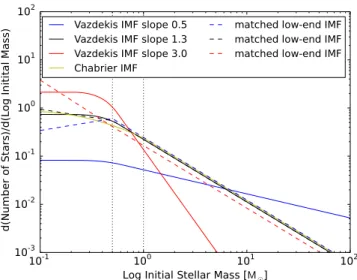
Figure 1. The IMF for the two parametrizations used throughout this work. The yellow solid line depicts the Chabrier IMF. The other solid lines are for the Vazdekis IMF (Vazdekis et al.1996), which is parametrized by its high-end slope. The indicated IMF slopes for the blue-, black- and red curves correspond to an [M/H] value in equation (1) of respectively−0.55,−0.29 and 0.26. Dashed lines show our corresponding low-end IMF, for which the slope below 0.5 Mis the free parameter. Lines with the same colour are matched on the dwarf-to-giant ratio, equation (3), defined as the ratio of the mass in stars below 0.5 Mwith respect to the mass in stars below 1.0 M. These mass regimes are indicated with the vertical dotted lines. The same dwarf-to-giant ratio, as measured from IMF sensitive spectral lines (Mart´ın-Navarro et al.2015c), can be accommodated by vastly different IMFs.
mass), see Fig.1. It is customary to define this IMF slope to be positive for a descending curve.
Mart´ın-Navarro et al. (2015c) report a strong trend of the IMF slope with metallicity, expressed in their equation 2:
b=2.2(±0.1)+3.1(±0.5)×[M/H], (1)
where [M/H] is the logarithm of the metallicity with respect to solar3and
b is the IMF slope above a stellar mass of 0.6 M
in the bimodal IMF parametrization of Vazdekis et al. (1996).4In
this work we will refer to this IMF parametrization as the Vazdekis IMF. We show some examples of this IMF for different values of bin Fig.1. This Vazdekis IMF has a slope of zero below a stellar
mass of 0.2 and a spline from 0.2 Mto 0.6 M. The spline is normalized such that the endpoints would be the same if the IMF of the two outer parts would be interpolated and matched at 0.4 M. The IMF is defined between 0.1 Mand 100 M. Equation (1) is a fit to spectroscopic IMF determinations from local CALIFA mea-surements, SDSS measurements and radial profile measurements of three ETGs by Mart´ın-Navarro et al. (2015c). These three data sets use a similar spectroscopic IMF analysis on different sources and give consistent results, as can be seen from fig. 2 of Mart´ın-Navarro et al. (2015c).
The aim of this paper is to apply this relation on a galaxy-by-galaxy basis to a large sample of SDSS galaxies and to investigate
3Note that the inferred high-end IMF slope is quite high for solar metallicity (b = 2.2 forZ=0.019) which is possibly in tension with local IMF measurements, although adopting a solar metallicity ofZ=0.012 lowers the inferred IMF slope tob=1.58.b=1.3 is reached forZ=0.010.
the potential consequences of such a metallicity-dependent IMF. We use the stellar metallicity measurements of Gallazzi et al. (2005) as input for the metallicity-dependent IMF. In doing so we implicitly assume that these metallicity measurements themselves are not de-pendent on the IMF. This will not be completely accurate, but it is a valid approximation, since the typically IMF-dependent metal line indices TiO and NaD are excluded from the metallicity measure-ment of Gallazzi et al. (2005). They concentrate on those indices that are best reproduced by the Bruzual & Charlot (2003) models with a fixed IMF.5A recent mass–metallicity relation measurement
by Gonz´alez Delgado et al. (2014) with the CALIFA integral field spectrograph for a sample of 300 galaxies, ranging from ellipticals to late-type spirals, agrees well with the SDSS measurements by Gallazzi et al. (2005). At a given mass, the scatter in the metallicity is expected to be mostly intrinsic, rather than due to measurement uncertainties (see fig. 8 of Gallazzi et al.2005).
The spectroscopic IMF determination of Mart´ın-Navarro et al. (2015c) relies on the light being dominated by old stars. Therefore these measurements are done exclusively for ETGs. We will assume that the same relation holds also for star-forming galaxies. Of course there is a possibility that a metallicity–IMF relation will manifest itself differently in star-forming galaxies, but large differences are not expected, since the IMF is literally a property of the galaxy during star formation. Hence, for any given ETG, the measured IMF corresponds to the time when most of its stellar mass was build up, at which time it would be classified as a star-forming galaxy. There is a possibility of a redshift dependence of equation (1), which could mean that it would be different for ETGs and star-forming galaxies observed at redshift zero, but here we will assume that the IMF is solely determined by the local gas metallicity during star formation and does not depend directly on redshift. The measured stellar metallicity reflects this local gas metallicity during star formation.
Another simplifying assumption of our analysis is that we ne-glect metallicity gradients and characterize each galaxy by a single metallicity. This is justified by the fact that the IMF determina-tions of galaxy regions by Mart´ın-Navarro et al. (2015c) lie on the same metallicity-dependent trend as that of complete SDSS galax-ies. Another caveat is that the CALIFA ETG sample consists mostly of high-velocity dispersion galaxies. We assume that the reported IMF–metallicity trend for this sample is representative for all galax-ies. We will see that the implications of this IMF trend for inferred galaxy properties are most prominent at high masses and therefore are not expected to be affected much by this assumption.
The two main galaxy properties that we want to adjust to a metallicity-dependent IMF are galaxy stellar mass and star for-mation rate. We use the SDSS masses and star forfor-mation rates from Chang et al. (2015) and ther-band weighted ages from Gallazzi et al. (2005). We match on Plate ID, Fibre ID and modified julian date and select the galaxies with a well-defined metallicity and age in Gallazzi et al. (2005). This leaves a sample of 186 886 SDSS galaxies.
To recompute the galaxy masses, for each galaxy we compare the CousinsR-band mass-to-light ratio of a simple stellar population
5The metallicities measured by Mart´ın-Navarro et al. (2015c) are expected to deviate slightly from those of Gallazzi et al. (2005). Generally the age-sensitive features (e.g. Hβ) have a slight sensitivity to the IMF (La Barbera et al.2013), which results in slightly younger ages and thus slightly higher metallicities for a bottom-heavy IMF with respect to a Chabrier IMF.
(SSP) with the given metallicity and age and a Chabrier IMF6to the
mass-to-light ratio of an SSP with the same metallicity and age, but with the IMF implied by equation (1). We verified that the results are almost the same if we use the JohnsonV-band or the SDSS
r-band.
All results in this paper are obtained with the flexible stellar population synthesis (FSPS) code of Conroy & Gunn (2010), but
where possible we verified that very similar results are obtained by using the tables from the MILES website. Metallicities are restricted to the range for which there are BaSTI isochrones (Pietrinferni et al.2013),−1.80<log10(Z/Z)<0.32, for a solar metallicity
of Z =0.019 (which is used throughout this paper). The FSPS spectra are generated for IMF slope values binned with a separation ofδ=0.1. Then theM/LRvalues are interpolated in the
three-dimensional space of (log age, metallicity, IMF slope).
We apply equation (1) slightly outside the metallicity regime of the observations by Mart´ın-Navarro et al. (2015c) (−0.40< log10(Z/Z)<0.25). The highest metallicity in Gallazzi et al.
(2005) is log10(Z/Z)=0.417. At the low-metallicity-end we
ex-trapolate to log10(Z/Z)= −0.60 or equivalently a Vazdekis IMF
slope of 0.34, and keep the IMF constant for lower metallicities. This extrapolation, necessitated by a lack of measurements for galaxies in the metallicity range−1.80<log10(Z/Z)<−0.40, introduces
a large uncertainty in the predictions for these low-metallicity galax-ies. Equation (1) gives very shallow high-end IMF slopes for very metal-poor galaxies, thus much depends on the exact choice of the low-metallicity cut-off. Also, for shallow high-end IMF slopes, the results become quite sensitive to the precise high-mass cut-off that is used. For an IMF defined in between 0.1 M and 100 M, half of the initial mass is created in stars heavier than 50 M for a high-end IMF slope of zero. In equation (1) this happens at log10(Z/Z)= −0.71. At our adopted low-metallicity cut-off of
log10(Z/Z)= −0.6, 37 per cent of the stellar mass is created in
stars heavier than 50 M. It is good to keep in mind that the IMF measurements of Mart´ın-Navarro et al. (2015c) are still marginally consistent with a minimal high-end slope of 1.3 (Kroupa) for galax-ies with log10(Z/Z) < −0.29, in which case there would be a
bottom-heavy IMF for metal-rich galaxies, but no top-heavy IMF for metal-poor galaxies.
We may expect a top-heavy IMF for extremely low metallicities in theorised Population III stars, but the IMF in the intermediate metallicity regime is not well constrained. This metallicity regime is however probed by the IMF determination of Marks et al. (2012). They report an IMF dependence on metallicity for globular clusters that is qualitatively similar to Mart´ın-Navarro et al. (2015c). Their fit of the metallicity-dependent high-end IMF slope reaches 0.05 for the lowest metallicities (Z ≈ −2.5Z), so even lower than our adopted minimum value of 0.34. Fig.2shows the fraction of galaxies in our sample that fall below our adopted cut-off of the IMF–metallicity relation as a function of stellar mass for a Chabrier IMF. Below a mass of 109.2M
(from SED fitting with a Chabrier
6The Chabrier IMF (Chabrier 2003) is defined as dN d log10(M/M)=
A1exp[−
(log10(M/M)−log10(0.079))2
2×0.692 ] forM<1.0 Mand
dN d log10(M/M)=
Figure 2. The dashed line shows the fraction of galaxies below our adopted low-metallicity cut-off of the IMF–metallicity relation, equation (1), at log10(Z/Z)= −0.6. For masses below 109.2M, more than 50 per cent of the galaxies have a metallicity below this cut-off. The solid line shows the same fraction for the lowest metallicity in the sample of Mart´ın-Navarro et al. (2015c).
IMF) 50 per cent of the galaxies have a metallicity lower than the cut-off. A simple extrapolation of equation (1) would therefore enhance the effect of a top-heavy IMF at low metallicities with respect to the results reported in this work for low masses.
2.2 The matched low-end IMF
Another implicit extrapolation of the IMF determination from spec-tral indices by Mart´ın-Navarro et al. (2015c) is contained in the parametrization used for the IMF. Although the free parameter of the Vazdekis et al. (1996) IMF parametrization is the high-end IMF slope, this high-end slope is not directly measured. Mart´ın-Navarro et al. (2015c) state that the IMF sensitive features more closely trace the dwarf-to-giant ratioF0.5, as defined in La Barbera et al. (2013):
F0.5=
0.5M
0.1M M(M)dM
100M
0.1M M(M)dM
, (2)
which denotes the initial mass fraction in stars below 0.5 M. In fact, since most ETGs contain very few stars more massive than 1.0 M, beyond this mass the inferred IMF is more sensitive to the parametrization than to the direct observations. It would be interesting to see whether the use of an IMF parametrization for which the low-mass end varies in the analysis of Mart´ın-Navarro et al. (2015c), would indeed give similar results in terms of the trend between metallicity andF0.5.
In this work, apart from the Vazdekis IMF parametrization, we will also use an alternative ‘low-end’ IMF parametrization in which the IMF slope below 0.5 Mis varied and the slope above 0.5 M is fixed at the standard Kroupa value of 1.3. Instead of matching the Vazdekis IMF slope to the low-end slope that yields the same
F0.5, we match the two IMF parametrizations by requiring the same
value ofF0.5/F1.0:
F0.5/F1.0=
0.5M
0.1M M(M)dM
1.0M
0.1M M(M)dM
. (3)
Matching directly onF0.5would not eliminate the implicit
extrapo-lation of the Vazdekis IMF to high masses.
For a shallow Vazdekis IMF slope,F0.5can become very small,
but this does not mean that the stars below 0.5 Mdo not give a significant contribution to thecurrentmass- or light-budget of the galaxy, since all the high-mass stars have turned into stellar rem-nants. Matching the two IMF parametrizations onF0.5/F1.0 more
closely preserves the actually measured signal related to the dwarf-to-giant ratio. In principle one could choose to tune the mass pa-rameter inFMseparately for each galaxy, depending on its age, but
we chose to fix this value at 1.0 M. The fact that the TiO2and
TiO1indices in La Barbera et al. (2013) do not depend much on
the SSP age below 10 Gyr (see their fig. 4) shows that even for ETGs that have some stars with masses above 1.0 M, these will not dominate the measured IMF signal.
Throughout this paper we will present results for the two IMF parametrizations described above, but one should keep in mind that any normalized linear combination of the two, distributing the metallicity-dependent dwarf-to-giant ratio variations over the low-and high-end IMF slopes, would also be in agreement with the data from Mart´ın-Navarro et al. (2015c). Fig.1shows some examples of IMFs for the two different parametrizations that are matched on
F0.5/F1.0.
2.3 Star formation rates
In order to estimate the changes to the inferred star formation rates due to a variable IMF, we compare the magnitudes in several ultra-violet bands for a 100 Myr old constant star formation rate popu-lation, implemented with the help of theFSPScode. We do this for
each galaxy in the sample, interpolating the metallicity between the discrete BaSTI values and the IMF slope on a 0.1 width grid. As SFR tracers we use the SDSSu-band, theGALEXFUV band and the total intensity of ionizing radiation obtained from integrating the FSPS spectra up to 912.0 Å.7These three different bands are
sensitive to star formation on different time-scales. The FUV-band magnitude of a galaxy with a constant star-forming rate levels off after about 100 Myr (although this is an IMF-dependent statement), with Hα(which tracks the ionizing luminosity) being sensitive to shorter time-scales and theu-band to much longer time-scales. Part of the high energy photons that are emitted by the young massive stars will be absorbed by dust and re-emitted in the infrared. For our purposes this is a second-order effect. Assuming that the infrared output from dust is in equilibrium with the input in energetic radia-tion from massive young stars, it scales in a similar way with IMF changes as the UV emission.
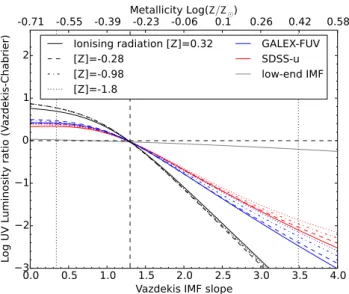
Fig.3shows how the luminosity in different bands of a 100 Myr old constant star formation rate population changes with respect to a Chabrier IMF as a function of the assumed Vazdekis slope. There is a slight dependence on the metallicity of the stellar population (the metallicity–IMF relation has not yet been implemented here). The SDSS-u,GALEX-FUV and total ionizing luminosity show similar offsets. For a shallow Vazdekis IMF slope (i.e. a low metallicity) most star formation goes into massive stars and the different tracers can indicate, if interpreted using a Chabrier IMF, an SFR up to an order of magnitude too high. For a steep Vazdekis IMF slope (i.e. a high metallicity) mostly dwarf stars are formed and the luminosity in the given bands drops dramatically by up to three orders of
Figure 3. The luminosity ratio of a 100 Myr old constant star formation rate stellar population with a Vazdekis IMF with the given high-end slope and that of the same stellar population with a Chabrier IMF. The top horizontal axis gives the metallicities corresponding to the IMF slopes via equation (1). Different colours depict different bands: black for for the total luminosity in ionizing radiation, blue for theGALEX-FUV band and red for the SDSS-u band. Different line styles depict different metallicities. The black dashed horizontal and vertical lines depict the Chabrier values and the black dotted vertical lines show the minimum and maximum values of the Vazdekis IMF slope that are used in this work. The implied correction to the star formation rate when switching from the Chabrier to the Vazdekis IMF is the inverse of this luminosity ratio. These implied SFR changes span orders of magnitude. The much smaller luminosity ratio between the low-end IMF and the Chabrier IMF is indicated by the solid grey curve. It does not depend on the choice of UV-band.
magnitude. The difference between the FUV luminosity and the luminosity in ionizing radiation also implies a calibration offset between the FUV-SFR and Hα-SFR that can exceed an order of magnitude.8
For our sample of observed galaxies we adjust the SFR on a galaxy-by-galaxy basis by the inverse of the luminosity ratio of Fig.3. For each galaxy we use the Vazdekis IMF slope implied by the IMF–metallicity relation, equation (1). As a conservative estimate of the implied SFR change, we use the ratio of luminosities in theGALEX-FUV band.
For the ‘low-end’ IMF parametrization, shown in grey in Fig.3, the SFR changes are much smaller than for the ‘Vazdekis’ case. Moreover, the implied changes are in this case nearly identical for the different bands and metallicities. This is because the ‘low-end’ IMF changes the reservoir of stars that are formed below 0.5 M, while keeping the IMF slope above 0.5 Mfixed. Because dwarf stars withM<0.5 Mgive a negligible contribution to the luminosity in these bands, the only effect is that of a change in the overall normalization of the high-mass end of the IMF.
2.4 Stellar masses
Fig.4shows the galaxy mass changes caused by a switch from a Chabrier IMF, depending on metallicity andr-band weighted age. The mass change is determined by the change in mass-to-light ratio
8A similar offset in the Hα-UV flux ratio appears in the IGIMF theory for low-SFR galaxies (Pflamm-Altenburg, Weidner & Kroupa2009).
Figure 4. The implied stellar mass changes of galaxies resulting from switching from a Chabrier IMF to a metallicity-dependent IMF, equation (1), for a fixed observed luminosity. The double horizontal axis reflects this equation. The mass changes are based on the change in mass-to-light ratio in the CousinsR-band for a galaxy with a fixed age and metallicity. Different line colours represent different SSP ages. The dashed lines represent the low-end IMF parametrizations matched to the Vazdekis IMF onF0.5/F1.0, equation (3). The black dashed lines depict the Chabrier values and the black dotted vertical lines show the minimum and maximum values of the Vazdekis IMF slope used in this work. The stellar mass increase at high metallicities is due to dwarf stars. The slight stellar mass decrease for low metallicity and a low-end IMF is due to a shortage of dwarf stars. The Vazdekis IMF shows an increase in mass in this region due to stellar remnants. A similar plot for a constant star formation rate instead of a simple stellar population is shown in the appendix, Fig.A2.
in the CousinsR-band. Galaxies are represented by a simple stellar population. This is a much better approximation for the ETGs used in the IMF determination of Mart´ın-Navarro et al. (2015c) than for actively star-forming galaxies. This simplification of the star formation history is justified in the appendix by comparing results from an SSP with those from a constant star formation history. Qualitative differences only show up for low-metallicity galaxies in the Vazdekis IMF parametrization.
Fig.4shows that for steep Vazdekis IMF slopes, or equivalently high metallicities, switching from a Chabrier IMF to a Vazdekis IMF can increase the inferred stellar mass by more than an or-der of magnitude due to an increase in the fraction of dwarf stars. Most of these metal-rich galaxies are old though, which results in a mass change of approximately 0.6 dex. For metal-poor galaxies, the increased fraction of stellar remnants can induce a mass increase of 0.2−0.65 dex. For the low-end IMF the expected stellar mass changes are much smaller, ranging from−0.06 dex at low metallic-ities due to a shortage of dwarf stars to 0.29 dex at high metallicmetallic-ities due to an excess of dwarf stars. Mass changes for the low-end IMF are almost independent of age.
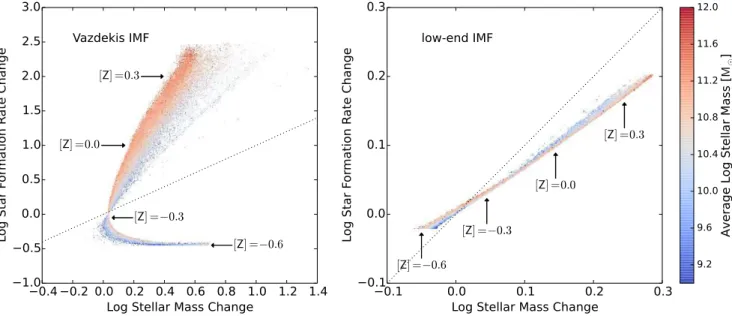
Figure 5. The implied stellar mass change and star formation rate change with respect to observations that assume a Chabrier IMF for a sample of SDSS galaxies that obey the IMF–metallicity relation of Mart´ın-Navarro et al. (2015c), equation (1), with metallicities from Gallazzi et al. (2005). The colour scale indicates the average log stellar mass of the galaxies in each pixel. Some typical metallicity values are indicated with arrows. The black dotted line depicts a constant specific star formation rate. The left-hand panel assumes the Vazdekis IMF parametrization for which the free parameter is the high-end IMF slope. The right-hand panel assumes our low-end IMF parametrization, for which the free parameter is the low-end IMF slope. Both panels show large changes, but the ‘Vazdekis’ case has much more drastic consequences, with star formation rate changes of over two orders of magnitude. At a given metallicity, any normalized linear combination of these two IMFs would be in agreement with the IMF measurements from line indices by Mart´ın-Navarro et al. (2015c).
3 S TA R F O R M AT I O N M A I N S E Q U E N C E
Fig.5shows the mass and SFR changes relative to a Chabrier IMF implied by the metallicity-dependent IMF from Mart´ın-Navarro et al. (2015c), equation (1), for 186 886 SDSS galaxies. The left-hand panel shows the results for the Vazdekis IMF parametrization and the right-hand panel shows the results for the low-end IMF parametrization. The large difference between both panels clearly shows that the effects of the IMF change is more sensitive to the IMF parametrization, rather than to the direct measurements of Mart´ın-Navarro et al. (2015c).
The ‘Vazdekis IMF’ panel shows two tails emanating from the (zero SFR change, zero mass change) point. The lower tail con-sists of low-metallicity galaxies, which have a shallow high-end IMF slope. This results in a negative SFR correction, since there are fewer dwarf stars formed than for a Chabrier IMF. The stel-lar mass correction for most of these galaxies is positive though, because of invisible mass locked up in stellar remnants. The maxi-mum extent of this effect depends in part on the assumed cut-off in equation (1) below log10(Z/Z)= −0.6. The upper tail consists of
high-metallicity galaxies, which have a steep high-end IMF slope. These have more star formation in dwarf stars than for a Chabrier IMF, which results in an increase of the inferred star formation rate of up to two orders of magnitude. The increase in stellar mass is smaller, which means that the specific star formation rate (SSFR) is increased as well.
The effect for the ‘low-end’ IMF parametrization is much smaller (especially for the SFR) but still significant. In this case the whole effect can be understood in terms of how much mass is locked up in dwarf stars, since the IMF slope above 0.5 Mis kept fixed. Naively one might think that the specific star formation rate should remain unchanged in this case, since the percentage of extra dwarf stars formed in current star formation is the same as the percentage of extra dwarf stars locked up from older generations. This would be true if the SSFR were defined as the SFR divided by the total
initial stellar mass formed, but it is instead defined with respect to the current stellar mass (Hopkins & Beacom2008). The current total stellar mass is lower than the initial stellar mass, because of mass loss by intermediate-mass and massive stars. This means that for an IMF with relatively more dwarf stars, there is an extra relative ‘increase’ of stellar mass with respect to the Chabrier case, caused by a diminished stellar mass loss (and thus a diminished difference between the initial stellar mass and the current stellar mass). This means that the change in stellar mass is larger than the change in SFR and thus that the SSFR decreases. The opposite happens in the case where the ‘low-end’ IMF has fewer dwarf stars than the Chabrier IMF. This causes the pattern in the second panel of Fig.5, which shows the displacement of the galaxies in the mass-SFR plane. The change in SFR is roughly two thirds of the change in mass.
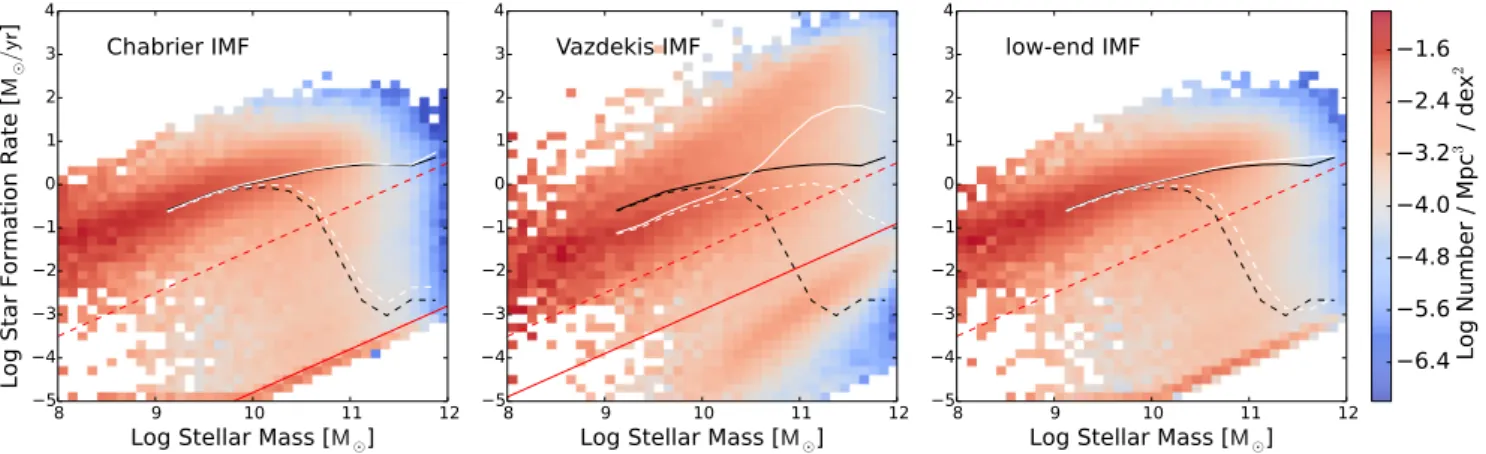
Fig.6shows the effect of the metallicity-dependent IMF on the star formation main sequence. The left-hand panel shows the mass-SFR relation for the selection of 186,886 galaxies out of the 858 365 SDSS galaxies of Chang et al. (2015) that have a well-defined metal-licity and age determination by Gallazzi et al. (2005). The running median SFR of star-forming galaxies with SSFR> 10−11.5yr−1,
black solid line, coincides with that for the complete Chang et al. (2015) sample (solid white line). Therefore, we expect no signifi-cant selection effects for the main sequence. The running median for the complete sample (black and white dashed lines) shows a slight under-representation of quiescent galaxies in our sample with re-spect to the complete Chang et al. (2015) sample. The colour scale in Fig.6represents the number of galaxies per Mpc3, per dex
stel-lar mass, per dex SFR. Individual galaxies have been weighted by 1/Vmaxfrom Chang et al. (2015), correcting for the maximum
Figure 6. The inferred star formation rate as a function of inferred stellar mass for different IMFs. The left-hand panel shows the matched sample of SDSS galaxies with metallicities from Gallazzi et al. (2005) and masses and star formation rates from Chang et al. (2015), assuming a Chabrier IMF. The middle panel shows the results for the metallicity-dependent Vazdekis IMF, as described in Fig.5. The right-hand panel shows the effect of a low-end metallicity-dependent IMF. For ease of comparison, the medians of the matched sample with the Chabrier IMF have been plotted in black in all panels: dashed lines denote the median for all galaxies and solid lines denote the median for all star-forming galaxies (defined as those galaxies with a SSFR larger than 10−11.5yr−1, indicated with a red dashed line). White lines in the left-hand panel show the medians for the complete sample from Chang et al. (2015). In the middle and right-hand panels the white lines show the medians of the underlying distributions. The excellent agreement between the white and black solid lines in the left-hand panel shows that our selection on galaxies for which stellar metallicities are available, does not introduce a bias. The red solid line in the left-hand panel demarcates the boundary below which the star formation rates should be regarded as upper bounds. The region below the red solid line in the middle panel is contaminated by these upper bounds. The middle panel shows that the metallicity-dependent Vazdekis IMF has a large influence on the mass-SFR relation, while the low-end metallicity-dependent IMF in the right-hand panel has only a small effect. Any normalized linear combination of these two cases would be in agreement with the IMF measurements from line indices by Mart´ın-Navarro et al. (2015c).
The middle and right-hand panels show the effect of the metallicity-dependent dwarf-to-giant ratio for respectively a Vazdekis IMF parametrization and a low-end IMF parametrization, as described in Section 2. The Vazdekis IMF has a dramatic influ-ence on the star formation main sequinflu-ence (compare the black and white solid lines in the middle panel). Below a mass of∼1010.5M
the dominant effect is from metal-poor galaxies which lower the me-dian inferred SFR by∼0.5 dex relative to a Chabrier IMF. Above this mass the dominant effect is from metal-rich galaxies which increase the median SFR, effectively extending the SSFR main se-quence up to a stellar mass of∼1012M
and making it more linear. We used a running median to represent the typical galaxy at each mass. The true average SFR at low masses is actually increased, because of an increase in the scatter.
The increased scatter in this plot could indicate that the underlying metallicity–IMF relation or the Vazdekis parametrization of the IMF is wrong, because in general a more precise description will cause a decrease in the observed scatter. This is not necessarily the case though. Apart from measurement or modelling errors in the metal-licity, the increased scatter could also be an intrinsic property of the galaxy population. For a galaxy population that truly follows the assumed Vazdekis IMF–metallicity trend, the middle panel would indicate the total star formation, but the left-hand panel would still indicate the effective high-mass star formation. It is possible that the high-mass star formation is better behaved than the total star formation. For a varying IMF these two quantities are no longer directly linked to each other, but it is the high-mass star formation that determines the stellar feedback. It could well be that this causes the high-mass star formation to be regulated, whereas the increased dwarf star formation for metal-rich galaxies could create a runaway process of star formation that is less regulated and therefore shows a larger galaxy-by-galaxy variation at a given mass. We will discuss this possibility in Section 6.
The right-hand panel shows results for the low-end IMF parametrization. For this parametrization there is almost no effect
at low masses and at high masses the star formation main sequence is prolonged to slightly higher masses. The effect on the median for star-forming galaxies is especially small, since individual galaxies are displaced almost parallel to lines of constant SSFR, along the main sequence, see also Fig.5. In practice one could construct an IMF parametrization in between the two options described here, for which part of the observed trend of the IMF sensitive line in-dices would be caused by a changing low-end IMF slope and part would be caused by a changing high-end slope. The effects on the mass-SFR plot would fall somewhere in between the middle and right-hand panels of Fig.6. Qualitatively this means an extension of the star formation main sequence together with a possible lowering of the median SFR at low masses, but quantitatively the magnitude of this effect is not well constrained by current observations.
Fig. 7 shows the inferred low-redshift SFR densities of the Universe as a function of galaxy mass. The effect of a low-end metallicity-dependent IMF is quite small, shifting the star forma-tion to higher masses by about 0.2 dex. The implied increase of the total SFR density of galaxies more massive than 109M
is a factor of 1.11. For the Vazdekis IMF this is a factor of 16.6. The effect is much stronger, with a large peak of dwarf star formation around M∗,SSP≈1011.3M.
4 G A L A X Y S T E L L A R M A S S F U N C T I O N
Figure 7. The inferred star formation rate density as a function of the inferred stellar mass for the sample of SDSS galaxies with different IMFs. The black line shows the original estimate for a Chabrier IMF. The red line corresponds to the metallicity-dependent Vazdekis IMF and the blue line corresponds to the metallicity-dependent low-end IMF. The increased number of dwarf stars for metal-rich galaxies causes a very large increase in the inferred SFR, which peaks around a mass of 1011.3M
for the Vazdekis IMF. For the low-end IMF the effect is much more subtle.
Figure 8. The difference in stellar mass estimates between a metallicity-dependent IMF and a Chabrier IMF as a function of the stellar mass inferred for a Chabrier IMF for the sample of 186 886 SDSS galaxies. The red line and shaded region show the median and the 10–90 per cent region for the Vazdekis IMF. Blue corresponds to the low-end IMF. The black dashed and dotted lines depict the Chabrier and Salpeter IMFs, respectively.
dwarf stars. Nevertheless, the overall effect is insensitive to mass, with a large scatter at all masses. Thus, metallicity-dependent IMF changes do not necessarily create a clear trend ofM∗true/M∗Chabrier
withM∗Chabrier, where the latter is obtained through SED fitting.
The low-end IMF parametrization gives smaller mass changes, but it does produce a clear trend ofM∗true/M∗Chabrier withM∗Chabrier,
with a progressively larger IMF-induced mass correction towards higher masses.
In Fig.9we show the effect on the galaxy stellar mass function inferred from the observations of Moustakas et al. (2013). Galaxies are scattered as a function of mass according to the exact distri-bution underlying Fig.8. For galaxies below a mass of 109M
we extrapolate the Moustakas mass function with a slope of 0.41
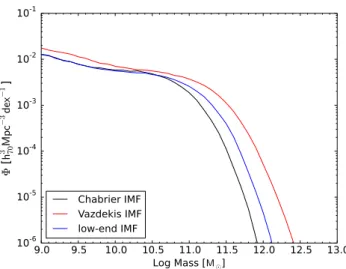
Figure 9. The galaxy stellar mass function inferred from observations of Moustakas et al. (2013) for several IMFs: Chabrier (black), metallicity-dependent Vazdekis IMF (red) and metallicity-metallicity-dependent low-end IMF (blue). For both metallicity-dependent IMFs the knee of the mass function shifts to higher masses, but the steepness of the drop-off is hardly affected.
and we apply the mass changes corresponding to the lowest 0.1 wide mass bin at 109M
. For both IMF parametrizations the knee of the mass function shifts to a higher mass, but the steepness of the high-mass drop-off is not affected much. The abrupt nature of this drop-off is generally believed to be caused by the feedback of active galactic nuclei (AGN). This AGN feedback should be very effective at quenching high-mass galaxies in order to prevent more massive galaxies from forming. A metallicity-dependent IMF does not remove the need for such an efficient quenching mechanism at high masses, it only shifts the mass at which this quenching occurs, which can also be seen in Fig.6. The IMF changes also imply a change in the total stellar mass density of the Universe. The total stellar mass density in galaxies above 109M
increases by a factor of 1.33 for the low-end IMF and by a factor 2.31 for the Vazdekis IMF.
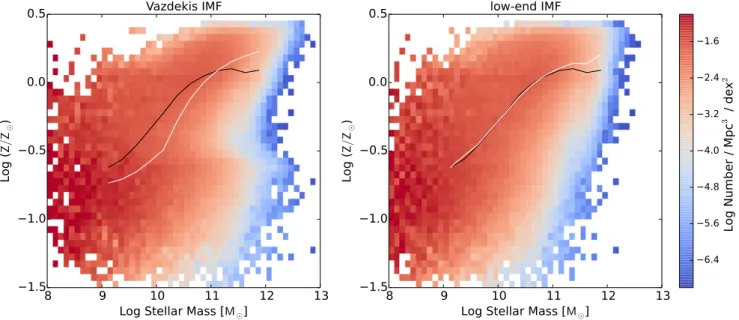
Figure 10. The effect of a metallicity-dependent IMF on the inferred stellar mass–metallicity relation from Gallazzi et al. (2005). The left-hand and right-hand panels show the results for respectively the Vazdekis and the low-end IMF parametrizations. White solid lines indicate the running median and the black solid line indicates the running median for a universal Chabrier IMF. In both panels the mass–metallicity relation shows considerably less flattening at high masses for the variable IMF. In the ‘Vazdekis IMF’ panel there is a clear feature of galaxies shifting to the right at log10(Z/Z)≈ −0.6. The reason that this shift remains constant below log10(Z/Z)= −0.6 is that we do not extrapolate the IMF–metallicity relation, equation (1), below this metallicity, which is a somewhat arbitrary choice. This mass shift is due to stellar remnants that are created by a presumably more top-heavy IMF at low metallicities. The ‘low-end’ panel does not have this feature. The effect of extrapolating below log10(Z/Z)= −0.6 in this panel would be a slight shift to the left instead of to the right.
5 M E TA L S
We used the stellar mass–metallicity measurements of Gallazzi et al. (2005) as input for the metallicity-dependent IMF. However, a metallicity-dependent IMF will alter the stellar masses of these observed galaxies and will therefore change the mass–metallicity relation. Fig.10shows the effect that this has for both the Vazdekis IMF and the low-end IMF. Solid white lines in both panels show the running median metallicity for the Vazdekis (left-hand panel) and low-end (right-hand panel) IMFs, while the black curve indi-cates the median metallicity for a universal Chabrier IMF. In both cases the mass–metallicity relation is steeper at high mass for the metallicity-dependent IMF than for the Chabrier IMF. We used the same weighting with 1/Vmaxas in Fig.6.
The behaviour at low metallicity is different for the two parametrizations. In the Vazdekis case we see a clear shift to higher masses forZ< Z. At the low-metallicity end this shift is caused by a progressively more top-heavy IMF for lower metal-licities and the resulting mass gain is comprised of stellar remnants. We did not extrapolate the IMF–metallicity trend, equation (1), be-low log10(Z/Z) = −0.6, otherwise this shift to the right in the
left-hand panel of Fig.10would get more prominent towards lower metallicities, as can be seen in Fig.4.
The mass–metallicity relation inferred from the low-end IMF is much less sensitive to this extrapolation and the effect goes in the opposite direction. Since in this case the high-end IMF slope is kept fixed, the net effect of extrapolating to lower metallicities would be to have an IMF that is increasingly deficient inM<0.5 Mstars. The resulting galaxies would be less massive than suggested by SED fitting with a Chabrier IMF. This would shift the galaxies in the right-hand panel of Fig.10at metallicities below log10(Z/Z)= −0.6
slightly to the left. This effect is much less drastic than for the Vazdekis case as it is clearly bounded from below by having no
Figure 11. The total metal mass released by a simple stellar population over its lifetime as a function of metallicity for the metallicity-dependent Vazdekis IMF, the corresponding low-end IMF and the Chabrier IMF. The metal release for different stellar masses and stellar stages are taken from Portinari et al. (1998) and Marigo (2001). The trends are primarily due to changes in the IMF with metallicity and to a lesser extent due to a metallicity-dependence in the metal output of individual stars. Dotted vertical lines show the minimum and maximum values of the metallicity used in this work.
stars below 0.5 M, whereas in the Vazdekis case the ratio of observed stars over remnants is not bounded.
Bressan (1998) and Marigo (2001). There are two ways in which the metal release of a simple stellar population depends on metallic-ity. First, through a metallicity dependence of the metals released by individual stars, but the more significant contribution comes from the metallicity dependence of the IMF, especially for the Vazdekis IMF. In this case, a galaxy would presumably start out on the left, with a low metallicity, a top-heavy IMF and a high metal output. During the lifetime of a galaxy on average its metallicity will grow and as a result it will shift to the right in this graph, towards a more bottom-heavy IMF and a lower metal output. Apart from a boost in the metal release, the early top-heavy IMF will leave not much evidence, because these metal producing stars will have been turned into stellar remnants. The metal output inferred from the integrated contribution of SFR observations at higher redshifts over time would not change drastically though, since these SFR obser-vations effectively measure the formation rate of high-mass stars. These are exactly the stars that produce the metals.
The same situation applies to ionizing radiation, because the bulk of the ionizing radiation and metals are produced by the same massive stars. In principle reionization would get a head start due to an early top-heavy IMF. For redshifts where we have representative Hα-based SFR measurements, the IMF–metallicity relation should not change the implied ionizing photon production much, but for higher redshifts the IMF effect on reionization can potentially be large.
6 R A P I D G A L A X Y Q U E N C H I N G
The distribution of galaxies in a colour–magnitude plot is observed to follow a bimodal pattern (e.g. Strateva et al.2001; Bell et al.
2004), with most galaxies being classified as either a ‘red sequence’ or a ‘blue cloud’ galaxy. The red sequence is comprised of red, mostly elliptical galaxies and the blue cloud is comprised of blue, mostly spiral galaxies. Galaxies that fall in between those categories are called ‘green valley’ galaxies. They are believed to be mostly galaxies that are currently quenching, making the transition from the blue cloud to the red sequence (e.g. Trayford et al.2016).
A similar classification of galaxies can be made based on stellar mass and specific star formation rate, although this may depend on the type of SFR estimator used. A short-time SFR indicator like Hαmay be inherently more bursty, so a quiescent galaxy based on the HαSFR may not be quiescent based on theu-band SFR. Regardless of this ambiguity in defining a green valley galaxy, in general relatively few galaxies are in this ‘in between’ state. This suggests that the quenching of a typical galaxy is a fast process. Also, especially at high masses, quenching needs to be very effective to explain the sharp drop-off in the number density of high-mass galaxies beyond the knee of the galaxy mass function.
A bottom-heavy IMF at the late stages of galaxy evolution could help speed up the last phase of the quenching process, because it produces less feedback per unit mass of stars formed and because it shortens the gas consumption time-scale inferred from the observed galaxy properties. Fig.5shows that a metallicity-dependent IMF can cause the inferred SFR to increase by of up to 2.5 orders of magnitude relative to a Chabrier IMF (although the implied SFR changes are much smaller if the IMF changes apply to the low-end IMF slope rather than the high-low-end IMF slope). The implied gas consumption time-scale,9 τ
gas=1.33(MHI+MH2)/SFR, i.e.
the time-scale for the galaxy to run out of its current cold gas reserve,
9The factor of 1.33 captures the contribution from helium.
scales with the inverse of the SFR and will thus be significantly shortened. On the other hand, the expected stellar feedback for a galaxy with such a bottom-heavy IMF will not change much, because the observed SFR already effectively represents the SFR in high-mass stars.
A late time bottom-heavy IMF for massive present-day galax-ies would help to explain the bimodal distribution of galaxgalax-ies in another way. It would make the quenched galaxies effectively less quenched, because most of their star formation is in dwarf stars, the star formation rates implied by the observations would be higher. The requirements on the efficiency of the feedback process that is responsible for preventing gas accretion and for the ejection of gas lost by evolved stars would thus be reduced.
The higher SFRs imply shorter gas consumption time-scales. Previous work on the effect of a variable IMF on gas consumption time-scales has been done by Pflamm-Altenburg & Kroupa (2009) in the context of the IGIMF model. They report a gas consump-tion time-scale of 3 Gyr, that does not depend on the neutral gas mass for dwarf irregular and large disc galaxies alike. Table1lists the median values for the gas consumption time-scale implied by the SFR changes and the measurements of total HI plus H2 gas
from the GASS and COLD GASS surveys (Catinella et al.2010; Saintonge et al.2011). For a universal Chabrier IMF the median gas consumption time-scale is almost constant over the mass range from 1010M
to 1011.5M
at a value of≈2×10⁹yr. Over the
same mass range a metallicity-dependent Vazdekis IMF implies a progressively shorter median gas consumption time-scale for more massive galaxies, with a decrease by a factor of 32 to a value of 67 million years for the most massive galaxies. If this star formation were to be sustained for longer periods, it would require an efficient refueling of the cool gas reservoir of 50 Myr−1(in which case
the refueling rate equals the star formation rate). We can compare this rate to the rate of gas accretion on to the halo. For this we use the stellar mass-halo mass relation from Behroozi et al. (2010) to determine the halo mass (where we always use the Chabrier IMF) and the corresponding halo gas accretion rate from Correa et al. (2015). At a stellar mass of 1010M
, the accretion on to the halo is about a factor of 2.5 larger than the median SFR, both for a uni-versal Chabrier IMF and for the Vazdekis IMF. For the Chabrier IMF this ratio becomes progressively larger for larger masses, but for the Vazdekis IMF it first drops, around the knee of the galaxy mass function, where the halo gas accretion rate is just marginally larger than the SFR, before rising again at the high-mass end.
In conclusion, the increased SFR, relative to Chabrier, for the metallicity-dependent Vazdekis IMF may require large cooling flows on to the galaxy, of the same order as the gas accretion rate on to the halo, and would imply very short gas consumption time-scales. The large gas accretion rates may be inconsistent with X-ray observations of galaxy clusters (e.g. Peterson et al.2003). Combin-ing the high-end metallicity-dependent IMF changes with changes to the low-end slope would reduce the magnitude of these effects. They would imply a speedup of the quenching process, especially around the knee of the galaxy stellar mass function.
7 C O N C L U S I O N S
Table 1. The first column gives some typical stellar mass values for a universal Chabrier IMF. The second column gives the corresponding median stellar mass for a metallicity-dependent Vazdekis IMF, from Fig.8. The third column gives the corresponding halo mass from Behroozi, Conroy & Wechsler (2010). The fourth column gives the median total HI plus H2gas mass from Bahe et al. (2016) and references therein. (∗) This measurement indicates a slight extrapolation beyondM≈11.3 M. There is at least a 0.5 dex uncertainty in this median gas mass value. The fifth and sixth columns give the median SFR for a Chabrier respectively Vazdekis IMF from Fig.6. The seventh column gives the halo gas accretion rate at the given halo mass from Correa et al. (2015). The accretion rates in the middle two lines are very close to the implied SFR for the Vazdekis IMF. The eighth and ninth columns give the median gas consumption time-scales for respectively a Chabrier and Vazdekis IMF, calculated from the corresponding star formation rates and the hydrogen gas mass (column four), including a correction for helium. The Chabrier IMF implies a nearly constant median gas consumption time-scale across 1.5 dex in mass, whereas the median gas consumption time-scale for a Vazdekis IMF decreases by a factor of 32 over this mass range.
log10(M) log10(M) log10 log10 SFR SFR Halo gas Gas consump- Gas
consump-Chabrier Vazdekis (MHalo) (MHI+H2) Chabrier Vazdekis accretion rate tion time tion time
[M] [M] [M] [M] [Myr−1] [Myr−1] [Myr−1] Chabrier [yr] Vazdekis [yr]
10.0 10.3 11.6 9.2 1.0 1.0 2.5 2.1×10⁹ 2.1×10⁹
10.5 10.8 12.1 9.5 1.8 7.1 8.0 2.3×10⁹ 5.9×10⁸
11.0 11.3 13.1 9.5 2.5 50 79 1.7×10⁹ 8.4×10⁷
11.5 11.8 14.9 9.4∗ 2.5 50 1×10⁴ 1.3×10⁹ 6.7×10⁷
IMF–metallicity relation given by equation (1) (Mart´ın-Navarro et al.2015c).
The measurement of IMF-specific spectral lines in ETGs by Mart´ın-Navarro et al. (2015c) is effectively sensitive to the cur-rent dwarf-to-giant ratio, equation (3). It is insensitive to the IMF slope for stellar massesM1.0 M, because of a sparseness of stars in this mass range in the observed ETGs and because of the relative insensitivity of the used line indices to stars in this mass range. The implications of this varying IMF for the masses and star formation rates of observed galaxies are however very dependent on the high-end IMF. For this reason we investigate two extreme cases. First, we use the IMF parametrization of Mart´ın-Navarro et al. (2015c), for which the high-end IMF slope is varied and the low-end slope is held fixed. We refer to this case as the ‘Vazdekis IMF’. Secondly, we use a ‘low-end’ IMF parametrization, for which the high-end slope is fixed at the Chabrier value and the slope below 0.5 Mis varied. Our main conclusions are as follows.
(i) When we match both IMF parametrizations on the current dwarf-to-giant ratio, the same observations lead to completely dif-ferent IMFs (Fig.1).
(ii) The trend between the high-end IMF slope and metallicity can imply large changes in the SFR inferred from observations, depending on the SFR tracer. Compared to a Chabrier IMF, the implied bottom-heavy SFR can be up to three orders of magnitude larger for the most metal-rich galaxies, with a calibration offset between the observed FUV-SFR and the Hα-SFR of up to an order of magnitude. The top-heavy IMF for metal-poor galaxies can reduce the inferred SFR by up to 0.8 dex. When we vary the low-end IMF slope instead of the high-end slope, the same IMF–metallicity trend causes much smaller SFR changes ranging from−0.02 dex to 0.20 dex and no FUV-HαSFR calibration offsets (Fig.3).
(iii) The stellar mass changes implied by the IMF–metallicity trend are also much smaller when the low-end IMF slope is varied (−0.06 dex< log10(M) < 0.29 dex) than when the high-end
IMF slope is varied (−0.06 dex < log10(M) < 1.25 dex). A
combination of a metallicity-dependent variation of the low-end and high-end IMF slope would cause a behaviour that is in between these two extremes (Fig.4).
(iv) The high-end slope of 1.3 for a Chabrier IMF (or a similar Kroupa/Canonical IMF) minimizes the total mass of old galaxies. Changing the high-end slope will always increase the inferred mass of the galaxy by either locking up more mass in dwarf stars or in stellar remnants (Fig.4).
(v) The implied combined mass-SFR changes for our sample of 186 886 SDSS galaxies are shown in Fig.5. When the high-end IMF slope is varied, metal-rich galaxies will become more massive and their SSFR will increase by up to two orders of magnitude. When changing the low-end IMF slope, the increase in mass is combined with a slight decrease in the SSFR.
(vi) Fig.6shows the effect of a variable IMF on the star-forming main sequence. The effect for the low-end IMF is mild, because most galaxies are displaced along the sequence. When changing the high-end slope the effect is large, especially at the high-mass end. The star-forming main sequence is effectively prolonged up to a stellar mass of 1012M
. In between 109M
and 1010M
the median SFR becomes lower, but the same does not hold for the average SFR, due to an increased scatter.
(vii) Increases in the total low-redshift SFR density range from a factor of 1.11 for the low-end IMF to a factor of 16.6 for the Vazdekis IMF, with a larger SFR contribution from galaxies around a mass of 1011.3M
(Fig.7).
(viii) If the metallicity-dependent IMF variations only affect the low-end slope, then they will produce a clear trend of the IMF-dependent mass change with SED-fitting mass (using a Chabrier IMF for the SED fit) (Fig.8). ForM1011M
a small fraction of galaxies will be more massive than for a Salpeter IMF. High-end IMF slope variations produce a larger mass change, possibly in tension with dynamic mass measurements, but no clear trend with Chabrier SED mass.
(ix) Independent of the IMF parametrization, the IMF– metallicity trend will produce a shift of the galaxy stellar mass function to higher masses, without changing the steepness of the high-mass dropoff much, see Fig.9. This means that these IMF variations do not remove the need for an efficient quenching mech-anism for high-mass galaxies, but they shift the mass at which this happens upwards by 0.2–0.5 dex. The implied total stellar mass density of the Universe increases by a factor of 1.3–2.3.
(x) The IMF–metallicity trend implies a steeper stellar mass– metallicity relation forM∼1011M
(Fig.10).