ISSN-L: 2501 - 1235 Available on-line at: www.oapub.org/edu
Copyright © The Author(s). All Rights Reserved.
doi: 10.5281/zenodo.1756827 Volume 5 │ Issue 2 │ 2018
A SURVEY INTO THE RELIGIOUS RITES
IN THE TRADITIONAL KIRKPINAR WRESTLING TOURNAMENT
AND THE RELIGIOUS BELIEFS OF THE WRESTLERS
Mehmet Haşim Akgül1, Ahmet Azmi Yetim2
1Mehmet Akif Ersoy University,
Scholl of Physical Education and Sports, Burdur, Turkey
2Gazi University,
Sports Sciences Faculty, Ankara, Turkey
Abstract:
All sportive activities known throughout history take place and have a meaning in a natural, social and cultural environment. Sports meets such human demands and desires as competition, heroism, strength, courage, etc. The sportman’s world of action and world of value are not cut off from each other in the sphere of sports, on the contrary, they are closely linked together as in other sections that shape and regulate the human life. For the human being is a being of value. This study deals with the Religious Rites in Kirkpinar Wresting Tournaments and the Religious Beliefs of the Wrestlers. Within the frame of historical and cultural background of Kirkpinar oil wrestling tournaments, the aim is to determine peshrev / ritualistic behavior of the wrestlers in these tournaments and implicit religious-historical sense of the world of wrestling competitions as well as the religious belief levels of the wrestlers that participate in the oil wrestling tournaments. In this regard, the Religious Worldview Scale was used on the samples selected among the wrestlers that participate in Kirkpinar Oil Wrestling Tournament. Certain results were reached through the use of data acquired from this scale. Appropriate statistical tests were applied for the analysis and assessment of the acquired data. In addition to the religious-historical background of the wrestling tournaments, the religious beliefs of the wrestlers were determined as well. As a result of this finding, significant differences were found between the demographic variables and religious worldview.
1. Introduction
The relationship of sports and religion has recently been one of the highly debated topics. The reason for this is that both fields represent important components of the humane activities. Sports as a social institute has continued its existence as an important part of human life throughout history in the forms of game, entertainment, competition and pass time activity. Similarly, it is known that religion as a social institute and field of values, has an indispensable importance for human life and cultural progress. Culture is a dynamic structure that maintains its liveliness as a product of human and social life throughout history. Within this dynamic structure, religion just like sports is stated to be part of a culture that is as old as the history of humanity (Yetim, 2010). Therefore, sports and religion continue to be the indispensable part of human life in a mutual interaction.
Since the history of religion is as old as the history of humanity, its future seems to be as long as the history of humanity as well (Güngör, 2011). In line with the historical experience, the phenomenon of religion has an impact on the individuals and societies today just like in the past, comes forth as a power that is able to hold people together as a group of societies and makes its presence felt with the function of explanation and justification in social life. Therefore, we can say that culture, which is strengthened by religion and religious beliefs, finds its place as an indispensable phenomenon in the lives of each society (Okumuş, 2009). The sociologists of religion state that religious experience became objective in various ways and assumed various forms of statement. In a religious experience, elements like holy, belief, worship, congregation, reverend, sacrifice, rite, myth, ritual and mysticism are included structurally (Günay, 2012).
│ │
up of various plant and animal motifs that resemble certain totemism, are used as an emblem in sports clubs with the belief that it would reinforce group identity and belonging (Akgül, 2013). Mythic, magical, semi-religious or religious practices, which have supernatural contents in its roots, has its wider existence that is witnessed at almost every level of a person’s daily life and has its impact on every social/institutional sectors.
In this regard, the traditional oil wrestling competition held in Kırkpınar, which is the topic of our study, has religious, historical and ritualistic elements within each of its stage; for example the kispet worn by the athletes is known to have a long history based on the figure ornamented on a tool belonging to Scythian Turks (Alpman,1972). Likewise, the rumor has it that the history of Kırkpınar Oil Wrestling Competitions is based on the conquest of Edirne (1264) by Sari Saltik as one of the Horasan Saints and his friends; or according to another rumor, it is based on the conquest of Rumelia (1354) by Suleiman Pasha. However, this date is generally accepted to be 1349.
Historical Kırkpınar Oil Wrestling Competitions not only represent certain sportive demonstrations and competitions symbolizing the progress of Turks in the European continent, but they also have cultural, religious, social and psychological dimensions due to having a long history. It is clear that the religious beliefs and practices, which have a deep impact on the traditional worldviews, have an impact on Kirkpinar Oil Wrestling competitions as well. Although it seems like a wrestling competition, Kirkpinar presents itself as the reflections of ceremonial statements, history of motivational impacts implicit in athlete behaviors and the religious worldview (Delice, 2011; Atabeyoğlu, 2000).
Along with researching the historical background and meaning of Kirkpinar Oil Wrestling competitions we accepted as our national and traditional sport, this study aims to measure the religious beliefs and attitudes of wrestlers that participate in these competitions.
1.1. Kirkpinar Oil Wrestling Competitions’ Place in the History of Sports
Kirkpinar is the symbol of semi-epic past of the motherland and homeland of the Turks, who continued from Turkistan to Anatolia, and from Anatolia to Europe. Therefore, the history of Kirkpinar hosts the Turks’ understanding of state and nation, their worldview and the semantic world of sports. In addition, the Kirkpinar Turkish history of sports is continued as a rooted tradition through each wrestler with legendary names in oil wrestling such as Kazıkçı Karabekir, Arnavutoğlu, Kavalalı Mümin Hoca, Adalı Halil, Kel Aliço, Kurtdereli Mehmet Pehlivan and Ahmet Taşçı (Delice, 2011; Atabeyoğlu, 2000).
preparing people for wars and always keeping them ready. Because life of an empire required in one sense a constant growth and conquests.
According to the legends, since the band of raiders sent by Suleiman Pasha (1349) consisted of fourty people and they wrestled among each other after the conquest, this wrestling was named after the region Kirkpinar they were in, which had a separate story. Additionally, the number ‚forty‛ bears a holy meaning in the Turko-Islamic tradition. ‚Forties‛ is based the forty saints culture, who granted people with goodness and beauties (Atabeyoğlu, 2000).
Although Kirkpinar oil wrestling competitions were postponed or changed locations from time to time due to wars and loss of lands, it is an important value of Turkish history of sports that has reached today. Being the only traditional sport that has its history in the world for approximately 678 years since 1349 or 1354, and that maintained its existence, Kirkpinar carries the value of rooted history and culture (Erdem, 2012; Atabeyoğlu, 2000).
1.2. Ritualistic Characteristics of Kirkpinar Oil Wrestling Competitions
Concepts of ‚rite‛ and ‚ritual‛, which is stated as ‚mensek‛ in Turkish though being one of the fundamental elements of each religious experience and culture, are used in connection with the theoretical/belief, practice/worship and sociological/social dimension of any religion (Wasch, 1990; Şahin,2008). Although it is quite difficult to describe the concept of ritual, it can be said that the rituals represent values that have pressure and power on a group. Rites that turn into common behaviors within a group, represent a strong unity and power of solidarity. Rites not only meets the needs of protection and expansion of a society, but also play a role in the creation of unity and sense of solidarity among the group members (Wach, 1990). Whether it is primitive or universal, rituals exist in all religions and the explanation and interpretation of the meanings they stand for is based on the common beliefs of the group members. Though seems meaningless, silly and even unscientific from an external perspective, its impact on the group members is undeniable. From the outside, rituals are likened to puzzles and the duty to solve these puzzles falls on sociologists and anthropologists. Because, in addition to being a social phenomenon, rituals are also related to the world of emotions of the participants of the rituals. Because of this reason, the interpreter of the ritual should also try to grasp the meanings attributed to the ritual by the participant experiencing it; the success in interpreting and defining the ritual is dependent on it (Karaman, 2010).
│ │
collective or a single person. That is why, Max Gluckman considers rituals as activities that are similar to ceremonial activities but include mystical thoughts as well. Ritual reinforces the belonging of the participant to the group and impacts his happiness (Karaman, 2010). Many of the ceremonies included in Kirkpinar Oil Wrestling tournaments have ritual characteristics.
There are various information in regard to the religious function of the traditional Kirkpinar Oil Wrestling competitions, which are considered to be the Olympics of our ancestral sport of oil wrestling. Religious ceremonies are encountered within the ceremonies of Kirkpinar wrestling competitions. Among these ceremonies, it is represented that Islam is the supreme religion; it has supremacy over all the religions, strengthening religious beliefs and enabling religious-cultural awareness. Before the start of the wrestling, religious ceremonies are held, and the competitions are started on a Friday, which is accepted to be holier than other days and accepted as a holiday from the traditional perspective of time. Wrestlers visit the graves of the deceased wrestlers during these ceremonies. Koran is read for the souls of all the wrestlers of all times, memorial service is held and the Friday prayer is performed as a mass. During the Friday prayer sermon, the reverends give sermons especially on being wrestlers and on Kirkpinar oil wrestling competitions, and they say prayers. Later on the wrestling competition is initiated (Güven, 2003). Historical memories are re-enacted, and the historical awareness is constantly kept alive through religious worships and ceremonies. In other words, wrestling is not merely a sports activity.
Wrestlers put on their leather kispet before the start of wrestling, they come before the oil cauldron and turn towards qibla to read Ikhlas three times and Al-Fatiha one time, and pray for their patriarch Revered Hamza. These rituals help turn violence within a person into peace, and create and control the etiquette through customs and the fundamentals of the belief system. There should be no fight and violence before the creator that naturally sees and knows everything. Wrestlers believe that and adorn the arena with supreme humane characteristics such as bravery and courage. According to the salutation made by the warriors through the signs of earth, chest, forehead and sky, the earth is holy and only Allah possesses the might and authority between the land and the sky. Allah, who is the owner of everything, power and authority, also gives the power needed by that wrestler (Kaya, 2012). In addition, Kisbet, which is worn by the wrestler, is a wrestling clothing that is designed accordingly with the religious customs (setr-i avret). In anecdotes about the fights of Revered Ali, the wrestles made during the wars, one-to-one combats so as to scare away the enemy are mentioned. Because Revered Hamza is accepted as the representative of courage and heroism within the history of religion, he is always prayed for as the patriarch of the wrestlers during the oil wrestling competitions (Başaran, 1989). Revered Muhammed, who is told to have wrestled with his companions as well as some of the polytheists, is accepted as the biggest patriarch (Kaya, 2012).
wrestling sport and training. Wrestling in Ottoman Turks was managed through lodges (just like clubs today) that were opened for the purpose of raising better people in terms of religion, and it is known that the president was called as sheikh and the athletes as disciple (Talimciler, 2010).
Kirkpinar, which transfers the whole history and cultural background from past to present, is an important symbol in Turkish history. In addition to these, along with the length of the Kirkpinar wrestles, invitation of the wrestlers, selection of agha, organization of the competitions, calling the guests, the elements that are considered to be indispensable for Kirkpinar wrestling competitions such as agha, cazgır (announcer), drum-zurna, oiling and peshrev all cary a religious-sportive ritual value. The characteristics above are explained by resources about the Turkish history of sports in short as follows (Delice, 2011; Kahraman, 1997; Atabeyoğlu, 2000).
1.2.1. Kirkpinar Agha
Agha of the Kirkpinar oil wrestling competitions is the only judge of the wrestling organization and the arena throughout the competitions, and he meets all the expenses to be made throughout the tournament. Aghas are generally elected from among the aghas of the surrounding villages and esteemed people that love wrestling. The election of Kirkpinar agha is accepted as the first and most important event of the wrestles.
1.2.2. Cazgır (Announcer)
Cazgırs, known for their knowledge and experience, are selected among the people that know all the athletes very well and have the best knowledge and culture on wrestling. At the same time, they are orators and know how to pray well. Cazgırs introduce the wrestlers to the audience with their own words, and explain their names, mastery and abilities. They pray for them and release them to the arena with salawats. The known form of prayer is as follows:
“Allah Allah, Almighty Allah. May benevolence be upon us. Two warriors came forward. They are manlier than one another. May Almighty Allah give them strength. This arena is the arena of men.
Countless brave warriors have been on this arena. They drank bitter-sweet water and went away. Don’t slack because you fell under.
Don’t rejoice because you prevailed above. Collapse if you fall under.
Grab if you prevailed above.
│ │ Say salawat for Mohammed.
I ran, went to the spring. May Allah mend our craft.”
1.2.3. Drum-Zurna
As in mehter, which is part of the traditional music culture, drum and zurna give excitement to the wrestles in the arena, give courage and excitement to the wrestlers thanks to their magical tunes. The best drummers and zurna players in town get together, and when the wrestles start to lose its pace in the arena, they bring life to them with their enthusiastic tunes. These tunes mobilize the wrestlers and provide them with the power of competition, morale and motivation. The drums sometimes play at a low pitch sound while sometimes play at a high pitch sound, they bring color and meaning to wrestling and is an important element that bring life to the environment.
1.2.4. Oiling
As the name implies, the ‚oiling‛ in the oil wrestling has its unique method. Cauldrons, which are filled with oil and water and placed in a suitable place in the arena, are used by wrestlers to oil themselves, getting ready for the wrestling. The oiling is not random and there are certain ritualistic qualities. As it is known, starting a work from the right is a religious advice. First, the right hand oils the left shoulders, chest, left arm and kispet. Later on, the wrestlers oil each other’s back. When this work is done, the wrestler is ready for the wrestling.
1.2.5. Peshrevi
The method of peshrev and the ceremonial actions made by the wrestlers within peshrev prior to wrestling all have meaning. Wrestlers, with the master wrestler being on top right, face qible, holding with his right hand the right hand of his opponent, and with his left hand the left hand of his opponent, listen to the prayer of the cazgır. Why do they face qible? Because in our culture, the war is not for mere fight, but for Nizam-ı Alem (ruling the world with justice) and İlây-ı Kelimetullah (praising Allah’s name), and for protecting the motherland against the enemies. Since the oil wrestling is the
iPeshrev, which stands for the meaningful actions made by the oiled wrestlers to warm up before the start of the
preparation for peace during war, that is to say, since it first spreads terror among the enemies and prepares for war, and symbolizes war against the enemy afterwards, the wrestlers face qible - Kaaba - during the prayer said by cazgır prior to the wrestling. Because Kaaba is Allah’s home on earth. Wrestlers, who are close to each other, hold each other’s hand with right hand holding right hand, left hand holding left hand. This is to say to the opponent that ‚you are more than a brother to me; you are my friend in fate in wrestling that represents war on the way to martyrdom; we are just like the wrestlers Ali and
Selim who made Kirkpinar to be possible, we are their representative today‛ (Delice, 2011).
Wrestlers kiss the earth and give salutations, and then shake each other’s hand. This is called ‚giving blessings‛. Since it is possible to give your life on the arena. Later on, they again face each other. They kneel down and touch each other’s right heels and cuffs, and they kiss the hand they touched and lift it on their foreheads. The meaning of this move is to say ‚you are such a masterful wrestler that, the dust of your feet has a place upon my head.‛ A wrestler on the arena, regardless of who is, never ever looks down on his opponent. Thus, with the completion of peshrev, the time has come for wrestling. The wrestlers take on wrestling position. The drums roll and zurnas blown faster. Wrestlers wrestle and compete. Yelling out ‚come on, wrestler!‛ after the initial wrestle and competition, symbolizes the respect towards each other and following the wrestling etiquette (Atabeyoğlu, 2000). As a result, each movement during peshrev is the reflection of an understanding of ‚jihad‛ in empire culture, in short, the religious worldview.
1.3. Motivational Impact of Religious Beliefs and Attitudes on Athletes
Although beliefs and attitudes are similar due to being the last results of the learning process thanks to their cognition and motivational dimensions, there are important differences between them. Since beliefs are deep and inseparable parts of our psychological realms, it is hard to find a logical starting point in their analysis. If we are to make a definition, A belief is the continuous organization of cognition and information belonging to one aspect of the world of an individual. A belief is the whole of the meanings represented by something; it is the total of the individual’s knowledge on an object. In general terms, the definition of belief is used to mean knowledge, opinion and faith.
Attitudes ensure the classification of a stimulant based over an assessment dimension with the basis of emotional, behavioral and cognitive information. Emotional element is made up of a person’s emotions and excitements about the attitude object, behavioral element is made up of a person’s tendency to act according in a certain way against the attitude object, and cognitive element is made up on a person’s experiences in relation to the attitude object that include phenomenon, knowledge and beliefs (Taylor, Peplau and Sears, 2015).
│ │
relationship between religion and sports in every period of history in one way or another (Tükenmez, 2009). In addition to that, physical, mental and spiritual integrity of the creation called human caused a situation, in which different scientific disciplines include each other (Sert, 2000). Therefore, recently, there have been many academic studies, especially in international literature, that include both religion and sports. While the relationship of sports and religion continue their association in various eras during their historical journey, their relationship turned into almost a contrasting relationship in modern times. It is stated in certain history of sports studies that, especially the traditional sports have a religious origin and there are certain issues pointing that they receive their references from historical memory and religion (Yıldıran, 2014). In areas where both traditional and modern sports are played both in the world and in Turkey, we encounter various religious beliefs and rituals that have a motivational impact on power and success. These are seen as the indispensable elements of sportive activities and actions and as an ordinary act. However, the studies that analyze them in depth show the contrary.
Various technological tools and scientific methods that are included every part of human life thanks to the development of science and technology, are used in a very effective way in preparing the athletes for sportive activities and in enhancing the athlete’s performance. Therefore, the athletes prepare for the competitions through most advanced training methods and motivational tools. However, what is the reason for the athletes to frequently need the religious practices during the competitions?
Considering the values contributed by the religious beliefs and practices to the human psychology and action, we can clearly see the functions of the religious rituals frequently referred by the athletes. As we said above, when the international literature is analyzed, certain studies that include sports and religion show that various forms of religion and religious beliefs can be used for the athletes as sources of psychological support in dealing with competition, challenge and uncertainty as well as giving meaning to their sports lives.
2. Methodology
Useful written materials were collected so as to create the theoretical framework of the study and to explain the subject of study, and literature review was conducted in connection with the field. Document information used for creating the theoretical framework such as official resources of Kirkpinar, records of the institutions, related documents, published books and articles, and biographies were analyzed, and a theoretical ground was set that could be useful in explaining the practical part of the study.
2.1. Study Group
250 voluntary athletes participated in the study. Wrestlers that participated in the study were selected among the oil wrestlers via random sampling method. However due to the reasons such as the scale forms that were analyzed scientifically, missing information filled in or inconsistent response as part of the limitations and difficulties of the study, this number dropped down to 177. The data, on which the study was based, were acquired from 177 participants.
2.2. Data Collection Tool
Religious Worldview Scale, which has an extensive use scientifically, was used for this study as a data collection tool. This scale was developed by Goplen and Plant (2015) and translated to Turkish and worked on validity and reliability by Kuşat and Bulut (2016). The findings showed that the psychometric characteristics of the scale was at a sufficient level for the Turkish culture (Kuşat and Bulut, 2016). In the first part of the question form, there are questions in regard to the personal characteristics of the participants such as their age, gender, education status, income level, and years of being a professional athlete. In the second part of the scale, there are various questions in regard to the religious worldviews of the participants. The scale is likert type scale. In this scale, 19 attitude sentences in connection with the various dimensions of the religious and world views, with the field of belief being in the first place.
2.3. Statistical Analysis
│ │ 3. Findings
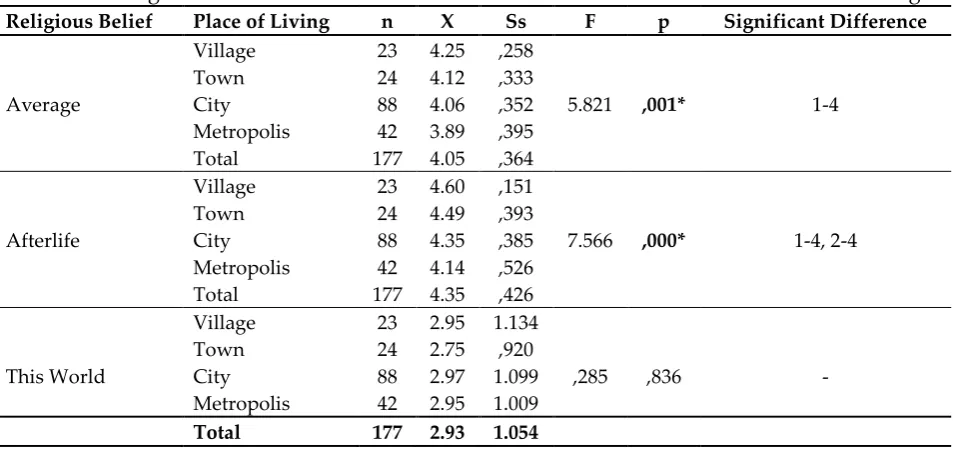
Table 1: Religious Worldviews and Sub-dimensions of the Athletes based on Place of Living
Religious Belief Place of Living n X Ss F p Significant Difference
Village 23 4.25 ,258
Town 24 4.12 ,333
Average City 88 4.06 ,352 5.821 ,001* 1-4
Metropolis 42 3.89 ,395 Total 177 4.05 ,364 Village 23 4.60 ,151
Town 24 4.49 ,393
Afterlife City 88 4.35 ,385 7.566 ,000* 1-4, 2-4 Metropolis 42 4.14 ,526
Total 177 4.35 ,426 Village 23 2.95 1.134
Town 24 2.75 ,920
This World City 88 2.97 1.099 ,285 ,836 -
Metropolis 42 2.95 1.009
Total 177 2.93 1.054
According to Table 1, there were significant differences in the study participant athletes’ average point of religious worldviews and sub-dimension of explaining afterlife based on the place of living. While there was a significant difference (p<0,05) between the village and metropolis in terms of point averages of religious worldviews, there were significant differences (p>0,05) between the village and metropolis and between metropolis and town in the sub-dimension of explanation of afterlife. There was no significant difference (p>0,05) in the sub-dimension of explaining this world.
Table 2: Religious Worldviews and Sub-dimensions of the Athletes based on Education Statuses
Religious Belief Education n X ss t P
High school and equal 50 4.09 ,282
Average Bachelor’s Degree 127 4.04 ,392 ,990 ,324
High school and equal 50 4.47 ,270
Afterlife Bachelor’s Degree 127 4.30 ,467 2.924 ,004*
High school and equal 50 2.67 ,973
This World Bachelor’s Degree 127 3.03 1.070 -2.118 ,036*
Total 177
Table 3: Religious Worldviews and Sub-dimensions of Athletes based on their Professional Background
Religious Belief Period n X f p Significant Difference
1-5 years 65 4.07 ,415 6-10 years 73 4.02 ,334
Average 11 and above 39 4.08 ,330 ,476 ,622 - Total 177 4.05 ,364
1-5 years 65 4.35 ,448 6-10 years 73 4.31 ,447
Afterlife 11 and above 39 4.42 ,342 ,866 ,423 - Total 177 4.35 ,426
1-5 years 65 3.01 ,975 6-10 years 73 2.93 1.026
This World 11 and above 39 2.79 1.232 ,549 ,579 -
Total 177 2.93 1.054
According to Table 3, when the religious worldviews of the study participant athletes were compared to their professional background, there was no significant difference between the variables (p>0,05).
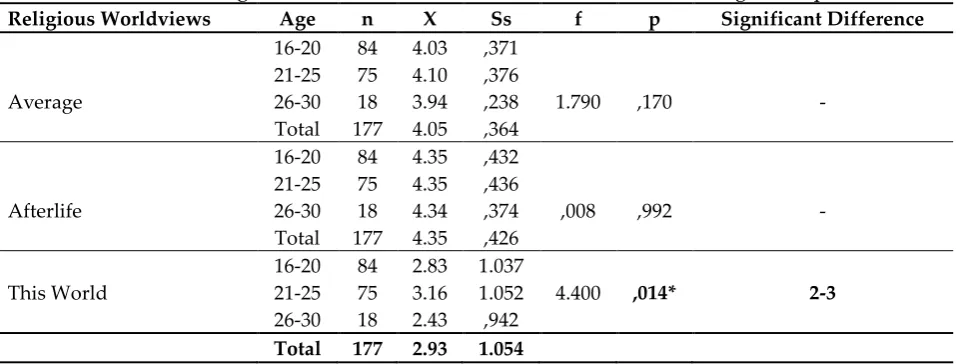
Table 4: Religious Worldviews and Sub-dimensions based on Age Groups
Religious Worldviews Age n X Ss f p Significant Difference
16-20 84 4.03 ,371 21-25 75 4.10 ,376
Average 26-30 18 3.94 ,238 1.790 ,170 -
Total 177 4.05 ,364 16-20 84 4.35 ,432 21-25 75 4.35 ,436
Afterlife 26-30 18 4.34 ,374 ,008 ,992 -
Total 177 4.35 ,426 16-20 84 2.83 1.037
This World 21-25 75 3.16 1.052 4.400 ,014* 2-3
26-30 18 2.43 ,942
Total 177 2.93 1.054
│ │
Table 5: Religious Worldviews and Sub-dimensions of the Athletes based on Monthly Income
Religious Belief Place of Living n X Ss F p Significant Difference
0-1500 TL 53 3.93 ,410 1501-3000 TL 62 4.09 ,367
Average 3001-4500 TL 44 4.12 ,294 3.150 ,026 - 4501-6000 TL 18 4.13 ,292
Total 177 4.05 ,364 0-1500 TL 53 4.15 ,531 1501-3000 TL 62 4.40 ,370
Afterlife 3001-4500 TL 44 4.49 ,329 6.510 ,000* 1-2, 2-3 4501-6000 TL 18 4.46 ,250
Total 177 4.35 ,426 0-1500 TL 53 3.09 ,899 1501-3000 TL 62 2.93 1.138
This World 3001-4500 TL 44 2.75 1.087 ,837 ,475 - 4501-6000 TL 18 2.88 1.112
Total 177 2.93 1.054
According to Table 5, when the religious worldviews of the study participant athletes were compared to their income levels, there was no significant difference between the point averages and the sub-dimension of explaining this world (p>0,05). There were significant differences in the sub-dimension of explaining afterlife (p<0,05). Among groups, there were significant differences between the incomes of 0-1500 tl and 1501-3000 tl, and 1501-1501-3000 tl and 3001 and 4500 tl.
Table 6: Religious Worldviews and Sub-dimensions of Athletes based on the Age of Starting the Sport
Religious Belief Starting Sport n X Ss f P Significant Difference
ages 5-7 45 3.88 ,449 ages 8-10 64 4.08 ,305
Average ages 11-13 43 4.20 ,330 6.280 ,000* 1-2, 1-3 14 and above 25 4.05 ,265
Total 177 4.05 ,364 ages 5-7 45 4.11 ,575
ages 8-10 64 4.40 ,374 1-2,
Afterlife ages 11-13 43 4.50 ,252 7.662 ,000* 1-3, 1-4 14 and above 25 4.42 ,306
Total 177 4.35 ,426 ages 5-7 45 3.01 ,927 ages 8-10 64 2.89 ,986
This World ages 11-13 43 3.07 1.267 ,966 ,410 - 14 and above 25 2.65 1.038
Total 177 2.93 1.054
afterlife (p<0,05). There was no significant difference in the sub-dimension of explaining this world (p>0,05). There were significant differences in the point averages of religious worldviews between the age groups of 5-7 and 11-13. There were significant differences in the sub-dimension of explaining afterlife between the age groups of -7, 8-10 and 5-7 ,and 14 and above.
4. Discussion and Result
When the religious worldviews of the study participant athletes were compared based on the place of living (Table 1), there were significant differences in the point average of religious worldviews and the sub-dimension of afterlife based on the athletes’ place of living. There were significant differences in point averages of religious worldviews between village and metropolis. Again, there were significant differences in the sub-dimension of explaining afterlife between the options of village and metropolis, and between metropolis and town. There was no significant difference in the sub-dimension of explaining this world. When the related literature is analyzed and when the theoretical framework was put into consideration, the positive impact of living in rural areas in terms of socialization is also reflected on the religious beliefs as well. Traditional religious beliefs and practices maintain their existence. The urban life on the other hand, have a negative impact on religious beliefs, as it is an area where worldly practices in social life are more prevalent. In that sense, it is seen that people living in rural areas have a bigger tendency towards religious beliefs and practices in comparison to the people living in cities or more crowded places (Kurt, 2009). When the historical value and essential place of oil wrestling sport in the Turkish and Islamic culture is considered, it can be said that the athletes that are part of the society also carry the historical, religious and socio-cultural characteristics of the society they belong to, and the culture they own maintains the existence of the life of the society. The acquired data seem to support this in the general sense.
│ │
Education data directs the social change and development. The majority of the participant athletes have the education level of university. It can be said that, as the level of education and training increase, having religious beliefs, participating in the religious life (ritual) and having religious worldviews relatively decrease. This can be said to be replaced by more worldly beliefs and practices. In a study by Kavas (2013) called ‚religious attitude based on the demographic variables‛, it is stated that piety is less active in parallel with the increased level of education, yet it gains a character that has a rational and consistent foundation.
When the religious worldviews of the study participant athletes were compared to their background as athletes (Table 3), there was no significant difference between the variables. This situation shows that there no positive or negative relationship could be formed between the background as athletes and the measured attitudes. In addition to that, it is seen that the rate of persons with a sportive background of 6-10 years was higher. In that sense, the interest towards sports increase generally and also the interest towards wrestling increase specifically. Therefore, it can be said that the increase in interest in, attention and tendency towards wrestling by society can have a positive impact on their preferences of religious worldviews.
When the religious worldviews of the study participant athletes were compared based on their age groups (Table 4), there was no significant difference in the point averages and sub-dimension of explaining afterlife. However, there were significant differences in the sub-dimension of explaining this world. When the religious worldviews were compared to the attitudes in regard to the sub-dimension of explaining this world based on the age groups, the points of the participants aged 21-25 were statistically more significant than the points of the participants aged 16-20 and 26-30. The fact that the age group of the participants of the study are mostly from the age group of 16-20 can be accepted as the society cares about the traditional wrestling and as a sign of relative increase in the tendency of the athletes towards religion. In a study by Kavas (2013) called ‚religious attitude based on demographic variables”, it is seen that as the age increases, the piety increase as well. This result does not support our study.
However, in Akgül and Kaplan’s (2017) study called ‚popular sports culture and religion”,
there was no significant difference between age and popular sports and piety attitudes in general. This result shows parallelism with our study.
levels. This situation is similar to the study of Kavas (2013) called ‚religious attitude based on demographic variables‛. Additionally, in the study of Kinter (2006) called ‚A study on the relationship of religious belief, worship and prayer with hopelessness, it is understood that the socio-economic level does not have a significant contribution in explaining the changes in the piety factor.
When the religious worldviews of the study participant athletes were compared to their age of starting the sport (Table 6), there was no significant difference in the sub-dimension of explaining this world. Nevertheless, there were significant differences in the point averages of religious worldviews and the sub-dimension of explaining afterlife. There were significant differences in the point averages of religious worldviews between the age groups of 5-7, 8-10 and 11-13. The point averages of religious worldviews of the participants with the sports starting ages between 8-10 and 11-13 were higher than the point averages of the religious worldviews of the participants that started the sport between the ages of 5-7. There were significant differences in the sub-dimension of explaining afterlife between the age groups of 5-7, 8-10, 11-13 and, 14 and above. The points of the sub-dimension of explaining afterlife of the participants with the ages of 8-10, 11-13, and 14 and above were found to be statistically higher than the points of the sub-dimension of explaining afterlife of the participants with the ages of 5-7. According to the acquired data, it is seen that, as the age of starting the sport increased, the religious belief levels increase in parallel with the growing and maturation process.
As a result, it is known that, in the analysis of the relationship between the human action and attitude in the psychological sense, the actualization of an action firstly depends on the prior knowledge, perception or belief. It can be said that the religious beliefs of the athletes and the religious rituals presented by them in their sporting life have a positive impact on the sportive success and behaviors of the athletes. Thus, it can be guessed that for a person’s level of having a religious worldview can have a high success of giving meaning to his sports life and personal life. In the final analysis, we can say that the religious beliefs and practices in today’s world have an increasing impact on the athlete behaviors. Along with that, a more clear answer on whether the religious belief have an impact on the actions of athletes in other sports fields in addition to wrestling, or on which branch of sports the religious belief has a bigger impact can be determined through scientific studies to be conducted on this field and through the comparison of findings to be acquired.
References
Akgül, M. (1999). Türk Modernleşmesi ve Din, Konya: Çizgi Kitabevi, 67.
Akgül, M.H., Kaplan, T. (2017). The culture of popular sports and religion. Journal of
│ │
Akgül, M. (2013). Mit, Din ve Toplum İlişkisi. Remzi Duran (Ed.), Mitoloji ve Din, içinde
(s. 20-42). Eskişehir: Anadolu Üniversitesi Yayınları, 30.
Alpman, C. (1972). Eğitimin Bütünlüğü İçinde Beden Eğitimi ve Çağlar Boyunca Gelişimi, İstanbul: Milli Eğitim Basımevi. 34.
Altunışık, R., Coşgun, R., Yıldırım, E., Bayraktaroğlu, S. (2001). Sosyal Bilimlerde Araştırma Yöntemleri, Sakarya: Sakarya Kitabevi, 55-68.
Alver, K. (2010). Emile Durkheim ve Kültür Sosyolojisi. Sosyoloji Dergisi. 21(3): 199-210.
Atabeyoğlu, C. (2000). Geleneksel Türk Güreşi ve Kirkpinar, İstanbul: Türkiye Milli Olimpiyat Komitesi Yayınları, 16-17.
Aydın, A.R. (2009). İnanma İhtiyacı ve Dinî Ritüellerin Psikolojik Değeri. Din Bilimleri
Akademik Araştırma Dergisi, 9(2): 87-99.
Başaran, M. (1989). Serbest ve Grekoromen Güreş: Teknik, Taktik,Teori ve Metodik Bilgiler, Ankara: GSGM Yayınları, yayın no:84
Delice, H. (2011). Kirkpinar: Türklerde Spor Anlayışı ve Kirkpinar Ruhu, İstanbul: Babıali Kültür Yayıncılığı,.9-10.
Erdem, H. (2012). Kirkpinar. K. Cesur (Ed.), Din ve Hayat Dergisi, Türkiye Diyanet Vakfı
Yayınları, sayı 17, 56-58.
Goplen, J., Plant, E.A. (2015). A Religious Worldview: Protecting One’s Meaning System
through Religious Prejudice. Personality and Social Psychology Bulletin.1-14.
Gordon, M. (1999). Sosyoloji Sözlüğü. Ankara: Bilim ve Sanat Yayınları.624. Günay, T. (1986). Çeşitli Yönleriyle Din. A.Ü.İ.F.Dergisi, Ankara, cilt: 28; 222. Günay, Ü. (2012). Din Sosyolojisi, İstanbul. İnsan Yayınları. 213-214.
Güngör, E. (2011). Türk Kültürü ve Milliyetçilik, İstanbul: Ötüken Yayınları.171.
Güven. Ö. (2003). Geleneksel okçuluk ve güreş sporunda ahiliğin etkileri, Türk Kültürü
ve Hacı Bektaşi Veli Araştırma Dergisi, Sayı 27.
Haviland. W.A. (2002). Kültürel Antropoloji. (çev.Hüsamettin İnaç), İstanbul: Kaknüs yayınları. 421.
Jona, I.N., Okou, F.T. (2013). ‘Sports and Religion’, Asian Journal of Management Sciences
and Education. vol:2 no.1.
Kahraman, M.A. (1997). Osmanlı ve Cumhuriyet Dönemi (1924-1951) Kirkpinar Güreşleri, Ankara: Kültür Bakanlığı Yayınları.
Kaptan, S.(Tarihsiz). Bilimsel Araştırma Teknikleri ve İstatistik Yöntemleri, Ankara: Tek Işık Matbaası, 63-66.
Karaman, K. (2010). ‘Ritüellerin toplumsal etkileri’. SDÜ Fen Edebiyat Fakültesi, Sosyal
Bilimler Dergisi. Sayı:21: 227-236.
Kavas, E. (2013). Demografik değişkenlere göre dini tutum. Akademik Bakış Uluslar arası
Hakemli Sosyal Bilimler Dergisi. Sayı:38: 1-20.
Kaya, Y. (2012). Yağlı güreşlerdeki adab ve anlayışın toplumsal barışa katkısı. K.Cesur (Ed.), Din ve Hayat Dergisi, Tdv Yayınları, sayı 17 ss,59-63.
Krech. D, Crutchfıld. S,R. (1999). Sosyal Psikoloji. (çev.Erol Güngör). İstanbul: Ötüken Neşriyat. 227-230.
Kurt, A. (2009). Dindarlığı Etkileyen Faktörler. Uludağ Üniversitesi İlahiyat Fakültesi
Dergisi, 18(2). 1-26.
Kuşat, A., Bulut, M.B. (2016). Adapting the religious worldviews scale to turkish: a study of validity and reliability. The Journal of International Social Research. 9(43). 2502-2509.
Okumuş, E. (2009). Socıal change and religion. Electronic Journal of Social Sciences, 8(30).
323-347.
Parker, A., W, J.S. (2012). Sport, spirituality and protestantism: a historical overview.
Thelogy SAGE Journals, 115(4). 253-265.
Racdliffe-Brown, A.R. (1952). Structure and Function in Primitive Society; Essays and Addresses, Illinois: The Free Press Gloncoe.
Sert, M. (2000). Gol Atan Galip- Futbola Sosyolojik Bir Bakış. Ankara: Bağlam Yayınları, 13.
Şahin, İ. (2008). ‘Dini Hayatın Ritmi: Ritüel ve Müzik’. Ankara Üniversitesi İlahiyat
Fakültesi Dergisi, sayı:2, 269-285.
Talimciler, A. (2010). Sporun Sosyolojisi Sosyolojinin Sporu. Ankara: Bağlam Yayıncılık,
21.
Taylor, S.E., Peplau, L.A., Sears, D. O. (2015). Sosyal Psikoloji. (çev.Ali Dönmez). Ankara: İmge Yayınevi,140.
Tükenmez, M. (2009). Toplumbilim ve Spor. İstanbul: Kaynak Yayınları, 230.
Tüzer, A. (1999). İnsan, Spor ve Din. Düşünen Siyaset Dergisi, Yıl:1 Sayı:2, 127-130.
Wulf. C. (2009). Tarihsel Kültürel Antropoloji. (çev. Özgür Dünya Sarısoy).Ankara: Mattek Matbaacılık. 232.
Yetim, A.A. (2010). Sosyoloji ve Spor. (4.Baskı), Ankara: Berikan Yayınevi, 112.
Yıldıran, İ. (2014). Antikiteden moderniteye olimpiyat oyunları: idealler ve gerçekler.
│ │
Creative Commons licensing terms