ANTIOXIDANT ACTIVITY OF COMPOUNDS ISOLATED FROM
PYCNANTHUS ANGOLENSIS (WELW.) WARB AND
BYROPHYLLUM PINNATUM (LAM.) OKEN
Olawale H. Oladimeji,
[a]*and
Augustine A. Ahmadu
[b]Keywords: extracts; isolates; antioxidant; Pycnanthus angolensis; Byrophyllum pinnatum
Pycnanthus angolensis (Welw.) Warb and Byrophyllum pinnatum (Lam.) Oken are two herbal recipes employed in native medicine for the treatment /management of gastrointestinal disorders, skin infections and more especially cancers, wounds and many other inflammatory conditions. Before now, seven compounds (NG-1b, NG-2, NG-3b,NG-4c,NG-5a, KF-1a and KF-2) have been obtained from the extracts of these plants by column and /or preparative thin-layer chromatographies. The search for new and more active antioxidant agents necessitated the screening of these compounds for potential activity. Generally the isolates gave (IC50) of between 0.50and 0.60 μg mL-1.However,
NG-1b demonstrated a significant activity at 0.48 μg mL-1 which compare favourably with that shown by Vitamin A (a standard antioxidant drug)
at 0.49 μg mL-1. These compounds, most especially NG-1b could be further worked on with the aim of improving on the observed antioxidant
activity through in-vitro structural activity relationship studies (SARS) and probably in-vivo clinical trials. .
* Corresponding Authors
E-Mail: [email protected];
[a] Department of Pharmaceutical and Medicinal Chemistry, Faculty of Pharmacy, University of Uyo, Uyo, Nigeria.
[b] Department of Pharmaceutical and Medicinal Chemistry, Faculty of Pharmacy, Kaduna State University, Kaduna, Nigeria.
Introduction
Free radicals occur in the human body in the forms of reactive oxygenated species (ROS), super-oxides, peroxides, hydroxyl and nitrogenous species. These chemical species are natural by-products of cellular metabolism and also form an integral part normal physiology.1 Furthermore, they can also be produced by bacterial leucocytes, atmospheric pollutants, drugs, xenobiotics and in mitochondrial respiration. In addition, chemical conversion of fats during lactation, exercise, fever, infections and even fasting can result in increased radical activity leading to damage of the immune and nervous systems. The stress hormones (adrenalin and noradrenalin) secreted by the adrenal glands under conditions of continuing and excessive emotional stress are metabolized into simpler, albeit, free radical molecules which can attack biological moieties such as proteins, lipids, enzymes, DNA and RNA resulting in cellular or tissue or organ injury associated with degenerative diseases.2 The consumption of fruits and vegetables containing antioxidants has been found to offer protection against these diseases.3 Besides playing an important role in the physiological systems, antioxidants have been used in the food industry to prolong the shelf life of foods especially those rich in polyunsaturated fats. The consumption of natural antioxidants has been reported to have potential health benefits.4-6 However, the continued use of synthetic antioxidants is a source of concern 7-8 due to the health risks and associated toxicity.1, 7-8
Phytochemicals such as flavonoids, terpenes and polyphenols have been reported to inhibit free radical reactions, protect the human body from disease 9-10 and retard lipid oxidative rancidity.11 Therefore, researches are
presently focused on obtaining antioxidants from plant sources. Two of such plants namely, Pycnanthus angolensis
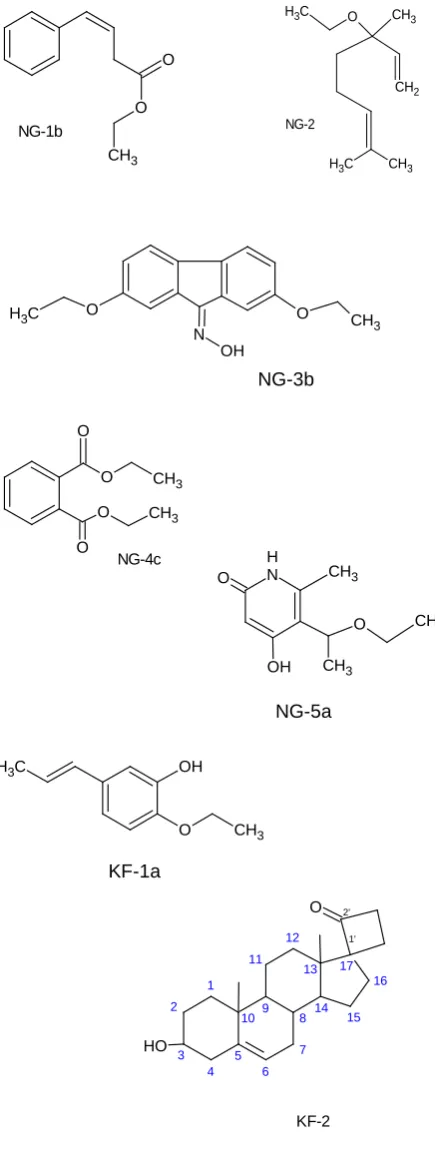
(Welw.) Warb and Byrophyllum pinnatum (Lam.) Oken are employed in folkloric medicine for the treatment of gastrointestinal disorders, skin diseases and more especially cancers, ulcers, wounds and inflammations. Previous studies by the lead author and co-workers have led to seven compounds namely, ethyl cinnamate (cinnamic acid, ethyl ester) (NG-1b), 3-ethoxy-3,7-dimethyl-1,6-octadiene (ethyl linalool) (NG-2), 9-oximino-2,7-diethoxyfluorene (2,7-diethoxy-9H-fluoren-9-one oxime) (NG-3b), 1,2-benzenedicarboxylic acid diethyl ester (diethyl phthalate) (NG-4c), ethyl 1,6-dihydro-2-methyl-4-hydroxy-6-oxo-3-pyridine carboxylic acid, ethyl ester (1,6-dihydro-2-methyl-4-hydroxy-6-oxo-3-nicotinic acid, ethyl ester (NG-5a), 1-ethoxy-2- hydroxy-4-prophenyl guaethol (KF-1a) and 17-(1ʹ -cyclobutan)-2ʹ-one-3-hydroxy)-(3β,17β)-spiro(andorst-5-ene, (KF-2) from the plants.12-15 This present study was done by subjecting the crude extracts and the seven isolated compounds to antioxidant tests with a view of confirming or disproving the reported uses in ethno-medicine for the treatment/management of inflammatory conditions which arise from the debilitating incidence of free-radicals.
Experimentals
(Gallenkamp, England) at 40 0C for 48 h and the resultant materials powdered on an electric mill (Uniscope, England).
Extraction and processing of plant material
The powders were extracted with cold 96 % ethanol at room temperature (27 ± 2 0C) for 72 h. The obtained filtrates were then evaporated to dryness in-vacuo on a rotary evaporator (R205D, Shensung BS & T, China). The extracts,
NG-1b, NG-2, NG-3b, NG-4c, NG-5a, KF-1a and KF-2
previously isolated from chromatographic separations of organic fractions of the two plants 12-15 were kept in appropriately labelled amber bottles and then stored in a refrigerator at -4 0C prior to the antioxidant tests.
DPPH (2, 2-Diphenyl-1-picryhydrazyl hydrate) assay
The purple colour of the methanolic solution of DPPH is bleached when it accepts hydrogen or electrons from extract/isolate/standard antioxidant drug. The 2, 2-diphenyl-1-picrylhydrazyl (DPPH) molecule is noted for its stable free radical nature and when mixed with a substance that can donate a hydrogen atom or electrons results in its reduced form, 1,1-diphenyl-2-picrylhydrazine. The tests were done by developing the spotted samples of crude extracts, NG-1b, NG-2, NG-3b, NG-4c, NG-5a, KF-1a and KF-2 in ethyl acetate: methanol (1:2) solvent mixture in duplicates. Ascorbic acid (Gemini Chemicals, Nigeria) was spotted along to serve as positive control. The developed chromatograms were sprayed with 0.1 % w/v methanolic solution of DPPH reagent (Sigma-Aldrich, Germany). The plates were irradiated with ultra-violet light at λm 366 nm for 15 minutes. Spots which appeared white against a purple background were taken as evidence of positive tests indicating antioxidant activity. 18-21
Spectrophotometric determination of antioxidant activity using DPPH reagent
Substances which are capable of donating electrons or hydrogen atoms (free-radical scavengers) can convert the purple-coloured DPPH radical (2, 2-diphenyl-1-picrylhydrazyl hydrate) to its yellow-coloured non-radical form (1,1-diphenyl-2-picryl hydrazine).2, 22 This reaction can be monitored by spectrophotometry. This is the most widely employed method of screening for antioxidant activity in plants.23-26
DPPH (4 mg) was weighed and dissolved in methanol (100
mL) to produce the stock solution (0.004 % w/v). Serial dilutions of the stock solution were
carried out. The absorbance of each of the sample was taken at λm 512 nm using the UV-VIS spectrophotometer (Jenway 6405, USA). A solution of methanol without DPPH served as the blank.
Determination of the antioxidant activity of crude extract / isolate
In every case, 2 mg of the extract/isolate was dissolved in 50 mL of methanol. Serial dilutions were done to obtain the
and 0.0024 mg mL-1 using methanol. 5 mL of each concentration was incubated with 5 mL of 0.004 % w/v methanolic DPPH solution for optimal analytical accuracy. After an incubation period of 30 minutes in the dark at room temperature (25 ± 2 0C), observation was made for a change in the colour of the mixture from purple to yellow. The absorbance of each of the test samples was then taken at λm 512 nm. The Radical Scavenging Activity (RSA %) or Percentage Inhibition (PI %) of free radical DPPH was thus calculated:
RSA % (PI %) = [(Ablank – Asample)/ Ablank] ×100
where
Ablank is the absorbance of the control reaction (DPPH solution without the test sample and
Asample is the absorbance of DPPH incubated with the extract/isolate /anti-oxidant drug.
Extract/isolate /standard antioxidant drug concentration providing 50 % inhibition (IC50) was calculated using a graph of inhibition percentage against the concentration of the extract/isolate/standard antioxidant drug.27-28
DPPH assay of standard antioxidant drugs
Standard antioxidants namely, vitamin A (Emzor Drugs, Nigeria), vitamin C (Greenfield Drugs, Nigeria) and vitamin E (Gemini, Nigeria) were used. While vitamin C was in a tablet dosage form, vitamins A and E were formulated as gelatine capsules. The estimated weight of the formulations containing 2 mg of the standard antioxidant drugs were determined by proportionality and then diluted. Methanol was used to dissolve vitamin C, while n-hexane was used to dissolve vitamins A and E because solubility problems encountered with these two vitamins. Thus, methanolic and hexane solutions of 0.004 % w/v DPPH were used for incubation of vitamin C, vitamin A and E respectively for 30 minutes.
The absorbance value of each of the drugs was taken at wavelength at λm 512 nm and the IC50 determined.
Results and discussion
3-ethoxy-3,7-dimethyl-1,6-(2,7-diethoxy-9H-fluoren-9-one oxime), 1,2-benzenedicarboxylic acid diethyl ester (diethyl phthalate), ethyl 1,6-dihydro-2-methyl-4-hydroxy-6-oxo-3-pyridine carboxylic acid, ethyl ester (1, 6-dihydro-2-methyl-4-hydroxy-6-oxo-3-nicotinic acid, ethyl ester, 1-ethoxy-2- hydroxy-4-prophenyl guaethol and 17-(1ʹ-cyclobutan)-2ʹ -one-3-hydroxy)-(3β,17β)-spiro(androst-5-ene, respectively using a combination of MS and IR spectral techniques.12-15
Figure 1. Structures of the studied compounds
Table 1. Absorbance of samples incubated with DPPH at different concentrations λmax (512 nm)
NG-1b=ethyl cinnamate (cinnamic acid, ethyl ester); NG-2=3-ethoxy-3,7-dimethyl-1,6-octadiene (ethyl linalool); NG-3b=9-oximino-2,7-diethoxyfluorene (2,7-diethoxy-9H-fluoren-9-one oxime); NG-4c=1,2-benzenedicarboxylic acid diethyl ester (diethyl phthalate); NG-5a = ethyl 1,6-dihydro-2-methyl-4-hydroxy-6-oxo-3-pyridine carboxylic acid, ethyl ester (1,6-dihydro-2-methyl-4-hydroxy-6-oxo-3-nicotinic acid, ethyl ester; KF-1a=1-ethoxy-2-hydroxy-4-prophenyl guaethol; KF-2 = 17-spiro(1ʹ-cyclobutan)-2ʹ -one-3-hydroxy)-(3β, 17β)-androst-5-ene; RSA % (PI %) = Radical scavenging activity (Percentage inhibition); IC50 = concentration at
which 50 % of DPPH is scavenged or inhibited; NR=Not regressed (value could not be regressed from the % inhibition-concentration curve).
Table 2. Radical scavenging activity (percentage inhibition) of samples at different concentrations (mg mL-1) and IC
50 of samples
(blank absorbance of 0.004 % w/v methanolic DPPH reagent: 0.613)
Rapid thin-layer chromatographic analysis for antioxidant activity
The extracts, isolates and ascorbic acid showed white spots on purple background when the chromatogram was sprayed DPPH reagent. The observation of white spots (irrespective of initial spotted colour) was the evidence of reduction of DPPH reagent (discoloration) by the by free-radical scavenger in the samples.
Sample Absorbance
0.0008 mg mL-1
0.0016 mg mL-1
0.0024 mg mL-1
P. angolensis 0.538 0.532 0.520
B. pinnatum 0.324 0.322 0.276
NG-1b 0.299 0.282 0.280
NG-2 0.270 0.263 0.259
NG-3b 0.194 0.188 0.181
NG-4c 0.166 0.164 0.161
NG-5a 0.192 0.183 0.179 KF-1a 0.202 0.189 0.184 KF-2 0.115 0.107 0.096 Vitamin A 0.298 0.267 0.257 Vitamin C 0.115 0.098 0.078 Vitamin E 0.163 0.157 0.152
Sample RSA % (PI %) IC50
μg mL-1
0.000 8
0.0016 0.0024
P. angolensis 12.23 13.21 15.17 NR
B. pinnatum 47.14 47.47 54.97 1.17 NG-1b 51.22 54.00 54.32 0.48 NG-2 55.95 57.10 57.75 0.55 NG-3b 68.35 69.33 70.47 0.58 NG-4c 72.93 73.24 73.74 0.59 NG-5a 68.67 70.15 79.79 0.54 KF-1a 67.05 69.17 69.98 0.50 KF-2 81.24 82.54 84.40 0.59 Vitamin A 51.39 56.44 58.07 0.49 Vitamin C 81.57 84.01 87.28 0.67 Vitamin E 73.41 74.39 75.20 0.60
O
O
CH3 NG-1b
CH2 CH3 O C H3
CH3 C H3 NG-2
O CH
3
O C H3
N OH
NG-3b
O
O
O O
CH3
CH3
NG-4c
N H O
CH3
O CH3
CH3
OH
NG-5a
OH C
H3
O CH3
KF-1a
10
5 1
4 2
3
8
7 9
6 14 13 11
12
15 16 17 O
O H
2'
1'
Determination of the antioxidant activity of extract/ isolate/ antioxidant drug
The Beer-Lambert Law is the basis of all absorption spectrophotometry. Therefore, a plot of absorbance against concentration for a cell of unit thickness (1 cm) should give a straight line passing through the origin.The reduction of the DPPH radical was determined by taking its absorption at a wavelength of λm 512 nm. It was observed that the absorbance of DPPH decreased as the concentration of added free radical scavenger extract /isolate /standard antioxidant drug) increased which suggested that the DPPH reagent was being reduced. The results of the reduction are as presented in
Table 1. The Radical Scavenging Activity (RSA %) or percentage inhibition (PI %) and the IC50 values of extract and standard antioxidant drugs were computed as Table 2 shows.
The RSA % is an indicator of the antioxidant activity of extract/ isolate /standard antioxidant drug.32 All the isolated compounds gave largely moderate antioxidant activity (IC50) of between 0.50 μg mL-1 and 0. 60 μg mL-1.
However, NG-1b elicited a remarkable activity at 0.48 μg mL-1. It should be stated that this activity compare favourably with that demonstrated by Vitamin A (a standard antioxidant drug) at 0.49 μg mL-1. Furthermore, the antioxidant activities demonstrated by the isolated compounds were not surprising because different preparations of the plants are used in ethno-medicine to treat /manage disease conditions such as wounds, inflammations and tumours amongst so many others.33-38 In addition, secondary metabolites such as flavonoids or flavonoid-like, terpenes and phenols or hydroxylated compounds (such as NG-2, NG-3b, NG-4c, NG-5a, KF-1a and K-2) have been reported to inhibit free radical reactions and protect the human body from disease. 9, 18, 39-45 Also, the importance of the radical scavenging ability of some phytochemical compounds have found useful applications in the extensionof shelf-life and control of deterioration of fatty foods, nutriceuticals and spices. 46-49 Aside the DPPH assay, other methods for determining the antioxidant activity of plants include the hydrogen peroxide, nitric oxide, conjugated diene, superoxide, phosphomolybdenum, peroxynitrile and xanthine oxidase assay methods amongst many others. 50-51
Conclusion
The results of this present study indicate that compounds isolated from the plants have demonstrated antioxidant activities which can compare with those of standard antioxidant drugs in clinical practice. Also, these compounds are to be further investigated (in-vitro SARS) in our laboratories with a view to improving on the observed activities.
Acknowledgement
The authors gladly acknowledge the kind gesture of the Department of Pharmaceutical and Medicinal Chemistry, University of Uyo for the use of its Jenway 6405 UV/VS Spectrophotometer in the antioxidant assays.
References
1Wong, S. P., Antioxidant activities of aqueous extract of selected
plants. Food science and technical program, Department of Chemistry, National University of Singapore, Singapore, 2005.
2Nagalapur, S. K., Paramjyothi, S., In vitro antioxidant activity of
Launaea pinntifida, The Bioscan, 2010, 5(1), 105-108.
3Halliwell, B., Protection against tissue damage in vivo by
desferrioxamine: What is its mechanism of action ? Free Radical Biol. Med., 1989, 7, 645-657. https://doi.org/10.1016/0891-5849(89)90145-7
4Di Carlo, G., Maxolo, N., Izzo, A., Capasso F., Flavonoids: old and
new aspects of a class of natural therapeutic drugs, Life Sci.,
1999, 65, 337-353. https://doi.org/10.1016/s0024-3205(99)00120-4
5Pulido, R., Bravo, L., Savana-Calixto, F., Antioxidant Activity of
Dietary Polyphenols As Determined by a Modified Ferric Reducing/Antioxidant Power Assay, J. Agric. Food Chem., 2000, 48(8), 3396-3402. DOI: 10.1021/jf9913458
6Sumino, M., Sekine, T., Ruangrungsi, N., Igarashi, R., Ikegami, F.,
Ardisiphenols and Other Antioxidant Principles from the Fruits of Ardisia colorata, Chem. Pharm. Bull., 2002, 50(7),
1484-1487.
https://doi.org/10.1248/cpb.50.1484
7Kahl, R., Kappus, A., Toxikologie der synthetischen
Antioxidantien BHA und BHT im Vergleich mit dem natürlichen Antioxidans Vitamin E, Z. Lebensmit.-Untersuch. Forsch., 1993, 196(4), 329-338.
https://doi.org/10.1007/BF01197931
8Valentao, P., Fernandes, E., Carvalho, F., Andrade, P. A., Seabra,
R. M., Bastos, M. L., Antioxidative Properties of Cardoon
(Cynara cardunculus L.) Infusion Against Superoxide Radical, Hydroxyl Radical, and Hypochlorous Acid, J. Agric. Food Chem., 2002, 50, 4989-4993.
DOI: 10.1021/jf020225o
9Kinsella, J. E., Frankel, E., German, B. J., Kanner, J., Possible
mechanisms for the protective role of antioxidants in wine and plant foods, Food Tech., 1993, 47, 85-89.
10Terao, J., Piskula, M. K., Flavonoids as inhibitions of lipid
peroxidation in membranes. Inca Rice Evans and L. Packer (Eds.), 1997.
11Duthie, G. G., Lipid Peroxidation.Eur. J. Clin. Nutr., 1993, 47(11),
759-746.
12Oladimeji, H. O., Attih, E. E., Onu, O. N.,Ethyl linalool and
diethyl phthalate from Pycnanthus angolensis (Welw.) Warb.
Eur. Chem. Bull., 2017, 6(2), 76-78. DOI: 10.17628/ecb.2017.6.76-78
13Oladimeji, H. O., Onu, O. N., Isolation of ethyl cinnamate and
substituted fluorene from Pycnanthus angolensis (Welw.) Warb, Eur. Chem. Bull., 2017, 6(9), 421-423, DOI: 10.17628/ecb.2017.6.421-423.
14Oladimeji, H. O., Eberefiak, K. E., Isolation and antimicrobial
analysis of a steroidal terpene from the butanol fraction of
Byrophyllum pinnatum (Lam.) Oken Eur. Chem. Bull., 2017,
6(7), 292-294. DOI: 10.17628/ecb.2017.6.292-294
15Oladimeji, H. O., Onu, O. N., Antimicrobial activities of
compounds isolated from Pycnanthus angolensis (Welw.) Warb and Bryophyllum pinnatum (Lam) Oken. Eur. Chem. Bull., 2018, 7(7), 190-193. DOI: 10.17628/ecb.2018.7.190-193.
16Oladimeji, H. O., Ubulom, P. M. E., Igboasoiyi, A. C., Ndukwe,
K., Nia, R., Some biological activities of Pycnanthus angolensis (Welw.) Warb.
J. Pharm. Biores., 2006a, 3(1), 49-55. https://doi.org/10.4314/jpb.v3i1.32092
17Oladimeji, H. O., Nia, R., Edoho, E. J., Investigation into the
larvicidal and antimicrobial activity Bryophyllum pinnatum
18Alemika, T. E., Onawunmi, G. O., Olugbade,T. A., Isolation and
characterization of incensole from Boswellia dalzielli stem bark. J. Pharm. Biores., 2004, 1(1), 7-11.
https://doi.org/10.4314/jpb.v1i1.32041
19Bondet, V., Brand-Williams, W., Berset, C., Kinetic and
mechanisms of antioxidant activities using the DPPH free-radical method, Lebensmitt. Wissenschaft. Tech., 1997, 30,
609-615.
20Cuendet, M., Hostettmann, K., Potterat, O.,Indoid glycosides with
free-radical scavenging properties from Fragranea blumei
.
Helv. Chim. Acta, 1997, 80(8), 1144-1152. https://doi.org/10.1002/hlca.1997080041121Kirby, A. J., Schmidt, R. J.,Antioxidant activity of Chinese herbs
for eczema and placebo herbs. Int. J. Pharmacol.,1997, 56, 103-108. https://doi.org/10.1016/s0378-8741(97)01510-9
22Guangrong, H., Jiaxin, J., Dehui, D., Anti-oxidative and
antibacterial activity of the methanol extract of Artemisia anomala S. Moore , Afr. J. Biotech., 2008, 7(9), 1335-1338.
23Hu, C., Kitts, D. D., Studies on the antioxidant activity of
Echinacea root extract, J. Agric. Food Chem., 2000, 48, 1466-1472.
24Khaled, F. E., Ahmed, H. E, Amr, F., Antioxidant activity of
volatile components of Egyptian Artemisia judaica L. Food Chem., 2002, 78(3), 331-336.
25Singh, R. P,. Chidambara, M. K.,Jayaprakash,, G. K., Studies on
the antioxidant activity of pomegranate (Punica granatum) peel and seed extracts using in-vitro model. J. Agric. Food Chem.,
2002, 50, 81-86.https://doi.org/10.1021/jf010865b
26Oladimeji, H. O., Akpan, B. C., Antioxidant potential of some
Nigerian herbal recipes
.
J. Pharm. Biores., 2014, 11(2), 77-85.27Lebeau, J., Furman, G., Bernier, J. L., Durietz, P., Teissier, E.,
Cotelle, N., Antioxidant properties of di-tert-butylhydroxylated flavonoids.Free-Radicals Biol. Med., 2000,
29(9), 900-912. https://doi.org/10.1016/s0891-5849(00)00390-7
28Leitao, G. G., Leitao, S. G., Vilegas, W., Z. Quick preparative
separation of natural naphthoquinones with antioxidant activity by high speed counter current chromatography, Z.
Naturforsch, 2002, 57C, 1051-1055. https://doi.org/10.1515/znc-2002-11-1217
29Odebiyi, O. O., Sofowora, A., Phytochemical screening of
Nigerian medicinal plants-Part I. Lloydia, 1978, 41, 234.
30Odebiyi, O. O., Sofowora, A., Phytochemical screening of
Nigerian medicinal plants-Part II. 2nd OAU/STRC Inter-African symposium. Traditional pharmacopoeia of African medicinal plants. OAU/STRC publishers, 1979, 115, 216.
31Oladimeji, H. O., Usifoh, C. O., Phytochemical and antimicrobial
studies on some Nigerian medicinal plants. J. Pharm.Biores.,
2015, 12(2), 156-164. https://doi.org/10.4314/jpb.v12i2.11
32Meir, S., Kanner, J., Akiri, B.,Determination and involvement of
aqueous reducing compounds in oxidative defence systems of various senescing leaves. J. Agric. Food Chem., 1995, 43, 1813-1815. https://doi.org/10.1021/jf00055a012
33Dalziel, J. M., Useful plants of West Tropical Africa. Crown agents
for overseas governments and administrations, 1956, 122.
34Oliver, B., Medicinal Plants in Nigeria I. Nigerian college of arts,
Science and Technology,1959, 21.
35Oliver, B., Medicinal plants in Nigeria II. Nigerian college of arts,
science and technology, 1960, 70-72.
36Watt, J. M., Breyer-Brandwijk, M. G., The medicinal and
poisonous plants of Southern and Eastern Africa. E. S. Livingstone limited,1962, 59.
37Sofowora, A., Medicinal plants and traditional medicine in Africa.
Spectrum book limited, 2008, 112-114.
38Evans, W. C., ‘Pharmacognosy’. 16th edition. WB Saunders
company, 2009, 248-249.
39Tsimidou, M., Boskou, D., Antioxidant activity of essential oils
from the plants of Laminaceae family. In: G. Charalampous spices, herbs and edible fungi. Elsevier publishers, 1994, 273-284.
40Lagouri, V., Boskou, D., Screening for antioxidant activity of
essential oils obtained from spices. In: Charalampous G. food flavors. Generation, analysis and process influence. Elsevier, 1995, 869-874.https://doi.org/10.1016/s0167-4501(06)80203-7
41Yokosawa, T., Dong, E., Liu, Z. W., Shimizu, M., Antioxidative
Activities Flavones and Flavonols. In-vitro, 1997, 11, 446-449.
42Daniel, R. S., Bifu, C. M., Devi, K. S., Augusti, K. T.,Antioxidant
effects of two flavonoids from the bark of Ficus bengalensis
Linn., in hyperlipidemic rats Ind. J. Expt. Biol., 1998, 36, 902-906.
43Grassmann, J., Schneider, D., Weiser, D., Elsmer, E. F.,
Antioxidative effect of lemon oil and its components on copper induced oxidation of LDL Arzneimittel- Forschung, 2001, 51, 799-805. https://doi.org/10.1055/s-0031-1300118
44Malaya, G., Upal, K. M., Ramanathan, S. K., Thangavel, S.,
Madgula, L., Mohan, V., Anti-tumour activity and antioxidant status of Caesalpinia bonducella against Ehrlich ascites carcinoma in Swiss Albino Mice, J. Pharmacol. Sci., 2004, 94,
177-184. https://doi.org/10.1254/jphs.94.177
45Svoboda, K., Brooker, J. D., Zrustova, J., Antibacterial and
antioxidant properties of essential oils. their potential applications in food industries Acta. Horticul. (SHS), 2006,
709(1), 35-43. https://doi.org/10.17660/actahortic.2006.709.4
46Thomas, P. G., Wade, A. M., Official gazette of US trade mark
office patents,2001, 1253, 2.
47Braca, A., Polili, M., Sanogo, R., Sanou, H., Morelli, I., Pizza, C.,
De-Tommasi, N., Chemical composition and antioxidant activity of phenolic compounds from wild and cultivated
Sclerocerya birrea (Anacardiaceae) leaves J. Agric. Food Chem.,2003, 51(23), 6689-6695.
https://doi.org/10.1021/jf030374m
48Shahidi F., Antioxidants in food and food antioxidants.
Nahrung, 2000, 44, 158-163. https://doi.org/10.1002/1521-3803(20000501)44:3<158::aid-food158>3.0.co;2-l
49Liyana-Pathirana, C. M., Shahidi, F., Antioxidant properties of
commercial salt and hard water wheat (Trilicum aestivum L.) and their Milling Fractions. J. Sci. Food Agric., 2006, 86(3),
477-485. https://doi.org/10.1002/jsfa.2374
50Bunta, G. W., Ingold, R. U., β-carotene: An unusual type of lipid
antioxidant. Science, 1984, 224, 569-573. https://doi.org/10.1126/science.6710156
51Dapkevicius, A., Vanskulons, R., Van-Beek, T. A., Linssen, J. P.,
Antioxidant activity of extracts obtained by different isolation procedures from some aromatic herbs grown in Lithuania. J. Sci. Food Agric., 1998, 77(1), 140-146.
https://doi.org/10.1002/(sici)1097-0010(199805)77:1<140::aid-jsfa18>3.3.co;2-b