International Journal Advances in Social Science and Humanities
Available online at: www.ijassh.com
RESEARCH ARTICLE
Conduct Disorder: Assessment and Prescriptive Treatment. A Case of
Zimbabwe
Winifrida Shingirayi Nyamande
1, Nyengeterai Chemhuru
1, Janet Prisca Mahlatini
1,
Ephias Gudyanga
2*1Zimbabwe Open University, Faculty of Applied Social Sciences, Box 1810, Gweru, Zimbabwe.
2Midlands State University, Faculty of Education, Department of Educational Foundations, Management and
Curriculum Studies.,Gweru, Zimbabwe.
*Corresponding AuthorE-mail:[email protected]
Abstract
The study focused on the counselling of children with conduct disorders in the primary schools. Children with conduct disorders present excessively aggressive and defiant behaviour and have interpersonal problems with teachers, peers, parents and significant others. Such children are usually less responsive to social reinforcement, less empathetic and less understanding of peers’ behaviours. These antisocial behaviours lead to poor adjustment, risk of school failure, membership in deviant peer groups, school drop-out and eventual delinquency. We sought to find out how such children are counselled. Questionnaires and interviews were used as data collecting instruments. The sample comprised of thirty –two educationists. The study established that the educational psychologists had the role of counselling students with special educational needs including those with conduct disorders. They assist schools in the assessment, placement and counselling of such children through the administration of psychological tests to establish the behavioural problems and recommend treatment. It was realised that the implementation of the Guidance and Counselling policy in primary schools was not consistent. Each primary school was carrying out counselling of students in their own way, with others not even aware of the existence of such a policy. The study recommended that the educational psychologists should visit schools frequently and staff develop school heads and teachers on the Guidance and Counselling policy. They should equip teachers with counselling skills to ensure implementation of policy at all levels. Each school should have a counsellor and a counselling room, which would ensure confidentiality and security of children during counselling.
Keywords: Counselling, Conduct disorder, Guidance, Psychologist, Teachers.
Introduction and Background
A diagnosis of conduct disorder (CD) is met when three of 15 anti-social behaviours are observed over a period of 12 months [1]. The term conduct disorders(CD) refers to instances where children show a pattern of antisocial behaviour, when there is a significant impairment in everyday functioning at home or school when the behaviours are regarded as unmanageable by significant others [2]. Children with CD show serious dysfunction [3] in their interactions in and out of the home. There is a high rate of aggressiveness and violation of others’ rights. Fighting, lying, school problems, physical aggression and legal transgressions are typical of children with CD [2].Children exhibit concomitant problems, such as social incompetence, peer rejection and other mental health disorders including substance abuse, academic failure,
suicidal behaviour, a high rate of physical injury and premature death [4]. These behaviours include a variety of cognitive and attribution processes such as deficits in problem solving skills and attributing hostile intent to others [5]. Once CD becomes chronic, they are quite refractory to intervention [2].
hostility towards peers, lack of perspective taking, failure to consider alternative solution to social problems [9].
Children with (CD) present excessively aggressive and defiant behaviour and have interpersonal problems with teachers, peers, parents and significant others [10]. These children with conduct disorders are included in regular classes in the primary schools in Zimbabwe. In most cases, teachers in those classes are not alerted of the disorders when the children are admitted into their classes. This may be partly because some parents may not be aware that their child has serious problems or they may conceal the information for fear that their child may be refused admission into the school. The school administrators responsible for admitting children into the school cannot tell on admission that a child has serious behavioural problems unless they are informed by the parent or guardian. The child is placed in the classroom alongside other children without CD.
In class, the teacher may take the child for just playing truant. The child may also not be aware of his/her own behavioural problems. The child may seem to be intentionally refusing to comply with teachers. Such teachers may then resort to punishing the child who may not be aware of the reasons why he/she is being punished. Children with severe CD problems are a concern to parents, teachers and society. Such behaviours are considered to be the path by which certain youngsters develop a life of juvenile delinquency and adult criminality [8].
CD is one of the most common reasons for referral of a child or adolescent for psychological or psychiatric treatment. About one out of every two to three children seen in child guidance clinics have been diagnosed with CD [8] Reasons for high rate of referral are that the symptoms of CD are external, frequently observed by others, and may bring the youngster into contact with the law or other authorities [4] These behaviours are frequently more distressing to those around the youngsters than the youngster who exhibits them.
Age-onset of CD has been found to be an important factor not only in the outcome, but also in terms of the severity of the problem presented. Individuals who are found to have child-onset form of CD tend to be more aggressive [11], are more likely to drop out of school [12], have increased rates of truancy [13], tend to have a higher probability of persisting in that antisocial
appears that the primary developmental pathway to continued serious conduct problems into adulthood is established during the preschool period. This suggests that a strategic part for primary intervention in an individual with CD may be in primary school and early elementary school years (4-7 years).
An antisocial personality disorder includes a pervasive pattern of disregard for and violation of the rights of others that begin in childhood or early adolescence and continues into adulthood [14]. Children with CD show a high rate of violation of family, school and societal rules [10].
Due to the pathological nature of CD there was need to establish who was responsible for counselling such children in primary schools. Counselling is seen as essential in addressing adjustment problems of children with CDs in the primary school [8]. It is against this background that this study sought to assess and find out the nature of treatment offered to Zimbabwean child with CD.
Research Questions
The research questions under consideration are:
Assessment of the guiding principles in counselling students in the primary schools?
Which are the prescriptive treatments in existence for CD pupils?
Method
Results
All school counsellors and teachers did not have a formal training in Guidance and Counselling. Their experience and counselling skills were as a result of on the job training through attending workshops and seminars hosted by the Guidance and Counselling Education Officer. All thirty two participants (100%) were aware that the role of Educational Psychologists involved assessment of pupils with special educational needs which include CD. Responses showed mixed views on the functions of Educational Psychologists, Guidance and Counselling teachers (school counsellors) in relation to the demands of counselling of the CD child. This raised a lot of questions than answers why teachers who were supposed to work with the psychologists were not aware of their roles.
Behavioural characteristics of students with CD Most (80%) teachers of Guidance and Counselling indicated that they were aware of the behavioural
characteristics of children with CD. They indicated that fighting, truancy, and aggression were common characteristics of children with CD. Temper tantrums, lying and intentionally ignoring rules was indicated by eighty percent (80%). Defiance, negativeness, stealing and running away was also shown as fairly common among children with CD. Destructiveness was indicated by forty percent (40%) while only twenty (20%) indicated fire setting as a characteristic of children with CD. These responses reveal that teachers are aware of common behavioural symptoms of children with CD and can deal with them effectively if they are provided with necessary support and skills in counselling.
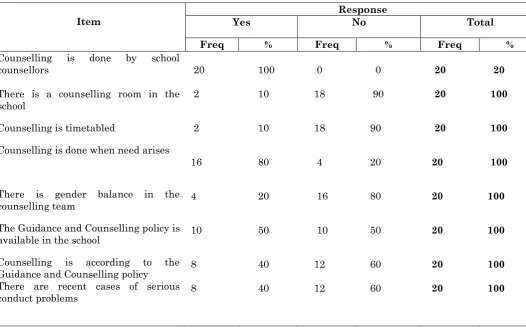
Most schools (80%) practice individual counselling. Group counselling, peer counselling and crisis counselling was indicated by (60%) of the teachers. These counselling programmes were consistent with the recommendations of the Guidance and Counselling policy.
Table 1: Counselling in primary schools (N=20)
Item Yes Response No Total
Freq % Freq % Freq %
Counselling is done by school
counsellors
There is a counselling room in the school
Counselling is timetabled
Counselling is done when need arises
There is gender balance in the counselling team
The Guidance and Counselling policy is available in the school
Counselling is according to the Guidance and Counselling policy There are recent cases of serious conduct problems
20
2
2
16
4
10
8
8
100
10
10
80
20
50
40
40
0
18
18
4
16
10
12
12
0
90
90
20
80
50
60
60
20
20
20
20
20
20
20
20
20
100
100
100
100
100
100
100
The responses in Table 1 showed that most counselling in schools was done by teachers. Most schools (90%) did not have counselling rooms
Involvement of Educational Psychologists (EP) and Education Officer (EO) Guidance and Counselling
Fourteen teachers (70%) concurred that Educational Psychologists were not visiting schools regularly for Guidance and Counselling issues of children with conduct disorders. Responses indicated that staff development workshops for teachers on counselling of children with CD were not consistently being carried out. Non-Governmental Organisations were observed to be providing most of the technical support in counselling children in primary schools.
Discussion
The Educational Psychologist confirmed that their role included administering psychological tests, identify children’s behavioural and learning problems and design intervention strategies, assess children with special educational needs, facilitate establishment of special education programmes, offer counselling to teachers, pupils and parents. This implies that the Educational Psychologist has a significant role to play in the counselling of children with conduct disorders. But responses from teachers and heads clearly indicate that Educational Psychologists and EO Guidance and Counselling seldom visit primary schools on issues of counselling children including those with CD. Therefore whose business is it to counsel children with CDs? This implies that very little assistance was provided to teachers in counselling of children. No staff development workshops have been held on Guidance and Counselling in recent times. But the roles of the Schools Psychological Services include in-service training and staff development workshops for teachers as stipulated in the [15]. It is important to further establish the reasons why Educational Psychologists are not visiting schools, including the one nearest to them.
Some heads admitted they had the Guidance and Counselling policy in their schools and among these, some have availed it to teachers while others had them in files with teachers not aware of such a document in the school. Other heads were not aware of such a document in their schools. These mixed responses confirm those of the teachers and this shows mixed views on counselling of children with CD in primary schools. The Educational Psychologist indicated that there was a policy document on Guidance and Counselling of children in primary schools, but was not certain whether it had been
responsibility of the EO Guidance and Counselling.
The EO Guidance and Counselling stated that the policy document had been distributed to primary schools. In his response he indicated that implementation was of Guidance and Counselling teachers. This was based on the major recommendations of the 1999 Presidential Commission of Inquiry into Education and Training with a direct bearing on Guidance and Counselling [15], outlines the procedures to be followed in the implementation of Guidance and Counselling. The EO clearly indicated that the circular had been availed to primary schools. In primary schools, the implementation was left to the discretion of the head and teachers of Guidance and Counselling. Further research may want to find out whether heads of primary schools are supervising teachers of Guidance and Counselling. What discretion do these heads have?
The EO and Educational Psychologist indicated that visits to schools for purposes of counselling and staff development had been limited by lack of funds. However, some schools within walking distances were never visited for the past twelve months. The researchers would challenge the system by saying therefore whose business is it to assess and counsel CD children.
welfare and rarely to Schools Psychological Services. Referring the child to the police only removes the child from causing damage to others and property but does not remove or reduce the misbehaviours. [11] argued that Educational Psychologists are the providers of psychological services that include conducting individual assessment and offering counselling to the learner.
Conclusions and Recommendations
Schools were offering counselling services with limited assistance from the Schools Psychological Services (SPS). The SPS personnel seldom visit schools for the purposes of counselling children with CD. There were discrepancies in distribution and implementation of the Guidance and Counselling policy in the schools. Schools Psychological Services personnel are not offering staff development workshops to teachers on counselling of children assisting in the counselling process. The Guidance and Counselling policy hard copies were to be distributed to all primary schools in Zimbabwe. The implementation of the policy had to be initiated and monitored by the Schools Psychological Services. Staff development
workshops for teachers and school counsellors on counselling of children with conduct disorders were to be held on a regular basis if the counselling of CD children were to be effective. The Educational Psychologists and EO Guidance and Counselling were strongly advised to visit schools more frequently on issues of children with CD. All primary schools were encouraged to have resource rooms. There is need for further research
to establish reasons why Educational
Psychologists are not visiting schools for the purposes of counselling children with CD’s even those in walking distances from their offices. It will also be prudent to find out if heads of primary schools are supervising Guidance and Counselling teachers. Do they know what to look for during these supervisions? There is need for further research on the counselling of children with CD.
Acknowledgements
This paper was a result of contributions made by the Educational Principal Psychologist, Guidance and Counselling Education Officer, school heads and their teachers of whom we would like to acknowledge the role they played individually and collectively in making this research a success.
References
1. Pouf E (2003) Conduct disorder: Presentation, treatment options and cultural efficacy in an African setting. International Journal of Disability, Community and Rehabilitation 2(1) Online on http:// www.ijder. co/vo12_01_CAN/articles/mpofu.shtml.
2. Kazdin AE (1995) Child, parent and family dysfunction as predators in cognitive-behavioural treatment of antisocial children. Behavioural therapy and research, 33:271-281. 3. Herbert M (1998) Clinical child psychology, social
learning, development and behaviour. New York: John Wiley and Sons.
4. Ammerman RT, Hersen M, Last CG (1999) Handbook of Prescriptive Treatments for Children and Adolescents. Boston: Allyn and Bacon.
5. Robins LN, Price RK (1991) Adult disorders predicted by childhood conduct problems: Results from the NIMH Epidemiologic Catchment Area project. Psychiatry, 54:116-132.
6. Lahey BB, Hart EL, Pliszka S, Applegate B, Mc Burnett K (1993) Neurophysiological correlates of conduct disorder: a rationale and a review. Journal of Clinical Child Psychology, 22:141-53.
7. Frick PJ (1998) Conduct disorders and severe antisocial behaviour. New York: Plenum Press.
8. Finch AJ, Nelson WM, Hart KJ (2006) Conduct disorders: A practical trainer’s guide to comparative treatments. New York: USA, Springer Publishing Company
9. Mpofu E, Mutepfa MM, Chereshe R, Kasayira JM (2007) School psychology in Zimbabwe. In S.R. Jimerson, T. Oakland and P. Farrell (Eds). The Handbook of International School Psychology (437-452). Thousand Oaks, CA: SAGE Publications.
10.Walter HJ, DeMaso DR (2011) Disruptive behavioural disorders. In Kliegman, RM, Stanton BF, St. Geme, JW III, et al., (eds). Nelson Textbook of Paediatrics. Philadelphia, PA: Elsevier Saunders.
11.Mpofu E, Maree JG, Oakland T (2009) Developing a framework for the use of psychometric tests in Botswana schools. Gaborone: Ministry of Education and Skills Development.
12.Sege R, Dietz W (1994) Television viewing and violence in children: the paediatrician as agent for change. Paediatrics. 94:600-607.
13.Nurcombe B (2008) Oppositional defiant disorder and conduct disorder. In Ebert M.H.,Loosen, P.T. Nurcombe, B. Leckman J.F., (eds). Current Diagnosis & Treatment Psychiatry. New York, NY: McGraw Hill.
14.American Psychiatric Association (2000) Diagnostic and Statistical Manual of Mental Disorders (4th Ed). Washington DC: American Psychiatric Association. 15.Ministry of Education Sport and Culture (2005) Director’s