FOUND IN TRANSLATION: KURT WEILL ON BROADWAY AND IN HOLLYWOOD, 1935–1939
Naomi Graber
A dissertation submitted to the faculty of the University of North Carolina at Chapel Hill in partial fulfillment of the requirements for the degree of Doctor of Philosophy in the Department of Music.
Chapel Hill 2013
Approved by:
Tim Carter
Annegret Fauser
Jon Finson
Bryan Gilliam
Severine Neff
ii ©2013 Naomi Graber
iii
ABSTRACT
NAOMI GRABER: Found in Translation: Kurt Weill on Broadway and in Hollywood, 1935– 1939
Musicology
(Under the direction of Tim Carter)
This dissertation reexamines composer Kurt Weill’s position as an “assimilated” émigré by
investigating his musical plays and film scores of the late 1930s, his first years in the United
States. Previously unconsidered archival evidence, including correspondence, scripts,
screenplays, and music, reflect both Weill’s keen awareness of the Depression-era culture and
his continued commitment to innovation on the musical stage. He worked within experimental
and political circles like the Group Theatre and the Federal Theatre Project to comment on
pressing issues of the Depression, including pacifism (Johnny Johnson, 1936) and homelessness
(the unfinished One Man from Tennessee, 1937). In Hollywood, Weill worked with fellow
émigrés Fritz Lang and William Dieterle on films by two of the most prominent Left-wing
directors, the anti-Fascist epic The River is Blue (released as Blockade 1938, although Weill’s
score was not used) and the “social problem” film You and Me, 1938. Weill also composed
scores for the more commercial Playwrights’ Producing Company. His best-known show from
this period, Knickerbocker Holiday (1938), is often seen as simply a satire on President
Roosevelt’s New Deal, but it also depicts European immigrants throwing off an Old World
tyrant and embracing democracy at a time when suspicion of German émigrés prevented many of
Weill’s European associates from securing visas to escape Nazi Germany. Weill also tried to
iv
is filled with hidden analogies to Weill’s own experiences as a German-Jewish exile, and
represents an attempt, albeit a clumsy and patronizing one, to reach across the U.S. color line.
All of these works show that Weill did not simply “go commercial” upon arrival in the United
States, as much current scholarship suggests, but, rather, carefully constructed an identity as a
politically forward-thinking cultural figure. Weill’s experiences also reveal that, rather than the
1930s being a backward interregnum between early modernism of the early twentieth century
vi
ACKNOWLEDGEMENTS
First, thanks are due to my advisor Tim Carter, whose attention to detail and generosity
with both his time and his expertise inform every aspect of this dissertation. Throughout this
process, his never-ending enthusiasm, support, and patience with my missteps and misprisions
allowed me to grow as a scholar at my own pace. I am also grateful to Annegret Fauser for her
input on issues of theoretical framing and to the rest of my committee, Bryan Gilliam, Jon
Finson, and Severine Neff for their comments on this project, and for their guidance throughout
my graduate work. In addition, conversations with Brigid Cohen gave me a broader and more
nuanced perspective of immigration studies, Wayne Shirley’s advice on Weill and film have
been immensely helpful, and discussions with Elmar Juchem, bruce mcclung, and Kim Kowalke
opened my eyes to new perspectives on Weill, and musicology in general. My colleagues at the
University of North Carolina at Chapel Hill have been and continue to be a source of inspiration,
encouragement, and thoughtful critique. I have particularly benefitted from conversations with
Laurie McManus, Dan Guberman, Anna Ochs, and Megan Eagan.
Various departments of the University of North Carolina at Chapel Hill have supported
this project. An early James W. Pruett Fellowship at the Library of Congress sparked my interest
in Weill and set me down the path for this dissertation. The Rhonda A. and Robert Hillel Silver
Fellowship from the Carolina Center for Jewish Studies allowed me to use my final year to write
and polish without distraction, and the Kenan Graduate Fund in the Music Department supported
vii
Gratitude is also due to the tireless librarians and archivists at the New York Public
Library, Irving S. Gilmore Music Library at Yale University, the Weill–Lenya Research Center,
Harry Ransom Center for the Humanities at the University of Texas, Library of Congress,
National Archives and Records Administration, Louis B. Mayor Library at the American Film
Institute, and the Margaret Herrick Library at the Academy for Motion Picture Arts and
Sciences. In particular, Mark Horowitz at the Library of Congress guided my first steps toward
Weill research, and Dave Stein at the Weill–Lenya Research Center took the time to point me
towards resources and documents I would not otherwise have noticed, as well as to share is
enormous knowledge of Weill and Lenya. Richard Boursy patiently guided me through the
immense collection of Weill’s papers at Yale, and Suzanne Eggleston Lovejoy cheerfully
answered all my questions about other collections. Robert Vaughn at the American Film Institute
took the time to help me through Fritz Lang’s papers and advise me regarding permissions. Anita
Graber, Abigail Graber, and Josh Packman generously put a roof over my head during my
various excursions.
I could not have completed my graduate work without the love and support from various
friends and family. Laurie Pahel helped me through a particularly dark time, and Naomi
Hernandez has never failed to answer the phone or respond to a message that I needed to talk.
Zack Sheffield has stayed at my side through the all triumphs and the disappointments, and even
when my faith in myself faltered, his never did. He made sure that I occasionally got away from
my computer to watch my beloved Red Sox lose, and in doing so preserved my sanity. His love
and support have sustained me throughout this project (even though he is a Yankees fan).
Finally, thanks go out to my family. My grandparents fed my early addictions to Broadway and
viii
parents Mark Graber and Julia Frank have supported my ambitions from the very beginning.
They have never asked why I did not go to law school, but have encouraged me every step of the
way to follow my (admittedly unconventional) dream. My mother’s participation in community
theatre and opera brought me into the fold of musical theatre fanatics at an early age, and my
father’s advice on surviving graduate school saved me from numerous headaches along the way.
Both made sure I had a love of music and love of history, for which I am eternally grateful. Their
love has been palpable through every stage of this project. It is to them that this dissertation is
ix
TABLE OF CONTENTS
ABSTRACT ... iii
ACKNOWLEDGEMENTS ... vi
LIST OF TABLES ... xii
LIST OF EXAMPLES ... xiii
INTRODUCTION ... 1
Modernist Thought in the Great Depression... 5
Early Lessons: The Eternal Road and Johnny Johnson ... 19
Sources ... 37
CHAPTER ONE ... 44
BALLAD OPERA: THE FEDERAL THEATRE PROJECT AND ONE MAN FROM TENNESSEE ... 44
A Symbiotic Relationship ... 49
The Ballad of Davy Crockett by H.R. Hays ... 55
One Man from Tennessee ... 68
The Plot(s) ... 77
The Music ... 98
The FTP Aesthetic ... 122
An American “Epic Theatre”? ... 128
Conclusion: The Same Old Story ... 132
x
WEILL GOES WEST: THE RIVER IS BLUE AND YOU AND ME ... 135
Hollywood Opera ... 141
Weill and the Group Theatre in Los Angeles ... 154
The Ideal Score... 169
Weimar in Hollywood... 191
The Gangster Musical ... 209
Failures to Communicate ... 224
Conclusion: Ideals versus Realities ... 228
CHAPTER THREE ... 230
“HOW CAN YOU TELL AN AMERICAN?”: MODELLING ASSIMILATION IN KNICKERBOCKER HOLIDAY ... 230
Weill and the Playwrights’ Producing Company ... 234
The Evolution of the Libretto ... 244
Knickerbocker Holiday and the Changing Face of the Left ... 254
“Good” and “Bad” Germans ... 262
Becoming American ... 276
Other Projects with the Playwrights’ Producing Company... 281
Conclusion: Questions and Answers ... 293
CHAPTER FOUR ... 295
“WHEN ISRAEL WAS IN EGYPT’S LAND”: RACE AND CULTURAL MOBILITY IN ULYSSES AFRICANUS ... 295
Chronology ... 300
xi
Paul and Eslanda Robeson ... 321
Cultural Mobility in the Shadow of Uncle Tom ... 328
Reclaiming the Minstrel Show... 343
Celebrating Black Music ... 358
Conclusion: Towards a Common Ground ... 367
CONCLUSION ... 368
Failures to Collaborate ... 369
War on the Horizon ... 372
Beyond the “Two Weills” Question ... 376
APPENDIX ... 385
TRANSCRIPTION OF “SYNOPSIS OF THE BALLAD OF DAVY CROCKETT” BY H.R. HAYS AND KURT WEILL ... 385
BIBLIOGRAPHY ... 392
PERMISSIONS... 406
xii
LIST OF TABLES
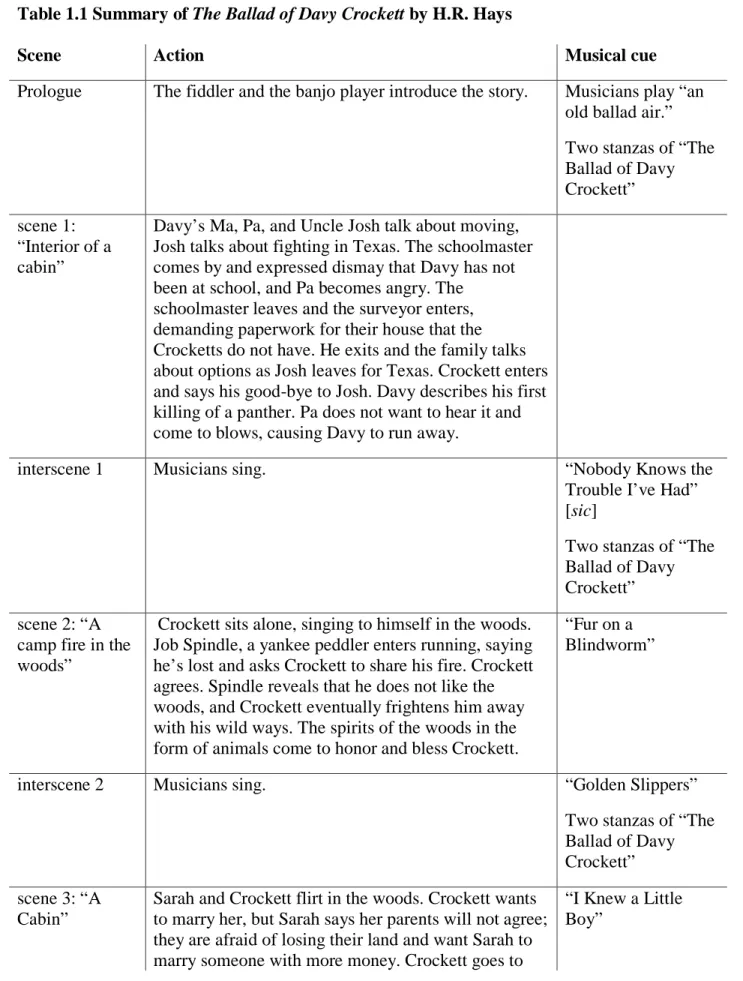
Table 1.1 Summary of The Ballad of Davy Crockett by H.R. Hays ... 60
Table 1.2 Summary of One Man from Tennessee by H.R. Hays ... 84
Table 2.1 Summary of Castles in Spain by Clifford Odets. ... 170
Table 2.2 Summary of You and Me,final cut, by Virginia van Upp. ... 196
Table 2.3 Songs Weill composed for You and Me... 207
Table 2.4 Weill’s cue sheet for You and Me. ... 210
xiii
LIST OF EXAMPLES
Example 1.1 One Man from Tennessee, “I'm a Rolling Stone,” mm. 16–43. ... 100
Davy Crockett, vocal score (incomplete), WLA, Box 2, Folder 21.
Example 1.2 One Man from Tennessee, “Watch Out for Me,” complete number. ... 102 Davy Crockett, vocal score (incomplete), WLA, Box 2, Folder 21.
Example 1.3 One Man from Tennessee, “The Hand is Quicker Than the Eye,” mm. 1–12. ... 108 Davy Crockett, vocal score (incomplete), WLA, Box 2, Folder 21.
Example 1.4a Die Bürgschaft, no. 8, mm. 712–21. ... 109
Die Bürgschaft: Oper. Vienna: Universal-Edition, 1931.
Example 1.4b Die Bürgschaft, no. 10, mm. 1066–74. ... 110
Die Bürgschaft: Oper. Vienna: Universal-Edition, 1931.
Example 1.5 One Man from Tennessee, “Politics,” mm. 1–16. ... 111 Davy Crockett, vocal score (incomplete), WLA, Box 2, Folder 21.
Example 1.6 One Man from Tennessee, “Interscene 1,” mm. 6–12. ... 113 Davy Crockett, vocal score (incomplete), WLA, Box 2, Folder 21.
Example 1.7a One Man from Tennessee, “Interscene 2,” mm. 2–9. ... 114 Davy Crockett, vocal score (incomplete), WLA, Box 2, Folder 21.
Example 1.7b One Man from Tennessee, “Interscene 3,” mm. 2–13. ... 114 Davy Crockett, vocal score (incomplete), WLA, Box 2, Folder 21.
Example 1.8 One Man from Tennessee, “Opening march,” complete number. ... 118 Davy Crockett, vocal score (incomplete), WLA, Box 2, Folder 21.
Example 1.9 One Man from Tennessee,“Where the Green Pines Shadow the Ground,” mm. 17– 24. ... 119 Davy Crockett, vocal score (incomplete), WLA, Box 2, Folder 21.
Example 1.10 One Man from Tennessee, “Battle of the Alamo,” complete number. ... 120 Davy Crockett, vocal score (incomplete), WLA, Box 2, Folder 21.
Example 1.11 Marie Galante,“Tango-Habanera,” mm. 58–66. ... 120
Youkali Sheet Music (Piano/Vocal), Novato Music Press. http://www.onlinesheetmusic.com/.
Example 1.12 Johnny Johnson, “Song of the Goddess,” mm. 32–39. ... 121
Vocal Score of Johnny Johnson. New York: Samuel French, 1940.
xiv
Example 2.2 The River is Blue, “Love theme,” sequence 10, mm, 1–49. ... 178 WLRC, Series 10, Box R5, Folder 1.
Example 2.3 The River is Blue, “Revolutionary song,” sequence 4, mm. 1–57. ... 182 WLRC, Series 10, Box R5, Folder 1.
Example 2.4 The River is Blue, “Music-box theme,” sequence 19, mm. 33–63. ... 186 WLRC, Series 10, Box R5, Folder 1.
Example 2.6 The River is Blue, sequence 21, mm. 1–8. ... 188 WLRC, Series 10, Box R5, Folder 1.
Example 2.7 You and Me, “Song of the Lie,” mm. 23–47... 217 WLA, Box 33, Folder 458.
Example 2.8 You and Me, “The Kind of People Who Sing Lullabies,” mm. 17–32. ... 219 WLA, Box 33, Folder 458.
Example 3.1 Knickerbocker Holiday (cut), “I Do Business in my Hat,” mm. 19–48. ... 270
Knickerbocker Holiday (vocal score),WLA, Box 14, Folder 238.
Example 3.2 Knickerbocker Holiday (cut), “Brom’s Complaint,” mm. 6–39. ... 271
Knickerbocker Holiday (vocal score),WLA, Box 14, Folder 238.
Example 3.3 Knickerbocker Holiday,“Hush Hush,” mm. 1–10. ... 273 Knickerbocker Holiday: A Musical Comedy, Vocal Score. New York: Crawford, 1951.
Example 3.4 Knickerbocker Holiday,“Sitting in Jail,” mm. 17–26. ... 273 Knickerbocker Holiday: A Musical Comedy, Vocal Score. New York: Crawford, 1951.
Example 3.5 Knickerbocker Holiday,“Ballad of the Robbers, mm. 12–20. ... 274 Knickerbocker Holiday: A Musical Comedy, Vocal Score. New York: Crawford, 1951.
Example 3.6 Incidental music, Madam Will You Walk? mm. 3–10. ... 287 WLA, Box 33, Folder 465.
Example 3.7 Incidental music, Madam Will You Walk? mm. 75–85. ... 289 WLA, Box 33, Folder 465.
Example 4.1 Ulysses Africanus, “In an Old Time Far Away and Long Ago,” mm. 1–33. ... 353 WLA, Box 32, Folder 443.
Example 4.2a Stephen Foster, “The Old Folks at Home,” mm. 27–28. ... 355 H.T. Burleigh, ed. Negro Minstrel Melodies. New York: G. Schirmer, 1909.
xv
Example 4.3a Stephen Foster, “Nelly was a Lady,” m. 2. ... 356 H.T. Burleigh, ed. Negro Minstrel Melodies. New York: G. Schirmer, 1909.
Example 4.3b “The Old Cabin Home,” author unknown, mm. 3–4. ... 356 H.T. Burleigh, ed. Negro Minstrel Melodies. New York: G. Schirmer, 1909.
Example 4.4 Ulysses Africanus,“Discernible Today,” mm. 4–12. ... 358 WLA, Box 32, Folder 443.
Example 4.5 Ulysses Africanus, “Discernible Today,” mm. 21–28. ... 358 WLA, Box 32, Folder 443.
Example 4.6 Ulysses Africanus, “White Folks,” mm. 1–8. ... 360 WLA, Box 32, Folder 443.
Example 4.7 Ulysses Africanus,“Dance Little Doggies,” mm. 1–8. ... 362 WLA, Box 32, Folder 443.
Example 4.8a “Heav’n Bound Soldier,” arranged by J. Rosamund Johnson, m. 3. ... 362 James Weldon Johnson, The Book of American Negro Spirituals and The Second Book of American Negro Spirituals. New York: Viking, 1926.
Example 4.8b “Sometimes I Feel Like a Motherless Child,” arranged by J. Rosamund Johnson, m. 3. ... 362 James Weldon Johnson, The Book of American Negro Spirituals and The Second Book of American Negro Spirituals. New York: Viking, 1926.
Example 4.9 Ulysses Africanus, “Lady, You Drop Your Feminine Wiles,” mm. 1–10. ... 363 WLA, Box 32, Folder 443.
Example 4.10 Weill’s transcription of “Death Valley.” ... 364 WLA, Box 32, Folder 443.
xvi
ABBREVIATIONS
LOC/FTP Federal Theatre Project Collection. Library of Congress, Music Division, Washington DC. FLP Fritz Lang Papers. Special Collections #40, Louis B. Mayer Library, American Film
Institute, Los Angeles, CA. FTP Federal Theatre Project.
GS2 Weill, Kurt. Musik und Musikalisches Theater: Gesammelte Schriften. Mit einer Auswahl von Gespächen und Interviews. Expanded and revised edition. Edited by Stephen Hinton and Jürgen Schebera. Mainz: Schott, 2000.
MAC Maxwell Anderson Collection. Harry Ransom Research Center, University of Texas, Austin.
MHL/CC Core Collection. Margaret Herrick Library, Academy of Motion Picture Arts and Sciences, Beverly Hills, CA.
NARA/FTP Federal Theatre Project Collection. National Archives and Records Administration, Record Group 69, College Park, MD.
NYPL New York Public Library, Schwartzman Building, Fifth Avenue at 42nd Street, New York, NY.
PPC Playwrights’ Producing Company.
PPS Paramount Pictures Scripts. Margaret Herrick Library, Academy of Motion Picture Arts and Sciences. Beverly Hills, CA.
WLA Weill–Lenya Archive, MSS 30, The Papers of Kurt Weill and Lotte Lenya, Irving S. Gilmore Music Library, Yale University, New Haven, CT.
WLRC Weill–Lenya Research Center, New York, NY.
W-Fam Weill, Kurt. Briefe an die Familie, 1914–1950. Edited by Lys Symonette and Elmar Juchem. Stuttgart and Weimar: J.B. Metzler, 2000.
W-LL(e) Weill, Kurt and Lotte Lenya. Speak Low (When You Speak Love): The Letters of Kurt Weill and Lotte Lenya. Edited and translated by Kim H. Kowalke and Lys Symonette. Berkeley and Los Angeles: University of California Press, 1996.
WPA Works Progress Administration, renamed Works Projects Administration in 1939. WPD(e) Farneth, David, with Elmar Juchem and Dave Stein. Kurt Weill: A Life in Pictures and
INTRODUCTION
The learning and blundering people will live on. They will be tricked and sold and again sold And go back to the nourishing earth for rootholds, The people so peculiar in renewal and comeback, You can’t laugh off their capacity to take it.
Carl Sandburg, The People, Yes (1936)
When Kurt Weill arrived in the United States on September 10, 1935, the nation had only barely
begun to claw its way out of the Great Depression. The market crash on October 29, 1929
shocked the country, and shook the people’s faith in the very foundations of their way of life.
The deep-rooted trust in the free market that had driven business and culture from
Reconstruction through the boom of the Jazz Age had collapsed. The economic turbulence
caused the United States to rethink the role of government in their lives. After Franklin Delano
Roosevelt took office in 1933, the first hundred days of his presidency saw dramatic changes in
economic policy, including the suspension of the gold standard, and the creation of many new
government programs aimed at putting citizens back to work such as the Civilian Conservation
Corps. By 1935, Roosevelt pushed through Congress both the Emergency Relief Appropriation
Bill, the largest peacetime appropriation in the history of the nation to date, and the newly
established Social Security system.1
1
2
Still, despite the tumultuous times, Weill managed to find a modicum of success during
the second half of the decade, supported by both the Left-wing experimental community and
more mainstream circles. Between 1935 and 1939, he was remarkably productive, writing two
Broadway shows (Johnny Johnson in 1936, for the Group Theatre; and Knickerbocker Holiday,
1938, for the Playwrights’ Producing Company), two pageants (The Eternal Road, 1937; and
Railroads on Parade, 1939 and 1940), and a film score (You and Me, Paramount, 1938). He also
completed a piano-vocal score for another musical, One Man From Tennessee (1937, sometimes
called The Ballad of Davy Crockett), for the Federal Theatre Project, and sketched yet another,
Ulysses Africanus (1939). As for the other film score (which did not make it into production),
Weill spent much of the early part of 1937 writing music for the film that was released as
Blockade (Wanger Studios, 1938), although when the composer was involved with the project, it
was titled Castles in Spain, and then The River is Blue. Weill also worked with some of the most
prominent theatrical minds and organizations of the era, including Franz Werfel, Max Reinhardt,
the Group Theatre, Fritz Lang, Burgess Meredith, the Federal Theatre Project, and Maxwell
Anderson.
Although many of these works, and others, remained unfinished, unused, or abandoned,
they still reveal crucial aspects of both Weill’s creative development, the course of American art
during the Great Depression, and the paths that were open to the anti-Fascist émigrés that fled
Hitler’s regime in Europe. Weill’s theatrical experiments of the middle and late 1930s helped
him develop the theatrical techniques that he would use in some of his better-known works later
in in his career. These experiments were conducted in collaboration with other like-minded
3 and even correct the troubling political and social times.2
This dissertation takes Weill’s Broadway and Hollywood works as a starting point to
explore his various creative and professional strategies to continue the project he began in
Europe: developing a new, simplified, and modern musical theatre that would speak to a
contemporary audience. Weill found allies within the same sorts of communities that supported
his work in Europe, politically-aware communities like the Group Theatre, the Federal Theatre
Project, and the Hollywood Left. In these organizations, he rubbed shoulders with some of the
most important figures of what historian Michael Denning has termed the Popular Front, an
historical bloc made up of “young plebian artists and intellectuals,” allied with “the older
generation of American Modernists,” and “anti-fascist émigrés” that made up the vanguard of
progressive politics and art in the 1930s.
Weill also forged his own path through
the thorny life of an émigré; while many of his colleagues went into academia or found work in
the Hollywood studios, he made a career for himself on Broadway, although he did, for a brief
period in 1937, considering taking the Hollywood route.
3
2
Throughout this dissertation, I use the term “music theatre” after W. Anthony Sheppard, who notes that as the twentieth century progressed, composers (and other artists) began to experiment with theatrical works that did not fit into the traditional categories of “opera,” “ballet,” or “play.” However, he writes that “It may be wrong even to think of music theater as a genre, since so much twentieth-century art has been concerned with genre-blurring,” and that the term encompasses a wide-range of subgenres, including “dance-drama, polytechnic drama, melodrama, monodrama, dramatic oratorio, opera-oratorio, school opera, chamber opera, mini-opera, rock opera, TV opera, radio play, musical play, puppet play, pantomime, dance-pantomime, burlesque, didactic piece, theater piece, and music-theatre.” He concludes that “The label ‘music theater,’ then, indicates not so much a set of traits signaling a specific new genre as it does a fundamental aspiration toward discovering some novel form of theatrical-musical performance.” W. Anthony Sheppard, Revealing Masks: Exotic Influences and Ritualized Performance in Modernist Musical Theatre (Berkeley and Los Angeles: University of California Press, 2001), 4. Weill’s American works are similarly varied in genre designation (play with music, musical tragedy, musical vaudeville, Broadway opera, circus opera), indicating that he also found it difficult to compose within the standard generic boundaries, rendering Sheppard’s term “music theatre” appropriate for his oeuvre. Weill used the term similarly throughout his writings as well.
He participated in contemporary artistic movements
3
4
that combined a documentary aesthetic with modernist formal experimentation, finding new
ways to communicate with an audience confused and scared by domestic and international
politics.
In examining these works, I not only illuminate a crucial period in Weill’s creative and
professional development, but also reframe the 1930s as a decade of artistic progress and
innovation. As Denning has noted, the 1930s are seen as “an interregnum between modernism
and postmodernism, the last hurrah of a lost nineteenth century realism.”4 Broadly speaking, too
many historiographies of musical Modernism run from the 1890s through the 1920s, and then
resumes around 1945, or from Debussy and Richard Strauss through Weimar, the neo-classical
Stravinsky, and the serial Schoenberg, then resuming with Darmstadt and its various discontents.
This vision of Modernism focuses primarily on abstraction, complexity, and (with the exception
of Weimar) withdrawal from the world, with the assumption that all Modernist music is written
for an “expert” listener in the Adornian sense of someone who “Spontaneously following the
course of music, even complicated music … hears the sequence, hears past, present, and future
moments together so that they crystallize into a meaningful context.”5
4
Denning, The Cultural Front, 120.
This narrative includes
5
Theodor W. Adorno, Introduction to the Sociology of Music, trans. E.B. Ashton (New York: Seabury, 1976), 4. Rose Rosengard Subotnik described this sort of Modernism in “The Cultural Message of Music Semiology: Some Thoughts on Music, Language, and Criticism since the Enlightenment,” Critical Inquiry 4 (1978): 741–68. She argues that twentieth-century music extended the nineteenth-century aesthetics of “opacity (nonreferentiality), autonomy, sound, and internal coherence, along with a tendency toward self-destruction.” As a result, “the increased precision of the metalanguages … has assured their incomprehensibility on a social scale precisely because their precision is not referential but merely (imperfectly) self-consistent. … [E]pistemological language in the twentieth century has more or less dissociated itself from the communicative functions of language” (at pp. 750–51).
5
only a handful of composers—mostly Americans like Copland and Marc Blitzstein—from the
eras of the Great Depression and World War II, and only then because of their activities in the
1920s.6 Yet as Björn Heile has observed, this is an incomplete history of the movement: “there is
no simple historical continuity or ‘grand narrative’ linking they ‘heroic’ modernism of the early
twentieth century with the post-war avant-gardes, as well as their putative successors in the early
twenty-first century.”7 There may or may not be a need for a “grand narrative,” but there is an
urgent need for a recognition of the multiplicity of broader definition of Modernisms that takes
into account how other groups of artists envisioned the movement, such as those active in the
United States in the Great Depression. Weill’s film and Broadway scores from this period
present a unique opportunity to study how an anti-Fascist émigré participated in these new
developments.
Modernist Thought in the Great Depression
Recent scholarly work in film and literary studies has offered new ways of looking at the notion
of “Modernism” which broaden the base of the movements associated with the term, particularly
within the United States. During the 1920s, as Carol J. Oja observed, “the variety of musics
classified as ‘modernist’ grew ever more varied, and by [the decade’s] end, a new generation of
of artistic production, on the exploration of the extremes of expression, and on abstraction and formalization”; Sheppard, Revealing Masks, 8.
6
The standard narrative of American Modernisms has composers simplifying their style during the Depression and World War II in order to reach a broader public and to promote an autochthonous American culture. For example, Carol J. Oja writes that “The musical language of Copland’s Appalachian Spring [1944], for example, is not so far removed from that of the Piano Variations [1930]. Rather the meaning and the overall accessibility of the work were changed”; Making Music Modern: New York in the 1920s (Oxford and New York: Oxford University Press, 2000), 363.
7
6
American composers and critics had come into its own.”8 Kim Kowalke notes that the modernist
world Weill encountered was “overheated by the friction among various factions of composers
disputing the identity appropriate for American art music.”9
Modernism in America links a demotic urge to represent the plebeian, the everyday, the regular Joe, through experiments with diverse forms—realist, naturalist, cubist, lyric—in various media—prose, poetry, photography, film. … The American modernist
afterthought, freed from the need to be original, could be redundant; it could be
vernacular; it could be pulpy, embracing Whitman’s ecstatic catalogues and Dickinson’s wacky prosody as it accommodated Main Street, Fordism, Hollywood, and the New Deal.
While Kowalke focuses on schools
defined by their withdrawal from public tastes (at least in their compositional lives), such as
those populated by figures like Henry Cowell, Carl Ruggles, and Rogers Sessions, another
branch of modernists in the 1930s considered mass and popular culture part of their national
tradition, and drew on its genres, forms, sounds, and sights. As literary scholar Paula Rabinowitz
puts it:
10
Film scholar Miriam Hansen has termed this movement “vernacular modernism,” that is, the
“mass-produced and mass-consumed phenomena of fashion, design, advertising, architecture and
urban environment, of photography, radio, and cinema” that “combines the dimension of the
quotidian, of everyday usage, with connotations of discourse, idiom, and dialect, with
circulation, promiscuity, and translatability.”11
8
Carol J. Oja, Making Music Modern, 361.
The U.S. Modernists of the Great Depression
focused on experimenting with the forms and genres of mass culture in order to effect social
9
Kim H. Kowalke, “Formerly German: Kurt Weill in America,” in A Stranger Here Myself: Kurt Weill Studien, ed. Kim H. Kowalke and Horst Edler, (Hildensheim and Zurich: Georg Olms, 1993), 35–57, at p.40.
10
Paula Rabinowitz, “Social Representations within American Modernism,” in The Cambridge Companion to American Modernism, ed. Walter Kalaidjian, (New York: Cambridge University Press, 2005), 261–83, at p. 266.
11
Miriam Hansen, “The Mass Production of the Senses: Classical Cinema as Vernacular Modernism,”
7
change. This was particularly true in the case of the documentary. Jeff Allred argues that the
1930s fascination with the history and culture of the United States is a Modernist impulse. He
writes of the Depression-era documentary book that it “represents social others in ways that
arrest or interrupt, rather than confirm, dominant ideologies … they disrupt the identities of
reading selves and represented others and refigure the orderly teleology of historical progress as
a contingent and unpredictable process.”12
Such “vernacular modernists” of the era conceived of the movement more in terms of
experimenting with historical and popular forms and speaking to a society mired in modernity,
than with producing abstract, complex, and autonomous works of art. The challenges of
modernity in the form of economic depression, the rise of new technologies, and political
radicalism provoked artists to respond in varying ways; as some withdrew, others consciously
engaged by testing the boundaries of traditional media. These included experiments composing
or writing at the boundaries of elite and mass culture, particularly in newspapers. James Agee’s
Modernist classic Let Us Now Praise Famous Men (1941)began as an article for New York
Magazine but eventually grew too long to publish. Agee explicitly urged readers to think outside
the generic box:
The text was written with reading aloud in mind. That cannot be recommended; but it is suggested that the reader attend with his ear to what he takes off the page: for variations of tone, pace, shape, and dynamics are here particularly unavailable to the eye alone, and with their loss, a good deal of meaning escapes. It was intended also that the text be read continuously, as music is listened to or a film watched.13
For The Grapes of Wrath (1939), often considered the quintessential novel of the era, John
Steinbeck drew on a series of articles he wrote for the San Francisco Chronicle, which may have
12
Jeff Allred, American Modernism and Depression Documentary (New York: Oxford University Press, 2010), 7.
13
8
influenced One Man from Tennessee, as I discuss in Chapter 1. In the musical realm, Ruth
Crawford took up the proletarian cause by setting a poem by H.T. Tsaing published in The Daily
Worker, “Chinaman, Laundryman,” as the second song in her Two Ricercari (1932). For many
Left-wing artists, mass culture provided the raw material for Modernist expression.
Weill made a concerted effort to both learn and shape the tastes of U.S. audiences. On
June 4, 1936, he wrote to his publisher Heugel, “Right now, I am trying to create a place for
myself in American theatrical life. That will be very difficult, and I will need all of my patience
and all of my energy. Once I have found my place here, I will be able to return to the kind of
work which corresponds to my talents and ambitions, and that would be the time to offer you
operatic works of international caliber.”14 However, for Weill, finding his place meant looking
for a way to continue the work he had done in Europe, rather than conforming to contemporary
U.S. notions of musical theatre. In his notes for a lecture to the Group Theatre that same summer,
Weill laid out his vision for American musical theatre, working towards a new form: “Situation
of musical theatre in this country: Metropolitan, worst example of old fashioned opera (museum)
on the one side, musical comedy, which tried to be sophisticated and low brow at the same time
on the other side. Nothing in between. Enormous field for musical theatre. Collaboration of
playwright and composer.—Composer as dramatist (Mozart, Verdi, Wagner).”15
14
WPD(e), 164.
This position
between museum opera and musical comedy approaches a space similar to the Modernisms
described above, which seek to draw on popular resources to create new forms of art that would
transform the entire field of artistic and political play, just as Mozart did with the Singspiel and
as Verdi’s politically charged operas captured the public’s attention during the Risorgimento.
15
9
Weill explicitly tied this to his work in Germany, writing that he had to “leave the opera house”
and “go to the theater” when he wrote Die Dreigroschenoper (1928). In trying to convey his
sense of the way music and drama should interact to the music theatre novices at the Group, he
explained in his “Notes for a Lecture for the Group Theatre”:
Most important element of musical theater: the song. Not only lyrical, not only expression of sentiments, but: clarification of the idea of the drama. A song is the shortest, clearest, most intense expression of an idea, the quickest, most direct and most affectful [sic] way to the meaning of a scene. The action of the play comes to a point where a song can express the philosophie [sic], the general aspect of the scene.16
These echo the sentiments Weill expressed in Germany, and attest to the fact that, as much as he
was trying to find his place in American musical theatre, he was still trying to make his own way
without sacrificing the work he had done Europe to the popular conception of Broadway.
Moreover, Stephen Hinton has noted that in this essay, Weill maintains “his basic commitment to
an ideal of absolute music, conceived in a Busonian (not Hanslickian) terms.”17
A year later, he felt secure enough in his knowledge of U.S. culture to clarify these ideas
in a public forum. In the May-June 1937 issue of Modern Music, he laid out his plans in a piece
entitled “The Future of Opera in America.”
Weill’s
fundamental stance has not changed, observes Hinton, but, rather, its presentation; Weill’s
American writings do not contain the same strongly anti-Wagnerian rhetoric (although it is often
hidden in the subtext, as I discuss below) as his European writings, focusing on a prescriptive
recipe for how the United States might cultivate a more modern form of musical theatre.
18
16
Kurt Weill, “Notes for a Lecture for the Group Theatre,” WPD(e), 65.
In this essay, he called the European opera world
17
Stephen Hinton, Weill’s Musical Theater: Stages of Reform (Berkeley and Los Angeles: University of California Press, 2012), 269.
18
Kurt Weill, “The Future of Opera in America,” trans. Joel Lifflander, Modern Music 14 (1937):183–88, available
online at
10
“stagnant,” and praised the United States for not being “burdened with an opera tradition.” The
first part of the essay decries the state of opera in Germany and France, because
the contents of the librettos drew farther away from the realities of life, from the simple natural relations between people, and lost themselves in artificial, false emotions, in a meaningless world of kings, knights and princesses, or in pure symbolism.
Coincidentally, the means of musical expression became increasingly complicated. Melody, always the most expressive element of the music theatre, was threatened by over-emphasis on harmony and by orchestral effects. In an almost diseased passion for musical originality, the central problem of the music theatre—to bring words and tones together in equilibrium—was lost to sight. In the process of extending its musical structure, making it more fine-spun, opera presentation was so neglected as to become almost ridiculous. The stiff, unnatural movements of singers, the old-fashioned scenery, the meaningless interruptions by ballets, these are the tragic signs of an age in which opera lost contact with the theatre and led the existence of a museum piece, toilsomely preserved by its devotees.
The reference to balletic interruptions is the only jab at French opera, as Weill reserves the
majority of criticisms for the figure that lurks behind most of Weill’s writings on music theatre:
Wagner. The charges of “pure symbolism,” “over-emphasis on harmony, on orchestral effects,”
“extending musical structure” to the point of “ridiculousness,” and the “stiff, old-fashioned
movements of the singers” are all familiar complaints from Weill, who in his German writings
often advocated against Wagner’s influence.19
The flowering of Italian opera in the nineteenth century brought forth in Verdi a new peak of popular opera. The melodic invention of its music and the technical mastery of the means of expression rank it with the great masterpieces. At the same time its public reception was such that it could stand on its own feet. The circumstances under which
Weill’s accusation of “an almost diseased passion
for musical originality” is particularly telling. Rhetoric of “disease” plagued Nazi propaganda
against figures like Weill and Schoenberg, who were accused of unwholesome contributions to
German culture. Turning the same charge back on Wagner is a not-so-subtle jab at the culture
that had evicted him. Instead, Weill considers Verdi the pinnacle of the European operatic canon:
19
See particularly his essays “Der Neue Oper” and “Busoni’s Faust und die Eneurerung der Opernform” (both 1926), translated as “New Opera” and “Busoni’s Faust and the Renewal of Operatic Form,” in Kim H. Kowalke,
11
Verdi wrote his operas provided the healthiest condition of the theatre. There was a group of impresarios who were commissioning operas. Each had several prominent singers under contract, and from Verdi’s letters to his librettists we know that with each work there was a consultation about which singers had to be provided with roles. … The influence of the Verdi revival on post-war composers was accompanied by a realization that opera must again find a union with the theatre, and return to a simplified, clear and direct musical language.
Weill’s description of the world in which Verdi operated resembles the contemporary U.S. studio
system in Hollywood, with stars contracted to a handful of powerful producers, and also,
perhaps, what he had hoped to find with the Group Theatre. Even more tellingly, Weill advocates
a “clear” and “simplified” musical language, which his echoes observation that “theatre was
originally a folk-art, it needed music, always the most natural, most ‘popular’ form of artistic
expression.”
Weill’s narrative of the history of opera (and music in general) directly contradicts
standard narratives of musical Modernism, which generally begin with Wagner’s prelude to
Tristan und Isolde and proceed toward increasing intricacy and distance from the everyday.
Weill instead advocates for something resembling Hansen’s “vernacular Modernism,” based in
popular styles and topicality. Most of all, he disdains “empty play with form,” implying that
(Wagnerian) innovation is not enough: it must make a point relevant to a contemporary audience.
The second part of the essay extends this idea by speculating on what the future of opera (or
music theatre) could become in the United States. He predicts that the nation will become home
to an American Johann Strauss, Offenbach, or Gilbert and Sullivan, who prove that it is possible
to make “a musical theatre culture of high merit can arise from the field of light music.” None of
the figures Weill praises—from Verdi to Gilbert and Sullivan—is part of the standard Modernist
canon, but they are key figures for the way Weill conceives of “modern” music, that is, music
12
During Weill’s first years in the United States, he continued similar vernacular modernist
experiments with form, genre, and mass culture. One Man from Tennessee draws on the
aesthetics of the Federal Theatre Project, particularly the documentary Living Newspapers. He
also employed some of the techniques of the “epic”-style theatre he developed with Brecht in the
1920s. Weill’s two film scores play with the boundaries between the mass medium of film and
the high-art genre of opera. Knickerbocker Holiday, which is a frank homage to Gilbert and
Sullivan’s The Mikado, blurs the meta-dramatic line between frame and inset, and the multiple
shows-within-shows in Ulysses Africanus not only make an argument for racial equality, but also
play with the notion that art imitates life, as the character Ulysses, who has left his wife Penny,
puts on a minstrel show of Homer’s Odyssey.
Weill also participated in the contemporary movement to create a uniquely American art
form. In 1918, Van Wyck Brooks chastised professors of American literature for “severing the
warm artery that ought to lead from the present back to the past,” calling on the academy not to
search for masterpieces in American literature, but, rather, to examine the cultural and social
circumstances that influenced authors to write in a certain way, all in an effort to give aspiring
writers a “usable past” on which to build.20
20
Van Wyck Brooks, “On Creating a Usable Past” (1918), in American Literature, American Culture, ed. Gordon Hutner (New York and Oxford: Oxford University Press, 1999), 213–16, at p. 216.
The search for a “usable past” was part of a larger
American project that began in the 1920s, but whose heyday was in the 1930s to develop a
unique, autochthonous artistic culture, distinct from European influence. As U.S. artists searched
for way to break creative and cultural ties with Europe, Van Wyck’s “usable past” proved a
helpful starting point; artists in the United States began to look to their own historical figures and
13
Victoria Grieve has observed that “as the Depression deepened and Americans searched for
some validation of their culture and community in their ‘way of life,’ the notion of a shared
experience rooted in a common past proved especially reassuring.”21
As the reforms of the Progressive Era (1890–1929) such as new regulations on business,
child-labor reform, and the expansion of the public school system began to yield results, the
Great Depression saw the rise of an educated working class with a new consciousness of their
nation and national culture. The Popular Front provided an outlet for this new fascination with
history and the desire for “a usable past.” The Federal Writers Project set out to document stories
from all over the nation as part of its effort to produce guidebooks for every state in the union,
highlighting each state’s unique history. Epic novels like Margaret Mitchell’s Gone with the
Wind (1934)and William Faulkner’s Absalom, Absalom! (1936) detailed the failing grandeur of
the American South before, during, and after the Civil War. On Broadway, Stephen Vincent
Benét, Douglas Moore, and Fritz Reiner teamed up to produce an operatic version of The Devil
and Daniel Webster (1939), while Jacques Wolfe and Roarck Bradford’s John Henry (1940)
took up the challenge of integrating American folk music into drama. The Metropolitan Opera
Company mounted pieces by American composers on American subjects, such as Louis
Gruenberg’s operatic adaptation of Eugene O’Neill’s The Emperor Jones (1933) and Howard
Hansen’s Merry Mount (1934), the latter concerning a conflict between Native Americans and
English settlers in 1630s Massachusetts.Europeans other than Weill also found inspiration in
Americana, such as Benjamin Britten and W.H. Auden’s operetta Paul Bunyan (1941), which
was written for the Columbia University Morningside Players (the same institution that staged
H.R. Hays’s The Ballad of Davy Crockett in 1936, the play that eventually became One Man
21
14
from Tennessee). By the 1930s, the cultural gaze had also turned to statesmen of days gone by,
and the market flooded with biographies that tended to emphasize the nobility inherent in these
figure’s lives, intended for an audience that craved historical validation. Presidents Abraham
Lincoln and Andrew Jackson became symbols of the lessons of the past. Consequently, they
functioned as emblems of the entire nation, and particularly the common folk because of their
humble pasts, or as historian Alfred Haworth Jones has put it:
Each … had emerged, in his own characteristic rough-and-tumble fashion, during the romantic, exuberant, antebellum years. Each had about him that homespun coarseness of texture, that pungent tang of the soil which marked him as distinctly, indomitably
American. Each had been cut of the “native grain.” From their humble origins [they] retained, albeit not without misgivings, warm humanitarian sympathies, a real but studied uncouthness, a tendency to defy polite convention, an earthy sense of humor … and withal a self-consciousness about their public images.22
Lincoln, in particular, became a major cultural icon during the Great Depression. Plays such as
E.P. Conkle’s Prologue to Glory (1938) and Robert Sherwood’s Abe Lincoln in Illinois (1938)
bear witness to the fact that the nation was searching for answers to the issues dividing the
country from the one figure who had dealt with anything close to that scale of dissent. Weill
participated in this movement. The Lincoln presidency and his assassination form the centerpiece
of the second version of Railroads on Parade, and Andrew Jackson appears as a major character
in One Man from Tennessee.
This turn inward and to the past was more than just a nationalist effort, but a political one
as well. Literary scholar Simon Edwards notes that “the historical novelist, suspended between
the ideologies of revolutionary enlightenment and romantic reaction, strives to achieve a quality
22
15
of epic impersonality in giving an adequate account of the forces that drive modernity.”23
Similarly, Jerome de Groot writes that historical fiction opens up space for authors to employ
marginalized voices from the past in a way that destabilizes common conceptions of the past.24
After Johnny Johnson and The Eternal Road (each discussed further, below), Weill
turned toward projects that focused on America’s past. One Man from Tennessee told the legend
of the American hero Davy Crocket; Knickerbocker Holiday depicted early New Yorkers under
the governorship of Pietr Stuyvesant, who by the twentieth century had become a secular “patron
saint” of New York City. Ulysses Africanus went back to the Reconstruction-era South to tell the
story of a freed slave trying to make his way in the world. It is also telling that although Weill
considered writing many projects that had nothing to do with U.S. history, including the Liliom
project (described below),an adaptation of S.N. Behrman’s The Pirate (discussed in Chapter 3),
and the “Opera from Mannheim” (Chapter 1), the only ones that came to fruition—at least on
Broadway—were historically minded. The one exception in terms of unfinished projects is The Many writers, musicians, and artists during the Great Depression used the past as a parable for
problems of their present, showing the origins of contemporary problems, and demonstrating
past solutions. William Dieterle, for example, released a series of biopics of historical
anti-Fascists between 1936–39. Others offered a new version of the past, one in which marginalized
voices could speak, such as the epilogue of Willa Cather’s Sapphira and the Slave Girl (1940),
with abused slave Nancy.
23
Simon Edwards, “The Geography of Violence: The Historical Novel and the National Question,” NOVEL: A Forum on Fiction 34 (2001): 293–308, at p. 304.
24
16
Common Glory, a historical pageant about the Revolutionary War that the FTP commissioned
from Weill and Paul Green for sesquicentenary of the signing of the U.S. Constitution in 1937.25
In his compositions from 1935–39, Weill presents new accounts of well-known stories
events that highlight the plight of the marginalized in an attempt to present historical analogues
to contemporary problems. The mixture of opera, liturgical music, and jazz in The Eternal Road
presents biblical history as something living, immanent, and relevant. The simultaneous
depiction of biblical suffering with the plight of the Jews hiding from the pogrom highlights the
“eternal” troubles of the Jewish people, placing the rise of the Nazis and of anti-Semitism in the
Soviet Union in the context of the events such as subjugation of the Israelites in Egypt and the
sacking of Jerusalem.26 For The Common Glory, Green wanted to write about the 1929 and 1934
textile strikes in Gastonia and Burlington, NC, but Weill steered Green towarda grander
historical overview by advocating an all-encompassing pageant in the vein of The Eternal Road.
Green eventually settled on afictional episode in the American Revolution, with the
everyman-style patriot Jonathan Smith (whom Weill wanted modeled on his and Green’s other everyman
hero, Johnny Johnson)27 wooing the daughter of an English Loyalist as the story of Sam Adams
and Paul Revere plays out in parallel, before they abandoned the project in early 1938.28
25
On The Common Glory, see Tim Carter, “Celebrating the Nation: Kurt Weill, Paul Green, and the Federal Theatre Project (1937),” Journal of the Society for American Music 5 (2011): 297–334.
One
Man from Tennessee re-envisions Davy Crockett not as a military hero, but as a Frank
Capra-esque congressional legislator who fights for the little people. Knickerbocker Holiday revisits the
26
Norbert Abels, “Von den Mühen eines Bibelspiels. Franz Werfel und Kurt Weill: Der Weg der Verheißung,” in
Kurt Weill: Auf dem Weg zum Weg der Verheissung,” ed. Helmut Loos and Guy Stern (Freiburg im Breisgau: Rombach, 2000), 133–56, at p. 136.
27
Letter from Weill to Paul Green, October 13, 1937, WLA, Box, 47, Folder 6.
28
17
origins of the nation not on Plymouth Rock, but in an immigrant New Amsterdam, with another
American everyman, Brom Broeck, taking on Pietr Stuyvesant and his corrupt council of
Dutchmen. Finally, Ulysses Africanus tells the story of the Reconstruction from the point of view
of a former slave.
The similarity of Weill’s Davy Crockett to Capra’s Jefferson Smith further suggests how
deeply Weill and his librettists were enmeshed in U.S. culture, particularly toward the end of the
decade.29 The ordinary-man-turned-hero who fights for his own rights and those of the little man
was a prominent cultural trope in during the Great Depression, with Capra’s Jefferson Smith and
George Bailey sharing screen time with Steinbeck’s Tom Joad. Historical figures, as well, were
often portrayed as down-to-earth and relatively ordinary before they were called to greatness.
These everyman heroes stood out as the best of “The People,” one of the great cultural
watchwords of the Great Depression.30 Like the narrator of John La Touche and Earle
Robinson’s WPA (Works Progress Administration, renamed the Works Projects Administration
in 1939) radio cantata Ballad for Americans (1939), they represented the “everybody who’s
nobody” and the “nobody who’s everybody.”31
29
Crockett and Smith are both outdoorsmen who spend their congressional careers fighting for land rights. Some of the similarities are so striking one might think the former was modeled on the latter but for the fact that Weill wrote
One Man from Tennessee during late 1937, and Mr. Smith Goes to Washington was not released until 1939. Because they were ostensibly “nobodies,” they
could be anybody, and they embodied the power of the ordinary masses against the ingrained
structures of government. These heroes succeed because they harness the power of the People
they represent (literally in Davy Crockett’s case). They fail because they try to act alone.
30
Denning, The Popular Front, 124. As Denning observes, “The People” was not a monolithic slogan of the era, but rather a concept that many different political and artistic movements—Left and Right—coopted for their own ends. However, for an immigrant, the lines between these various factions may not have been terribly clear.
31
John La Touche, lyrics of “Ballad for Americans,” performed by the New York City Labor Chorus, available
18
While Weill’s choice of subjects and time periods appears quite varied on the surface,
most of his works from this period engage with the problems of rootlessness and immigration.
Weill took the American penchant for politically engaged historical fiction and used it to
advocate for the rights of displaced peoples. In One Man From Tennessee, a representative from
the bank scars the young Crockett for life as he re-possesses his parents’ farm, forcing his family
to become wandering tenant farmers. Crockett then resolves to run for Congress in order to
prevent banks from buying up more than had already been settled by homesteaders. The
Dutchmen in Knickerbocker Holiday struggle to figure out what constitutes correct American
behavior, in the end proving that they can be loyal citizens of the country. The initial journey of
the title character of Ulysses Africanus echoes aspects of Weill’s flight from Germany. Weill
extended this advocacy into his non-historical films as well. One of the taglines for You and Me
was “A tabloid story of America’s men and women without a country!” The trailer for You and
Me also begins with a mock newsreel describing “these American men and women without a
country. To all appearances, they lead the lives of average Americans. They seek employment,
they look for a place to live. But though they are Americans, they may not vote, they have no
civil rights.” While these turn out to be parolees, the contradiction of “American men and
women without a country” could just as easily be describing immigrants (or African Americans,
an issue which I address in Chapter 4). In The River is Blue, the migrant Norma (the romantic
lead) struggles to find work in France, only to be turned away time and again because she lacks a
French passport.Weill’s works from the late 1930s advocate for the poor, downtrodden, and
19 Early Lessons: The Eternal Road and Johnny Johnson
Weill originally came to the United States to put the finishing touches on The Eternal Road, a
massive biblical pageant that recounted parts of the Hebrew Bible. The project began in the mind
of Meyer Weisgal, a Zionist and aspiring producer who experienced his first success with The
Romance of a People, a pageant depicting the history of the Jewish people from Creation to the
present performed mostly by amateurs, written for the 1933 World’s Fair in Chicago. After
learning that the director Max Reinhardt, famous for spectacles such as The Miracle (1924), had
been forced out of Germany, Weisgal resolved to “put together a Reinhardt-directed spectacle on
a theme resembling The Romance, as a sort of answer to Hitler; but unlike The Romance it was
to be the project of some of the greatest artists of our time.”32 Reinhardt contacted Weill
sometime in the winter of 1933. On December 16, he wrote to Lenya, “I almost went to America
with Reinhardt for a huge Jewish theatre work. But the date they wanted for it was too soon.
Perhaps we’ll do it in the fall.”33 By the following February (1934), after meeting with Reinhardt
in France, he was reassured that all was in order, and he officially agreed to compose the score.
Weisgal, Weill, Werfel, and Reinhardt met at the director’s lavish castle, the
Leopoldskronschloss, in Salzburg in August 1934 to sign the contract. Werfel had already
completed the first draft of the libretto called Der Weg der Verheissung, and staged a successful
reading at the meeting. One month later, Reinhardt, Weill, and Werfel met in Venice.34
32
Meyer Weisgal, Meyer Weisgal… So Far: An Autobiography (New York: Random House, 1971), 116.
After the
meeting, everyone went their separate ways to work on their own individual aspects of the
33
W-LL(e), 107.
34
20
production: Weill on the music, Werfel on the libretto, Reinhardt on the staging, and Weisgal on
the financing.
It was not until almost a year later that the four collaborators convened again (although
Weill and Reinhardt did meet in Venice in July 1935 without the other two), this time in the
United States, ostensibly to oversee production, now called The Road of Promise (a literal
translation from the German; it was changed in mid-November to The Eternal Road), with a
translated libretto by Ludwig Lewisohn. Although he never intended it to be a permanent trip,
Weill would not return to Europe for another twelve years after he arrived in the United States.35
After settling in to the St. Moritz Hotel in Manhattan (a fairly upscale establishment) on a
semi-permanent basis, he set to work, preparing for a late December opening.36
35
Weill arrived with Weisgal in the United States slightly earlier than Reinhardt, who docked on October 3, and Werfel, who arrived in November. See “News of the Stage,” The New York Times, September 5, 1935, p. 24; “Reinhardt is Here to Produce Play,” New York Times, October 4, 1935, p. 25; “Book Notes,” New York Times, October 29, 1935, p. 19. Weill visited Europe during 1947, but, as he wrote to Maxwell Anderson on May 30, 1947, by then he felt more at home in the United States than anywhere else; MAC, Series Misc., Folder “Weill, Kurt, TLS, 2 ALS to Anderson, Maxwell and Anders, [Gertrude (Maynard)], 1939 June 5, 1947 May 30, 1947 June 22.” Reinhardt had spent the previous few years traveling back and forth between Europe and the United States.
However, during the
previous year, Reinhardt had hired set designer Norman Bel Geddes to design the production
after his usual collaborator Oscar Strnad fell ill. Their grandiose conception required extensive
renovations to the dilapidated Manhattan Opera House, including ripping out several rows of the
orchestra section, the most expensive seats in the house, which later hurt the revenues. The
overhaul required more money than Weisgal had budgeted for the project, so by January 29,
1936, all support had dried up, and Equity ordered rehearsals stopped because the chorus and
actors had not been paid. After Weisgal failed to raise the necessary $200,000 within the ten-day
36
21
grace period, the project went dark.37 Undeterred, Weisgal raised another $125,000 even as
Werfel retreated back to Europe, Reinhardt moved on to his production of Jedermann at the
Hollywood Bowl, and Weill began work with the Group Theatre on Johnny Johnson. In late
1936, production began again, and The Eternal Road finally opened on January 7, 1937, a few
weeks before Weill left for Los Angeles to pursue a film opportunity with members of the Group
Theatre. Despite a rough opening night, critical reviews were generally favorable, particularly
towards Weill’s music. Brooks Atkinson wrote that “when the portals of heaven open, disclosing
a sacred choir of angels, the glory that floods the theatre is the voice of an inspired composer.”38
Ira Wolfert of the Los Angeles Times declared that “The Eternal Road is fabulous and it is Mr.
Reinhardt and Mr. Weill and $465,000 that have made it so.”39 However, despite some good
notices, the production turned out to be too long and difficult for audiences. Attendance was not
good, and continued attempts to shorten the show only made for squabbles between Werfel,
Weill, and the rest of the production team, who by that point were geographically disparate. The
Eternal Road closed on May 17, 1937 without turning a profit. It was not quite the end of Weill’s
relations with Reinhardt: he then tried to get Paul Green (the librettist of Johnny Johnson, who
also knew the director) interested in Reinhardt’s proposed English language revival of
Hofmannsthal’s Das Salzburger groβe Welttheater with the FTP in Los Angeles in April 1937,
but Green remained lukewarm and funding for the FTP was in short supply, and the idea never
took hold.40
37
“Equity Edict Ends Show Rehearsals,” New York Times, January 29, 1936, p.14. The Times reported that Weisgal had already spent an unprecedented $259,519 before Equity got involved.
38
Brooks Atkinson, “The Play: The Eternal Road,” New York Times, January 8, 1937, p. 14.
39
Ira Wolfert, “Current Film and Play Productions: Three Great Dramas in New York,” Los Angeles Times, January 17, 1937, p. D4.
40
22
The Eternal Road taught Weill a hard lesson about the business aspect of American
“show business.” After the first month, he was under the impression that it was going to be a hit.
However, a telegram from Louis Nizer (Weisgal’s lawyer) on February 6, 1937 shattered that
view. Although the telegram does not survive, Weill wrote a letter from Los Angeles on the same
day to Motty Eitingon, one of the show’s backers, asking for help:
[The Eternal Road] was, as you know, a fantastic success in the history of the theatre. The critics were unanimously enthusiastic, as I have never seen them before. The audience is giving it a reception which one rarely finds in the cases of such works. The performance is now at a height that no other theatrical event in America has achieved. The revenues are now rising steadily and for two weeks have been over the weekly average. And yet today I received a telegram from Nizer, in which he says that
everything must come apart in a short time if no immediate help is found. From here I cannot see the reasons for this terrible situation, but for you there it would be an easy thing to ascertain the financial situation, and if it is necessary, to make possible changes to the management. There is no doubt about it: if someone helps this show out of its present difficulties, it will have a long run and bring in a lot of money.41
Weill’s letter to Eitingon is somewhat disingenuous given that he had written to his brother,
Hans, on January 15 that “the box office so far is not we had expected after those reviews.”42
41
“Es war, wie Sie wissen, einer fantastischen Erfolge in der Geschichte des Theaters. Die Kritiken waren von einer einmütigen Begeisterung, wie ich sie noch nie gesehen habe. Das Publikum bereitet dem Werk eine Aufnahme, wie sie selten ein Werk gefunden hat. Die Aufführung ist jetzt auf einer Höhe wie kein anderes Theaters-Ereignis in Amerika. Die Einnahmen steigen ständig und sind bereits seit zwei Wochen über dem Wochentat [sic]. Und doch bekam ich heute von Nizer ein Telegramm, in dem er sagt, dass die ganze Sache in kurzer Zeit zusammenbrechen muss, wenn nicht sofortige Hilfe geschaffen wird. Ich kann von hier aus nicht überblicken, wo die Gründe für diese furchtbare Situation liegen, aber es wird für Sie dort ein leichtes sein, die finanzielle Situation festzustellen und, falls es nötig ist, eventuelle Aenderungen im Management durchzuführen. Es besteht kein Zweifel darüber, dass diese Show, wenn man ihr über die momentanen Schwierigkeitend hinweghilft, einen langen run haben wird und viel Geld bringen wird”; WLA, Box 47, Folder 12. Eitingon was also an émigré who had escaped the Bolsheviks, but maintained business ties to the Soviet Union and patronized many radical artists, writers and musicians, including Marc Blitzstein; see Howard Pollack, Marc Blitzstein: His Life, His Work, His World (Oxford and New York: Oxford University Press, 2012), 156.
As
I discuss below, Weill was prone to exaggeration when he was trying to manipulate someone, a
strategy he quickly found did not work. He likely never saw any of his royalties, and he found
that he had little ability to enforce his contract. On February 7, 1937, in response to the telegram,
42
23
he sent a letter to Nizer demanding that he be paid his share of the royalties, and that advertising
for the show be increased.43 Nizer responded on February 10 that the show had opened $70,000
dollars in debt and that the weekly operating expenses were presenting an even further strain on
the budget, such that no one had been paid royalties and there was no money left for marketing.
He explained that if they could not reduce the weekly operating budget to $20,000 (the show was
currently running at about $30,000, but only taking in about $22,500), the show would collapse,
and he requested that Weill take a lower percentage of royalties (a two-sevenths reduction,
according to a letter of February 26). Weill side-stepped the question of royalties in a letter of
February 18, saying that it was up to his “publisher” (it is unclear whom he means, but it
suggests that he was thinking on the European model, where publishers often acted as agents for
their clients, negotiating royalties and contracts), although he was probably more in control of
that part of his contract than he was letting on given that he had already asked his lawyer John C.
Pinto whether or not he should accept the cut. Pinto advised Weill not to accept any reduction in
royalties, but cautioned that any action might be a futile effort given that he had yet to see a
cent.44
I don’t think that ever in the history of the american [sic] theatre an author has been treated the way you treat me. … You cannot imagine how this whole affair looks from the point of view of a man who has spent two years of his life, who has risked his whole existence, who has used all his talent, his strength, his personal influence, his friends, to bring about this show, and who does not get anything out of it.
Weill and Nizer continued to exchange letters until April along the same lines, with Weill
demanding his royalties and refusing to take a pay cut, Nizer pleading financial difficulties and
telling Weill that he was the only person who had not agreed to less money. Finally, on April 8,
Weill threatened legal action (likely a bluff, given his communications with Pinto):
43
These letters are in WLA, Box 47, Folder 12. Nizer’s replies are in WLA, Box 49, Folder 36.
44