AN ETHNOGRAPHIC ANALYSIS OF STIGMA TOWARDS MENTAL ILLNESS AND MENTAL HEALTH CARE AT CLUBHOUSES IN NORTH CAROLINA
Nikhil Tomar
A dissertation submitted to the faculty at the University of North Carolina at Chapel Hill in partial fulfillment of the requirements for the degree of Doctor of Philosophy in the Department
of Allied Health Sciences in the School of Medicine.
Chapel Hill 2018
Approved by: Nancy Bagatell Antoine L. Bailliard Brian Boyd
ABSTRACT
Nikhil Tomar: An ethnographic analysis of stigma towards mental illness and mental health care at Clubhouses in North Carolina
(Under the direction of Antoine L. Bailliard)
mental illness continue to struggle due to systemic issues, such as incarceration, unemployment, poverty, and homelessness.
Keywords: stigma, ethnography, occupational engagement, community participation,
My aim is to put down on paper what I see and what I feel in the best and simplest way. -Ernest Hemingway (Died by suicide in 1961)
ACKNOWLEDGEMENTS
I am forever indebted to the members and staff of Clubhouse Journey and Clubhouse Odyssey as they helped me not just in my career as a student researcher but the clubhouses were also a space that I could call my home away from home. In numerous ways, members’ and staff’s support and camaraderie helped me finish this doctoral degree.
Next, I am eternally thankful to Dr. Antoine L. Bailliard (dissertation chair), as without his support and guidance I would not have completed this dissertation. No amount of words can convey my gratitude for Dr. Sue Estroff, as through discussions with her I came to understand the importance of humility and an unquenchable thirst for knowledge. Like Dr. Bailliard and Dr. Estroff, I am also grateful to my dissertation committee members Drs. Nancy Bagatell, Brian Boyd, Sir Graham Thornicroft, and Mirja Koschorke (consultant) for their guidance. I am also thankful to Dr. Gary Cuddeback for his guidance and for providing me numerous opportunities to conduct and understand research. It is through the support and guidance of the entire
dissertation committee and Dr. Gary Cuddeback that I now understand sentiment behind the statement: If I have seen further it is by standing on the shoulders of giants.
I am also thankful for support from my fellow doctoral students: Drs. Ashley Mason, Khalilah Johnson, Tyson Harmon, Mei-Ling, Todd Jensen, and Nelson Pace (former doctoral students), and Ben Lee. I learned from you as much as I learned from my books.
To my dear friends: Noorain, Lakshmi, Chetan, Neha, Beth, Eric, Nithya, Chris, Kim, Rachel, Kofi, Max, Gary, Keith, Chelsea, Taylor, Dimas, Susana, Peter, Sal, John, and Tuba, your support was my shield against numerous encounters with despair. I consider myself fortunate because of your friendships. I know these words will never fully convey my gratitude but know this: you were my home when I needed it the most.
Above all, I am very lucky to have the family that I have. Through their struggles, my father (Dilip Tomar) and mother (Pushpa Tomar) taught me that no dream can be achieved without struggle, and my biggest struggle to accomplish this doctoral degree was to live away from you for more than 7 years. This dissertation is as much an outcome of your struggles as it is of mine, and my only hope is that you are proud of this accomplishment. Finally, my dear
brother (Akhil Tomar), your witticism has always been a reminder of the festivity that is life.
TABLE OF CONTENTS
CHAPTER 1: BACKGROUND AND PRIMARY PURPOSE……….……….1
1.1 Introduction………1
1.2 Background and Significance………....1
1.3 Theoretical Framework……….……….5
1.4 Research Aims and the Core Chapters.………..7
CHAPTER 2: LITERATURE REVIEW……….9
2.1 Introduction………9
2.2 Stigma towards Mental Illness………...9
2.2.1 Influence of Stigma on Community Participation………10
2.2.2 Limitation in Stigma Research………..11
2.3 Occupational Science and Stigma………14
2.3.1 Critiquing Occupational Science………..15
2.4 Conclusion………...17
CHAPTER 3: METHODS……….18
3.1 Introduction………..18
3.2 Ethnography……….18
3.3 Ethnographic Access………21
3.4 Reflexivity………22
3.4.1 Thinking about Stigma………..23
3.5.1 The Clubhouse Model………...25
3.5.2 Clubhouse Odyssey………...26
3.5.3 Clubhouse Journey………27
3.5.4 Work-Ordered Day at Journey and Odyssey………28
3.6 Participants………...30
3.6.1 Member Participants……….30
3.6.2 Staff Participants………...31
3.6.3 Policy Experts………...33
3.7 Methods………33
3.7.1 Semi-structured Interviews………...33
3.7.2 Fieldwork and Participant Observation………35
3.7.3 Document Review………37
3.8 Data Analysis………...38
3.9 Conclusion………...40
CHAPTER 4: UNDERSTANDING THE MORAL ECONOMICS OF OCCUPATIONAL ENGAGEMENT………41
4.1 Introduction………..41
4.2 Methods………43
4.2.1 Data Collection Sites…...………..43
4.2.2 Participants………44
4.2.3 Data Collection Methods………..46
4.3 Analysis………46
4.4 Results………..47
4.4.2 Hierarchization of Occupations………50
4.4.3 Exchange of Occupations……….53
4.4.4 Institutionalization via Engagement in Occupations and Tools of Occupations………...……….………55
4.5 Discussion………59
4.6 Conclusion………...64
CHAPTER 5: CONCEPTUALIZING THE RELATIONSHIP BETWEEN STIGMA, POLICIES, AND COMMUNITY PARTICIPATION……….65
5.1 Introduction………..65
5.2 Methods………68
5.2.1 Design and Methods……….68
5.2.2 Participants………70
5.2.3 Policy Context of Data Collection………71
5.3 Analysis………72
5.4 Results………..73
5.4.1 Pathway 1………..73
5.4.2 Pathway 2………..77
5.4.3 Point of Change: Reducing Social Exclusion and Distancing………..80
5.4.3 Point of Contention: Economic “Rationality” of Marginalizing Policies and Structural Stigma………...81
5.5 Discussion………83
5.6 Conclusion………...88
CHAPTER 6: PRINCIPLE OF GRADIENT RATIONALITY: REVISITING STIGMA AND CONCEPTUALIZING ITS GUIDING MECHANISM………..……90
6.2 Definitions and Identification of Mental Illness……….……….92
6.3 Unreasonableness of Mental Illness: The Epicenter of Stigma………...93
6.4 Methods………...………94
6.4.1 Design and Methods……….94
6.4.2 Participants………...………96
6.5 Analysis………98
6.6 Results………..98
6.5.1 The Categories and Categorization via Stigma or Status Symbols...……...99
6.5.2. Movement within Categories via Exchange of Capital……….104
6.5.3 Institutionalization of Stigma via Interactional Stigma………..107
6.6 Discussion………..110
6.7 Conclusion……….113
CHAPTER 7: DISCUSSION AND CONCLUSION………..115
7.1 Introduction………115
7.2 Study Overview……….115
7.3 Integrated Discussion……….116
7.4 Implications for Occupational Science and Occupational Therapy………...121
7.5 Implications for Stigma Research………..123
7.6 Theoretical Support………124
7.7 Conclusion……….125
APPENDIX A: INFORMED CONSENT FORMS……….127
APPENDIX B: CONSENT TO RELEASE MEDICAL INFORMATION………136
APPENDIX D: OBSERVATION GUIDE………..144
APPENDIX E: PRELIMINARY CODE BOOK……….145
APPENDIX F: FLYER………147
LIST OF TABLES
Table 1 - Data collection overview...……….18
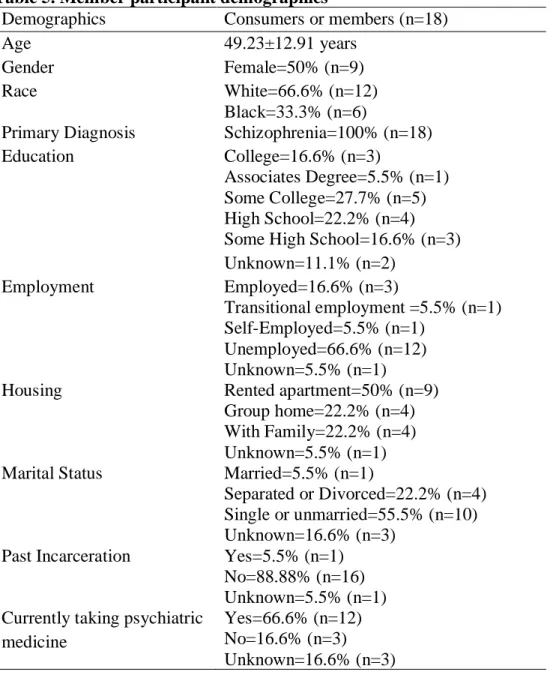
Table 2 - Member participant demographics.………..………..32
Table 3 - Overview of methods……….………34
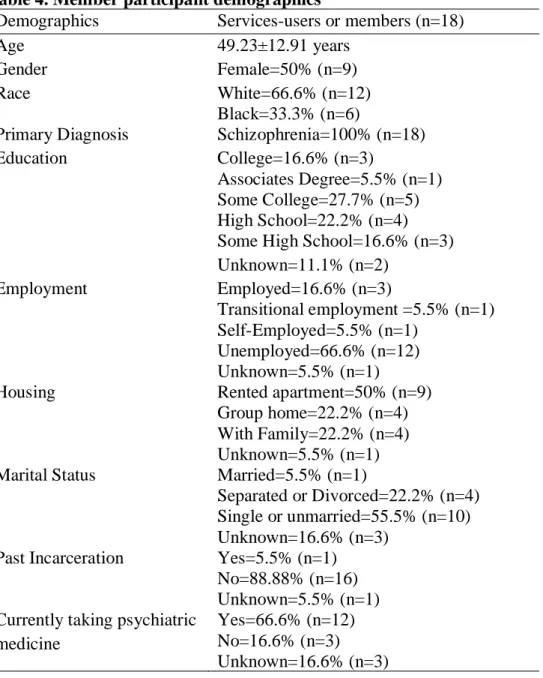
Table 4 - Member participant demographics.………..………..45
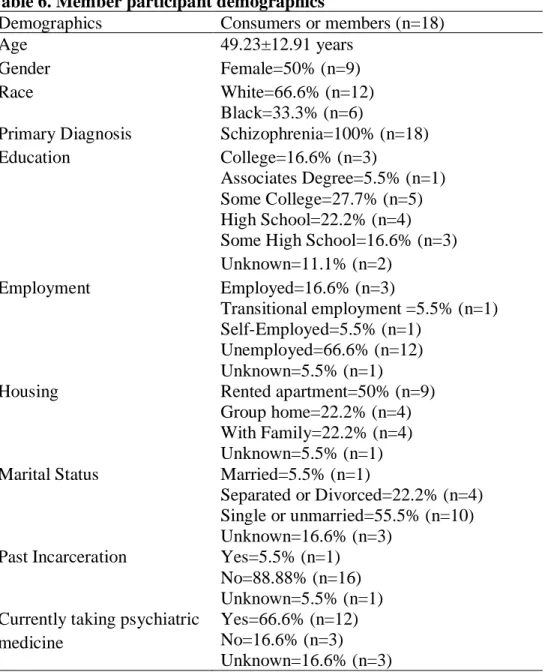
Table 5 - Member participant demographics.………..………..71
LIST OF FIGURES
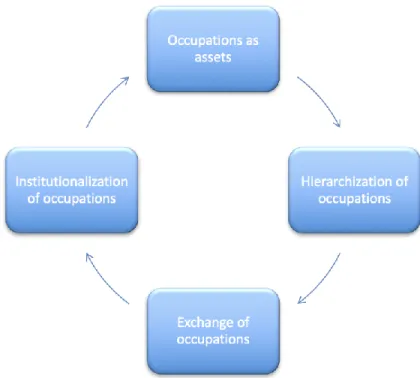
Figure 1 - Framework conceptualizing the moral economics of occupational engagement.…….47 Figure 2 - Relationship between social capital, agency, and occupations.………..……..61 Figure 3 - Framework conceptualizing relationship between stigma,
CHAPTER 1: BACKGROUND AND PRIMARY PURPOSE 1.1 Introduction
The primary purpose of this dissertation study was to identify the social processes guiding experiences of stigma and engagement in occupations1 (including community
participation and mental healthcare) for adults with serious mental illness2. This chapter briefly outlines the background for the study and describes the theoretical framework employed. This chapter also introduces the specific aims of the study. I conclude this chapter by briefly outlining the subject matter of the consequent chapters.
1.2 Background and Significance
The field of occupational science was brought into existence to study the construct of occupation and the processes related to occupational engagement and to generate evidence that provides theoretical support for the practice of occupational therapy (Clark et al., 1991; Yerxa, 1990). Since the field’s inception, occupational science scholars have vigorously studied, debated, and discussed a variety of aspects related to occupations and occupational engagement, such as the relevance of context on occupational engagement and the relevance of occupation in addressing issues of social justice (e.g., Bailliard, 2016; Dickie, Cutchin, & Humphry, 2006; Hammell & Beagan, 2017; Townsend & Wilcock, 2004). Numerous scholars have also provided their perspectives on what an occupation is and how it can be defined (Royeen, 2002). As the
________________________
1 Defined as participation in social acts, and thus, not conceptualized solely as engagement in employment.
field continues to grow, scholars have also critiqued conventional wisdom or taken for granted assumptions that are employed to study or examine occupations and occupational engagement (Hammell, 2009; Hocking, 2000; Laliberte Rudman et al., 2008). For example, scholars continue to critique the influence of Western-based knowledge on the study of occupations and
occupational engagement (Hammell, 2009; Hammell, 2014). The field is also brimming with sub-constructs related to occupation, such as occupational deprivation and co-occupation (Hammell & Beagan, 2017; Humphry & Thigpen-Beck, 1998; Pierce, 2009; Whiteford, 2000). While the field of occupational science is relatively nascent, it continues to grow and has a considerable knowledge base to defend its existence and maintain this growth. However, there are still numerous questions that are yet to be asked and numerous debates that are yet to be resolved.
Departing from the individualistic perspective on occupation, a transactional perspective provided guidance in steering occupational science towards a study of occupation and
occupational engagement, where the context and the individual are equally valued (Dickie et al., 2006). Scholars continue to highlight the influence of various contextual factors (such as
context, using the unit of occupation (Whiteford & Hocking, 2012). Further, the existing models or frameworks give limited guidance regarding various aspects of occupational engagement, such as agency related to occupational engagement and influence of social capital on
occupational engagement. Due to the lack of knowledge regarding social processes related to occupational engagement, there is inadequate evidence to address concerns related to
occupational engagement of various vulnerable populations, such as adults with serious mental illness.
Occupational science scholars continue to study mental illness and its influence on occupations, including the impact of stigma (Blank, Harries, & Reynolds, 2015; Eklund, Hermansson, & Hakansson, 2012; Lin, Kirsh, Polatajko, & Seto, 2009). Occupational science scholars have primarily explored the influence of stigma on occupational engagement and the use of occupations to manage stigma through identity work (e.g., Blank et al., 2015; Laliberte Rudman, 2002; Nagle, Cook, & Polatajko, 2002; Segal, Mandich, Polatajko, & Cook, 2002). For instance, Blank and colleagues (2015) found that adults with mental illness used occupations to construct their identities as productive members of society and to manage stigma. However, there is a lack of evidence regarding the social processes that dictate occupational engagement of adults with serious mental illness. Since much of the occupational science evidence regarding the experience of mental illness and the stigma is descriptive, effective strategies to address concerns related to occupational engagement, such as community participation, are difficult to devise for this population.
Sibitz et al., 2011; Thornicroft et al., 2009). There are around 10.4 million adults living with a serious mental illness in the United States (US), and many of them continue to experience challenges related to community participation, such as homelessness, unemployment, and/or incarceration (Luciano & Meara, 2014; Mechanic, Bilder, & McAlpine, 2002; SAMHSA, 2017; Torrey, Kennard, Eslinger, Lamb, & Pavle, 2010). Approximately, only 40% of adults with serious mental illness report being on full-time employment (Luciano & Meara, 2014; Mechanic et al., 2002). Concerns related to community participation are integral for this population since limited community participation deteriorates quality of life and can exacerbate psychiatric symptomatology (Burns-Lynch, Brusilovskiy, & Salzer, 2016; Kaplan, Salzer, & Brusilovskiy, 2012; Oliveira, Carvalho, & Esteves, 2015). It is important to note that challenges related to community participation are not solely related to psychiatric symptomatology as prevailing stigma significantly challenges community participation for adults with serious mental illness (Hinshaw & Stier, 2008; Pugh, Hatzenbuehler, & Link, 2015; Thornicroft et al., 2009). However, there is also a lack of evidence regarding the social processes that dictate experiences of stigma among adults with serious mental illness (Pescosolido & Martin, 2015; Thornicroft, Rose, Kassam, & Sartorius, 2007).
Evidence indicates that stigma involves ignorance, prejudice and discrimination towards a population that is deemed to have an undesirable attribute, such as a serious mental illness (Link & Phelan, 2001; Thornicroft et al., 2007). For example, prejudicial and stigmatizing
understandings of the social processes that guide experiences of stigma (Kleinman & Hall-Clifford, 2009; Thornicroft et al., 2007). Second, much of the stigma research has relied on survey research using a language of attributes (Pescosolido & Martin, 2015; Thornicroft et al., 2007). Due to an overreliance on surveys and a language of attributes, much of the research has ignored variability in adults who experience serious mental illness and the variability of stigma experiences on an individual level. Lastly, while scholars agree that there is a feedback loop between stigma at an individual and structural/institutional level, there is limited understanding regarding the social processes that maintain this feedback loop (Kleinman & Hall-Clifford, 2009; Pescosolido & Martin, 2015; Pugh et al., 2015; Thornicroft et al, 2007). Methodologically
diverse studies that include consumers’ perspectives to understand the social processes guiding experiences of stigma are urgently required. Thus, given the lack of evidence regarding the social processes related to occupational engagement and experiences of stigma, the primary objective of this study was to identify the social processes guiding experiences of stigma and occupational engagement (mental healthcare and community participation) for adults with serious mental illness.
1.3 Theoretical Framework
Since this dissertation is focused on the unit of occupational engagement, including community participation, it is important that I document my views regarding this unit. Using ideas regarding human action from Bourdieu (1998) and Cutchin and colleagues (2008), I
the occupation is primarily justified by its context of sharing food with others. Employing Bourdieu’s (1998) ideas and drawing on the work of Cutchin and colleagues (2008), I argue that occupational engagement or participation is guided via interaction between habitus and context. Bourdieu (1998) proposed that human action is shaped by one’s relative position in a social field, which can be defined as an arena of social interactions in which individuals develop or acquire their predispositions for action (or habitus). Per Bourdieu (1998), individuals compete for gains in social, economic, cultural, and symbolic capital in a social field. Capital in a social field can encompass a range of assets such as material assets (e.g., money) and cultural assets (e.g., academic credentials). In congruence with Bourdieu’s ideas, I do not view action as purely self-interested behavior because actions are not taken through unrestricted agency and context guides human behavior (Bourdieu, 1998; Cutchin et al., 2008; Nyman et al., 2013). Accordingly, humans are intricately related to their past experiences and relationships such that these form the rationales and the social context for human actions (Bourdieu, 1998; Cutchin et al., 2008).
In summary, I believe that occupational engagement is informed by past experiences as they form the rationalities that we employ, consciously and unconsciously, to undertake any act of participation or occupational engagement. Further, context (i.e., physical, cultural, historical, political) is an essential component for participation, as it guides an action, just like an individual does (Cutchin et al., 2008; Dickie et al., 2006). For example, an individual may not be able to cook for a potluck if there is no physical equipment, such as a cooking pot or stove, available. Similar to physical factors, a context also involves numerous social factors that affects human action, such as an individual’s socio-economic position and/or social network. For example, one would not be cooking for a potluck if s/he did not have a social network that allows participation in a potluck.
1.4 Research Aims and the Core Chapters
The primary objective of this study was to identify the social processes guiding experiences of stigma and occupational engagement (mental healthcare and community
participation) for adults with serious mental illness. In order to study the primary objective, three specific aims were undertaken: (1) identify consumers’ perspectives on and experiences with stigma towards mental illness; (2) explore how stigma interferes with consumers’ community participation, including engagement in mental healthcare, and (3) identify institutional factors that influence social interactions between consumers and service providers. Due to the
I have chosen to write this dissertation in a three-paper format. However, before
documenting the findings I will present literature review in Chapter 2 focusing on 1) the current state of and research gaps in occupational science and stigma research, and 2) the influence of stigma on community participation for adults with serious mental illness. In Chapter 3, I outline the methodology and analytic strategies employed for this study and describe the research sites and participants’ demographics.
The first chapter related to the findings, Chapter 4, will discuss the proposed moral economics of occupations framework, outlining a social process related to occupational
CHAPTER 2: LITERATURE REVIEW 2.1 Introduction
In the previous chapter, I briefly discussed the significance of this dissertation study. In this chapter, I provide a more detailed review of the existing evidence and highlight the research gaps relevant to the phenomena of interest, such as stigma towards mental illness and
occupational engagement. I begin this chapter by discussing stigma towards mental illness and its influence on community participation. I then provide a critique of the existing evidence regarding stigma towards mental illness. Next, I elaborate on the occupational science literature and highlight the limitations present in the study of occupational engagement. I conclude the chapter by highlighting the relevance of this study.
2.2 Stigma towards Individuals with Mental Illness
Stigma as a social phenomenon has been fervently studied for more than half a century and has been a subject of scientific inquiry for various human situations and conditions, such as bankruptcy and obesity (Pescosolido & Martin, 2015; Puhl & Brownell 2003; Sullivan, Warren, & Westbrook, 2006). One of the most studied areas in stigma research is stigma towards
of mental illness as a socially undesirable attribute, which leads to discrimination towards adults with mental illness (Link & Phelan, 2001; Thornicroft et al., 2007). Such prejudicial attitudes and discrimination negatively influence various aspects of community participation for adults with serious mental illness, such as social relationships and employment (Thornicroft et al., 2009).
2.2.1 Influence of Stigma on Community Participation
There is little doubt that humans are social/communal beings and that we maintain or improve our health and well-being via community participation3 (Axelrod, 1984; Herrmann, Call, Hernández-Lloreda, Hare, & Tomasello, 2007; House, Landis, & Umberson, 1988; Uchino, Cacioppo, & Kiecolt-Glaser, 1996). However, community participation continues to be a
concern for adults with serious mental illness. There are approximately 10.4 million adults living with a serious mental illness in the United States (U.S.) and many of them continue to experience barriers to community participation, such as homelessness, unemployment, and/or incarceration (Luciano & Meara, 2014; Substance Abuse and Mental Health Services Administration
[SAMHSA], 2017; Torrey et al., 2010; Housing & Urban Development, 2016). For example, in the US, there are three times as many adults with serious mental illness incarcerated in jails and prisons than receiving treatment in hospitals (Torrey et al., 2010). It is also estimated that in the U.S., 1 in 4 adults with serious mental illness are living below the poverty line (SAMHSA, 2016). Further, it is partly due to stigmatizing attitudes among employers that the high
unemployment rate among adults with serious mental illness is sustained, as employers are likely to discriminate against this population (Baldwin & Marcus, 2011; Luciano & Meara, 2014; Mechanic et al., 2002; Stuart, 2006). Further, internalized-stigma, that is internalization of public ________________________
stigma among psychiatric consumers, negatively influences community participation (Oliveira et al., 2016; Yanos, Roe, Markus, & Lysaker, 2008; Yanos et al., 2012). For example, internalized stigma increases active social avoidance, which in turn reduces community participation
(Oliveira et al, 2015; Yanos et al., 2008). Thus, due to the prevailing stigma, community participation is inevitably challenging for adults with serious mental illness.
Further, a lack of community participation adversely affects health and quality of life (QoL) outcomes for this population. The lack of adequate social relationships, support, and activities contributes to increased morbidity and mortality (Cacioppo & Cacioppo, 2014; Green et al., 2017; Liu et al., 2017). For example, living alone was found to be a significant predictor of mortality among adults with psychotic disorders (Keinänen et al., 2017). Lack of community participation also negatively influences psychiatric recovery (Burns-Lynch, Brusilovskiy, & Salzer, 2016; Kaplan, Salzer, & Brusilovskiy, 2012; Yanos et al., 2008). For instance: lack of engagement in employment and inadequate social relationships impedes psychiatric recovery (Burns-Lynch et al., 2016; Kaplan et al., 2012; Provencher, Gregg, Mead, & Mueser, 2002). Barriers to community participation are not solely related to psychiatric symptomatology. Prevailing stigma, both on an interactional and institutional level, contributes to challenges related to community participation (Link & Phelan, 2014; Thornicroft et al., 2009). 2.2.2 Limitations in Stigma Research
attributes and highlighting mental illness as an undesirable social attribute are remnants of Goffman’s (1963) ideas regarding stigma (Link & Phelan, 2001; Pescosolido & Martin, 2015; Thornicroft et al., 2007). However, while Goffman (1963) defined stigma using a language of attributes, he was clear that a language of relationships is ultimately required to understand the social processes related to stigma. Further, because it relies on a language of attributes related to mental illness, such as unpredictability and dangerousness, present stigma research is steeped with survey-based research examining stigma via attitudinal assessments (Pescosolido & Martin, 2015; Thornicroft et al., 2007). While survey methodology allows for assessing stigma via a language of attributes, an overreliance on surveys limits understandings of social processes related to stigma and yields evidence that is derived via methodologically non-diverse studies (Kleinman & Hall-Clifford, 2009; Thornicroft et al., 2007). Additionally, very few survey studies employ safeguards against or account for social desirability within participant responses while assessing stigma, thereby leaving findings vulnerable to flawed estimations of stigma and preserving conceptual limitations (Corrigan, Bink, Fokuo, & Schmidt, 2015; Fowler, 2013; Pescosolido & Martin, 2015; Thornicroft et al., 2007). Another limitation plaguing stigma research is a lack of perspectives regarding stigma from mental healthcare consumers, which further limits evidence related to experiences of stigma (Pescosolido & Martin, 2015;
2016). Further, existing interventions addressing stigma such as psychoeducation and contact strategies are limited in their long-term influence on reducing stigma (Mehta et al., 2015). Thus, methodologically diverse studies of stigma are required to adequately include consumers’ perspectives to better understand the social processes guiding experiences of stigma.
Further, due to an inadequate understanding of stigma, there are also limitations that impede addressing stigma at a structural or policy level. Various scholars have provided theoretical or conceptual frameworks connecting structural- and individual-level stigma (e.g., Pescosolido, Martin, Lang, & Olafsdottir, 2008), and there is agreement among scholars that a feedback loop between stigma at an individual- and structural-level exists (Corrigan, Markowitz, & Watson, 2004; Link & Phelan, 2001; Link & Phelan, 2014; Pescosolido et al, 2008;
Thornicroft et al., 2007). However, there is a lack of clarity on operationalizing structural stigma in order to understand and examine the social processes and tools (such as policies) that sustain it (Pescosolido & Martin, 2015; Pugh et al., 2015). There is also a lack of research that explicitly analyzes mental healthcare policy from the standpoint of stigma towards mental illness
maintain structural stigma in the arena of mental healthcare policy, which can limit community participation for adults with serious mental illness.
2.3 Occupational Science and Stigma
Occupational science scholars continue to study mental illness and its influence on occupations, including the impact of stigma (Blank, Harries, & Reynolds, 2015; Eklund, Hermansson, & Hakansson, 2012; Lin, Kirsh, Polatajko, & Seto, 2009). Research within occupational science has demonstrated that stigma is a barrier to occupational engagement among mental healthcare consumers (Nagle, Cook, & Polatajko, 2002; Segal, Mandich,
Polatajko, & Cook, 2002). For example, Sakiyama and colleagues (2010) found that adults with mental illness report difficulties in occupations engagement partly due to the prevailing stigma. Similar to Goffman’s work on stigma, occupational science scholars have also studied stigma in relation to identity construction and management (Blank et al., 2015; Laliberte-Rudman, 2002). For example, Blank and colleagues (2015) found that adults with mental illness managed stigma by engaging in vocational occupations to construct their personal and social identities as
productive members of society. However, in the occupational science literature, stigma has rarely been explored as a focal aspect of the lived experience of adults with serious mental illness. For instance: while Sakiyama and colleagues (2010) described community participation among consumers, they only briefly mentioned the negative influence of stigma on their
occupations.
Limited scientific understandings of stigma through an occupational lens also refrains from understanding stigma as a sociological force influencing the life experiences and
marginalization/discrimination of populations that are often deemed as social deviants is critical in expanding the role of occupational justice4 in larger scholarly arenas. The lack of occupational science scholarship on stigma has also limited understanding of how stigma changes human behavior in various contexts. For instance, public health strategists have harnessed stigma as a tool to change behaviors related to smoking (Bell, Salmon, Bowers, Bell, & McCollough, 2010). Occupational science, due to its limited study of stigma, has an inadequate understanding of how stigma influences human occupations, actions, and conditions. Such evidence can propel
understandings of occupation itself as occupational science scholars continue to illustrate the influence of social and contextual forces in influencing occupational engagement and the injustices related to occupational engagement.
2.3.1 Critiquing Occupational Science
A significant portion of occupational science scholarship focuses on understanding the construct of occupation (Clark et al., 1991; Hocking, 2009). Initially occupations were studied through an emphasis on individualistic perspective; currently, however, there is wider agreement that occupations are not individualistic and that context or environment guides occupational engagement, similar to individual actions (Cutchin et al., 2008; Dickie et al., 2006; Morris & Cox, 2017; Royeen, 2002). Further, as scholars continue to debate regarding occupational engagement, the field is brimming with sub-constructs related to occupation, carrying over various assumptions about occupations and/or occupational engagement (Hammell & Beagan, 2017). For example, multiple sub-constructs related to occupational injustice exist, such as occupational imbalance and occupational alienation; however, these concepts carry forward various assumptions, such as Western neoliberal expectations for occupational engagement or ________________________
participation, regarding the construct of occupation, and there is a lack of empirical evidence regarding the conclusive definitions and influences of these sub-constructs (Durocher, Rappolt, & Gibson, 2014; Hammell & Beagan, 2017).
Further, various occupational science scholars have promoted the idea that occupations exist within value systems that guide occupational engagement (Angell, 2012; Laliberte Rudman, 2012; Nyman et al., 2014; Persson, Erlandsson, Eklund, & Iwarsson 2001). As occupations are situated within a socio-cultural context, occupations inevitably exist within a value system that maintains the hierarchical and situated nature of occupations (Angell, 2012; Galvaan, 2015; Laliberte Rudman & Huot, 2013; Madsen & Jossephson, 2017; Prodinger, Laliberte Rudman, & Shaw, 2015; Ramugondo & Kronenberg, 2015). However, despite these advances in understanding the hierarchical and situated nature of occupations, there is a paucity of evidence to better understand the social processes that explain the situatedness of occupations and its role in maintaining social hierarchies (Prodinger et al., 2015; Whiteford & Hocking, 2012).
In occupational science, an ultimate goal for examining the power relationships and situatedness of occupations is to address concerns of occupational justice or injustice and change institutional policies/practices and to improve the lives of those experiencing marginalization and discrimination (Hammell & Beagan, 2017; Laliberte Rudman & Forwell, 2013; Pereira, 2014; Urbanowski, Shaw, & Chemmuttut, 2013). Scholars have highlighted the influence of various factors, such as governmental practices, on maintaining injustices related to occupational
Hocking & Whiteford, 2012). It is unlikely that issues related to the occupational engagement of marginalized populations can be effectively addressed if we, as occupational science scholars, do not understand the social processes that allow sustenance of occupations as vehicles for both sustaining and dismantling social discrimination and marginalization (Angell, 2012; Bailliard, 2016; Hammell & Beagan, 2017). For example, in order to address discriminatory employment practices against adults with mental illness, one has to understand the social process guiding the occupational engagement for a potential employee who is discriminated/stigmatized because of his/her serious mental illness, and an employer who believes that an individual with serious mental illness cannot successfully participate in an advertised occupation (Baldwin & Marcus, 2011). Thus, the disconnect between the aspirations of occupational science scholars and the inadequate availability of evidence for scholars to fulfill those aspirations limits the reach of occupational science to critically examine the unit of occupation and go beyond its own disciplinary boundaries.
2.4 Conclusion
CHAPTER 3: METHODS 3.1 Introduction
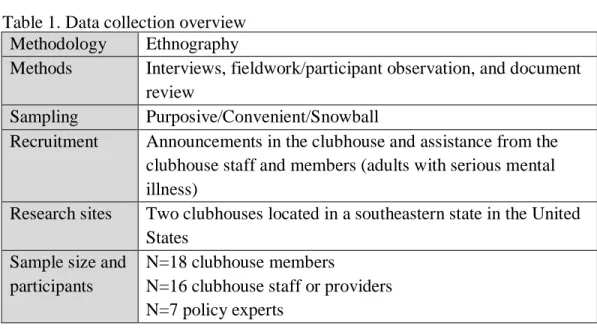
In this chapter, I will elaborate on the methodology and the methods that I employed to collect and analyze data for this study. I will begin with my rationale for employing ethnography as the methodology for this study and then describe the methods used for data collection (Table 1). Later, I will elaborate on the research sites and the participants included in the study. I will conclude the chapter by describing the data analysis strategies used for this study.
Table 1. Data collection overview Methodology Ethnography
Methods Interviews, fieldwork/participant observation, and document review
Sampling Purposive/Convenient/Snowball
Recruitment Announcements in the clubhouse and assistance from the clubhouse staff and members (adults with serious mental illness)
Research sites Two clubhouses located in a southeastern state in the United States
Sample size and participants
N=18 clubhouse members
N=16 clubhouse staff or providers N=7 policy experts
3.2 Ethnography
Scholars in anthropology and sociology are credited for the emergence of ethnography as a research methodology (Adler & Adler, 1987). Stemming from qualitative research,
Snow, Morrill, & Anderson, 2003). As a methodology, ethnography is an exploration of
everyday behaviors, interactions, relationships, and ways of living of a group, to understand the social processes that undergird a phenomenon, a culture, or an institution (e.g., participation in a clubhouse as a culture) (Adler & Adler, 1987; Creswell, 1998; Snow et al., 2003; Willis & Trondman, 2005). Conducting an ethnography requires gathering perspectives from individuals who are intimately involved or connected with the phenomenon of interest and collecting information on their everyday experiences via observations (Creswell, 1998; Snow et al., 2003). Thus, as the primary objective of this dissertation was to explore the social processes guiding experiences of stigma and its influence on occupational engagement by gathering participants’ perspectives, ethnography was chosen as the methodology for this study.
During early ethnographic works, scholars used this methodology to explore experiences of cultural groups that were either not in the vicinity of or occupied a non-normative locale in contemporary Western society (Becker, 1967; Katz, 1997). Many of the early ethnographic texts explored lived experiences of groups that were labeled as social deviants, such as marijuana users (Becker, 1963). Ethnography has also been used to examine the context and actions of others that help sustain the social systems/processes perpetuating discrimination and
marginalization of groups labeled as social deviants (Adler & Adler, 2007; Katz, 1997; Sercu & Bracke, 2016). Thus, ethnography allows a researcher to uncover both the social rules of
(Baumann, 2007; Corrigan, Edwards, Green, Diwan, & Penn, 2001; Link & Phelan, 2001; Link & Phelan, 2014).
Besides studying the situatedness or experiences of non-normative groups and behaviors, other reasons to conduct ethnography include: studying historically emergent social phenomena (e.g., stigma and mental healthcare), the need to elicit narratives from social groups (e.g., the perspectives of psychiatric service users on stigma and occupational engagement), and exploring the influence of or recommendations for policy (e.g., exploring influence of policies on
community and mental healthcare engagement)5 (Katz, 1997). I chose to employ ethnography, as the aforementioned aims of this methodology fit well with the primary purpose and aims of this research.
Ethnography also provides a researcher an opportunity to analyze the data in ways that are beyond descriptive. As I argued in the previous chapter, the theoretical limitations that scar contemporary enquiries regarding stigma (such as the lack of mental healthcare consumers’ perspectives regarding social processes that guide their experiences of stigma) required an understanding of stigma that could address those theoretical limitations. Ethnography allows for data to be interpreted in a way that can help in theory development and/or refinement (Snow et al., 2003). Through engaged fieldwork, in-depth interviews, document reviews, and other
methods, ethnography provides an opportunity for an interpretive account that allows unearthing social processes that exist in the data collection field (Daly, 1997; Snow et al., 2003). For
instance, Goffman’s (1961) “Asylums: Essays on the social situation of mental patients and other inmates” or Becker’s (1963) “Outsiders: Studies in the sociology of deviance” are ethnographies
that put forth ideas that continue to undergird the contemporary research on social deviance. ________________________
Like any other methodology, ethnography has limitations. Ethnography does not allow for hypothesis testing, quantitative predictions or the generalization of findings (Daly, 2007; Denzin & Lincoln, 1994). Ethnography relies on how a researcher understands a phenomenon based on his or her observation. This study involved two clubhouses and one researcher. Therefore, there were certainly sets of events that were missed, which may have altered the course of the research. To account for such limitation, I ended data collection when similar perspectives started to emerge from interviews and participation observation on a regular basis; that is, when data saturation was reached (Fusch & Ness, 2015).
3.3 Ethnographic Access
One of the challenging aspects of an ethnography is to gain entry into the ethnographic field or the culture or institution that a researcher intends to explore. My fieldwork took place at two clubhouses6 (psychosocial rehabilitation model) in North Carolina: Clubhouse Journey and Clubhouse Odyssey (pseudonyms). I had been a volunteer/research student at Journey for around 18 months before I formally began my dissertation data collection there. My first entry at
Journey was in January 2015, through an independent study course regarding stigma towards mental illness. Via the course fieldwork at Journey, I gathered knowledge that helped me critique the contemporary stigma research and rationalize a dissertation project with the purpose of examining social processes related to stigma experiences. Further, due to my past participation at Journey, I had established enough social relationships that my entry as a doctoral research
student was rarely problematic. Further, advantages of past experience at Journey were not limited to engagement at this site only.
As I was familiar with the culture of the clubhouse model via my participation at Clubhouse Journey, interacting with members and staff at Clubhouse Odyssey was rarely challenging. While I acknowledge that the two clubhouses are different in various aspects (such as architecture/social geography), it was helpful that both operated with similar practices that are consistent with the clubhouse model. Further, recruiting and establishing rapport with staff personnel at both the clubhouses was rarely challenging as the staff were interested to be part of the study. Many staff agreed to participate in the study as they hoped to better understand stigma and strategies to address it so that they can further enhance member participation at the
clubhouses and in the nearby communities. Further, I often framed my role as a learner trying to understand stigma towards mental illness and occupational engagement, instead of a researcher who is there to extract data. Adapting the stance of a learner helped establish a rapport with the staff and members alike.
3.4 Reflexivity
which helped in participant recruitment, as the answer led to discussions regarding this study. There were also multiple times when my accent was a hurdle for communication. However, the participants (members and staff) and I felt comfortable in asking clarifying questions.
There were also times when my color or the immigrant status became a proxy for cultural inferiority. For example, a member once asked me if Indian “culture is civilized and has
electricity.” I smiled and informed him about India and Delhi - the city where I grew up. Later in my fieldwork, the same member informed me about his perspectives on psychiatric
hospitalizations. Thus, even moments of conflict arising via ill-informed perspectives, which were far outweighed by genuine curiosity among participants, led to the development of fruitful and pleasant relationships.
Further, being different was also an advantage that, ironically, helped me to blend in. More than once during my fieldwork, I was mistaken as a member or asked “are you a member?” For example, more than once, a member, who routinely manages the reception desk of
Clubhouse Odyssey, gave me the member sign-in sheet to document my entry. Such instances, again, led to conversations regarding the dissertation study and assisted in establishing
relationships and participant recruitment.
I did not have any difficulties in establishing relationships with staff. As I would come to find later, staff care deeply about members. Staff at both clubhouses were very supportive of this dissertation project and almost every staff that I approached for recruitment agreed to participate. 3.4.1 Thinking about Stigma
degree. Prior to entering the doctoral program, I had rarely read research regarding stigma. During the beginning of my doctoral studies, my interest in stigma was to explore the
construction and implication of the stigmatizer-stigmatized relationship. However, this initial focus led me to mistakenly categorize a heterogeneous population of identities and behaviors under the homogenous labels of stigmatized and stigmatizer. With this erroneous perspective, everyone with a psychiatric label became a stigmatized person who needed advocacy while others became stigmatizers whose prejudices needed to be exposed. Consequently, I came to see the implications of stigma as a situation of conflict that needed to be successfully mediated. Later in the course of my degree, I discovered the limitations of my assumptions and biases through an independent course regarding stigma towards mental illness.
During the independent study/course, I volunteered/interned at Clubhouse Journey for approximately 8 months in 2015. Through my experiences at the clubhouse I discovered my assumptions/biases regarding the overly simplistic notion of the stigmatizer-stigmatized
3.5 Research Sites
Two clubhouses, Journey and Odyssey (pseudonyms), were chosen as data collection sites. Due to my previous research engagement and the dissertation’s focus on assessing stigma and community participation or occupations, the clubhouse model was chosen as a logical and pragmatic research site.
The study was approved by the Institution Review Board at University of North Carolina-Chapel Hill (IRB#16-2920).
3.5.1 The Clubhouse model
Clubhouses are non-profit psychosocial rehabilitation settings organized to support adults with serious mental illness, referred to as members. Members spend the daytime at the clubhouse and work with staff as colleagues to undertake tasks, such as preparing food and writing grants to sustain the clubhouse (Corcoran, 2013). Various support services, such as transitional
employment and opportunities to complete formal education, are provided at a clubhouse. Although clubhouses do not provide any formal healthcare services, staff does assist members in accessing healthcare services by providing transportation or establishing contacts with healthcare professionals. The model is included in the Substance Abuse and Mental Health Services
Administration’s registry for Evidence-Based Practices (SAMHSA, 2015).
(Vorspan, 2004, p. 2). In the next section I provide some detailed information of the clubhouses where I undertook my observations.
3.5.2 Clubhouse Odyssey
Clubhouse Odyssey is located in Carmon county (pseudonym) of North Carolina.
National estimates suggest that, as of 2015, Carmon county has a population of around 290,0007. Slightly more than half of Carmon county residents identify as White, while around one-third identify as Black or African-American, and the rest identify as Hispanic or Latino, or Asian (United States Census, 2015). Around 20% (national average at 14.7%) of individuals live below the poverty line in the county (United States Census, 2015). A Point-in-Time count survey in Carmon county revealed that around 15% of the adults experiencing homelessness reported experiencing serious mental illness (North Carolina Coalition to End Homelessness [NCCEH], 2015).
Unlike Journey, Odyssey is located in a low-income neighborhood. During my walks around the clubhouse neighborhood, it was not uncommon to see broken bottles on the sidewalk, houses with broken windows, cars with cardboards as windows, and caged dogs in backyards. During one of my walks, a member told me that he feels safer when somebody is walking with him during organized afternoon clubhouse walks.
Clubhouse Odyssey is situated in an old church building and has a hallway connecting all rooms, with a big meeting/dining room at the end of the hallway. Odyssey is bigger in size than Journey and that size difference did contribute to differences in usual routines of both staff and members at the two clubhouses. Odyssey has five units: culinary, snack bar, membership, transitional employment and education, and administration. There is a kitchen and a snack bar in ________________________
the clubhouse along with a library room and the great room (meeting space). The clubhouse also has a small garden and a back porch, where members are allowed to smoke. There is also an administrative unit room where many members “hang out” with other members and staff or use computers.
3.5.3 Clubhouse Journey
Clubhouse Journey is a clubhouse located in Woodward county (pseudonym) of North Carolina. National estimates suggest that, as of 2015, Woodward county has a total population of around 140,000. The majority (approximately 75%) of Woodward residents identify as White while rest of the residents identify as Black or African-American, Hispanic or Latino, or Asian (United States Census, 2015). In 2015, around 15% of individuals reported living below poverty line (national average was 14.7%). A Point-in-Time count survey in Woodward county revealed that around 30% of adults experiencing homelessness in the county reported having serious mental illness (NCCEH, 2015).
There are two buildings that comprise Clubhouse Journey. The main building houses the kitchen, membership unit, a small snack bar and a small meeting room while the other building houses a thrift store and the administrative unit. Members work in different units throughout their work-order day, such as the thrift store, the kitchen, or the administrative unit. Unlike Clubhouse Odyssey, Clubhouse Journey is situated in an economically thriving community. There are numerous public parks and shopping complexes including a community-owned natural foods grocery store nearby.
restaurants, coffee houses, and other shops, providing accessible avenues for shopping and transitional employment for members. The clubhouses also have vans that are used to assist members in transportation. The clubhouses are primarily funded via Medicaid billing that is disbursed through managed care organizations (MCOs). Accurate data regarding the overall incidence of serious mental illness was not available for either counties.
3.5.4 Work-Ordered Day at Journey and Odyssey
responsibilities (simultaneously writing multiple grants etc.). Both clubhouses would serve lunch around noon. Members and staff in the culinary unit would work together to cook and distribute meals to other members and staff. Clubhouse Odyssey holds a house meeting, which usually lasts for around 10-15 minutes, every day after lunch. However, a house meeting is held once a week at Clubhouse Journey and lasts for around 60-90 minutes. House meetings are held to discuss any crucial updates or pressing issues. For instance, one of the house meetings I attended at Journey was held to discuss renovation plans for the clubhouse space. After house meetings, members and staff return to their tasks. Around 4:30 pm, staff close the premises at Odyssey, unless a member is waiting for a ride back home. Journey closes its premises around 5pm; however, its thrift shop is open until 6pm on weekdays.
Most members and staff had their usual routines that they generally followed. Staff worked in their assigned units, unless there was a staff shortage during which a staff personnel would help manage more than one unit. Similar to staff, members also participated regularly in their preferred unit. For example, during the study period, Nolan (member) came regularly to the clubhouse around 1pm and mostly helped staff in maintaining records in the administrative unit. Routines changed primarily when there was an unusual activity in the clubhouses, such as painting the walls of a unit or being visited by an accreditation agency.
3.6 Participants
For members, demographic data were collected either during the interviews via a demographic questionnaire or by accessing the mental healthcare records, after receiving participant consent. However, one member participant did not provide consent for accessing healthcare records, and thus, information related to that participant is unknown. Further,
healthcare records did not always have the updated information about a few members so specific demographic information, such as current medication, for some members is unknown. Staff participants’ demographic data were collected during the interview through the demographic questionnaire.
3.6.1 Member Participants
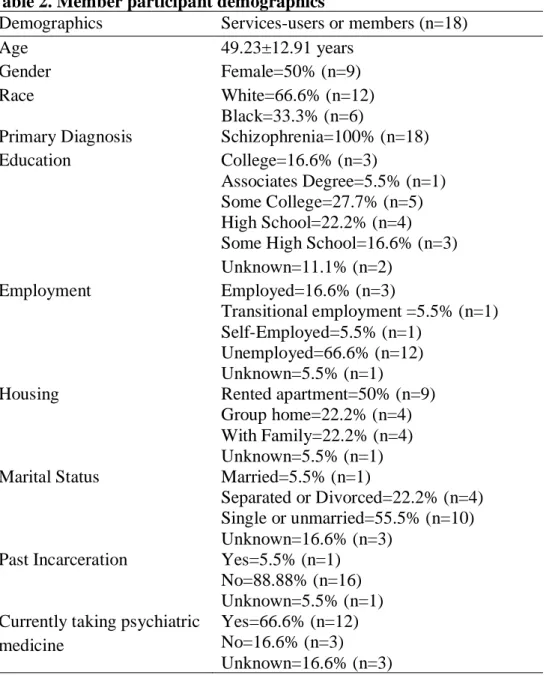
Members or adults with serious mental illness were recruited via purposive sampling (without stratification) as perspectives from consumers with specific characteristics were needed. The eligibility criteria included: 1) age more than 18 years; 2) diagnosis of a serious mental illness; and 3) ability to communicate in English. To avoid potential confounders of stigma, individuals who reported utilizing treatment for substance abuse and developmental disorders were not recruited. Eighteen members participated in the study (n=9 from each clubhouse). Informed consent was obtained from each participant (Appendix A). All but one member
divorced. All but three participants were taking some kind of psychiatric medication. Twelve participants identified as Caucasian and six as African-American or black. During the study period, most member-participants engaged almost daily at their respective clubhouses and others participated around 2 days/week.
Regarding demographic differences between the clubhouses, a majority of the
participants from Odyssey identified as African-American (n=5, 55.5%); however, a majority of the participants from Journey identified as Caucasians (n=8, 88.8%) and only one identified as African-American. Further, a majority of the participants from Odyssey identified as female (n=6, 66.6%); however, a majority of the participants from Journey identified as male (n=7, 77.7%). Participants also differed on the basis of housing situation as a majority of the
participants in Journey reported living in a rented apartment (n=7, 77.7%) while a majority of the participants in Odyssey reported living in a group home (n=4, 44.4%). Participants from Journey also reported having more education as a majority of the participants reported gaining some college experience or having a college degree (n=6, 66.6%) while no participant from Odyssey reported gaining any college experience. The samples did not differ on other demographic indictors.
3.6.2 Staff Participants
participants identifying as male. Most staff participants (n=12) identified as Caucasians while three participants identified as African-American and one as Iranian-American. On average, the staff had been working in their respective clubhouse for around 5 years. Educationally, while few staff (n=5) reported having an undergraduate degree, most staff personnel had graduate degrees in social work or other healthcare related fields.
Table 2. Member participant demographics
Demographics Services-users or members (n=18)
Age 49.23±12.91 years
Gender Female=50% (n=9)
Race White=66.6% (n=12)
Black=33.3% (n=6)
Primary Diagnosis Schizophrenia=100% (n=18)
Education College=16.6% (n=3)
Associates Degree=5.5% (n=1) Some College=27.7% (n=5) High School=22.2% (n=4) Some High School=16.6% (n=3) Unknown=11.1% (n=2)
Employment Employed=16.6% (n=3)
Transitional employment =5.5% (n=1) Self-Employed=5.5% (n=1)
Unemployed=66.6% (n=12) Unknown=5.5% (n=1)
Housing Rented apartment=50% (n=9)
Group home=22.2% (n=4) With Family=22.2% (n=4) Unknown=5.5% (n=1) Marital Status Married=5.5% (n=1)
Separated or Divorced=22.2% (n=4) Single or unmarried=55.5% (n=10) Unknown=16.6% (n=3)
Past Incarceration Yes=5.5% (n=1) No=88.88% (n=16) Unknown=5.5% (n=1) Currently taking psychiatric
medicine
3.6.3 Policy Experts
Policy experts were recruited via convenient and snowball sampling strategies. For instance, a policy expert was recruited after a member introduced us during a fieldwork day and another was recruited based on a policy expert’s suggestion. I interviewed seven policy experts for this study. Experts interviewed for the study included a state legislator, a former director of a county mental healthcare system, two mental health law experts, a clubhouse board member, a mental health consumer engaged in policy, and an official examining the state’s mental
healthcare system. I have not included demographic characteristics for policy experts since the information is not essential and presenting that information could compromise confidentiality. 3.7 Methods
Ethnographic methods involve extensive contact with participants, immersion in the context where the phenomenon of interest is manifest, and recording perspectives from participants (Snow et al, 2003; Willis & Trondman, 2000). Methods employed for this study were semi-structured interviews, participant observations, and document reviews (Table 3). In addition, I used the Community Participation Measure to collect data on the community participation of clubhouse members (Salzer, Brusilovskiy, Pruv-Bettger, & Kottsieper, 2014). 3.7.1 Semi-structured Interviews
Interviews, as a distinct method, first surfaced in social science research through survey methodology, where interviewees were asked to respond to questions by either choosing an option from a set of responses or providing their views on the questions posed (Fontana & Frey, 2000). However, departing from the question-response conceptualization, interviews are now considered as co-constructed and negotiated textual discourses between interviewers and
reflections on past experiences, opinions, and emotions about a topic of interest while providing a researcher the ability to ask queries related to a research question (Mack, Woodsong,
MacQueen, Guest, & Namey, 2005).
Semi-structured interviews allowed me to ask participants questions that were directly related to my research aims while providing participants the opportunity to expand on issues they wished to communicate. Semi-structured interviews also allowed me to add additional questions based on an interviewee’s responses, a technique called probing (Bernard, 2006).
Table 3. Overview of methods
Methods Participants
included Activities/Context Included Specific aim addressed Participant interviews Semi-structured Interviews
M + S Scheduled interviews at a participant’s preferred location or clubhouse
1,2,3
Semi-Structured Interviews
PE Participant’s preferred location
3 Survey
Measurement
M At the end of interview 2 Fieldwork
and
participant observation
Field notes M + S Observations of and participation in
activities with recruited participants at the clubhouse and in community 1,2,3 Document Review Document Review
None Review of documents related to mental
healthcare planning and implementation at the clubhouse
3
M=Members; S= Staff; PE=Policy experts
engagement of the members (such as mental healthcare policies). I also conducted interviews with mental healthcare policy experts to gather their perspectives on stigma and mental healthcare policies.
I used an interview guide (Appendix C) to conduct the interviews. Interviews were audio-recorded with permission from the interviewees and were conducted at a clubhouse, local public library or at a site preferred by a participant. Interviews lasted an hour on average (range=35-113 minutes). I transcribed all the interviews verbatim.
Community participation measure. I used the Community Participation Measure (Salzer et al., 2014) to measure community participation among the members. The purpose of this measure is to assess the community participation of adults with serious mental illness outside the context of healthcare. The scale has acceptable reliability and has been validated (Salzer et al., 2014). The measure was administered after each interview with a member. This measure also served as a probe to generate additional questions about community participation during an interview. For example, while the measure does not ask questions regarding factors influencing one’s community participation, I enquired about factors influencing specific aspects of
community participation, such as advocacy, to gain additional information. 3.7.2 Fieldwork and Participant Observation
Fieldwork allowed me to observe participants’ experiences at the clubhouses firsthand. I engaged in social activities with study participants (members and staff) to explore my research questions. I participated in the daily routines of the clubhouses and in various special events. For example, two of my fieldwork observations included participation in a clubhouse social at a bowling alley and a policy-focused meeting with local county commissioners that I attended with members and staff. My fieldwork typically included working on various tasks with staff and members, such as helping to cook a meal, writing grants, and guiding unit meetings with a member. My participation also included a significant portion of “hanging out” with members and staff such as talking with members in the smoking area, going out for lunch with members, or talking with staff while driving to a meeting. Participation in such activities helped me to contextualize the occupational engagement of participants by being in the context. Unlike interviews, this allowed me to construct explanatory arguments regarding some of the findings that are discussed later.
In addition, I also engaged in opportunistic interviews during participant observations in the community and at the clubhouses. Such interviews helped me explore immediate or current events, which I deemed important for the research investigation. These interviews were usually not audio-recorded, so I recorded my observations in fieldnotes. There were a few instances when an opportunistic interview was audio-recorded, after obtaining participant consent. For instance: one interview was conducted with a member to gather his perspectives on a recent clubhouse tour.
24-48 hours after the end of every visit. In addition to my observations, I also documented my thoughts and reflections in the field notes. In order to bypass the limitation of memory, I also took brief notes during fieldwork observations. Writing field notes also generated questions that I subsequently asked during interviews. Since field notes are inevitably biased towards research questions and researcher interests, the field notes I generated for this study were focused on aspects related to the primary research objective and specific aims (Clifford, 1990).
3.7.3 Document Reviews
Document review is a systematic procedure to analyze documents that are pertinent to a research question (Bowen, 2009). After obtaining consent from members, I accessed members’ mental healthcare records and clubhouse intervention notes, such as weekly notes that document members’ weekly psychosocial progress. I collected this data to understand the tools, including policies, that shape member and staff interactions and relationships. The documents also helped me understand the context of the mental healthcare system in the state. For example, Nolan (member, pseudonym) was confused and frustrated when he found out that he could not access his own psychiatric care plan unless he had authorization from his service-provider. Nolan questioned the basis of such policies/strategies and shared that such practices allow stigma to function on a larger level as consumers are not considered fit to access even their own
psychiatric records.
1978). Thus, this practice helped me to increase the trustworthiness of my findings (Bowen, 2009).
3.8 Data Analysis
Data collection and analysis are overlapping processes in a qualitative inquiry (Sandelowski, 1995). During data collection, a researcher is simultaneously immersed in
exploring and understanding a phenomenon, which subsequently influences future observations, interview probes, and data analyses (Becker, 1998). Repeated iterations of data collection and analysis in qualitative enquiry help a researcher untangle the complexity of a phenomenon. I engaged in such an iterative process of data collection and analysis. For example, analysis of state policy documents during the early phases of the study helped generate questions for policy experts’ interviews conducted later in the study. Further, transcribing interviews during data collection aided in preliminary data analysis, which helped inform subsequent interviews.
of open coding, which led to the generation of 4 primary codes and 17 secondary codes (Appendix E).
After employing open coding, I used focused coding to bring together identified
groupings of codes based on the relationships between them (Corbin & Strauss, 2008; Starks & Trinidad, 2007; Saldaña, 2015). Thus, focused coding involved identifying patterns or processes among the coded sets, using a second level of inductive analysis. For example, focused coding allowed connecting challenges experienced by staff to engage members with economic struggles to maintain a clubhouse, which are, partly, due to lack of effective mental healthcare policies.
Open and focused coding primarily entailed a descriptive strategy to analyze data. During coding, I did not provide explanations regarding why or how the phenomenon presented itself in the way it did. Therefore, in accordance with the primary purpose of exploring the social
processes guiding experiences of stigma and occupational engagement, I interpreted the collected data. Qualitative data interpretation is the process during which a researcher provides his or her understanding or account of the data and potential explanations regarding the phenomenon being studied (Peshkin, 2000).
existing knowledge. This interpretive approach to data analysis led to the generation of models, concepts, and principles that I present in the following chapters.
Finally, the Community Participation Measure (Salzer et al., 2014) scores were analyzed using descriptive statistics (e.g., frequencies and item means). However, statistical findings from the measurement are not reported, as a small sample size limits reporting statistically significant findings and no statistical strategy was employed to account for the small sample size.
3.9 Conclusion
This chapter described the methodology and the methods employed to collect and analyze data for this study. This chapter also provided details regarding the research sites and the
participants recruited for the study. I also elaborated on my role and biases as a student
CHAPTER 4: UNDERSTANDING THE MORAL ECONOMICS OF OCCUPATIONAL ENGAGEMENT
4.1 Introduction
A significant portion of occupational science scholarship aims to understand why humans do what they do and how occupations are related to health (Clark et al., 1991; Hocking, 2009; Yerxa, 1993). Occupational science scholars agree that humans are occupational beings and that occupations are integral to sustain life as a human (Wilcock, 2006). However, assumptions related to conceptualizations of occupations continue to be challenged. For example, the concept of occupational imbalance proposes that an imbalance in one’s daily routine is detrimental to human health; additionally, different types of occupations can be used to shift one’s occupational balance towards desired health outcomes (Townsend & Wilcock, 2004). However, these
assumptions have been challenged and occupational engagement is not conceptualized simply as participation in a structured routine revolving around normative expectations of healthy behavior (Anaby, Jarus, Backman, & Zumbo, 2010; Hammell, 2009; Hammell & Beagan, 2017). In order to better understand the relevance of occupations for human health, occupational science
scholars must better understand the unit of occupation and the social processes that underlie occupational engagement8.
Occupations were initially conceptualized through an individualistic perspective;
however, now there is a wide agreement that occupations are not entirely individualistic and are
________________________
inextricable from social context (Clark et al., 1991; Cutchin et al., 2008; Dickie, Cutchin, & Humphry, 2006; Morris & Cox, 2017; Royeen, 2002). Regarding social context, it is advocated that occupations exist within value9 systems that guide occupational engagement (Angell, 2012; Laliberte Rudman, 2012; Nyman, Josephsson, & Isaksson, 2014; Prodinger, Laliberte Rudman, & Shaw, 2015). However, given the complex nature of occupational engagement, occupations are rarely conceptualized as tangible assets existing within a value system, having
socio-economic value. For example, the occupations that a “good” mother can or should do have been considered as non-economic responsibilities for women; however, the occupational engagement of a mother has a significant economic and social value (Christopher, 2012; Duncan & Edwards, 1997; Primeau, 2000; Waring, 2017). Thus, despite the abstract formulations of occupations, occupations do have tangible socio-economic values and are integral for positioning individuals in social spaces.
Regarding social space, occupational science scholars have highlighted the hierarchical and situated nature of occupational engagement (Angell, 2012; Galvaan, 2015; Laliberte
Rudman & Huot, 2013; Madsen & Jossephson, 2017; Prodinger et al., 2015). Occupations have been conceptualized as sites for conscious or unconscious enactment of power that maintain social hierarchies within a social space or arena (Angell, 2012). The unconscious nature of occupational engagement also aids in implicit negotiations of power that sustain the hierarchical nature of occupations (Angell, 2012; Cutchin et al., 2008; Prodinger et al., 2015). However, despite such active acknowledgement of the hierarchical and situated nature of occupations, there is a paucity of research exploring the social processes that explain the situatedness of