THE EVERYDAY LIFE AND INFORMATION PRACTICES OF A NATURAL IMMUNITY ADVOCATE
Samantha J. Kaplan
A dissertation submitted to the faculty at the University of North Carolina at Chapel Hill in partial fulfillment of the requirements for the degree of Doctor of Philosophy in the
School of information and Library Science.
Chapel Hill 2018
ABSTRACT
Samantha J. Kaplan: The Everyday Life and Information Practices of a Natural Immunity Advocate (Under the direction of Ryan Shaw)
Parents continue to decline or delay immunizing their children resulting in outbreaks of vaccine-preventable disease across the United States. Efforts to profile these parents struggle to find demographic consensus or create a consistent profile of which parents make these problematic decisions. These parents are often assumed to be under the sway of
misinformation, exacerbating the division between them and healthcare providers. Research about this population typically studies the behavior in isolate and in relation to the mainstream
view where it is normative to vaccinate one’s children.
This dissertation, a grounded theory embedded chronological case study of a vaccine-avoidant mommy blogger, describes a worldview where vaccination avoidance and delay is
normative and documents related behaviors and beliefs that accompany not vaccinating one’s
children. This was accomplished using multiple methods, particularly inductive coding,
memoing, quantitative and qualitative content analysis, bibliometrics, and digital ethnography. Data streams included seven years of blog posts, videos, comment threads, information
From the data emerged a theoretical model that overlapped with Ludwik Fleck’s theory
of thought collectives and Elfreda Chatman’s theory of information poverty. The findings
include a set of family resemblances observed in the data and artifacts and assessed against a network of nearly 90 other cases. The findings include bibliometric evaluation of the
ACKNOWLEDGEMENTS
I would like to thank Dr. Susan Rathbun-Grubb for suggesting I pursue a doctoral degree and mentoring me throughout the process.
I am grateful for the advice, mentorship, and insight of my advisor, Dr. Ryan Shaw, as I have progressed through the doctoral program and prepared my dissertation. I must also express my thanks to my wonderful committee members, Drs. Jenny Bossaller, Amelia Gibson, Sandra Hughes-Hassell, and Brian Southwell, who have guided me through this research.
I would also like to thank Drs. Evelyn Daniel, Mary Grace Flaherty, Stephanie Haas, and Barbara Wildemuth for their support and wisdom. Additionally, behind every researcher is a stack of paperwork, and I thank the wonderful staff at SILS for always being willing to guide me through it with a smile.
I would also like to thank the friends and colleagues who have supported me through this process, Ashlee Edwards, Sarah Beth Nelson, Leslie Thomson, Annie Chen, Patrick Golden, Megan Threats, Kristen Bowen, Charlene Finley, Amanda Click, Sandeep Avula, and Emily Vardell.
TABLE OF CONTENTS
LIST OF TABLES ... XII
LIST OF FIGURES ... XIII
CHAPTER 1: LITERATURE REVIEW ... 1
1.1 Introduction ... 1
1.2 Phenomenon of Interest ... 1
1.3 Literature Review ... 3
CHAPTER 2: PROPOSED STUDY ... 7
2.1 Purpose of this study ... 7
Significance of the study ... 8
2.3 Methodological Design ... 11
2.3.1 Theoretical lens ... 11
2.4 Proposed case ... 13
2.4.1 “A single case” ... 19
2.5 Sources of evidence ... 21
2.6 Operationalizing the questions ... 24
2.7 Formal Data Collection Techniques ... 25
2.8.4 Metrics, impact, story ... 31
2.9 Summary ... 32
2.9.1 Ethical considerations—Anonymizing the case ... 32
2.9.2 Institutional Review Board ... 33
2.10 Challenges ... 33
2.10.1 Debriefing ... 34
2.10.2 Researcher as instrument ... 35
2.11 Impact ... 36
CHAPTER 3: METHODS ... 38
3.1 Summary of Data Collected ... 38
3.2 First Phase of Data Collection: ... 39
3.2.1 Comment Collection Rationale ... 41
3.2.3 Conclusion of first phase ... 42
3.3 Secondary Phases of Data Collection ... 42
3.3.1 Review of videos on YouTube but not on Blog ... 42
3.3.2 Coding of blog posts ... 43
3.4 Artifacts ... 43
3.5 Information Used ... 44
3.6 Evaluating the scholarly information used ... 45
3.7 Mama Natural’s Network ... 45
3.8 Statistical data analysis ... 47
3.9 Hidden and invisible posts ... 48
3.10 External perceptions of Mama Natural ... 48
3.11 Peer debriefing ... 48
CHAPTER 4: FINDINGS ... 50
4.1.2 Where does this case fit on this model? ... 57
4.1.3 Propositions ... 59
4.2 The willful traveler: The many cases of Mama Natural ... 60
4.2.1 Coming into focus ... 61
4.2.2 Hidden Mama Natural ... 67
4.2.3 A Natural Capitalist... 71
4.2.4 Quantitative findings of blog behavior ... 74
4.3 The message manager: Artifact analysis ... 78
4.4 The message manager compared to the information leader ... 81
4.4.1 Vegetarians not preferred ... 81
4.4.2 No judgment! ... 83
4.4.3 Allowing difference ... 85
4.4.4 What “causes” Autism Spectrum Disorder ... 86
4.5 A worldview in focus: Natural as Epistemology to explain information use and worldview ... 88
4.6 Beliefs, values, and thematic landscape of this worldview... 92
4.6.1 Offering another way ... 92
4.6.2 Redemption for the sinner ... 94
4.6.3 Exoticizing ancientness ... 94
4.6.4 Story first, facts later: “Anecdotal evidence” ... 97
4.6.5 Themes ... 98
4.7 Offering another way in action... 104
4.7.1 Contesting categories, classification, and metadata ... 104
4.7.2 Inclusion criteria: ... 106
4.7.3 Complementary and alternative medicine ... 107
4.7.4 What happens when a child is sick? ... 110
4.8 Anecdotal evidence: The information used ... 112
4.8.1 Full-text, full attention ... 112
4.8.2 Bibliometric findings... 113
4.8.3 Information Behavior ... 114
4.9 The spaces between: Family Resemblances ... 117
4.9.1 Rationale for Inclusion... 119
4.9.2 General Family Resemblances... 121
4.9.3 Food Family Resemblances ... 123
4.9.4 Child-Rearing Family Resemblances... 125
4.9.5 Information Sources Family Resemblances ... 126
4.9.6 Personal Habits Family Resemblances ... 127
4.10.2 What cannot be purchased ... 131
4.11 Outsiders: External perceptions of Mama Natural ... 134
CHAPTER 5: DISCUSSION OF FINDINGS ... 138
5.1 Discussion of theoretical findings ... 138
5.2 Discussion of values, beliefs, and thematic findings ... 142
5.2.1 The plural of anecdote is not evidence ... 143
5.2.3 Cultural appropriation ... 148
5.2.4 Nature is gentle? ... 149
5.2.5 Us v. Them ... 150
5.3 Message or money managers? ... 153
5.3.1 Discounting authority without assumption of equivalent responsibility ... 153
5.3.2 Financial Incentives ... 155
5.3.3 Privilege and power ... 159
5.3.4 Problematic proclamations from privileged and powerful people ... 162
5.4 Implicit bias toward outsiders ... 164
5.4.1 An image issue ... 165
5.4.2 Representation and selective speaking out ... 167
5.4.3 Beneath the surface—a danger of responsibility ... 169
5.4.4 Ableism ... 171
5.5 Researcher reflections ... 173
5.5.1 Faith, Spirit, Christianity ... 174
5.5.2 No kids, no problem ... 175
5.6 Future work and final considerations ... 176
5.6.1 Theoretical implications ... 176
5.6.2 Information implications ... 178
5.6.3 The limitations of fact-checking and information literacy ... 179
5.6.4 Reflections on authority and privilege ... 180
5.6.5 Vaccination—the pregnancy and childbirth connection ... 181
5.6.6 What else are they avoiding? ... 183
5.6.7 Moving forward—together? ... 183
APPENDIX A—ARTIFACTS ... 185
APPENDIX B—BLOG POST DATABASE ENTRY FORM ... 186
APPENDIX E—ORIGINAL MAMA NATURAL PAPER ... 194
LIST OF TABLES
1. Table 2.1 – Research Design………..…….25
2. Table 2.2 – Evidence, Collection Protocol and Storage Plan………..……..27
3. Table 3.1 – Data Summary………..………..…….….39
4. Table 4.1 – Genevieve Comments Per Post by Year………..…….75
5. Table 4.2 – External Citation and Self-Citation ……….………..…….77
6. Table 4.3 – External Citation and Product Recommendation……….………..……. 77
7. Table 4.4 – Self-Citation and Product Recommendation………..…………..……. 77
8. Table 4.5 – Journal Characteristics ……….………..…….113
9. Table 4.6 – Metrics ………..………..………..………..…….113
10. Table 4.7 – Summary of Year……….………..……. 114
11. Table 4.8 – Category and Characteristics….………..………..…….120
12. Table 4.9 –General Characteristics ………..…….122
13. Table 4.10 – Food Family Resemblances ………..………..…….123
14. Table 4.11 – Child-Rearing Family Resemblances ……….…….…….…….…….…………126
15. Table 4.12 – Information Sources Family Resemblances ………..……..…….127
16. Table 4.13 – Personal Habits Family Resemblances ……….….………128
LIST OF FIGURES
1. Figure 4.1 –Preliminary model……….………51
2. Figure 4.2 –Model with information leaders………..………52
3. Figure 4.3 – Model with message managers………53
4. Figure 4.4 –Model with passive participants………..………54
5. Figure 4.5 –Complete theoretical model………..………54
6. Figure 4.6 –Model with Mama Natural………..………58
7. Figure 4.7 – Model of Mama Natural’s worldview………..………59
8. Figure 4.8 –Current Mama Natural website………62
9. Figure 4.9 – Past Mama Natural website design………62
10. Figure 4.10 – May 2011 Mama Natural website design………..…………62
11. Figure 4.11 – February 2011 Mama Natural website design………62
12. Figure 4.12 – Original Mama Natural website design………63
13. Figure 4.13 –Mama Natural timeline………64
14. Figure 4.14 –Post with author………..…65
15. Figure 4.15 –Post without author………..65
16. Figure 4.16 –Original blog navigation………..………66
17. Figure 4.17 – Navigation with Mama Natural show………66
18. Figure 4.18 – Navigation without Mama Natural show………66
21. Figure 4.21 – How to be a natural mama………68
22. Figure 4.22 –News coverage………..………70
23. Figure 4.23 –Post with affiliate links……….………73
24. Figure 4.24 – Post without affiliate links……….………73
25. Figure 4.25 – Theoretical model with information objects………78
26. Figure 4.26 –Family resemblances map………..………118
27. Figure 4.27 – Alternative family resemblances map………119
28. Figure 5.1 –Sleeping fox card……….………150
29. Figure 5.2 –Pregnant African woman………166
30. Figure 5.3 –Woman cooking………166
31. Figure 5.4 –Woman in printed dress……….………166
32. Figure 5.5 – Woman of color………166
33. Figure 5.6 –Woman with plant………..………166
CHAPTER 1: LITERATURE REVIEW
1.1 Introduction
Octavia Butler’s short story, “The Evening and the Morning and the Night” depicts a
world that has cured cancer—with devastating results. Those who used the miraculous cure have passed an incurable disease to their children, a disease that will cause them to become psychotic and mutilate themselves. To delay disease onset, these children must follow a rigid diet that marks them as a future sufferer and makes their stigma visible. The parents’ cure came at the expense of their future progeny’s health.
A hallmark of the anti-vaccine movement, or vaccine safety advocacy, depending on your position, is linking vaccines to future suffering because parents chose to vaccinate their child. Advocates for and adherents to this belief remain convinced that the risk of their child contracting a vaccine-preventable disease is less than the risk of exposing their child to the disease remnants and chemical additives comprising a vaccine. Minute amounts of aluminum, mercury, thimerosal and formaldehyde (among others) are of greater concern than the perceived low susceptibility to and perceived treatability of measles or pertussis.
Unlike Butler’s story, where there are numerous children who can testify to the long
-term costs of their parents’ choices, there are relatively few who can speak with authority
shared their stories because one “thing they all had in common is a desire for the next
generations to know about them so we’ll realize how fortunate we are to have vaccines”
(Brown, 2017).
1.2 Phenomenon of Interest
According to Hinshaw et al. (2013), “Ever since vaccines were introduced in the 18th century, questions and concerns about their safety have been voiced” (p. 18). Of course,
“Vaccines—like all drugs or medical interventions—are neither 100 percent risk-free nor 100
percent effective” (Hinshaw et al., 2013, p. 2). Still, vaccination ranks among the most
successful public health interventions of all time. Zhou et al. (2014) report
because of vaccination, US children born in 2009 will suffer 20,000,000 fewer cases of vaccine-preventable diseases and 42,000 fewer early deaths related to those diseases during their lifetimes. From a societal perspective, at a program cost of $7.5 billion, the routine immunization schedule will save a total of $76 billion in direct and indirect costs, resulting in a net savings of $69 billion and a BCR of 10.1. In other words, from a societal perspective, every dollar spent ultimately saves at least 10 dollars. (Zhou et al., 2014, p. 581)
Most researchers make a distinction between children who have received no vaccines at all and children who have received some or all vaccines but not in accordance with the
recommended schedule, pursuing an alternative schedule. Researchers have estimated the number of children who receive no vaccines to be between 0.3 percent and two percent of all children in the United States (Dempsey et al., 2011; Gust, Darling, Kennedy, & Schwartz, 2008; P. J Smith, Chu, & Barker, 2004). The number of children who are vaccinated along an
alternative schedule is even less precise, with estimates ranging from 13 percent (Dempsey et al., 2011), 13 percent (Glanz et al., 2013), 21 percent (Robison, Groom, & Young, 2012), 22 percent (Smith, Humiston, Parnell, Vannice, & Salmon, 2010) to 37 percent (Smith, Chu, Barker, 2004). Despite the large numbers of parents who do not vaccinate or partially vaccinate their children, “Conflicting findings demonstrate that there is no firm profile of people who do not
vaccinate” (Bossaller, 2014, p. 233).
We cannot definitively say who engages in the wide range of anti-vaccination behavior—hesitancy, avoidance, delays, and so on—nor can we clearly say why. 1.3 Literature Review
Research about anti-vaccination behavior and attitudes typically attempts to profile the
population in some way (P. J Smith et al., 2004) describe the rhetoric and themes of extreme
vaccination material (Davies, Chapman, & Leask, 2002); catalog a skew toward
anti-vaccination materials in digital spaces (Buchanan & Beckett, 2014; Guidry, Carlyle, Messner, &
Jin, 2015); or center the issue around what happens in the office of a health care provider
(Luthy et al., 2010).
Each of these approaches is valuable and has made significant contributions to
understanding this phenomenon despite the inherent trade-offs of every methodological
decision. Studies using the strictest definition of anti-vaccination behavior still have a very large
population segment to work with. Even if one adheres to that strict definition, it is a
problematic choice because it falsely suggests the problem is only limited to those who engage in the most extreme behavior. Understanding outliers is valuable, but the evidence suggests this is a much more commonplace concern. Demographic and socioeconomic profiling of one percent of the population versus twenty percent of the population defines the problem by focusing on the one in one hundred parents who oppose all vaccines rather than the one in five parents who oppose some vaccines and have a lot of questions. Once the issue expands to such a large percentage of parents, statistical profiling seems to answer the wrong question. Instead
vaccinate. It is necessary to “engage with the spectrum of vaccine acceptance behaviors [and] the complexity of parental beliefs” (Gottlieb, 2015, p. 154).
Documenting “the magnitude, interest, and purpose and validity of the information
regarding vaccination available”(Buchanan & Beckett, 2014, p. 228) in digital spaces enhances
our understanding of the pitfalls awaiting parents on the Internet and how these places can be manipulated. Understanding why places like this are trusted, other ways individuals may come to them, among other questions, is outside of the scope of these content analyses. Given the high public costs to vaccine opposition and a large body of research that suggests there are communication issues between parents and providers (Busse et al., 2008; Dempsey et al., 2011; Diekema et al., 2005; Offit & Moser, 2009), there is surprisingly little research about the literal information used by parents and activists and anti-vaccine websites to justify their decisions. Offit and Moser (2009) addressed the claims of popular and problematic book, The Vaccine Book: Making the Right Decision for Your Child by Dr. Robert Sears, but a factual dressing down plays into anti-vaccination advocates’ hands—that they are persecuted by “scientific evidence.”
It also ignores how information objects are endowed with legitimacy, authority, and credibility
by individuals, institutions, and communities. While the book’s claims are not evidence-based,
it is probably a bigger problem that it is a national bestseller and sits on the shelves of many libraries.
Studies of vaccination behavior in health care provider’s offices have consistently found
vaccinating a child altogether or even partially requires regular discussion and potentially
disagreement with a health care provider, with school personnel, even with gatekeepers to
certain extracurricular activities like summer camp. This is not a decision accepted as final or
finite. Instead parents must renew it repeatedly and reaffirm their commitment to doing so.
In addition to health, vaccination choices should be seen as everyday life behavior.
There is another element of vaccination behavior that has received little to no
attention—stigma. In an ethnography of California mothers who lived in southern California
and had at least one child under 18, Gottlieb asserted that parents who do not vaccinate their
children are portrayed as “unsophisticated or disengaged” (Gottlieb, 2015, p. 154).
Exacerbating this, “mainstream US media and vaccine advocates have vilified parents who
refuse to vaccinate or who under-vaccinate their children,” (Gottlieb, 2015, p. 153-154). The
“mainstream” treats almost any deviation from the immunization schedule as a norm
violation which typically is stigmatizing. However, the research has not thoroughly examined
why a parent would violate this norm and take on this stigma and how they manage it over
time. Of course, it is a norm that parents make the best decision for their child, and it seems
likely that for these parents, not adhering to the immunization schedule is, in their eyes,
adherence to this norm. Perhaps because they are violating the norm to vaccinate in service
of the presumably higher norm, they feel they are wrongly stigmatized. The roles of stigma
and everyday life in vaccination behavior deserve examination.
When discussing the participants in her ethnography of southern California mothers,
Gottlieb (2015) asserts, “The information these women may use to justify their choices may be
information use deviates from a correct or normative standard, but also positions their
behavior within a scientific paradigm—evaluation and selection of information to justify and
defend a choice.
Perhaps this is not a “scientific” decision, but these mothers felt they had to present it in
this format, and doing so reveals their outsider status (the use of flawed information).
Regardless, “Constant affirmation of their decision requires commitment” (Gottlieb, 2015, p.
166). Parents who choose not to vaccinate or to under-vaccinate do not choose this one time.
They must reaffirm this stance at doctors’ appointments, with school officials, and other
reoccurring everyday life situations. To portray this decision as anything other than mindful,
considered, and intended does these parents a disservice. Additionally, it perpetuates feelings
of stigmatization, which adds to the “adversarial notion of ‘us versus them’” (Davies et al.,
2002, p. 22) found on many anti-vaccination sites—also reported in half of the websites
CHAPTER 2: PROPOSED STUDY
2.1 Purpose of this study
Among those who do not adhere to the immunization schedule, there is considerable nuance and range. Too often research focuses at the ends of the spectrum—those who are virulently opposed and those who follow the schedule, leaving a rich range unexamined. Some research looks at alternative schedule use, making it distinct from complete abstinence
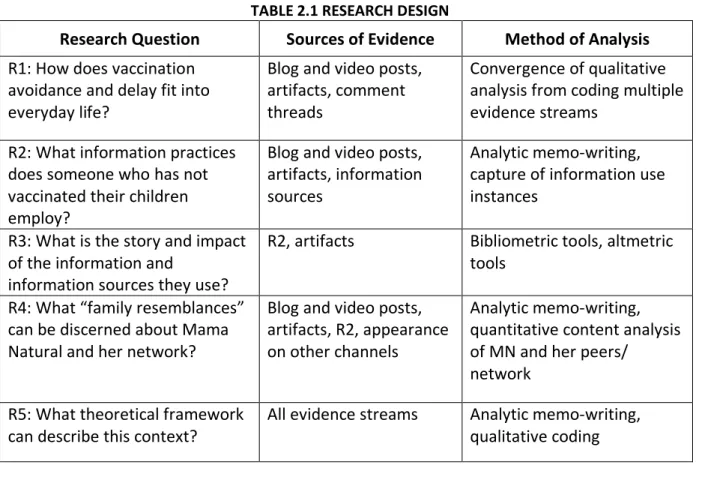
(Dempsey et al., 2011; Robison et al., 2012), but there is still much to learn. We also lack an understanding of the worldview of someone in this unexamined range. Within those who are not completely anti-vaccine, but are also not following the schedule, how does this fit into their lives? What information and sources do they use, engage with, find, look for, share, and trust? Does that information tell a larger story? I answered the following questions in this research:
• R1: How does vaccination avoidance and delay fit into everyday life?
• R2: What information practices does someone who has not vaccinated their children employ?
• R3: What is the story and impact of the information and information sources (including people) the case uses?
• R4: What “family resemblances” can be discerned about Mama Natural and her
network?
Significance of the study
Much of the existing research on people who do not vaccinate, who hesitate, or who
delay, is demographic or centers the behavior in the health care provider’s office. Because
parents must repeatedly reaffirm and maintain this decision over time, it is not just a health behavior, but an everyday life behavior. The first question I asked provides insight into how this behavior functions in everyday life. Everyday life is “the acquisition of various informational
(both cognitive and expressive) elements which people employ to orient themselves in daily life
or to solve problems” (Savolainen, 1995, p. 267).
Within the research about this phenomenon, parents frequently perceive information about vaccination to be biased and partial (Petts & Niemeyer, 2004), thus the information they use and how they use it is of interest. Lingel and boyd (2013) consider information practices “to
refer to the ways that people locate, use, share, and evaluate information” (p. 981). There is
evidence that vaccine opposition is louder than support online (Buchanan & Beckett, 2014; Guidry et al., 2015; Kata, 2010; Wolfe & Sharp, 2005), but limited insight into other information behaviors, which the second question could begin to answer. Lingel and boyd (2013) ask
“whether information itself constitutes a kind of stigma” (p. 990), and my third research
question is framed with this in mind. If mentioning belief in the retracted, falsified Wakefield
study can discredit a person, then the information and the information’s story is of interest.
Further, while the Wakefield study may be the most well-known, it is in no way the only
Given the limited demographic understanding of this population and how large it is, I suggested
the fourth question as a frame to describe the “complicated network of similarities overlapping
and criss-crossing: sometimes overall similarities, sometimes similarities of detail”
(Wittgenstein, 1967, p. 32). Learning what, if any, family resemblances can be discerned between my case and the information objects and sources she uses helps identify what family this behavior belongs to—for example, is someone likely to avoid or hesitate on vaccines if they want a natural birth, or if they use cloth diapers and amber teething necklaces?
The fifth question enhances our understanding of how stigma functions in vaccine opposition. Not vaccinating a child is a stigmatizing choice—the American Association of Pediatrics (Committee On Practice And Ambulatory Medicine, Committee On Infectious Diseases, Committee On State Government Affairs, Council On School Health, & Section On Administration And Practice Management, 2016) allows doctors to decline to treat families who do not want to vaccinate their children. Content analyses of anti-vaccination sites, which
represent the most extreme behavior, report themes of wrongful persecution (Kata, 2012). However, there is also evidence that wealthy, white parents are more likely to engage in this behavior (McNutt et al., 2016). How (if) this normally privileged group experiences, manages, and negotiates stigma in this context is of interest.
demanded a methodology that could absorb the interconnected network of variables, rather than isolating them or removing them to preserve the integrity of the method.
There is evidence that parents who deviate from the immunization schedule consult more information sources than those who do not (Brunson, 2013). There is also extensive evidence that regardless of the choice parents make, they consult multiple source types (Brunson, 2013; Gottlieb, 2016; Jones et al., 2012) including their own parents, peers,
healthcare providers, books, pamphlets, social media, and websites—to name a few. All of this information and these sources demanded equal consideration, rather than just tabulation of type.
I studied this phenomenon via a case study. This approach has not, to my knowledge, been utilized (or utilized extensively) in this context before. The case study was uniquely suited
for studying this phenomenon because “A case study is an empirical inquiry that a) investigates
a contemporary phenomenon (the ‘case’) in depth and within its real-world context, especially
when b) the boundaries between phenomenon and context may not be clearly evident” (Yin,
2014, p.16). The case study provided advantages to studying anti-vaccination behavior that other methods do not. It is well suited to answering how and why questions—answers that content analyses and large-scale surveys are not designed or able to provide. Further, it is a behavior of the moment, out of the researcher’s control, and influenced by a wide array of
variables. An additional strength was the case study’s appetite for multiple sources of evidence
and allowance for multiple methods to evaluate data.
over a period of time. The behavior and attitudes result in complicated decisions that individuals must defend and reinforce. The case study was ideally suited to explore and describe this instead of reducing it to a false binary of anti- or pro-vaccination.
2.3 Methodological Design
I conducted a case study of the information practices and everyday life behavior of a parent who has not vaccinated their children using multiple methods. Mixing methodological
approaches is appropriate when the “research problem may be one in which a need exists to
both understand the relationship among variables in a situation and explore the topic in further
depth” (Creswell, 2002, p. 76). I will now review the theoretical frame, the single-case design,
my proposed case, the sources of evidence, and how the questions were answered.
2.3.1 Theoretical lens
The case study methodology “differs from other qualitative methods because it has
theory development prior to data collection” (Yin, 2014, p. 37). Similar to mixed methods
studies, theory serves as a “lens or perspective to guide the study” (Creswell, p. 136). The case
is “the opportunity to shed empirical light about some theoretical concepts or principles” (Yin,
2014, p. 40). I employed grounded theory because, like the case study, it is “systematic, yet
flexible”and prioritizes “iterative strategies of going back and forth between data and analysis”
(Charmaz, 2014, p. 1) which, given the numerous evidence streams, was necessary. The
constructs and propositions of Elfreda Chatman’s theory of Information Poverty served as
sensitizing concepts, which Charmaz (2014) defines as “initial but tentative ideas to pursue and
questions to raise about their topics” (p. 30). The constructs and propositions of Information
Chatman’s theory of Information Poverty rests on four constructs and six propositions. The six propositions of information poverty; which draw from the constructs of insiders and
outsiders, secrecy, deception, and risk-taking; are
Proposition 1: People who are defined as information poor perceive themselves to be devoid of any sources that might help them.
Proposition 2: Information Poverty is partially associated with class distinction. That is, the condition of information poverty is influenced by outsiders who withhold privileged access to information.
Proposition 3: Information poverty is determined by self-protective behaviors which are used in response to social norms.
Proposition 4: Both secrecy and deception are self-protecting mechanisms due to a sense of mistrust regarding the interest or ability of others to provide useful
information.
Proposition 5: A decision to risk exposure about our true problems is often not taken due to a perception that negative consequences outweigh benefits.
Proposition 6: New knowledge will be selectively introduced into the information world of poor people. A condition that influences this process it the relevance of that
information in response to everyday problems and concerns. (Chatman, 1996, p. 197-198)
These constructs and propositions guided me in determining which questions to ask.
My first question, “How does vaccination avoidance fit into everyday life?” drew from
• R2: What information practices does someone who has not vaccinated their children employ?
• R3: What is the story and impact of the information and information sources (including people) the case uses?
• R4: What “family resemblances” can be discerned about Mama Natural and her
network?
• R5: What theoretical framework can describe this context? 2.4 Proposed case
I conducted a case study of Mama Natural, the online moniker and website of a woman named Genevieve Howland (alternately referred to as Genevieve and Mama Natural). I
previously conducted a small case study of Genevieve for an end-of-course project in Spring 2015 (attached in Appendix B). For that paper I was only able to read and view a portion of
Mama Natural’s posts and videos—about two years’ worth. While I think I answered the
questions I set out to, the study generated additional questions I could not attend to and during data collection I observed ways I could improve the methodological rigor of the study, which due to time constraints I could not implement.
Mama Natural could be described as a “mommy blogger.” According to Friedman
(2010), “Mommy blogs are online journals (Web logs) written by women documenting the
experiences of motherhood and motherwork. Most mommy blogs have been written since
2005.” The concept of mommy blogs has a greater presence in popular culture than scientific
for women who blogged, one non-mommy blogger spoke of mommy-blogging in a dismissive
way and “Alice Bradley, who writes about her children in a blog called ‘Finslippy’
(http://finslippy.typepad.com), declared: ‘Mommy blogging is a radical act’” (Lopez, 2009, p.
730). Lopez notes that the next year the statement was the name of a conference session.
However it must be mentioned that this “radical act” is mostly performed by “white,
middle-class, partnered women in heterosexual relationships” (Friedman, 2010). Lopez (2009)
agrees that “white, married, heterosexual women dominate this conversation” (p. 733). Their
blogs are also similar in appearance and functionality:
the most successful feature lively writing, gorgeous photos, iTunes playlists, Twitter, Facebook, and Instagram feeds, and most importantly, thousands of active readers and commenters. Many of them are also monetized, carrying multiple banner and side ads and featuring contests, promotions, product reviews, and giveaways. Bloggers have developed sophisticated public relations strategies and advertising policies to deal with the multitude of eager marketers clamoring for a piece of their audience (Whitehead, 2014, p. 128)
This “radical act” is also, potentially, a profitable one. Some readers feel this has compromised
the integrity of the once “radical act” and “what was once an act of resistance through which
communities formed has become simply a shallow marketing tool” (Hunter, 2016, p. 1307). The
markers Whitehead (2015) identified as synonymous with success in mommy blogging have
detractors who see them as signifiers that the bloggers are “glib, trite, and focused solely on
creating content that will appeal to advertisers” (Hunter, 2016, p. 1307) when they should be “providing alternate narratives of what it means to be a mother, and a woman” (p. 1307).
something positive about a blogger, they are often accused of ‘white knighting.’” (Hunter, p.
1312). Hunter analyzed the threads relating to several very popular bloggers (popular on the Internet and popular on GOMI) and found that in addition to distrust of sponsored content and
annoyance over clickbait, GOMI commenters expressed criticism that “bloggers monitor their
comments sections, censoring anyone who does not agree with the blogger, or is any way negative. Part of the reason people have come to GOMI is precisely because bloggers do not
allow for any dissenting viewpoints” (Hunter, p. 1316).
The “radical act” performed mostly by white, heterosexual, married women with high
technological literacy and access, that has become a means to make a living, has generated a massive website for those who feel censored by it. Hunter (2015) concludes that
The growing consensus on GOMI is that rather than fostering communities that allow for multiple points of view, blogging is more of a performance than anything else; a performance designed to sell an aspirational lifestyle where there is only room for applause and accolades. (Hunter, 2015, P1316)
Why are these white, heterosexual, married women performing this “radical act”? Song (2016)
interviewed numerous bloggers, in addition to attending many social media conferences for women and mothers, and noted:
Like so many other mom bloggers who are privileged in their race, education, and economic status, Kim opted out of a flourishing career to become a full-time mother, only to find the culturally circumscribed sphere of influence for mothers to be
distressingly confining and undervalued (Song, 2016, p. 49)
cannot be ignored. Blogging is, in this lens, a path to legitimacy, an attempt to reclaim power and restore past privilege.
In a survey of Australian mothers who blogged, Pettigrew, Archer, and Harrigan (2016)
reported five themes for blogging motivations, “connection, stimulation, validation,
contribution, and extension” (p. 1027). I read these themes as “peers, intellectual activity,
legitimacy/affirmation of choices, desire to be viewed as person with expertise, and desire to
influence.” Women who are blogging about motherhood are, in some regards, attempting to
create or mimic a workplace and a career by treating it as such. In that regard, mommy
blogging is a radical act because it pushes against “Motherhood … as part of the private or
domestic sphere that women are supposed to occupy and not challenge” (Lopez, 2009, p.731),
which is why it is even more the pity that “there appears to be relative absence of self
-consciousness within the mamasphere” and the homogeneous women who compose it
(Friedman, 2010, p. 2).
These criticisms are especially interesting given the tricky and contradicting nature of vaccine opposition. Anti-vaccination activists often claim they are being persecuted by pro-vaccine authorities or are the victim of larger conspiracies at work (Davies et al., 2002; Kata, 2010). However, they also position vaccine avoidance as a more natural way of life, the way it
“should” be. Are they stigmatized or are they an aspirational way of living? The intersection of
vaccine opposition and a profitable mommy blog will pull these tensions taut and allow for a close examination.
is her full-time job and career. She purports to help “mothers-to-be and moms of young
children lead healthier and more natural lives” (“About Mama Natural,” 2011). I considered
Genevieve an ideal case for several reasons. Petts and Niemeyer’s (2004) asserted that
“maternity appears a significant factor forming views on MMR” (p. 14). Mama Natural is a
mother of two children and devotes herself to helping women who are mothers or are
preparing to become mothers. Pregnancy is one of the main subtopics of her website; she has written a book on the topic and offers an online class about it, and sells several products for expectant mothers. This makes her an ideal case to examine the intersection of maternity and anti-vaccination attitude formation.
In line with her moniker, Mama Natural embraces and encourages natural living. This contributed to her suitability as a case because an affection for or pursuit of natural living has been reported in many studies of anti-vaccination parents or anti-vaccination advocates and content (Dempsey et al. 2011, Gottlieb, 2015, Kata, 2010, Davies, Chapman, and Leask, 2002). Davies, Chapman, and Leask (2002) suggested this alignment occurs because “Along with
alternative health and natural parenting, antivaccination sites represent a return to an
idealised, natural existence” (p. 24). Zimmerman et al.’s (2005) content analysis of
anti-vaccination websites also reported a strong presence of encouragement for pursuing alternative medicine.
Mama Natural’s expertise with online platforms and tools is another facet of what made
her an excellent case. Jones et al. (2012) reported “a relationship between Internet use and an acceptance of alternative views to traditional medicine about vaccination,” although the
uses the Internet and accepts and promotes alternative views. Not only is she this parent, but she is also the type of source to which this parent is potentially receptive. Jones et al. (2012) found Internet users “were less likely to agree with accepted tenets of vaccine science, less
likely to agree that children need or benefit from vaccines, and more likely to have obtained nonmedical exemptions from vaccination for their children” (p. 5). It was important to study both sides of this—a parent who met these criteria and the information they interacted with, Mama Natural was at this intersection.
Mama Natural provided a window into how stigma fits in vaccine opposition. To the outside eye, Mama Natural enjoys much privilege—she is white, attractive, in a heterosexual marriage, Christian, and appears to live in relative comfort. However she has also made videos
like “Sh*t crunch mamas say” (“Sh*t Crunchy Mamas Say,” 2012) which goes through common
things “crunchy” parents say that make them distinct (and possibly alienated) from other
parents. She also addressed a question from a reader struggling with the reaction of family and friends to her parenting choices with the video, “What to do when people think you’re nuts ;)”
(Mama Natural, n.d.). Perceived and felt stigma are something she experiences and engages with, though her relative privilege surely shapes how much this actually influences her, her parenting choices, and the community she builds online.
Selecting the case, for a single case study design, was of inestimable import, especially
because the “case may later turn out not to be the case it was thought to be at the outset” (p.
53). Yin identifies five rationales, “critical, unusual, common, revelatory, or longitudinal” (p. 51).
case, the researcher also selects a situation (p. 2), suggesting that the types of cases could also be seen as situational labels. Walton (1992) does not delineate with specificity, rather asserts
“cases are chosen for all sorts of reasons, from convenience and familiarity to fascination and
strategy” (p.125).
Considering these possible labels, Mama Natural fit in several categories. In some ways she was a common case—an Internet-savvy mother who has not vaccinated her children. She was also a critical or extreme case—an Internet personality and information resource who has not vaccinated her children, who is open to and endorses natural living and alternative health practices. She was also a longitudinal case, as her blog and videos provided more than 7 years of insight into her life. Adding another layer, Platt (1992) asserts “that the kind of a case a
whole work is may change over time” (p. 41). Ultimately, what kind of a case Mama Natural is
matters less than that she was the right case to answer the research questions.
2.4.1 “A single case”
A single case design is frequently subject to criticisms of rigor and representativeness. The latter is perhaps easier to dismiss—a single case study is not representative of the larger population from which it was selected because it is not designed to be. Expecting
representativeness from a single case study is akin to expecting quantitative data to talk, if you tried very hard you might manage it but it would be a challenge for you and for the data. Case studies can generate theoretical constructs that may transfer to or “represent” other contexts,
a substitute for a chair. You could sit on a television if you had to, but it is really not designed for that.
Whether a case study can be representative of any population or theory is frequently called into question because its N of one is used to diminish its potential rigor. Yin (2014) discourages equating a case to samples and instead compares a single case to a single experiment. One experiment examines isolates variables and analyzes them in a particular situation at a particular time and then tries to replicate it or expand the situation(s) or time(s) when those findings occur. A case study follows a similar path, except instead of empirical findings, it generates theoretical constructs and rich descriptions and explanations that can answer questions other approaches cannot.
But is any case only one case? Even a single experiment often contains embedded experiments. A single-case study design can still “involve units of analysis at more than one
level” (Yin, 2014, p. 53). Embedded case studies which collect and analyze data at multiple
levels may struggle “to return to the larger unit of analysis” (Yin, 2014, p. 55). Mama Natural as
a case was difficult to define because it existed at multiple levels and the delineation between them was murky. Her website, her blog, her family life, her social media channels, her
information use—co-occured.
According to Hennion (1989), “The intermediary is not at the interface of two known worlds: he or she is the one who constructs these worlds by trying to bring them into relation”
producer was used as a proxy to understand how production and consumption intertwine to create objects, she is a representation or an instance of a process we do not fully understand—
and provided an opportunity to examine it in depth.
White (1992) acknowledges “a case study takes a single count and opens it up, with
attention to context” (p. 83). Mama Natural was potentially a single count. However, the single instance of her and her blog consists of numerous decisions, another way of looking at cases, according to Yin (2014, p. 15). Mama Natural documented numerous decisions that are not normative—a set of decisions that are each “cases.” How she presented her decision not to vaccinate, compared to her decision to cosleep with her newborn, or whether she should have her son circumcised provided rich opportunities for comparison. While she may was a single
instance, comparing the “cases” of her deciding to make controversial childrearing decisions
was an opportunity for insight and compromised the idea of her as a single case. Instead her presence and website become a context in which I had the opportunity to examine multiple
“cases.”
2.5 Sources of evidence
Case studies are unique because of their allowance for multiple types of evidence—Yin (2014) identifies the 6 most common sources of evidence as documentation, archival records, interviews, direct observations, participant-observation, and physical artifacts (p. 106). While “a
good case study will therefore want to rely on as many sources as possible” (Yin, p. 105), Yin acknowledges “Any of the preceding sources of evidence can and have been the sole basis for
entire studies” (p. 118). Multiple sources of evidence are important and were sought because
on one evidence type. For example, survey work can tell you who participates in a workforce, but only conducting interviews with the workers will tell you why. Findings arise from
convergence across types of evidence—if they do not converge they also can identify points of
tension between different facets of the context’s fabric.
Mama Natural was an excellent candidate for the case study because, in addition to the characteristics already listed, there are numerous evidence streams related to her that are publically available. The first and foremost was her website, MamaNatural.com. On this site she writes about her everyday life and usually posts videos to accompany her posts. Her posts typically focused on educating the reader about a specific topic or about sharing her life with the reader. Educational posts provide an additional opportunity for evidence—Genevieve usually cited her sources, opening an avenue for bibliometric analysis. This was an excellent opportunity to study in-depth the information and sources utilized by a parent who has chosen not to vaccinate their child—to make that choice but also in her day-to-day life. Her posts also allow visitors to comment, to which she or someone from her team sometimes responded.
On her website, Genevieve also has a section where she endorses specific artifacts (in addition to talking about them in her posts) and also a storefront where visitors can purchase artifacts she has created. Examples of created artifacts included the book she authored and pregnancy affirmations. Examples of endorsed artifacts included books, natural food products and supplements (purchasable from Amazon, she is an Amazon affiliate and can receive income from people purchasing items they found via her site). Genevieve also maintains public
and “likes,” and if she engages with her followers. Artifact analysis was confined to information objects because limited value was seen in purchasing and trying the foods and supplements Mama Natural endorses. I also refrained from studying her social media usage because after a quick perusal they seemed to function as echo channels for her blog, rather than featuring distinct content.
In addition to the channels she controls, Genevieve does appear in other settings to promote her website. Her site mentions appearances on Daily Mail, The Doctors, CBS News, and in Newsweek. She also has appeared on the channels of others and written posts for other venues, possibly to promote herself or the channel hosting her. This was an additional stream of evidence and a possible place to assess the propositions—if her narrative, behavior, and information practices are consistent across contexts. I observed they were very consistent and usually focused around amplifying her blog and YouTube channel, so I did not evaluate them in detail. Genevieve also advertises a class on her website; the Mama Natural Birth Course
(“Mama Natural Birth Course - The #1 Online Childbirth Class,” n.d.). There are also forums,
such as Get Off My Internets (GOMI), where online personalities, such as Mama Natural are discussed—sometimes, even frequently, in unflattering terms. This was an additional source of evidence, along with comment threads on the MN site to understand how others perceived her. More evidence can be obtained from the Wayback Machine at the Internet Archive where I observed how MamaNatural’s website changed over time, with particular attention to how posts about stigmatized topics changed or were no longer available.
comment or visit her Facebook page instead. Because of this, and the likelihood that this research would be perceived as threatening—I did not try and contact Genevieve. Additionally, I did not think direct contact with Genevieve would reveal more than the video logs and web posts she has made over 7 years.
2.6 Operationalizing the questions
TABLE 2.1 RESEARCH DESIGN
Research Question Sources of Evidence Method of Analysis R1: How does vaccination
avoidance and delay fit into everyday life?
Blog and video posts, artifacts, comment threads
Convergence of qualitative analysis from coding multiple evidence streams
R2: What information practices does someone who has not vaccinated their children employ?
Blog and video posts, artifacts, information sources
Analytic memo-writing, capture of information use instances
R3: What is the story and impact of the information and
information sources they use?
R2, artifacts Bibliometric tools, altmetric tools
R4: What “family resemblances”
can be discerned about Mama Natural and her network?
Blog and video posts, artifacts, R2, appearance on other channels
Analytic memo-writing, quantitative content analysis of MN and her peers/
network R5: What theoretical framework
can describe this context? All evidence streams Analytic memo-writing, qualitative coding
2.7 Formal Data Collection Techniques
“The emergent nature of the investigation means that very often it is impossible to say
exactly what data collection techniques will be applied until” research begins (Pickard, 2007, p.
89). However, this also means the design can adapt “for confirmation or refutation of emerging
themes as the researcher is aware of them before vacating the site and can adapt the data
collection to respond to these emerging themes” (Pickard, 2007, p. 90). Due to inherent
always feasible—for example, in a semi-structured interview the data would be different each time—but the stronger and more detailed the protocol, the more feasible such replication is. Replication in case studies means another researcher, using the protocol(s), could replicate the
case, not replicate the case’s findings in another case.
Pickard (2007) notes, “You will collect and store multiple sources of evidence. This
needs to be done comprehensively and systematically, in formats that can be referenced and sorted so that converging lines of inquiry and patterns can be uncovered” (p. 89). Because I
collectd and evaluated multiple data types, there were multiple databases of evidence and data collection protocols. The collection protocol and storage plan for each evidence stream is in the table below. The data collection protocols are outlined in Appendices B, C, and D. As the design may shift during data collection and analysis, I intended to “keep a methodological journal in
which you jot down your methodological dilemmas, directions, and decisions” as Charmaz
TABLE 2.2
Evidence Stream Data Collection Protocol Storage Blog posts Detailed Qualtrics entry form
(Appendix B) Each post was saved as a PDF, the data collected about each post will be stored in Qualtrics
Videos Detailed Qualtrics entry form (if part of a blog post, Appendix B, other video will be Appendix C)
Data collected about video were stored in Qualtrics
Artifacts Inductive coding and memoing in Qualtrics or on the artifact when possible
Physical artifacts were stored in a safe space, some data collected about them were stored in Qualtrics and other digital tools
Information Used Collected during different rounds of data collection (from posts, videos, & artifacts) in different Qualtrics databases, then entered into protocol in Appendix B
Stored in Qualtrics, analysis stored in Excel and Stata files
Other Evidence
Streams Determined which of existing protocols was most suited for it or developed new one
Stored in Qualtrics and other spaces as needed
2.8 Formal Data Analysis Techniques
2.8.1 Digital ethnography
Hine (2015) considers the role of ethnography when studying the Internet and mediated communication and how it challenges basic assumptions, such as
When we watch a fight break out on Twitter we cannot be sure whether any of the followers of those involved are seeing the same fight, at the same time, and
understanding it in the same way that we do. The very notion of a singular “situation” as
a pre-existing object breaks down (p. 3).
Ethnographers strive to observe and do what those they study are doing, in many ways I was
observing and doing what Mama Natural’s followers do. I could only see the interactions they
chose to publish, but reading the blog without leaving a public comment, “lurking,” is an
extremely common behavior. Like a case study, an ethnographic study cannot be wholly
premeditated (Hine, 2015). Hine’s (2015) view of the Internet as “an infrastructure that
underpins the things that people do, rather than a foregrounded activity that they do in its own
right” (p. 8) is a helpful frame for looking at Mama Natural. The Internet is the infrastructure
that has allowed her to store years of the “mundane aspects of everyday existence” (Hine,
2015, p. 164) that I think shape the phenomenon of interest but that would be difficult to obtain in other forms of data collection.
This work was also driven by “a belief that engagement with the field should be driven
by a pursuit of the ways in which a setting uniquely makes sense, rather than the application of
a particular model of what a field should be” (Hine, 2015, p. 31). As case studies must
triangulate evidence, “Ethnographers need to triangulate their own perceptions with those of
typical ethnographic “learning-by-doing, observation, recording activities and archiving
documents” (Hine, 2015, p. 15) and “the embodied experiences of the researcher [will be] one
of its primary means of discovery” (p. 19).
However, the primary methodological approach was still the case study. While I do not
“aspire to develop depersonalized and standardized instruments of data collection” (Hine,
2015, p. 19), the data were collected in a systematic, standardized way that could be replicated by another researcher following the same protocol. Though our findings would differ, the data we collected, for the most part, should match. Like an ethnographer, I did not make an
“objective account independent of the specificities of a particular ethnographer’s engagement
with the setting” (Hine, 2015, p. 20), if only because such an account is, when examining such a
contested topic, impossible.
Unobtrusive digital ethnographic methods were embedded within this research design.
Hine (2015) does “not claim that unobtrusive methods applied to online settings are necessarily
in themselves sufficient to enable a robust ethnographic account to be constructed” (p. 157)
but “for an ethnographer interested in those aspects of the minutiae of everyday life which
participants may find it difficult to talk about retrospectively in an interview situation” (p. 157)
they can be illuminating. These methods were essential to my work and also underlined the rationale for avoiding face-to-face data collection because “non-reactive research methods are very useful where it may be difficult for respondents to give honest or authentic answers about
their behavior, possibly because answers might be seen as socially undesirable” (Hine, 2015, p
person questioning them is associated with the scientific community. Mama Natural’s site and
content are “a form of data that can readily be collected and interpreting it as a proxy for a
behavior that the researcher is interested in but cannot necessarily ask about or observe
directly” (Hine, 2015, p159).
2.8.2 Qualitative content analysis: Inductive coding analytic memo writing
I utilized certain grounded theory methods as articulated by Charmaz, particularly
inductive coding and analytic memo writing. Coding is a place to “define what is happening in
the data and begin to grapple with what it means” (Charmaz, 2014, p. 113). Grounded theory
coding typically involves multiple rounds, an initial broad phase and then a focused selective phase (Charmaz, 2014, p. 113). Via memo-writing I accessed the “implicit, unstated, and
condensed meanings” (Charmaz, 2014, p. 180). These codes and memos were distilled into
themes, “outcome[s] of coding, categorization, or analytic reflection, not something that is, in
itself, coded” (Saldaña, 2013, p. 14).
2.8.3 Quantitative content analysis
Quantitative content analysis “applies preconceived categories or codes to the data”
(Charmaz, p. 114). In assessing family resemblances, I utilized quantitative content analysis. The Mama Natural site exists within a network of mommy blogs that advocate natural living. Just the blog page advertising her book features endorsements from 13 other authors or digital creators (“The Mama Natural Week by Week Guide to Pregnancy & Childbirth | Mama
Natural,” 2017). A cursory look at their descriptions and web presences reveals some obvious
information sources identified in my third research question, such as the book, Nourishing Traditions. The creators of some of Mama Natural’s favorite artifacts, other blogs she appears
on, or individuals she regularly cites, could have been included in this assessment, but
ultimately were not because they were seen as experts she admired, rather than peers. Other individuals were identified by looking at who Mama Natural follows and interacts with on her social media accounts, particularly YouTube. To ensure a robust comparison, I aimed for a minimum of 30 individuals, though I was able to obtain over 80 cases to contrast.
2.8.4 Metrics, impact, story
The website RetractionWatch, a blog devoted to “tracking retractions as a window into
the scientific process” reported a surprising story—the top ten most cited retracted articles had
continued to be cited after they been retracted and some had received more citations since retraction than before (Oransky, 2015). This list included the infamous article by Wakefield et al. which alluded to a causal link between the MMR vaccine and Autism Spectrum Disorder. In my previous study of Mama Natural, I noticed she engages with information sources of all types
—scholarly, government, informal, et cetera. It is possible that some of the information she uses is a special case, such as the Wakefield article, but without examining the metrical aspect of such information it would be impossible to know. Thus, when possible, I intended to tell the bibliometric story of the information object’s influence.
stating the influence of a blog or a specific newspaper article is a nebulous task. However, that does not mean it is not worth attempting. Many researchers who study online spaces state the
space’s impact via Alexa ratings. Flaherty et al.’s (2014) work about the Jenny McCarthy effect
noted how many libraries the controversial book was available in via WorldCat. Sometimes the influence of an information object can be discerned in ways other than measurement. For example, the Dr. Sears Vaccine book inspired Offit and Moser (2009) to write an article specifically addressing it and many of its claims. I had intended to devote more time to analyzing the information objects cited, but because of the difficulties in understanding their influence, the amount of cited objects, and the relatively low importance Genevieve placed on them, I did not pursue this line of inquiry.
2.9 Summary
2.9.1 Ethical considerations—Anonymizing the case
Mama Natural is a website and an online personality. She is also a person who shares much of her personal life with whomever comes to any of her digital platforms. Studying her meant studying her livelihood and her family in great detail. While her husband chooses to be a part of this digital presence, her children cannot, however they are an integral part of her story. It was necessary at all times to remember that these are real people and not all are consenting adults.
identifiable aspects of her site make her distinct and a good case, anonymizing her threatened the integrity and salience of the findings. In addition, prior research that has focused on mommy blogs has not anonymized them. Bruckman, Luther, and Fiesler (2015) even “argue that anonymizing [Internet names] … would be unethical” (p. 244) because “we are studying
people who deserve credit for their work, and who are entitled to respond to our
representations of them” (p. 244).
2.9.2 Institutional Review Board
This research was found exempt by the UNC Office of Human Research Ethics on September 1, 2017, IRB Notice 17-2009.
2.10 Challenges
It was foreseeable that the research design, questions, and direction would change during data collection and analysis. The qualitative elements of this study relied on my interpretation—and another researcher might interpret the data differently, for “multiple
realities exist because we each perceive and interpret social life from different points of view”
(Saldaña, 2013, p. 8). Charmaz notes “Every researcher holds preconceptions that influence, but
may not determine what we attend to and how we make sense of it” (p. 156).
the empirical depth reached by a single case can contribute by generating thorough description and theoretical understanding that can be sought in other cases and contexts. There were aspects of this case that I could not say with certainty are pertinent to other cases and contexts, though they held great import to understanding Genevieve. This is discussed further in section 5.5.1.
One methodological limitation of this work was that it did not utilize direct interaction
with the case as an evidence source. Yin considers the interview “one of the most important
sources of case study evidence” (p. 110) though he notes that “interviews should always be
considered verbal reports only” (p. 113) especially because “Corroborating these views against other sources would not be as relevant as when you are dealing with behavioral events” (p.
113). At the time the research was undertaken, Mama Natural’s website said she did not respond to email inquiries (“About MamaNatural,” 2011), making contact a challenge.
Interviewing her would have presented such significant challenges in building rapport and trust that I did not think it would be a worthwhile use of time, especially given the immense amount of video diary-like evidence already available. Interviewing her followers also presented
challenges, as doing so with or without her consent would have disturbed the site more than necessary—something Creswell (2002, p. 181) cautions against.
2.10.1 Debriefing
new mothers. All agreed to participate in discussions with me to discuss findings, themes, and ask for their insight and experience. In practice, interviews with the new parents and the
midwife were the most necessary to check my interpretation and gain subject matter expertise. 2.10.2 Researcher as instrument
Holloway and Biley (2011) assert, “The self is always present” (p. 971), implicitly or
explicitly in fieldwork. In qualitative research it may be more so, thus more necessary to directly
assess one’s own standing in the work and how that can shape one’s interpretation. While I am
fond of children, I do not have my own and could not draw on personal experiences of child-rearing and maternity (though this same lack also meant my own experiences could not bias
me). However, if I have children I have every intention of adhering to the CDC’s vaccination
schedule. I am able to separate my perspectives on how I view the decision not to vaccinate as a researcher and as a member of society.
choosing to vaccinate is the right decision for virtually every child. In fact, studying it has intensified this belief.
Considering how my own views have evolved has shaped this research design. After working on my comprehensive exams for several months I concluded that I believed even more firmly in vaccination, but that I now had different language for it and could articulate why in a much richer way. Surprisingly to myself, the science became supporting evidence and
vaccination became a way to operationalize one’s values. As I began to see vaccination as a
choice made to align with values (for some, not for all), I wondered how it fit into everyday life, particularly as it is not a normative choice and can involve stigma, though the values-aspect likely imbues the parent with much conviction.
I was limited in certain ways that shaped my interpretation, but I am and was able to empathize with making a decision that is stigmatized for reasons the decider feels are unfair and wrong. I did not think Mama Natural and I make many of the same choices, but I thought we made our choices in similar ways. Also, while some of her behaviors are not the choices I make, many are choices my friends and family have made. At a reductive level, this research will be conducted by a pro-vaccine woman who is not a parent studying a woman who is a parent who has not vaccinated her children. The limitations were obvious, but also less limiting than they appeared.
2.11 Impact
CHAPTER 3: METHODS
3.1 Summary of Data Collected
A summary of all data I collected can be found in Table 3.1. The first data I collected were blog posts, along with comment interactions and citation data. During this phase, I viewed some of her videos, identified artifacts and began that analysis, conducted several interviews with peer debriefers. After all blog posts were read (and comments and citation data collected), I viewed all Mama Natural videos on YouTube but not on her blog—artifact analysis was
concurrent. After the completion of all videos, I registered for her birth course—an online-delivery education artifact consisting of 10 sessions with videos, quizzes, and handouts.
Concurrent with this period was iterative coding of blog posts. After completing the course and completing all of the other artifacts, I cleaned the bibliometric data and descriptive data from the blog posts. At the completion of these phases, I reviewed hidden blog posts and an external forum thread about Mama Natural discovered during the first phase. I then reviewed and distilled all memos, comments, and data from earlier phases. Nearing the completion of these
phases, the set of family resemblances was finalized and the list of Mama Natural’s potential