R E S E A R C H A R T I C L E
Open Access
A global sensitivity analysis approach for
morphogenesis models
Sonja E. M. Boas
1,2, Maria I. Navarro Jimenez
3, Roeland M. H. Merks
1,2and Joke G. Blom
1*Abstract
Background: Morphogenesis is a developmental process in which cells organize into shapes and patterns. Complex, non-linear and multi-factorial models with images as output are commonly used to study morphogenesis. It is difficult to understand the relation between the uncertainty in the input and the output of such ‘black-box’ models, giving rise to the need for sensitivity analysis tools. In this paper, we introduce a workflow for a global sensitivity analysis approach to study the impact of single parameters and the interactions between them on the output of morphogenesis models. Results: To demonstrate the workflow, we used a published, well-studied model of vascular morphogenesis. The parameters of this cellular Potts model (CPM) represent cell properties and behaviors that drive the mechanisms of angiogenic sprouting. The global sensitivity analysis correctly identified the dominant parameters in the model, consistent with previous studies. Additionally, the analysis provided information on the relative impact of single parameters and of interactions between them. This is very relevant because interactions of parameters impede the experimental verification of the predicted effect of single parameters. The parameter interactions, although of low impact, provided also new insights in the mechanisms ofin silicosprouting. Finally, the analysis indicated that the model could be reduced by one parameter.
Conclusions: We propose global sensitivity analysis as an alternative approach to study the mechanisms of morphogenesis. Comparison of the ranking of the impact of the model parameters to knowledge derived from experimental data and from manipulation experiments can help to falsify models and to find the operand mechanisms in morphogenesis. The workflow is applicable to all ‘black-box’ models, including high-throughputin vitromodels in which output measures are affected by a set of experimental perturbations.
Keywords: Morphogenesis, Vascular network development, Computational modeling, Cellular Potts model, Global sensitivity analysis, Sobol’ indices, Polynomial chaos expansion
Background
Morphogenesis, the organization of multiple cells into shapes and patterns, is a key process in biological devel-opment. Computational modeling is commonly used to study mechanistic hypotheses on morphogenesis [1–7] as they allow for simplification and isolation of the process. These computational studies typically involve multi-scale, non-linear and multi-factorial models. So far, the behav-ior of these computational models is studied for one or occasionally two parameters at a time, which can lead to a wrong interpretation for non-linear models. Studying
*Correspondence: [email protected]
1Life Sciences, CWI, Science Park 123, 1098XG Amsterdam, The Netherlands Full list of author information is available at the end of the article
all parameters collectively with global sensitivity analysis resolves this problem.
In this paper, we introduce a workflow that uses global sensitivity analysis to find the relevant single parame-ters and parameter interactions in ‘black-box’ models of morphogenesis, which are strongly non-linear and mul-tifactorial. Sensitivity analyses of computational mod-els enable us to identify the effects of uncertainties in parameter values on the model output. Local sensitiv-ity analysis investigates the behavior of the model in a small region around the nominal parameter values and is most often used to study model robustness. Global sensitivity analysis (GSA) covers the entire input param-eter space, or a specifically selected region hereof. In its most powerful form, it gives information on the impact of individual parameters and combinations thereof on
a nonlinear model for arbitrary parameter distributions. This is what e.g. variance-based methods like FAST [8] and the Sobol’ method [9, 10] do. This, of course, is computationally expensive, therefore many methods have been proposed with simplifying assumptions like linear-ity of the model (MLR [11]); methods that produce less sophisticated results, e.g. partial or no information on interactions (Morris method [12]); [13, 14] are less robust like DGSM ([15, 16]); or that use prior knowledge of the model, like Bayesian DGSM [17]). In this paper we use the Sobol’ method [10], where we have modified the orig-inal method for efficiency reasons (for more details see Section Global sensitivity analysis). Moreover, we intro-duce an approach to determine the sampling sizea priori with ana posteriorierror check. Thus, it is not likely that the proposed GSA will excel in computational efficiency, but it will excel in predictability of the costs and reliability of the results. In the biological field GSA is mostly applied to models consisting of ordinary differential equations, e.g., in pharmacology [18, 19], neurodynamics [20], or gene expression [21] and biochemical pathways [17] in cells.
GSA can give interesting new insights into models of morphogenesis. Firstly, GSA predicts which parameters can best be tuned to affect the model output. When the model parameters can be associated with biolog-ical cell properties, extracellular matrix properties, or gene expression, knowledge of their influence on mor-phogenesis can give predictions for in vitro perturba-tion experiments, e.g. genetic knock-outs. Secondly, apart from identifying the impact of single parameters, GSA notably identifies parameter interactions. These can give new mechanistic insights in the functioning of the model. Thirdly, GSA is a tool to reduce the number of parameters in the model. When the analysis indicates that parameter variation does not impact the model output, the param-eter value can be fixed. Fourthly, GSA can be used to make a selection of models that support biologically plau-sible hypotheses in a set of contradicting mechanistic hypotheses.
As a case study, we performed GSA on a previously published [22], well-studied computational model of vas-cular morphogenesis. In the model, a spheroid of cells develops into a vascular network. Cells secrete a com-pound to which cells chemotact by migrating towards higher concentrations of the compound. Vascular net-works form when chemotaxis is inhibited at cell-cell interfaces. Vascular endothelial growth factor (VEGF) is a candidate for the secreted compound and extensions of pseudopods in the direction of cell-cell contacts might be locally inhibited by interference of vascular endothe-lial cadherins with VEGF receptor 2 signaling. Because of the key role of such ‘contact-inhibited chemotaxis’ in this model, we will henceforth refer to it as the ‘contact
inhibition model’. Numerous alternative hypotheses for vascular morphogenesis have been proposed [2, 22–29], and it is unsure which of these - if any - is correct. Thus the contact inhibition model is here used as an example model for morphogenesis, while the proposed GSA approach can assist in falsifying mechanisms in the future.
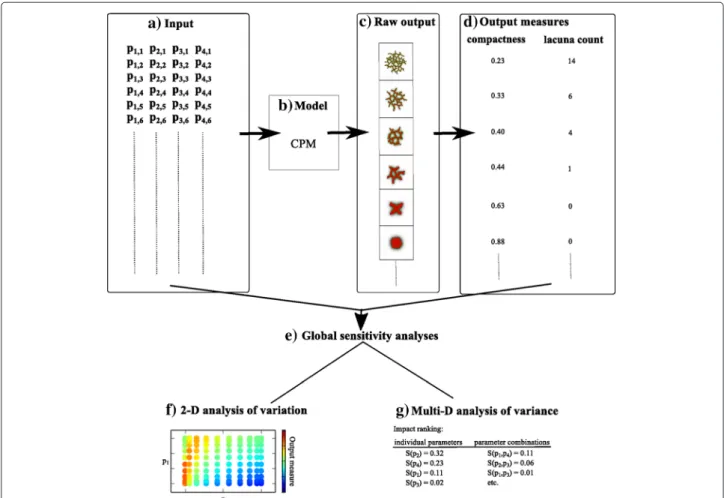
Figure 1 shows the workflow of the GSA analysis pro-posed in this paper. The input (Fig. 1a), a list of parameter sets, is fed into the cellular Potts-based contact inhibi-tion model (Fig. 1b). This model generates images (Fig. 1c) of the resulting cell configuration as raw output, ranging from spheroids, to networks, to dispersed cells. Subse-quently, two quantitative output measures (compactness and lacuna count) are derived from these images (Fig. 1d). Two types of GSA are performed on the output measures (Fig. 1e). Firstly, intensity plots show the impact of param-eter combinations on the variation in the output measures (Fig. 1f). This analysis only allows for a two-dimensional GSA, in which the value of two parameters are varied simultaneously while keeping all other parameter values fixed. Secondly, a truly multivariate GSA ranks the impact of individual parameters and of parameter combinations on the variance of the output measures (Fig. 1g). Impor-tant aspects we address in this paper are the reliability and the pitfalls of GSA.
Methods
Vascular morphogenesis model
The contact inhibition model [22] is based on the Cellu-lar Potts Model (CPM) [30, 31]. Cells are projected on a regular square lattice ( ⊂ Z2) as patches of connected lattice sites,x. Each lattice site, x ∈ , that is part of a cell is marked with that cell’s identifier (σ(x)) and cell-free lattice sites represent extracellular matrix (ECM) with σ =0. Each cell identifier is associated with a type:τ(σ)∈
{ECM, cell, border}. Cells have cell properties and behav-iors, such as adhesion, cell size, or chemotaxis. The forces resulting from the biophysical properties of the cells and their active behavior are represented in the Hamiltonian (H) of the system
H=
(x,x)
Jτ(σ(x)),τ(σ(x)) 1−δ(σ(x),σ(x))
+λA(σ)
σ
(A(σ)−a(σ))2,
(1)
in which adhesion (J) is restricted to the cell membrane by the Kronecker delta (δ(x,y) = {1,x= y; 0,x=y}) and (x,x)represents the set of adjacent lattice site pairs. There are three non-zero types of adhesion:Jcell,cell,Jcell,borderand
Fig. 1Overview of the global sensitivity analysis. (a) The input of the model is a list of parameter sets. Each parameter set contains uniformly randomly selected values of parametersp1top4. This input is then fed into (b) the Cellular Potts Model (CPM)-based contact inhibition model.
(c) The raw output of these models are images of the cell configuration at the end of the simulations. (d) Two output measures, compactness and lacuna count, are derived from these images. Two types of global sensitivity analysis are performed on these output measures (e). Firstly, intensity plots are used to study the impact of two-parameter combinations on the variation in the output measures (f). Secondly, Sobol’ indices are used to rank the impact of individual parameters and of parameter combinations on the variance of the output measures (g)
ECM. The lattice is surrounded with a border by which cells are repulsed, by settingJcell,border=100. The second term constrains the volume of cells, withArepresenting the preferred size of a cell andλAthe rigidity of the cell.
Deviation of the actual size (a) of cells from their preferred value increases the Hamiltonian.
A cell moves by copying the state (σ) of a randomly selected lattice site xinto a randomly selected adjacent lattice sitex. In this manuscript, we use the eight, sec-ond order neighbors. These copies represent extensions and retractions of pseudopods at the cell membrane. A copy attempt that diminishes the Hamiltonian represents a move along a force and is always accepted. If a copy increases the Hamiltonian, it will only occur due to active movements of the cell membrane. We assume that such active motions are distributed according to a Boltzmann probability function:PBoltzmann(H)=e
−H
μ , withμa
mea-sure of the amplitude of random membrane fluctuations;
μis a scaling factor of the weights (λ) of the constraints and we fixed it at μ = 50 conform the settings in our previous work [22]. The parameter values can only be qualitatively coupled to biological data.
We assume that cells secrete a chemoattractant at rateα (s−1), producing a concentration fieldc(x). The chemoat-tractant diffuses with a diffusion coefficientD(m2/s) and decays with rate (s−1) in the ECM, resulting in the following partial differential equation (PDE):
∂c
∂t =α(1−δ(σ(x), 0))− δ(σ(x), 0)c+D∇
2c, (2)
the Hamiltonian by that copy, H, is augmented with Hchemotaxis = λc(c(x) − c(x)) [32], and
contact-inhibition is implemented by setting λc = 0 at cell-cell
interfaces such that chemotaxis only occurs at the cell-ECM interface.
During one time step, referred to as a Monte Carlo Step (MCS), as many copy attempts are performed as there are sites in the lattice. The PDE for chemoattractant diffusion and degradation Eq. (2) is discretized on the CPM lat-tice and we solve it numerically using a finite-difference scheme. We use 15 diffusion steps per MCS. The model is initialized with a centralized spheroid of 256 cells within a lattice of 400∗400 sites (lattice spacing 2μm). We run the model for 5000 MCS, each representing 30 seconds, as networks are well formed in this time in the model as well asin vitro[25].
Global sensitivity analysis
The variation in a solution or a measure thereof, like com-pactness, over the complete parameter space can only be visually inspected by looking at one or at most two param-eters at a time while keeping the others fixed (cf. Figs. 2, 4, and 5). Since different measures will produce different multivariate output distributions and therefore also might result in a different outcome of the GSA, it is important to choose a measure or, more likely a number of measures
that are significant for the study at hand. If one wants to take the influence of all parameters simultaneously into account some form of a global measure of the multivari-ate output distribution is required. One such a measure is the variance of the distribution, which will be used in this paper.
We are specifically interested whether parameter inter-actionshave a large impact on the output of this specific CPM-based model. Interactions of the parameters are unpredictable in non-linear models such as the CPM, but their impact is significant, since a large combined effect of parameters on the output impedes the experimental testing of a predicted effect of a single parameter.
Sobol’ [9, 10] introduced so-called global sensitivity indices that describe the impact of specific parameters or combinations thereof on the uncertainty in the model output and more in particular on the variance of the out-put distribution, hence the term ‘variance-based’ GSA. In the original method the necessary integrals are com-puted with Monte Carlo. However, the Sobol’ indices can be computed very efficiently when the distribution of the output measure or response surface is expanded into a series of orthogonal polynomials, the Polynomial Chaos Expansion (PCE) [33, 34]. An overview of this method, using the same notation as in the following, can be found in [35]; here we summarize only the most
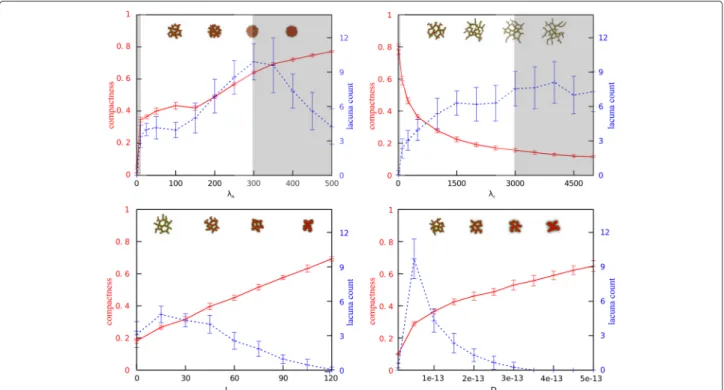
Fig. 2One-dimensional parameter sweeps for compactness and lacuna count. Plots of one-dimensional parameter sweeps for each of the four selected parameters: cell rigidity (λA), cell-cell adhesion (Jcell,cell), diffusion coefficient of the chemoattractant (D), and sensitivity of cells to the
important definitions for the case that the stochastic input consists of independently uniformly distributed random variables. Note, however, that the method can also be applied for arbitrary, even non-parametric, distributions, allowing for data-driven GSA (see also [36]). The strength of the method described below is that it (i) can efficiently study multiple output measures derived from the output images, (ii) can robustly identify parameter interactions, and (iii) checks the reliability of the result.
Letξbe then-dimensional vector of the independently uniformly distributed input parameters and(ξ)its joint probability density function (pdf ). The output measure u(ξ), e.g., of the (black-box) Cellular Potts Model, is expanded into a truncated series of polynomials that are orthogonal with respect to the pdf, separating the output into a deterministic and a stochastic part
u(ξ)≈
N
i=0
uii(ξ), (3)
where then-variate polynomialsi(ξ)are products ofn
univariate Legendre polynomials. The number of expan-sion termsNis given byN+1= (nn+ˆ!pˆp!)!, withnthe number of parameters and theapproximation orderpˆ the highest order ofi.
To compute the expansion coefficientsui of Eq. (3) we
applySpectral Projectionwhich has the advantage that it can be used for lack-box models since it projects the solu-tion - and not the model - onto the polynomial space
ui= u(ξ)
,i(ξ) i(ξ),i(ξ) = ||1i||2
u(ξ) i(ξ) (ξ)dξ, i=0, 1,. . .,N, (4)
whereis the support of the joint pdf(ξ). As the param-eter inputs are independent, bothiandcan be written
in product form; for the multivariate polynomiali this
results in a product of univariate polynomials
i(ξ)= n
k=1
index(i,k)(ξk), with index(i,k)
= {0,. . .,pˆ}and0(ξk)=1.
(5)
The integrals in Eq. (4) can then be computed by a repeated one-dimensional Gauss-Legendre quadrature rule
ui≈
1
||i||2
Nq
l1=1 · · ·
Nq
ln=1
u(ξl1,· · ·,ξln)
n
k=1
wlkindex(i,k)(ξlk),
(6)
withNqthe number of quadrature points andwthe
asso-ciated weights. Note, that for integrals with a known weight function, like e.g. a pdf, Gauss quadrature has the optimal convergence order of 2Nq − 1 for Nq
quadrature points, where the points and the weights of the quadrature rule are dependent on the weight function.
How to chooseNqandpˆto obtain reliable Sobol’ indices
will be the subject of Section Reliable GSA in practice.
Statistics and polynomial chaos expansion
Using a PC expansion, the only input needed to compute the moments and the Sobol’ indices of the output distribu-tion are the expansion coefficients. E.g., the meanμ=u0 and the variance is given by
(u(ξ)−μ)
2(ξ)dξ≈
N
i=1
u2i||i||2=: VarPCE. (7)
Note, that the approximation, VarPCE, is a monoto-nously increasing function ofN and thus ofpˆ. The sum in the variance formula can be directly split into con-tributions from the various parameters or combinations thereof, the Sobol’ indices (cf. [37]). E.g., for the first-order Sobol’ index for parameterjonly terms contribute if i(xi)equals a univariate polynomial inξj
Sj≈
N
i=1bool(i,j)u2i||i||2
VarPCE
, (8)
where bool(i,j)=index(i,j)>0∧index(i,k)=0,∀k=j. For a combined influence of more than one parameter like S13 the Sobol’ index can be computed analogously. The sum of all Sobol’ indices equals one.
Reliable GSA in practice
At first sight the accuracy of the PCE approximation of the response surface - and thus of the statistics - seems to be determined by thenumber of expansion terms,N, in Eq. (3). But theaccuracyof the expansion coefficients ui also plays an important role. This accuracy is
deter-mined by the approximation Eq. (6) of the integral in Eq. (4), which is determined by the number of quadra-ture points,Nq. Moreover, the higher PCE orderpˆneeded
to obtain sufficient accuracy, the higher the polynomial order ofi(ξ)becomes, which increases the complexity of
polynomial with a small amount of points, the resulting expansion coefficients are merely noise instead of being informative.
The question we want to answer in this section is how to determine the number of quadrature points,Nq, and the
expansion order,pˆ, to obtain a sufficiently high accuracy for the coefficients to allow us to trust the Sobol’ indices and more specifically the ranking of the parameters that follows from it. Here, we sketch a method to determine the number of quadrature points. It relies on the fact that the Sobol’ indices are variance-based, i.e., one can not expect to compute Sobol’ indices accurately from a PCE expan-sion for which the variance Eq. (7) is not a sufficiently accurate approximation of the true value or at least com-parable to the Gauss-Legendre quadrature approximation of the integral. So, let us define
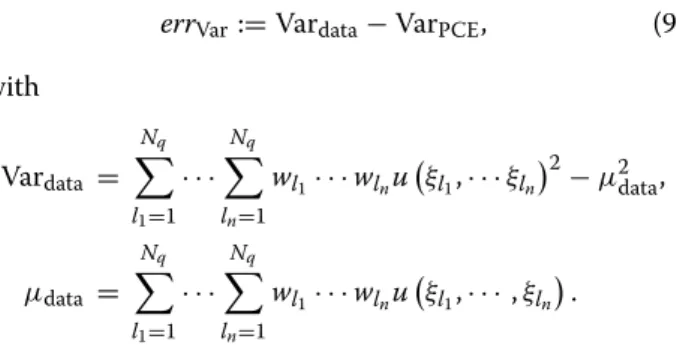
errVar:=Vardata−VarPCE, (9)
with
Vardata =
Nq
l1=1 · · ·
Nq
ln=1
wl1· · ·wlnu
ξl1,· · ·ξln
2−μ2 data,
μdata =
Nq
l1=1 · · ·
Nq
ln=1
wl1· · ·wlnu
ξl1,· · ·,ξln
.
For a given choice of Nq one can easily compute PC
expansions for various orderspˆ. IferrVaris small and the required Sobol’ indices have converged, the result can be trusted.
We illustrate this approach with a function for which the values of the statistics are analytically known, viz., the Ishigami function [38, 39]
f(ξ)=sin(ξ1)+asin2(ξ2)+bξ34sin(ξ1), (10)
withξi ∼U[−π,π],i= {1, 2, 3}, anda=7 andb= 0.1.
We compute the PCE approximation of Eq. (10) for an increasing number of PCE terms and an increasing num-ber of quadrature points. Table 1 illustrates the result of using not enough quadrature points (Nq=2 andNq=5):
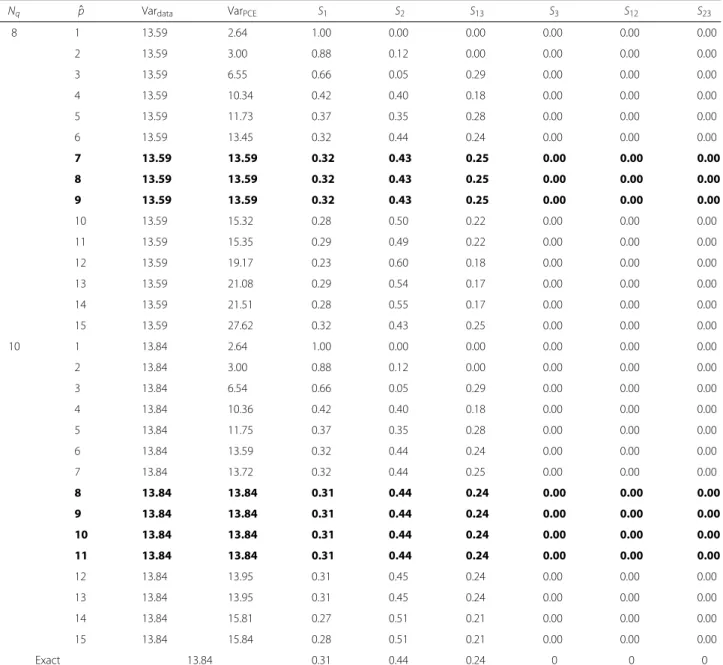
there is no convergence in the statistics of the PCE approx-imation and forpˆ = 3 and 6, respectively, the noise takes over and the results are meaningless. Table 2 shows that, using sufficient quadrature points, for an increasing num-ber of expansion terms the PCE variance converges to the data variance. If both variances are alike also the Sobol’ indices have converged to the true values (bold lines). Still the number of expansion terms should not be taken too large as can be seen forpˆ>9 andpˆ>13 where again the noise gradually takes over.
Finally, we also used the Saltelli method [40] - an improvement of the original Sobol’ method - to compute the Sobol’ indices for this problem. To reach a similar accuracy approximately 70–80 times as many sampling points are required, thus showing the gain in efficiency using the PCE-Gauss method to compute the Sobol’ indices.
Table 1Statistics computed with insufficient quadrature points
Nq pˆ Vardata VarPCE S1 S2 S13 S3 S12 S23
2 1 4.09 4.09 1.00 0.00 0.00 0.00 0.00 0.00
2 4.09 4.09 1.00 0.00 0.00 0.00 0.00 0.00
3 4.09 8.32 1.00 0.00 0.00 0.00 0.00 0.00
4 4.09 185.91 0.36 0.32 0.00 0.32 0.00 0.00
5 4.09 197.44 0.34 0.30 0.03 0.30 0.03 0.00
5 1 18.60 2.64 1.00 0.00 0.00 0.00 0.00 0.00
2 18.60 2.70 0.98 0.02 0.00 0.00 0.00 0.00
3 18.60 6.22 0.69 0.01 0.30 0.00 0.00 0.00
4 18.60 17.17 0.25 0.64 0.11 0.00 0.00 0.00
5 18.60 18.50 0.23 0.60 0.17 0.00 0.00 0.00
6 18.60 29.49 0.14 0.75 0.11 0.00 0.00 0.00
7 18.60 31.41 0.19 0.70 0.11 0.00 0.00 0.00
8 18.60 31.50 0.19 0.70 0.11 0.00 0.00 0.00
9 18.60 37.51 0.23 0.59 0.18 0.00 0.00 0.00
10 18.60 88.82 0.29 0.43 0.08 0.20 0.00 0.00
Exact 13.84 0.31 0.44 0.24 0 0 0
Table 2Statistics computed with sufficient quadrature points
Nq pˆ Vardata VarPCE S1 S2 S13 S3 S12 S23
8 1 13.59 2.64 1.00 0.00 0.00 0.00 0.00 0.00
2 13.59 3.00 0.88 0.12 0.00 0.00 0.00 0.00
3 13.59 6.55 0.66 0.05 0.29 0.00 0.00 0.00
4 13.59 10.34 0.42 0.40 0.18 0.00 0.00 0.00
5 13.59 11.73 0.37 0.35 0.28 0.00 0.00 0.00
6 13.59 13.45 0.32 0.44 0.24 0.00 0.00 0.00
7 13.59 13.59 0.32 0.43 0.25 0.00 0.00 0.00
8 13.59 13.59 0.32 0.43 0.25 0.00 0.00 0.00
9 13.59 13.59 0.32 0.43 0.25 0.00 0.00 0.00
10 13.59 15.32 0.28 0.50 0.22 0.00 0.00 0.00
11 13.59 15.35 0.29 0.49 0.22 0.00 0.00 0.00
12 13.59 19.17 0.23 0.60 0.18 0.00 0.00 0.00
13 13.59 21.08 0.29 0.54 0.17 0.00 0.00 0.00
14 13.59 21.51 0.28 0.55 0.17 0.00 0.00 0.00
15 13.59 27.62 0.32 0.43 0.25 0.00 0.00 0.00
10 1 13.84 2.64 1.00 0.00 0.00 0.00 0.00 0.00
2 13.84 3.00 0.88 0.12 0.00 0.00 0.00 0.00
3 13.84 6.54 0.66 0.05 0.29 0.00 0.00 0.00
4 13.84 10.36 0.42 0.40 0.18 0.00 0.00 0.00
5 13.84 11.75 0.37 0.35 0.28 0.00 0.00 0.00
6 13.84 13.59 0.32 0.44 0.24 0.00 0.00 0.00
7 13.84 13.72 0.32 0.44 0.25 0.00 0.00 0.00
8 13.84 13.84 0.31 0.44 0.24 0.00 0.00 0.00
9 13.84 13.84 0.31 0.44 0.24 0.00 0.00 0.00
10 13.84 13.84 0.31 0.44 0.24 0.00 0.00 0.00
11 13.84 13.84 0.31 0.44 0.24 0.00 0.00 0.00
12 13.84 13.95 0.31 0.45 0.24 0.00 0.00 0.00
13 13.84 13.95 0.31 0.45 0.24 0.00 0.00 0.00
14 13.84 15.81 0.27 0.51 0.21 0.00 0.00 0.00
15 13.84 15.84 0.28 0.51 0.21 0.00 0.00 0.00
Exact 13.84 0.31 0.44 0.24 0 0 0
The PCE approximation and the statistics show convergence (bold lines)
Software and computational dataset
All software used in this paper is publicly available. The contact inhibition model resides at http://sourceforge.net/ projects/tst/. For GSA we provide a repository containing the computational dataset and the analysis software at http://persistent-identifier.org/?identifier=urn:nbn:nl: ui:18-23590.
Results
As a case study for the global sensitivity analysis (GSA) approach, we used a well-studied computational model of vascular morphogenesis: the contact inhibition model [22]. We studied what single parameters and parameter
interactions are important in the development of a spheroid of cells into vascular networks. For this purpose, we used the procedure outlined in Fig. 1: 1) select output measures, 2) select input parameters, 3) select a relevant subset of the global parameter space, 4) analyze the raw output, 5) perform GSA.
Selection of output measures
Acells/Ahull, with Acells the number of lattice sites occu-pied by cells within a convex hull around all cells andAhull the total number of lattice sites within the convex hull. A solid spheroid and a confluent monolayer of cells have a compactness close to one, while networks that contain lacunae have low values for compactness. Lacuna count is the number of lacunae in a network. Lacunae are defined as patches of medium (connected components ofσ = 0) enclosed by cells and are only counted when they have at least the size of a cell (50 lattice sites≈200μm2).
Selection of input parameters
The contact inhibition model [22] is a stochastic, multi-factorial model. We refer to Section Methods for a detailed description of the model. The contact inhibi-tion model has nine parameters: the number of cells (N), the target size of a cell (A), the rigidity of the cell (λA),
cell-cell adhesion (Jcell,cell), adhesion between cells and the extracellular matrix (Jcell,ECM), the secretion rate of a chemoattractant by cells (α), a diffusion coefficient of the chemoattractant (D), the decay rate of the chemoattrac-tant ( ), and a sensitivity of cells to the chemoattractant at cell-matrix interfaces (λc).
In total, there are four model components or mecha-nisms in the contact inhibition model, namely cell size, adhesion, contact-inhibited chemotaxis and the gradient of the chemoattractant. In order to study the impact of each mechanism in the model extensively, we selected one parameter for each, ensuring that it is computation-ally feasible to generate enough data points for reliable GSA results. We thus selected four parameters: the cell rigidity (λA), cell-cell adhesion (Jcell,cell), the diffusion coef-ficient of the chemoattractant (D), and a sensitivity of cells to the chemoattractant at cell-matrix interfaces (λc).
The other parameters that regulate cell size (A), adhesion (Jcell,ECM), or the gradient of the chemoattractant ( and
α) will be fixed at the reference values corresponding to the values in [22]. We kept the number of cells (N) in the spheroid constant, because we know from experience that it does not influence sprouting of spheroids in our model.
A GSA with four parameters can give new insights as four parameters are too many to obtain the relative impact of the parameters and their interactions with visual plots or to know their effect solely by logic or intuition, while the number of simulations required for a GSA with four input parameters is computationally very feasible. A GSA with all parameters of the model is not expected to give additional information on the relative balance of the mechanisms and would be very time-consuming for a computationally intense model like the contact inhibi-tion model. It would require roughly 109simulations (c.f., Section Reliable GSA in practice) to obtain reliable GSA results with all model parameters.
Selection of a relevant subset of the global parameter space
To select the parameter ranges for which spheroids of cells develop into networks, we studied one-dimensional parameter sweeps of the four selected input parameters for the compactness and lacuna count (Fig. 2). The red lines in Fig. 2 represent the compactness and the blue lines the lacuna count. We selected the region in which the morphology of the network, and thus the value of the out-put measures, is changing and where no model artefacts arise. It is well studied for which parameter ranges arte-facts arise in the CPM [6], such as lattice anisotropy and ‘frozen’ motility of cells. The regions shaded in gray indi-cate the deleted regions from the parameter space. ForλA
the region 0 to 5 is deleted: cells cannot retain their vol-ume here and disappear. This is a model artefact and does not represent a biological plausible situation. The region λA > 300 is deleted, because cells are so rigid here that
they hardly move. In the regionλc < 10 only spheroids
form and for λc > 3000 similar networks are always
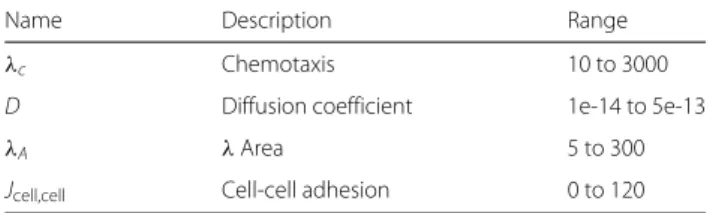
formed, thus these regions are deleted because the net-work morphology does not change. The parameters and their selected value ranges are listed in Table 3.
Based on the reliability study for the Ishigami test model (see Section Reliable GSA in practice), we expected that we required 10000 data points to perform a reliable GSA on our model. The points were chosen according to the Gauss-Legendre quadrature rule (see Section Global sen-sitivity analysis), resulting in ten values for each parame-ter. To correct for the stochasticity of the contact inhibi-tion model, each parameter set is replicated twenty times with a different random seed and the output is averaged over them. The size of the standard deviations in Fig. 2 indicate that the variation over different random seeds is very small for compactness, whereas the stochasticity in the model has a larger affect on the lacuna count. Never-theless, this lacuna count is a reasonable measure for the network morphology.
Analysis of the raw output
The raw output of a model simulation is an image of the cell configuration at the end of a simulation. Figure 3 gives an overview of the raw output for the selected parameter
Table 3Overview of the parameter selection for the GSA
Name Description Range
λc Chemotaxis 10 to 3000
D Diffusion coefficient 1e-14 to 5e-13
λA λArea 5 to 300
Jcell,cell Cell-cell adhesion 0 to 120
Fig. 3Overview of the raw output. An overview of the raw output of the contact inhibition model, the cell configurations at the end of a simulation, is shown in a collage of images. The cell rigidity (λA) is varied over the horizontal axis and cell-cell adhesion (Jcell,cell) over the vertical axis. For each
selected combination hereof, a subcollage is shown in which the diffusion coefficient of the chemoattractant (D) is plotted against the sensitivity of cells to the chemoattractant at cell-matrix interfaces (λc)
space. Examples of possible morphologies are shown in Fig. 3, ranging from spheroids to small networks with one lacuna, to fine-mazed networks with many lacunae. This is a visual reassurance that the input parameter space is well chosen. However, it is very difficult to predict from the raw output which parameters have a strong impact on the development of networks from spheroids. A GSA can give us insights into this, as we will show in the next section.
GSA of network development from spheroids
We performed two types of GSA on the distribution of the output measures, compactness and lacuna count, to study the impact of the parameters on vascular network development. The first type of GSA studies the variation of the output measures and the second type studies the decomposition of the variance of the distribution of the output measures.
GSA of the variation of the output measures
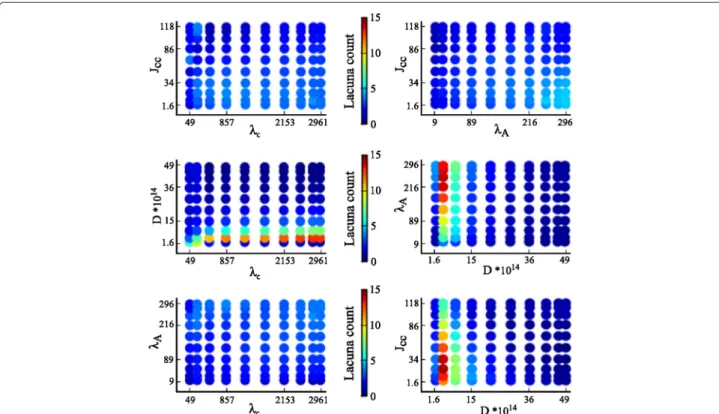
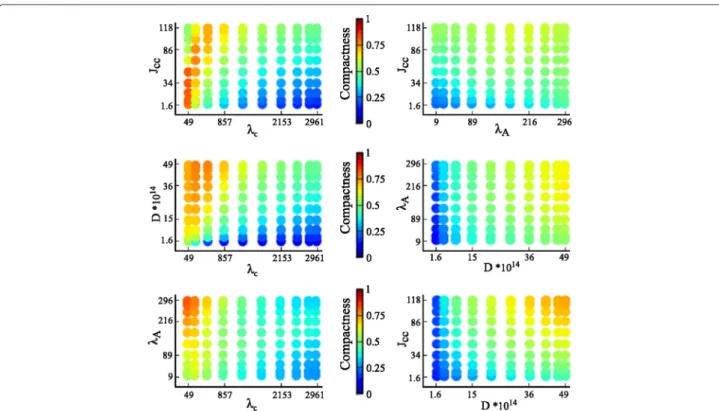
The variation in the output measures can be visualized by plotting the intensity of the output measures over two-dimensional slices of the parameter space. Figures 4 and 5 show the intensity plots of the lacuna count and compact-ness, respectively, for each possible pairing of parameters. The parameter values are selected according to the Gauss-Legendre quadrature rule.
Fig. 4Two-dimensional intensity plots of lacuna count. The intensity of the output measure lacuna count, mapped to an interval of 0 to 15 as indicated by the color bars, is plotted for each two-parameter combination of the parameters cell rigidity (λA), cell-cell adhesion (Jcell,cell), diffusion
coefficient of the chemoattractant (D), and sensitivity of cells to the chemoattractant at cell-matrix interfaces (λc)
Figure 5 shows a high variation of the compactness in each plot. As a consequence, it is difficult to deter-mine which parameters have a dominant impact on com-pactness. Interactions between parameters are difficult to deduce from these two-dimensional intensity plots. A variance-based GSA is well suited to derive parame-ter inparame-teractions and the ranking of individual parameparame-ter effects, as will be outlined in the following subsection.
Variance-based GSA of the output measures
To study the impact of single parameters and of param-eter combinations on the development of networks from spheroids, we performed a GSA of the output distribu-tion of compactness and lacunae count using the Sobol’ indices. We refer to Section Global sensitivity analysis for a detailed description of how to obtain the Sobol’ indices that represent the impact of the parameters. The GSA results of both measures are reliable, since the Sobol’ indices have converged for values of pˆ for which errVar Eq. (9) is small (see Additional file 2: Table S1 and Additional file 3: Table S2).
The second column of Table 4 lists the impact of the individual parameters and their combinations on com-pactness. The sensitivity for the chemoattractant at cell-matrix interfaces (λc) has the highest impact on network
development (S(λc)= 0.3188), followed by the diffusion
coefficient with S(D)=0.2969, and cell-cell adhesion with S(Jcell,cell)= 0.2048. Elasticity of cells has a low impact of (S(λA)= 0.0266). Seventeen percent of the variance is
caused by interactions of parameters.λcandJcell,cellhave a combined impact of 0.0559. The impact of all other inter-actions was lower than S(λA), which we will consider as a
threshold for relevant impact.
The third column of Table 4 lists the impact of the individual parameters and their combinations on lacuna count. The individual impact of the diffusion coefficient is dominant, with S(D)= 0.7130. Cell adhesion also has a small individual impact (S(Jcell,cell)= 0.0407). In total, twenty four percent of the variance is induced by nations of parameters. There are five parameter combi-nations, which all include the diffusion coefficient, with a higher impact than the threshold: S(λc,D)= 0.0570,
S(D,λA)=0.0347, S(D,Jcell,cell)=0.0521, S(λc,D,Jcell,cell)= 0.0476, and S(λc,D,λA)= 0.0315. The total impact of the
Fig. 5Two-dimensional intensity plots of compactness. The intensity of the output measure compactness, mapped to an interval of 0 to 1 as indicated by the color bars, is plotted for each two-parameter combination of the parameters cell rigidity (λA), cell-cell adhesion (Jcell,cell), diffusion
coefficient of the chemoattractant (D), and sensitivity of cells to the chemoattractant at cell-matrix interfaces (λc)
Interpretation of the GSA results
The GSA results show that three parameters account for over 80 percent of the variance of the compactness dis-tribution. Consistent with previous studies of the contact inhibition model [22], these three parameters are the diffusion coefficient, sensitivity to the chemoattractant at cell-matrix interfaces and cell-cell adhesion. For the lacuna count, the GSA identified solely the diffusion coef-ficient as the dominant parameter. This dominant effect is apparent in a collage of output images (Fig. 6): the number of lacunae varies over the horizontal axis that rep-resents the diffusion coefficientD, whereas there is little variation along the vertical axis that represents the sen-sitivity to the chemoattractant at cell-matrix interfaces λc. The number of lacunae is the largest for small
val-ues of the diffusion coefficient (aroundD = 4.3∗10−14 m2/s), whereas no lacunae are formed for large values of the diffusion coefficient. A similar trend is seen when the diffusion coefficient is plotted against cell-cell adhe-sion or cell rigidity (not shown). The distance over which adjacent branches can attract one another is given by the length of the chemoattractant gradient Eq. (2), which is characterized by the diffusion length, LD = √ /D, the
distance over which the secreted chemoattractant drops to 1/eof the concentration at the cells (see,e.g., the dis-cussion in Ref. [22]). IfLDbecomes shorter, branches that
would fuse for larger values ofLD will not fuse. Hence
the pattern will be more fine-grained. Also a shorter value of LD will create sharper gradients and hence increase
the inward chemotactic force (as H = λc ∗gradient)
hence “squeezing” the branches more and making them thinner.
In conclusion, the GSA is able to identify the dominant single parameters for compactness and lacuna count. In addition, it gives new information on the relative ranking of the impact of these single parameters.
In contrast to the one-dimensional parameter studies performed in [22], GSA provides information on interac-tions of parameters. Combinainterac-tions of parameters account for 17 % of the variance in the compactness distribu-tion, and for 24 % of the lacuna count distribution. This indicates that most parameters impact the model output independently. Interestingly, the parameter combination of λcand Jcell,cell impacted the lacuna count (as seen in Additional file 1: Figure S1, which is capped at a maxi-mum of five lacunae) as well as compactness. How can we explain this interaction? Sprout formation requires a balance between λc-dependent chemotaxis, creating an
Table 4Global sensitivity analysis results
Compactness Lacuna count
S(λc) 0.3188 0.0074
S(D) 0.2969 0.7130
S(λA) 0.0266 0.0125
S(Jcell,cell) 0.2048 0.0407
S(λc,D) 0.0125 0.0570
S(λc,λA) 0.0107 0.0043
S(λc,Jcell,cell) 0.0559 0.0145
S(D,λA) 0.0017 0.0347
S(D,Jcell,cell) 0.0127 0.0521
S(λA,Jcell,cell) 0.0102 0.0048
S(λc,D,λA) 0.0102 0.0315
S(λc,D,Jcell,cell) 0.0257 0.0232
S(λc,λA,Jcell,cell) 0.0217 0.0131
S(D,λA,Jcell,cell) 0.0075 0.0094
The Sobol’ indices for the individual parameters (indices above mid-line) and for their combinations (indices below mid-line) are listed for the GSA of compactness and lacuna count
zero-viscosity fluid and the chemotaxis would compress sprouts until they become infinitely thin [41]. The cellular surface tensions resist such compression, thus determin-ing the thickness of sprouts. Altogether, this parameter interdependence highlights a new insight in the mecha-nisms driving sprouting in our model.
Discussion
Biological morphogenesis is a highly complicated pro-cess, involving genetic regulation, pattern formation, the
biophysics of collective cell migration, mechanical cell-cell interactions, and so forth. As such multiscale mecha-nisms are practically impossible to understand intuitively, in recent years modeling and simulation has become a key tool in developmental biology (see, e.g., refs. [42–45]). These efforts have led to highly complicated models, where traditional analysis tools in dynamical systems the-ory, such as bifurcation analysis and phase plane analysis, fall short. The models must then be treated as ‘black-box’ systems: one- or two-dimensional parameter sweeps are performed, creating images and movies as output, which can be used to obtain various quantitative out-put measures. These parameter sweeps must be started from one or a few nominal parameter sets around which n-dimensional cross-shaped sweeps through the parame-ter space are performed. However insightful such studies are, a danger is that the impact of some parameters is overlooked: the conclusions may depend on what sets of nominal parameter values were selected. Using a simple, published simulation model of vascular morphogenesis, we have shown in this work how a multivariate GSA helps to get more insight in the relative impact of single param-eters and of their interactions. We introduced a workflow for GSA of ‘black-box’ models of morphogenesis.
We applied the workflow to a vascular morphogenesis model which we refer to as the ‘contact inhibition model’. The output of the contact inhibition model consists of images of the cell configuration in a simulation. To quan-tify network development, we measured the compactness and the lacuna count of the cell configuration at the end of the simulation. A GSA with four input parameter dis-tributions, that each described one of the four general
model components, was performed for both measures. The GSA results of compactness and lacuna count both indicated that variation of the rigidity of the cells (λA)
has very little impact on the model output. As a result, the model can be reduced by fixing this parameter. For compactness, the sensitivity for the chemoattractant at cell-matrix interfaces (λc) has the highest impact on
net-work development, followed by the diffusion coefficient (D) and cell-cell adhesion (Jcell,cell). In contrast, the GSA showed that the diffusion coefficient alone is dominant for lacuna count. The results for both measures are in line with what has been previously reported [22]. New infor-mation from the GSA results is the relative impact of the single parameters. In addition, GSA identified interactions between parameters, which have led to new insights in the mechanism of sprouting in the model. Most notably, the parameter interactions in this specific CPM-based model have very low impact. Since GSA has not been performed for CPM-based models before, it is an important new insight for the CPM community that the most basic mech-anisms of the CPM, such as cell size and adhesion here function independently.
Besides the contact inhibition model, there are mul-tiple other computational models of vascular network development [23–28]. These models often share common mechanisms that drive sprouting, but differ by one or a few mechanisms. It is still not known which mechanisms drive sproutingin vivo, or whether a different set of mech-anisms is used under different conditions. We propose GSA as an approach to help falsify these models. Firstly, the ranking of the relevance of the mechanisms in the models can be compared with knowledge of the impact of these mechanisms from experimental data to falsify mod-els. A second model falsification method is the validation of the experimental predictions of each model based on the GSA results.
The workflow is designed to take into account some pitfalls of GSA. These arise from the dependency of the outcome on the choices one makes for the output measure, input parameters and their distributions. Dif-ferent output measures can give difDif-ferent results, as was the case for compactness and lacuna count. This indi-cates that it is essential to consider carefully whether the selected measure truly describes your goal and if there are other measures for it. A selection of input parame-ters might be necessary when it is not computationally feasible or methodologically desirable to use all parame-ters of the model. The importance of the selection of the correct parameter distributions has also been discussed elsewhere [17]. Intuitively, a large range for the parame-ter values will allow for the largest variation in the output and thus the most interesting result. However, since the analysis is global over the entire parameter space, local though important features might become unnoticed if the
distribution is too widespread. For instance, for the con-tact inhibition model we were interested in the region where the networks developed and where the measures were changing accordingly, and variation in these regions could become unnoticed if we included large regions where for instance spheroids do not sprout. Ideally, the parameter distribution comes from experimental mea-surements, but in absence hereof we propose to study the variation of the output measures for each parameter individually.
It is crucial to have an estimate of the accuracy of the sensitivity results. One option is to compare the results with the outcome of an analysis with a higher accuracy computed with more quadrature points and a higher PCE order, like advocated in [17]. In this paper we proposed a simpler and cheaper rule: given the number of quadra-ture points the Sobol’ indices should show convergence for those values of pˆ for which the variance computed with the Gauss-Legendre quadrature rule is more or less equal to the variance computed from the PCE approxi-mation. If a higher PCE order is required, more model simulations are needed. Since the computation of the PCE statistics is ‘for free’ compared to model simulations this is an efficient way of judging whether the accuracy of the statistics is sufficient for one’s aim. Although Gauss quadrature is optimal, it has the disadvantage that it is not a nested quadrature rule, i.e., if more quadrature points are required, the old model results cannot be re-used. An alternative for Gauss quadrature is Monte Carlo (MC) integration. Sampling the PCE integrals by MC is less optimal, so more simulations are needed to obtain reli-able GSA results. For the Ishigami test model, MC needs a 100 times more simulations to get comparable results. The benefit of MC is that you can check ‘on the fly’ if there are enough data points generated to get reliable results. Adding simulations on the fly is particular useful when the estimated number of simulations based on the Gauss quadrature rule is computationally unfeasible, but one expects or hopes that the output distribution is rel-atively smooth and thus can be described by a low order PCE approximation.
Some studies require GSA of a subspace of the out-put distribution. For instance in our case study, to study not the conditions for network formation per se, but the details of the network morphology (e.g. branch length, branch thickness, and so forth), we must preselect a region of the parameter space where networks actually form. Unfortunately, such a subspace would no longer guaran-tee that the input distribution is independently random uniform. For such cases, a more complicated method to compute the Sobol’ indices [35] is required.
systematically analyze the impact of genes or potential drugs on cell behavior, such as cell migration [46]. This ‘systems microscopy’ approach is well suited for parallel screening of cellular responses to numerous experimental perturbations [47]. Such high-throughput screens can be performed for the genes, growth factors or ECM concen-trations affecting morphogenesis. This is conceptually very similar to parameter studies ofin silico ‘black-box’ models. The perturbed biological factors represent the input parameters and the output is an image from which quantitative data can be derived. Therefore, the GSA workflow proposed in this paper is directly applicable to high-throughputin vitrostudies.
Conclusions
Morphogenesis is a complex biological process in which cells organize into shapes and patterns. Computational modeling is used to get insights in the mechanisms of morphogenesis. These models are often multi-scale, non-linear and multi-factorial, making it difficult to relate their input to their output. The behavior of such ‘black-box’ models is mostly studied by visual inspection and analy-ses of the individual output (e.g. images and movies) and with one- or two-dimensional parameter sweeps of out-put measures. However, this does not provide insight in the relative impact of single parameters and of their inter-actions on the outcome of the model. GSA fulfills this task. GSA results can give insights in the dynamics of the model and help to generate experimental predictions to manipulate morphogenesis. In this paper, we introduced a workflow for GSA of such models and addressed pit-falls and reliability of the analysis. The workflow is applied to the contact inhibition model, a cell-based model of vascular morphogenesis. GSA was able to correctly iden-tify dominant parameters and gave new insights on the magnitude and ranking of their individual impact and importantly, on their interactions. In summary, we pro-pose GSA of ‘black-box’ models, such as complex compu-tational models or high-throughputin vitromodels, as an alternative approach to get insights in the mechanisms of morphogenesis.
Additional files
Additional file 1: Figure S1.Two-dimensional intensity plots of lacuna count with maximum intensity of 5 lacunae. The intensity of the output measure lacuna count, mapped to an interval of 0 to 5 as indicated by the color bars, is plotted for each two-parameter combination of the parameters the cell rigidity (λA), cell-cell adhesion (Jcell,cell), the diffusion coefficient of the chemoattractant (D), and sensitivity of cells to the chemoattractant at cell-matrix interfaces (λc). (PNG 568 Kb)
Additional file 2: Table S1.Global sensitivity analysis results for compactness. (PDF 51.7 Kb)
Additional file 3: Table S2.Global sensitivity analysis results for lacuna count. (PDF 51.5 Kb)
Additional file 4: Table S3.Global sensitivity analysis results for lacuna count capped at maximum of 5 lacunae. (PDF 52.3 Kb)
Abbreviations
CPM: Cellular Potts model; ECM: Extracellular matrix; GSA: Global sensitivity analysis; MC: Monte Carlo; MCS: Monte Carlo step; PCE: Polynomial chaos expansion; PDE: Partial differential equation; PDF: Probability density function; VEGF: Vascular endothelial growth factor.
Competing interests
The authors declare that they have no competing interests.
Authors’ contributions
SB, MNJ, RM and JB conceived of the study. SB performed the computational simulations, participated in the data analysis and drafted the manuscript. MNJ analyzed the data and helped to draft the manuscript. RM participated in the design and coordination of the study and helped to draft the manuscript. JB participated in the design and coordination of the study and in the data analysis, and helped to draft the manuscript. All authors read and approved the final manuscript.
Acknowledgements
We thank Indiana University and the Biocomplexity Institute for providing the CompuCell3D modeling environment and SURFsara (www.surfsara.nl) for the support in using the Lisa Compute Cluster.
The investigations were supported by the Division for Earth and Life Sciences (ALW) with financial aid from the Netherlands Organization for Scientific Research (NWO).
Author details
1Life Sciences, CWI, Science Park 123, 1098XG Amsterdam, The Netherlands. 2Mathematical Institute, University of Leiden, Niels Bohrweg 1, 2333CA Leiden,
The Netherlands.3CEMSE Division, King Abdullah University of Science and Technology (KAUST), Thuwal, Kingdom of Saudi Arabia.
Received: 30 July 2015 Accepted: 26 October 2015
References
1. Tanaka S. Simulation Frameworks for Morphogenetic Problems. Computation. 2015;3:197–221. doi:10.3390/computation3020197. 2. Merks RMH, Koolwijk P. Modeling Morphogenesisin silicoandin vitro:
Towards Quantitative, Predictive, Cell-based Modeling. Math Model Nat Phenom. 2009;4(4):149–71. doi:10.1051/mmnp/20094406.
3. Iber D, Tanaka S, Fried P, Germann P, Menshykau D. Simulating tissue morphogenesis and signaling In: Nelson CM, editor. Tissue
Morphogenesis. Methods in Molecular Biology, vol. 1189. New York: Springer; 2015. p. 323–38. doi:10.1007/978-1-4939-1164-6_21. 4. Iber D, Menshykau D. The control of branching morphogenesis. Open
Biology. 2013;3(9):130088. doi:10.1098/rsob.130088.
5. Boehm B, Westerberg H, Lesnicar-Pucko G, Raja S, Rautschka M, Cotterell J, et al. The role of spatially controlled cell proliferation in limb bud morphogenesis. PLoS Biol. 2010;8(7):. doi:10.1371/journal.pbio.1000420. 6. Anderson ARA, Chaplain MAJ, Rejniak KA, (eds). 2007. Single-cell-based Models in Biology and Medicine. Switzerland: Birkhäuser Verlag Basel. 7. Herrero MA, Köhn-Luque A, Pérez-Pomares JM. Modelling vascular
morphogenesis: current views on blood vessel development. 2009. doi:10.1142/S021820250900384X.
8. Saltelli A, Tarantola S, Chan KP-S. A quantitative model-independent method for global sensitivity analysis of model output. Technometrics. 1999;41(1):39–56.
9. Sobol’ IM. Sensitivity estimates for nonlinear mathematical models. Mathematical Modeling and Computational Experiment. 1993;1(4): 407–14.
10. Sobol’ IM. Global sensitivity indices for nonlinear mathematical models and their Monte Carlo estimates. Math Comput Simul. 2001;55:271–80. doi:10.1016/S0378-4754(00)00270-6.
12. Morris MD. Factorial sampling plans for preliminary computational experiments. Technometrics. 1991;33(2):161–74.
13. Zheng Y, Rundell A. Comparative study of parameter sensitivity analyses of the TCR-activated erk-MAPK signalling pathway. Syst Biol, IEE Proc. 2006;153(4):201–11. doi:10.1049/ip-syb:20050088.
14. Cho KH, Shin SY, Kolch W, Wolkenhauer O. Experimental design in systems biology, based on parameter sensitivity analysis using a Monte Carlo method: A case study for the TNFα-mediated NF-κB signal transduction pathway. SIMULATION. 2003;79(12):726–39. doi:10.1177/0037549703040943.
15. Kucherenko S, Rodriquez-Fernandez M, Pantelides C, Shah N. Monte Carlo evaluation of derivative-based global sensitivity measures. Reliab Eng Syst Saf. 2009;94:1135–1148. doi:10.1016/j.ress.2008.05.006. 16. Sobol’ IM, Kucherenko S. Derivative based global sensitivity measures
and their link with global sensitivity indices. Math Comput Simul. 2009;79: 3009–17. doi:10.1016/j.matcom.2009.01.023.
17. Rodriguez-Fernandez M, Banga JR, Doyle III FJ. Novel global sensitivity analysis methodology accounting for the crucial role of the distribution of input parameters: application to system biology models. Int J Robust Nonlinear Control. 2012;22:1082–102. doi:10.1002/rnc.2797.
18. Lumen A, McNally K, George N, Fisher JW, Loizou GD. Quantitative global sensitivity analysis of a biologically based dose-response pregnancy model for the thyroid endocrine system. Front Pharmacol. 2015;6(107):. doi:10.3389/fphar.2015.00107.
19. Zhang YY, Trame MN, Lesko LJ, Schmidt S. Sobol sensitivity analysis: A tool to guide the development and evaluation of systems pharmacology models. CPT: Pharmacometrics & Systems Pharmacology. 2015;4(2): 69–79. doi:10.1002/psp4.6.
20. Torres Valderrama A, Witteveen J, Navarro M, Blom J. Uncertainty propagation in nerve impulses through the action potential mechanism. J Math Neurosci. 2015;5(3):. doi:10.1186/2190-8567-5-3.
21. Dresch JM, Liu X, Arnosti DN, Ay A. Thermodynamic modeling of transcription: sensitivity analysis differentiates biological mechanism from mathematical model-induced effects. BMC Syst Biol. 2010;4(142):. doi:10.1186/1752-0509-4-142.
22. Merks RMH, Perryn ED, Shirinifard A, Glazier JA. Contact-inhibited chemotaxis in de novo and sprouting blood-vessel growth. PLoS Comput Biol. 2008;4(9):1000163. doi:10.1371/journal.pcbi.1000163.
23. van Oers RFM, Rens EG, LaValley DJ, Reinhart-King CA, Merks RMH. Mechanical cell-matrix feedback explains pairwise and collective endothelial cell behavior in vitro. PLoS Comput Biol. 2014;10(8):1003774. doi:10.1371/journal.pcbi.1003774.
24. Szabó A, Czirók A. The role of cell-cell adhesion in the formation of multicellular sprouts. Math Model Nat Phenom. 2010;5(1):106–22. doi:10.1051/mmnp/20105105.
25. Merks RMH, Brodsky S, Goligorksy M, Newman S, Glazier JA. Cell elongation is key to in silico replication of in vitro vasculogenesis and subsequent remodeling. Devel Biol. 2006;289:44–54.
doi:10.1016/j.ydbio.2005.10.003.
26. Köhn-Luque A, de Back W, Yamaguchi Y, Yoshimura K, Herrero MA, Miura T. Early embryonic vascular patterning by matrix-mediated paracrine signalling: a mathematical model study. Phys Biol. 2013;11(6): 066007. doi:10.1088/1478-3975/10/6/066007.
27. Bauer AL, Jackson TL, Jiang Y. A cell-based model exhibiting branching and anastomosis during tumor-induced angiogenesis. Biophys J. 2007;92(9):3105–21. doi:10.1529/biophysj.106.101501.
28. Shirinifard A, Gens JS, Zaitlen BL, Popławski NJ, Swat M, Glazier JA. 3D multi-cell simulation of tumor growth and angiogenesis. PLoS ONE. 2009;4(10):. doi:10.1371/journal.pone.0007190.
29. Czirok A, Isai DG. Cell resolved, multiparticle model of plastic tissue deformations and morphogenesis. Phys Biol. 2015;12(1):016005. doi:10.1088/1478-3975/12/1/016005.
30. Glazier JA, Graner F. Simulation of the differential adhesion driven rearrangement of biological cells. Phys Rev E. 1993;47(3):2128–54. doi:10.1103/PhysRevE.47.2128.
31. Graner F, Glazier JA. Simulation of biological cell sorting using a two-dimensional extended Potts model. Phys Rev Lett. 1992;69: 2013–016. doi:10.1103/PhysRevLett.69.2013.
32. Savill NJ, Hogeweg P. Modelling morphogenesis: from single cells to crawling slugs. J Theor Biol. 1997;184:229–35. doi:10.1006/jtbi.1996.0237. 33. Wiener N. The homogeneous chaos. Am J Math. 1938;60:897–936.
34. Xiu D. Fast numerical methods for stochastic computations: a review. Communications in Computational Physics. 2009;5(2–4):242–72. 35. Navarro M, Witteveen J, Blom J. Polynomial Chaos Expansion for general
multivariate distributions with correlated variables. 2014. arXiv:1406.5483[math.NA].
36. Oladyshkin S, Nowak W. Data-driven uncertainty quantification using the arbitrary polynomial chaos expansion. Reliab Eng Syst Saf. 2012;106: 179–90.
37. Sudret B. Global sensitivity analysis using polynomial chaos expansions. Reliab Eng Syst Saf. 2008;93(7):964–79. doi:10.1016/j.ress.2007.04.002. 38. Ishigami T, Homma T. An importance quantification technique in
uncertainty analysis for computer models. In: First International Symposium on Uncertainty Modeling and Analysis (ISUMA’90); 1990. p. 398–403. doi:10.1109/ISUMA.1990.151285.
39. Sobol’ IM, Levitan YL. On the use of variance reducing multipliers in Monte Carlo computations of a global sensitivity index. Comput Phys Commun. 1999;117:52–61. doi:10.1016/S0010-4655(98)00156-8. 40. Saltelli A. Making best use of model evaluations to compute sensitivity
indices. Comput Phys Commun. 2002;145:280–97. doi:10.1016/S0010-4655(02)00280-1.
41. Shirinifard A. Vascular patterning and its application in cancer and choroidal neovascularization. PhD thesis, Indiana University, Department of Physics. 2012.
42. Sheth R, Marcon L, Bastida MF, Junco M, Quintana L, Dahn R, et al. Hox genes regulate digit patterning by controlling the wavelength of a Turing-type mechanism. Science (New York, NY). 2012;338(6113): 1476–80. doi:10.1126/science.
43. De Rybel B, Adibi M, Breda AS, Wendrich JR, Smit ME, Novák O, et al. Integration of growth and patterning during vascular tissue formation in Arabidopsis. Science (New York, NY). 2014;345(6197):1255215. doi:10.1126/science.1255215.
44. Besnard F, Refahi Y, Morin V, Marteaux B, Brunoud G, Chambrier P, et al. Cytokinin signalling inhibitory fields provide robustness to phyllotaxis. Nature. 2015;505(7483):417–21. doi:10.1038/nature12791.
45. Buske P, Przybilla J, Loeffler M, Sachs N, Sato T, Clevers H, et al. On the biomechanics of stem cell niche formation in the gut - modelling growing organoids. FEBS Journal. 2012;279(18):3475–87. doi:10.1111/j.1742-4658.2012.08646.x.
46. Le Dévédec SE, Yan K, de Bont H, Ghotra V, Truong H, Danen EH, et al. Systems microscopy: An emerging strategy for the life sciences. Cell Mol Life Sci. 2010;67(19):219–3240. doi:0.1007/s00018-010-0419-2.
47. Lock JG, Strömblad S. Systems microscopy: An emerging strategy for the life sciences. Exp Cell Res. 2010;316(8):1438–1444.
doi:10.1016/j.yexcr.2010.04.001. Special Issue Celebrating the 60-Year Anniversary of ECR and the 200-Year Anniversary of the Karolinska Institute.
Submit your next manuscript to BioMed Central and take full advantage of:
• Convenient online submission
• Thorough peer review
• No space constraints or color figure charges
• Immediate publication on acceptance
• Inclusion in PubMed, CAS, Scopus and Google Scholar
• Research which is freely available for redistribution