A R T I C L E
Mapping the encounter state of a transient protein complex
by PRE NMR spectroscopy
Alexander N. Volkov• Marcellus Ubbink• Nico A. J. van Nuland
Received: 25 August 2010 / Accepted: 28 September 2010 / Published online: 4 November 2010
ÓThe Author(s) 2010. This article is published with open access at Springerlink.com
Abstract Many biomolecular interactions proceed via a short-lived encounter state, consisting of multiple, lowly-populated species invisible to most experimental tech-niques. Recent development of paramagnetic relaxation enhancement (PRE) nuclear magnetic resonance (NMR) spectroscopy has allowed to directly visualize such tran-sient intermediates in a number of protein-protein and protein-DNA complexes. Here we present an analysis of the recently published PRE NMR data for a protein com-plex of yeast cytochromec(Cc) and cytochrome c perox-idase (CcP). First, we describe a simple, general method to map out the spatial and temporal distributions of binding geometries constituting the Cc-CcP encounter state. We show that the spatiotemporal mapping provides a reliable estimate of the experimental coverage and, at higher cov-erage levels, allows to delineate the conformational space sampled by the minor species. To further refine the encounter state, we performed PRE-based ensemble sim-ulations. The generated solutions reproduce well the experimental data and lie within the allowed regions of the
encounter maps, confirming the validity of the mapping approach. The refined encounter ensembles are distributed predominantly in a region encompassing the dominant form of the complex, providing experimental proof for the results of classical theoretical simulations.
Keywords Encounter stateParamagnetic relaxation enhancementCytochromecCytochromecperoxidase
Transient complex
Introduction
Many biomolecular interactions proceed via lowly popu-lated, transient intermediates, which are increasingly rec-ognized as important determinants of macromolecular recognition and association kinetics (Schreiber et al.2009; Ubbink 2009). Due to a low population and inherent dynamics, this minor species is invisible to most structural and biophysical methods, which severely thwarts its experimental characterization. Recent advances in para-magnetic relaxation enhancement (PRE) nuclear para-magnetic resonance (NMR) spectroscopy have enabled direct visu-alization of transient intermediates in protein–protein (Tang et al. 2006; Volkov et al. 2006; Bashir et al.2010; Xu et al.2008) and protein-DNA complexes (Iwahara and Clore2006) and biomolecular self-association (Tang et al. 2008a, b; Hartl et al. 2010). These and other studies (reviewed in refs. Schreiber et al.2009; Ubbink2009) have confirmed a long-held view that formation of a protein complex proceeds via a short-lived encounter state, which enables proteins to undergo reduced-dimensionality search of the optimal binding geometry, thereby accelerating molecular association as compared to 3D diffusion (Adam and Delbruck 1968).
Electronic supplementary material The online version of this article (doi:10.1007/s10858-010-9452-6) contains supplementary material, which is available to authorized users.
A. N. VolkovN. A. J. van Nuland
Department of Molecular and Cellular Interactions, VIB, Pleinlaan 2, 1050 Brussels, Belgium
A. N. Volkov (&)N. A. J. van Nuland
Jean Jeener NMR Centre, Structural Biology Brussels, Vrije Universiteit Brussel, Pleinlaan 2,
1050 Brussels, Belgium e-mail: [email protected]
M. Ubbink
Recent experimental work on weak, transient protein interactions has revealed that the population of the encounter state—defined as percentage of time spent in this state relative to the total lifetime of the complex—varies in a wide range, spanning predominantly single-orientation systems (Tang et al.2006; Volkov et al.2006; Bashir et al. 2010) and highly dynamic, pure encounter complexes (Worrall et al. 2002; Xu et al. 2008). Moreover, it was shown that the amount of the encounter state in a protein– protein complex can be broadly modulated by interfacial point mutations (Volkov et al. 2010), suggesting an intriguing possibility of adjusting the population of the minor species.
PRE is caused by magnetic dipolar interactions between a protein nucleus and unpaired electrons of a paramagnetic probe (Clore2008; Clore and Iwahara2009), which can be introduced into the molecular frame by bioconjugation techniques. Due to the large magnetic moment of the unpaired electron andhr6i distance dependence, protein nuclei located close to the paramagnetic center experience very large PREs, so that even lowly populated species can give rise to a measurable effect. This exquisite sensitivity makes PRE NMR spectroscopy a suitable tool for the study of transient intermediates in biomolecular interactions. For protein complexes in the fast exchange regime, the measured PRE is a population-weighted average of the contributions from all protein–protein orientations and, as such, contains the information on both the specific binding form and the encounter state (Clore 2008). In principle, PREs contain both temporal (population) and spatial (dis-tances from the paramagnetic center) information on the minor species, which in favorable cases can be decom-posed into separate contributions.
One of the systems studied by PRE NMR spectroscopy is a complex of cytochrome c (Cc) and cytochrome c peroxidase (CcP). Both proteins come from the inter-membrane space of yeast mitochondria, where CcP catal-yses the reduction of peroxides using the electrons donated by Cc—an important process mitigating the oxidative stress (Chance et al.1967). In our earlier work we showed that interaction between Cc and CcP comprises a well-defined Cc–CcP form and a combination of non-specific protein–protein orientations (Volkov et al.2006). The latter constitute an encounter state with the total population of 30% (Bashir et al.2010). Here we present an analysis of the recently published, extended PRE dataset (Bashir et al. 2010). First, we describe a simple, general spatiotemporal mapping approach that provides a reliable estimate of the experimental coverage and, at higher coverage levels, allows to delineate the conformational space sampled by the minor species. Further, we use PRE-based ensemble simulations to refine the encounter state and show that
encounter ensembles are distributed predominantly in a region encompassing the dominant form of the complex, providing experimental proof for the results of classical theoretical simulations (Northrup et al. 1988). The com-bination of the methods used here is superior to a low-resolution, geometric analysis employed in our earlier work (Volkov et al.2006) and offers a detailed visualization of the encounter state.
Materials and methods
Encounter state PREs
The transverse paramagnetic relaxation enhancement, C2, is given by the Solomon–Bloembergen equation (Eq. 1; Solomon1955; Solomon and Bloembergen1956): C2¼
1 15
l0
4p 2
c2 1g
2l2
BSðSþ1Þr
6 4s
cþ
3sc
1þx2 hs2c
ð1Þ
where r is the distance between the paramagnetic center and the observed proton,l0is the permeability of vacuum,
c1 is the proton gyromagnetic ratio, g is the electron g-factor,lB is the electron Bohr magneton,S is the electron spin number,scis the rotational correlation time, andxhis the proton Larmor frequency. The rotational correlation time is defined as sc¼ sr1þs
1 s
1
, where sr is the
rotational correlation time of the protein complex (equal to 16 ns for Cc–CcP; Volkov et al. 2006) and ss is the
effective electron relaxation time. For a nitroxide SL used in this work, sssr so that scsr (Clore and Iwahara
2009).
For each Cc backbone amide (i), the observed Cobs2;i
is the sum of the population-weighted contributions of the specific form Cspecific2;i
and the encounter state C2;i
: Cobs2;i ¼ptotC2;1þ ð1ptotÞC
specific
2;1 ð2Þ
where ptot is the total population of the encounter state, defined as the percentage of time spent in this state relative to the total lifetime of the complex. The Cspecific2;i values were
Bashir et al. 2010),Cobs2;i were set to 5 s
-1and the errors derived fromIpara/Idiavalues as reported before (Bashir et al. 2010). Otherwise Cobs2;i and their errors were taken from
previous work (Bashir et al.2010). For each of the 10 SL conjugation sites, theC2;ivalues were obtained from Eq.2 and used in further analysis.
Generating the conformational space grid
All molecular simulations were performed in Xplor-NIH (Schwieters et al.2003,2006). The coordinates of Cc–CcP complex were taken from the X-ray structure (PDB 2PCC; Pelletier and Kraut1992) and oriented such that centers of mass (CMs) of CcP and Cc appeared at the origin of the coordinate system and on the positivezaxis, respectively. The position of CcP was fixed, while Cc molecule was systematically rotated aroundxandzaxes, corresponding tohandurotations around CcP in the spherical coordinate space (Fig.1b). The rotation incrementsdhanddu deter-mine the desired spatial resolution, which in our case was set to 1 A˚ separation between neighboring Cc CMs. To emulate the rotational freedom, Cc was rotated around orthogonalv,w,naxes originating at its CM (Fig.1b). By systematically varying the rotational coordinates v, w, n
(0Bv B2p, 0 BwB2p, 0Bn\p) in the increments of dv=dw =dn=p/3, a set of 108 non-redundant Cc rotamers was produced at each (h,u) position. For every
(h, u, v, w, n) combination, the intermolecular van der Waals (vdW) energy term was calculated, with vdW potential set to zero for protein sidechain atoms extending beyond Cb. Cc was then translated along the vector joining Cc and CcP CMs in steps of 1 A˚ until the vdW energies reached the values between zero and a chosen cut-off, thus either relieving intermolecular steric clashes or bringing together separated molecules in a rigid-body mimic of a protein complex. The distance between protein CMs at each (h,u,v,w,n) defines the other translational coordi-nate,r. In this way, we explored the entire conformational space available to the interacting proteins (0 BhBp, 0 Bu\2p), sampling 12,205 (h, u) positions and pro-ducing a total of 1,318,140 Cc–CcP orientations at varying (h,u,r,v,w,n).
Mapping the encounter state
For each of 1,318,140 (h,u, r, v, w, n) orientations, the expected PREs (C2,i) were back-calculated as described above, and the maximal population (pmax) at which no violations of the experimentalC2;i restraints occurred was obtained (Eq.3):
pmax
min
i C
2;i=C2;i
; min
i C
2;i=C2;i
\ptot
ptot; min
i C
2;i=C2;i
ptot
8 <
: ð3Þ
To visualize the results, the largest pmax of 108v,w,n Cc rotamers at each (h,u) position [pmax(h,u), Eq.4] was noted, and pmax(h, u) values were color-coded onto the interaction grid isosurface h, u, r(v,w,n=0), thus producing the spatiotemporal map shown in Fig.2b.
pmaxðh;uÞ ¼max
v;w;n½pmaxðv;w;nÞh;u¼const ð4Þ
To delineate the area containing protein–protein orientations contributing to C2 (restricted by the white curve in Fig. 2b), we defined a set of encounter PRE restraints for Cc residues that exhibit violations ofCobs
2;i in
the specific Cc–CcP complex (i.e. highlighted areas in Fig.4c) with Cobs2;i dC
obs 2;i
Cspecific2;i [5 s1, where dCobs
2;i is the error of C obs
2;i, and selected all Cc molecules
that contribute at least 5 Hz to these encounter restraints at a givenp. The scripts for the encounter state mapping are provided in Supplementary Material.
Ensemble refinement against intermolecular PREs
Using the C2 dataset obtained from all 10 SL conjugation sites (see above), the rigid-body simulated annealing refinement of the Cc–CcP encounter state was carried out in Xplor-NIH (Schwieters et al.2003,2006) following the Fig. 1 Specific form of Cc–CcP complex. a Crystallographic
published procedure (Tang et al.2006). Briefly, the posi-tion of CcP was fixed, and multiple copies of Cc molecules, representing ensembles with N=1–20, were docked to minimize the energy function consisting of the PRE target term, vdW repulsion term to prevent atomic overlap between Cc and CcP, and a weak radius-of-gyration restraint used to encourage intermolecular Cc–CcP con-tacts (Tang et al.2006). Note that this procedure allows for the atomic overlap among Cc molecules constituting an ensemble. As a rule, 100 independent refinement runs were performed.
To assess the agreement between the observed PREs and the PREs back-calculated from Cc ensembles generated in each run, we calculated aQfactor (Eq.5):
Q¼
ffiffiffiffiffiffiffiffiffiffiffiffiffiffiffiffiffiffiffiffiffiffiffiffiffiffiffiffiffiffiffiffiffiffiffiffiffiffiffiffiffiffiffiffiffiffiffiffiffiffiffiffiffiffiffiffiffiffiffiffiffiffiffiffiffiffiffiffiffiffiffiffiffiffiffiffiffiffiffiffiffiffiffi X
j
X
i
Cobs2;ijCcalc2;ij
2,X
j
X
i
Cobs2;ij
2
v u u
t ð5Þ
where j=1 -3 runs over three SL positions showing paramagnetic effects (N38C, N200C and T288C; Fig.1a) andCcalc
2;i is given by Eq.6:
Ccalc 2;ij ¼
ptot
N
XN
k¼1
C2;ijkþ ð1ptotÞCspecific2;ij ð6Þ
whereptotis the total population of the encounter state,Nis the size of the encounter ensemble, C2;ijkis the PRE from SL (j) back-calculated for the residue (i) of the Cc ensemble member (k), and Cspecific2;ij is the PRE back-calculated from SL (j) for the residue (i) of Cc in the dominant form of the complex. The reported Qe is the averageQfactor obtained from the ensembles generated in repeated refinement runs, while Qee is the ‘ensemble of ensembles average’ (Tang et al.2006) calculated by using the averageCcalc2;ij computed from all nensembles (Eq.7):
Ccalc2;ij ¼
ptot
nN
Xn
m¼1
XN
k¼1
C2;ijkmþ ð1ptotÞC specific
2;ij ð7Þ
Results
Mapping the encounter state
To map out the conformational space occupied by the Cc– CcP encounter state, we have analyzed the intermolecular paramagnetic effects exerted on Cc nuclei by an unpaired electron of a nitroxide spin-label (SL) placed at ten dif-ferent positions, one at a time, on the surface of CcP (Fig.1a). As reported before (Volkov et al. 2006; Bashir et al.2010), three SLs located close to the crystallographic binding site (N38C, N200C and T288C, shown as red spheres in Fig.1a) give rise to PREs, while SLs attached to any of the other seven positions (blue spheres in Fig.1a) show no effects. Most of the observed PREs arise from the dominant form of Cc–CcP complex; however, several Cc regions experience additional paramagnetic effects (high-lighted in Fig. 4c), originating from protein–protein ori-entations constituting the encounter state (Volkov et al. 2006). By subtracting the effects of the dominant orienta-tion from the observed PREs (Eq.2 in ‘‘Materials and methods’’), we obtained a set of the encounter state’s PRE contributions C2;i
. This dataset, together with the Fig. 2 Spatiotemporal analysis of Cc–CcP encounter state.a
information from the SLs exhibiting no measurable effects, was used in the subsequent analysis.
First, using a rigid-body sampling procedure (see ‘‘Materials and methods’’), we generated a grid of Cc–CcP orientations, corresponding to the entire conformational space available to the interacting proteins (Fig.2a). Note that each dot in Fig.2a represents the centre of mass (CM) of Cc orientations with the same (h,u) coordinates, pro-duced by non-redundant rotations aroundv,w,naxes (see Fig.1b for axes definition and ‘‘Materials and methods’’ for details). Second, for each of the generated orientations, we back-calculated the expected PREsC2;iand obtained
the maximal population (pmax) at which no violations of the experimental C2;i restraints occurred (Eq.3). Finally, for each grid point in Fig.2a, the largest pmax of v,w, n Cc rotamers [pmax(h,u), Eq.4] was noted, and allpmax(h,u) values were color-coded onto the interaction isosurface, providing spatial (location) and temporal (population) map of the encounter state distribution (Fig.2b and Supple-mentary Movie S1). The spatiotemporal map in Fig.2b delineates the extent of the conformational space accessible to Cc–CcP orientations with populationsp. In other words, the map shows regions of space where all solutions for a given p are to be found. This all-inclusiveness of p solu-tions is a salient feature of the spatiotemporal encounter maps and an important achievement afforded by the pres-ent approach.
However, there are several drawbacks associated with the current analysis. First, such ‘zero-resolution’ approach provides no molecular-level details on protein–protein geometries constituting the encounter state. Second, the introduced spatiotemporal maps outline the areas thatcan be, but not necessarily are, populated in the encounter state. Thus, to pin down the actual region occupied by an encounter ensemble, an adequate experimental coverage of the entire conformational space is essential. To illustrate this point, imagine that no experimental PRE data on Cc– CcP complex has yet been collected. Following our rea-soning, the entire interaction surface in Fig.2b can be painted red, with pmax =ptot for all grid points. In other words, with no a priori assumptions, encounter ensemble members can be located anywhere in the conformational space, and their populations range from zero to the total encounter population, ptot. To continue our thought experiment, imagine that the first PRE dataset has been collected and, for simplicity’s sake, the introduced SL exhibited no paramagnetic effect. This would allow us to color an area next to the SL in blue, indicating that only protein–protein orientations with very low populations, if any, can be found there, thereby restricting the effective conformational space available to the encounter. Addition of more experimental data from SLs placed at other surface
positions would restrict the red area even further, bringing us closer to the actual region encompassed by the encounter state. Note that at this stage the SLs exhibiting no effects are as valuable as those showing PREs, because they allow for large portions of no-go space to be carved out. Ultimately, with an adequate experimental coverage, we end up with a warm-color area found only around the SLs showing C2 effects, which indicates the true location
of the encounter space.
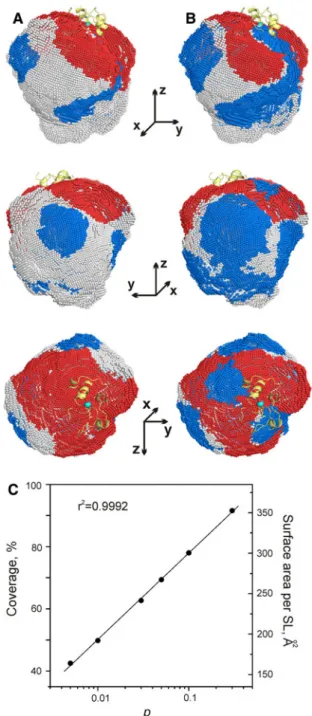
Going back to Fig.2b, we notice that a large part of the isosurface is composed of warm-color grid points. Most of these correspond to Cc molecules that contribute to the experimental C2 restraints (the region above the white curve in Fig.2b), thus defining the extent of the encounter space at the current level of experimental coverage. However, many warm-color points lie outside this area, which indicates incomplete PRE sampling. To assess the experimental coverage of the Cc–CcP encounter state, we mapped out the regions containing Cc molecules contrib-uting to (red) or violating (blue) the experimental C2 restraints at differentp values (Fig.3a, b and Supplemen-tary Fig. S1). In these views, the conformational space not covered by the effects from the introduced SLs is shown in white. As expected, the white areas increase with decreasing p values, implying that progressively more experimental input is required to track down more lowly populated species.
Integration over red and blue areas in Fig.3a, b provides a simple means of quantifying the extent of the experi-mental coverage. In our case, there is a good, log-scale correlation between p and the calculated coverage (Fig.3c). Thus, about one half of the conformational space is probed by PREs atp=0.01, increasing to nearly 80% at p =0.1 (Table 1, cf. Fig.3a, b). We estimate that 13–20 SLs per CcP—corresponding to one SL attached per each 190–300 A˚2 of the total surface area—are required to provide an adequate coverage atp=0.1–0.01 (Table1). Ensemble refinement of the encounter state
Direct use of C2 restraints in an ensemble-based, rigid-body simulated annealing structure calculation protocol— pioneered by Clore and co-workers (Iwahara et al. 2004; Schwieters et al. 2006; Tang et al. 2006)—provides an alternative, potentially more informative, means of refining the encounter state. In this approach, multiple copies of Cc are docked simultaneously to CcP by minimizing the dif-ference between the combination of PREs from all Cc molecules and the experimentalC2 values (see ‘‘Materials and methods’’ for details).
state populationptot=0.3, determined in our earlier work (Bashir et al.2010, also see below). To assess the quality of solutions, we calculated aQ factor (Iwahara et al. 2003, 2004), which is a measure of agreement with the
experimental data (the smaller the Qfactor, the better the agreement; Eq.5). In Fig.4a, Qe(an average Qfactor of the individual ensembles) and Qee (a Q factor calculated by averaging PREs of Cc molecules in all ensembles; Tang et al. 2006) are plotted as a function of N. The Q factors diminish with the increasing ensemble size, leveling off at N=10–20. As can be seen from Fig.4a, Qeeis systematically smaller thanQe, which is due to the stochastic rather than unique combination of protein–pro-tein orientations within each ensemble, such that averag-ing over all ensembles leads to a better agreement with the data (Tang et al.2006). By randomly omitting 10% ofC2
restraints and verifying how well these ‘free’ PREs are predicted by the remaining, ‘working’ data set (i.e. 90% included in the refinement), we performed a complete cross-validation (Bru¨nger et al. 1993), with Qfree as a measure of the fit. The calculated Qfree values (Fig.4a) indicate that N=10–20 is the optimal size of the Cc ensemble required to satisfy the experimental restraints and that the improvement in the Q factors is not due to over-fitting (Tang et al. 2006).
As can be seen from Cobs2 vs. C calc
2 plots (Fig.4b) and
PRE profiles (Fig. 4c), a combination of PREs from the refined encounter ensemble and the dominant, crystallo-graphic Cc–CcP orientation provides a good agreement with the experimental data. Clearly, most of the encounter PRE restraints are now satisfied (highlighted regions in Fig.4c). To visualize the distribution of Cc molecules in the encounter state, we use a reweighted atomic probability density map (Schwieters and Clore2002), calculated from 100 independently generated ensembles with N=10 (Fig.5a). Most of the minor species are found in an area surrounding the dominant form of the complex, and a small, low-density patch of solutions is located at the back of CcP (see below).
Note that the atomic probability density maps in Fig.5a are derived from all Cc atoms, while spatiotem-poral maps in Figs.2, 3 show only the CMs. Thus, to Fig. 3 Experimental coverage of the conformational space of
Cc–CcP encounter state. Cc CMs for the orientations that, respec-tively, violate experimental PREs (blue) or contributeC5 Hz toC2 (red) atap=0.01 andbp=0.1. Combination of theblueandred areas defines the total conformational space covered by the effects from the introduced SLs. The same isosurface as in Fig.2a, b is shown. See the legend to Fig.2 for more details. c Plot of experimental coverage, or surface area of CcP covered by PREs from a single SL, versus the population of the minor species
Table 1 Experimental coverage of the conformational space
p Coverage (%) Number of SLsa Surface area (A˚2) per SLa,b
0.005 42.5 24 164 (138)
0.01 49.8 20 192 (162)
0.03 62.7 16 242 (204)
0.05 69.4 14 268 (226)
0.1 78.0 13 301 (254)
0.3 91.6 11 353 (298)
a Required for complete coverage
enable a direct comparison of the two representations, we plotted the CMs of Cc molecules from 100 generated ensembles (N=10) together with the interaction grid isosurface contoured at p =ptot/N=0.03 (Fig.5b and Supplementary Movie S2). With a few exceptions, Cc CMs are located in the allowed regions of the encounter maps, indicating a good agreement between the two methods. It should be noted that, unlike in the spatio-temporal mapping approach, small violations are tolerated in the simulated annealing ensemble refinement: a slight violation of one restraint, accompanied by concomitant satisfaction of several others, can provide a better agree-ment with the experiagree-mental data than a good solution for the same restraint coming at a price of multiple bad solutions for others.
Despite making no individual contributions to the observed PREs, Cc molecules found in the white regions of the encounter maps nevertheless influence the ensem-ble-averaged C2 values obtained in the refinement pro-cedure. The presence of such non-contributing solutions (e.g. in a low-density region at the back of CcP, Fig.5a) could signify: (1) excessive ensemble size, (2) incor-rect population of the encounter state used in the
calculations, or (3) insufficient experimental coverage of the conformational space. In our case, the first of these possible causes can be dismissed as decreasing the ensemble size from N=10 toN=5 to N=3 does not completely eliminate the non-contributing solutions and steadily increases the Q factor (Fig.4a). Moreover, the complete cross-validation of C2 dataset ruled out a pos-sible over-fitting at higher N values (see above). To test the second possibility, we repeated calculations at dif-ferent ptot for ensembles with N=5 and N=10 (Sup-plementary Fig. S2). In both cases, the Q factors fall sharply from p=0 to p =0.3 and then level off at p =0.3–0.5, confirming that the value of ptot=0.3, determined in a recent study (Bashir et al.2010) and used throughout this work, is correct. Finally, to explore the third option, we performed control runs in which the number of Cc molecules in the ensemble was varied from N=5 to N=9 but their individual populations kept constant at pi=0.03, so that Ripi\ptot. In this way, we assessed whether a subset of binding geometries with the combined population of 0.15B RipiB0.27 can account for C2 effects of the entire encounter state (ptot=0.3). In the control runs, decrease in Ripiis accompanied by only Fig. 4 PRE-based ensemble
simulations of the Cc–CcP encounter state.
aIntermolecularQfactors:Qe (black),Qee(red), andQfree (blue). See text for the definitions.bCorrelation between the observed Cobs
2
and calculated Ccalc2
PREs for the dominant form of the complex alone (N=0,top) or in combination with the simulated encounter ensemble (N=10,bottom).cObserved and calculated PREs for Cc– CcP-SL complexes, with SLs attached at position N38C (top), N200C (middle) and T288C (bottom). ExperimentalCobs 2 (black; Volkov et al.2006; Bashir et al.2010),Ccalc
2 for the specific orientation (blue), and Ccalc
a small increase in Q factors (Supplementary Fig. S3), and the overall distribution of encounter ensembles remains essentially the same as that shown in Fig.5a, except that the low-density patch at the back of CcP is steadily reduced with decreasing Ripi (e.g. compare the views for Ripi=0.21 in Supplementary Fig. S4 and Ripi=ptot=0.3 in Fig.5a). These results indicate that the experimental C2 values can be accounted for by a limited subset of protein–protein orientations, suggesting that Cc ensemble members found in the white regions of the encounter maps might represent a minor sub-popula-tion of the encounter state, not reported upon by the SLs introduced so far.
Discussion
Experimental description of the encounter state
The spatiotemporal mapping approach presented here is superior to a simple, geometric analysis of the encounter state employed in our earlier work (Bashir et al. 2010; Volkov et al. 2006) in that it uses protein structures and realistic van der Waals potentials, rather than spheres and uniform cut-off values, to sample the conformational space; relies on explicit C2 data, instead of uniform
esti-mates, for calculation of allowed p values; and utilizes extensive ensemble-averaging of the PRE effects over multiple SL conformers, thus accounting for the mobility of the attached paramagnetic probes. When applied to an extended experimental dataset spanning 10 SL positions, these methodological advances result in a more informative and detailed encounter map compared to our earlier, roughly shaped ‘‘clouds’’ drawn from the effects of 5 SLs (Volkov et al. 2006).
The main advantage offered by the encounter maps is that they include all possible spatial solutions forQ?0 at Ripi=ptot. However, this comes at a price of providing no molecular-level details on the protein–protein orientations constituting the encounter state. To overcome the ‘zero-resolution’ limitation of the mapping, the encounter space was further refined by restrained ensemble simulations, affording a more detailed description of the minor species. The generated solutions reproduce well the experimental data (Fig.3c); however, the Q factor (Qee=0.32 for N=10–20) is slightly higher than those obtained in PRE NMR studies of other biomolecular interactions (Iwahara and Clore2006; Tang et al.2006). This can be attributed to large errors on the experimentalCobs2 values (Volkov et al.
2006; Bashir et al.2010), obtained from intensity analysis of HSQC spectra (Battiste and Wagner2000). In principle, longer spectral acquisition or the use of a two-point C2
measurement scheme (Iwahara et al. 2007; Clore and Iwahara2009) could increase both accuracy and precision of the data. In practice, however, the instability of Cc–CcP complex—caused by autoreduction of Cc (Young and Caughey 1987) occurring on time scale of several hours (A.N.V., M.U. unpublished observations)—severely restricts the effective experimental time, precluding the use of two-point C2 measurements. Still, despite the practical
limitations inherent in our system, the PRE NMR analysis provides a meaningful picture of the Cc–CcP encounter state.
There is a certain overlap between the concepts of the two approaches used here to analyze the encounter state. For instance, the number of Cc molecules included in the ensemble simulations could be thought of as defining the Fig. 5 Spatial distribution of the encounter ensembles.aReweighted
size of a brush to paint the encounter space map, imbuing it with spatial resolution. Concerning the temporal resolution, though all ensemble members are uniformly populated at p=ptot/N, allowing for the overlap of Cc molecules during the simulations effectively reproduces non-uniform popu-lations captured in the encounter maps. The major con-ceptual difference between these methods is that the encounter mapping is inherently negative (or exclusive, i.e. relies on carving out the regions of space that cannotbe populated at a given p), while ensemble simulations are essentially positive (or inclusive, i.e. finding the solutions thatsatisfygiven restraints). As a result, the former benefits from SLs exhibiting no PRE effects and is sensitive to the extent of the experimental coverage, while the latter relies on the observed PREs and is more tolerant to incomplete experimental sampling.
Narrower distribution of Cc CMs in the N=10 ensembles, compared to the red area of the encounter map (Fig.5b), indicates that only a limited subset of allowed solutions has been found in the ensemble simulations. This can be due to an incomplete experimental coverage of the encounter maps or an insufficient sampling during the refinement procedure. The former can be improved by the introduction of more SLs to further restrict the encounter space, while the latter may be remedied by a more aggressive search. Alternatively, to tease out encounter ensembles directly from the spatiotemporal maps, one could sample multiple combinations of allowed orienta-tions in search for the ones reproducing the experimental C2 data, using a suitable algorithm (e.g. a metaheuristic search; A.N.V. work in progress).
We would like to stress that the spatiotemporal map presents pmax values for individual Cc–CcP orientations, some of which could populate the encounter state (enclosed by the white curve in Fig.2b). Reconstitution of the analogous map for the entire encounter state is a non-trivial, multivariate problem. For instance, it is conceivable that a combination of protein–protein orientations, each of which is allowed individually at a givenp, will summarily yield a prohibitively highC2 value, violating the
experi-mental PRE. Thus, a good sampling of multiple combina-tions of allowed orientacombina-tions would be required to glean the total encounter state map. One way to approach this problem is offered by the metaheuristic search mentioned above, which is currently under investigation in our laboratory.
In its use ofpmax—the maximal population of a partic-ular orientation compatible with the experiment—the present approach is akin to the method of maximum allowed probabilities, developed to characterize flexible, partially independent protein domains from residual dipo-lar couplings and pseudocontact shifts (Gardner et al.2005;
Longinetti et al. 2006; Bertini et al. 2007) and recently extended to small-angle X-ray scattering data (Bertini et al. 2010). Here we show that a similar idea can be successfully applied to characterization of protein–protein interactions by PRE NMR spectroscopy.
Comparison with theoretical simulations
The interaction between oppositely charged Cc and CcP was studied before by theoretical simulations employing Poisson–Boltzmann electrostatic potentials (Fig. 6a, c; Northrup et al.1988; Gabdoulline and Wade2001; Bashir et al. 2010). As shown in our recent work (Bashir et al. 2010), the ensemble of protein–protein geometries gener-ated by electrostatics-based Monte Carlo (MC) protocol provides a good description of the Cc–CcP encounter state. In Fig.6b, a typical MC ensemble is visualized using a reweighted atomic probability density map, revealing a good agreement with the results of a classical Brownian dynamics study (Fig.6c; Northrup et al. 1988). In partic-ular, four energy minima shown in the latter are also present in the MC simulations. In our case, the energy minimum around D148 is shallower, possibly due to the difference in the electrostatic potentials of Cc molecules used in the simulations (horse heart Cc in those of Northrup et al.1988and yeastiso-1 Cc in our case).
The density maps generated from the theoretical (MC) and experimental (PRE-based) encounter ensembles encompass an area around the dominant form of Cc–CcP complex and broadly overlap (Fig.6d). Despite a similar location, the MC and PRE ensembles exhibit differentQ-factors [Qee=0.54 and 0.32 (N=10), respectively], indicating that the latter reproduce the experimentalCobs2 better. This is further
evi-denced by comparison of the corresponding PRE profiles (Fig.4c here and Fig.4a–c in Bashir et al.2010). In this light, a somewhat broader distribution of the PRE ensembles could suggest that, in addition to electrostatics, other intermolecular forces may contribute to protein–protein interactions in the encounter state.
Practical considerations for the analysis of protein encounters by PRE NMR spectroscopy
As shown here, a good experimental coverage of the entire conformational space available to the interacting proteins is essential for an accurate description of the encounter state. In our case, the experimental sampling was achieved by
varying the conjugation site of the paramagnetic probe on the surface of CcP. We estimate that 13–20 uniformly spaced SL attachment positions, located outside the crys-tallographic binding site, are required to provide an ade-quate PRE coverage for Cc–CcP complex atp=0.1–0.01 (Table1). This means that, in addition to our dataset, at least 3–10 extra SLs would be needed to complete the encounter map. (In practice, this number is expected to be higher due to non-uniform distribution of the already introduced SLs.)
To transpose our findings to other systems involving globular proteins, we note that attachment of one SL per each 190–300 A˚2 of the total surface area (SA)—or 160–250 A˚2 of the SA excluding the binding site—is required for the complete coverage at p=0.01–0.1 (Table1). In other words, a SL should be placed every 5–10 protein surface residues (defined as those with sol-vent-accessible SA[10 A˚2). The introduced SL must not perturb the biomolecular interaction studied (e.g. steric clashes with the dominant binding form or substitutions of charged residues altering electrostatic potentials should be avoided), which limits the choice of the SL attachment locations. In practical terms, introduction of a SL at each site necessitates preparation of the corresponding single-cysteine protein variant. Thus, a comprehensive, SL-based PRE NMR encounter mapping requires a significant experimental effort, approaching that of labor-intensive EPR studies (Crane et al. 2005,2006,2008).
Several strategies can be followed to expedite the analysis. First, if possible, paramagnetic labeling of the smaller protein should be carried out as it requires fewer conjugation sites for a good experimental coverage. In case of Cc–CcP, 5–7 SLs attached to Cc (i.e. approximately one-third of those needed for CcP; Table1) would be enough for the complete coverage at p=0.1–0.01. Fur-ther, paramagnetic tagging of both interacting proteins, one at a time, would allow one to decrease the number of attachment sites even more. The main limiting factors of this approach are the quality of the NMR spectra and the availability of backbone assignments for the bigger protein, which have thwarted its application to the Cc–CcP com-plex. Second, the use of stronger paramagnetic labels (e.g. an EDTA-Mn chelate or lanthanide-containing probes; Clore and Iwahara 2009; Su and Otting 2010) would significantly decrease the number of conjugation sites required for a good experimental coverage and could offer a number of additional advantages. For example, pseudo-contact shifts originating from the introduced lanthanide atoms could provide an independent means of verifying the structure of the dominant binding form in solution, and the use of rigid, two-armed, paramagnetic tags (Keizers et al. 2007,2008) would obviate the need for extensive ensemble Fig. 6 Comparison of the theoretical and experimental simulations of
the Cc–CcP encounter state.aCrystallographic Cc–CcP orientation. To facilitate the comparison with the published data, three aspartates of CcP arelabeledand shown as orange sticks.bOverall distribution of 1,701 Cc molecules in the simulated Cc–CcP encounter complex (Bashir et al.2010), displayed as a reweighted atomic probability density map (Schwieters and Clore2002; plotted at a threshold of 0.5% maximum,blue). The surfaces ofaCc andbCcP arecoloredby the electrostatic potential calculated at ±5 kBT (red—negative, blue—positive) with APBS (Baker et al. 2001). cThe Boltzmann-averaged total electrostatic potential energy of interaction between CcP and horse Cc in units ofkBTas a function of Cc CM. Thispanel is taken from ref. (Northrup et al. 1988) with permission from Science.dThe blueand greenmeshes indicate reweighted atomic probability density maps for the overall distribution of Cc molecules obtained from, respectively, Monte-Carlo simulations (same as in
averaging of the measured PREs, thus allowing for a more accurate description of the encounter state.
Conclusions
The spatiotemporal mapping approach presented here provides a reliable estimate of the experimental coverage and, at higher coverage levels, allows to delineate the conformational space sampled by the minor species. As shown in recent studies of Cc–CcP (Bashir et al.2010) and other complexes formed by charged proteins (Kim et al. 2008), electrostatics-based MC simulations afford a robust estimate of the encounter state population, which is further confirmed by ensemble refinement performed in this work. However, to obtain an accurate description of the encounter state’s conformational space, further refinement of MC solutions appears to be necessary. The combination of methods employed here for the analysis of Cc–CcP encounter state illustrates a general approach for compre-hensive visualization of transient species in biomolecular systems.
Acknowledgments A.N.V. is an FWO Post-Doctoral Researcher. M. U. acknowledges the funding by the Netherlands Organisation for Scientific Research (NWO), VICI grant, no. 700.58.441. We acknowledge the access to the VUB/ULB Computing Centre and thank Lieven Buts for the help with debugging the scripts and G. Marius Clore for critical reading of the manuscript.
Open Access This article is distributed under the terms of the Creative Commons Attribution Noncommercial License which per-mits any noncommercial use, distribution, and reproduction in any medium, provided the original author(s) and source are credited.
References
Adam G, Delbruck M (1968) Structural chemistry and molecular biology. Freeman, San Francisco, pp 198–215
Baker NA, Sept D, Joseph S, Holst MJ, McCammon JA (2001) Electrostatics of nanosystems: application to microtubules and the ribosome. Proc Natl Acad Sci U S A 98:10037–10041 Bashir Q, Volkov AN, Ullmann GM, Ubbink M (2010) Visualizaiton
of the encounter ensemble of the transient electron transfer complex of cytochromecand cytochromecperoxidase. J Am Chem Soc 132:241–247
Battiste JL, Wagner G (2000) Utilization of site-directed spin labeling and high-resolution heteronuclear nuclear magnetic resonance for global fold determination of large proteins with limited nuclear Overhauser effect data. Biochemistry 39:5355–5365 Bertini I, Gupta YK, Luchinat C, Parigi G, Peana M, Sgheri L, Yuan J
(2007) Paramagnetism-based NMR restraints provide maximum allowed probabilities for the different conformations of partially independent protein domains. J Am Chem Soc 129:12786–12794 Bertini I, Giachetti A, Luchinat C, Parigi G, Petoukhov MV, Pierattelli R, Ravera E, Svergun DI (2010) Conformational
space of flexible biological macromolecules from average data. J Am Chem Soc 132:13553–13558
Bru¨nger AT, Clore GM, Gronenborn AM, Saffrich R, Nilges M (1993) Assessing the quality of solution nuclear magnetic resonance structures by complete cross-validation. Science 261: 328–331
Chance B, Devault D, Legallais V, Mela L, Yonetani T (1967) Kinetics of electron transfer reactions in biological systems. In: Claesson S (ed) Fast reactions and primary processes in chemical reactions. Interscience, New York, pp 437–464
Clore GM (2008) Visualizing lowly-populated regions of the free energy landscape of macromolecular complexes by paramag-netic relaxation enhancement. Mol Biosyst 4:1058–1069 Clore GM, Iwahara J (2009) Theory, practice, and applications of
paramagnetic relaxation enhancement for the characterization of transient low-population states of biological macromolecules and their complexes. Chem Rev 109:4108–4139
Cooper DB, Smith VF, Crane JM, Roth HC, Lilly AA, Randall LL (2008) SecA, the motor of the secretion machine, binds diverse partners on one interactive surface. J Mol Biol 382:74–87 Crane JM, Mao C, Lilly AA, Smith VF, Suo Y, Hubbell WL, Randall
LL (2005) Mapping of the docking of SecA onto the chaperone SecB by site-directed spin labeling: insight into the mechanism of ligand transfer during protein export. J Mol Biol 353:295–307 Crane JM, Suo Y, Lilly AA, Hubbell WL, Randall LL (2006) Sites of interaction of a precursor on the export chaperone SecB mapped by site-directed spin labeling. J Mol Biol 363:63–74
DeLano WL (2002) The PyMOL molecular graphics system. DeLano Scientific, Palo Alto
Gabdoulline RR, Wade RC (2001) Protein-protein association: investigation of factors influencing association rates by Brown-ian dynamics simulations. J Mol Biol 306:1139–1155
Gardner RJ, Longinetti M, Sgheri L (2005) Reconstruction of orientations of a moving protein domain from paramagnetic data. Inv Probl 21:879–898
Hartl MJ, Schweimer K, Reger MH, Schwarzinger S, Bodem J, Ro¨sch P, Wo¨hrl BM (2010) Formation of transient dimers by a retroviral protease. Biochem J 427:197–203
Iwahara J, Clore GM (2006) Detecting transient intermediates in macromolecular binding by paramagnetic NMR. Nature 440: 1227–1230
Iwahara J, Anderson DE, Murphy EC, Clore GM (2003) EDTA-derivatized deoxythymidine as a tool for rapid determination of protein binding polarity to DNA by intermolecular paramagnetic relaxation enhancement. J Am Chem Soc 125:6634–6635 Iwahara J, Schwieters CD, Clore GM (2004) Ensemble approach for
NMR structure refinement against1H paramagnetic relaxation enhancement data arising from a flexible paramagnetic group attached to a macromolecule. J Am Chem Soc 126:5879–5896 Iwahara J, Tang C, Clore GM (2007) Practical aspects of 1H
transverse paramagnetic relaxation enhancement measurements on macromolecules. J Magn Reson 184:185–195
Keizers PHJ, Desreux JF, Overhand M, Ubbink M (2007) Increased paramagnetic effect of a lanthanide protein probe by two-point attachment. J Am Chem Soc 129:9292–9293
Keizers PHJ, Saragliadis A, Hiruma Y, Overhand M, Ubbink M (2008) Design, synthesis, and evaluation of a lanthanide chelating protein probe: CLaNP-5 yields predictable paramag-netic effects independent of environment. J Am Chem Soc 130: 14802–14812
Kim YC, Tang C, Clore GM, Hummer G (2008) Replica exchange simulations of transient encounter complexes in protein-protein association. Proc Natl Acad Sci U S A 105:12855–12860 Longinetti M, Luchinat C, Parigi G, Sgheri L (2006) Efficient
Northrup SH, Boles JO, Reynolds JCL (1988) Brownian dynamics of cytochromecand cytochromecperoxidase association. Science 241:67–70
Pelletier H, Kraut J (1992) Crystal structure of a complex between electron transfer partners, cytochrome c peroxidase and cyto-chromec. Science 258:1748–1755
Schreiber G, Haran G, Zhou H-X (2009) Fundamental aspects of protein-protein association kinetics. Chem Rev 109:839–860 Schwieters CD, Clore GM (2002) Reweighted atomic densities to
represent ensembles of NMR structures. J Biomol NMR 23: 221–225
Schwieters CD, Kuszewski JJ, Tjandra N, Clore GM (2003) The Xplor-NIH NMR molecular structure determination package. J Magn Reson 160:66–74
Schwieters CD, Kuszewski JJ, Clore GM (2006) Using Xplor-NIH for NMR molecular structure determination. Prog Nucl Magn Reson Spectrosc 48:47–62
Solomon I (1955) Relaxation processes in a system of two spins. Phys Rev 99:559–565
Solomon I, Bloembergen N (1956) Nuclear magnetic interactions in the HF molecule. J Chem Phys 25:261–266
Su X-C, Otting G (2010) Paramagnetic labelling of proteins and oligonucleotides for NMR. J Biomol NMR 46:101–112 Tang C, Iwahara J, Clore GM (2006) Visualization of transient
encounter complexes in protein-protein association. Nature 444:383–386
Tang C, Ghirlando R, Clore GM (2008a) Visualization of transient ultra-weak protein self-association in solution using paramag-netic relaxation enhancement. J Am Chem Soc 130:4048–4056
Tang C, Louis JM, Aniana A, Suh J-Y, Clore GM (2008b) Visualizing transient events in amino-terminal autoprocessing of HIV-1 protease. Nature 455:693–696
Ubbink M (2009) The courtship of proteins: understanding the encounter complex. FEBS Lett 583:1060–1066
Volkov AN, Worrall JAR, Holtzmann E, Ubbink M (2006) Solution structure and dynamics of the complex between cytochrome c and cytochrome c peroxidase determined by paramagnetic NMR. Proc Natl Acad Sci U S A 103:18945–18950
Volkov AN, Bashir Q, Worrall JAR, Ullmann GM, Ubbink M (2010) Shifting the equilibrium between the encounter state and the specific form of a protein complex by interfacial point mutations. J Am Chem Soc 132:11487–11495
Worrall JAR, Liu Y, Crowley PB, Nocek JM, Hoffman BM, Ubbink M (2002) Myoglobin and cytochrome b5: a nuclear magnetic resonance study of a highly dynamic protein complex. Bio-chemistry 41:11721–11730
Xu X, Reinle W, Hannemann F, Konarev PV, Svergun DI, Bernhardt R, Ubbink M (2008) Dynamics in a pure encounter complex of two proteins studied by solution scattering and paramagnetic NMR spectroscopy. J Am Chem Soc 130:6395–6403