Sharif University of Technology
Scientia IranicaTransactions E: Industrial Engineering www.scientiairanica.com
Three meta-heuristics to solve the no-wait two-stage
assembly ow-shop scheduling problem
A. Mozdgir
a, S.M.T. Fatemi Ghomi
b;, F. Jolai
cand J. Navaei
b,d a. Payame Noor University, Tehran, 19395-4697, Iran.b. Department of Industrial Engineering, Amirkabir University of Technology, Tehran, 424, Iran. c. Department of Industrial Engineering, College of Engineering, University of Tehran, Tehran, Iran. d. Intelligent Manufacturing Systems (IMS) Centre, University of Windsor, Windsor, Ontario, Canada. Received 21 November 2012; accepted 11 May 2013.
KEYWORDS No-wait assembly ow-shop;
Genetic algorithm; Dierential evolution algorithm;
Population-based variable neighborhood search.
Abstract.This paper addresses the No-Wait Two-Stage Assembly Flow-shop Scheduling Problem (NWTSAFSP) with the objective of makespan minimization. The problem is a generalization of previously proposed general problem in the Two-Stage Assembly Flow Shop Scheduling Problem (TSAFSP). The TSAFSP is NP-hard, thus the NWTSAFSP is NP-hard too, and three meta-heuristic algorithms, namely, Genetic Algorithm (GA), Dierential Evolution Algorithm (DEA) and Population-based Variable Neighborhood Search (PVNS) are proposed in this article to solve this problem. Computational results reveal that PVNS outperforms other algorithms in terms of average error and average Coecient of Variation (CV). Nevertheless, GA has the least run time among the proposed algorithms.
c
2013 Sharif University of Technology. All rights reserved.
1. Introduction
With the advent of global markets and product or-dering systems, manufacturing rms are more and more being dragged into a contest in which cutting cost and reducing production span are vital traits of dominant companies. For this reason, production planning and scheduling are of a foremost importance for such companies. By making wise plans and sched-ules, manufacturing rms can reduce their redundancy times and thus reduce their current costs. In pursuing this goal, abundant researches have addressed ow-shop, job-shop and other kinds of scheduling problems. One of these problems which most resembles the manufacturing processes in reality is the Two-Stage Assembly Flow-shop Scheduling Problem (TSAFSP) in which in the rst stage parts are processed in parallel,
*. Corresponding author. Tel.: +98 21 66545381; Fax: +98 21 66954569
E-mail address: [email protected] (S.M.T. Fatemi Ghomi)
and then in the second stage, the nal product is assembled.
Since its introduction by Lee et al. [1] and Potts et al. [2], TSAFSP has been widely studied by re-searchers. This problem is recognizable in many real world manufacturing problems where a set of parts are processed on dierent machines, and then have to be assembled to form the nal product. More-over, the problem has gained application in areas other than production scheduling, such as in database distribution [3], supply chain management and batch production [4] and invoice printing system [5]. On the other hand, there are some industries such as chemical, pharmaceutical, food, plastic, and textile goods in which we cannot have any delay between stages [6], because these kinds of products are exposed to become decayed. Thus, the beginning of a given job must be postponed as if the completion of the operation concurs with the start of the operation at the next stage; however, the machine that processes it is idle. This is known as \no-wait assembly
ow-shop" problem. Gupta et al. [7], who addressed it for the rst time, extended two models of the problem and developed a comprehensive complexity classication of the associated two-stage no-wait scheduling problems. Some researchers have attempted in the eld of no-wait ow-shop problems [6-10] according to which the most recent work is corresponded to Ruiz and Allahverdi [10]. They have considered the m-machine no-wait ow-shop problem with independent setup times, and proposed four genetic algorithms as solution approaches.
To the best of our knowledge, no one has consid-ered the no-wait two-stage assembly ow-shop. Lee et al. [1] and Potts et al. [2] proved that TSAFSP with only two machines in the rst stage and a single assembly machine in second stage is strongly NP-hard. We can eortlessly assume that this holds true for problems with more than two processing machines and no-wait consideration. For this reason, implementation of heuristics are more popular than exact models among researchers; heuristics have been widely used in the literature, and mathematical models are less taken note of. One of the few mathematical models in this area is carried out by Zhang et al. [5] in which an invoice printing system, a special assembly ow-shop problem, is modeled into Mixed-Integer Linear Programming (MILP). However, the model is only able to solve small-sized problems, and so dierent heuris-tics and meta-heurisheuris-tics have been used in addressing the TSAFSP. Nepalli et al. [11] used genetic algorithm in a bi-criteria problem. Allahverdi and Al-Anzi [3] proposed three heuristics; simple Earliest Due Date (EDD), Particle Swarm Optimization (PSO) and tabu search heuristics in which both PSO and tabu search proved to yield good results. In another study, Al-Anzi and Allahverdi [12] utilized tabu search, PSO and Self-adaptive Deferential Evolution (SDE) heuristics in addressing the problem with bi-criteria of maximum lateness and makespan minimization in which PSO was again shown to be the best heuristic. Gupta et al. [13] extensively experimented several variants of simulated annealing, threshold accepting and tabu search, and analyzed the parameter settings of these heuristics. Allouhi and Artiba [14] developed two algorithms and a heuristic in addressing TSAFSP with availability constraints. Koulamas and Kyparisis [15], Lin et al. [16] and others have also proposed heuristics of their own. Javadian et al. [17] however developed a Variable Neighborhood Search (VNS) heuristic for TSAFSP, and concluded that VNS outperforms SA in terms of accuracy and consistency.
This paper proposes three meta-heuristic algo-rithms; GA, DEA and PVNS. GA is a well-known algorithm, which has shown it is germane for the scheduling problems [18-20]. The most important ben-ets of using a DEA is its simple but eective mutation
process [21]. On the other hand, the PVNS is a novel metaheuristic algorithm. Since almost all the meta-heuristics use one type of neighborhood mechanism, there exists high probability to become trapped in a local optimum, while the use of multiple neighborhoods in PVNS overcomes this drawback successfully.
The rest of this paper is organized as follows: Section 2 states the problem. Section 3 proposes three meta-heuristic algorithms for the problem. Experi-mental results are presented in Section 4, and nally Section 5 concludes the paper and recommends some areas for future studies.
2. Problem statement
In the No-Wait Two-Stage Assembly Flow-shop Scheduling Problem (NWTSAFSP) there are n jobs available at time zero. Each job consists of m + 1 operations; the rst m operations are performed at the rst stage on m parallel machines, so that each machine is capable of performing one job at a time with no preemption, i.e. once a job has begun, it will continue without interruption till the job is nished in the rst stage. Then the output is assembled by an assembly machine at the second stage. Because of the no-wait limitation, when a job begins to be processed, it must be continued without any interruptions between stages. In other words, the beginning of a part of a given job in a given machine at the rst stage should be delayed, so that the completion of the m operations can coincide with the start of assembly process at the second stage. We aim to nd the best sequence of jobs to minimize the makespan.
As stated in previous section, makespan is the dominating objective function in the ow-shop prob-lems. This is because the overall time of nishing the jobs most particularly aects the total costs of the rm. Makespan is thus chosen as the objective function of our study.
Let:
t[jk] Process time of the job in position
j on machine k at the rst stage, k = 1; :::; m.
P[j] Assembly time of job in position j on
assembly machine at the second stage, j = 1; 2; :::; n.
R[j] Finishing time of job in position j at
the rst stage, j = 1; 2; :::; n.
C[j] Completion time of job in position j,
j = 1; 2; :::; n.
C1=maxk=1m ft1kg + P1; (1)
R2= maxfmaxm k=1ft1kg +
m
max
k=1ft2kg; C1g; (3)
C3= R3+ P3; (4)
R3= maxfmaxfmaxk=1m ft1kg +maxk=1m ft2kg; C1g
+maxm
k=1ft3kg; C2g = maxfR2+ m
max
k=1ft3kg; C2g;(5)
Cj= Rj+ Pj; (6)
Rj = maxfRj 1+maxm
k=1ftjkg; Cj 1g 8j = 1; :::; n:(7)
3. Meta-heuristic algorithms
As mentioned before, the NWTSAFSP is known as NP-hard, and therefore, heuristic or meta-heuristic algorithms should be used to solve the problem. In this paper, we propose GA, DEA and PVNS in Subsections 3-1, 3-2 and 3-4, respectively.
3.1. Genetic algorithm
Genetic algorithm is a population-based heuristic which rst was introduced by Holland [22]. GA is usually termed as a part of, and sometimes used as an equivalent of, Evolutionary Algorithms (EA) to solve optimization problems, using techniques natu-rally inspired evolution such as selection, inheritance, mutation and crossover. GA is extensively used in optimization and search problems, and is proved to be a powerful heuristic. The basic idea of GA is: At each iteration, the current population or genetic pool consists of dierent solutions called genomes or chromosomes.
The evolution begins with a population of ran-domly generated individuals, and later takes place in generations to come. In each generation, the tness of every genome in the population is calculated. The tness function, depending on the problem, is dened over the genetic representation, and measures the quality of solution.
Several genomes are then selected from the cur-rent population. In this selection, usually by the roulette wheel, the genomes which have the best tness value are most likely to be selected, and this probability decreases for genomes with reduced tness. When the candidate genomes are selected, the GA improves the solution through mutation and crossover operators, and creates new ospring and population. The new population is then used in the next iteration of the algorithm. Usually, the algorithm terminates when either a maximum number of generations has been produced, or a satisfactory tness level has been reached for the population. In this paper, we have used a maximum number of generations.
While solutions are traditionally represented in binary 0 and 1 strings, other encodings are also possible. For instance, in our problem, genomes are strings of n successive numbers indicating the sequence of the jobs. The reproduction operations used in this paper are dened below.
1. Crossover
We have used a certain type of one-point cross over for ordered chromosomes in our algorithm. To do the crossover, two of the genomes are randomly chosen. As stated earlier, in choosing the two genomes, solutions are given a weight according to the quality of their tness function, and so, better solutions have a higher chance to be chosen for the crossover operation. Then a random number k is generated between 1 and n, and the rst k sequences of the two genomes are swapped. In each solution, there must be numbers 1 to n, so the algorithm then searches for duplicate numbers, and randomly swaps duplicated numbers of the two genomes with each other. The selection from two of the repetitive numbers is also random. Consider the following two genomes and their new ospring; random number is k = 3.
[1 5 2 3 4 6 7] ! [3 5 1 3 4 6 7] ! [3 5 1 2 4 6 7] [3 5 1 7 4 6 2] ! [1 5 2 7 4 6 2] ! [1 5 3 7 4 6 2] Note that the second 3 was selected randomly from the rst genome, and was swapped by randomly selected rst repetitive 2 in the second genome. If more than one duplicate number was seen, a random repetitive number from rst genome was swapped with a random one from the second genome.
2. Job mutation
Two random jobs of the best solution are selected and swapped. Consider the following ospring from its parent:
[1 2 3 4 5 6 7] ! [1 2 7 4 5 6 3] 3. Sequence mutation
A random job of the best solution is selected, and the place of former jobs and later jobs are swapped. Consider the following ospring from its parent: [1 2 j 3 4 5 6 7] ! [3 4 5 6 7 1 2]
By changing some genomes randomly, both job and sequence mutations prevent the algorithm to fall in local minima.
Provided that the rate of crossover, job mutation and sequence mutation are f, g, h, respectively, and the rate of last generation which goes to the next
generation directly is i, a pseudo code of GA will be as below:
1. Create the rst generation (population) with N initial solutions randomly;
2. Set k 1;
3. while k kmaxdo/// maximum number of
gener-ations;
4. Sort the solutions according to their tness;
5. Calculate the selection probability of each solution, using roulette wheel rule;
6. Do crossover and job mutation and sequence mutation according to their rates (f, g, h) and the probability calculated for each current solution to create a part of next generation;
7. Complete the next generation, using the rate of i and the probability calculated for each current solution;
8. k k + 1;
9. End while.
3.2. Dierential evolution algorithm
Dierential Evolution Algorithm (DEA) is a kind of Evolutionary Algorithms (EA), rst introduced by Storn and Price [23] for optimization over continuous spaces. Due to its invention, DEA has been extensively applied with high success on many numerical opti-mization problems outperforming other more popular population heuristics such as GAs [24,25]. Recently, some researchers successfully extended the applica-tion of DEA to complex combinatorial optimizaapplica-tion problems with discrete decision variables, such as the machine layout problem [26] and the ow-shop scheduling problem [27]. The main features and stages of a classical DEA are as follows:
Step 1. DE utilizes Np, D-dimensional parameter vectors xi;k, i = 1; 2; :::; Np, as a population to search
the feasible region uniformly of a given problem. The index k denotes the iteration (or generation) number of the algorithm (k = 0 denotes initial population).
= fx1;0; x2;0; :::; xNP;0g : (8)
Step 2. At each iteration, all vectors in ' are targeted for replacement. Therefore, Np competitions are held to determine the members of ' for the next iterations. This is achieved using three operators which are mutation, crossover and acceptance.
Step 3: Mutation phase.
For each target vector xi;k, i = 1; :::; Np, a mutant
vector ^xik is obtained by:
^xi;v=r:xbest;k+ (1 r) (x;k
+F s (x;k x;k)) ; (9)
where , , 2 fI; :::; Npg are mutually exclusive random indices, and are also dierent from the current target index i, and r 2 [0; 1] is a random number that is generated randomly for each mutant vector. It is a coecient for the convex combination between the best element xbest;k of ', and a randomly combination
of three random elements. The vector x;kis known as
the base vector, and F s 2 (0; 2] is a scaling parameter. Step 4. Crossover phase.
The crossover operator is applied to obtain the trial vector yi;k from ^xikand xi;k by the following equation:
yL i;k=
( ^xL
i;k if RL CR or L = Ii
xL
i;k otherwise
: (10)
In the above equation, CR shows the crossover rate, Ii is a random number in [1; D] which guarantees that
the dierence between xi;k and yi;kis at least one gene
and therefore, xi;k and yi;k are not the same no way.
Step 5. Acceptance phase.
Acceptance is applied after all Np trial vectors yi;khave
been generated. In the acceptance phase, the tness function of the trial vector, F (yi;k), is compared with
F (xi;k); the value at the target vector, and the target
vector is updated as below:
xi;k+1=
(
yi;k if F (yi;k) < F (xi;k)
xi;k otherwise : (11)
Step 6: Mutation, crossover and acceptance phases continue until some stopping conditions are met. 3.3. Population-based variable neighborhood
search
The Variable Neighborhood Search (VNS) is a recent meta-heuristic technique introduced by Mladenovic and Hansen [28], and has quickly gained widespread popularity. This meta-heuristic was successfully ap-plied to solve complex optimization problems such as routing problem [29], allocation problems [30] and production scheduling problems [31]. The basic idea in VNS is that it focuses on the mechanism of systemat-ically exploring more than one kind of neighborhood structure during the searching process. The local optimum in each neighborhood is found iteratively and hopefully to reach the global optimum at the end. In its basic form, VNS explores a set of neighborhoods of the current solution, makes a local search from a neighbor solution to a local optimum, and moves to it only if there has been an improvement [32]. Since
almost all the meta-heuristics make use of one type of neighborhood mechanism, there exists high probability to become trapped in a local optimum, while the use of multiple neighborhoods in VNS overcomes this drawback successfully. The reasons why VNS has been used widely in researches are due to the utilization of several neighborhood structures, easy to implement and high exibility and brilliant adaptability of VNS to dierent problems [31]. Despite the good potentials of VNS, it is necessary to devise strong systematic neigh-borhood structures and sucient potential to escape from local optima. Therefore, in this paper we describe a population-based VNS algorithm (PVNS), which is an enhanced version of the basic VNS algorithm. 3.3.1. Implementation of PVNS
Though the variable neighborhood search has been successfully applied in many combinatorial optimiza-tion problems, the existing research shows a lack of application of PVNS to the NWTSAFSP. As stated before, in this subsection we present a population-based VNS algorithm (PVNS) for the NWTSAFSP, which is an enhanced version of the basic VNS. The idea of PVNS was rst introduced by Wang and Tang [33]. Like basic VNS algorithm, PVNS uses two important functions, i.e. shake procedure and local search to enhance the solution quality. The shake function diversies the search by switching the solution to another neighborhood structure, while the local search strives to nd an improved solution within the current neighborhood structure. In this section, to further improve the performance of the basic VNS, we adapt a population k of solutions in which the solution quality is taken into account. Dierent from basic VNS, in the PVNS, multiple trial solutions are simultaneously generated to improve the search diversication and pre-vent local optimum solutions. A subset of population is randomly selected in each iteration of inner loop, and the epitome of group is established as the average property of the selected individuals as follows:
e = m1 Xm
i=1
xi; (12)
where xi represents the ith member of subset. Since
the new chromosomes obtained as epitome of the group may represent infeasible solutions, some modications are required. For production part, according to Largest Order Value (LOV) rule [34], we suggest to convert the individuals found by Eq. (12) into the feasible solutions. According to the LOV rule, e = (e1; e2; :::; en) are rstly ranked by descending order
to obtain a sequence = (1; 2; :::; n). Then, the
job permutation y = (y1; y2; :::; yn) is calculated by the
formula yk= k.
After the shake procedure is implemented and the resultant solution x0 is transformed to the local
optimum x00, the current solution xand population P
would be updated if x00 dominates x0. The procedure
of adapted PVNS is illustrated below:
1 Create a set of neighborhood structures Nk(k =
1; 2; :::; Kmax);
2 Initialize the rst population P with Np solutions;
3 For i = 1 to imax do /// maximum number of
iterations of outer loop;
4 Set k 1;
5 Generate a random number q (1 q Np);
6 Select q solutions randomly from P and calcu-late the epitome of solutions x;
7 Rank elements of xin production part by
de-scending order to reach sequence = (1; 2:::; n);
8 Calculate the feasible solution y = (y1; y2;
:::; yn)
by the formula yk= k, and replace the
prod-uction part of x with y;
9 set x x;
10 while k kmax do /// maximum number of
iterations of inner loop;
11 For current solution x, execute shake
procedure r times to nd r trial solutions x02 N
k(x);
12 For each trial solution, execute local search on Nk(x0) to nd the best local
solution x00;
13 if tness (x00) < tness (x), then
14 x x00;
15 set k 1;
16 Update population P by replacing the worst solution in P with x;
17 else;
18 k k + 1;
19 end if;
20 end while;
21 i = i + 1;
22 End for.
3.3.2. Neighborhood search
The neighborhood structure deals with the systematic way of moving from one solution to its neighborhood such that infeasible solutions are prevented. A vari-ety of neighborhood structures has been adapted to scheduling problems. As described previously, the main principle of VNS concerns with the use of several neighborhood structures and systematic switching from one structure to another, so as to improve the search
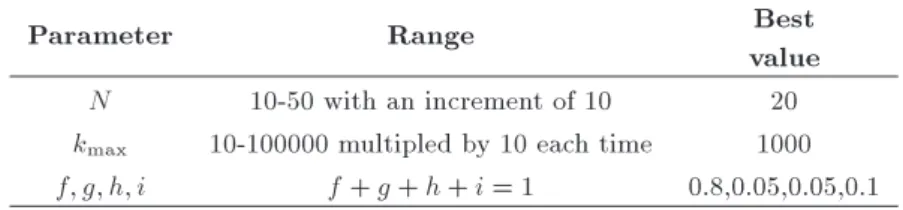
Table 1. Parameters tuned for the proposed GA.
Parameter Range Best
value N 10-50 with an increment of 10 20 kmax 10-100000 multipled by 10 each time 1000 f; g; h; i f + g + h + i = 1 0.8,0.05,0.05,0.1
intensication as well as its diversication. Javadian et al. [17] developed a three-neighborhood search which is able to nd excellent solutions to the TSAFS problem, and therefore, we use it in this paper. The proposed neighborhood structures are as follows:
Neighborhood 1. Two pairs of jobs are selected ran-domly from a given sequence and swapped indepen-dently.
Suppose that we have a sequence of jobs: [3 7 2 1 4 6 8 5]. Four numbers are generated randomly from \1\ to \8". Consider that these random numbers are: 1, 2, 6, 8. So, the jobs in positions 1 and 2 and the jobs in positions 6 and 8 must be swapped independently: [3 7 2 1 4 6 8 5] ! [7 3 2 1 4 5 8 6].
Neighborhood 2. A random number , in which 2 < < n=2, is generated and the rst jobs are swapped with the last ones. For addressed sequence and a random = 3, we have:
[3 7 2 1 4 6 8 5] ! [6 8 5 1 4 3 7 2].
Neighborhood 3. A random number is generated. Then, the rst jobs are inversed, and last n jobs are inversed too. For the above sequence and a random = 5, we have:
[3 7 2 1 4 6 8 5] ! [4 1 2 7 3 5 8 6].
4. Computational results
Subsection 4.1 tunes parameters of three meta-heuristics, while Subsection 4.2 compares their perfor-mances.
4.1. Tuning parameters
Setting parameters is an important factor, whereby we can establish a trade-o between time and quality of heuristic solutions. Each meta-heuristic has some parameters which should be tuned. Theses parameters are set by doing some experiments and evaluating the results with respect to run time and quality of solutions. Tables 1 to 3 summarize the results for GA, DEA and PVNS, respectively. For each meta-heuristic, no signicant improvement was observed beyond the
Table 2. Parameters tuned for the proposed DEA.
Parameter Range Best
value
CR (0.5,0.75,0.9) 0.75
F s (0.5,1,1.5) 1.5
r (0,0.4,0.8) 0.4
(NP; NI) ((n; 3n); (1:75n; 1:75n); (3n; n)) (n; 3n)
Table 3. Parameters tuned for the proposed PVNS.
Parameter Range Best value
imax (3,4,5,6,7) 5
kmax (5,6,7,8,9,10,11,12) 8
Np (15,20,25) 25
value given in the tables. The parameters for GA have been acquired in Table 1. Parameters required for DEA consist of the Crossover Rate (CR), scaling parameters (F s), rate (coecient) of best function (r) and nally Number of Populations and Iterations (NP and NI). Table 2 shows these parameters. According to Subsection 3.3, parameters tuned for PVNS are shown in Table 3.
4.2. Evaluation of the meta-heuristics
We have used a PC with 8.2 GHz CPU processor under the Windows XP operating system with 2 GB of RAM, and the proposed meta-heuristics were implemented in Borland C++ compiler version 5.02.
The processing time at the rst stage on each m machines and assembly time at the second stage were generated randomly from uniform distribution [1, 100]. The reason why a Uniform distribution with a wide range is used is that the variance of this distribution is large, and if a heuristic performs well with such a distribution, it is likely to perform well with other distributions [12].
In this paper, we consider 20, 40, 60 and 80 as dierent number of jobs (n) and 3, 5 and 7 as dierent number of machines at the rst stage (m). These types of classes are very common among the researchers [3,8-10]. Each combination was solved 40 times by each meta-heuristic, and so a total of 1440(43403) instances were evaluated.
Figure 1. Average run time versus dierent number of jobs.
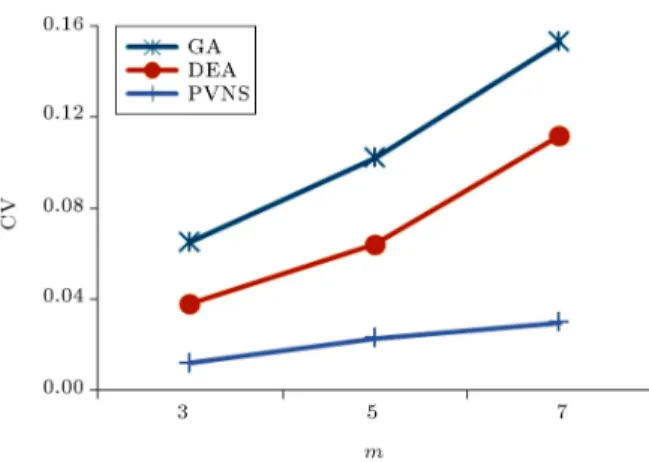
algorithms, we use three measures: the rst measure is average run time. Another measure is the Rela-tive Percentage Deviation (RPD). RPD is a common measure frequently used in literature, and is obtained by the following manner. When the best solution yielded by three algorithms in each combination is found, the percentage error is calculated as follows: 100*(the solution found by the algorithm { the best solution)/ (the best solution). The last measure is the Coecient of Variation (CV) which is dened as: CV= (standard deviations (STD) of the algorithm solutions)/ (average of the algorithm solutions). The reason why CV is used is that we cannot compare the STD of two combinations which have dierent means, and hence it is better to use CV instead of STD. For the sake of brevity, the results are shown in gures and are not tabulated.
Figure 1 illustrates run times of the meta-heuristics for dierent number of jobs. From Figure 1, it can be inferred that GA has the smallest CPU times and PVNS has the greatest one in comparison with other algorithms. In fact, according to the CPU times, GA outperforms other algorithms.
Figures 2 and 3 demonstrate the RPD measure, with respect to the number of jobs and number of machines at the rst stage, respectively. Figure 2 reveals that GA has the worst performance among the algorithms. In contrast, PVNS has the lowest RPD and performs much better than GA and DEA. Figure 3 yields that PVNS outperforms other algorithms again, and GA has the worst performance. Figures 4 and 5 show CV versus dierent number of jobs and machines at stage one, respectively. Again, the gures reveal that GA and PVNS have the worst and best performances among the algorithms.
5. Conclusion and recommendation for future studies
In this paper, the no-wait two-stage assembly ow-shop scheduling problem was addressed. The makespan was
Figure 2. RPD versus dierent number of jobs.
Figure 3. RPD versus dierent number of machines at the rst stage.
Figure 4. Average coecient of variation versus dierent number of jobs.
selected as an objective function of the problem to be minimized. Three meta-heuristics were proposed: Genetic Algorithm (GA), Dierential Evolution Algo-rithm (DEA) and Population base Variable Neighbor-hood Search (PVNS). Computational experiments have revealed that the performances of PVNS and GA are the best and worst, respectively, among the algorithms
Figure 5. Average coecient of variation versus dierent number of machines at the rst stage.
in terms of RPD and CV. However, according to the CPU time, the result is dierent; GA and PVNS are the best and worst, respectively.
To have a more realistic situation, adding some constraint such as sequence-dependent setup time to the problem could be proposed. Furthermore, some other assumptions made in this paper could be also relaxed, such as priorities in jobs, having a set of similar jobs, probabilistic processing time, etc.
References
1. Lee, C.Y., Cheng, T.C.E. and Lin, B.M.T. \Mini-mizing the makespan in the 3-machine assembly-type owshop scheduling problem", Management Science, 39, pp. 616-625 (1993).
2. Potts, C.N., Sevast'janov, S.V., Strusevich, V.A., Van Wassenhove, L.N. and Zwaneveld, C.M. \The two-stage assembly scheduling problem: Complexity and approximation", Operations Research, 43, pp. 346-355 (1995).
3. Allahverdi, A. and Al-Anzi, F.S. \A PSO and a tabu search heuristics for assembly scheduling problem of the two-stage distributed database application", Computers & Operations Research, 33, pp. 1056-1080 (2006).
4. Lin, B.M.T, Cheng, T.C.E. and Chou, A.S.C. \Scheduling in an assembly-type production chain with batch transfer", Omega, 35, pp. 143-151 (2007).
5. Zhang, Y., Zhou, Z. and Liu, J. \The production scheduling problem in a multi-page invoice printing system", Computers & Operations Research, 37, pp. 1814-1821 (2010).
6. Aldowaisan, T. and Allahverdi, A. \Total owtime in no-wait owshops with separated setup times", Computers & Operations Research, 25(9), pp. 757-765 (1998).
7. Gupta, J.N.D., Strusevich, V.A. and Zwaneveld, C.M. \Two-stage no-wait scheduling models with setup and removal times separated", Computers & Operations Research, 24(11), pp. 1025-1031 (1997).
8. Allahverdi, A. and Aldowaisan, T. \No-wait and sep-arate setup three-machine owshop with total com-pletion time criterion", International Transactions in Operational Research, 7(3), pp. 245-264 (2000).
9. Allahverdi, A. and Aldowaisan, T. \Minimizing total completion time in a no-wait owshop with sequence-dependent additive changeover times", Journal of the Operational Research Society, 52(4), pp. 449-462 (2001).
10. Ruiz, R. and Allahverdi, A. \No-wait owshop with separate setup times to minimize maximum late-ness", International Journal of Advanced Manufactur-ing Technology, 35, pp. 551-565 (2007).
11. Neppalli, V.R., Chen, C.L. and Gupta, J.N.D. \Ge-netic algorithms for the two-stage bicriteria owshop problem", European Journal of Operational Research, 95(2), pp. 356-373 (1996).
12. Al-Anzi, F.S. and Allahverdi, A. \Heuristics for a two-stage assembly ow shop with bicriteria of maximum lateness and makespan", Computers & Operations Research, 36, pp. 2682-2689 (2009).
13. Gupta, J.N.D., Hennig, K. and Werner, F. \Local search heuristics for two-stage ow shop problems with secondary criterion", Computers & Operations Research, 29, pp. 123-149 (2002).
14. Allaoui, H. and Artiba, A. \Scheduling two-stage hy-brid ow shop with availability constraints", Comput-ers & Operations Research, 33, pp. 1399-1419 (2006).
15. Koulamas, C. and Kyparisis, G.J. \The three-stage assembly owshop scheduling problem", Computers & Operations Research, 28, pp. 689-704 (2001).
16. Lin, B.M.T., Cheng, T.C.E. and Chou, A.S.C. \Scheduling in an assembly-type production chain with batch transfer", Omega, 35, pp. 143-151 (2007).
17. Javadian, N., Mozdgir, A., Gazani Koohi, E., Davallo Qajar, M.R. and Shiraqai, M.E. \Solving assembly owshop scheduling problem with parallel machines using variable neighborhood search", 39th Interna-tional Conference of Computers and Industrial En-gineering, University of Technology of Troyes, Paris, France, pp. 102-107 (2007).
18. Luo, H., Huang, G.Q., Zhang, Y., Dai, Q. and Chen, X. \Two-stage hybrid batching owshop scheduling with blocking and machine availability constraints using genetic algorithm", Robotics and Computer-Integrated Manufacturing, 25, pp. 962-971 (2009).
19. Chang, P.C., Chen, S.H., Fan, C.Y. and Chan, C.L. \Genetic algorithm integrated with articial chromo-somes for multi-objective owshop scheduling prob-lems", Expert Systems with Applications, 36, pp. 7135-7141 (2009).
20. Tseng, L.Y. and Lin, Y.T. \A hybrid genetic lo-cal search algorithm for the permutation owshop scheduling problem", European Journal of Operational Research, 198, pp. 84-92 (2009).
21. Mozdgir, A., Mahdavi, I., Seyedi, I. and Solimanpur, M. \Using the Taguchi method to optimize the dier-ential evolution algorithm parameters for minimizing the workload smoothness index in simple assembly line balancing", Mathematical and Computer Modelling, 57, pp. 137-151 (2011).
22. Holland, J., Adaptation in Natural and Articial Sys-tems, Ann Arbor, The University of Michigan Press, MI, USA (1975).
23. Storn, R. and Price, K. \Dierential evolution - a sim-ple and ecient heuristic for global optimization over continuous spaces", Journal of Global Optimization, 11(4), pp. 341-354 (1997).
24. Ali, M.M. and Torn, A. \Population set-based global optimization algorithms: Some modications and nu-merical studies", Computers & Operations Research, 31, pp. 1703-1725 (2004).
25. Kaelo, P. and Ali, M.M. \A numerical study of some modied dierential evolution algorithms", European Journal of Operational Research, 171, pp. 674-692 (2006).
26. Nearchou, A.C. \Meta-heuristics from nature for the loop layout design problem", International Journal of Production Economics, 101(2), pp. 312-328 (2006).
27. Onwubolu, G.O. and Davendra, D. \Scheduling ow shops using dierential evolution", European Journal of Operational Research, 169, pp. 1176-1184 (2006).
28. Mladenovic, N. and Hansen, P. \Variable neighbor-hood search", Computers & Operations Research, 24, pp. 1097-1100 (1997).
29. Polacek, M., Hartl, R.F., Doerner, K. and Reimann, M. \A variable neighborhood search for the multi depot vehicle routing problem with time windows", Journal of Heuristics, 10, pp. 613-627 (2004).
30. Yun-Chia, L. and Min-Hua, L. \Multi-objective redun-dancy allocation optimization using a variable neigh-borhood search algorithm", Journal of Heuristics, 16, pp. 511-535 (2010).
31. Naderi, B., Zandieh, M. and Fatemi Ghomi, S.M.T. \A study on integrating sequence dependent setup time exible ow lines and preventive maintenance scheduling", Journal of Intelligent Manufacturing, 20, pp. 683-694 (2009).
32. Perez, J.A.M., Vega, J.M.M. and Martin, I.R. \Vari-able neighborhood tabu search and its application to the median cycle problem", European Journal of Operational Research, 151, pp. 365-378 (2003).
33. Wang, X. and Tang, L. \A population-based vari-able neighborhood search for the single machine total weighted tardiness problem", Computers & Operations Research, 36, pp. 2105-2110 (2009).
34. Bean, J.C. \Genetic algorithm and random keys for sequencing and optimization", ORSA Journal on Computing, 6, pp. 154-160 (1994).
Biographies
Ashkan Mozdgir was born in Tehran, Iran, in 1984. He received his BS degree in Industrial Engineering from K. N. Toosi University of Technology, Tehran in 2006, and his MS degree in Industrial Engineering from Mazandaran University of Science and Technology, Mazandaran 2009. He is currently a PhD student in Industrial Engineering at K. N. Toosi University of Technology.
Seyyed Mohammad Taghi Fatemi Ghomi was born in Ghom, Iran, in 1952. He received his BS degree in Industrial Engineering from Sharif University, Tehran in 1973, and his PhD degree in Industrial Engineering from University of Bradford, England in 1980. He is currently a Professor in the Department of Industrial Engineering at the Amirkabir University of Technology in Tehran. His research and teaching interests are in stochastic activity networks, production planning and control, scheduling, queueing systems and statistical quality control.
Fariborz Jolai is currently Professor of Industrial Engineering at College of Engineering, University of Tehran, Tehran, Iran. He obtained his PhD degree in Industrial Engineering from INPG, Grenoble, France in 1998. His current research interests are scheduling and production planning, supply chain modeling and optimization problems under uncertainty condtions. Javad Navaei was born in Tehran, Iran. He received his BS degree in Industrial Engineering from K. N. Toosi University of Technology, Tehran in 2009, and his MS degree in Industrial Engineering from Amirkabir University of Technology at Tehran, Iran, in 2011. He is currently a PhD student in Industrial Engineering at the Department of Industrial and Manufacturing Systems Engineering, University of Windsor, Windsor, Ontario, Canada.