The AARP Public Policy Institute, formed in 1985, is part of the Policy and Strategy Group at AARP. One of the missions of the Institute is to foster research and analysis on public policy issues of importance to mid-life and older Americans. This publication represents part of that effort.
The views expressed herein are for information, debate, and discussion, and do not necessarily represent official policies of AARP.
© 2007, AARP.
Reprinting with permission only.
AARP, 601 E Street, NW, Washington, DC 20049 http://www.aarp.org/ppi
#2007-08 April 2007
ASSISTED LIVING IN UNLICENSED HOUSING: THE REGULATORY EXPERIENCE OF FOUR STATES
by
CONTENTS EXECUTIVE SUMMARY ... i BACKGROUND ... i PURPOSE ... i METHODOLOGY ... i PRINCIPAL FINDINGS ... i
Bringing Assisted Living Services to Subsidized Housing ... i
Physical Environment ... ii
Ensuring Quality of Care ... ii
Resident Assessments, Service Terminations, and Evictions... ii
Disclosure and Consumer Understanding... ii
Residents’ Rights ... iii
CONCLUSIONS... iii BACKGROUND ... 1 PURPOSE ... 3 METHODOLOGY ... 3 FINDINGS... 4 CONNECTICUT ... 4 Physical Environment ... 5 Services ... 5 Management Issues... 6 Affordability ... 7
Resident Assessments, Service Terminations, and Evictions... 7
Residents’ Rights ... 9
Disclosure and Consumer Understanding... 9
Ensuring Quality of Care ... 9
MINNESOTA ... 11
Physical Environment ... 11
Services ... 12
Management Issues... 13
Affordability ... 14
Resident Assessments, Service Terminations, and Evictions... 15
Residents’ Rights ... 16
Disclosure and Consumer Understanding... 17
Ensuring Quality of Care ... 19
NEW JERSEY ... 20
Physical Environment ... 20
Services ... 21
Management Issues... 22
Affordability ... 22
Resident Assessments, Service Terminations, and Evictions... 23
Residents’ Rights ... 24
Disclosure and Consumer Understanding... 25
New Jersey regulations require that the following items be included in the admission agreement of an ALR or CPCH: ... 25
Ensuring Quality of Care ... 25 NORTH CAROLINA ... 27 Physical Environment ... 27 Services ... 29 Management Issues... 29 Affordability ... 30
Resident Assessments, Service Terminations, and Evictions... 30
Residents’ Rights ... 32
Disclosure and Consumer Understanding... 33
Ensuring Quality of Care ... 34
CONCLUSIONS... 36
Bringing Assisted Living Services to Subsidized Housing ... 36
Physical Environment ... 36
Ensuring Quality of Care ... 37
Resident Assessments, Service Terminations, and Evictions... 37
Disclosure and Consumer Understanding... 37
Residents’ Rights ... 37
EXECUTIVE SUMMARY BACKGROUND
Assisted living is regulated differently in each state. In most states, assisted living is licensed as
a single entity that provideshousingand services to residents. However, in a growing number of
states a model of assisted living has emerged, in which housing and services are separate. In this model, the building is not licensed, but instead makes arrangements with licensed service
agencies to provide services to residents. Even in these unlicensed housing arrangements, the
building is subject to the relevant building codes, fire codes, and other requirements for multi-unit housing. The state may also require the building to be registered. Registration involves a much lower level of oversight than licensure and may require only that the building file a
registration form, for example, and provide a disclosure statement to residents. Some states have additional standards specifying, for example, the type of building in which services may be arranged and the services that must be made available to residents. This model blurs the lines between assisted living, independent senior housing, and home care.
PURPOSE
AARP’s Public Policy Institute undertook this study to examine the unique issues that assisted living in unlicensed housing might have for consumers, in terms of quality of care, quality of life, and access to affordable assisted living services. This study describes four states’ experiences with this model and discusses the implications for state policy.
METHODOLOGY
This study examines the experiences of Connecticut, Minnesota, New Jersey, and North Carolina with assisted living in unlicensed housing. The states were selected based on their diverse approaches to this model.
Information was gathered through several sources: (1) a review of the laws and regulations governing assisted living in the four states, plus information obtained from the states’ websites, newspaper articles, and previous studies that examined assisted living in those states; and (2) structured telephone interviews with key informants, including consumer advocates,
representatives of provider organizations, and state regulators from the four states.
PRINCIPAL FINDINGS
The findings suggest several issues for states to consider regarding assisted living in unlicensed housing:
Bringing Assisted Living Services to Subsidized Housing
Three of the study states (CT, MN, and NJ) provide Medicaid funding for assisted living services in subsidized housing. Informants agreed that this approach has made assisted living available to people with low incomes. Tenants who are eligible for Medicaid do not have to move, but can
stay in their apartments and obtain services. Quality standards in these settings may be more rigorous than in private-pay assisted living, because Medicaid waiver requirements apply.i
Physical Environment
Some of the study states had minimum standards for the building where services are provided, such as requiring security systems, private rooms, transportation, meals, and housekeeping. In other states, these features and services were optional. A common theme, however, was that assisted living in unlicensed housing generally provides a home or homelike environment that supports residents’ privacy and independence.
Ensuring Quality of Care
Although the housing where services are provided is not licensed in this model, the states use a range of other ways of assuring quality, such as the long-term care ombudsman program, fire standards, food and kitchen standards, and requirements for the contracts. Some informants pointed to a need for more oversight of the housing. However, one informant was concerned that increased monitoring could detract from the home environment that appeals to consumers.
Resident Assessments, Service Terminations, and Evictions
The states vary in their requirements for assessments of prospective residents. In North Carolina and Connecticut, providers use their own assessment processes, and some informants were concerned that assessments were not always adequate. Evictions from the building are covered by landlord-tenant law. However, the service providers have criteria for discharging clients from receiving services. Residents who need more services than are available through the service agency may be able to arrange additional help from other paid caregivers or family members, just as they could in their own homes. However, several barriers to remaining in these apartment buildings exist: hiring additional help can be expensive; paid caregivers may not be available (particularly in rural areas); the provider’s discharge criteria may require residents to move; and the resident and family may be unable to arrange for the needed services. Some of the states have addressed these concerns by requiring 30 days’ notice of discharge, a process to appeal service terminations or evictions, and other consumer protections. Minnesota recently added such protections.
Disclosure and Consumer Understanding
Informants in all four study states mentioned problems related to consumer information, including lack of consumer awareness about their rights, the providers’ discharge criteria, and where to go to get concerns addressed, as well as a variety of service packages that make it difficult to compare providers. Minnesota’s new law calls for the development of a uniform consumer information guide, requires housing with services establishments to have a designated person to help residents resolve concerns about arranged home care services, and strengthens disclosure requirements.
i
The Medicaid waiver program gives states flexibility to cover services for specific groups, such as persons with developmental disabilities or aged and disabled persons, rather than to all Medicaid eligible persons. It also permits states to use higher income and resource thresholds, and provide a broader package of services.
Residents’ Rights
Resident rights varied among the four study states. Only New Jersey has an assisted living residents’ bill of rights that applies to assisted living services in unlicensed housing. In the other states, these residents have rights under the home care bill of rights and landlord-tenant law; informants had different views on whether these protections were sufficient.
CONCLUSIONS
Assisted living in unlicensed housing has several potential benefits, as well as possible issues of concern for consumers. Potential benefits include: increased access to assisted living services for people with low incomes living in subsidized apartments, a home environment, a range of housing options, and, in some cases, the increased ability of people to live in an assisted living environment when they need a high level of services. Challenges for states considering this model include: ensuring that consumers are well informed; protecting residents’ rights and ensuring quality of care, particularly regarding assessments, service terminations, and evictions; and providing adequate oversight and enforcement while maintaining the home environment that consumers prefer.
BACKGROUND
Assisted living is regulated differently in each state. In most states, assisted living is licensed as
a single entity that provideshousingand services to residents. However, in a growing number of
states a model of assisted living has emerged, in which the housing and services are separate. In this model, the building is not licensed, but instead makes arrangements with licensed service
agencies to provide services to residents. Even in these unlicensed housing arrangements, the
building is subject to the relevant building codes, fire codes, and other requirements for multi-unit housing. The state may also require the building to be registered. Registration involves a much lower level of oversight than licensure and may require only that the building file a
registration form, for example, and provide a disclosure statement to residents. Some states have additional standards specifying, for example, the type of building where services may be
arranged and the services that must be made available to residents. This model blurs the lines between assisted living, independent senior housing, and home care.
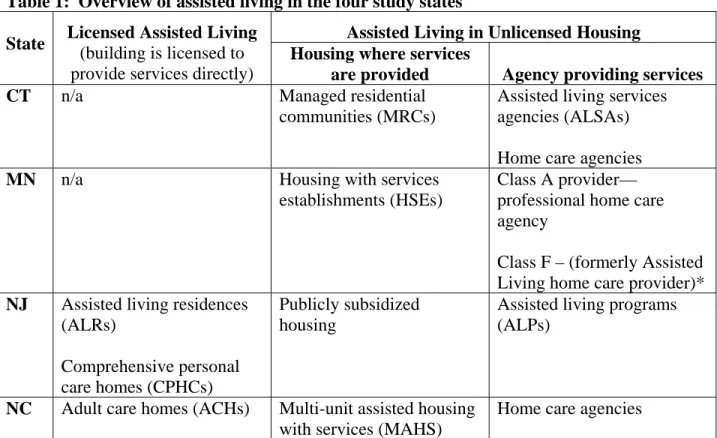
This study examines this new model of assisted living in unlicensed housing in four states: Connecticut, Minnesota, New Jersey, and North Carolina. Table 1 provides an overview of assisted living in the four study states.
Table 1: Overview of assisted living in the four study states
Assisted Living in Unlicensed Housing State Licensed Assisted Living
(building is licensed to provide services directly)
Housing where services
are provided Agency providing services
CT n/a Managed residential
communities (MRCs)
Assisted living services agencies (ALSAs) Home care agencies
MN n/a Housing with services
establishments (HSEs)
Class A provider— professional home care agency
Class F – (formerly Assisted Living home care provider)*
NJ Assisted living residences (ALRs)
Comprehensive personal care homes (CPHCs)
Publicly subsidized housing
Assisted living programs (ALPs)
NC Adult care homes (ACHs) Multi-unit assisted housing with services (MAHS)
Home care agencies
* In Minnesota, a new law that took effect January 1, 2007 renamed “assisted living home care provider” as “Class F provider.” The law defined “assisted living” to include only providers that provide or make available services through a Class A or Class F agency. Previously, some HSEs provided services through Class E providers— assisted living programs, which provided a lower level of services.*
The study includes states with assisted living in private-pay apartments (Connecticut, Minnesota, and North Carolina), as well as in publicly subsidized housing (Connecticut, Minnesota, and New Jersey). Public housing developments for older persons were built under the assumption that they would be occupied by able-bodied older people living independently.1 Yet today, older persons in public housing are more likely to report chronic health problems such as hypertension, diabetes, arthritis, and asthma than are other older Americans or low-income older Americans. Although many senior public housing residents are in good health, many others have illnesses or disabilities that cause them to need assisted living services. Recognizing this need, states are increasingly interested in offering assisted living services in subsidized housing as a strategy for increasing access to affordable assisted living.2
To subsidize the cost of assisted living services, states may use the Medicaid Personal Care Option, the Medicaid Home and Community-Based Services (HCBS) Waiver Program, state funds, or a combination of these options. Federal HCBS waiver regulations require that
participating providers meet applicable state standards.3 However, the state’s Medicaid program may set more stringent standards for settings that serve waiver clients than for other assisted living providers in the state. For example, a state’s licensure requirements may permit assisted living settings to offer rooms shared by two, three, or more residents, but the state’s assisted living waiver program may choose to contract only with providers that offer private occupancy unless the resident requests to share a room.
In 1994, Connecticut became the first state to license assisted living as a service, rather than a building where services are provided.4 In Connecticut, assisted living consists of senior
apartment buildings called managed residential communities (MRCs) that contract with assisted living services agencies (ALSAs) to provide services to residents. The state also provides Medicaid funding for ALSA services in three federally and 16 state-subsidized senior housing communities.
In 1995, Minnesota passed the Housing-with-Services Contract Act, which established
Minnesota’s version of assisted living, in which apartment buildings called housing with services establishments (HSEs) contract with home care agencies to provide services to residents.5 ii The HSE may also obtain a home care license and provide services directly. Assisted living services are also available to eligible residents in six low-income apartments and subsidized housing communities. In May 2006, the state revised its assisted living laws, making changes that improved consumer protections while continuing to license assisted living as a service. New Jersey originally licensed two types of assisted living: assisted living residences and comprehensive personal care homes. These settings are based on the model used in most states, in that the building is licensed to provide services directly. In 1996, the state added a new licensure category, assisted living programs, which bring services to eligible tenants of publicly subsidized housing.6 An assisted living program is a licensed agency that provides services in one or more subsidized housing communities.
ii
Some HSEs in Minnesota are licensed as corporate adult foster care facilities or board and lodging facilities. However, this paper focuses on unlicensed HSEs that provide assisted living services.
North Carolina enacted assisted living legislation in 1995. The legislation defined two types of assisted living: adult care homes, which were formerly licensed as domiciliary care, and a new model called multi-unit assisted housing with services (MAHS). Adult care homes are licensed to provide assisted living services directly. MAHS are apartment buildings that are not licensed but instead contract with licensed home care agencies to provide services to residents. MAHS are private pay, and residents are generally more independent than adult care home residents. In addition to the four states examined in this study, Indiana is another state with a similar model. Indiana does not license the building if an outside agency provides the assisted living services.7 However, the housing provider (a “housing with services establishment” as it called in Indiana regulations) must complete a disclosure form on an annual basis and submit the form along with a copy of the resident contract to the state. An establishment may not use the term “assisted living” if it has not filed a disclosure form.
Other states have less formal arrangements to provide personal care services to residents in apartments that are not licensed as assisted living. For example, the Massachusetts Supportive Housing Program, developed in 1999, creates an “assisted living like” environment in state- funded public elderly housing.8 Services provided through the program include service coordination and case management, 24-hour personal care, on-call response, homemaker services, laundry, medication reminders, social activities, and at least one meal a day.
PURPOSE
AARP’s Public Policy Institute undertook this study to examine the unique issues that assisted living in unlicensed housing might have for consumers, in terms of quality of care, quality of life, and access to affordable assisted living services. The study describes four states’
experiences with this model and discusses the implications for state policy.
METHODOLOGY
This study focuses on Connecticut, Minnesota, New Jersey, and North Carolina. The states were selected based on their diverse approaches to assisted living services in unlicensed housing. The study was conducted in two phases. First, the author reviewed the relevant laws and regulations on assisted living and home care in each of the four states, as well as information obtained from the states’ websites, newspaper articles, and previous research. The review of laws was updated throughout the duration of the study.
In the second phase, the author conducted structuredtelephone interviews with key informants from each of the four states. The interview guide was developed based on the key issues identified in phase one. A total of 17 individuals were interviewed, including state regulators, long-term care ombudsmen and other consumer advocates, and representatives of provider
associations. Because of the limited number of interviews, the results are intended to provide insight about each state’s approach, rather than to represent the views of all stakeholders. Contact information for state regulatory officials and long-term care ombudsmen was obtained through the regulatory agencies’ websites, the National Center for Assisted Living’s “Assisted Living State Regulatory Review,”9 the website of the National Long-Term Care Ombudsman Resource Center,10 and Assisted Living Today.11 Prior to the interviews, the director of each organization was sent a letter describing the study and requesting his or her participation. To identify additional knowledgeable people to interview, respondents were asked if they had any suggestions about other people to interview.
Respondents were asked about their knowledge, experience, and opinions regarding assisted living in unlicensed housing in their states. The interviews focused on topics related to quality of care, quality of life, and access to affordable services for consumers. When consent was given, the interviews were tape recorded and transcribed.
FINDINGS
The following sections present the findings from each state. Each state’s section begins with a list of the interview participants and then describes the issues, first by summarizing what the laws and regulations provide and then by presenting the insights and comments of the interviewees. The information is presented for each state on the following topics:
1) the physical environment of assisted living settings, 2) assisted living services,
3) issues related to coordination between housing management and services management, 4) affordability, including assisted living in subsidized housing,
5) resident assessments, service terminations, and evictions, 6) residents’ rights,
7) disclosure and consumer information, and 8) quality of care.
CONNECTICUT
In addition to reviewing the regulations for Connecticut, six key informants were also interviewed:
• two regulators, interviewed together via conference call;
• a representative of the state long-term care ombudsman program; and
• three members of organizations representing managed residential communities and assisted living service agencies, interviewed together via conference call.iii
iii
The providers asked that the call not be tape recorded. Therefore, notes were taken during the interview, but the interview was not recorded or transcribed.
Physical Environment
In Connecticut, senior apartments called managed residential communities (MRCs) contract with licensed assisted living service agencies (ALSAs) to provide services to residents. The laws emphasize providing a secure, homelike environment for residents. MRCs must provide private apartments, shared with a roommate only at the request and mutual consent of both residents, with access to food storage and preparation equipment in each apartment.12 They must also provide 24-hour security and emergency call systems in each living unit. MRCs may be apartments, continuing care retirement communities, or a range of other housing settings.13 The ombudsman said that some consumers can function better in a MRC because of the
availability of supports such as meals, laundry, and security, when they need greater assistance with these activities than home care can provide. However, MRCs were not home, she added, only small apartments with “strangers caring for you.” Private-pay MRCs can also be “quite costly,” she added, although it can sometimes be difficult to compare those costs with the added expenses of ancillary services needed to stay in one’s home.
The regulators noted that very often, MRC residents include individuals who do not need health or supportive services, as well as individuals who are receiving services from an ALSA, home care agency, or both. However, the regulators noted that residents of MRCs do not have all the freedoms that they would have in their own homes: “It’s not home. So consequentially, not being home, you are dictated by schedules. …you can’t make your own decisions about every aspect of your life…”
Services
A MRC may contract with one or more ALSAs, home health care agencies, or other licensed health care providers to provide personal care and health services for tenants.14 Connecticut law specifies a minimum set of services that must be provided. ALSAs provide nursing services (including client teaching, wellness counseling, health promotion, disease prevention, and medication administration) and assistance with activities of daily living. An ALSA must designate a registered nurse to be on call 24 hours a day, but is not required to provide staff on-site 24 hours a day.
Home health agencies provide professional nursing services and at least one of the following additional services directly: homemaker-home health aide services, physical therapy, speech therapy, occupational therapy, or medical social services.
In addition, the MRC must provide five “core services:”
• three meals per day,
• laundry,
• regularly scheduled transportation for personal shopping, social and recreational events, health care appointments, and similar needs,
• housekeeping, and
The ALSA is responsible for ensuring that all of the “core services” are provided in the MRC served by the ALSA.
While the providers and the regulators said they were not aware of any issues that needed to be addressed regarding the level of services available, the ombudsman said that consumers often lacked complete information about available services such as provision of transportation and attention to dietary needs. The ombudsman said that an ALSA needed to provide full disclosure of available services and fees for those services.
Management Issues
While a MRC may contract with one or more ALSAs, home health care agencies, or other licensed health care providers, it may obtain a license to operate an ALSA to provide services directly to its residents.15 In some cases, the MRC providing the housing and the ALSA
providing the services are both owned by the same larger organization, while in other cases they are unrelated. Interview participants gave widely varying estimates of the proportion of cases in which the MRC and the ALSA are owned by the same organization--ranging from “the vast majority” to “about two percent” of providers. No data are available on this topic.
Clients have the right to make individual arrangements with service agencies that do not have a formal contract with the residences in which they reside, just as they would in their own homes. To assist residents with coordinating services, each MRC must employ an on-site service
coordinator, who ensures that needed services are provided or made available to all tenants, assists tenants in making arrangements for services, establishes relations with service providers, and serves as a liaison with the ALSAs.
Although none of the respondents were aware of any problems resulting from the building and the services being managed by two unrelated groups, the providers and regulators said that having a single entity manage both could have advantages for consumers. Potential advantages mentioned included “continuity of care,” “continuity of management,” “quality,” and “common goals.” An advantage of an ALSA being onsite, the ombudsman said, might be improved communication in regard to a resident’s needs.
On the other hand, the ombudsman pointed out that a contractual agreement between the MRC and the ALSA might ensure “greater accountability” by the ALSA. The regulators mentioned that the ALSA might be more focused on providing good services to residents if it was managed separately from the MRC. Also, the MRC could terminate the contract with the ALSA if the ALSA did not meet expectations:
…When the ALSA and the MRC are not one and the same, there’s an
independent voice there for care and services. So I think the orientation to the clients and their needs, and their health and safety are foremost in the minds of that ALSA.… When they’re not the same, the other thing that’s good for the ALSA side is when the MRC doesn’t meet up to their expectations, they can pull out of there. So I think that could be both an advantage and a disadvantage to clients, that their services could be interrupted. (Regulator)
The ombudsman noted that one disadvantage of the separate ALSA arrangement was the possibility of a worker not showing up without notification to the resident or family. Another problem with which she had had experience arose when an ALSA “backed out of its agreement with a MRC and left families pretty upset because no new agency was in place to provide services.”
Affordability
Connecticut has several programs to help fund assisted living services, as well as the
construction of housing where services will be provided. However, the programs are limited in the number of people served.
In 1998, legislation was passed establishing an “assisted living demonstration program” and authorizing construction of up to 300 units of state-subsidized affordable housing for assisted living. Legislation in 2000 expanded the program to allow all state-subsidized elderly
congregate housing projects to offer assisted living to their residents and permit the state-funded Connecticut Home Care Program for Elders (CHCPE) to pay for the services for those who qualify. Currently, Connecticut uses both a Medicaid waiver and state funds to help pay for ALSA services for eligible residents in 16 of the state’s 24 state-funded subsidized housing communities and in three federally funded subsidized housing settings. The subsidized housing communities with ALSA services are designated as MRCs, and are very similar to private-pay MRCs in the range of services available.
In 2002, two pilot programs (one funded under a Medicaid waiver and the other with state funds) were established to help pay for assisted living services for some residents of private MRCs who had spent most of their own resources. This program is limited to 75 participants, although legislation was pending in 2007 to increase the number of participants.
All the interview participants spoke positively about the approach of bringing assisted living services to subsidized housing. The regulators said that the major advantage is that residents who need assisted living services can receive those services in their apartments and do not need to move. The ombudsman noted that this approach has made assisted living services available to people with low and moderate incomes. “The more we can do to increase these options for low- income people, the better,” she said, noting that the federal “Money Follows the Person” grant program is helping the state to move additional people out of nursing homes into assisted living. Respondents were also positive about the subsidies to help pay for services for assisted living services in private-pay MRCs for consumers who had spent down their resources. The ombudsman said that this program helps private-pay residents to remain in their MRC apartments when they run out of money and become eligible for Medicaid or CHCPE.
Resident Assessments, Service Terminations, and Evictions
Connecticut’s model of assisted living is intended to support residents’ ability to remain in their MRC homes, moving from a low level to a high level of services when needed.16 The regulators expressed concern, however, about the MRC admissions processes. They said: “… the big issue right now is making sure that clients are appropriate for that level of care…at the time they’re
going to receive services from the assisted living service agency.” The ombudsman said that standardizing admission practices was an issue that needed to be explored.
Service termination criteria for ALSAs and home health agencies are set by agency (Department of Public Health) policy. The only restriction is that persons receiving services from an ALSA must have conditions that are “chronic and stable.” Home health care agencies may serve any client as long as an assessment determines that the client may be served safely in the home.17 Although ALSAs may serve only those clients that have chronic and stable conditions, the interview participants explained that MRC residents whose conditions are not chronic and stable can remain in the MRC if they have appropriate care, such as from a home health agency. Residents may also bring in private duty caregivers, as they could in their own homes, and the ALSA and MRC will coordinate the additional services. Residents with a terminal illness may also receive hospice care and remain in the MRC.
The ombudsman said that if the ALSA lets a family know that they are discharging a resident from their care because they believe the agency can no longer meet the resident’s needs, the MRC must ask the family whether it is prepared to provide the additional care needed through some other means or wishes to move the resident to a skilled nursing facility. A major issue regarding discharge criteria, said the ombudsman, was “full disclosure in the contractual agreement about what the MRC can and cannot do regarding discharge. The discharge criteria need to be clear.”
Informants also expressed concern about residents who need more services and choose to stay in the MRC. One concern was that residents have remained in MRCs longer and have more service needs than were envisioned when the state’s assisted living regulations were first enacted:
[These are] very difficult questions. People want to age in place and don’t want to leave [even if they need additional services.] We need to look at what needs to be done about the definition of “chronic and stable” compared to “skilled nursing services.” The Department of Public Health convened a Connecticut Assisted Living Regulations Advisory Committee in January 2007 to look at the Assisted Living Services regulations. This is one of the issues they will be looking at. (Ombudsman)
Residents’ rights regarding termination of the resident agreement are governed by landlord-tenant law. Providers were satisfied with the process for an MRC terminating the housing or services contract with a resident. When a resident is moving out, the providers explained that the ALSA and MRC would typically work with residents and families to help with the resident’s transition if skilled care was needed. The ombudsman noted, however, several issues that her office and the newly appointed advisory committee were looking at with regard to eviction or termination of services:
Is the process timely enough to that people can make alternative arrangements? Are people getting the support they need to make those arrangements? What went into the decision-making process to terminate services or evict the resident? (Ombudsman)
Residents’ Rights
Under current regulations, ALSAs are to provide clients with a written bill of rights addressing the following areas: the right to choose one’s service provider; participation in care planning; freedom from abuse; confidentiality; complaint procedures; notification of services included in Medicare or Medicaid payment; policy regarding access to one’s service record; notification of services and charges; notification of admission/discharge criteria; and the right to have personal property treated with respect. The home care bill of rights addresses similar issues: participation in care plan; confidentiality; grievances/complaints; notification of services and charges;
notification of admission and discharge criteria; and the right to have one’s property treated with respect. In addition, MRC tenants are also covered by the rights under landlord-tenant law. The ombudsman said that while local municipalities have building fire code and health and sanitation regulations for MRCs, the residents of MRCs still need a bill of rights. Through word of mouth, the ombudsman said, problems about lack of transportation and security issues have come to the attention of the ombudsman. She mentioned the case of one resident with
Alzheimer’s disease who wandered away from his facility and was found at a gas station, a situation that illustrated a security problem at some facilities.
The providers and regulators have a different point of view. The providers said that the rights provided are “adequate” and “comprehensive.” The regulators agreed:
…the rights are taken care of for both sides. …the ALSA client has the bill of rights for the ALSA services, as well as the tenant agreement. People that don’t need ALSA services have their rights through the tenant agreement for their housing. (Regulators)
Disclosure and Consumer Understanding
Connecticut law does not include any specific topics to be covered in a residency agreement with an MRC, although MRCs are subject to landlord-tenant laws.18 An MRC must include, in its registration application, a description of how the MRC will inform tenants of the assisted living and home care services available and how to obtain the itemized cost of these services.
Although the state does not specify topics to be disclosed in a service contract with a home health care agency or an ALSA, some disclosure items, such as notification of services included in Medicare or Medicaid payment, are included in the bills of rights that ALSAs and home health agencies must provide to clients (see above). The ombudsman noted, however, that full
disclosure of services to be provided and the fees for those services is still not adequate and needs to be addressed in future regulations or legislation.
Ensuring Quality of Care
Although MRCs are not licensed, a variety of state and local laws and agencies have a role in ensuring quality and protecting residents’ rights. The MRC must be registered and must comply with local zoning ordinances and building codes, the state fire safety code, and landlord-tenant law. Other enforcement mechanisms include the state attorney’s office (for fraud and abuse
complaints), the state department of consumer protection, and Health Department requirements for kitchen and food service in the MRC.
ALSAs and home health agencies are licensed by the Department of Public Health and inspected biennially and as necessary. This inspection may be waived for home health agencies that are certified by the federal government to participate in the Medicare or Medicaid programs. If a substantial failure to comply with the licensure law and regulations is found, the Commissioner of Public Health may impose any of the following penalties, after a hearing: revoke a license, suspend a license, censure a licensee, issue a letter of reprimand to a licensee, place a licensee on probationary status, restrict the acquisition of other facilities, or issue an order compelling
compliance. The state also investigates complaints about ALSAs and home health agencies. Following passage of a 2004 law, the long-term care ombudsman program started serving older persons residing in assisted living in January 2005. The law directed the Connecticut Office of the Long-Term Care Ombudsman to develop and implement a pilot program to assist residents in certain assisted living settings, with priority given to residents receiving services from subsidized assisted living programs.19 Previously, the ombudsman program operated only in nursing homes and residential care homes, at least partially because of insufficient funding. The ombudsman noted that while the 2004 law extended ombudsman responsibilities to MRCs, the facilities are not required to post a notice of the availability of ombudsman services, leaving most residents unaware of these resources for assistance.
Overall, informants in Connecticut had a positive view of assisted living in the state. The ombudsman said that assisted living was a popular option with consumers “when home care is not working and skilled nursing care is not appropriate.” The providers stated that most companies have their own quality control standards and that they think Connecticut has an “outstanding reputation for quality” and “pretty high standards.” In addition, the providers said, because the state has a very competitive assisted living market, poor quality providers will go out of business.
One regulator said there were some quality problems, but suggested that these problems were not widespread. The ombudsman said there were isolated cases of concern with quality of care. She cited the case of the Alzheimer resident who had wandered away from his facility, and another situation that had recently arisen involving a husband who called for her assistance because his wife living in a MRC had been repeatedly hospitalized. He did not believe he was getting clear answers from the facility about her condition and the reasons for the hospitalizations.
The regulators also acknowledged that some quality issues do arise:
…I think it all relates to the appropriateness of the client and the fact that they’re safe in that environment at all times, and that they get the care and services they need to take care of their needs. But there’s always some degree of quality of care issues on some level often times. (Regulators)
The main concerns informants had were about possible consumer confusion resulting from assisted living services being provided in unlicensed MRCs. The regulators suggested that a
disadvantage to Connecticut’s model might be that the separation of housing and services can lead to consumer confusion over which agency to turn to for resolving complaints. For example, consumers are sometimes unaware that the Department of Public Health has jurisdiction over the ALSA but not the MRC:
…we only have jurisdiction over the service side, so that’s where we come from. The only disadvantage that I see that could possibly be a disadvantage is that sometimes people will call and then they’ll complain about some of the housing pieces, like the food’s not good… The rent is going up. …we have no jurisdiction over that. …so they need to look elsewhere for some assistance with
that….consumer protection, Better Business Bureau…--they look at their tenant agreement… (Regulators)
The ombudsman said the state had many MRCs and ALSAs that were following best practices and were models of quality care, but that a number of issues still needed to be addressed to ensure that all the facilities and services were adequate. She cited the need for standardizing admission agreements; providing full disclosure of services and fees, and admission and discharge provisions; posting of ombudsman information; and addressing care issues, such as the definition of “chronic and stable” and clarification of what ALSA staff are capable of handling.
MINNESOTA
At the time of the interviews, an assisted living workgroup was meeting in Minnesota to develop proposed changes to the state’s assisted living law. In May 2006, a new law was passed that improves consumer protections while continuing to license assisted living as a service. The new law addresses several of the concerns that were raised by interview participants. This section describes the new law and the results of the interviews.
Five key informants were interviewed from Minnesota:
• A representative of the state long-term care ombudsman program,
• A consumer advocate,
• A representative of an association for housing with services establishments (HSEs) and home care agencies providing assisted living services, and
• Two representatives of the state regulatory agency (interviewed together via conference call).
Physical Environment
In Minnesota, assisted living services are provided only in HSEs. The HSEs arrange health and supportive services for residents.20 Before the passage of the new law, HSEs were required to be registered only if 80 percent or more of the residents were age 55 or older; otherwise registration was optional. The new law requires registration for all HSEs effective January 1, 2007.
Registration is a much lower level of oversight than licensure. Registered HSEs must provide certain information to the state in order to be registered, and they must meet requirements for
consumer disclosure, the contract with residents, and staff training on Alzheimer’s disease and dementia if the HSE serves persons with these conditions. There are no requirements for the physical environment, other than meeting the building codes. As a result, HSEs may include a variety of housing types.
Respondents were generally pleased with the level of privacy and homelike environment in HSEs. The ombudsman noted that HSEs usually have “very attractive physical plants” and “afford more space and more privacy” compared to nursing homes and older board and care homes.
Informants viewed the range of housing options as an advantage of Minnesota’s assisted living model:
The advantage [of not licensing the HSEs] is…the fast growth of a wide variety of housing establishments and a wide variety of prices, so consumers have lots of choice in their housing. (Ombudsman)
…I think that’s the advantage of keeping the service license and the building separate, not putting limits on where people can live just because of the services they might need, letting the services follow the person. (Provider)
A possible disadvantage to not licensing the HSEs, however, is the lack of standards regarding security. The ombudsman and consumer advocate were concerned that some of the buildings are not equipped to safely evacuate residents in emergencies:
…there are some physical plants, for example, that are totally inappropriate… and we've had the fire marshal in some areas have to close them down, where
somebody has purchased a large two-story house, big old house, and renovated it … and has taken in six people with dementia. And, yet, doesn't staff it
sufficiently, and it doesn't meet fire code… so that those people with dementia who are on the second story could ever be evacuated in time… (Ombudsman)
(It should be noted that even with the situation of an unlicensed facility, fire marshals are present to inspect such homes and close them in the event of unsafe situations.) At the same time, HSEs generally provide a higher level of security compared to living alone in one’s own home since HSE residents are living near other people, and HSEs often choose to provide security features, such as pull cords:
…the security of being near where people are. These buildings typically have pull cords or some other kind of communication system, so if you have some kind of emergency, need some kind of help, it’s right there. (Provider)
Services
Before the new law, the state did not mandate any specific services to be provided in assisted living. Services packages varied widely, depending on the services that the residence chose to
provide and the licensure class of the home care agency. The 2006 law defined a minimum set of services that must be provided in any HSE that uses the term “assisted living:”
1) health-related services under a class A (professional home care agency) or class F (assisted living home care provider) home care license. These services must include assistance with self-administration of medication or medication administration and assistance with at least three activities of daily living;
2) registered nurse assessments of the physical and cognitive needs of clients;
3) a system of delegating health care activities to unlicensed personnel by a registered nurse; 4) staff access to an on-call registered nurse 24 hours a day;
5) a system to check on each assisted living client at least daily;
6) a means for clients to request assistance for health and safety needs 24 hours a day; 7) an awake staff available 24 hours per day (HSEs with 12 or fewer residents may apply for
an exemption to this requirement); and
8) the following supportive services: two meals per day, weekly housekeeping, weekly laundry service, assistance with arranging for transportation to medical and social services appointments, assistance with accessing community resources, and periodic opportunities for socialization.
Respondents had different views on whether the variety of service packages allowed under the old law was good for consumers. The regulator viewed it as an advantage, “…it affords a great deal of choice for the client, in a wide variety of services that they can choose.” However, some stakeholders were concerned that the wide range of services made it difficult for consumers to compare settings:
The consumer group stakeholders, and some of the provider group stakeholders, like the Home Care Association and the Minnesota Nurses Association, are very, very unhappy with… the rules that currently allow the provider to define their scope of service, so that there is no standard definition. There is no way for a consumer to reasonably shop and compare costs… (Ombudsman)
It remains to be seen how the new law will work in addressing these concerns.
Management Issues
A HSE may either contract with a separate home care agency to provide services, obtain a home care license and provide services directly, or be part of a larger organization that has a home care license. Residents also have the right to contract with a provider that does not have an
arrangement with the HSE, just as they could in their own homes.
To provide a clear point of accountability when multiple providers are involved, effective
January 1, 2007, Minnesota’s new law requires that an HSE provide each client with information about the HSE staff person or persons who are available to assist the client with any concerns about the services provided by the home care provider arranged by the HSE. Upon request, such persons are to assist the client in addressing his or her concerns.
The provider estimated that the majority of HSEs, perhaps 70 to 75 percent, have a home care license or are part of a larger organization that has such a license. The other informants said they did not know how often this was the case.
Prior to the new law, interview participants agreed that consumers were often confused over who was accountable. The consumer advocate suggested that it would be better to license the housing and services as a single entity, to alleviate the confusion for consumers:
My enduring impression is that… if we were like other states to have an entity that is assisted living, that is clearly a dwelling, that… has healthcare services, supportive services, and emergency security kinds of services, that both the consumers and general public would be better served. Right now there are confusions. ...A single point of accountability would be, in my mind, in the consumer interest… (Consumer advocate)
Time will tell how the new law will work in providing a clear point of accountability for consumers.
Affordability
Minnesota has a Medicaid waiver program, called the Elderly Waiver, which funds services for older persons at risk of nursing home placement. The waiver covers services in the home and in a range of residential care settings, including adult foster homes, board and lodging homes, non-certified board and care homes, and HSEs with assisted living services.21 Providers who do not meet the requirements of the new assisted living law may continue to receive payment under the Elderly Waiver as long as they continue to meet the standards for assisted living set forth in the waiver program. This exemption may cause confusion for persons receiving assisted living services under the waiver program.
Minnesota also has a state-funded Alternative Care program that funds services for older persons who are at risk of nursing home placement and have low income and assets, but do not meet Medicaid financial criteria.22 The program provides a comprehensive array of services, including home modifications, adult day services, adult foster care, assisted living, and other residential care services. The waiver and Alternative Care programs help pay for services only and do not assist with the cost of housing.
Some HSEs are market-rate apartment buildings and some are HUD-subsidized buildings.23 The state-funded Group Residential Housing program helps pay the room-and-board costs in licensed or registered settings for eligible low-income residents who are at risk of institutionalization or homelessness.
Respondents viewed assisted living in subsidized housing as an effective approach to increasing access to affordable assisted living:
…the state doesn’t have a very good way of subsidizing the housing costs for a low-income person in a building that doesn’t have federal rent subsidy… So if you’re low income and need home care services, really, the best possible situation
is to be in a HUD subsidized building where they have a home care program that can provide assisted living, because then your rent is subsidized and then you could get your home care services and probably be eligible for Medicaid to pay for those services…. (Provider)
Also, the consumer advocate noted that, because these settings are subject to Medicaid waiver requirements, the quality standards are higher than for private-pay assisted living:
…because those services are provided under the Medicaid waiver, there are actually some more requirements about supervision and care-related issues than we find in elderly housing with services as a whole… (Consumer advocate)
Resident Assessments, Service Terminations, and Evictions
Minnesota’s new law establishes requirements for assessments of prospective residents. HSEs that offer or provide assisted living must: (1) offer to have the home care provider conduct an assessment of the prospective resident’s needs and develop a service plan prior to move-in, and (2) provide the prospective resident with contact information for “long-term care consultation services,” that is, services provided by counties to assist people in making long-term care
decisions and selecting options that meet their needs and reflect their preferences.24 An arranged home care provider must provide an assessment when requested by a prospective resident, and it must comply with applicable home care licensure requirements with respect to providing a nursing assessment prior to the delivery of nursing services. HSE tenants who will not be receiving nursing services from the arranged home care provider are not required to undergo an assessment.
In Minnesota, criteria for discharging a client from home care services are established by the home care agency. The new law strengthens consumer protections in the event of service termination or building eviction:
• The home care bill of rights is amended to provide assisted living clients with at least 30 days’ advance notice of service termination;
• Notices of home care service termination must include the following: an offer to meet with the client or client’s representative to discuss the termination, a statement that the provider will participate in a coordinated transfer of the client’s care to another service provider, information about other home care providers in the area, and a statement that the termination of home care services does not constitute termination of the contract with the HSE; and
• HSEs that terminate the housing with services contract with an assisted living client must provide the client with a written notice of termination that includes: an offer to meet with the client within five business days to discuss the termination, an explanation of the clients’ right to appeal the eviction in court and to seek legal counsel, and a statement that, if necessary, reasonable accommodations are available for the disability of the client.
Prior to the new law, stakeholders expressed concern that HSEs might inappropriately admit residents whose needs could not be met by the arranged home care provider:
…the assisted living home care provider license that we have doesn't require a nursing assessment for the service plan for the health-related services until two
weeks after you've moved in. And so we have had problems with people who have looked at a site, and they have talked with the housing manager, who is predominately a marketing person, and been given all kinds of wonderful representations of what this place can do for them. Paid a deposit, established a move-in date, have moved in, and then two weeks later when the nurse comes to do the assessment for the health-related services they need, said, "Oh, you can't stay here… we don't staff sufficiently to meet all of your needs." (Ombudsman)
The ombudsman also expressed concern that residents often did not have enough time to arrange for other services, because the home care bill of rights required only 10 days’ notice of service termination. In addition, she said home care agencies were not required to assist residents with finding other service providers, nor was any appeal process available when services were
terminated. Although residents had the right to appeal an eviction under landlord-tenant law, the consumer advocate said that consumers were seldom aware of this right.
The new law aims to address these concerns by requiring HSEs to provide a 30-day notice of service termination and to inform residents of their rights to appeal an eviction and to receive reasonable accommodations for a disability.
Informants indicated that, although residents may be able to arrange for additional services when their needs change, their ability to do so can vary, depending on the policies of the HSE where they live:
I think the reason why we think having home care used as a vehicle for providing assisted living services, rather than licensing buildings, is that it gets people a lot more choices in where they live and doesn’t force the to move because their needs change… even if the on-site home care program doesn’t provide all the services they need. It may be possible for them to hire an additional provider to come in to supplement… (Provider)
…there are times in which the facility will bend over backwards to make it work and even look the other way while the individual is really failing from want of services, but the individual and the family want to stay put. …There are times when the establishment staff will help make referrals for other kinds of contracted services that are simply contracts between the individual and another service provider…and that allows the person to stay….In other situations, the housing entity really pushes the individual out…. (Consumer advocate)
As mentioned above, the new law established a minimum set of services that must be provided in HSEs that provide or offer assisted living. This change may increase residents’ chances for being able to remain in assisted living when their needs change.
Residents’ Rights
In Minnesota, MRC residents receiving assisted living services are covered by the home care bill of rights. The new law created an addendum to this bill of rights establishing the right of
Other topics covered in the home care bill of rights include: choice of service provider; participation in care plan; freedom from abuse; confidentiality; grievances/complaints;
notification of services included in Medicare or Medicaid payment; notification of rights, rules, and regulations; notification of services and charges; notification of admission / discharge criteria; the right to be treated with dignity and respect; the right to a coordinated transfer in the event of a change in the provider of services; the right to be served by people who are properly trained and competent to perform their duties; and the right to have the patient’s property treated with respect.
Stakeholders had mixed views on whether these home care rights were adequate for assisted living residents. The regulators and the provider emphasized that, although there is no HSE residents’ bill of rights, residents have adequate rights through the other applicable laws and regulations:
…there are other rules that apply to them--tenant/landlord contract law and other rules.… The home care bill of rights is covered under the home care license. We don’t have a housing with services bill of rights to speak of here in Minnesota. We have a 17-point contract that they have to have… The 17-point contract is pretty in depth. (Regulators)
However, the ombudsman and consumer advocate had some concerns about the adequacy of the home care bill of rights for assisted living residents. The new law did not address these
concerns:
…It doesn't have any provisions that address the kinds of issues that come up in communal living… we've had problems, for example, with mail getting dropped off at the front office and not being delivered to the individual rooms or
apartments the way it should be.…. Likewise, with the privacy issues and
whatnot, the kinds of things that are in a nursing home bill of rights, where people share a lot of common space and have minimal private space, we don't have any of those things because our home care bill of rights was written assuming everybody was in [his or her] own personal home, of course.…--we've seen in some of these contracts language that attempts to get the consumer to waive some of their rights by contract, by saying that they will agree, for example, to purchase all of their home care services from the home care licensed provider that the building has arranged for… (Ombudsman)
The consumer advocate was also concerned about the adequacy of assisted living residents’ rights and suggested that it might be better to have similar rights that apply to all persons receiving services, whether at home, in HSEs, or in nursing homes.
Disclosure and Consumer Understanding
Minnesota’s Housing with Services Contract Act lists 17 elements that must be included in each resident’s housing and services contract. In 2001, the state added additional disclosure
or section of the residence for residents with Alzheimer’s disease or a related condition.25 The home care provider must also provide a written service agreement to each resident who is receiving home care services.
The new assisted living law establishes three new requirements related to consumer information:
• HSE contracts must include a description of the available home care services and a schedule of fees charged for additional services;
• Arranged home care providers must provide residents with the following: a description of the process through which a home care service agreement or service plan may be modified, amended, or terminated; the arranged home care provider’s billing and payment procedures and requirements; and any limits to the services available from the arranged provider; and
• The commissioner of health is directed to establish an advisory committee (to include representatives of consumers, providers, county and state officials) to develop
recommendations for a uniform consumer information guide. The guide will include information on services offered by the provider, service costs, and other relevant provider-specific information, as well as a statement of philosophy and values associated with assisted living, presented in uniform categories that facilitate comparison of guides from different providers.
Before the new law, interview participants agreed that consumer information could be improved. The most commonly mentioned area of consumer confusion was the move-out criteria:
…I would think it would be an issue on a national level that facilities are required to only accept clients that they can care for… and to be up front and really be honest with the clients on that… It’s never easy when a large health concern comes up, and they may need to go elsewhere for appropriate care. But it needs to be stated up front. (Regulator)
I think consumer education is clearly one area where a lot of people just either don’t get the information they need or come with assumptions about what they assume will be available or not available... So there’s a lot that needs to be done in the way of consumer education, to get people to be informed consumers when they’re making a decision about a place to live and to be sure that they’re not fooling themselves or getting an incomplete picture of the setting they’re moving into. (Provider)
And the unhappiest situations are those where the establishment is insisting that they were quite clear up front about what the criteria for continued stay are while the family sees it all very, very different, and the documents are kind of
ambiguous. (Consumer advocate)
A related problem was that consumers had difficulty finding information to help them compare assisted living settings and to select the right setting for them:
And even though we’ve made some strides in contract and disclosure laws, it still seems as if even fairly knowledgeable consumers are at a real disadvantage when
they’re selecting services…. Because it’s very hard to get solid information through which they can compare one facility against another. (Consumer advocate)
The ombudsman pointed to a need for clearer information about when rates can increase: “I would like clarification about when rates and prices can change and go up. …I just want clear language about that in the contract…”
It remains to be seen the extent to which the new disclosure requirements and consumer information guide will ensure that consumers have the information they need.
Ensuring Quality of Care
In developing Minnesota’s model of assisted living, state policymakers aimed to avoid a detailed, prescriptive regulatory system and instead adopt a more flexible, consumer-driven model, based on the concepts of consumer choice and negotiated risk.26 Quality in the housing portion is enforced primarily by consumers. Under Minnesota’s Housing with Services Contract Act, consumers may enforce the contract in court, and the Minnesota Department of Health has the authority to intervene if a building appears to be out of compliance with the Contract Act.27 Upon receiving information that suggests the failure of a HSE to comply with a law or
regulation, the commissioner of health is authorized to bring an action for injunctive relief in court to compel the HSE to comply with the applicable legal requirements. Minnesota’s new assisted living law establishes a “surcharge for injunctive relief” to be charged each HSE that offers or provides assisted living, to fund the costs related to bringing actions for injunctive relief.
In addition to the Housing with Services Contract Act, HSEs must comply with a variety of other state and federal laws, such as Minnesota’s Vulnerable Adults Act, the Nurse Practice Act, landlord-tenant law, criminal background check laws, contract law, and the federal Fair Housing and Americans with Disabilities Acts.28 They must also meet state and local building and fire codes, food and restaurant licensing, zoning, and other local requirements.
Agencies providing services in assisted living are regulated by the Minnesota Department of Health, through home care agency licensure requirements.29 The oversight and enforcement process is similar to that for home care agencies providing services in private homes. Unannounced surveys are conducted annually, or biennially if they have been licensed for at least two years and are in substantial compliance with the law and regulations. For home care providers, these surveys are coordinated with Medicare certification surveys when possible. Client’s homes are visited with the clients’ permission. Clients may file complaints with the Department of Health’s Office of Health Facility Complaints and may also seek assistance through the state’s Long Term Care Ombudsman program.30
Although the new law strengthened the standards for assisted living staffing levels by providing, for example, for staff access to an on-call registered nurse 24 hours a day, and a means for assisted living clients to request assistance for health and safety needs 24 hours a day, the
consumer advocate had a couple of additional quality-related concerns that were not addressed by the new law. In particular, she noted the lack of oversight of the HSE and staff training requirements:
I do believe that the environment of the facility and its safety mechanisms and the kind of staffing that it has for basic safety ought to be subject to public oversight, not just the healthcare provider, the home care agency, that isn’t there around the clock. (Consumer advocate)
…the assisted living home care provider license… It has requirements for orientation of paraprofessional staff, but minimal training requirements. It really focuses all of that responsibility on the RN consultant, who is supposed to individually train the paraprofessional staff to do the tasks that she is delegating them to do…. that's why we have such huge variation in quality…
(Ombudsman)
NEW JERSEY
Two key informants were interviewed from New Jersey:iv
• A representative of the state agency that regulates assisted living;v and
• A representative of an organization representing non-profit long-term care facilities (assisted living residences, comprehensive personal care homes, and subsidized housing) in the state.
Physical Environment
New Jersey originally licensed two types of assisted living: assisted living residences (ALRs) and comprehensive personal care homes (CPCHs). In both categories, the residence is licensed to provide services. The main difference between the two types is that double occupancy units are allowed in CPCHs, while ALRs have private units only.
1994, the New Jersey Division on Aging developed a demonstration program to provide assisted living services in subsidized housing where older people already lived.31 In 1996, based on the success of the demonstration, the state created a new licensure category for service agencies called assisted living programs (ALPs) that provide assisted living services for residents in subsidized housing. The buildings are not licensed to provide services but are subject to the requirements of the financing agency and the building codes.32 State regulations prohibit requiring residents to move to a special section in the building to receive services.33
Respondents commented that, while both subsidized housing communities and licensed assisted living settings tend to be homelike and noninstitutional, an advantage of receiving services in subsidized housing is that tenants who need assisted living services can receive those services in their own apartments:
iv
Two consumer advocates were also contacted for interviews; however, both declined to be interviewed because they were not familiar with assisted living in unlicensed housing in New Jersey.
v
I think that the initial thing is that you're not forced to give up your home [i.e., apartment]…--I think it’s an issue of security. It's an issue that I think helps maintain the mental wherewithal of the residents… they're not giving up
everything in their life because some of their needs are increasing…. (Provider)
The only possible disadvantage that informants mentioned related to the physical environment of assisted living in subsidized housing is that these settings are less likely to offer common areas for dining and activities, compared to purpose-built assisted living:
Assisted living residences, in the newer construction, is going to be better [at providing common areas] because those buildings were designed to have common areas. And in the assisted living program, where you're talking about HUD-subsidized housing, those buildings tend not to have a lot of public areas. They may have a limited lobby. They may have a community room. It all depends on the year in which those buildings may have been built. (Provider)
Services
In ALRs and CPCHs, services are provided primarily by staff of the residence. In subsidized housing, in contrast, the housing community contracts with one or more ALPs to provide
services to residents. Regardless of setting, New Jersey regulations specifies that assisted living services include, at a minimum, assistance with activities of daily living, medication
administration and assistance with self-administration of medications, transportation, and
monitoring of vital signs and physical and cognitive status by a nurse. The regulations allow, but do not require, assisted living providers to serve people who require 24-hour, 7 days a week nursing supervision.
ALRs and CPCHs must provide additional services, including resident activities, housekeeping, laundry, pest control, and maintenance services, and three meals a day. ALPs provide dining services or meal preparation assistance to meet the daily nutritional needs of residents and must have a means of assisting residents with shopping or preparing meals.
ALRs and CPCHs must have at least one awake personal care assistant and at least one
additional employee on the premises at all times. ALPs must ensure the presence of at least one publicly subsidized housing staff or ALP staff 24 hours a day to respond to emergencies, but are not required to have personal care staff on site 24 hours a day. Subsidized housing communities may also provide or contract for additional services, beyond those provided by the ALP that has arrangements with the subsidized housing provider:
Very often the housing providers employ… an individual that they would call a service coordinator, which is somebody specifically hired to seek out services in the community that the residents may be able to benefit from. Depending on the community, there could be a broad array of program services that the senior housing provider provides. (Provider)