Chapter 1 – Historical Overview of Disability Insurance 17
1.3. Basic principles of disability insurance
In order to properly understand the concepts related to disability insurance, it is first necessary to review the fundamental principles of this type of coverage. In this regard, the following five central principles of disability insurance will be discussed: mutuality; equitable allocation; the law of large numbers; morbidity; and, finally, the establishment of a reserve.
1.3.1. Mutuality
Mutuality is the basic principle that holds that it is possible to protect oneself against the occurrence of a risk through pooling. A risk is an event, such as an accident, that is random, clearly defined and of real significance, whose probability of occurrence is calculable, and that is not catastrophic for the insurer. Given that a specific risk is not likely to affect all members of a group, the contributions of each member make it possible to indemnify those who do in fact suffer the occurrence of the specific risk.
Without the principle of mutuality, an individual would have to save the entire amount of the costs related to a potential disability. Such a situation is difficult to contemplate, given that very few people have the necessary means to protect themselves against the occurrence of such a risk. Thus, generally speaking, mutuality is a way of protecting oneself against the possible significant financial losses resulting from a disability. Obtaining insurance for an uncertain event is much less expensive than self-insuring against risks through one’s savings. Moreover, mutuality makes it possible to provide all individuals, including low-income clienteles, with access to high-quality insurance services.
Example
Donald is disabled for a period of eight months. His net income, before the disability, was $3,000 per month. In principle, Donald would need $24,000 of short-term liquid assets in order to cope with this occurrence; it is highly unlikely he would have such liquid assets.
If he pays an annual disability insurance premium of $1,000, namely, $83.33 per month, he will only have paid $666.64 to cover his loss of income during his months of disability.
1.3.2. Equitable allocation
(Deleted sentence) The apportionment of insurance costs among policyholders must reflect the risks presented by the various classes of
Chapter 1 – Historical Overview of Disability Insurance 19
statistical profiles based on the law of large numbers. They use these statistics in order to establish morbidity rates.
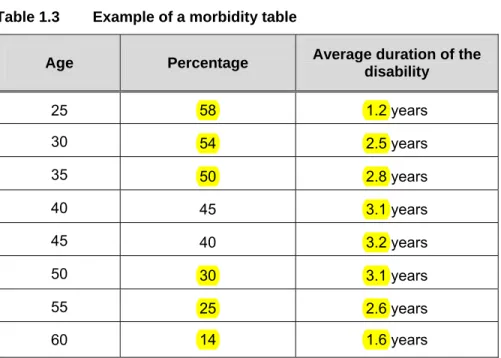
Table 1.3 is an example of a morbidity table. It is based on data collected by Statistics Canada in 2006. The statistical analyses present the percentage of individuals that will be affected by a long-term disability (longer than 90 days) before the age of 65.
Table 1.3 Example of a morbidity table
Age Percentage Average duration of the disability 25 58 1.2 years 30 54 2.5 years 35 50 2.8 years 40 45 3.1 years 45 40 3.2 years 50 30 3.1 years 55 25 2.6 years 60 14 1.6 years
Thus, according to the above morbidity table, 50% of insureds currently 35 years old will be struck by a long-term disability before the age of 65. The disability will have an average duration of 2.8 years.
Various factors influence morbidity rates: a person’s state of health, gender, age and place of residence, the nature of the person’s occupational activities and his lifestyle.
1.3.5. Establishment of a reserve
The establishment of a reserve is a logical principle pursuant to which an insurer must have the funds required to indemnify its insureds in the event an insured risk materializes. Once an insurer is able to predict the probability that a risk will occur, and is therefore able to attribute a cost to the coverage offered, it can establish the amount of the premiums required for each of its insureds. Given that insureds are required to pay the premium (at the beginning of the coverage period) in order to keep the coverage in effect, the
Disability Insurance 50
are paid monthly. However, if benefits are paid as a lump sum, co-ordination of benefits is not taken into account.
After 120 days or 17 weeks (elimination period of two weeks if the employee has not been earning sick leave pay from his employer following his last day worked + coverage period of 15 weeks), which is the coverage period granted under the Employment Insurance Plan in case of sickness, accident or quarantine, an insured will be entitled to receive, from his individual disability insurance plan, the total amount of the benefit provided for in the contract.
The following example illustrates co-ordination of benefits between the Employment Insurance Plan and an individual disability insurance plan.
Example
Marie contributes to the Employment Insurance Plan and earns an annual salary of $40,000. Based on her individual disability insurance plan, she is entitled to a maximum net monthly benefit of $2,000 in the event of disability, after an elimination period of 30 days.
If Marie is disabled, she will receive a net monthly benefit of $1,419 under the Employment Insurance Plan, namely, ($40,000 × 55% × 77.4%) ÷ 12: $40,000 is equal to the maximum annual earnings for purposes of the premium;
77.4% is the net rate after deducting income tax (22.6%);
55% is the benefit rate under the EI Plan. This benefit will be paid over a maximum period of 15 weeks.
After the 30-day elimination period, namely, 15 days after the special employment insurance benefits begin to be paid, Marie’s private insurer will pay the difference between the monthly benefit provided for under the contract ($2,000) and the benefit paid under the Employment Insurance Plan ($1,419), namely, a non-taxable amount of $581. The insurer will pay this amount throughout the 15 weeks during which Marie is indemnified under the Employment Insurance Plan.
After the 15 weeks of co-ordination of benefits, the insurer will be required to pay Marie the total amount of the benefit provided for in the individual disability insurance contract, namely, $2,000.
Chapter 2 – Governmental Plans 71
Self-Evaluation Exercise
Answer the questions in the self-evaluation exercise. The following questions are intended to help you review the topics discussed in the chapter. For each question, circle the correct answer.
Question 1
Louise is temporarily disabled following a skiing accident that leaves her unable to work for a period of three months. She is entitled to the special benefit in the event of an accident under the Employment Insurance Plan. In such a case:
(a) The elimination period is usually 4 months, and the maximum benefit period is 65 years.
(b) The elimination period is usually 2 weeks, and the benefit period is established on the basis of the duration of the disability.
(c) The elimination period is usually 2 weeks, and the maximum benefit period varies depending on the unemployment rate in the disabled person’s region.
(d) The elimination period is usually 2 weeks, and the maximum benefit period is 15 weeks.
Question 2
Which of the following statements applies to the Québec Pension Plan? (a) The disability must be permanent and of indefinite duration in order for
an individual to be covered by the plan.
(b) The plan is administered solely by the Régie des rentes du Québec.
(c) The employment earnings recorded under the plan during a marriage do not form part of the family patrimony.
(d) The plan is financed solely by the workers’ contributions.
Chapter 2 – Governmental Plans 77
Answer Sheet for the Self-Evaluation Exercise
Answer 1Louise is temporarily disabled following a skiing accident that leaves her unable to work for a period of three months. She is entitled to the special benefit in the event of an accident under the Employment Insurance Plan. In such a case:
(a) The elimination period is usually 4 months, and the maximum benefit period is 65 years.
(b) The elimination period is usually 2 weeks, and the benefit period is established on the basis of the duration of the disability.
(c) The elimination period is usually 2 weeks, and the maximum benefit period varies depending on the unemployment rate in the disabled person’s region.
(d) The elimination period is usually 2 weeks, and the maximum benefit period is 15 weeks.
Answer 2
Which of the following statements applies to the Québec Pension Plan?
(a) The disability must be permanent and of indefinite duration in order for an individual to be covered by the plan.
(b) The plan is administered solely by the Régie des rentes du Québec.
(c) The employment earnings recorded under the plan during a marriage do not form part of the family patrimony.
(d) The plan is financed solely by the workers’ contributions.
Chapter 5 – Business Disability Insurance Contracts 203
Answer Sheet for the Self-Evaluation Exercise
Answer 1What type of clientele is not eligible for overhead expense coverage? (a) Sole proprietors.
(b) Professionals.
(c) Self-employed workers.
(d) Insurance companies.
Answer 2
What overhead expenses are eligible under this type of contract? (a) All expenses related to the business’s expenditures.
(b) Most of the fixed costs that the insured continues to assume during his disability.
(c) The majority of expenditures, including travel and entertainment expenses.
(d) Most of the fixed costs that the business continues to assume during the insured’s disability.
Reason: This question refers to the fixed costs of a business that the
insured continues to assume during his disability. The insured and not the business is covered. However, for the purpose of calculating the eligible amount, the insurance company will take into account the business's current expenses. If the insured did not have this coverage, he would have to assume most of the business's fixed costs. His disability could cause the business to shut down, and this is why the company can offer him such a guarantee.
Answer 3
What amount will he receive from the insurance company? (a) He will receive the amount provided for in his contract.
(b) The company will adjust the amount based on the actual expenses.
(c) He will receive $3,600.
(d) He will receive $4,000, but this amount will be subject to increases, depending on the actual expenses of the business.
Reason: Benefits cannot exceed the expenses incurred during the disability.
Disability Insurance 262
documents that may be required depending on the applicant’s occupational situation.
Table 7.4 Examples of documents required depending on the client’s occupational situation
Occupational situation Financial documents required
Employee receiving fixed wages Personal income tax return for the two most recent years.
Commissioned employee Personal income tax return for the two most recent years.
Sole proprietor of a business or partner in a partnership
Personal income tax return or complete financial statements for the two most recent years.
Owner of an incorporated business Personal income tax return for the two most recent years. If profits are to be insured, the complete financial
statements for the two most recent taxation years must be provided.
It should be noted that certain insurers require financial documents for the most recent completed year before accepting an application for insurance. Furthermore, owners of incorporated businesses must usually submit their personal income tax return and the financial statements of the business in order to allow the underwriter to determine whether the business has suffered any losses during the most recent year. If so, the amount will be deducted from the owner’s personal income in order to determine the maximum amount of the benefits.
7.4.5. Calculation of the premium
Calculation of the premium depends on several factors:
• the applicant’s age;
• the applicant’s gender;
• the applicant’s occupation class;
• the applicant’s income;
• the fact that the applicant is a smoker or not;
• the monthly amount of the benefit;
• the elimination period;
• the benefit period; and
• the supplementary coverages.
Chapter 7 – Ratemaking and Selection of Risks 275
Answer questions 5 and 6 by referring to the following situation.
Jacques is a chartered accountant (CA) and has been self-employed for three years. Before that, he worked for eight years for an accounting firm. In 2005, he reported fees of $82,564 and investment income totalling $4,644 and the lease of the residential building he purchased during the year provided him with net income of $10,320. His office expenses amounted to $32,470.
In 2006, he reported net business income of $55,682, net rental income of $12,462 and investment income of $3,754.
Question 5
Determine Jacques’ monthly insurable income. (a) $3,108.17
(b) $4,407.33 (c) $5,339.91 (d) $5,706.00
Question 6
In which occupation class does Jacques’ occupation fall? (a) 4A
(b) 3A (c) 2A (d) A
Disability Insurance 276
Question 7
Lucie is a sales manager at Beaubien inc., a business that manufactures cabinets. She earns $38,400 annually, and her tax rate is 26%. She wants to insure her salary in the event of a disability until the age of 65, and the elimination period will be 120 days. The benefits will not be co-ordinated with employment insurance benefits.
Based on the table of issue limits (table 7.3), what is the amount of the benefit to which she will be entitled?
(a) $900 (b) $1,200 (c) $2,100 (d) $3,200
Question 8
Bernadette works in the field of advertising sales. She earns a basic salary of $25,000, plus commissions. This year, she earned $10,000 in commissions. However, she incurred selling expenses of $2,000 in connection with her sales activities. Sentences deleted
What is Bernadette’s earned income? (a) $35,000
(b) $33,000 (c) $23,100 (d) $42,900
Chapter 7 – Ratemaking and Selection of Risks 277
Question 9
Calculate the monthly premium for Stéphane who wishes to obtain a monthly benefit of $2,400 based on the following premium rates:
Basic amount: $50.40 per $100 of benefits
COLA: $10.26 per $100 of benefits
ROE: $7.04 per $100 of benefits
Policy expenses: $50.00 per year
Monthly premium: Annual premium × 0.087 (a) $150.73
(b) $145.71 (c) $139.56 (d) $121.42
Answer questions 10 and 11 by referring to the following situation:
Marie-Ange is a computer analyst and earns an annual salary of $55,000. She wishes to insure her income in the event of a disability. She would like to purchase the maximum benefit to which she would be entitled according to her financial situation.
Marie-Ange would like coverage with a benefit period until the age of 65 and an elimination period of 30 days. The coverage will be co-ordinated with employment insurance.
Her coverage will have to include the following additional coverages: cost of living adjustment (COLA) and partial disability (PD).
The expected policy expenses will be $40 and the pre-authorized monthly debit will be equal to the annual premium multiplied by 0.087.
Question 10
According to table 7.3, what maximum monthly benefit would Marie-Ange be entitled to receive based on the issue limits?
(a) $2,800 (b) $1,700 (c) $1,100 (d) $3,800
Chapter 7 – Ratemaking and Selection of Risks 283
Answer 5
Determine Jacques’ monthly insurable income.
(a) $3,108.17
(b) $4,407.33 (c) $5,339.91 (d) $5,706.00
Reason: Calculation of insurable income:
Insurable income in 2005: $82,564 (fees in 2005) - $32,470 (office expenses in 2005) $50,094 (net income in 2005) - $14,964 (unearned income in 2005) $35,130 Insurable income in 2006:
$55,682 (net business income in 2006) - $16,216 (unearned income in 2006) $39,466
Average monthly insurable income in 2005 and 2006: $74,596 ($35,130 + $39,466)
÷ 2 $37,298 ÷ 12 $3,108.17
Since Jacques is the owner of the company, the office expenses must be deducted from the income earned in 2005 ($82,564 - $32,470 = $50,094). In 2005, since unearned income exceeds 15%, the investment and rental income ($4,644 + $10,320 = $14,964. In 2006, unearned income totalled $16,216 ($12,462 + $3,754)) must be deducted from income.
The annual average is then calculated by dividing by 2. The result is $37,298. By dividing this result by 12, the monthly insurable income is established at $3,108.17.
Disability Insurance 284
Answer 6
In which occupation class does Jacques’ occupation fall?
(a) 4A
(b) 3A (c) 2A (d) A
Reason: Given that Jacques is a chartered accountant, most companies will
classify him in class 4A.
Answer 7
Based on the table of issue limits (table 7.3), what is the amount of the benefit to which she will be entitled?
(a) $900 (b) $1,200
(c) $2,100
(d) $3,200
Reason: Calculation: $38,400 ÷ 12 = $3,200
According to column 1 of the table, this is equivalent to monthly earned income that falls between $3,101 and $3,300, namely, $2,100 (column 4). Lucie is entitled to the total benefits, given that her benefits are not co-ordinated with employment insurance.
Answer 8
What is Bernadette’s earned income? (a) $35,000
(b) $33,000
(c) $23,100 (d) $42,900
Reason: $25,000 (salary) + $10,000 (commissions) – $2,000 (business expenses) = $33,000.
Chapter 7 – Ratemaking and Selection of Risks 285
Answer 9
Calculate the monthly premium for Stéphane who wishes to obtain a monthly benefit of $2,400 based on the following premium rates:
Basic amount: $50.40 per $100 of benefits
COLA: $10.26 per $100 of benefits
ROE: $7.04 per $100 of benefits
Policy expenses: $50.00 per year
Monthly premium: Annual premium × 0.087 (a) $150.73 (b) $145.71 (c) $139.56 (d) $121.42 Reason: Basic amount: $50.40 × 24 = $1,209.60 COLA: $10.26 × 24 = $246.24 ROE: $7.04 × 24 = $168.96 Policy expenses: $50.00 Annual premium: $1,674.80 Monthly premium ($1,674.80 x 0.087): $145.71 Answer 10
According to table 7.3, what maximum monthly benefit would Marie-Ange be entitled to receive based on the issue limits?
(a) $2,800
(b) $1,700 (c) $1,100 (d) $3,800
Reason: Marie-Ange’s monthly earned income: $55,000 ÷ 12 = $4,583.33.
According to table 7.3, this income entitles her to a total benefit of $2,800.