advances.sciencemag.org/cgi/content/full/5/3/eaau5655/DC1
Supplementary Materials for
Composite lithium electrode with mesoscale skeleton via simple mechanical
deformation
Zheng Liang, Kai Yan, Guangmin Zhou, Allen Pei, Jie Zhao, Yongming Sun, Jin Xie, Yanbin Li, Feifei Shi, Yayuan Liu, Dingchang Lin, Kai Liu, Hansen Wang, Hongxia Wang, Yingying Lu, Yi Cui*
*Corresponding author. Email: [email protected] Published 15 March 2019, Sci. Adv.5, eaau5655 (2019)
DOI: 10.1126/sciadv.aau5655 This PDF file includes:
Fig. S1. Effect of Li strip thickness on the electrochemical performance of the composite electrode.
Fig. S2. Schematics and the corresponding SEM characterization of dense composite Li electrode with nonporous PE film as the skeleton.
Fig. S3. Li stripping on composite Li electrode with porous and dense PE films. Fig. S4. Comparison of long-term cycling of symmetric cells.
Fig. S5. Morphology comparison of Li electrode center part with outer region, before and after cycling.
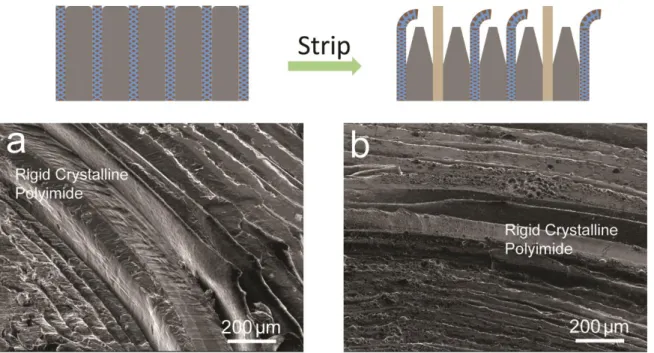
Fig. S6. Characterizations of crystalline PI film.
Fig. S7. Li stripping study of composite Li electrode without crystal PI support. Fig. S8. Li stripping study of composite Li electrode with rigid PI support.
Fig. S9. Symmetric cycling of control Li electrode, composite Li electrode without PI support, and composite electrode with PI support.
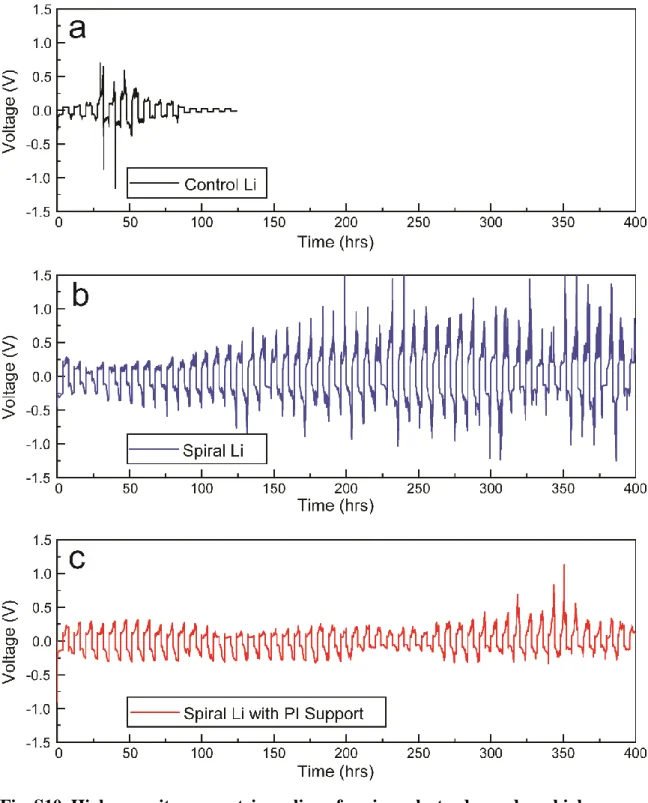
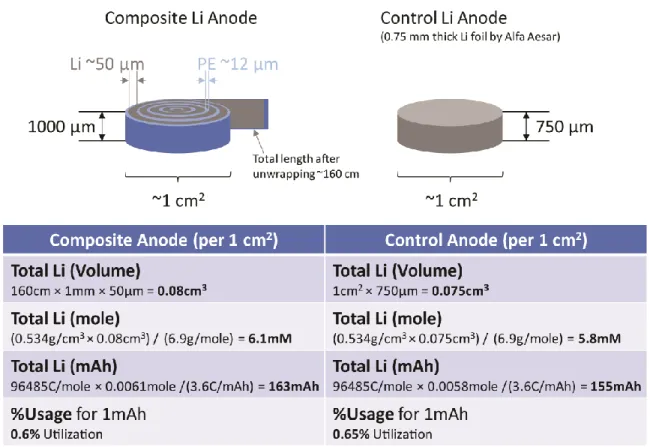
Fig. S10. High-capacity symmetric cycling of various electrodes under a high current density of 8 mA/cm2 for a total of 32 mAh/cm2 in an EC/DEC electrolyte containing 10% FEC and 1% VC. Fig. S11. Detailed information about Li usage for both composite Li and control Li anode and the related calculations.
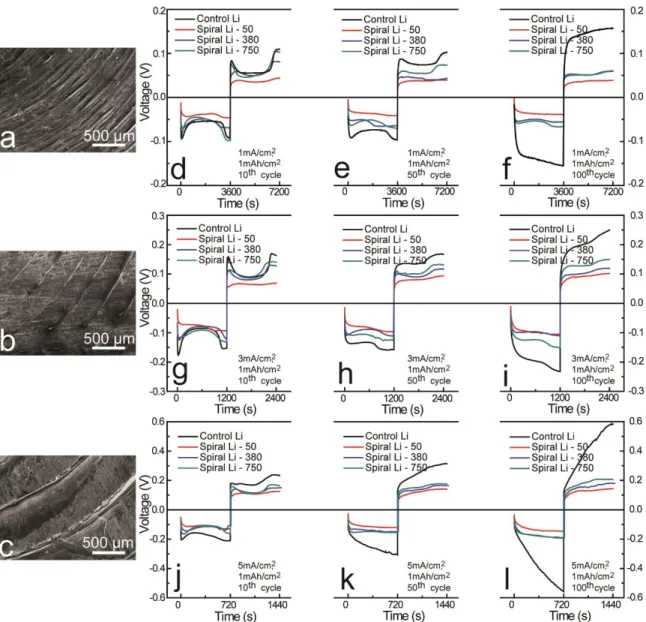
Fig. S1. Effect of Li strip thickness on the electrochemical performance of the composite electrode. (a) SEM image of the composite electrode with 50-μm thick Li
strip, denoted as Spiral Li-50. (b) SEM image of the composite electrode with 380-μm
thick Li strip, denoted as Spiral Li-380. (c) SEM image of the composite electrode with
750-μm thick Li strip, denoted as Spiral Li-750. All three types of composite electrodes show a close-packed structure with Li strips and porous PE films stacked tightly.
Comparison of symmetric cycling voltage profiles of cells with various electrodes at (d)
10th cycle, (e) 50th cycle and (f) 100th cycle at 1 mA/cm2; (g) 10th cycle, (h) 50th cycle and (i) 100th cycle at 3 mA/cm2; (j) 10th cycle, (k) 50th cycle, and (l) 100th cycle at 5 mA/cm2.
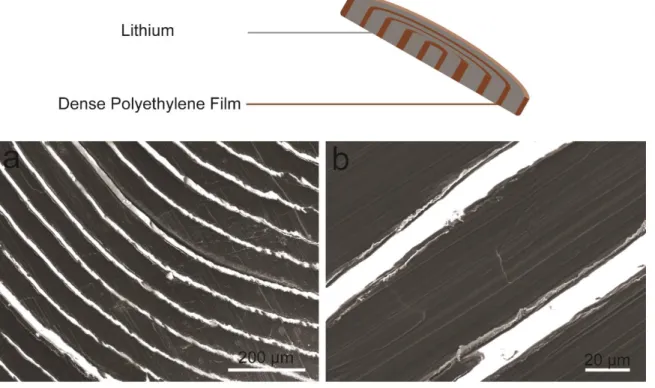
Fig. S2. Schematics and the corresponding SEM characterization of dense composite Li electrode with nonporous PE film as the skeleton. (a) Low-magnification and (b) high-magnification images. The Li strip and the dense PE film have the same geometric dimension as that of the porous composite electrode. The SEM images show that the Li strips and dense PE films are closely packed, ensuring minimal electrolyte diffusion along the sidewall of Li strip. The non-porous PE film inhibits liquid electrolyte
infiltration and therefore exhibits no Li ion conductivity along the sidewall. As a result, Li stripping/plating can only occur at the top surface down to the bottom and vice versa.
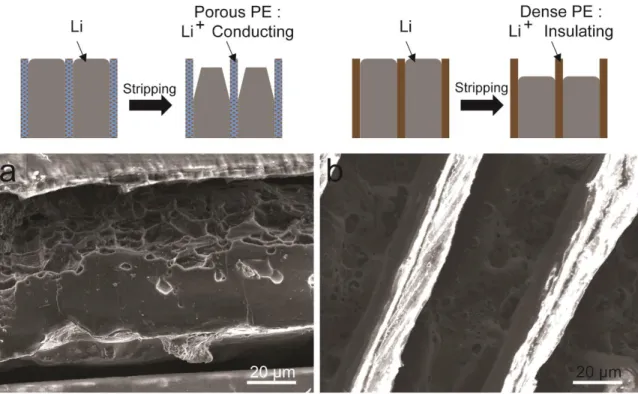
Fig. S3. Li stripping on composite Li electrode with porous and dense PE films. (a) Schematics and the corresponding SEM image of composite electrode with porous PE
film after Li stripping. (b) Schematic and the corresponding SEM image of composite
electrode with dense PE film after Li stripping. For the composite electrode with porous PE film, both height and width of the Li strip are reduced after stripping due to its ion conducting sidewalls, revealing a three-dimensional electrochemical deposition/stripping. Whereas for the composite electrode with non-porous film, no noticeable decrease in Li strip width is observed due to the non-electroactive sidewalls. The stripping process occurs only at the top surface and down to the bottom. The Li stripping is performed at a
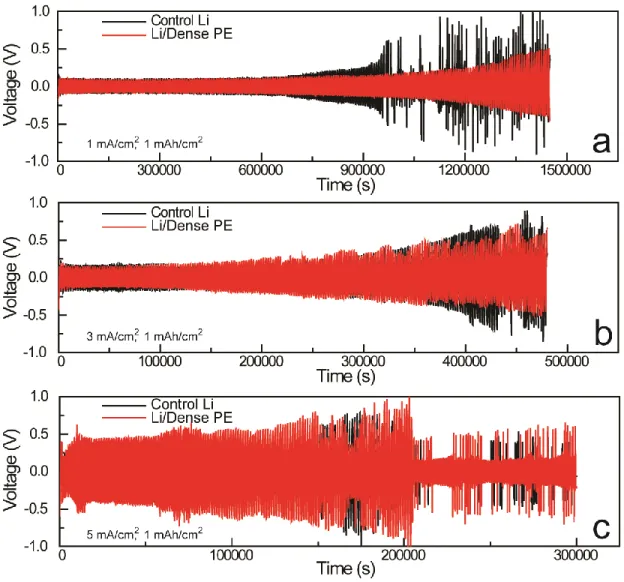
Fig. S4. Comparison of long-term cycling of symmetric cells. employing control
electrode (bare Li foil) and composite electrode with dense film at (a) 1 mA/cm2, (b) 3
mA/cm2 and (c) 5 mA/cm2 for a total of 1 mAh/cm2. No significant improvement on the
cycling stability as well as the polarization is observed for the dense composite electrode compared with the control, elucidating the effectiveness of the porous PE film on the electrochemical performance. The dense PE film allows no liquid electrolyte infiltration, and thus limits the total electroactive surface area.
Fig. S5. Morphology comparison of Li electrode center part with outer region, before and after cycling. SEM images of the outer region of Li electrode, (a) pristine
and (b) after cycling. SEM images of the center part of Li electrode, (c) pristine and (d)
after cycling. The Li electrode was subject to 50 cycles under 5 mA/cm2 for a total of 1
Fig. S6. Characterizations of crystalline PI film. (a) Digital image of the crystalline PI
film. (b) XRD diffraction pattern and (c) Fourier transform infrared spectra of pristine
crystalline PI film.
Fig. S7. Li stripping study of composite Li electrode without crystal PI support. (a)
before and (b) after electrochemical Li stripping for a total of 5 mAh/cm2 under 3
Fig. S8. Li stripping study of composite Li electrode with rigid PI support. (a) before
and (b) after electrochemical Li stripping for a total of 5 mAh/cm2 under 3 mA/cm2.
Fig. S9. Symmetric cycling of control Li electrode, composite Li electrode without PI support, and composite electrode with PI support. Detailed voltage profiles were enlarged and shown as the inset.
Fig. S10. High-capacity symmetric cycling of various electrodes under a high current density of 8 mA/cm2 for a total of 32 mAh/cm2 in an EC/DEC electrolyte containing 10% FEC and 1% VC. (a) Symmetric cycling of cells using bare Li. (b)
Symmetric cycling of cells using spiral Li structure with porous PE film as the matrix. (c)
Symmetric cycling of cells using strengthened spiral Li structure with polyimide-reinforced PE as the matrix.
Fig. S11. Detailed information about Li usage for both composite Li and control Li anode and the related calculations.
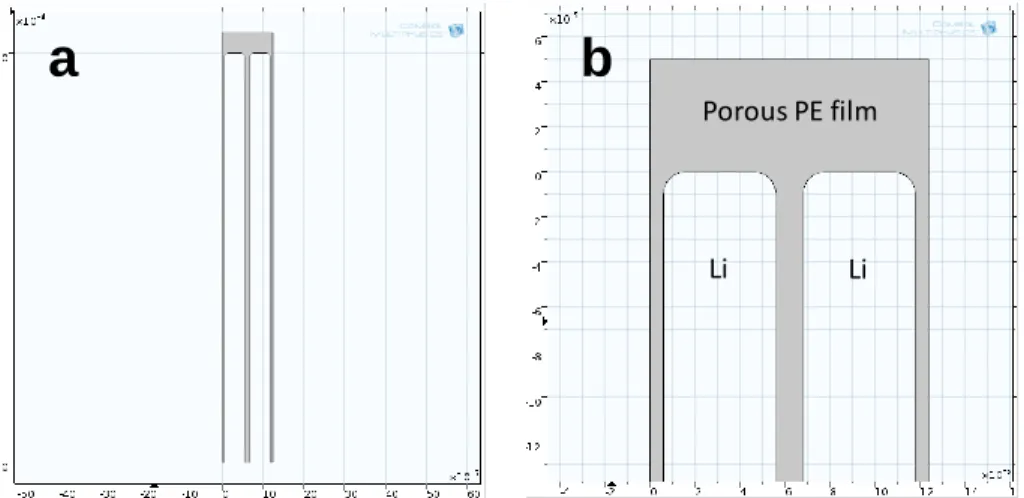
Fig. S12. The magnified simulation cell geometry in COMSOL. for (a) the cross
section of two lithium strips and (b) zoomed-in view of the electrode closest to the top,
corresponding to the model result images in Fig. 2. 1 mm tall Li strips with thickness 50
µm, representing the cross section of the Li strips used in the composite Li electrode, were generated. The area between the Li was filled with electrolyte infused in the porous PE film, as was the area between the Li and the counter electrode. The overpotential of Li
stripping was set to +300 mV vs. Li/Li+ at the working electrode (the entire boundary of
the Li strips) relative to the planar counter electrode, which was held at 0 V. The
diffusion coefficient of Li+ was set to 1x10⁻⁷ cm2/s in the electrolyte. The
electrodeposition module in COMSOL uses the Einstein relation (D = µkbT/q) to
calculate the ionic mobility, µ, and the diffusion coefficient chosen closely matches that calculated from experimental electrolyte conductivities. Due to the potentiostatic nature of the COMSOL model, various snapshots of the stripping process were used to
schematically represent the geometric change in the electrode structure in comparison
with the experimental results from galvanic stripping in Fig. 2 in the main text.
Li
Porous PE film