Contents lists available atScienceDirect
Radiation Physics and Chemistry
journal homepage:www.elsevier.com/locate/radphyschem
A hybrid model for estimation of pore size from ortho-positronium lifetimes
in porous materials
L.Anh Tuyen
a,b,∗, T. Dong Xuan
c, H.A. Tuan Kiet
d,e, L. Chi Cuong
f, P. Trong Phuc
a, T. Duy Tap
g,
Dinh-Van Phuc
c, L.Ly Nguyen
a,g, N.T. Ngoc Hue
a,g, P. Thi Hue
a, L. Thai Son
a,g, D. Van Hoang
a,
N. Hoang Long
a, N. Quang Hung
c,∗∗aCenter for Nuclear Techniques, Vietnam Atomic Energy Institute, 217 Nguyen Trai, District 1, Ho Chi Minh City, Viet Nam bJoint Institute for Nuclear Research, 6 Joliot Curie, Dubna, Russia
cInstitute of Fundamental and Applied Sciences, Duy Tan University, Ho Chi Minh City, Viet Nam dInstitute of Research and Development, Duy Tan University, Danang City, Viet Nam
eGraduate School of Education, University of Pennsylvania, Philadelphia, PA, 19104, USA fUniversity of Technical Education, 1 Vo Van Ngan, Thu Duc District, Ho Chi Minh City, Viet Nam
gUniversity of Science, Vietnam National University Ho Chi Minh City, 227 Nguyen Van Cu, District 5, Ho Chi Minh City, Viet Nam
A R T I C L E I N F O
Keywords:
Positron annihilation lifetime Ortho-positronium Porous materials
A B S T R A C T
The present paper proposes a novel model for estimating the free-volume size of porous materials based on the analysis of various experimental ortho-positronium (o-Ps) lifetime data. The model is derived by combining the semi-classical (SE) physics model, which works in the region of large pores (pore sizeR>1 nm), with the conventional Tao-Eldrup (TE) model, which is applicable only for the small-pore region (R<1 nm). Thus, the proposed model, called the hybrid (HYB) model, is able to smoothly connect theo-Ps lifetimes in the two regions of the pore. Moreover, by introducing theo-Ps diffusion probability parameter (D), the HYB model has re-produced quite well the experimentalo-Ps lifetimes in the whole region of pore sizes. It is even in a better agreement with the experimental data than the most up-to-date rectangular TE (RTE) and Tokyo models. In particular, by adjusting the value ofD, the HYB model can also describe very well the two defined sets of experimentalo-Ps lifetimes in the pores with spherical and channel geometries. The merit of the present model, in comparison with the previously proposed ones, is that it is applicable for the pore size in the universal range of
−
0.2 400nm for most of porous materials with different geometries.
1. Introduction
Using and controlling the reciprocal influences between porosity, crystal structure, lattice defects, surface property, molecular transport, and reactions (chemical, catalytic, ion-exchange, etc) in functional materials are keys to various technologies for sustainable development of the world (Davis, 2002). Nanostructured materials such as silica, zeolite, metal-organic framework materials, etc., contain a complex matrix of pore structures, which plays a fundamental role to their ap-plications in environmental treatments, industrial catalysis, energy storage, etc. In the structural research of above materials, the applicable limitations of adsorbed/desorbed methods at the nanometer scale lead to participation of the nuclear techniques such as the small angle neutron scattering (SANS) (Jacrot, 1976), small angle X-ray scattering
(SAXS) (Glatter and Kratky, 1982), positron annihilation lifetime spectroscopy (PALS) (Siegel, 1980; Gidley et al., 1976), etc. Among these techniques, PALS has been commonly and widely applied for the structure study of various materials and matters in many decades, in-cluding solids (Kahana, 1963), molecular substances (Tao, 1972), electron liquid (Arponen and Pajanne, 1979) and gas (Drummond et al., 2011), solid pivalic acid (Eldrup et al., 1981), thinfilms (Dull et al., 2001), semiconductors (Tuomisto and Makkonen, 2013), zeolites (Tuyenet al, 2015; Tuyen et al, 2017), etc. One of the most obvious applications of PALS arises from the fact that in materials, the structural traps such as micro/mesopores (channels, cavities or cages) and defects (vacancies, voids, etc.) could affect the local electron distributions and consequently lead to a significant change of the positron lifetimes (Dull et al., 2001;Kajcsoset al, 2007). As a result, the localizedo-Ps lifetime is
https://doi.org/10.1016/j.radphyschem.2020.108867
Received 10 December 2019; Received in revised form 3 February 2020; Accepted 10 March 2020
∗Corresponding author. Center for Nuclear Techniques, Vietnam Atomic Energy Institute, 217 Nguyen Trai, District 1, Ho Chi Minh City, Viet Nam. ∗∗Corresponding author.
E-mail addresses:[email protected](L.A. Tuyen),[email protected](N. Quang Hung).
sensitive to the trap size, that is, the larger the trap is, the longer life-time of the localizedo-Ps can be obtained (Tuyen et al, 2017). For the spherical pores, thefirst and simplest model describing the correlation of o-Ps lifetime and pore radius (R) via the pick-offannihilation was proposed long time ago by Tao and Eldrup (TE model) by using a spherically symmetric infinite potential well (Tao, 1972;Eldrup et al., 1981). The TE model, which was derived based on the quantum me-chanics, considers theo-Ps in the pore as a single particle, whose mass is twice the electron mass, in a spherical potential well of radiusR. Thus, this model is applicable only for estimation of the pores with a very small sizeR<1nm. In other words, this model is not applicable for
>
R 1nm (Goworek, 2002).
Many attempts have been made since last three decades in oder to extend the TE model to the region of larger pores. Thefirst attempt was made by extending the TE model (also called the ETE model) to include some thermally excited states in the spherical and infinitely long cy-lindrical wells using the Bessel functions (Goworek et al., 1998). However, this approach becomes computationally difficult once the order of the spherical Bessel functions is high. A year later, a classical model (CM) was proposed byGidley et al. (1999). This model is indeed an extension of the quantum mechanical TE model to the classical large-pore limit by assuming the rectangular geometry of the large-pores. Although this model is adequately accounted forRin the range of 0.1–600 nm, it always overestimates the experimental data in the small posize re-gime (R<1nm). At the same year, Ito et al. proposed the modified TE model (called Tokyo model) based on a phenomenological assumption that theo-Ps exhibits more like a quantum particle, bouncing back and forth between the energy barriers as the potential well or pore size is extended (Ito et al., 1999a). With this assumption, they have derived a simple analytical relation between the pore size and theo-Ps lifetime but the results obtained agree with the experimental data only at 1 nm < <R 30 nm (Dull et al., 2001). The latest updated model, called the rectangular Tao-Eldrup model (RTE), was proposed by Dull et al. (2001). The RTE was derived by switching to the rectangular pore geometry instead of the spherical one as in the conventional TE model and then taking into account the temperature effect (within the Boltz-mann statistics) of theo-Ps lifetime. Since then, this model has been commonly used because it is applicable for the pores of any size at any sample temperature. However, the later tests byThraenert et al. (2007)
andZaleski et al. (2012)have shown that the RTE agrees with the ex-perimental data at R>2−3 nm and around the room temperature (T≈300K) only. AtRbelow2−3nm, the RTE predicts the lifetimes of about 20% lower than those predicted by the ETE as well as the ex-perimental data. In addition, at low temperatures, for small pores (R<3 nm), this model can not explain the increase of the experimental lifetime, whereas for larger pores (R>5 nm), it shows a contrary be-havior with the experimental data. Nevertheless, the RTE has still considered as the most up-to-date extension of the TE model. It is therefore highly desirable to develop a new model, which overcomes the shortcomings of all the above approaches.
In fact, we have recently proposed a semi-empirical model based on the semi-classical (SE) picture, which is used to determine the o-Ps radial probability function for the large pores, and weighting with the TE model, which is applicable for the small pores (Thanh et al., 2008). This semi-empirical model offers a better agreement with the experi-mental data than the ETE and RTE but only in the region of pore size from 1 nm to around 30 nm. Moreover, this approach does not take into account either the geometry of the pore or the effect of temperature. In the present paper, we report a new model for calculating the universal free-volume size in porous materials by combining the quantum (TE) model with the semi-classical (SE) one and taking into account also different pore geometries. To determine the model parameters, the experimental data of theo-Ps lifetimes in porous materials reported and updated over past four decades are used. In addition, the correctness of the model is verified by using theo-Ps lifetimes in the spherical and channel pores of porous materials.
2. Theoretical models ofo-Ps lifetime and pore-size estimations
2.1. The Tao-Eldrup model for small pores
The Tao-Eldrup model, which was thefirst model describing the relation between theo-Ps lifetime and pore radius in porous materials, assumes that theo-Ps in the pore can be treated as a single quantum particle moving in a spherically symmetric infinite potential well of radiusR(Tao, 1972;Eldrup et al., 1981). The pick-offannihilation rate of the trappedo-Ps in the pore of radiusR+ΔRin this case is given by
= ⎡ ⎣ ⎢ − + + ⎛⎝ + ⎞⎠ ⎤ ⎦ ⎥=
λ λ R
R R π
πR
R R λ f R
1 Δ
1 2 sin
2
Δ ( ),
TE A A TE
(1)
where = − +
+
(
+)
fTE( )R 1 R sin
R R π
πR R R Δ 1 2 2
Δ is the pore-size correlation function, whereasλA=(λS+3 )/4λT ≈2ns−1is the spin-averaged
va-cuum annihilation rate withλSandλTbeing, respectively, the intrinsic annihilation rates of spin-singlet Ps (p-Ps) ando-Ps in the vacuum. The value of the parameterΔR, which is the thickness of the virtual electron layer, was empirically obtained to be 0.166 nm. The lifetime of theo-Ps is simply calculated from equation(1) asτTE( )R =1/λTE( )R. The TE model describes very well the porous materials with pore size less than 1 nm. However, when the pore size is larger than 1 nm, theo-Ps lifetime calculated from the TE model deviates from the experimental data. The reason is that the TE model neglected the annihilation rate of theo-Ps lifetime in vacuumλT, which is equal to~1/142 ns (Dull et al., 2001).
2.2. The models for large pores
The simplest way to extend the TE model for the estimation of large pores is to modify Eq.(1)by addingλTto its right-hand side. This semi-phenomenological model, which was proposed by a group of the Uni-versity of Tokyo and thus called the Tokyo model (Ito et al., 1999a;Dull et al., 2001;Thraenert et al., 2007), divided the pore radius into two regions according to a critical radiusRa, namely
=⎧ ⎨ ⎩ + < ⎡ ⎣ − ⎤⎦ + ≥ − +
(
)
λ Rλ R λ R R
λ R λ R R
( )
( ) for ,
( ) 1 for ,
Tokyo
TE T a
TE a RR RR b
T a
Δ
a
(2) whereRaandbare two free parameters, whose values are empirically determined via the fitting to various experimental data (Thraenert et al., 2007). Although the Tokyo model is able to treat theo-Ps lifetime in the large pores, it overestimates the experimental data when the pore sizeRis smaller than 1 nm and higher than 30 nm (see e.g., the dotted lines in Fig. 6 of Ref. (Dull et al., 2001)).
The above drawback of the Tokyo model can be solved by using the rectangular TE (RTE) model (Dull et al., 2001). The RTE model was proposed by switching the pores from spherical to rectangular geome-tries. By using this rectangular geometry, the RTE model has avoided to use the complicated Bessel functions as in the spherical case. The RTE equation is obtained by solving the Schrodinger equation for theo-Ps in an infinite rectangular well with side length ofa b, , andcin thex y, , andzdirections. Thefinal pick-offannihilation rate of theo-Ps is cal-culated from the following equation
= − −
λ ( , , ,a b c T) λ λ λ F a δ T F b δ T F c δ T
4 ( , , ) ( , , ) ( , , ),
RTE A S T (3)
where = − + − − = ∞ = ∞
(
)
(
)
( )
F x δ T δ
x
( , , ) 1 2
sin exp exp . i iπ iπδ x βi kTx i βi kTx 1 1 2 1 2 2 2 2 (4)
Here,Tis temperature, β=h2/16m=0.188 eVnm2
channel-like pores, and compact three-dimensional (3D) cubic pores. Amongst these cases, the 3D cubic one with the cube width ofa, which is related to the pore radiusRviaa=2(R+Δ )R, was popularly used. The value ofδ=0.18 nm was chosen so thatλRTE( ,R T=0)agrees with λTE( )R in the region in which the TE model offers the most accurate results, namely the region ofR<1 nm.
A recent model for large pores has been proposed by Wada and Hyodo (2013). This model was developed by modifying the classical model (MCM) to include the size effect of Ps atom for large pores and combining it with the Tokyo model (called as the modified TE (MTE) model in Ref. (Wada and Hyodo, 2013)) for small pores. Theo-Ps an-nihilation rate in this MTE + MCM model is given as
= ⎧ ⎨ ⎩
= <
≥
+
λ λ R L L
λ L L
( 3‾/4) (‾ 1.28 nm),
(‾) (‾ 1.28 nm),
MTE MCML
MTE
MCM ‾
(5) whereλMTE( )R =λTE( )R +λTand
=
− +
λ L v P
L λ
(‾)
‾ 2Δ‾ ,
MCM th A T (6)
with L‾=4 /3,R vth, and PA being the mean free length of the pore, thermal velocity of the Ps, and pick-off annihilation probability per collision with the cavity wall, respectively (Wada and Hyodo, 2013). The parameterΔ‾, which characterizes thefinite size effect, is adjusted so that theo-Ps lifetime coincides with that obtained within the MTE model. Practically, the MTE + MCM model combines the MTE model for the pores withL‾<1.28nm or theo-Ps lifetime less than 21.1 ns and the MCM model for the pores with L‾≥1.28nm or the o-Ps lifetime longer than 21.1 ns. When the pore is in cubic geometry, results ob-tained within the MTE + MCM are almost the same as those predicted by the RTE.
2.3. The semiclassical model
The semiclassical model (SE) model was first introduced in Ref. (Thanh et al., 2008). This model was derived based on an assumption that in the region of small pores (R<1 nm), theo-Ps is confined in an infinite potential well and its state is presented by the standing wave as depicted in Fig. 1(a). However, when the pore size is increased, its radius moves toward the semiclassical region (Gidley et al., 1999), hence theo-Ps energy is in the range ofkTat room temperature withk
being the Boltzmann constant. As a result, theo-Ps with lower energy will exist with a longer lifetime, leading consequently to the larger pore size or the higher de-trapping probability ofo-Ps (Goworek et al., 2000;
Dutta et al., 2008;Maheshwari et al., 2010). Therefore, instead of using a spherically symmetric infinite potential well (Ugoes from 0 to in-finity) as in the TE model (Fig. 1(a)), the SE model applied a similar potential well but with the finite depthU=U0 (Fig. 1(b)). With this finite potential well, the assumption of standing waves as in the TE model is no longer hold. Instead, the SE model employed the Gaussian wave packets, which describe the scattering of o-Ps back and forth
between the energy barriers on the pore wall before annihilating with electrons, similar to those proposed in Ref. (Ito et al., 1999a). Thus, the annihilation process ofo-Ps will pass through both the intrinsic and pick-offannihilations in vacuum around the pore center and at the pore wall, respectively. When the pore size is increased to a large enough space, theo-Ps probability density function becomes mostly uniform in the pore andΔRis very small in comparison withR. Therefore, theo-Ps wave function in the range fromRtoR+ΔRcan be approximated by
=
ψSE( )r Dα r/, whereαis the normalization factor determined from the condition that theo-Ps probability function in the pore should be uni-form andD≈exp( 2 Δ )− κ R (κ= 4m Ue( 0−E)/ℏ2 withmeandℏbeing the electron mass and Planck constant, respectively) (Thanh et al., 2008). The pick-offannihilation rate ofo-Ps in this case is then given as
=
+ + ⎛⎝ + ⎞⎠ =
λ λ D
D R
R R
R
R R λ f R
3 1
Δ
Δ Δ ( ),
SE A P SE
2
(7)
where =
+
λP 13DD Aλ andfSE( )R = +
(
+)
R R RR R R Δ
Δ Δ
2
. Equation(7)is formally similar to Eq.(1), that is,λPandfSE( )R are equivalent toλAandfTE( )R, respectively. However, λPis now expressed in terms of the diffusion probability D, whereas fSE( )R does not contain the sine function be-cause of its simple wave function (ψSE( )~1/r r) within the region ofR
andR+ΔR. Moreover, it should be noted here that the parameterD
was defined in Ref. (Thanh et al., 2008) as theo-Ps diffusion coefficient, which was then approximated byD≈exp( 2)− . This artificial definition and approximation ofDare still difficult to physically justify. As dis-cussed later, Dshould be correctly considered as the probability for which theo-Ps could diffuse into the virtual electron layerΔR(diffusion probability). Hence, the value ofDshould be found via thefitting to the experimental data in a wide and diversified range ofR, which corre-sponds to different geometries of the pore.
2.4. The hybrid model
The SE model in Eq.(7)was proposed to treat the annihilation ofo -Ps in the region of large poreR>1nm. To have a continuous estima-tion for all the pores, Ref. (Thanh et al., 2008) has proposed a semi-empirical equation (see Eq.(9)therein), which is simply a arithmetic mean of the weighted TE and SE pick-offannihilation rates, namely
= + + + +
−
λ 1 λ λ λ λ λ λ λ
2[( ) ( )( ) ].
semi emp TE SE T TE T SE T (8)
This arithmetic mean comes from an assumption in Ref. (Dull et al., 2001) that the parameterD is considered as the diffusion constant, which is nothing related to the pore geometry. In fact, influence of the pore geometries on theo-Ps lifetimes was considered by replacing the radius of spherical pore with the mean free path ofo-Ps in rectangular geometry. In such case, theo-Ps lifetime depends on the number of times at which theo-Ps interacts with the pore wall, which should be related to the diffusion probability of o-Ps into the virtual electron layer. In a later study,Shantarovich (2008)indicated the effect of the
length of channel pores on theo-Ps lifetimes and reconfirmed the im-portance of pore geometries (shapes) in calculating the o-Ps lifetime. Various experimental data have also shown that when the pore size becomes large enough, the influence of pore geometries on theo-Ps lifetime is significant and should not be neglected. Therefore, the parameter Din Eq.(7)must be correctly considered as the diffusion probability associated with the pore geometry. As a result, the simple arithmetic mean in Eq.(8)should be replaced with the geometric one and the proposed model is called the hybrid (HYB) model, namely
= + × + +
λHYB [( λ λTE SE λT) (λTE λT)(λSE λT) ] , 1/2
(9) which can be approximately shorten to
≈ + +
λHYB (2λTE λT)(λSE/2 λT) . (10)
Two Eqs.(8) and (9)produce similar results ifλTis relatively small compared toλSEandλTE.
3. Results and discussions
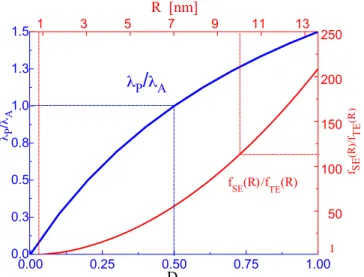
Fig. 2plots the relation between the ratiosλ λP/ AandfSE/fTEversus the pore radiusRand diffusion probabilityD, whereasFig. 3depicts the
o-Ps lifetime τ obtained within different models (TE, SE, RTE, MTE + MCM, and HYB) in comparison with the experimental data collected from various experiments (Gidley et al., 1976; Dull et al., 2001;Ito et al., 1999a;Dutta et al., 2008;Mikrushin et al., 1972;Ito et al., 1999b;Dutta et al., 2004;Dutta et al., 2005;Sudarshan et al., 2007;Liszkayet al, 2012;Zubiaga et al., 2017). InFig. 2, the ratioλ λP/ A increases with increasingD, equals to 1 atD=0.5, and reaches 1.5 at the maximum valueD=1. In addition,λPis affected by not only the pore radiusRbut also the diffusion probabilityD. This result suggests that for the small pores, theo-Ps will interact and diffuse strongly to the virtual electron layerΔR, leading to the increase of the pick-off anni-hilation rate and the decrease ofo-Ps lifetime as predicted by the TE model. However, when the pore size is large enough, theo-Ps has some possibilities to diffuse to the virtual electron layer at the wall, resulting in the pick-offannihilation process via the emission of 2γor the scat-tering back to the center of the pore before the appearance of the 3γ intrinsic annihilation phenomenon. Thus, the SE model reconfirms the important contribution of the intrinsic annihilation rate ofo-Ps men-tioned in the Tokyo model (see Eq.(2)). As for the ratio between the two pore-size correlation functions fSE/fTE, Fig. 2 shows that at R≤
0.7 nm, this ratio increases very slowly, leading to the value ofτSEbeing lower than that ofτTE. With increasingR>0.7 nm, this ratio rapidly
increases by more than two orders of magnitude atR=10 nm. This is a striking result, which indicates that theo-Ps lifetime obtained within the SE model will reach the extreme value much slower than that ob-tained within the TE model and thus the calculating limitation of the SE model will be more extensive in comparison with the TE model. In other words, the TE model is only applicable for the small pores, whereas the SE model is favorable for the large pores. Hence, the combination of the TE and SE models as presented in Eq.(9)should result in a hybrid model, which smoothly connects the two regions of the pores and is consequently workable for all the materials with any pore sizes. This can be clearly seen viaFig. 3.
InFig. 3, one can see that in the small pore region (R<0.7 nm),τTE andτRTEexcellently agree with the experimental data, whereasτSEand τTokyooverestimate the data. At higherR>0.7 nm,τTErapidly increases, while the increase ofτSEis relatively slower. Also in this region,τRTE agrees with the upper data points, whereasτTokyofits to the lower data ones. The values of λMTE MCM+ taken fromFig. 3 of Ref. (Wada and
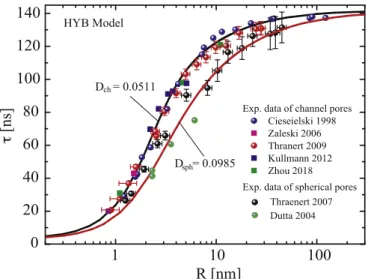
Hyodo, 2013) are found to be almost the same with the RTE results. Obviously, the HYB model with the bestfitted valueD=0.0985 has successfully connected the two pore-size regions, resulting in a smooth curve ofτHYBin the whole region ofR. In addition, the values ofτHYB, which are in the middle of the upper and lower data points, are in the best agreement with the experimental data as compared with the Tokyo and RTE models. This result of HYB model reveals the important con-tribution of the diffusion probabilityDproposed in Eq.(7).
As discussed above, the diffusion probabilityDshould depend on the pore geometry. Two popular pores, which have been often studied and detected within the experiment, are those having spherical and channel geometries. Within the HYB model, theo-Ps lifetime also varies withD, so there must be different values ofDcorresponding to different pore geometries. By selecting the experimental data detected for ma-terials with the defined spherical (Thraenert et al., 2007;Dutta et al., 2004) and channel (Ciesielski et al., 1998;Zaleski et al., 2006;Thranert et al., 2009;Kullmann et al., 2012;Zhou et al., 2018) pores, we are able to determine the values ofDso that theo-Ps lifetimes obtained within the HYB modelfit excellently the corresponding experimental data. The results are shown inFig. 4. Here, the values ofDare found to be 0.0985 (Dsph) and 0.0511 (Dch) for the spherical and channel pores, respec-tively. These values ofDare physically reasonable because the prob-ability that the particle diffuses into the spheres must be always higher than that occurs in the channels.
Fig. 2.The plots of the relation betweenλAandλPas well asfTE( )R andfSE( )R
obtained from equations(1) and (7).
4. Conclusion
The present paper proposes a semi-classical (SE) model, which treats theo-Ps lifetime in the region of large pores where the quantum mechanical effect should be negligible in comparison with the classical one. The SE model, which takes into account the important effect coming from the diffusion probabilityD, is then consistently combined with the conventional Tao-Eldrup model for small pores, resulting a hybrid (HYB) version. As the result, the HYB model not only connects smoothly two regions of the pore but also agrees well with various experimentalo-Ps lifetime data for the whole region of pore size from 0.2 to 400 nm. This HYB model is also in a better agreement with the experimental data than the rectangular TE (RTE) and Tokyo models, which are the most up-to-date models of theo-Ps lifetime and pore size. In particular, by varying the diffusion probabilityD, we are able to describe very well two defined sets of experimental data for theo-Ps lifetime in the pores with spherical and channel geometries. The value ofDfor the pores with the spherical geometry is found to be larger than that obtained for the channel one. Thisfinding is physically reasonable since the diffusion probability of the particle in the spheres must be certainly higher than that in the channels. The merit of the present model, in comparison with the previously proposed ones, is that it is applicable for the pore size in the universal range of0.2−400nm for most of porous materials with different geometries.
In the present model, the effect of temperature has not been con-sidered. In fact, the temperature effect should be treated via the tem-perature-dependent diffusion probabilityDsinceDis strongly depen-dent on temperature. The calculations with temperature are undergoing and the results will be reported in a separate paper.
Declaration of competing interest
The authors declare that they have no known competingfinancial interests or personal relationships that could have appeared to infl u-ence the work reported in this paper.
Acknowledgements
This work is funded by Ministry of Science and Technology of Vietnam under the Grant Number DTCB: 14/19 TTHN.
Appendix A. Supplementary data
Supplementary data to this article can be found online athttps://
doi.org/10.1016/j.radphyschem.2020.108867.
References
Arponen, J., Pajanne, E., 1979. Electron liquid in collective description. III. Positron annihi-lation. Ann. Phys. 121, 343.
Ciesielski, K., Dawidowicz, A.L., Goworek, T., Jasinska, B., Wawryszczuk, J., 1998. Positronium lifetimes in porous Vycor glass. Chem. Phys. Lett. 289, 41.
Davis, M.E., 2002. Ordered porous materials for emerging applications. Nature 417, 813.
Drummond, N.D., Lopez, R.P., Needs, R.J., Pickard, C.J., 2011. Quantum Monte Carlo study of a positron in an electron gas. Phys. Rev. Lett. 107, 207402.
Dull, T.L., Frieze, W.E., Gidley, D.W., 2001. Determination of pore size in mesoporous thinfilms from the annihilation lifetime of positronium. J. Phys. Chem. B 105, 4657.
Dutta, D., Ganguly, B.N., Gangopadhyay, D., Mukherjee, T., Dutta-Roy, B., 2004. Microstructural study of silica gel by positron annihilation. J. Phys. Chem. B 108, 8947.
Dutta, D., Chatterjee, S., Ganguly, B.N., Pillai, K.T., 2005. A comparative assay through positron annihilation and gas adsorption methods. J. Phys. Chem. B 108, 8947.
Dutta, D., Pujari, P.K., Sudarshan, K., Sharma, S.K., 2008. Effect of confinement on the phase transition of benzene in nanoporous silica: a positron annihilation study. J. Phys. Chem. C 112, 19055.
Eldrup, M., Lightbody, D., Sherwood, J.N., 1981. The temperature dependence of positron lifetimes in solid pivalic acid. Chem. Phys. 63, 51.
Gidley, D.W., Marko, K.A., Rich, A., 1976. Precision Measurement of the decay Rate of Orthopositronium in SiO2powders. Phys. Rev. Lett. 36, 395.
Gidley, D.W., Frieze, W.E., Dull, T.L., Yee, A.F., Ryan, E.T., Ho, H.M., 1999. Positronium an-nihilation in mesoporous thinfilms. Phys. Rev. B 60, 8 (R).
Glatter, O., Kratky, O., 1982. Small Angle X-Ray Scattering. Academic Press, London.
Goworek, T., 2002. Comments on the relation: positronium lifetime-free volume size para-meters of the Tao-Eldrup model. Chem. Phys. Lett. 366, 184.
Goworek, T., Ciesielski, K., Jasinska, B., Wawryszczuk, J., 1998. Positronium states in the pores of silica gel. Chem. Phys. 230, 305.
Goworek, T., Ciesielski, K., Jasinska, B., Wawryszczuk, J., 2000. Temperature variations of average o-Ps lifetime in porous media. Radiat. Phys. Chem. 58, 719.
Ito, K., Nakanishi, H., Ujihira, Y., 1999a. Extension of the equation for the annihilation lifetime of ortho-positronium at a cavity larger than 1 nm in radius. J. Phys. Chem. B 103, 4555.
Ito, K., Yagi, Y., Hirano, S., Miyayama, M., Kudo, T., Kishimoto, A., Ujihira, Y., 1999b. Estimation of pore size of porous materials by positron annihilation lifetime measurement. J. Ceram. Soc. Jpn. 107, 123.
Jacrot, B., 1976. The study of biological structures by neutron scattering from solution. Rep. Prog. Phys. 39, 911.
Kahana, S., 1963. Positron annihilation in metals. Phys. Rev. 129, 1622.
Kajcsos, Zs, et al., 2007. Competitive positron and positronium trapping in porous media. Radiat. Phys. Chem. 76, 231.
Kullmann, J., Enke, D., Thraenert, S., Krause-Rehberg, R., Beiner, M., 2012. Characterization of porefilling of mesoporous host systems by means of positronium annihilation lifetime spectroscopy (PALS). Opt. Appl. 42, 281.
Liszkay, L., et al., 2012. Positron annihilation in latex-templated macroporous silicafilms: pore size and ortho-positronium escape. New J. Phys. 14 065009.
Maheshwari, P., Dutta, D., Sharma, S.K., Sudarshan, K., Pujari, P.K., Majumder, M., Pahari, B., Bandyopadhyay, B., Ghoshray, K., Ghoshray, A., 2010. Effect of interfacial hydrogen bonding on the freezing/melting behavior of nanoconfined liquids. J. Phys. Chem. C 114, 4966.
Mikrushin, A.D., Levin, B.M., Goldanskii, V.I., Tsyganov, A.D., Bardyshev, I.I., 1972. Annihilation of positrons in silica-gels. Russ. J. Phys. Chem. 46, 368.
Shantarovich, V.P., 2008. Positron annihilation and free volume studies in Polymer glasses. J. Polym. Sci. B 46, 2485.
Siegel, R.W., 1980. Positron annihilation spectroscopy. Annu. Rev. Mater. Sci. 10, 393.
Sudarshan, K., Dutta, D., Sharma, S.K., Goswami, A., Pujari, P.K., 2007. Air quenching of po-sitronium in mesoporous materials: positron porosimetry. J. Phys. Condens. Matter 19, 386204.
Tao, S.J., 1972. Positronium annihilation in molecular substances. J. Chem. Phys. 56, 5499.
Thanh, N.D., Dung, T.Q., Tuyen, L.A., Tuan, K.T., 2008. Semiempirical formula for large pore-size estimation from the o-Ps annihilation lifetime. Int. J. Nucl. Energy Sci. Technol. 4, 81.
Thraenert, S., Hassan, E.M., Enke, D., Fuerst, D., Krause-Rehberg, R., 2007. Verifying the RTE model: ortho?positronium lifetime measurement on controlled pore glasses. Phys. Status Solidi 4, 3819.
Thranert, S., Enke, D., Dlubek, G., Krause-Rehberg, R., 2009. Positron lifetime spectroscopy on controlled pore glass porosimetry and pore size distribution. Mater. Sci. Forum 607, 169.
Tuomisto, F., Makkonen, I., 2013. Defect identification in semiconductors with positron anni-hilation: experiment and theory. Rev. Mod. Phys. 85, 1583.
Tuyen, L.A., et al., 2015. Structural effects induced by 2.5 MeV proton beam on zeolite 4A: positron annihilation and X-ray diffraction study. Radiat. Phys. Chem. 106, 355.
Tuyen, L.A., et al., 2017. Simultaneous existence of defects and mesopores in nanosized ZSM-5 zeolite studied by positron annihilation and X-ray diffraction spectroscopies. J. App. Phys. 121 084303.
Wada, K., Hyodo, T., 2013. A simple shape-free model for pore-size estimation with positron annihilation lifetime spectroscopy. J. Phys: Conf. Ser. 443 012003.
Zaleski, R., Goworek, J., Borowka, A., 2006. Characterization of porous solids VII. Stud. Surf. Sci. Catal. 160, 471.
Zaleski, R., Kierys, A., Dziadosz, M., Goworek, J., Halasz, I., 2012. Positron annihilation and N2
adsorption for nanopore determination in silica-polymer composites. RSC Adv. 2, 3729.
Zhou, B., Li, C.Y., Qi, N., Jiang, M., Wang, B., Chen, Z.Q., 2018. Pore structure of mesoporous silica (KIT-6) synthesized at different temperatures using positron as a nondestructive probe. Appl. Surf. Sci. 450, 31.
Zubiaga, A., Warringham, R., Mitchell, S., Gerchow, L., Cooke, D., Crivelli, P., Perez-Ramirez, J., 2017. Pore topology effects in positron annihilation spectroscopy of zeolites. ChemPhysChem 18, 470.