ON IMPROVING EFFICIENCY OF DATA-INTENSIVE APPLICATIONS IN GEO-DISTRIBUTED ENVIRONMENTS
Fan Jiang
A dissertation submitted to the faculty of the University of North Carolina at Chapel Hill in partial fulfillment of the requirements for the degree of Doctor of Philosophy in the Department of Computer Science.
Chapel Hill 2020
© 2020 Fan Jiang
ABSTRACT
Fan Jiang: On Improving Efficiency of Data-Intensive Applications in Geo-Distributed Environments (Under the direction of Stan Ahalt and Claris Castillo)
Distributed systems are pervasively demanded and adopted in nowadays for processing data-intensive workloads since they greatly accelerate large-scale data processing with scalable parallelism and improved data locality. Traditional distributed systems initially targeted computing clusters but have since evolved to data centers with multiple clusters. These systems are mostly built on top of homogeneous, tightly integrated resources connected in high-speed local-area networks (LANs), and typically require data to be ingested to a central data center for processing. Today, with enormous volumes of data continuously generated from geographically distributed locations, direct adoption of such systems is prohibitively inefficient due to the limited system scalability and high cost for centralizing the geo-distributed data over the wide-area networks (WANs). More commonly, it becomes a trend to build geo-distributed systems wherein data processing jobs are performed on top of geo-distributed, heterogeneous resources in proximity to the data at vastly distributed geo-locations. However, critical challenges and mechanisms for efficient execution of data-intensive applications in such geo-distributed environments are unclear by far.
The goal of this dissertation is to identify such challenges and mechanisms, by extensively using the research principles and methodology of conventional distributed systems to investigate the geo-distributed environment, and by developing new techniques to tackle these challenges and run data-intensive applications with efficiency at scale. The contributions of this dissertation are threefold.
Firstly, the dissertation shows that the high level of resource heterogeneity exhibited in the geo-distributed environment undermines the scalability of geo-distributed systems. Virtualization-based resource abstraction mechanisms have been introduced to abstract the hardware, network, and OS resources throughout the system, to mitigate the underlying resource heterogeneity and enhance the system scalability.
to optimize the network resource utilization and circumvent unnecessary expenses imposed on data sharing in WANs.
To Kobe Bryant
ACKNOWLEDGMENTS
First of all, I would like to thank my advisors Stan Ahalt and Claris Castillo for their unreserved support and help throughout my Ph.D. career. They not only provide guidance to me in my research, but also offer me valuable advice and help for my life. I started my Ph.D. career with little experience in research and have made every possible mistake one can make in the past five years, but they show great patience in mentoring me and always bring me back to the right track, which I am very grateful for. Stan and Claris are veteran researchers who can quickly pinpoint the crux and provide me useful feedback during our research discussions. I truly enjoy every discussion with them, from which I always learn enlightening ideas that resolve my confusions and help me overcome obstacles in research. They also give me a lot of guidance with my formal writing in English, which I was extremely struggling with at the beginning of my Ph.D. career. Furthermore, I also want to thank the members of my dissertation committee: Jay Aikat, Shahriar Nirjon, and Kapil Singh. I do appreciate all the advice and help from you, and have learned a lot from our discussions about and beyond this dissertation.
I also would like to thank the RENCI family for their wholehearted support. Notably, I want to thank Charles Schmitt for giving me the opportunity to work in RENCI and learn research. I also would like to thank Ray Idaszak and Steven Cox for their help and advice on the projects we have worked on together. I am also very thankful to the research and engineering teams at RENCI, including the ExoGENI Team, ACIS Team, and DevOps Team, for their dedicated support throughout my Ph.D. career. I want to specially thank Hong Yi, Michael Stealey, Kyle Ferriter, Chris Calloway, Ananya Mukherjee, Diptorup Deb, Marcin Sliwowski, Cole Dickens, Terrell Russell, Anirban Mandal, Paul Ruth, Mert Cevik, and Ilya Baldin.
Finally, I would like to thank my family, particularly my parents, Jun, Charlie, and Le, for their unconditional support and love.
TABLE OF CONTENTS
LIST OF TABLES . . . xiii
LIST OF FIGURES . . . xiv
LIST OF ABBREVIATIONS . . . xvi
1 Introduction . . . 1
1.1 Data-Intensive Applications . . . 1
1.1.1 Data Volume . . . 1
1.1.2 Data Velocity . . . 3
1.1.3 Data Variety . . . 4
1.2 Geo-Distributed Computing . . . 5
1.2.1 High Scalability . . . 6
1.2.2 Low Latency . . . 6
1.2.3 Strong Resilience . . . 7
1.2.4 Regulatory Compliance . . . 8
1.2.5 Cost Effectiveness . . . 8
1.3 Challenges for Data-Intensive Applications in Geo-Distributed Environments . . . 9
1.3.1 High Degree of Heterogeneity . . . 9
1.3.2 Loss of Data Locality . . . 10
1.3.3 Inefficiency in Data Sharing . . . 11
1.4 Thesis Statement . . . 12
1.5 Contributions . . . 13
1.5.2 Preservation of Data Locality . . . 13
1.5.3 Network Optimization . . . 14
1.6 Organization . . . 15
2 Background and Prior Work . . . 16
2.1 Virtualization-Based Resource Abstraction . . . 16
2.1.1 Hardware Virtualization . . . 16
2.1.2 OS-Level Virtualization . . . 17
2.1.3 Network Virtualization . . . 20
2.2 Data Locality in Distributed Computing . . . 22
2.2.1 Computation Caching . . . 23
2.2.2 Distributed Data Caching and Replication . . . 23
2.2.3 Locality-Aware Scheduling . . . 25
2.2.4 Data Locality and Cost Awareness in the Cloud . . . 27
2.3 TCP Optimization for Remote Data Transfer . . . 28
3 Advancing Data-Driven Scientific Collaboration in the Geo-Distributed Environment . . . 31
3.1 Collaboration Representation . . . 32
3.1.1 Scope . . . 32
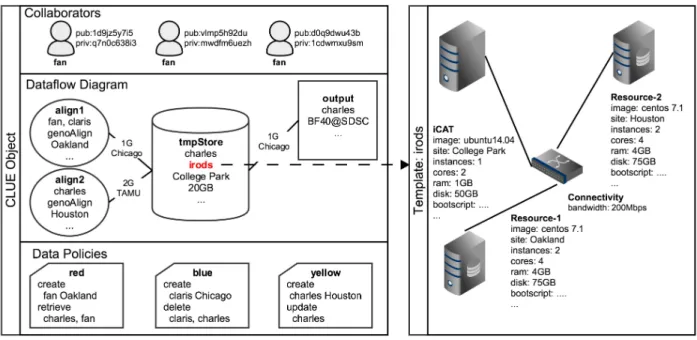
3.1.2 Collaboration Model . . . 32
3.1.2.1 Collaborator . . . 32
3.1.2.2 Data Policy . . . 33
3.1.2.3 Data Flow . . . 34
3.1.2.4 Template . . . 35
3.1.3 Collaborative Infrastructure . . . 35
3.2 System Design . . . 36
3.2.1 CLUE . . . 38
3.2.2 Orchestrator . . . 38
3.2.4 D2I . . . 40
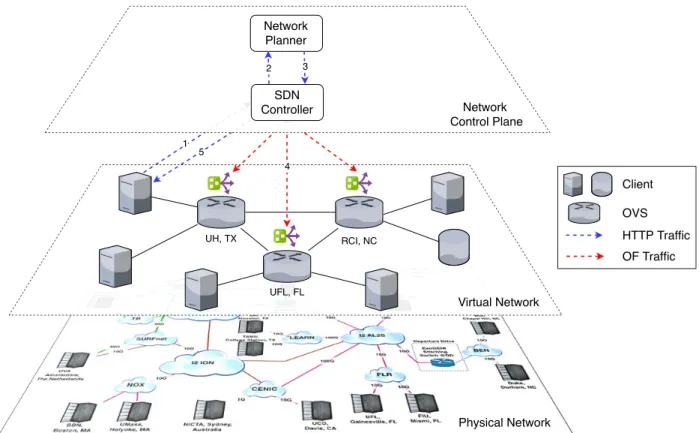
3.3 SDN-Based Network Abstraction . . . 41
3.3.1 Physical Network . . . 41
3.3.2 Virtual Network . . . 42
3.3.3 Network Control Plane . . . 43
3.3.4 Data Transfer Mechanism . . . 44
3.4 Priority-Based Global Network Optimization . . . 47
3.5 TCPMarioFor Bandwidth-Reservable Networks . . . 50
3.6 Experimental Evaluation. . . 51
3.6.1 Experiment Setup . . . 52
3.6.2 Evaluation ofMCF+ . . . 54
3.6.3 Evaluation of TCP MARIO. . . 56
3.7 Chapter Summary . . . 58
4 Geo-Distributed, Network-Aware Caching for Data-Intensive Applications . . . 59
4.1 Problem Formulation . . . 60
4.2 System Design . . . 62
4.2.1 Architecture . . . 62
4.2.2 Ondatapods,dataserveranddataclients. . . 65
4.2.3 Network-Aware Cache Algorithm . . . 67
4.2.4 Computation Sharing . . . 71
4.3 Evaluation . . . 72
4.3.1 Experiment Setup . . . 73
4.3.1.1 System Configuration and Environment . . . 73
4.3.1.2 Workloads . . . 73
4.3.1.3 Baseline Algorithms . . . 74
4.3.2 Synthetic Data Set . . . 74
4.3.2.2 Impact of Network Bandwidth . . . 75
4.3.2.3 Stability ofdatapodsand replicas . . . 77
4.3.3 Real-World Data Set . . . 81
4.3.3.1 Impact of Cache Capacity on Performance . . . 81
4.4 Chapter Summary . . . 83
5 Enable Cost-Aware Scheduling of Applications in a Multi-Cloud Environment . . . 84
5.1 System Design . . . 85
5.1.1 PIVOT Application . . . 85
5.1.2 PIVOT Architecture . . . 86
5.1.2.1 Cross-Cloud Virtual Infrastructure . . . 87
5.1.2.2 Abstraction Layer . . . 89
5.1.2.3 Scheduling Layer . . . 91
5.2 Cost-Aware Scheduling Algorithm . . . 92
5.2.1 Problem Definition . . . 92
5.2.2 Algorithm Design . . . 93
5.2.3 Task Grouping and Data Locality Inference . . . 95
5.2.4 Task Ordering . . . 96
5.2.5 VM Ordering . . . 97
5.2.6 First-Fit Vector Bin Packing . . . 98
5.3 Evaluation . . . 99
5.3.1 Experiment Setup . . . 99
5.3.1.1 Alibaba Cluster Trace and Simulation . . . 99
5.3.1.2 Big Data Applications and Real Deployment . . . 100
5.3.1.3 Baseline . . . 101
5.3.2 Results . . . 101
5.3.2.1 Simulation on Alibaba Cluster Trace . . . 101
5.3.2.3 CWL Workflows. . . 107
5.4 Chapter Summary . . . 108
6 Conclusion and Future Work . . . 109
6.1 Summary of Results . . . 109
6.2 Other Work . . . 111
6.3 Future Work . . . 111
LIST OF TABLES
3.1 DFD entities . . . 34
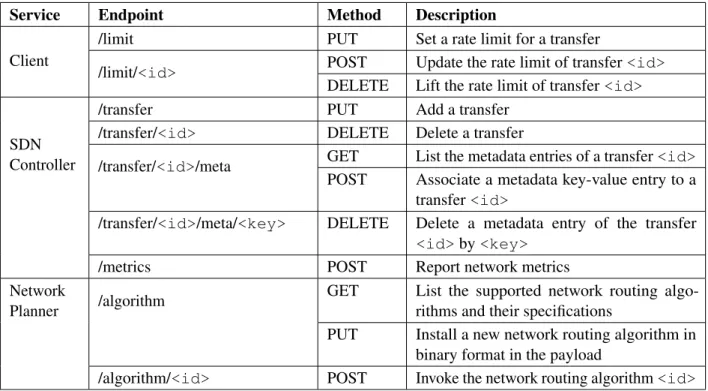
3.2 REST API of key components in the network ofcollaborative infrastructure. . . 45
3.3 Baseline TCP congestion control algorithms . . . 54
LIST OF FIGURES
1.1 Excessive egress network traffic and cloud expenses caused by loss of data locality . . . 11
2.1 Comparison of hardware virtualization approaches (Hwang et al., 2013) . . . 18
2.2 Comparison between container-based and traditional virtualization (Zhang et al., 2010) . . . 19
2.3 SDN Architecture (Braun and Menth, 2014) . . . 21
3.1 CLUE Object . . . 33
3.2 RADII architecture . . . 37
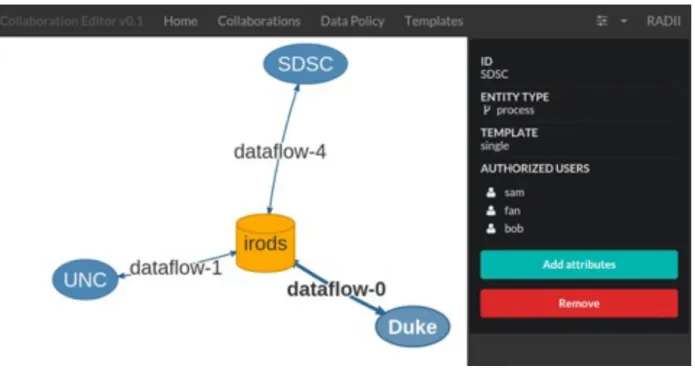
3.3 Web GUI of CLUE . . . 38
3.4 Network architecture in acollaborative infrastructure. . . 42
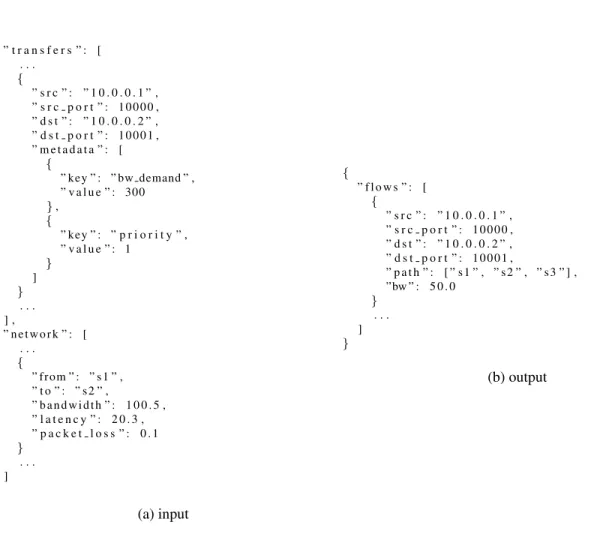
3.5 Examples of input and output of thenetwork planner . . . 46
3.6 Network topology for evaluation . . . 52
3.7 The ECMP algorithm . . . 53
3.8 Comparison of average data transfer throughput between ECMP and MCF+ . . . 55
3.9 Throughput variation of 50 data transfers between UFL and UMASS . . . 56
3.10 Variation of overall bandwidth utilization in 30 minutes . . . 57
3.11 Comparison of bandwidth utilization among the selected TCP congestion control algorithms in different network conditions with varying bandwidth, latency and packet loss rate . . . 58
4.1 CACHALOTphysical infrastructure . . . 63
4.2 Interaction among the client, CA and CM in CACHALOT. . . 64
4.3 CACHALOTarchitecture. The bottom layer is the physical infrastructure in which CAs are interconnected via WAN and co-located with clients. The CM coordinates cache operations among CAs. The upper layers are datapod the topology of different data objects. CAs with a crown are thedataserversanddataclientsfetch replicas from thedataserverofdatapods. Note that adataclientof onedatapod may migrate to anotherdatapod(shown in the middle layer) due to changes in replica distributions and network conditions. . . 66
4.4 CACHALOTcache algorithm performance breakdown . . . 76
4.6 Distribution ofdatapodnumber and lifetime . . . 78
4.7 Performance with varying sizes . . . 79
4.8 Performance with varying popularity distribution . . . 80
4.9 Characteristics of OpenCloud and ExoGENI trace data set . . . 81
4.10 Performance with varying capacity . . . 82
5.1 An example of PIVOT application . . . 86
5.2 PIVOT architecture . . . 87
5.3 Cloud regions in AWS and GCP used for evaluating PIVOT . . . 100
5.4 Comparison of egress cost, host subscription cost, average number of VM instances used and application runtime. cost-aware saves up to 90.8% and 99.2% of the cost for host subscription and egress traffic. . . 102
5.5 Average data transfer time per task. cost-aware saves up to 82.8% of data transfer time due to strategic selection of fast network path and avoidance of network congestion. . . 103
5.6 Variation of cloud expenses with increasing number of running applications. De-spite the lowest egress and host subscription cost, cost-aware achieves mildest cost increase as applications scale up. . . 104
5.7 CDF of worker co-locations/data transferred for Hail clusters/CWL workflows in different scopes, respectively. cost-aware effectively co- locates the workers/tasks for improved data locality and less egress cost. . . 105
5.8 Footprints of the Hail cluster deployments in the cost-throughput space. Most deployments by cost-aware are clustered in proximity to the optimum, while those by the baselines mostly distributed at the far end. . . 106
LIST OF ABBREVIATIONS
ACK Acknowledgement
ACL Access Control List
AES Advanced Encryption Standard
AIMD Additive-Increase/Multiplicative-Decrease API Application Program Interface
AZ Availability Zone
BDP Bandwidth-Delay Product
BLOB Binary Large Object
BF Best Fit Algorithm
CDF Cumulative Distributed Function
CI Cyberinfrastructure
CPU Central Processing Unit CRUD Create, Read, Update, Delete
CWL Common Workflow Language
DAG Directed Acyclic Graph
DFD Data-Flow Diagram
ECMP Equal-Cost Multi-Path
FF First Fit Algorithm
FFD First Fit Decreasing Algorithm
GD Greedy Dual Size Frequency Algorithm
HPC High-Performance Computing
HTB Hierarchical Token Bucket HTTP Hyper Text Transfer Protocol IaaS Infrastructure-as-a-Service
I/O Input/Output
IoT Internet of Things
IP Internet Protocol
KB Kilobyte
LAN Local Area Network
LDAP Lightweight Directory Access Control
LFU Least Frequently Used
LP Linear Programming
LRU Least Recently Used
LRV Least Relative Value
MAC Media Access Control
MB Megabyte
MCF Multi-Commodity Flow
MD5 Message-Digest Algorithm 5
MDVPP Multi-Dimensional Vector Bin Packing Problem MKP Multiple Knapsack Problem
MPTCP Multipath TCP
MSS Maximum Segment Size
NDL Network Description Language
NFS Network File System
NP Nondeterministic Polynomial
OF OpenFlow
OS Operating System
OLAP On-Line Analytical Processing
OVS Open vSwitch
POSIX Portable Operating System Interface
QoS Quality of Service
RAM Random Access Memory
REST Representational State Transfer
RTT Round Trip Time
SDN Software-Defined Network
SOA Service-Oriented Architecture SPARC Scalable Processor Architecture TCP Transmission Control Protocol URL Uniform Resource Locator
VBP Vector Bin Packing
VLAN Virtual Local Area Network
VM Virtual Machine
VMM Virtual Machine Monitor VPC Virtual Private Cloud VPN Virtual Private Networking
CHAPTER 1: Introduction
1.1 Data-Intensive Applications
A data-intensive application performs massive data processing activities upon vast amounts of raw data to gain insights into the data and unearth valuable facts to advance research and business, e.g., genomic sequence workflows, business intelligence analytics, among others. The data activities performed by data-intensive applications involve every phase of data processing, including but not limited to acquisition, warehousing, mining, cleansing, aggregation, integration, analysis, and modeling of data. The data being processed and analyzed is also stored and presented in a multiplicity of forms ranging from binary (e.g., program executables) to multimedia content (e.g., videos). The large scale of data, diversity of data activities, and intricacy of data composition characterize a typical data-intensive application nowadays. More specifically, data-intensive applications run on data sets with 3Vs (Assunc¸˜ao et al., 2015; Shah et al., 2015): volume, velocity, and variety – the volume means the sheer amount of data being processed; the velocity indicates the high rate of newly produced inflow data; the variety represents the various data formats and varying levels of data noise. These three factors have a profound influence on the performance of data-intensive applications and deeply impact the architectural and algorithmic design of data-intensive applications and the platforms they are executed on. Hence, our discussion on data-intensive applications in this dissertation centers on these three key factors of data.
1.1.1 Data Volume
in any single data center, prohibiting traditional centralized data processing (Corbett et al., 2013; Gupta et al., 2014; Hwang et al., 2007). Furthermore, the data is highly distributed, generated by devices, individuals and organizations from around the world. The ubiquity of data sources and sparse distribution of data necessitate data transport for data analytics, which is hindered by the lack of network bandwidth in WANs – massive data transfers can easily oversubscribe network capacity and stall due to severe network congestion (Pu et al., 2015; Vulimiri et al., 2015a,b). This phenomenon, referred to as Data Deluge, is recognized as a clear trend (Fox, 2011) and calls for highly scalable design of data-intensive applications and the underpinning infrastructure to cope with the ever-growing data volume.
Further, traditional scaling models (Amdahl, 1967; Gustafson, 1988; Sun and Chen, 2010) have inadequa-cies in modeling data-intensive applications because of their oversight of the huge data volume. Traditional models mostly focus on the speedup achieved by data parallelism but ignoring the overhead induced by scaling, e.g., task dispatching, inter-task communication, among others (Li et al., 2019). This state of affairs is due to the fact that these models are designed for high-performance computing (HPC) systems wherein it is assumed that the high-speed local area network (LAN) has abundant network capacity and transmission of moderate volume of data takes a trivial amount of time as compared to data processing time. This assumption does not hold true for the majority of data-intensive applications since data processing activities are mostly I/O-bound in nature and thereby up to an order of magnitude more time-consuming than their memory-intensive counterpart. Consequently, it is common for data transmission time to dominates the end-to-end execution time of data-intensive applications due to the slowness of frequent data processing activities.
1.1.2 Data Velocity
Despite the gigantic data volume, the high rate of data influx is another major challenge faced by data-intensive applications. For instance, Walmart processes over a million transactions per hour (Cukier, 2010); Square Kilometer Array Telescope generates 100 terabits per second; exascale simulation produces result dumps at the rate of terabytes per second (Fox, 2011). The torrent of data continuously stresses the applications and infrastructure underneath. Therefore, it is imperative for data infrastructures to guarantee high reliability and fault tolerance for data-intensive applications.
With data constantly flooding in, some applications impose more stringent time constraints on the processing of data to pace up with the rapid data arrival and capture momentary changes in data. For instance, automatic trading systems continuously monitor stock prices and need to react to instant price spikes in seconds; retail stores need to analyze data collected from users’ mobile devices (e.g., location) to generate personalized promotion offers in minutes (Gandomi and Haider, 2015); online robotic dialog systems (e.g., Slackbot1) are required to comprehend and respond to user interactions promptly. Assunc¸˜ao et al. (2015) categorize data-intensive applications into four types based on the strictness of time constraints, which are batch, near-time, real-time, and streams. Particularly, data velocity has the most salient impact upon real-time, e.g., data analytics queries (Rabkin et al., 2014; Pu et al., 2015; Vulimiri et al., 2015a), and streams, e.g., data streaming applications (Xu et al., 2014; Peng et al., 2015; Caneill et al., 2016). Given more rigorous time constraints, low latency is of greater importance to these time-critical applications than high throughput due to costly penalties for delays in data processing.
Latency arises mainly due to shortage in processing ability and data movements – data processing tasks may contend for limited computing cycles and forcibly queue up to wait for next available ones, causing queuing delay; communication and data sharing among the tasks initiate data movements and unavoidably incur data propagation delay. To mitigate the queuing delay, it is requisite to invest more in computing resources to resolve the bottleneck in resource provisioning and guarantee abundant computing cycles. More importantly, applications should be highly scalable by design, able to scale out and exploit additional resources. Data propagation delay is a product of round trip time (RTT) between tasks and network congestion. The RTT is largely determined by the speed of light and therefore it is difficult to overcome, while
1An Introduction to Slackbot:
network congestion forces packet loss and retransmission, bogging down data transfers over the network. To reduce data propagation delay, computer networking studies have proposed a series of network optimization approaches to circumventing or alleviating network congestion (Al-Fares et al., 2010; Hong et al., 2013; Alizadeh et al., 2014; Cai et al., 2016; Cardwell et al., 2016; Langley et al., 2017). On other alternative approach that has gained much attention in the community for its effectiveness in enabling low-latency data analytics is to retain data locality and shorten the traveling distance of data movements (Hindman et al., 2011; Zaharia et al., 2012; Pu et al., 2015; Caneill et al., 2016).
1.1.3 Data Variety
Data variety refers to the heterogeneity found in data forms, provenance, crudity and quality of data-intensive applications (Sivarajah et al., 2017). Data to be processed ranges from unstructured free text to annotated video snippets; some data sets are provided in raw formats, while others are excerpts of original data. To make things worse there are also different levels of noise across various data sets. This heterogeneity adds to the difficulty for data-intensive applications to comprehend and make sense of data. Further, the data variety forces applications to use a diversity of data processing frameworks among which interoperability is absent and data formats are incompatible, therefore further worsening the heterogeneity challenge. Hindman et al. (2011) reveal that lack of interoperability among data processing frameworks prevents applications from scaling out and harms data locality. From the perspective of system administration, maintaining a large number of frameworks is laborious and error-prone, costing a non-trivial, increase in IT investment.
providers prevent applications from scaling across cloud platforms to gain access to and make use of more resources across cloud platforms. As cloud competitors inherently lack the initiative to promote inter-cloud application scaling, broker services that orchestrate applications across clouds need to be developed to achieve higher level of elasticity and scalability (Grozev and Buyya, 2014).
1.2 Geo-Distributed Computing
A massive scale of data is being generated at very high rates all over the world every day, e.g., emails, ad clicks, online purchases, social media posts, temperature readings, and many others. Particularly, with the development of mobile technologies and the emergence of Internet of Things (IoT) (Li et al., 2015), intelligent portable devices, e.g., smart phones, smart home devices and sensors, are widely equipped and increasing the already formidable data volume worldwide. Major IT service providers, e.g., Google (Calder et al., 2013; Jain et al., 2013), Microsoft (Hong et al., 2013), Amazon2and AT&T (Hung et al., 2015), deploy tens to hundreds of global data centers to acquire, store and analyze geo-distributed data sets. Example analyses include querying user clicks to aid advertisement recommendation (Corbett et al., 2013), querying server logs to monitor system health, querying network logs to detect malicious attacks, etc. These data analytics applications are data-intensive in nature, producing a large scale of intermediate and output data from distributed geo-locations.
Traditional data analytics frameworks still adopt the centralized data processing model (Pietzuch et al., 2006; Corbett et al., 2013; Gupta et al., 2014; Kraska et al., 2013). With this model, geo-distributed data sets are transferred to a single central data center over WANs for aggregation and analysis. The centralized model has several critical disadvantages in a geo-distributed setting. First, centralized data processing heavily stresses the central data center in computing, storage and power provisioning, and greatly limits scalability of applications to the capacity of the data center, which is nontrivial to scale on demand to handle load bursts. Second, backhauling data over WANs is inefficient from the perspective of resource utilization and application performance. Transferring large amounts of data between geo-distributed data centers incurs substantial network traffic and wastes valuable WAN bandwidth. On the other hand, application performance will be impeded by remote data transfers over scare network resources prolonging the application execution time. In addition to the bandwidth shortage, the huge volume of data may overflow buffers of top-of-the-rack
2
switches in data centers, causing a known network problem referred to as TCP incast (Chen et al., 2012b) and further degrading the performance of TCP data transfers. Third, centralized data processing is susceptible to single point of failure upon data center outage and affects reliability of applications. Last but not least, a centralizing approach is often prohibited by data privacy and sovereignty laws, which limit data movements within only authorized domains or locations.
Geo-distribured computing has emerged as the de-facto model for performing geo-distributed data analytics since it addresses the limitations of the centralized model. Following, we elaborate on the benefits of geo-distributed computing for data-intensive applications.
1.2.1 High Scalability
Geo-distributed computing model allows data-intensive applications to scale out across multiple geo-distributed data centers rather than be confined to a single one. The ability to scale out is essential to data-intensive applications since their workloads are bursty, and unexpected workload spikes may exceed the capacity of a well resourced data center. For instance, in our experiments we have encountered such resource shortage in Google’sus-east4data center at North Virginia. More specifically, a RNA sequence alignment workflow we use to drive experiments was frequently unable to scale out to other data centers in Google Cloud due to insufficient resources. Upon this situation, pending jobs would block long periods of time impacting significantly the overall execution time of the workflow. Data centers typically overprovision resources to cope with workload bursts (Grozev and Buyya, 2014), leaving data centers underutilized for the majority of time and incurring wasteful power consumption. In the geo-distributed model, applications gain access to a large pool of resources from multiple geo-distributed data centers. If resources in a data center are depleted, applications can scale out to other data centers to continue making progress instead of halting for long periods of time. Hence, geo-distributed computing enhances the scalability of applications and lowers the risk of resource shortage.
1.2.2 Low Latency
they need and reduce or even eliminate the latency they would have experienced otherwise. As discussed in the prior section, low latency is crucial for time-critical, data-intensive applications such as real-time data analytics queries and data streaming applications. A plethora of studies (Wu and Madhyastha, 2013; Pu et al., 2015; Hung et al., 2015; Wu et al., 2013) have shown that increasing density of geo-distributed data centers is conducive to lowering network latency for geo-distributed applications. In practice, using multiple cloud platforms is a viable way to improve geospatial coverage of data centers since cloud providers collectively have widespread data center deployments globally. It is worth mentioning that certain data operations such as aggregation must always be done in a centralized manner. However, the geo-distributed model can support data cleansing, selection and partial data aggregation at the edge to reduce the amount of data to be backhauled for final centralized processing, therefore greatly shortening the time for data transmission over WANs (Rabkin et al., 2014). This has a huge implication on user-perceived latency of applications since time for data transfers often dominates the end-to-end runtime of applications.
1.2.3 Strong Resilience
Relying on a single data center exposes data-intensive applications to potential breakdown caused by data center failures, which are not uncommon as observed in recent years. Major cloud providers, including Amazon Web Services (AWS)3, Microsoft Azure4and Google Cloud Platform (GCP)5, have all experienced disruptive data center outages in the past few years. A post-mortem analysis performed by Amazon6even advised their clients to distribute their applications across multiple data centers for fault tolerance. Although cloud providers today deploy multiple independent clusters at every single region, referred to as availability zones (AZs), to lower the risk of total data center breakdown, site-wide failures are still possible due to unexpected disasters. The geo-distributed computing model uses multiple geo-distributed data centers as insurance against potential breakdown of one or multiple data centers, greatly lowering the risk of application breakdown and ensuring strong resilience of applications.
3
Summary of the AWS Service Event in the US East Region:http://aws.amazon.com/message/67457
4Windows Azure Service Disruption Update:http://blogs.msdn.com/b/windowsazure/archive/2012/03/01/
windows-azure-service-disruption-update.aspx
5
Post-mortem for February 24th, 2010 outage:https://groups.google.com/group/google-appengine/browse_ thread/thread/a7640a2743922dcf?pli=1
6
1.2.4 Regulatory Compliance
Valuable data sets are mostly sensitive and proprietary. Regulatory constraints are commonly imposed on these data sets to protect the intellectual properties and data sovereignty (Mohan et al., 2012; Vulimiri et al., 2015b). These regulatory policies typically prevent protected data sets from being physically moved around at will to ensure data security. For instance, European Union forbids transfer of personal data to non-member countries without an adequate level of protection measures (Varghese and Buyya, 2018); most cloud providers are compliant to Healthcare Insurance Portability and Accountability7, prohibiting sensitive patient health information from being disclosed without the patient’s consent and knowledge. These legislative and regulatory constraints prevent centralized data aggregation and processing for data-intensive applications running on top of the most sensitive and proprietary data. Instead of moving sensitive data to a central data center, geo-distributed computing has the flexibility to distribute data processing tasks to data centers with proper security clearance and authorization to perform in-place data analytics without violating regulatory constraints. This capability ensures regulatory compliance of data-intensive applications.
1.2.5 Cost Effectiveness
Despite performance degradation, transferring colossal amounts of data sets over WANs is prohibitively expensive due to the huge consumption of WAN bandwidth it incurs, which is scarce and charged for usage at a high unit price. Most cloud providers charge for egress network traffic produced by applications, which is the outbound network traffic from a geo-location such as a data center in the cloud; the rate is increased if the traffic goes outside the cloud platform to the Internet. For instance, GCP charges $0.01 per gigabyte for network traffic traveling among its cloud regions in United States and Canada but penalizes egress Internet traffic by a rate of $0.12 per gigabyte – a 12x price increase. Other providers such as AWS and Microsoft Azure have a similar pricing model for egress network traffic. Reserving dedicated network links between geo-locations can reduce egress network traffic cost, since cloud providers usually charge a one-time fee for setting up network circuits independently of the network traffic. However, the initial investment for such dedicated network links is typically too high to be amortized for applications at small to medium scale. Hence, a large number of research efforts focus on reducing the amount of data transferred over WANs for
7Health Insurance Portability and Accountability Act of 1996 (HIPAA):https://www.cdc.gov/phlp/publications/
data-intensive applications in geo-distributed environments to save the monetary cost associated with egress network traffic (Wu et al., 2013, 2015; Pu et al., 2015; Kloudas et al., 2015; Hsieh et al., 2017). With the geo-distributed model, data pre-processing and partial aggregation are performed at the edge, significantly reducing the amount of data being transferred among geo-distributed data centers and, thus, saving the egress network traffic cost (Rabkin et al., 2014). Additionally, as data-intensive applications are being migrated to the cloud in nowadays, geo-distributed computing can take advantage of the price discrepancies among cloud providers to minimize the cloud expenses for resource subscription (Wu et al., 2013). For instance, AWS offers resources with variable prices, i.e., Spot Instances8, which change based on the supply and demand in the market can be exploited for cost saving.
1.3 Challenges for Data-Intensive Applications in Geo-Distributed Environments
In the prior sections, we elaborate on the characteristics of data-intensive applications and advantages of a geo-distributed computing model for running these applications upon large-scale, geo-distributed data sets. In this section we focus on three key challenges we have identified which hinder running data-intensive applications in geo-distributed environments.
1.3.1 High Degree of Heterogeneity
Geo-distributed environments are intrinsically heterogeneous. They typically consist of loosely-coupled, geo-distributed infrastructures, which are designed, built and maintained independently from each other. At low level, geo-distributed data centers employ heterogeneous hardware and software from central processing units (CPU) to operating systems (OS). Servers in different racks even use disparate CPU platforms; some nodes are equipped with accelerators such as graphic processing units (GPU), field-programmable gate array (FPGA) and many-core processors (e.g., Intel Xeon Phis) – a variety of OS, including Microsoft Windows Server, Solaris, BSD family, and miscellaneous Linux distributions, are running on different servers. Standardization of Application Programming Interfaces (APIs) is limited thus impeding interoperability across data intensive applications running on diver high-level frameworks. Furthermore, network heterogeneity is even more severe in geo-distributed environments as WANs are made of heterogeneous subnets backed by various network providers – despite the high level of heterogeneity in network devices (e.g., assorted models
8
of network switches and routers), there are plenty of discrepancies in network architecture and management among providers. Consequently, heterogeneous WANs are susceptible to connectivity issues and network congestion, causing underwhelming and unpredictable network performance. As summarized by Varghese and Buyya (2018), heterogeneity exists in nine layers of a geo-distributed system from bottom up, including network, storage, servers, virtualization, OS, middleware, runtime, data, and application.
Particularly, as geo-distributed computing is often realized on top of multiple cloud platforms in prac-tice (Stefanov and Shi, 2013; Wu et al., 2013; Jonathan et al., 2016), there is also heterogeneity in cloud services and pricing models. Different cloud providers expose heterogeneous APIs for subscribing, managing and releasing miscellaneous resources, impeding data-intensive applications from scaling across clouds to leverage featured services offered by specific vendors and alleviate platform-wide risks (e.g., political or legislative restrictions). Furthermore, cloud providers are disincentivized to improve interoperability among cloud platforms, relying on lock-in strategists to discourage clients from migrating to the competitors. This further exacerbates the heterogeneity in the cloud. Although plenty of efforts have been made to bridge the gap between cloud platforms (Grozev and Buyya, 2014), they are still preliminary, and deeper integration among cloud platforms is needed to mitigate the heterogeneity.
1.3.2 Loss of Data Locality
expected, long-distance data transfers slow down data-intensive applications given the large volume of data to be transferred over the WAN. We will further demonstrate the negative impact on application performance caused by loss of data locality in the experimental evaluation introduced in the following chapters.
Figure 1.1: Excessive egress network traffic and cloud expenses caused by loss of data locality
There are two lines of work in improving data locality in geo-distributed environments. One line of work focuses on task scheduling optimization (Vulimiri et al., 2015a; Pu et al., 2015; Viswanathan et al., 2016; Jonathan et al., 2016). Another line of work focuses on data caching and replication (Wu et al., 2013; Corbett et al., 2013; Stefanov and Shi, 2013; Gupta et al., 2014) to improve data locality in geo-distributed environments. These approaches have a piecemeal nature, while comprehensive and generalizable solutions are still absent. We believe that proper abstraction of compute resources is fundamental to preserving data locality in geo-distributed environments since it can standardize and enrich information about the environments for high-level scheduling processes.
1.3.3 Inefficiency in Data Sharing
by distributed processes (Hsieh et al., 2017). In addition, tasks of genomic alignment workflows generate pre-aligned intermediate results consumed by its next steps running on distributed nodes. Hence, it is crucial to ensure the efficiency of data sharing to satisfy quality-of-service (QoS) requirements imposed on data-intensive applications.
WAN performance is key to achieving high efficiency of data sharing in geo-distributed environments since the majority of data transmissions rely on WANs. However, it is common for geo-distributed applications to encounter performance issues in WANs. First, most WANs suffer from constrained bandwidth and high latency, therefore increasing the likelihood to network congestion. Second, traditional WAN architecture has design limitations that hinder network optimization, leading to several performance challenges in the operation and use of WANs (McKeown et al., 2008; Braun and Menth, 2014). Finally, infrastructure for supporting high-speed WAN is lacking. More specifically, advanced WAN solutions such as Multi-Protocol Label Switching Traffic Engineering (MPLS-TE) (Meyer and Vasseur, 2010) are proprietary and expensive to adopt; and, data transfer infrastructures such as SDX (Gupta et al., 2015), are only available in highly specialized settings. Commonly, data-intensive applications resort to the Internet for remote data transfers, which is extremely inefficient. It took us over two weeks to transfer 5 terabytes of hydrology data sets between two institutions in the United States. On the other hand, data processing frameworks lack WAN awareness to circumvent performance bottlenecks, since limited bandwidth, high latency and high probability of packet loss are unique in WANs and rarely considered in the design of data center solutions. Enhancing network awareness in data-intensive applications can facilitate the efficiency of data sharing in geo-distributed environments.
1.4 Thesis Statement
In the recognition of these critical challenges, we seek to address each of these challenges systematically in this dissertation. This leads to the following thesis statement:
Data-intensive applications face high levels of heterogeneity, loss of data locality and
inef-ficiency in data sharing in geo-distributed environments, which create significant detriments
to application efficiency. To improve the efficiency, these challenges ought to be tackled via
1.5 Contributions
To support the aforementioned thesis, we summarize the contributions made in this dissertation in the following three aspects.
1.5.1 Resource Abstraction
As explained in Section 1.3.1, heterogeneity exists in many aspects of geo-distributed computing from low-level infrastructure to high-level representation of data-intensive applications. Heterogeneity is recognized as the major culprit impeding data-intensive applications from running smoothly in geo-distributed environments. Hence, it is imperative to first address all issues related to heterogeneity in order to further improve the efficiency of data-intensive applications.
In this dissertation, we develop resource abstraction mechanisms across different levels of geo-distributed computing systems to mitigate the aforementioned heterogeneity. Specifically, in Chapter 3, we introduce a high-level abstraction based on the flow diagram (DFD) model to simplify the description of data-centric scientific collaborations and bridge the gap between computing and data in scientific collaborative applications. We develop a virtual network layer using software-defined networking (SDN) to abstract the highly heterogeneous WANs connecting geo-distributed, participating research institutions, addressing not only the heterogeneity found in the WAns but also opening the door to complex network optimization. In order to generalize caching of computation, in Chapter 4, we characterize jobs of data-intensive applications based on their key properties. Further, we create an abstraction layer to standardize access and use of cache spaces contributed by a multiplicity of geo-distributed servers. In Chapter 5, we achieve cloud agnosticism across geo-distributed cloud regions by creating an abstraction of compute resources provisioned by multiple cloud providers, allowing seamless scaling and migration of data-intensive applications across geo-distributed cloud regions and multiple clouds. These pieces of work lay the groundwork for other contributions, which would otherwise be intractable in geo-distributed environments.
1.5.2 Preservation of Data Locality
In this dissertation, we are committed to preserving data locality for data-intensive applications in geo-distributed environments.
In Chapter 3, we develop a mechanism that allows users to create data stores at geo-locations in proximity to their applications to ensure data locality. In Chapter 4, we develop a network-aware cache network spanning multiple geo-locations to cache and reuse intermediate and output data of repeatedly executed data-intensive jobs thus retaining data locality for applications. As part of this work, we devise an intelligent, network-aware cache algorithm that dynamically caches and replicates data across geo-distributed cache servers to achieve global optimum of data locality and shorten job completion time. Additionally, in Chapter 5, we introduce a novel cost-aware scheduling algorithm that factors in cloud expenses incurred by resource subscription and egress network traffic and co-locates application tasks intelligently across cloud platforms, therefore preserving data locality and minimizing cloud expenditures. These solutions can jointly preserve data locality for data-intensive applications in geo-distributed environments and improve their efficiency.
1.5.3 Network Optimization
We also contribute to the field of network optimization to improve data transfers over WANs. The Internet is unreliable for supporting critical applications, while specialized high-speed WANs are rarely available to the public sector. Furthermore, most applications are oblivious to the unique characteristics of WANs and geo-distributed environments, thus unable to fully utilize the network resources offered by WANs. Last, heterogeneity in WANs aggravates the inefficiency in WANs.
respect to resource subscription and egress network traffic in the cloud. Last, as explained in Section 1.5.1, we rely on network abstraction to mitigate the heterogeneity in WANs and therefore clear the path for complex network optimization.
1.6 Organization
CHAPTER 2: Background and Prior Work
In this chapter, we present the background for this dissertation by surveying the related prior work. The organization of this chapter is as follows: we first introduce resource abstraction techniques in Section 2.1; then, we focus on approaches to achieving data locality in distributed systems in Section 2.2; lastly, we present the related works on TCP optimization in WANs in Section 2.3.
2.1 Virtualization-Based Resource Abstraction
Virtualization is a technique of creating software-based virtual resources on the basis of their physical counterparts such as computing, storage, and networking devices and platforms. It is commonly adopted in distributed systems and cloud computing to achieve resource abstraction and enable dynamic, scalable distributed applications.
The idea of virtualization originates as a time-sharing solution on mainframe computers, which creates logically isolated environments for users and applications to share the resources with minimal interference with each other. Today, virtualization has been extensively applied to abstracting other types of resources such as memory, storage, network, among others. Particularly, network virtualization abstracts network devices using software components and creates virtual network spaces, creating opportunities for more dynamic and sophisticated network optimization and enhancement. Recently, lightweight virtualization approaches, e.g., containerization, have emerged to enhance the granularity and agility of distributed application deployment. These modern virtualization technologies lay the groundwork for national cyberinfrastructures (CIs) and cloud computing platforms of today, where geo-distributed, data-intensive applications are primarily deployed and executed on a mass scale.
2.1.1 Hardware Virtualization
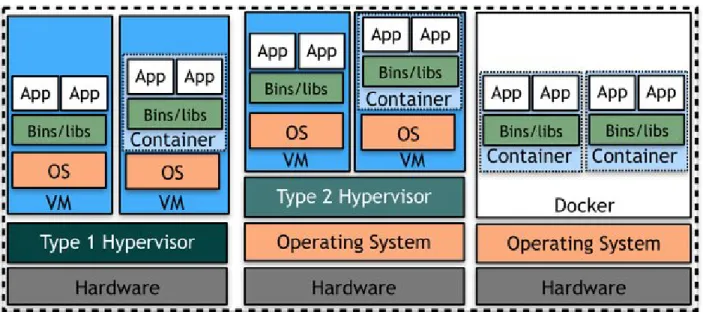
enable time-sharing of resources among users and applications. Modern hardware virtualization extends the technique to commodity computers using hardware emulation and software simulation. Specifically, full virtualization techniques rely on 100% binary translation to emulate privileged instruction sets embedded in the hardware and create isolated virtual environments referred to as virtual machines (VMs) in parallel on a single machine, which allows the OS and applications to run on top without any modification as if on a bare-metal machine. Magnusson et al. (1998) first demonstrate the full virtualization of unmodified Linux and Solaris on the SPARC v8 architecture. Devine et al. (2002) propose a virtual machine monitor (VMM) that enables full virtualization on the x86 architecture. Bellard (2005) develops a portable machine emulator that supports full virtualization across multiple CPU architectures. Kivity et al. (2007) introduce a Linux kernel-based VMM namedkvmspecialized for full virtualization on Linux platforms. These works built the foundation for hardware virtualization of today. However, full virtualization is recognized heavyweight by Barham et al. (2003) due to the substantial overhead caused by the full binary translation – certain operations and tasks are significantly time-consuming when performed in the virtual domain as compared to the physical domain. To alleviate the overhead, hardware enhancement, e.g., Intel VT-x (Uhlig et al., 2005), has been developed to provide extra support for circumventing the inefficient binary translation. As an alternative to full virtualization, Whitaker et al. (2002) and Barham et al. (2003) propose the concept of
para-virtualization, which presents hardware instructions in the form of a software interface and defers the implementation of resource abstraction to the OS running on top. This approach mitigates the performance overhead and can be ported to commodity hardware without any specialized assistance. However, it requires OS modifications to make the OS aware of the virtualized environment and interface to properly execute instructions. Hwang et al. (2013) compare the aforementioned virtualization approaches as depicted in Figure 2.1.
Hardware virtualization underpins most well-known Infrastructure-as-a-Service (IaaS) providers includ-ing mainstream cloud platforms and academic cloud testbeds, providinclud-ing the fundamental low-level resource abstraction for modern distributed computing, especially cloud computing. The infrastructure we have built in this dissertation is laid on hardware-virtualized resources provisioned from distributed geo-locations.
2.1.2 OS-Level Virtualization
Figure 2.1: Comparison of hardware virtualization approaches (Hwang et al., 2013)
applications running on top. Specifically, it encapsulates applications in a compact and fine-grained fashion, by packaging only application-specific assets, e.g., executables, runtime, and libraries, into isolated containers but sharing other OS resources, e.g., kernels, among applications. In contrast with hardware virtualization, the OS-level virtualization eliminates the overhead for hardware emulation and software simulation; meanwhile, it also avoids resource waste caused by redundant loading of duplicate OS resources as commonly practiced in the one-task-per-instance model (Mao et al., 2010; Van den Bossche et al., 2010; Bittencourt and Madeira, 2011; Mao and Humphrey, 2011), achieving agile application scaling and fast failover in distributed systems. There have been many academic and industrial efforts devoted to realizing and improving OS-level virtualization. Pahl et al. (2017) conduct a comprehensive taxonomical review of state-of-the-art techniques and methods of containerization and its orchestration. Notably, the introduction ofcgroups1enables the isolation of resource usage by processes in Linux, laying the foundation for modern container techniques. Docker2streamlines the use of containers and boosts the development of microservices architecture (Dragoni et al., 2017). containerd3 is an active open-source project in which industry standards for container runtime are being defined and adopted. These containerization techniques facilitate resource abstraction
1
cgroups:http://man7.org/linux/man-pages/man7/cgroups.7.html
2
Docker:https://www.docker.com/
3
for intensive applications. Hindman et al. (2011) propose to encapsulate data processing tasks of data-intensive applications using containers in order to remove the coupling between computing clusters and application frameworks and allow multiple application frameworks to co-exist on a single cluster to improve resource utilization.
Figure 2.2: Comparison between container-based and traditional virtualization (Zhang et al., 2010)
Zhang et al. (2010) conduct an in-depth survey on virtualization technologies adopted in the cloud and compare different virtualization strategies as illustrated in Figure 2.2. With traditional hardware virtualization, applications are running in units of VMs loaded with full-featured OS. Consequently, it takes extra time to load OS assets before starting applications, slowing down application start-up. In the meantime, application migration and failover are time- and resource-consuming, since the VM hosting the migrating application needs to be transferred from one machine to another in its entirety. In comparison, the container-based solutions enabled by services, such as Amazon Elastic Container Service4and Google Kubernetes Engine5, are more lightweight since they deploy and migrate only application assets, which are typically smaller than an entire OS in size. Further, by combining OS-level and hardware virtualization as shown in Figure 2.2, users can have more freedom in customizing resource management for applications running in the cloud – they can develop custom algorithms for scheduling VMs and containers rather than delegate the resource management to cloud providers, and therefore reap more benefits granted by resource abstraction. We
4
Amazon Elastic Container Service:https://aws.amazon.com/ecs
5
leverage the combination of OS-level and hardware virtualization to enable the cost-aware cloud agnosticism as introduced in Chapter 5.
2.1.3 Network Virtualization
Network virtualization abstracts network resources and functionalities of physical networks by creat-ing virtual networks connectcreat-ing distributed, virtualized resources and enablcreat-ing dynamic software-defined networking (SDN). A virtual network is established over segregated physical network partitions, providing connectivity for distributed applications and presenting a simple logical network topology. It can be created using techniques including virtual local area network (VLAN) (McPherson and Dykes, 2001) and virtual private network (VPN) (Gleeson et al., 2000), which are offered as standard services by mainstream cloud vendors for creating virtual networks in the cloud. A number of prior works adopt virtual networks in the geo-distributed environment to connect applications running in geo-distributed, isolated network domains and improve the network performance among them. Baldine et al. (2012) build the ExoGENI on top of a federation of geo-distributed cloud sites and network circuit providers, allowing users to create dedicated virtual networks for deeply networked, multi-domain, multi-site applications at scale. Cai et al. (2016) develop the cloud-routed overlay networks using VMs provisioned by cloud providers to re-route the Internet traffic and bypass the Internet core, avoiding the congestion at the Internet core and therefore improving the network performance over the Internet. Pfaff et al. (2009) and Pfaff et al. (2015) abstract the network switching and routing functionalities into a software component, further facilitating the creation and deployment of virtual networks on commodity servers and VMs.
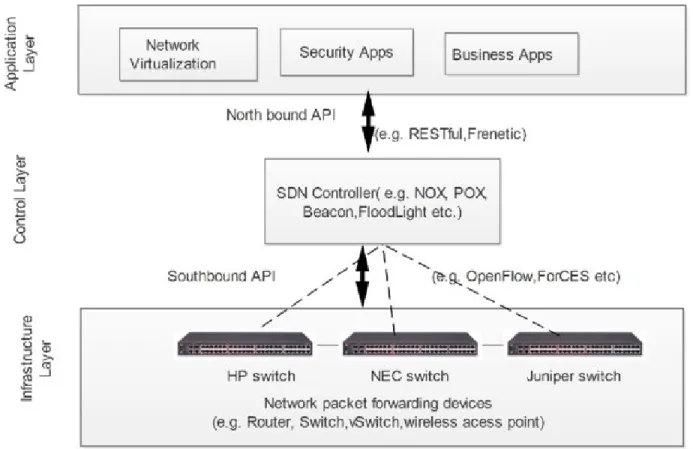
Furthermore, the emergence of SDN advances network virtualization by enabling the programmability of networks and presenting a flexible network architecture on which complex algorithms and configurations are made possible. Casado et al. (2007) propose an early architectural design of the SDN of today. McKeown et al. (2008) extend it into the OpenFlow protocol, which evolves as a major SDN communication protocol of today. Gude et al. (2008) develop the first network OS implementing the OpenFlow protocol, which serves as the reference implementation for OpenFlow controller frameworks. Koponen et al. (2010) introduce a distributed network control platform for SDN networks.
decentralized algorithms to improve network performance in a best-effort manner. SDN abstracts the control layer into a centralized, stateful software component, referred to as an SDN controller, which can be fed with internal and external states of the network and uses them to drive complex routing algorithms. An SDN controller is equipped with a northbound and southbound APIs – the controller interacts with applications via the northbound API to acquire external states, and communicates with SDN-compatible switches via the southbound API to learn of the network states and install network flows. By centralizing the control layer, the SDN controller can gain a global view of the entire network and perform optimization for network routing. Additionally, with the northbound API, it is more knowledgeable about applications running on top than its counterpart in traditional networks.
Figure 2.3: SDN Architecture (Braun and Menth, 2014)
centers as a multi-commodity (MCF) problem and develop a global optimization approach to maximize the bandwidth utilization in WANs. In Chapter 3, we introduce our approach based on this work to address priority-based bandwidth allocation in WANs.
2.2 Data Locality in Distributed Computing
Data locality refers to the property of keeping computation in proximity to the data it needs. Preserving data locality is crucial for distributed data-intensive applications, since it avoids the significant performance overhead for massive data movement and therefore boosts application execution. Particularly, we treat the absence of data immediately needed by a computational task as the loss of data locality, since it costs extra time to retrieve the data by performing disk or network I/O or generate the data by executing associated computation. More importantly, preserving data locality for applications may also have financial implications, especially in the cloud, as cloud providers monetize the resources needed for storing and transferring data in the geo-distributed environment, and preserving data locality may avoid certain unnecessary cloud expenses.
2.2.1 Computation Caching
A plethora of studies (Agrawal et al., 2008; Olston et al., 2008; Logothetis et al., 2010; Gunda et al., 2010) reveal that redundant computations are commonly performed within data centers, especially by data-parallel workloads, causing severe waste of computing resources and affecting data locality as local computational results cannot be reused but are unnecessarily re-computed. To tackle this problem, the concept of computation caching is proposed (Popa et al., 2009; Zaharia et al., 2010b) to reuse working sets of applications and avoid duplicate computation execution for improved data locality. Chambers et al. (2010) defer evaluation of data-parallel pipelines to seek for opportunities for reusing existing computational results. Zaharia et al. (2012) identify that computation caching serves well for iterative (e.g., machine learning algorithms) and interactive (e.g., data analyses) workloads in data-intensive applications and develop a fault-tolerant, in-memory data structure that retains working sets for reuse within applications. Gunda et al. (2010) and Li et al. (2014) break the boundary between applications and allow the in-memory data sets to be shared across applications. Gunda et al. (2010) implement computation caching by caching intermediate data of application jobs in a central server and employing a utility function for cache replacement. Rabkin et al. (2014) first extend this concept into the geo-distributed environment to cache intermediate results of data analytics queries and accelerate repeated queries initiated by geo-distributed clients.
However, existing computation caching approaches only adopt simplistic caching strategies, e.g., least-recently-used (LRU) (Zaharia et al., 2012), which are insufficient for environments with a high level of heterogeneity, e.g., the geo-distributed environment (Pu et al., 2015). On the other hand, there are plenty of complex data caching and replication strategies invented for geo-distributed environments. Herein, exploring existing caching and replication strategies may be conducive to improving computation caching in geo-distributed environments.
2.2.2 Distributed Data Caching and Replication
et al., 2014) confirm that the Zipf’s distribution is extensively applicable to modeling data distribution and access pattern in the geo-distributed environment. This insight provides important guidance for designing effective and generalizable distributed caching strategies and algorithms.
As suggested by Fricker et al. (2012) and Shafiq et al. (2014), LRU, least-frequently-used (LFU), and their minor variants are commonly used in geo-distributed environments for their simplicity and stability. Cao and Irani (1997) extend the LFU algorithm by factoring data size into cache replacement decisions and favoring the retention of small-sized data objects in cache. Rizzo and Vicisano (2000) propose the least-relative-value (LRV) algorithm in which a utility function is used to evaluate the relative values of data objects in cache and ones with the least relative value will be evicted from a full cache. Lee et al. (2001) combine the LRU and LFU algorithms to handle both recently and frequently used data objects in a weighted manner. Gunda et al. (2010) devise a novel utility function that factors in the cost for generating data objects by executing associating computational jobs, which is unique in the scenario of computation caching. However, Shafiq et al. (2014) argue that using these simplistic algorithms is insufficient for effective data caching in the geo-distributed environment considering the unique workload characteristics and geo-distributed system settings. This argument is supported by our experimental results shown in Chapter 4. Hence, it is compelling to investigate more delicate caching strategies and algorithms suitable for geo-distributed data caching.
As a complementary measure to data caching, data replication creates multiple replicas of popular data sets across geo-distributed data stores, trading storage space for avoidance of expensive remote data transfers over WANs. Although few works integrate geo-distributed data caching and replication, there is a bulk of literature on geo-distributed data replication. Kangasharju et al. (2002) formulate data object replication in content distribution networks as a combinatorial optimization problem and propose heuristics for approximating the optimal replication plans. Chervenak et al. (2002) build a scalable metadata service that keeps track of locations of geo-distributed replicas. This work inspires our development of the logically centralized metadata service for CACHALOTas introduced in Chapter 4. Corbett et al. (2013) introduce Google’s globally distributed database named Spanner, which implements synchronous data replication at the global scale. Gupta et al. (2014) present Google’s geo-replicated data warehousing system named Mesa, which serves billions of data analytics queries in a near real-time manner. Muralidhar et al. (2014) develop a large-scale, geo-replicated storage system for storing binary large objects (BLOBs) in Facebook, and focus on the mechanism for dynamically tuning the replication factor. Wu et al. (2013) construct a cost-effective, geo-replicated key-value store spanning across multiple cloud platforms.
Last but not least, network factors have a non-trivial impact on the performance of geo-distributed caching due to frequent data transmissions over WANs among the distributed cache. Rizzo and Vicisano (2000) develop a network-aware cache algorithm based on the assumption that the data transfer rate is uniform throughout the network, which is unrealistic in WANs. Kalnis et al. (2002) build a peer-to-peer cache network that relies on static, coarse-grained network metrics to capture network factors at low accuracy. Borst et al. (2010) and Sourlas et al. (2013) take optimization approaches to incorporate network factors for optimal cache management decisions. However, it is debatable whether these heavyweight approaches are scalable.
2.2.3 Locality-Aware Scheduling
Opposite to data caching and replication, locality-aware scheduling gains data locality by placing computation in proximity to data it needs. This approach has been thoroughly studied in data-parallel computing and event processing systems.
task placement for data locality, this intrusive approach can be detrimental to applications since the speedup gained from improved data locality may be overrun by the delay caused by task preemption. Instead, Zaharia et al. (2010a) propose to intentionally delay the scheduling of tasks that cannot launch immediately on nodes with needed data for a predetermined amount of time, expecting the desired nodes to be available shortly during the waiting and therefore preserving data locality. This approach passively co-locates tasks with data and retains data locality. However, it is only feasible for workloads with mostly short tasks, in which case the delay scheduling will be rewarded by improved data locality but defers task execution otherwise. Instead of the static data locality constraint, Boutin et al. (2014) develop a function that gradually relaxes the data locality constraint as the delay of task scheduling increases to accommodate data locality and scheduling timeliness dynamically. Similarly, Jonathan et al. (2016) introduce a minimum locality level for every task that allows a task to be scheduled on time with suboptimal but acceptable data locality, trading the optimality of data locality for timely task scheduling.
Locality-aware scheduling has also been adopted in geo-distributed environments to reduce the costs for bandwidth usage while improving performance by limiting inefficient data transfers over WANs. Hung et al. (2015) concentrate on the coordination of tasks among geo-distributed data centers to gain data locality. They realize that skewed distribution of task completion time among data centers tends to prolong job execution, since job completion time is determined by the last finished task. To address the problem, the authors propose to reorder tasks among data centers with respect to their completion time in order to eliminate outliers and balance task completion time across data centers. They also propose a greedy scheduling heuristics that prioritize the scheduling of the shortest tasks, which significantly improves the average job completion time. Pu et al. (2015) and Viswanathan et al. (2016) focus on network factors in geo-distributed environments, which greatly impact application performance. Pu et al. (2015) propose to jointly schedule tasks and data to achieve data locality for data analytics queries in geo-distributed Spark deployment. The authors develop an online heuristic that redistributes data sets and co-locates tasks with the data to circumvent network bottlenecks during query execution. Viswanathan et al. (2016) build WAN awareness into query optimizers for data analytics, which make joint decisions on the optimal query execution plan that places tasks in proximity to data in consideration of WAN factors.
Therefore, these applications must infer data locality in order to optimize task scheduling. For instance, Peng et al. (2015) adopt a bin-packing approach that greedily consolidates processing operators of every data streaming application into a few machines in a cluster to increase the chance to co-locate interacting operators. However, this approach packs operators based on resource demand and availability with little insight into communications between operators. In contrast, Xu et al. (2014) monitor network traffic between operators and dynamically co-locate those with heavy traffic exchanges. Caneill et al. (2016) take a data-oriented approach, uncovering correlations between keys processed by successive operators and using the correlations as evidence to guide the co-location of operators.
2.2.4 Data Locality and Cost Awareness in the Cloud
Only preserving data locality is insufficient for data-intensive applications running in geo-distributed environments, especially in the cloud, since cloud vendors impose charges on resources for running data-intensive applications, and there are price discrepancies among different types of resources and providers. Without the awareness of costs associated with resource subscription, running data-intensive applications in the cloud can incur substantial cloud expenses unnecessarily and increase the financial burden. Further, retaining data locality is mostly aligned with saving cost in the cloud, since it deters unnecessary VM subscription and remote data transfers that are heavily charged by cloud vendors. In the meantime, it entails certain costs necessary for co-locating computation and data. Hence, it is crucial to preserve data locality while gaining cost awareness for data-intensive applications in the cloud.
order to minimize data transfers over WANs and restrict costs for WAN usage. Hsieh et al. (2017) propose a cost-effective, geo-distributed machine learning model that can converge with approximately synchronous parameters and eliminates unnecessary cross-region communications, significantly saving the monetary cost associated with parameter synchronization across geo-distributed data centers.
In addition, VM subscription costs are also a major source of cloud expenses. Traditional elastic computing solutions adopt the one-task-per-instance model (Mao et al., 2010; Van den Bossche et al., 2010; Bittencourt and Madeira, 2011; Mao and Humphrey, 2011) to attain dynamic resource provisioning in the cloud, which harms data locality since inter-task communication is limited to inter-node data transmission and therefore slows down application execution. Further, the coarse-grained task scheduling model tends to result in low utilization of subscribed VM instances, especially for data-intensive workloads, as the predominant IO-bound tasks can hardly saturate the capacity of every single VM but wastes computing resources allocated with each VM instance. Chung et al. (2018) and Gunasekaran et al. (2019) propose to adopt lightweight task encapsulation with containers and serverless functions, respectively, opening the door to packing multiple tasks into a single VM and saving VM subscription cost. Specifically, Chung et al. (2018) develop a cost-aware task scheduler that dynamically scales the VM cluster at a fine granularity of VM size and consolidates tasks in the form of containers into VM instances in the cluster based on the estimation of task runtime. The task consolidation technique used by Chung et al. (2018) stems from the general multi-dimensional vector bin packing (MDVBP) problem, which has been thoroughly studied in energy-conserving task scheduling (Li et al., 2009; Beloglazov and Buyya, 2010, 2012; Knauth and Fetzer, 2012) and VM packing (Sindelar et al., 2011; Corradi et al., 2014; Ahmad et al., 2015). The optimization for this problem is proven NP-hard (Frenk et al., 1990). Panigrahy et al. (2011) conduct an inclusive survey on a variety of approximate heuristics for the MDVBP problem.
2.3 TCP Optimization for Remote Data Transfer
connections with high latency and overreacts to random packet loss. This behavior is unfriendly to remote data transfers as they typically show high latency and the tendency of packet loss. Further, the authors reveal that large product of bandwidth and network delay on a TCP connection, referred to as bandwidth-delay product (BDP), may overflow buffers of network devices along the network path and further deter TCP performance with increasing packet loss. Mathis et al. (1997) manifest the problem by formulating a mathematical model to describe the TCP fast retransmit mechanism as follows:
BW = M SS·C
RT T ·√p (2.1)
In this equation, BW, RT T, andpdenote bandwidth, round trip time (RTT), and the probability of packet loss, respectively. M SS andC are constant values, representing maximum segment size (MSS) and constant of proportionality. As reflected in the equation, the probability of packet loss is inversely correlated with bandwidth and RTT. In other words, high BDP will amplify packet loss, which in turn hurts throughput and degrades TCP performance. Padhye et al. (1998) refine the model of Mathis et al. (1997) by incorporating the TCP timeout mechanism. Floyd et al. (2000) propose the equation-based congestion control as a replacement for the best-effort, additive-increase/multiplicative-decrease (AIMD) mechanism using such mathematical models, which adjusts the sending rate as a function of measured rate of packet loss.
The prevailing approaches share a common assumption that packet loss is an indication of network congestion. The rationale behind this is that network congestion causes bandwidth oversubscription, and certain packets are forcibly dropped due to buffer overflow on intermediate network devices. However, as network capacity exponentially grows, the relationship between packet loss and network congestion becomes tenuous as identified by Cardwell et al. (2016). Hence, Cardwell et al. (2016) build a non-loss-based congestion avoidance model based on bandwidth and RTT and devise a new distributed congestion control mechanism named BBR which achieves optimal bandwidth utilization as a result.