Design and evaluation of video
portfolios
Leiden University Graduate School of Teaching
This research was carried out in the context of the Interuniversity Center for Educational Research
This research was funded by the Netherlands Organization for Scientific Research (NWO) (Project no. 411-02-207).
Title: Design and evaluation of video portfolios: Reliability, generalizability, and validity of an authentic performance assessment for teachers
Titel: Design en evaluatie van videodossiers: De betrouwbaarheid,
generaliseerbaarheid en validiteit van competentiebeoordelingen bij docenten
Print: Mostert & Van Onderen! Leiden
Cover design: Simon Ouwerkerk (www.ouwerkerk.tv) ISBN 978-90-804722-8-0
© 2008, Mirjam Bakker
Design and evaluation of video
portfolios
Reliability, generalizability, and validity of an authentic
performance assessment for teachers
Proefschrift
ter verkrijging van
de graad van Doctor aan de Universiteit Leiden,
op gezag van Rector Magnificus prof. mr. P.F. van der Heijden,
volgens besluit van het College voor Promoties
te verdedigen op dinsdag 2 december 2008
klokke 13.45 uur
door
Maria Elisabeth Jacomina Bakker
geboren te Beverwijk
Promotiecommissie
Promotores Prof. dr. N. Verloop Prof. dr. D. Beijaard
Copromotores Dr. E.C. Roelofs Dr. E.H. Tigelaar
Referent
Prof. dr. J.M.G. Brekelmans
Table of contents
1. Introduction 9
1.1 Background to the study 10
1.1.1 New forms of teacher assessment 10
1.1.2 Validity and reliability issues in authentic performance assessment 11 1.1.3 Validity arguments for authentic performance assessments 12 1.1.4 Measures to reduce the threats to validity 14
1.2 Problem definition and research questions 16 1.3 Context of the study: Assessing teachers’ coaching competence 19
1.3.1 Competence-based and self-regulated learning in senior secondary vocational education 19
1.3.2 Competent coaching 19
1.3.3 Scoring procedure 22
1.3.4 Assessor training 22
1.4 Relevance of the study 23
1.5 Outline of the study 24
References 28
2. Video portfolios: The development and practical utility of an authentic
teacher assessment procedure 33
Abstract 33
2.1 Introduction 33
2.2 Development of the assessment procedure 37
2.2.1 Defining teaching interventions that can be marked as coaching interventions 38 2.2.2 Defining criteria and performance levels for competent coaching 40
2.2.3 Content of the video portfolio 43
2.2.4 Scoring method for assessing video portfolios 47
2.2.5 Assessor training 50
2.3 Evaluation of the practical utility of the assessment procedure 51
2.3.1 Participants 51
2.3.2 Procedure 51
2.3.3 Instruments 51
2.3.4 Analysis 52
2.4 Results 53
2.4.1 Interrater agreement 53
2.4.2 Interview study 54
2.5 Conclusion and discussion 57
3. Reliability and generalizability of performance judgments based on a video
portfolio 65
Abstract 65
3.1 Introduction 66
3.2 Validity and reliability in scoring, generalization, and extrapolation 68
3.3 Method 72
3.3.1 Design of the performance assessment procedure 72 3.3.2 Measures to achieve reliable and valid scoring 74 3.3.3 Measure to generalize across video episodes 77 3.3.4 Measures to extrapolate to performance outside the assessment context 77
3.3.5 Participants 78
3.3.6 Data collection 78
3.3.7 Analysis: Assessors’ scoring 79
3.3.8 Analysis: Generalization across video episodes 81
3.4 Results 82
3.4.1 Assessors’ scoring 82
3.4.2 Generalization across video episodes 85
3.5 Conclusion and discussion 87
References 92
4. The impact of construct-irrelevant variance and construct
under-representation in assessing teachers’ coaching competence 95
Abstract 95
4.1 Introduction 95
4.2 Threats to validity and reliability 98
4.3 Method 101
4.3.1 Design of the assessment procedure 101
4.3.2 Materials 105
4.3.3 Participants 105
4.3.4 Data collection 105
4.3.5 Analysis 106
4.4 Results 110
4.5 Conclusion and discussion 118
5. General conclusions and discussion 127
5.1 Overview of the study 127
5.2 Conclusions and discussion 131
5.2.1 Reliability of judgments based on a video portfolio 131 5.2.2 Generalizability of judgments based on a video portfolio 135 5.2.3 Validity of judgments based on a video portfolio 137
5.3 Limitations of the study 139
5.4 Suggestions for future research 140
5.5 Implications for assessment practices 142
References 146
Apendices 149
Nederlandse samenvatting 161
Publications 172
Curriculum Vitae 174
Dankwoord 175
Chapter 1
Introduction
10
1.1 Background to the study
1.1.1 New forms of teacher assessment
New forms of teacher assessment have been developed in recent decades in response to dissatisfaction with both content and formats of existing assessments. These new forms of assessment are often referred to as ‘authentic performance assessments’ (Darling-Hammond & Snyder, 2000; Haertel, 1991). The most important characteristic of performance assessments is that they are grounded in a more professional model of teaching in which the complexity of teaching and teachers’ context-specific decisions and actions are acknowledged. Teaching is viewed as complex because it involves immediate and adequate decision-making and acting that fit in the specific situation. It is also recognized that teaching is shaped by the context in which it occurs. Factors like grade level, subject, students’ ability, and school policy largely determine what approaches to teaching will be effective (Darling-Hammond & Snyder, 2000; Gipps, 1994; Haertel, 1991). Furthermore, teaching is viewed not only in terms of demonstrating adequate behavior or applying relevant knowledge, but as an integrated concept denoting teachers’ knowledge, skills, and attitudes that the teacher calls upon while performing in a specific context (Eraut, 1994; Gonzi, 1994). These conceptions of teaching have implications for the design of assessment procedures used to assess teaching. First, instead of assessing separate components of teaching, the use of multiple methods is recommended to cover the different aspects of teaching, such as knowledge, decisions, and actions (Uhlenbeck, 2002). Second, assessment tasks need to reflect the complexity of teaching. This requires that open-ended assessment tasks should be used that elicit complex decision-making and acting (Darling-Hammond & Snyder, 2000; Dwyer, 1998; Gipps, 1994; Haertel, 1991; Uhlenbeck, 2002). Third, the assessment should take place in a context that resembles the actual teaching context (Darling-Hammond & Snyder, 2000; Dwyer, 1998; Gipps, 1994; Haertel, 1991; Uhlenbeck, 2002).
teaching situations. The evidence can pertain to teachers’ actions, teachers’ decision making, and students’ learning. The use of connected evidence is visible in the methods of teacher work samples (Girod, 2002; Salzman, Denner, Bangert, & Harris, 2001; Schalock, Schalock, & Girod, 1997), structured types of teacher portfolios (Barton & Collins, 1993, 1997; Seldin, 1991; Wade, & Yarbrough, 1996), and, particularly, video portfolios (Frederiksen, Sipusic, Sherin, & Wolfe, 1998).
1.1.2 Validity and reliability issues in authentic performance assessment
12
2000; Dunbar, Koretz, & Hoover, 1991; Linn, Baker, & Dunbar, 1991; Linn & Burton, 1994; Miller & Linn, 2000; Ruiz-Primo, Baxter, & Shavelson, 1993; Shavelson, Baxter, & Gao, 1993).
1.1.3 Validity arguments for authentic performance assessments
The most important consideration relating to the quality of assessment procedures pertains to validity. The primacy of validity is emphasized in professional standards and reaffirmed in most books and articles on assessment. Recent efforts to build a more coherent and unified view of validity have expanded its scope and further strengthened its importance (Kane 1992, 2004, 2006; Linn, 1994; Messick, 1989, 1994; Shepard, 1993). This breadth is evident in Messicks’ definition of validity: “Validity is an integrated evaluative judgment of the degree to which empirical evidence and theoretical rationales support the adequacy and appropriateness of inferences and actions based on test scores or other modes of assessment (1989, p. 13).” Although some objections to this definition can be raised, like that it is very broad (Borsboom & Mellenbergh, 2004), it is now generally accepted.
Although the Messick framework undoubtedly contains relevant aspects of validity, it poses the practically inclined assessment developer with difficulties in applying the framework to assessment programs. The framework does not offer practical guidelines as to how to arrive at conclusions during a validation study, as critics put it (Brennan, 1998; Crocker, 2003; Kane, 1992, 2004, 2006). In response to this problem, Kane proposed an eight-step argument-based approach to validity in which he offers some practical criteria for prioritizing different kinds of evidence that can be used to validate assessment procedures, including performance assessments. In his argument-based approach, Kane states that the validity of a performance assessment can be investigated by evaluating the chain of inferences that takes place when interpreting the outcomes of an assessment. Three inferences form the heart of the validity argument: (1) reliable and valid scoring of performance by assessors, (2) generalization from the observed score on an assessment task to a universe of assessment tasks, (3) extrapolation of assessment results to practice. In a thorough validity investigation, the tenability of all three inferences should be examined.
The first inference pertains to the scoring of the performance of respondents by the assessor: are the assessors’ interpretations and judgments of the performance valid and reliable? As stated above, the influence of personal characteristics on judgments, such as selective observation, biases, and personal prejudices, can be a serious threat to the tenability of the first inference regarding scoring (Gipps, 1994; Moss, 1994). In determining the tenability of the second inference, the following question is relevant: does the score obtained on the basis of the assessment tasks represent the score that a respondent would have achieved if he or she had accomplished all possible tasks to measure the construct that is to be measured? In examining the third inference, the question is to what extent it is possible to extrapolate the performance measured in the assessment to performance outside the assessment context.
14
The research was started by designing an authentic performance assessment. In constructing an assessment, the design activities can be structured in such a way that validity evidence will emerge. Much of the work during this stage involves constructing representation in designing tasks and scoring procedures in addition to setting the boundaries of the performance domain. Thus, evidence for a valid performance assessment can be collected during the design of the performance assessment, in addition to evaluation of its validity afterwards. This process is referred to as a ‘design-argument’ for a valid performance assessment (Mislevy, 2007). In addition to the evaluation of validity based on Kane’s chain of inferences, we show how the reliability, generalizability, and validity are warranted in the design of the performance assessment constructed.
1.1.4 Measures to reduce the threats to validity
In order to minimize the occurrence of threats to reliability, generalizability, and validity in authentic performance assessments, several measures have been proposed in the literature. The following (types of) measures are expected to have a positive effect on the validity of authentic performance assessments.
(1) Scoring guide based on a conceptual framework
should specify what aspects of teaching are to be assessed, and not how teachers should carry them out (Darling-Hammond & Snyder, 2000; Dwyer, 1998; Gipps, 1994; Haertel, 1991; Uhlenbeck, 2002). This directs assessors to the core of teaching and not to the style of teaching. In this dissertation it was aimed to apply the above-mentioned measures by
- formulating criteria in terms of what the teacher should achieve; - using relevant criteria formulated on an appropriate level of specificity;
- including only aspects that distinguish competent from less competent performance in the performance levels;
- adjusting the literature-based criteria and performance levels to practice by discussing them with teachers and through classroom observations.
(2) Assessor scoring
Regarding the scoring of performance, the following measures can be taken. First, use of a large number of assessors contributes to more reliable scoring (Kane, 2006). When multiple assessors judge a performance, the personal influence on the judgment of individual assessors decreases, so that the scores assigned are more accurate. Twelve assessors participated in this study. This relatively large number of assessors was used in order to be able to determine the minimum number of assessors needed for an acceptable level of interrater agreement. Second, to reduce the risk of invalid and unreliable judgments, it is advisable to use a systematic and transparent scoring procedure (Frederiksen & Collins, 1989; Linn, Baker, & Dunbar, 1991). In this study, this measure was applied by using a detailed scoring procedure that started with the scoring of specific aspects of the performance; a judgment was subsequently assigned to the whole performance based on guidelines and criteria. We elaborate on the scoring procedure in section 1.3.3.
(3) Assessor training
A factor that has a positive influence on the application of the criteria, performance levels, and scoring rules is assessor training (Day & Sulsky, 1995; Stamoulis & Hauenstein, 1993). In this dissertation, we aimed to apply this measure by setting up an assessor training course consisting of four training sessions. In section 1.3.4, we elaborate on this training.
16
(4) Standardizing the assessment task
A measure that is expected to overcome task specificity is the standardization of assessment tasks (Kane, 2006). As a result of standardizing assessment tasks, the openness of the tasks is reduced in order to direct the assessors to more homogeneous responses from respondents. This measure is expected to contribute to the reliability of the assessment outcomes. However, reducing the openness of the assessment tasks can directly harm validity of the assessment outcomes. It is a matter of finding a balance between open-ended tasks and standardized tasks (Kane, 2006). In the present study, video recordings of teachers’ teaching in practice were judged by assessors. The video recordings were very authentic, but it was aimed to standardize them by selecting only video episodes showing a ‘key situation’, i.e., a situation that calls upon essential aspects of the competence to be measured in the performance assessment.
(5) Number of tasks included
A simple and highly effective measure to increase the representativeness of the sample of assessment tasks is to raise the number of tasks included in the assessment (Dunbar, Koretz, & Hoover, 1991; Ruiz-Primo, Baxter, & Shavelson, 1993). In practice, however, this measure cannot often be applied because of the time and costs involved. This remains a difficult issue in authentic performance assessment for which no clear-cut solution is at hand. In this study, the aim was to apply this measure by including ten video episodes in a video portfolio. Ten video episodes is a considerable number of video recordings in order to create variation in situations, but can be scored by assessors within a reasonable amount of time.
1.2 Problem definition and research questions
the reliability, generalizability, and validity of performance assessment procedures in order to enable improvement of the methodological quality of such procedures. To realize this, a performance assessment procedure was developed based on design principles from the literature. The performance assessment procedure developed is referred to as ‘video portfolios’. These portfolios consist of a mix of sources of evidence that were expected to provide assessors with a complete picture of teachers’ competence. In this study, the video portfolios were aimed at measuring the coaching competence of teachers working in senior secondary vocational education. The assessment procedure was designed for this specific teacher competence, because the coaching of students has become an important competence owing to the recent implementation of self-regulated and competence-based education in vocational education. Based on the work of Frederiksen, Sipusic, Sherin, and Wolfe (1998), the main sources of evidence were video episodes representing coaching performance. For this, teachers were filmed on the job during coaching sessions with groups of students. The video episodes represent performance in an authentic context. In order to enable valid scoring and judging of teachers’ coaching performance in the video episodes, other sources of evidence were also included in the video portfolios. These sources concerned information about the learning tasks the students worked on during a video episode, information about students’ progress with regard to completing the task, the students’ backgrounds, the teachers’ backgrounds, interviews with the teachers about the decisions underlying their actions, and interviews with students about the perceived impact of the teachers’ actions on their work. In the interviews with the teachers, questions were posed with regard to the reasons for coaching, the aims the teachers wished to achieve with the students, the approaches the teachers used, and the extent to which the teachers were satisfied with the results of their coaching. The interviews with the students concerned whether the students felt that the teacher had helped them with a specific topic or problem and whether the support came at the right time. In addition to these sources of evidence, information was added to the video portfolios about educational materials used and students’ products that were discussed during the video episodes. Following the development of the performance assessment, trained assessors scored the video portfolios according to a detailed scoring procedure.
18
answer this question, more specific research questions were formulated and addressed in three studies.
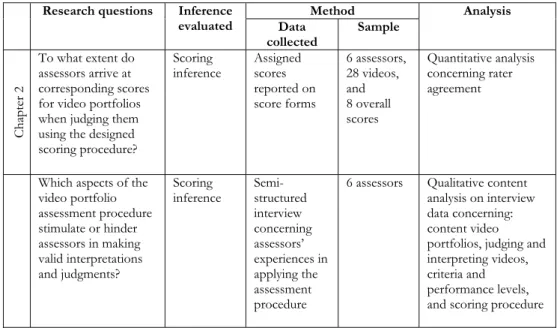
In Study 1, the authentic performance assessment was developed and tested on a small scale. In order to get an indication of the methodological quality of the assessment procedure constructed, two aspects of this were investigated. First, the interrater agreement between assessors was examined as part of the reliability of scores. Second, the utility of the video portfolio assessment procedure with respect to making valid interpretations and judgments was examined. The following research questions were addressed in Study 1:
1a) To what extent do assessors arrive at corresponding scores for video portfolios when judging them using the designed scoring procedure?
1b) Which aspects of the video portfolio assessment procedure stimulate or hinder assessors in making valid interpretations and judgments?
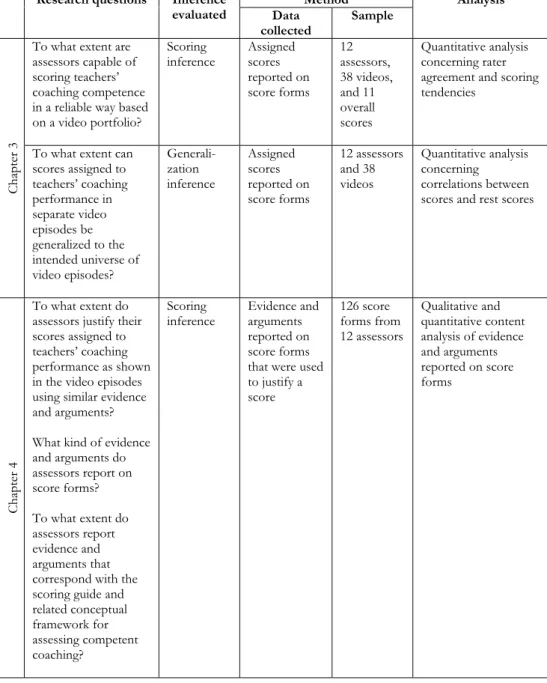
In Study 2, the reliability of assessors’ scores using the designed performance assessment was investigated in-depth, and based on a larger sample of assessors. Another important aspect of the methodological quality was also examined in this study: the generalizability of performance scores. The following research questions were addressed:
2a) To what extent are assessors capable of scoring teachers’ coaching competence in a reliable way based on a video portfolio?
2b) To what extent can scores assigned to teachers’ coaching performance in separate video episodes be generalized to the intended universe of video episodes?
In Study 3, first, the interrater agreement with regard to evidence and arguments underlying numeral scores was investigated. Second, assessors’ use of the scoring guide and related conceptual framework was investigated as part of the validity of their scoring processes. The following research questions were addressed:
3a) To what extent do assessors justify their scores assigned to teachers’ coaching performance as shown in the video episodes using similar evidence and arguments?
3b) What kind of evidence and arguments do assessors report on score forms? 3c) To what extent do assessors report evidence and arguments that correspond with
1.3 Context of the study: Assessing teachers’ coaching competence
1.3.1 Competence-based and self-regulated learning in senior secondary vocational education
As part of this dissertation, an authentic performance assessment procedure was developed based on design principles from the literature. This assessment procedure was aimed at assessing teachers’ coaching competence in the context of senior secondary vocational education. As a result of the implementation of competence-based and self-regulated learning in vocational education, coaching has become an important competence domain for teachers. It is expected that teachers who take on a coaching role will contribute to self-regulated and independent learning of the learners, one of the central aims of competence-based learning in vocational education (Moerkamp, De Bruijn, Van der Kuip, Onstenk, & Voncken, 2000; Onstenk, 2000). As part of this innovation, a specific project was started called the ‘MTS+ project’. This project was implemented in the first and second years of the highest level of vocational education (beroepsopleidende leerweg, niveau 4), in relation to technical studies. This section of vocational education concerns building and construction techniques, electro technology, and mechanical engineering. Students are educated in construction technology, theory of strength of materials, architectural drawing, etc. Students between 16 and 20 years of age enter this type of education. In the MTS+ project, a specific learning environment was developed to foster self-regulated learning by organizing the education around complex tasks that were closely related to tasks people undertake in practice. The complex tasks entailed, for example, designing homes or constructing a dam. Relevant domain-specific knowledge and (to some extent) skills had to be used while students worked on these tasks. The tasks were relatively large projects; students worked on a single task for approximately four weeks. Furthermore, four to six students worked together on one complex task. Since the students did not posses all knowledge and skills needed to fulfill the complex task beforehand, the teachers were expected to coach the students. The teachers were expected, first, to coach the students in performing learning activities that they were not (yet) able carry out on their own, and, second, to coach the students in developing realistic perceptions of professional thinking and acting in practice.
1.3.2 Competent coaching
20
competence. This conceptual framework was then elaborated on in a concrete scoring guide that included scoring rules, criteria, and performance levels that could be used for scoring and judging video portfolios.
The first step in defining competent coaching was to formulate teacher interventions that could be marked as coaching interventions. From a theoretical point of view, coaching can be described as stimulating and supporting self-regulated learning (Boekaerts, 1999; Boekaerts & Simons, 1995; Bolhuis, 2003; Butler & Winne, 1995). Typical coaching interventions that can be used to stimulate and support such learning are asking questions and providing feedback on learning activities employed by students. By asking questions and providing feedback, the teacher makes students aware of their learning activities and provides them with information about the adequacy, efficiency, and effectiveness of (performed) learning activities (Boekaerts & Simons, 1995; Butler & Winne, 1995). Students can use this information to direct and regulate new learning activities. Providing clues, hints, advice, and examples also constitutes relevant coaching interventions (Boekaerts & Simons, 1995; Butler & Winne, 1995). Such feedback can be effective, for example, when students do not know how to continue their tasks or to find out where they made mistakes. Coaching interventions are used to stimulate and support four different learning activities: cognitive, meta-cognitive, and affective learning activities, and learning activities related to collaborative learning (Perry, 1998; Perry, Phillips, & Dowler, 2004; Shuell, 1993; Vermunt & Verloop, 1999, Winne & Hadwin, 1998). Cognitive learning activities concern processing activities that students use to process subject matter and that lead to learning outcomes in terms of changes in students’ knowledge base and skills. Affective learning activities pertain to coping with emotions that arise during learning and that lead to a mood that fosters or impairs the progress of the learning process. Meta-cognitive or regulation activities are thinking activities that students use to decide on learning contents, to exert control over their processing and affective activities, and to steer the course and outcomes of their learning (Vermunt & Verloop, 1999). Learning activities related to collaborative learning concern communication, coordination, and the realization of a positive group climate (Johnson & Johnson, 1994; Slavin, 1990).
by Roelofs and Sanders (2007) was used as a starting point. According to this definition, teachers’ competence is the extent to which a teacher, as a professional, takes deliberate and appropriate decisions (based on personal knowledge, skills, conceptions, etc.) within a specific and complex professional context (students, subject matter, etc.), resulting in actions which contribute to desirable outcomes, all according to accepted professional standards. This definition shows the important relationship between teachers’ actions and desirable consequences for students. It shows that competent performance is always directed towards positive consequences for students. Based on this notion, coaching was considered in this dissertation as competent coaching when teachers used coaching interventions that provided students with opportunities to improve their learning activities and their perceptions of practice. Opportunities for improving learning activities can be created through constructive coaching, and opportunities for improving perceptions of practice through practice-oriented coaching. In constructive coaching, the teacher provides just enough support to enable the students to make the step to a higher level in employing learning activities, which they couldn’t have made on their own (Vygotsky, 1978). As the improvement in performing a learning activity increases, the support of the teacher decreases until the student can perform the learning activity by him/herself; this is referred to in the literature as ‘fading’ (Collins, Brown, & Newman, 1989). When the teacher is capable of providing just enough support to accomplish improvement of a learning activity, coaching is considered ‘constructive’ (Vermunt & Verloop, 1999). When a teacher provides too much or too little support, improvement in conducting learning activities is expected not to take place. In that case, coaching is considered to be ‘non-constructive’ (Vermunt & Verloop, 1999). In practice-oriented coaching, a coach should refer to rules, norms, procedures, methods, and typical situations that are used or occur in practice (Brown & Campione, 1994; Lave, 1991). When a teacher neglects to refer to professional practice during coaching, it is expected that students do not get a proper chance to construct representative views of professional thinking and acting in practice.
22
deciding which performance level was matched by the coaching performance observed.
1.3.3 Scoring procedure
The assessors were expected to score the video portfolios according to a detailed scoring procedure. In this procedure, for each video episode, the assessors started by collecting specific evidence pertaining to teachers’ questions and feedback that did or did not provide the opportunity for students to improve their performance of learning activities and perceptions of practice. The assessors then used the specific evidence to build a judgment of the performance in the whole video episode, based on four distinguished performance levels. Subsequently, the assessors formed an overall judgment about teachers’ coaching competence based on the performance across the video episodes. In this judgment, the four performance levels were also used. The assessors were urged to follow the steps of the scoring procedure in detail.
1.3.4 Assessor training
1.4 Relevance of the study
The theoretical relevance of this dissertation lies in its contribution to the knowledge base concerning issues and measures in performance assessments pertaining to reliability, generalizability, and validity. The studies presented in this dissertation were aimed at investigating the design of performance assessments in relation to methodological issues that specifically pertain to assessors’ scoring (scoring inference) and to the generalization of an observed score on an assessment task to a universe score (generalization inference). The studies were aimed at providing greater insight into the extent to which the design principles proposed in the literature actually lead to reliable and valid performance assessments. Another goal of the studies was to provide greater insight into the magnitude of threats to reliable and valid scoring and into the generalizability of scores across assessment tasks. In brief, this research was aimed at expanding insights into the occurrence of threats such as the impact of assessors’ personal beliefs, assessors’ biases, selective observation, and task specificity, as well as into measures in the design of performance assessments that can reduce these threats.
The practical relevance of this dissertation lies in its contribution to insights into the methodological opportunities and restrictions of performance assessment. These insights can be used in the design of performance assessments and in the use of these instruments in teacher education and schools. It is expected that authentic performance assessment will be used more frequently in the future to make different (high-stakes) types of decisions about, for example, the selection of educational personnel, admission to teacher education or continuation of the course in teacher education, differential payment, and licensure of educational personnel. In the event of such situations it is important to be knowledgeable about the methodological quality of performance assessments.
24
1.5 Outline of the study
In this dissertation, three studies are presented in which the reliability, generalizability, and validity of performance assessments were examined in different manners. Table 1 provides an overview of the design of the three studies. In the columns, the following information is presented: research questions; the inference (in Kane’s chain of inferences) that was evaluated; the type of data collected; the sample of assessors, video episodes, or score forms that were included in the analyses; and the analyses done in order to answer the research question.
In Chapter 2, the first study is presented. In this study, the assessment procedure was designed and tested on a small scale. Two important aspects of the reliability and validity of the video portfolios were investigated: the interrater agreement between assessors, and aspects in the design of the video portfolios that stimulated or hindered assessors in making valid interpretations and judgments. This study was focused on the first inference of Kane’s chain of inferences: the scoring inference. To investigate this inference, scores assigned to video episodes and overall scores were collected, and the interrater agreement was determined. Furthermore, a semi-structured interview was carried out with all assessors in order to obtain information on aspects of the assessment procedure that stimulated or hindered assessors in making valid interpretations and judgments.
Furthermore, it was determined for each video episode to what extent the score assigned to it matched the scores assigned to the other video episodes.
In Chapter 4, the last study is presented. In this study, the validity of assessors’ scoring was investigated. The emphasis was once more on the scoring inference. However, in contrast to the previous studies, the analyses were focussed on the evidence and arguments assessors used to justify the scores assigned. Most validity and reliability research focuses on the technical soundness of the assessment procedures. However, statistics lack information about the process of scoring and the actual use of the scoring rules by raters (Linn, 1994; Messick, 1995; Moss, 1994; Van der Schaaf, Stokking, & Verloop, 2005). For that reason, qualitative analyses were used in this study to enable more thorough investigation of the validity of assessors’ scoring processes.
Table 1.1 Design of the three studies
Method Research questions Inference
evaluated Data
collected Sample
Analysis
Chapte
r 2
To what extent do assessors arrive at corresponding scores for video portfolios when judging them using the designed scoring procedure?
Scoring
inference Assigned scores reported on score forms
6 assessors, 28 videos, and 8 overall scores
Quantitative analysis concerning rater agreement
Which aspects of the video portfolio assessment procedure stimulate or hinder assessors in making valid interpretations and judgments?
Scoring
inference Semi- structured interview concerning assessors’ experiences in applying the assessment procedure
26
Table 1.1 Design of the three studies (Continued)
Method Research questions Inference
evaluated Data
collected Sample
Analysis
To what extent are assessors capable of scoring teachers’ coaching competence in a reliable way based on a video portfolio?
Scoring inference Assigned scores reported on score forms 12 assessors, 38 videos, and 11 overall scores Quantitative analysis concerning rater agreement and scoring tendencies
Chapte
r 3 To what extent can scores assigned to teachers’ coaching performance in separate video episodes be generalized to the intended universe of video episodes? Generali-zation inference Assigned scores reported on score forms 12 assessors and 38 videos Quantitative analysis concerning correlations between scores and rest scores
Chapte
r 4
To what extent do assessors justify their scores assigned to teachers’ coaching performance as shown in the video episodes using similar evidence and arguments?
What kind of evidence and arguments do assessors report on score forms?
To what extent do assessors report evidence and arguments that correspond with the scoring guide and related conceptual framework for assessing competent coaching?
Scoring
28
References
Aronson, E., Wilson, T.D., & Akert, R.M. (2007). Social psychology (5th ed.). Amsterdam: Pearson Education Benelux BV.
Barton, J., & Collins, A. (1993). Portfolios in teacher education. Journal of Teacher Education, 44, 200-210. Barton, J., & Collins, A. (1997). Portfolio assessment: A handbook for educators. Dale Seymour Publications. Boekaerts, M. (1999). Self-regulated learning: Where we are today. International Journal of Educational
Research, 31, 445-457.
Boekaerts, M., & Simons, P.R.J. (1995). Leren en instructie. Psychologie van de leerling en het leerproces (Learning and instruction. Psychology concerning student and students’ learning process). Tweede druk. Assen: Van Gorcum.
Bolhuis, S. (2000). Naar zelfstandig leren: Wat doen en denken docenten (Towards self-regulated learning: What teachers do and think). Apeldoorn: Garant.
Borsboom, D., & Mellenbergh, G.J. (2004). The Concept of Validity. Psychological Review, 111(4), 1061-1071.
Brennan, R.L. (1998). Misconceptions at the intersection of measurement theory and practice. Educational Measurement: Issue and Practice, 17(1), 5-9.
Brennan, R.L. (2000). Performance assessments from the perspective of generalizability theory. Applied Psychological Measurement, 24(4), 339-353.
Brown, A.L., & Campione, J.C. (1994). Guided discovery in a community of learners. In K. Mcgilly (Ed.), Classroom lessons: Integrating cognitive theory and classroom practice (pp. 229-270). Cambridge, MA: MIT Press/Bradford Books.
Butler, D.L., & Winne, P.H. (1995). Feedback and self-regulated learning: A theoretical syntheses. Review of Educational Research, 65(3). 245-281.
Collins, A., Brown, J.S., & Newman, S.E. (1989). Cognitive apprenticeship: teaching the crafts of reading, writing, and mathematics. In L.B. Resnick (Ed.), Knowing, learning and instruction: Essays in honor of Robert Glaser (pp. 453-494). Hillsdale, NJ: Erlbaum.
Crocker, L. (2003). Teaching for the test: Validity, fairness, and moral action. Educational Measurement: Issue and Practice, 22(3), 5-11.
Day, D.V., & Sulsky, L.M. (1995). Effects of frame-of-reference training and information configuration on memory organization and rating accuracy. Journal of Applied Psychology, 80, 158-167.
Darling-Hammond, L., & Snyder, J. (2000). Authentic assessment of teaching in context. Teacher and Teacher Education, 16, 523-545.
Dwyer, C.A. (1993). Teaching and diversity: Meeting the challenges for innovative teacher assessments. Journal of Teacher Education, 44(2), 119-129.
Dwyer, C.A. (1998). Psychometrics of praxis III: Classroom performance assessments. Journal of Personnel Evaluation in Education, 12(2), 163-187.
Eraut, M. (1994). Developing professional knowledge and competence. London: Falmer Press.
Fredriksen, R.F., & Collins, A. (1989). A systems approach to educational testing. Educational Researcher, 19(9), 27-32.
Frederiksen, J.R., Sipusic, M., Sherin, M., & Wolfe, E.W. (1998). Video portfolio assessment of teaching. Educational Assessment, 5(4), 225-298.
Gipps, C.V. (1994). Beyond testing: Towards a theory of educational assessment. London, Washington D.C.: The Falmer Press.
Girod, G. (Ed.) (2002). Connecting teaching and learning. A handbook for teacher educators on teacher work sample methodology. Monmouth: Western Oregon University, Washington DC: American Association of colleges for teachers. ERIC Clearinghouse on Teaching and Teacher Education, ED 463 282. Gonzi, A. (1994). Competency based assessment in the professions in Australia. Assessment in Education
1(1), 27-45.
Haertel, E.H. (1991). New forms of teacher assessment. Review of Research in Education, 17, 3-19.
Johnson, D., & Johnson, R. (1994). Learning together and alone: cooperative, competitive, and individualistic learning (4th ed.). Boston: Allyn & Bacon.
Kagan, D.M. (1990). Ways of evaluating teacher cognition: Inferences concerning the Goldilocks principle. Review of Educational Research, 60, 419-469.
Kane, M.T. (1992). An argument-based approach to validity. Psychological Bulletin, 112, 527-535.
Kane, M.T. (2004). Certification testing as an illustration of argument-based validation. Measurement, 2(3), 135-170.
Kane, M.T. (2006). Validation. In R.L. Brennan (Ed.), Education Measurement (4th ed.). Westport: Praeger Publishers.
Lave, J., & Wenger, E. (1991). Situated Learning: Legitimate peripheral participation. Cambridge: Cambridge University Press.
Linn, R.L. (1994). Performance assessment. Policy promises and technical measurement standards. Educational Researcher, 23(9), 4-14.
Linn, R.L., Baker, E., & Dunbar, S. (1991). Complex, performance-based assessment: Expectations and validation criteria. Educational Reseacher, 20(8), 15-21.
Linn, R.L., & Burton, E. (1994). Performance-based assessment: Implications of task-specificity. Educational Measurement: Issues and Practice, 13(1), 5-15.
30
Messick, S. (1989). Validity. In R.L. Linn (Ed.), Educational measurement (3rd ed.). New York: MacMillan. Messick, S. (1994). The interplay of evidence and consequences in the validation of performance
assessments. Educational Researcher, 23(2), 13-23.
Messick, S. (1995). Validity of psychological assessment. Validation of inferences from persons’ responses and performances as scientific inquiry into score meaning. American Psychologist, 50(9), 741-749. Miller, M.D., & Linn, R.L. (2000). Validation of performance assessments. Applied Psychological Measurement
24(4), 367-378.
Mislevy, R.J. (2007). Validity by design. Comments on Lissitz and Samuelson. Educational Researcher, 36(8), 437-448.
Moerkamp, T., De Bruijn, E., Van der Kuip, I., Onstenk, J., Voncken, E. (2000). Krachtige leeromgevingen in het MBO. Vernieuwingen van het onderwijs in beroepsopleidingen op niveau 3 en 4 (Powerful learning invironments in senior secondary vocational education. Educational innovations in vocational education on level 3and 4). Amsterdam: SCO-Kohnstamm Instituut.
Moss, P.A. (1994). Can there be validity without reliability? Educational Researcher, 23, 5-12.
Onstenk, J. (2000). Op zoek naar een krachtige beroepsgerichte leeromgeving: fundamenten voor een onderwijsconcept voor de bve-sector (A search for powerfull learning environments: A basis for a teaching philosophy in senior secondary vocational education). 's-Hertogenbosch: CINOP.
Perry, N., Phillips, L., & Dowler, J. (2004). Examining features of tasks and their potential to promote self-regulated learning. Teachers College Record, 106, 1854-1878.
Perry, N.E. (1998). Young children’s self-regulated learning and the context that support it. Journal of Educational Psychology, 90, 715-729.
Roelofs, E., & Sanders, P. (2007). Towards a framework for assessing teacher competence. European Journal for Vocational Training, 40(1), 123-139.
Ruiz-Primo, M.A., Baxter, G.P., & Shavelson, R.J. (1993). On the stability of performance assessments. Journal of Educational Measurement, 30, 41-53.
Salzman, S.A., Denner, P.R., Bangert, A.W., & Harris, L.B. (2001). Connecting teacher performance to the learning of all students: Ethical dimensions of shared responsibility. Pocatello, Idaho: Idaho State University; ERIC Reproduction services ED 451182.
Schaaf, van der, M.F., Stokking, K.M., & Verloop, N. (2005). Cognitive representations in raters’ assessment of teacher portfolios. Studies in Educational Evaluation, 31, 27-55.
Schalock, H.D., Schalock, M., & Girod, G. (1997). Teacher work sample methodology as used at Western Oregon University. In J. Millman (Ed.)., Grading teachers, grading schools: Is student achievement a valid evaluation measure? (pp. 15-45). Newbury Park, CA: Corwin Press.
Seldin, P. (1991). The teaching portfolio. Bolton, MA. Anker Publishing Company,Inc.
Shephard, L.A. (1993). Evaluating test validity. Review of Research in Education, 19, 405-450.
Shuell, T.J. (1993). Toward an integrated theory of teaching and learning. Educational Psychologist, 28, 291– 311.
Slavin, R. (1990). Cooperative learning: Theory, research, and practice. Englewood Cliffs: NJ, Prentice-Hall. Stamoulis, D.T., & Hauenstein, N.M.A. (1993). Rater training and rater accuracy: Training for
dimensional accuracy versus training for rater differentiation. Journal of Applied Psychology, 78(6), 994-1003.
Uhlenbeck, A.M. (2002). The development of an assessment procedure for beginning teachers of English as a foreign language. Doctoral dissertation. Leiden: ICLON Graduate School of Education.
Vermunt, J.D., & Verloop, N. (1999). Congruence and friction between learning and teaching. Learning and Instruction, 9, 257-280.
Vygotsky, L.S. (1978). Mind in society: The development of higher psychological processes. Cambridge, MA: Harvard University press.
Wade, R. C., & Yarbrough, D. B. (1996). Portfolios: A tool for reflective thinking in teacher education? Teaching and Teacher Education, 12, 63-79.
Winne, P.H., & Hadwin, A.F. (1998). Studying as self-regulated learning. In D.J. Hacker, J. Dunlosky, & A.C. Graesser (Eds.), Metacognition in educational theory and practice (pp. 277-304). Hillsdale, NJ: Erlbaum.
32
Chapter 2
Video portfolios: The development and practical utility of an
authentic teacher assessment procedure
1Abstract
This chapter reports on the design and practical utility of an authentic assessment procedure that can be used for assessing teachers’ coaching competence in the context of senior secondary vocational education. The aim was to determine to what extent assessors are able to cope with the assessment procedure designed, and to explore how assessors can be supported in making valid interpretations and judgments. Video recordings of teachers’ coaching performance in the classroom are the main elements of the assessment procedure constructed. Additional data sources were included that provide information on the context of the videotaped coaching situations. This combination of video recordings and context information is called a ‘video portfolio’. Six trained assessors scored three video portfolios. The scores they assigned were collected and the interrater agreement was determined. After the video portfolios had been scored, the assessors were interviewed about their experiences of scoring and judging them. The overall conclusion is that assessors seem to be reasonably capable of using the scoring procedure, and that it yields relatively comparable judgments. The assessors indicated that it is necessary to be trained in using the assessment procedure, and that following this procedure takes a lot of energy. Particularly mastering the scoring method takes much time.
2.1 Introduction
The last two decades, new forms of teacher assessment have been developed and used. These new forms of assessment, often referred to as ‘performance assessment’ and ‘authentic assessments’, reflect a shift in assessment purposes and conceptions of teaching (Darling-Hammond & Snyder, 2000; Haertel, 1991; Gipps, 1994). New views on teacher assessment place more emphasis on the formative function of assessment,
1 This chapter has been submitted in adapted form as:
34
in which assessment results are used for teachers’ further professional development. To ensure that assessment tasks make up a meaningful learning experience, it is argued that they should be authentic and realistic to teachers who are being assessed (Uhlenbeck, Verloop, & Beijaard, 2002). In the new conception of teaching, teaching is recognized as a complex activity that is highly contextual and personal (Darling-Hammond & Snyder, 2000; Dwyer, 1994). To ensure that assessments reflect these conceptions, assessments should be authentic and emphasize the assessment of actual teaching performance in complex everyday conditions. Based on the changing conceptions of teaching, new methodologies have emerged for authentic assessment, like teacher work samples (Girod, 2002; Salzman, Denner, Bangert, & Harris, 2001; Schalock, Schalock, & Girod, 1997), structured types of teacher portfolios (Barton & Collins, 1993, 1997; Seldin, 1991; Wade & Yarbrough, 1996), and, more specific, video portfolios (Frederiksen, Sipusic, Sherin, & Wolfe, 1998). In these methods the focus is on collecting and judging evidence using a deliberately chosen sample of instructional activities based on a curricular unit. The various forms of evidence all refer to the same set of instructional situations, which are deliberately set out to attain learning objectives (Girod, 2002).
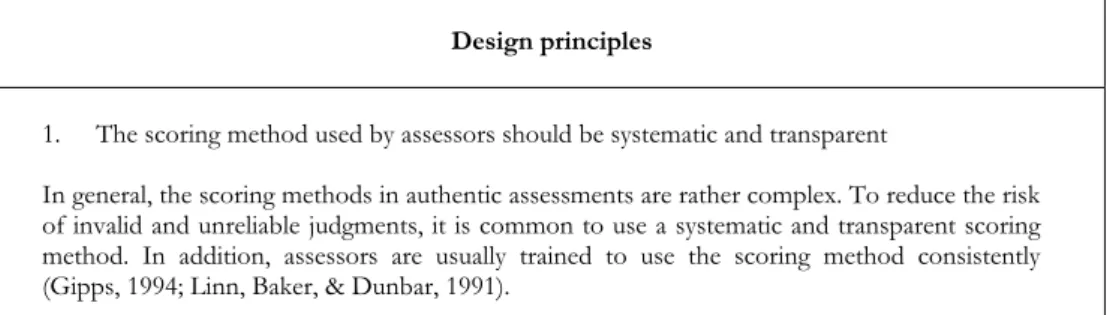
These new purposes, conceptions, and methods of teaching and teacher assessment have consequences for the design of authentic teacher assessments. A common knowledge base is gradually emerging of what constitutes valid, reliable, and educative authentic teacher assessments. Frequently cited design principles and underlying notions for authentic teacher performance assessments are listed in Table 2.1.
Table 2.1 Design principles for authentic performance assessments
Design principles
1. The scoring method used by assessors should be systematic and transparent
Table 2.1 Design principles for authentic performance assessments (Continued)
Design principles
2. Criteria and performance levels should include theoretical perspectives on competent teaching as well as practice-based perspectives
In order to obtain representative criteria and performance levels for judging competent teaching, theoretical as well as practice-based perspectives should be included in the criteria and standards (Uhlenbeck, 2002).
3. Criteria and performance levels should describe essential aspects of professional performance in terms of what professional teachers should know and be able to do
A major issue in formulating criteria and performance levels is choosing the appropriate level of specificity of these key aspects of professional performance. If the criteria or performance levels are formulated too broadly/generally, then it is difficult for assessors to apply these criteria and performance levels consistently. If the criteria and performance levels are formulated too narrowly/specifically, then there is the risk of getting lost in specifics and the essence of teaching is missed (Dwyer, 1993; Kagan, 1990).
4. Criteria and performance levels should not favour any style of teaching
Criteria and performance levels used in teacher assessment should specify what aspects of teaching will be assessed and not how teachers should carry them out (Darling-Hammond & Snyder, 2000; Dwyer, 1998; Gipps, 1994; Haertel, 1991; Uhlenbeck, 2002).
5. Multiple methods should be used to cover different aspects of teaching
Not only relevant performance (acting) should be assessed, but also relevant knowledge and decisions that underlie performance (Beijaard & Verloop, 1996; Dwyer, 1998; Uhlenbeck, 2002).
6. The assessment should take place in a context that closely resembles the actual teaching context
It is recognized that all teaching and learning is shaped by the context in which it occurs. Factors like grade level, subject, students’ ability, and school policy largely determine what approaches to teaching will be effective, and it is, therefore, important to include the context in assessment tasks (Darling-Hammond & Snyder, 2000; Dwyer, 1998; Gipps, 1994; Haertel, 1991; Uhlenbeck, 2002).
7. Assessment tasks should reflect the complexity of teaching
36
In this chapter we present the design of an authentic assessment procedure in which the principles listed in Table 2.1 were taken as starting point. This assessment procedure was aimed at assessing teachers’ coaching competence in the context of senior secondary vocational education. As a result of the implementation of competence-based teaching in the Netherlands, coaching has become an important domain of teacher competence. It is expected that teachers who take on a coaching role will contribute to self-regulated and independent learning of the learners, one of the central aims of competence-based learning in vocational education (Moerkamp, De Bruijn, Van der Kuip, Onstenk, & Voncken, 2000; Onstenk, 2000). In this relatively new learning environment, teachers are supposed to coach students who work collaboratively in small groups on complex, job-related tasks.
Different kinds of evidence for assessing teachers’ coaching competence were gathered. Inspired by the work of Frederiksen, Sipusic, Sherin, and Wolfe (1998), a procedure for video portfolio assessment was set up. The main evidence collected consisted of video recordings of teachers’ coaching performance in the classroom. The videos were collected in a systematic way, and additional data sources were added that outlined the context in which the coaching took place. This collection of documented video registrations and context information is referred to as a video portfolio. Video portfolios are supposed to provide assessors with a structured and well-documented collection of evidence with regard to the coaching performance. In this study, researchers constructed the video portfolios.
An authentic assessment procedure based on video portfolios consists of rich, qualitative information that requires interpretations and judgments of assessors to determine what it means. The validity of their interpretations and judgments largely determines the quality of the assessment. However, it is not easy to interpret and judge qualitative data in a consistent, objective, and comparable way (Gipps, 1994; Moss, 1994). The aim of this study was to explore to what extent assessors were able to apply the designed procedure for assessing video portfolios, and to explore which aspects of the procedure supported or hindered the assessors in making valid interpretations and judgments.
The specific research questions were the following:
- Which aspects of the video portfolio assessment procedure stimulate or hinder the assessors in making valid interpretations and judgments?
The development of the assessment procedure is first described. Attention is given to the domain of competence that was assessed; the criteria and performance levels designed for the assessment; the kinds of evidence that were gathered, structured, and documented for the assessment; how the evidence was to be scored and judged by the assessors; and in what way the assessors were trained in applying the scoring method.
2.2 Development of the assessment procedure
In designing the assessment procedure, we started by defining the domain of competence to be assessed. The video portfolios were to be used to assess teachers’ coaching competence in senior secondary vocational education. In the context of this innovation, a specific project was started called the ‘MTS+ project’. In the MTS+ project, a specific learning environment was developed to foster self-regulated learning in the context of technical studies. Teachers’ task in this context was to coach students who work collaboratively on complex tasks. Relevant domain specific knowledge and (to some extent) skills related to building and construction techniques had to be applied while students worked on these tasks. The students were asked to carry out authentic tasks such as designing holiday homes and building a dam. The tasks were relatively large projects; students worked on a single task for approximately four weeks. In order to accomplish a task, students were expected to carry out various learning activities. In this learning context, teachers were expected, first, to coach students in performing learning activities that they could not (yet) carry out on their own, and, second, to coach students in developing realistic perceptions of professional thinking and acting in practice.
38
The main purpose of the interpretive framework was to prevent assessors from scoring and judging video portfolios according to their own criteria as much as possible. It is known from the literature that assessors, while assessing, use schemata in understanding and predicting respondents’ behavior (DeNisi, Cafferty, & Meglino, 1984; Feldman, 1981; Landy & Farr, 1980). The schemata are comparable to personal constructs (Kelly, 1955), and are used to organize and simplify information. The schemata work like filters, causing assessors to look selectively at information and interpret it according to their own constructs (Van der Schaaf, Stokking, & Verloop, 2005). In providing an interpretive framework, the assessors were urged to score and judge the video portfolios according to the constructs in the framework.
2.2.1 Defining teaching interventions that can be marked as coaching interventions
The first step in designing criteria and performance levels for assessing teachers’ coaching competence was to formulate interventions that could be marked as coaching interventions. This part of the interpretive framework was meant to support assessors in identifying and judging coaching interventions out of all teaching interventions taking place during the performance. The design principles 1 and 2 as presented in Table 2.1 were the starting point in defining coaching activities. In accordance with principle 1, coaching interventions were defined based on the findings of a literature study; these coaching interventions were adjusted and refined to suit the specific context of MTS+, so that theoretical as well as practice-based perspectives were represented in the framework. In order to conform with design principle 2, the goal was to capture only essential coaching interventions in the framework using a literature study and observations in practice aimed at extracting interventions commonly used in coaching situations.
Theoretical perspective on coaching interventions
information to direct and regulate new learning activities. Providing clues, hints, advice, and examples also constitutes relevant coaching interventions (Boekaerts & Simons, 1995; Butler & Winne, 1995; Winne & Hadwin, 1998). Such feedback can be effective, for example, when students do not know how to continue their tasks or to find out where they made mistakes.
Coaching interventions are used to stimulate and support cognitive, meta-cognitive, affective learning activities, and learning activities concerning collaborative learning (Perry, 1998; Perry, Phillips, & Dowler, 2004; Shuell, 1993; Vermunt & Verloop, 1999). Cognitive learning activities concern processing activities that students use to process subject matter and that lead to learning outcomes in terms of changes in students’ knowledge base and skills. Affective learning activities pertain to coping with emotions that arise during learning and that lead to a mood that fosters or impairs the progress of the learning process. Meta-cognitive regulation activities are thinking activities that students use to decide on learning contents, to exert control over their processing and affective activities, and to steer the course and outcomes of their learning (Vermunt & Verloop, 1999). Learning activities concerning collaborative learning concern communication, coordination, and realization of a positive group climate (Johnson & Johnson, 1994; Slavin, 1990).
Practice-based perspective on coaching interventions
In line with design principle 1, a practice-based perspective on coaching was also included in the interpretive framework. Based on observations and interviews with teachers, the literature-based framework was adjusted and refined to the specific context of MTS+. Five teachers participating in the MTS+ project were observed for two hours each during their coaching conferences with students, and interviewed afterwards. Three teachers were randomly selected; the other two teachers were pointed out as ‘best coaches of the technical studies unit’ by the principal.
40
2.2.2 Defining criteria and performance levels for competent coaching
The second part of the interpretive framework specifies criteria and performance levels to be used by assessors to judge the quality of the individual coaching interventions and the entire coaching performance. Design principles 1, 2, and 3 were the starting point for defining criteria and standards for competent coaching. This implies that in this part of the framework theoretical as well as practice-based perspectives on competent coaching should be included. Furthermore, in formulating criteria and levels of performance, only aspects that distinguish competent from less competent coaching should be represented in this part of the interpretive framework. Observations in practice and a literature study were used to track down these aspects of competent coaching. In accordance with design principle 3, the criteria and levels of performance were formulated in terms of what a teacher should achieve.
In defining competent coaching, a general model for teachers’ competence developed by Roelofs and Sanders (2007) was used as a starting point. According to this model, teachers’ competence is defined as the extent to which a teacher, as a professional, takes deliberate and appropriate decisions (based on personal knowledge, skills, conceptions, etc.) within a specific and complex professional context (students, subject matter, etc.), resulting in actions which contribute to desirable outcomes, all according to accepted professional standards (Roelofs & Sanders, 2007). This definition shows the important relationship between teachers’ actions and desirable consequences for students. It shows that competent performance is always directed towards positive consequences for students. Based on this notion, criteria for competent coaching were defined in terms of positive consequences for students in the context of MTS+.
Practice-based perspective on competent coaching
Theoretical perspective on competent coaching
In line with design principle 1, a theoretical perspective on competent coaching was also included in the criteria and performance levels. The literature study was done in order to elaborate on how teachers can support students in achieving these learning goals. This part of the interpretive framework is based on theories concerning process-oriented instruction (Vermunt & Verloop, 1999; Vermunt & Verschaffel, 2000) and cognitive apprenticeship (Collins, Brown, & Newman, 1989).
42
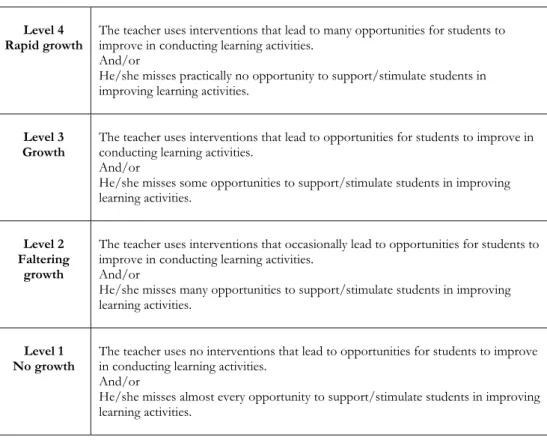
Table 2.2 Performance levels for constructive coaching
Level 4
Rapid growth The teacher uses interventions that lead to many opportunities for students to improve in conducting learning activities. And/or
He/she misses practically no opportunity to support/stimulate students in improving learning activities.
Level 3
Growth The teacher uses interventions that lead to opportunities for students to improve in conducting learning activities. And/or
He/she misses some opportunities to support/stimulate students in improving learning activities.
Level 2 Faltering
growth
The teacher uses interventions that occasionally lead to opportunities for students to improve in conducting learning activities.
And/or
He/she misses many opportunities to support/stimulate students in improving learning activities.
Level 1
No growth The teacher uses no interventions that lead to opportunities for students to improve in conducting learning activities. And/or
He/she misses almost every opportunity to support/stimulate students in improving learning activities.
Table 2.3 Performance levels for practice-oriented coaching
Level 4 Full-grown perception of
practice
The teacher uses interventions that lead to many opportunities for students to construct realistic perceptions of professional thinking and acting in practice. And/or
He/she misses practically no opportunities to stimulate students in constructing realistic perceptions of professional thinking and acting in practice.
Level 3 Representative
perception of practice
The teacher uses interventions that lead to opportunities for students to construct realistic perceptions of professional thinking and acting in practice.
And/or
He/she misses some opportunities to stimulate students in constructing realistic perceptions of professional thinking and acting in practice.
Level 2 Fragmented perception of
practice
The teacher uses interventions that occasionally lead to opportunities for students to construct realistic perceptions of professional thinking and acting in practice. And/or
He/she misses some opportunities to stimulate students in constructing realistic perceptions of professional thinking and acting in practice.
Level 1 No perception
of practice
The teacher uses no interventions that lead to opportunities for students to construct realistic perceptions of professional thinking and acting in practice. And/or
He/she misses almost every opportunity to stimulate students in constructing realistic perceptions of professional thinking and acting in practice.
2.2.3 Content of the video portfolio
In order to cover all aspects of coaching and to provide assessors with a complete picture of teachers’ coaching competence, a mix of evidence is needed (design principle 4). The assumption was that assessors are better capable of understanding and interpreting the coaching performance shown in the video episodes when they know about the context in which the coaching performance took place. Research has shown that especially understanding the performance is a first and important step in making valid interpretations with regard to the performance (Heller, Sheingold, & Myford, 1998; Schutz & Moss, 2004).
44
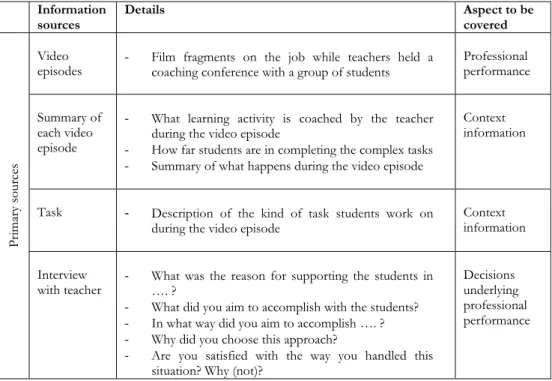
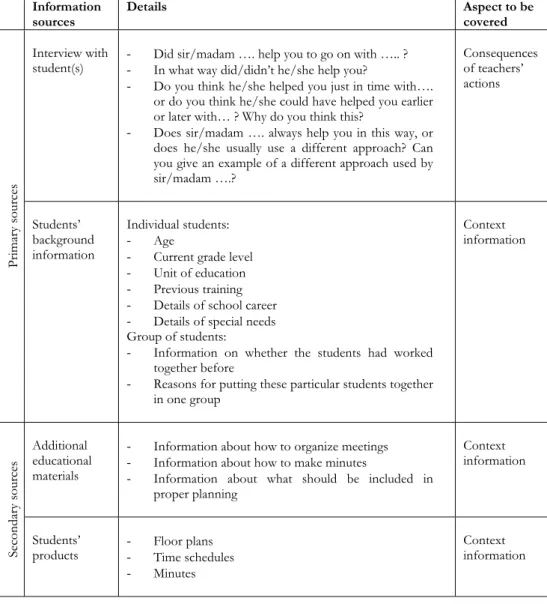
of evidence consisted of video episodes that represented coaching performance. For this, teachers were filmed on the job while they held coaching conferences with a group of students. The video recordings represented authentic performance in an authentic context (design principles 5 and 6). Other sources of evidence were added: interviews with the teachers about the decisions underlying their actions; interviews with students about the impact of teachers’ actions on their work; information about students’ background; information about the task students worked on during a video episode; information about students’ progress in completing the task; and information about teachers’ background. Assessors were expected to examine all these primary sources when assessing a video portfolio. The secondary sources of evidence consisted of educational materials students used during video episodes and students’ products discussed during video episodes. Assessors could use the secondary sources of evidence in assessing a video portfolio if they felt the need for this extra information.
Recording professional performance
The researchers constructed four video portfolios of four teachers (one female coach and three male coaches). The participating teachers coached first-year students in MTS+ (of the technical vocational studies unit). All coaches had one to two years’ experience in coaching students working on complex tasks. Each coach was filmed within a period of four weeks in which students completed one such task.
Before the actual recording, test recordings were carried out to get teachers and students used to the presence of video cameras. In addition, recording equipment and the positions of the different cameras were tested. Three cameras were used, placed around the students and the teacher. During coaching, teachers wore a wireless microphone, and two microphones were placed on the tables. The students and teachers were filmed frontally.
Documentation of video episodes
or on a specific student product, a close-up was used and in the event of rapid interaction, the group-shot was used.
After the film was mixed, video episodes representing professional performance were selected from the recorded coaching conferences and were marked using time marks. In this process, the following guideline for selecting a video episode was used: the video episode had to be a situation in which students needed support in conducting a specific learning activity to complete the complex task they were working on. Such situations were expected to provide valuable evidence of teachers’ coaching competence. In addition, for all video episodes, a short summary was written of what happened during the video episode, including what learning activity or activities the teacher supported. Information on the progress of the students in completing the task was also included in the summary.
Interviewing teachers and students and collecting context information
Immediately after the coaching session, two researchers made an initial selection of situations that occurred during the session, based on notes they took during the coaching conference. This selection of situations was used as input for the interview about the teachers' underlying decisions that resulted in performance. The teachers were interviewed directly after the recording of the coaching session. The specific interview questions used in the interview are included in Table 2.4. To retrieve information about the perceived effects of coaching, the students were also interviewed about the selected situations. Directly after the coaching conference, one or two students who received the most coaching were selected for the interview. The specific interview questions used in the interview are included in Table 2.4. In addition to the video episodes and the interviews, information about the students’ and teachers’ backgrounds, and copies of the instructional materials for teacher and students, were collected. Only information was gathered that was expected to support assessors’ understanding of the performance shown in the video recordings. The specific information gathered is listed in Table 2.4.
Finalizing the video portfolio