Project Management
Skills for All Careers
By Project Management Open Resources and
TAP-a-PM
Foreword by Daniel Dishno, Occupational
Training Institute, De Anza College
Copyright © 2011, 2012 by Project Management Open Resources and TAP-a-PM Edition 2 January, 2012
Creative Commons Attribution 3.0 Unported (CC BY 3.0) Bound Book
ISBN-10: 0984813802 ISBN-13: 978-0-9848138-0-3
e book
ISBN-10: 0984813810 ISBN-13: 978-0-9848138-1-0
Based on Project Management for Scientists and Engineers by Merrie Barron and Andrew Barron
http://cnx.org/content/col11120/1.4/
Significant contributions from the following sources
Maura Irene Jones, Career Descriptions in Chapter 1 Several photographs Copyright © 2011 by Maura Irene Jones
Creative Commons Attribution 3.0 CC BY Attribution URL http://www.linkedin.com/in/maurajones
Randy Fisher, Chapter 12
(a subset of Organization Management and Development at http://wikieducator.org/OMD/Culture_PM)
Rekha Raman, Microsoft Word template and formatting Ali Daimee, syllabus and more
Mike Milos, syllabus Shuly Cooper, reviews
Bob Sawyer, Project Manager for the Saylor Foundation proposal Victor Cesena, Project Manager for the bound textbook
Jim Huether, Program Manager Jacky Hood, Managing Editor
Page 3 of 135
Author and Editor Bios
Project Management Open Resources (PMOR) is an organization dedicated to
creating, publicizing, and distributing open-licensed project management information. PMOR‘s community includes over 60 members, many with extensive project management experience and certifications. See http://projectmanagementopenresources.ning.com/.
Tap-a-PM is a cooperative association of project and program managers founded in February of 2008 that acts as a source of accomplished program and project managers with full project life-cycle skills across a set of disciplines and industries. The association supports its members with a wealth of domain expertise and connections into the wider project and program management community. Tap-a-PM members include highly-qualified project and program managers with over 200 years of project/program management experience with backgrounds in software, computers, electronics, IT, on-line learning, instrumentation, telecom, bio-tech, and more. See http://www.tapapm.org/.
Professor Andrew Barron co-authored Project Management for Scientists and Engineers. He is the Charles W. Duncan, Jr. – Welch Chair of Chemistry, a Professor of
Materials Science, and the Associate Dean for Industry Interactions and Technology Transfer at Rice University. See http://chemistry.rice.edu/FacultyDetail.aspx?RiceID=585.
Merrie Barron, a Project Management Professional and Certified Scrum Master, co-authored Project Management for Scientists and Engineers. She teaches project management for science and engineering at Rice University. See http://www.linkedin.com/in/merriephinney.
Victor Cesena is a Project Management Professional (PMP) and Certified Scrum Master (CSM). His extensive project management experience includes stints at Electronics for Imaging, Read-Rite, Sumitomo, Hitachi Metals, Tri-media, Kennedy, Eikon, and Ampex. Victor holds an Electrical Engineering degree from the University of the Pacific.
Shuly Cooper is president of PhytoScience, Inc. She has extensive experience in software quality engineering at companies including Verano, Spyglass, Space Systems Loral, Micro Focus, and Sybase. Shuly holds a Masters in Biochemistry from the Hebrew University and a PhD in Biophysics from the Weizmann Institute of Science.
Ali Daimee recently completed certification in program management at the University of California at Santa Cruz. He has taught project management at the University of California – Irvine, and Northwestern Pacific University. In his career Ali has worked for companies such as Broadcom, Sega, Sun, Oracle, Tandem, Compaq, Novell, Novellus, Cadence, Nortel, Control Data, Honeywell, and ICL. He has also co-founded startup companies managing development of web and network application products. Ali holds honors degrees in Mathematics and Electrical Engineering from London University.
Page 4 of 135
Randy Fisher holds certifications in advanced technology management and instructional design. He is the Manager of Community Service Learning at the University of Ottawa‘s Centre for Global and Community Engagement. He has made significant contributions to the
Community College Consortium for Open Education Resources, the Commonwealth of Learning, the OER Foundation and WikiEducator. Randy holds an MA in Organization Management and Development and a post-graduate degree in Journalism,
Jacky Hood is a program manager, service/support executive, management consultant, and educator. Prior to serving as Director of College Open Textbooks, her clients included Apple, HP, IBM, RightWave, and Slam Dunk Networks. She has published four books and numerous articles, and won writing awards from McGraw-Hill and Patton Consultants. Jacky holds a Masters of Systems Engineering from Carleton University, Ottawa, and a Bachelors degree in Electrical Engineering from the University of Nebraska.
Jim Huether, a Certified Scrum Master, has served as Program/Project Manager for companies such as Philips Semiconductors, Logitech, and Symantec, as well as Foothill College and College Open Textbooks, where he led the development of several on-line courses. Jim has also taught several courses in project management. Prior to this, he served in software
development management positions for a number of companies before founding Nchant, an invention, licensing and product development company. Jim holds both a Bachelors degree and a Masters degree in Electrical Engineering from Rice University.
Mike Milos is a senior consultant at Deloitte & Touche, and teaches a system development lifecycle class at both undergraduate and graduate levels at the University of Phoenix In the past he has worked for Hewlett-Packard, Network Appliance, KLA-Tencor, and the US Navy. Mike holds a Masters degree in Computer Information Systems and a Bachelors degree in Information Technology from the University of Phoenix.
Maura Jones is a Project Management Professional, and holds certifications in audit (ISACA CISA) and security (ISC2 CISSP). Maura has provided project management expertise to a variety of global clients, and taught Business Data Communications and eCommerce at the University of San Francisco and Notre Dame de Namur University. Maura holds an MS in Telecommunications Management from Golden Gate University, a BS in Psychology from San Jose State University, and Certificates in Project Management from UC Berkeley and Stanford. Maura is active in professional organizations, including PMI and ITIL.
Rekha Raman, a Project Management Professional, is a marketing communications manager at LitePoint, responsible for a wide spectrum of documents, including datasheets, quick start guides, user manuals, field service instructions, and regulatory documents. With over 15 years of experience in technical writing, Rekha‘s interests range from effective communications to marine biology to wireless technology. On behalf of College Open Textbooks, she reviewed the Project Management for Scientists and Engineers textbook.
Page 5 of 135
Bob Sawyer, a consultant in product management and product marketing, has worked for a wide range of technology companies, both large and small, including IBM, Solid, Panta, HP, Compaq, and Tandem. He holds a Bachelors degree from Northwestern University and a Masters degree from the Kellogg School of Management.
Dalvinder Singh Matharu has worked as a project manager for 3 years and has been a team member for more than 15 years. He is a Project Management Professional (PMP) and a Certified Scrum Master (CSM).
Page 6 of 135
Foreword
Daniel Dishno, Supervisor, Occupational Training Center, De Anza College, Cupertino, CA, USA
Every organization has a purpose for existing. It has a set of ongoing organized functions and structures (aka work) that have been established to accomplish something that relates to the purpose of the organization. At a college, instructors teach classes, counselors provide academic advice, and administrators guide the day to day operations. This is not project management, it is ongoing work. Project Management Skills for All Careers defines project management as "the application of knowledge, skills, tools, and techniques applied to project activities in order to meet project requirements. Project management is a process that includes planning, putting the project plan into action, and measuring progress and performance. Projects are unique,
temporary in nature and have a definite beginning and end. Projects are completed when the project goals are achieved. A successful project is one that meets or exceeds the expectations of the stakeholders."
In our department at the college, we have projects. Mainly these projects originate from grants and contracts. In developing a grant proposal or contract, team members gather around and look at what is required in the grant and try and figure out how best to submit a competitive proposal. Sometimes we are overwhelmed when we read what is expected. Sometimes we laugh, and we face our fears and proceed into the unknown. Our projects usually involve job training and job placement services, catering to a specified group of unemployed clients such as refugees, laid-off high tech workers, or welfare recipients. After reading Project Management Skills for All Careers, I realized the project plan is the same as a grant proposal or contract.
This is exciting stuff. We are bringing something new to the campus. A new group of students that just arrived from some war-torn country training for a job, a laid-off worker re-training for a new career, a welfare mom gaining skills to be self-sufficient, a new skills re-training program.
I read Project Management Skills for All Careers in less than one week, and I feel better equipped in planning, implementing, measuring, changing and completing projects. This book refreshed my passion for my work. I am excited to have this book in my arsenal of professional resources.
Page 7 of 135
Preface
When an opportunity presents itself, we look around for people with these skills: leadership, decisiveness, scoping, identifying tasks and deliverables, defining relationships among tasks, finding and assigning resources, scheduling, and budgeting. We also want soft skills including building relationships, communicating with all concerned parties, and motivating people to produce quality work quickly and efficiently.
Similarly when confronted with a problem such as a natural disaster, many of the same skills are required.
For more than half a century, project managers have learned and applied these skills in engineering, science, construction, and more. Today‘s rapidly-changing world calls for expanding the use of project management skills to many more industries and careers.
Managing repetitive work, process management, was the norm for centuries. Agriculture, manufacturing, retail, transportation, and other endeavors remained the same for years or
decades. Those days are past. The world is moving much faster and all processes must change often. Changing a process is a project and it demands project management skills. No longer can a business manager, nurse, teacher, or any other worker assume that he or she can learn a routine and then repeat it for years.
The mission of this textbook is two-fold:
To provide students with project management skills they can apply in any chosen profession.
To provide instructors with an open-licensed textbook they can freely copy, move into a learning management system; and modify to suit their teaching style, student demographics, available teaching time, and more.
With attribution to the original authors Merrie Barron and Andrew Barron, the Project Management Open Resources community, the TAP-a-PM project/program management
cooperative, and other sources, any instructor, indeed any person or organization, may freely use and even sell the materials in this textbook. Please include the information on the copyright page in your attribution.
Page 8 of 135
A Word to Business School and
Other Instructors
The following syllabus is suggested for an introductory 15-week one-semester class in project management for business school students. For shorter terms such as 12-week quarters or multi-day workshops in industry, chapters 1-6 could be covered in a single session, and chapters 17 and 18 omitted and saved for an advanced class.
This textbook could also be used in many vocational programs; examples appear in Chapter 1. The particular skills needed in those occupations could be addressed, e.g., scheduling and budgeting. Week/ Session # Book Part # Book Chapter #
Topic Covered Assignment
1 I 1, 2, 3, 4, 5
Definition and characteristics of Project; Project Management and its history; Various applications Project Management and its benefits to business; Participants in Project Management its beneficiaries
Form small teams of 3-5 students; Brainstorm about a specific business the team wants to select and define a project for your team
2 6 Skill set and expertise necessary
for a successful Project Manager; Examples and Challenges faced by a Project Manager; Focus on Interpersonal skills – the most important tool set
Practice interpersonal skills among your team members using role play and
recognize leadership traits of your team
3 7 The Project Life Cycle and its
phases – key activities, focus, and challenges of each phase
Define key deliverables per each phase for your teams project and define
beginning and end of these phases for your project 4 II 8, 9, 10,
11, 12
Recognizing stakeholders, Project Political Environment,
Organizational Culture and their importance in Project Initiation; Types of Project Management Certification and their benefits
Page 9 of 135 Week/ Session # Book Part # Book Chapter #
Topic Covered Assignment
5 III 13, 14 Inputs to Project Planning Phase, Factors considered during the Scope planning step of Project Planning
Develop the scope of your teams project
6 15 Schedule Planning step – tools
and techniques – types of schedules and their characteristics; Activities, dependencies, relationships, graphical presentation, tracking, etc.
Develop a Work
Breakdown Structure for your project, define
activities and create a basic network diagram
7 16 Resource Planning step –
Defining effort, durations and type of resources required for a project – types of estimates, tools used, adding information to the project schedule
Define resource needed for each activity, duration allowed and the effort required for your project – Update your project plan with this information
8 17 Budget Planning – Consideration
of costs and tradeoffs of various execution options such as Company Internal cost of doing the project versus contracting or subcontracting all part of the project – developing a budget for the project
Develop a budget for your project considering a mix of subcontractors and internal resources
9 18 Risk and its definition; Risk
identification process, Probability and impact consideration of Risks; Developing a Risk Register and identifying various Risk mitigation options.
Identify Risks on your project, their probability and impact, rank them and determine their triggers and mitigation options
10 19 Quality Planning considerations – Regulatory requirements,
Industry standards, Internal Policies and guidelines, Quality monitoring and control, Quality Assurance and its benefits
Page 10 of 135 Week/ Session # Book Part # Book Chapter #
Topic Covered Assignment
11 20 Communications Planning –
Defining communications channels, types of
communications, amount of communications, Defining Interfaces with Internal and external stakeholders,
consideration of conflicts and their resolution, etc.
Create a communications plan for your project employing techniques learned in this chapter
12 21 Completing the overall Project
Planning as the final deliverable from the Project Planning Phase
Review your overall
project plan and optimize it as necessary
13 IV 22 Project Implementation Phase and its tracking and control – Need for replanning as and when needed; tools and techniques of Project control
Define change control plan for your project
14 23 Project Completion and how to
recognize it – various actions involved in closing a project – importance of lessons learned and the celebration
Identify closing actions for your project and document Lessons Learned.
15 Final Final review and Team
Page 11 of 135
COMPLETE TABLE OF CONTENTS
Author and Contributor BiosForeword
Preface
A Word to Business School and other Instructors
PART I - INTRODUCTION
Chapter 1: Jump-Start Any Career with Project Management Skills
1.1 Careers Using Project Management Skills 1.2 Business Owners
1.3 Construction Manager 1.4 Creative Services 1.5 Educator
1.6 Engineers
1.7 Healthcare Careers 1.8 Paralegal
1.9 Software developer/computer programmer 1.10 Scientist Technicians
Chapter 2: History of Project Management
Chapter 3: What is a Project?
3.1 A Formal Definition of a Project Chapter 4: Project Characteristics
Chapter 5: What is Project Management?
Chapter 6: Project Management Areas of Expertise
6.1 Application knowledge; standards & regulations 6.2 Understanding the Project Environment
Page 12 of 135 6.4 Interpersonal Skills
Chapter 7: The Project Life Cycle
7.1 Initiation Phase 7.2 Planning Phase 7.3 Implementation Phase 7.4 Closing Phase
PART II – PROJECT STRATEGY
Chapter 8: Project Stakeholders
8.1 Top Management 8.2 The Project Team 8.3 Your Manager 8.4 Peers
8.5 Resource Managers 8.6 Internal Customer 8.7 External customer 8.8 Government
8.9 Contractors, subcontractors, and suppliers Chapter 9: The Politics of Projects
9.1 Assess the environment 9.2 Identify goals
9.3 Define the problem Chapter 10: Project Initiation
Chapter 11: Project Management Certifications
11.1 Project Management Institute Overview 11.2 Scrum Development Overview
Chapter 12: Culture and Project Management
12.1 What is Organizational Culture?
Page 13 of 135 12.3 Project Team Challenges
12.4 Dealing with Conflict 12.4 Bibliography for Chapter 12 PART III – PROJECT PLANNING
Chapter 13: Overview of Project Planning
Chapter 14: Scope Planning
14.1 Defining the Scope 14.2 Project Requirements 14.3 Functional Requirements 14.4 Non-Functional Requirements 14.5 Technical Requirements 14.6 User Requirements 14.7 Business Requirement 14.8 Regulatory requirements 14.9 An Example of Requirements Chapter 15: Project Schedule Planning
15.1 Preparing the work breakdown structure 15.2 A case study
15.3 Activity Definition 15.4 Leads and Lags 15.4 Milestones
15.5 The Activity Sequencing Process 15.6 Creating the Network Diagram Chapter 16: Resource Planning
16.1 Estimating the Resources 16.2 Estimating Activity Durations 16.3 Project Schedule
Page 14 of 135 17.1 Make or Buy Analysis
17.2 Contract Types
Chapter 18: Risk Management Planning
Chapter 19: Quality Planning
19.1 Quality planning tool Chapter 20: Communication Planning
Chapter 21: Bringing it all together
Part IV - IMPLEMENTATION and CLOSING
Chapter 22: Project Implementation Overview
22.1 Change control Chapter 23: Project Completion
23.1 Lessons learned 23.2 Contract closure 23.3 Releasing project team 23.4 Celebrate!
Appendix A: Solutions to Exercises
Solution to Exercise 10.1 Solution to Exercise 15
Solutions to Exercises in Chapter 16
Appendix B: Glossary of Project Management Terms
Page 15 of 135
PART I - INTRODUCTION
New Moon Copyright ©TallPomlin CC BY
http://www.flickr.com/photos/paultomlin/364907230/sizes/m/in/photostream/
PART
Page 16 of 135
Chapter 1: Jump-Start Any Career with Project Management
Skills
1.1 Careers Using Project Management Skills:
Skills learned by your exposure to studying project management can be used in most careers as well as in your daily life. Strong planning skills, good communication, ability to implement a project to deliver the product or service while also monitoring for risks and managing the resources, will provide an edge towards your success. Project Managers can be seen in many industry sectors including: Agriculture and Natural Resources; Arts, Media and Entertainment; Building Trades and Construction; Energy and Utilities; Engineering and Design; Fashion and Interiors; Finance and Business; Health and Human Services; Hospitality, Tourism and Recreation; Manufacturing and Product Development; Public and Private Education
Services; Public Services; Retail and Wholesale Trade; Transportation; and Information Technology.
Below we explore various careers and some of the ways in which project management knowledge can be leveraged.
1.2 Business Owners
Business owners definitely need to have some project management skills. With all successful businesses, the product or service that is being delivered to the customer meets their needs in many ways. The product or service is of the quality desired, the costs are aligned with what the consumer expected, and the timeliness of that product or service meets the deadline for the buyer of that item.
Copyright © 2011 by Maura Irene Jones
Creative Commons Attribution 3.0 CC BY Attribution URL http://www.linkedin.com/in/maurajones
Page 17 of 135
and the ability to analyze, communicate, budget, staff, equip, implement and deliver.
Copyright © 2011 by Maura Irene Jones
Creative Commons Attribution 3.0 CC BY Attribution URL http://www.linkedin.com/in/maurajones
Understanding the finances, the operations, and the expenses of the business are among the skills that project managers learn and practice. Some businesses may focus more on
accounting, providing financial advice, sales, training, public relations, and actuary or logistician roles. Business owners may own a travel agency or could provide hospitality. Business owners could be managing a store front or a location in their town‘s marketplace.
Copyright © 2011 by Maura Irene Jones
Creative Commons Attribution 3.0 CC BY Attribution URL http://www.linkedin.com/in/maurajones
1.2.1 Example: Restaurant Owner/Manager
Page 18 of 135
with the various departments (kitchen, dining room, banquet operations, food service managers, vendors providing the supplies) ensure that customers are satisfied with their dining experience. Managers‘ ability to recruit and retain employees, and monitor employee performance and training ensure quality with cost containment. Scheduling in many aspects, not only the staff but also the timing of the food service deliveries, is critical in meeting customer expectations.
Risk management is essential to ensure food safety and quality. Managers monitor orders in the kitchen to determine where delays may occur, and they work with the chef to prevent these delays. Legal compliance is essential in order for the restaurant to stay open, so Restaurant Managers direct the cleaning of the dining areas and the washing of tableware, kitchen utensils, and equipment. They ensure the safety standards and legality, especially in serving alcohol. Sensitivity and strong communication skills are needed when customers have complaints or employees feel pressured because more customers arrive than the forecast predicted.
Financial knowledge is needed for the soundness of running the restaurant, especially tracking special projects, events, and costs for the various menu selections. Catering events smoothly can be an outcome of using project plans and the philosophy of project management. The Restaurant Managers or the executive chef analyzes the recipes to determine food, labor, and overhead costs, determine the portion size and nutritional content of each serving, and assigns prices to various menu items, so that supplies can be ordered and received in time.
Copyright © 2011 by Maura I Jones
Creative Commons Attribution 3.0 CC BY Attribution URL http://www.linkedin.com/in/maurajones
Planning is the key for successful implementation. Managers or executive chefs need to estimate food needs, place orders with distributors, and schedule the delivery of fresh food and supplies. They also plan for routine services (equipment maintenance, pest control, waste
removal) and deliveries including linen services or the heavy cleaning of dining rooms or kitchen equipment, to occur during slow times or when the dining room is closed. A successful
restaurant relies on many skills that the project management profession emphasizes.
Page 19 of 135
show the need for the entire team to review the various proposals to choose the best plan.
Sample status chart which is typical with the use of a red-yellow-green Copyright © 2011 by Maura Irene Jones
Creative Commons Attribution 3.0 CC BY Attribution URL http://www.linkedin.com/in/maurajones
%
Comp Resp. 9/5 9/12 9/19 9/26 10/3 10/10 10/17 10/24 10/31 11/7 11/14 11/21 11/28 12/6 12/13 12/20 12/27
RFQ Task Name
1 Scope Definition:
1.1 Define RFQ Objectives; Draft & Approve Sourcing Plan 100% Sourcing (1) / Sponsors (2) 1.2 Complete Market Analysis 100% Sourcing 1.3
Kick-off RFQ Project with Key Stakeholders; Establish
Baseline & RFQ Scope w/ Key Stakeholders 100% Sourcing/Key Stakeholders 2 RFQ Process
2.1 Define Supplier Qualifications and Identify Bidders 100% Sourcing 2.2
Develop RFQ Technical & Functional Requirements; Draft RFQ
Document 100% All Key Stakeholders 2.3 Define RFQ Evaluation Criteria & Scoring Matrix 100% All Key Stakeholders 2.4
Sourcing, Sponsor, LOB, and Legal Review of RFQ Document;
Approval of final RFQ document 100% Sourcing 2.5 Release RFQ Documents to Bidders 100% Sourcing 2.6 Host Bidders Conference (optional) All Key Stakeholders 2.7 Bidders Q&A period 100%
2.8 RFQ (Round 1) Responses due to MIJ 0% Bidders 3 Round 1 MIJ Evaluation Period 0% All Key Stakeholders
3.1 Round 1 Responses reviewed by MIJ Stakeholders 0% All Key Stakeholders 3.2 Round 1 Responses are scored and Round 2 finalists selected 0% Sourcing 4 Round 2 MIJ Evaluation Period 0%
4.1
Round 2 Proposals requested from finalists and Round 2 evaluation criteria finalized 0%
4.2 Round 2 Response due to MIJ 0% Bidders 4.3 Round 2 Evaluated and scored 0% All Key Stakeholders 5 Bidder Selection:
5.1 Bidder Finalist(s) selected 0% All Key Stakeholders 5.2 Contract negotiations begin with Finalist(s) 0% Sourcing 5.3 Legal Review / Contract redlines (by MIJ and Finalist) 0% Sourcing 5.4 Stakeholder contract review and approval 0% All Key Stakeholders 5.5 Final Legal review and Contract approval 0% Sourcing 5.6 Contract execution (signed & counter signed) 0% Sourcing
Key: Milestone Decision Required
Complete In progress
Total # of Tasks 21
# of taks completed 10
% Complete 47.62%
December
Service Sourcing Initiative
September October November
Page 20 of 135
Copyright © 2011 by Maura Irene Jones
Creative Commons Attribution 3.0 CC BY Attribution URL http://www.linkedin.com/in/maurajones 1.3 Construction Manager
Construction managers plan, direct, coordinate, and budget a wide variety of residential, commercial, and industrial construction projects including homes, stores, offices, roads, bridges, wastewater treatment plants, schools, and hospitals. Strong scheduling skills are essential for this role. Communication skills are often used in coordination of design and construction processes, teams executing the work and governance of special trades (carpentry, plumbing, electrical wiring) as well as government representatives for the permit processes.
The Construction Manager may be called a project manager or project engineer. The Construction Manager ensures that the project gets completed on time and within budget while meeting quality specifications and codes and maintaining a safe work environment. These managers create project plans in which they divide all required construction site activities into logical steps, estimating and budgeting the time required to meet established deadlines, usually utilizing sophisticated scheduling and cost-estimating software. Many use software packages such as Microsoft Project® or Procure® or online tools like BaseCamp®. Most construction projects rely on spreadsheets for project management. Procurement skills used in this field include acquiring the bills of material, lumber for the house being built, and more. Construction managers also cording labor, determining the needs and overseeing their performance, ensuring that all work is completed on schedule.
Copyright © 2011 by Jennifer Russell
Creative Commons Attributions 3.0 CC BY Attribution URL: http://www.Tharpo.com
Page 21 of 135
in which the project manager includes in their decisions the best interest of society, the safety of the public, and enhancement of the environment.
1.4 Creative Services
Creative service careers include graphic artists, curators, video editors, gaming managers, multimedia artists, media producers, technical writers, interpreter, and translators. These
positions use project management skills, especially in handling the delivery channel and meeting clients‘ requirements.
Let us look at one example, graphic artists, to understand and identify some of the project management skills that aid in this career.
1.4.1 Graphic Artists
Graphic artists plan, analyze, and create visual solutions to communications problems. They use many skills found in project management, especially communications. They work to achieve the most effective way to get messages across in print and electronic media. They emphasize their messages using color, type, illustration, photography, animation, and various print and layout techniques. Results can be seen in magazines, newspapers, journals, corporate reports, and other publications. Other deliverables from Graphic Artists using project
management skills include promotional displays, packaging, and marketing brochures supporting products and services, logos, and signage. In addition to print media, graphic artists create
materials for the web, TV, movies, and mobile device apps.
Initiation in project management can be seen in developing a new design: determining the needs of the client, the message the design should portray, and its appeal to customers or users. Graphic designers consider cognitive, cultural, physical, and social factors in planning and executing designs for the target audience, very similar to some of the dynamics a project manager considers in communicating with various project stakeholders. Designers may gather relevant information by meeting with clients, creative staff, or art directors; brainstorming with others within their firm or professional association, and by performing their own research to ensure that their results have high quality and to manage risks.
Graphic designers may supervise assistants who follow instructions to complete parts of the design process. Therefore scheduling, resource planning, and cost monitoring are pillars of project management seen in this industry. These artists use computer and communications equipment to meet their clients‘ needs and business requirements in a timely and cost-efficient manner.
1.5 Educators
‗Educator‘ is a broad term that can describe a career in teaching, maybe being a lecturer, a professor, a tutor, or a home-schooler. Other educators include gurus, mullahs, pastors, rabbis, and priests. Instructors also provide vocational training or teach skills like learning how to drive a car or use a computer. Educators provide motivation to learn a new language or showcase new products and services. Educators use project management skills including planning and
communication.
Page 22 of 135
project management skills that are demonstrated in this profession.
1.5.1 Teachers
Some teachers foster the intellectual and social development of children during their formative years; other teachers provide knowledge, career skill sets and guidance to adults. Project management skills that teachers exhibit include acting as facilitators or coaches, communicating in the classroom and in individual instruction. Project managers plan and
evaluate various aspects of a project; teachers also plan, evaluate, and assign lessons; implement these plans, and monitor student‘s progress similar to the way a project manager monitors and delivers goods or services. Teachers use their people skills to manage students, parents,
administrators. The soft skills that project managers exercise can be seen in teachers encouraging collaboration in solving problems by having students work in groups to discuss and solve
problems as a team.
Project Managers may work in a variety of fields with a broad assortment of people, similar to teachers who work with students from varied ethnic, racial, and religious backgrounds with awareness and understanding of different cultures.
Teachers in some schools may be involved in making decisions regarding the budget, personnel, textbooks, curriculum design, and teaching methods demonstrating skills that a project manager would possess such as finance, and decision making.
1.6 Engineers
Engineers apply the principles of science and mathematics to develop economical solutions to technical problems. As a project cycles from an idea in the project charter to the implementation and delivery of a product or service, engineers link scientific discoveries to commercial applications that meet societal and consumer needs.
Copyright © Stanford Linear Accelerator Center (SLAC) Creative Commons Attributions 3.0 CC BY
Attribution URL: http://www.slac.stanford.edu
Page 23 of 135
Estimation skills in project management are used in Engineering. Engineers are asking many times to provide an estimate of time and cost required to complete projects.
1.7 Healthcare Careers
There are many jobs and careers in healthcare which use project management skills. The field of healthcare varies widely, such as athletic trainer, dental hygienist; massage therapist, occupational therapist, optometric, physician assistant and X-ray technicians. Again, these folks actively apply risk management in providing health care delivery of service to their clients, ensuring that they do not injury the person that they are caring for. Note: A section on nursing is covered within this area of the textbook.
Many of you may have experience taking a fall while you were growing up, and needed an x-ray to determine if you had a fracture or merely a sprain. Hence let us look at this career as an example of a healthcare professional using project management skills.
1.7.1 Radiologic Technologists and Technicians
Radiologic technologists and technicians perform diagnostic imaging examinations like x-rays, computed tomography, magnetic resonance imaging, and mammography. They could also be called radiographers, because they produce x-ray films (radiographs) of parts of the human body for use in diagnosing medical problems.
Project management skills, especially people skills and strong communication, are demonstrated when they prepare patients for radiologic examinations by explaining the procedure and what position the patient needs to be at, so that the parts of the body can be appropriately radiographed. Risk management is demonstrated when these professionals work to prevent unnecessary exposure to radiation, these workers surround the exposed area with
radiation protection devices, such as lead shields, or limit the size of the x-ray beam. Quality is needed to provide the expected results, with the health technician monitoring the radiograph and setting controls on the x-ray machine to produce radiographs of the appropriate density, detail, and contrast.
Safety and regulations concerning the use of radiation to protect themselves, their patients, and their coworkers from unnecessary exposure is tracked in an efficient manner and reported as a control to ensure compliance. Project management skills can also be use for they may prepare work schedules, evaluate purchases of equipment, or manage a radiology
department.
Some radiologic technologists specialize in computed tomography (CT), as CT technologists as they too use project management skills. Since CT scans produce a substantial amount of cross-sectional x rays of an area of the body, the CT uses ionizing radiation; therefore, it requires the same precautionary measures that are used with x rays, hence the need for risk management and monitoring for exposure.
Teamwork, not only with the patient which the Radiologic technologist is supporting, the doctor whom ordered the request, but also other healthcare providers rely on strong
Page 24 of 135 needed to obtain the objective.
1.7.2 Nurse
Nurses treat and educate patients and their family and public about various medical conditions and provide advice and emotional support. Nurses establish a care plan for their patients, activities like scheduling administering of medications as well as discontinuation of meds, i.e. intravenous (IV) lines for fluid, medication, blood, and blood products; applying therapies and treatments. Communication with the patient, their family, physicians and other healthcare clinicians may be done in person, or could use technology. Telehealth allows personnel to provide care and advice through electronic communications media including videoconferencing, the Internet, or by telephone.
Risk management is very important for a nurse, with some cases having a life or death consequence! Monitoring of pain management and vital signs and providing status to physicians help in responding to the health care needs of the patient.
The nursing field varies. Some nurses work in Infection control. They identify, track, and control infectious outbreaks in healthcare facilities and create programs for outbreak prevention and response to biological terrorism. Others are Educators, nurses who plan, develop, execute and evaluate educational programs and curricula for the professional development of students and professional nurses. Nurses may use project management skills while conducting healthcare consultations, advising on public policy, researching in the field or providing sales support of a product or service.
1.8 Paralegal
Attorneys assume the ultimate responsibility for legal work but they often obtain assistance. Paralegals assume this role in law firms and perform many tasks to aid in the legal profession. However, they are explicitly prohibited from carrying out duties considered to be the practice of law (i.e. giving legal advice, setting legal fees, court case presentations).
Project management skills from such as planning are used in helping lawyers prepare for closings, hearings, trials, and corporate meetings. Communication skills are used when
paralegals prepare written reports that help attorneys determine how cases should be handled, or the preparation of various drafts, such as pleading and motions to be filed, obtain affidavits, etc.
Monitoring tasks aid Paralegals who may track files of all important case documents, working on risk containment on filing dates and responses to the court. Procurement
considerations , skills that a project manager holds, can also be seen from a paralegal
Page 25 of 135
Copyright © 2011 by Maura Irene Jones
Creative Commons Attribution 3.0 CC BY Attribution URL http://www.linkedin.com/in/maurajones
Financial skills may be use as well, such as assisting in preparing tax returns, establishing trust funds, and planning estates or maintain financial office records at the law firm.
Government, litigation, personal injury, corporate law, criminal law, employee benefits, intellectual property, labor law, bankruptcy, immigration, family law, and real estate are many different law practices a Paralegal professional may experience which can use project
management skills in these various work environments.
1.9 Software developer/computer programmer:
Computer software developers and computer programmers design and develop software. They apply the principles of computer science and mathematics to create, test, and evaluate software applications and systems that make computers come alive. Software is developed in many kinds of projects: computer games, business applications, operating systems, network control systems, and more. Project management skills help develop the requirements for the software, identify and track the product development tasks, team communications, test cases, and management of the quality, schedule and resources (staff, equipment, labs, and more).
1.10 Scientist Technicians
Science Technicians use principles and theories of science and mathematics to assist in research and development and to help invent and improve products and processes with their jobs more practically oriented than scientists. Planning skills project managers use can be seen as Science Technicians set up, operate, and maintain laboratory instruments, monitor experiments, observe, calculate and record results. Quality is a factor here as it is in Project Management, essential in work to ensure the processes performed correctly, with proper proportions of ingredients, for purity, or for strength and durability.
There are different fields in which these scientist technicians can apply project
Page 26 of 135
other agricultural products, involved in food, fiber, and animal research, production, and processing. Control and risk management are important here in executing the tests and experiments to improve the yield and quality of crops, or plants and animals resistance to disease, insects, or other hazards. Quality factors are emphasis when food science technicians may conduct tests on food additives and preservatives to ensure compliance with Food and Drug Administration regulations regarding color, texture, and nutrients.
Soil chemistry—Toxins in rice plants
Copyright © Stanford Linear Accelerator Center (SLAC) Creative Commons Attributions 3.0 CC BY
Attribution URL: http://www.slac.stanford.edu
Biological technicians work with biologists studying living organisms. Many assist scientists who conduct medical research or who work in pharmaceutical companies help develop and manufacture medicines. Skills in schedule, especially in incubation periods for the study of the impact on cells, could impact projects, such as exploring and isolating variables for research in living organisms and infectious agents. Biotechnology technicians apply knowledge and execution skills, techniques, gained from basic research, including gene splicing and
recombinant DNA, and apply them to product development. Project Managers skills can be seen in the collaboration and communication between the team to record and understand the results and progress towards a cure or product.
Photo provided by LAVA Pathology Specialists CC BY
Page 27 of 135
and factories, using skills of monitoring and control in the way they collect and analyze samples. Again, quality assurance is of concern for most process technicians‘ work in manufacturing, testing packaging for design, integrity of materials, and environmental acceptability.
Page 28 of 135
Chapter 2: History of Project Management
Could the Great Wall of China, the pyramids, or Stonehenge (Figure 2.1) have been built without project management? It is possible to say that the concept of project management has been around since the beginning of history. It has enabled leaders to plan bold and massive projects and manage funding, materials and labor within a designated time frame.
Figure 2.1: Stonehenge was erected between 3,000 BC and 1,600 BC by no less than three different cultures and its orientation on the rising and setting sun has always been one of its
remarkable features
photo from Barron & Barron Project Management for Scientists and Engineers, http://cnx.org/content/col11120/1.4/
Page 29 of 135
Near the turn of the century, Frederick Taylor (Figure 2.2) began his detailed studies of work. He applied scientific reasoning to work by showing that labor can be analyzed and improved by focusing on its elementary parts that introduced the concept of working more efficiently, rather than working harder and longer.
Figure 2.2: Frederick Taylor (1856-1915).
Page 30 of 135
Taylor's associate, Henry Gantt (Figure 2.4), studied in great detail the order of operations in work and is most famous for developing the Gantt Chart in the 1910s.
Figure 2.4 Henry Gantt (1861 -1919)
Photo from Barron & Barron Project Management for Scientists and Engineers, http://cnx.org/content/col11120/1.4/
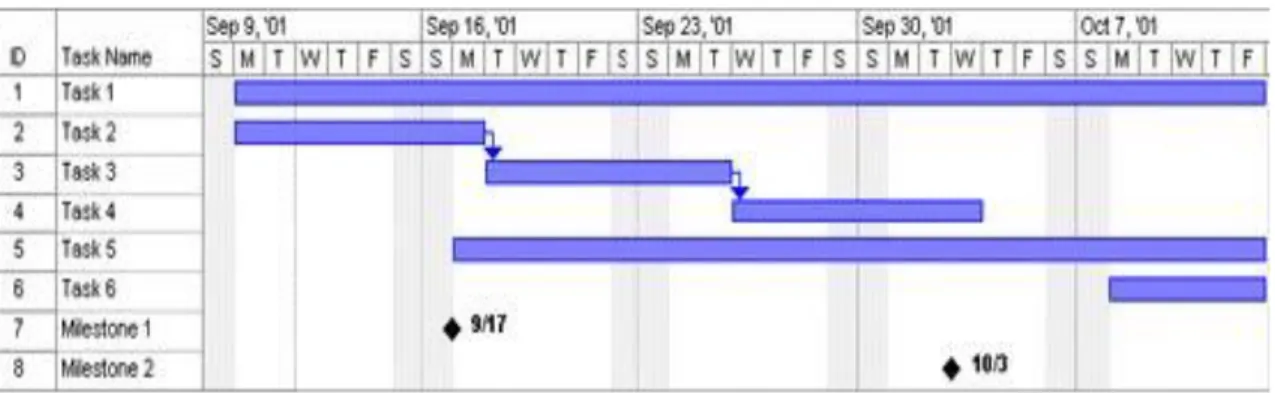
A Gantt chart is a popular type of bar chart that illustrates a project schedule and has become a common technique for representing the phases and activities of a project work
breakdown structure, so they can be understood by a wide audience (Figure 2.5). Although now considered a common charting technique, Gantt charts were considered quite revolutionary at the time they were introduced. Gantt charts were employed on major infrastructure projects
including the Hoover Dam and the Interstate highway system and are still accepted today as important tools in project management.
Page 31 of 135
By the mid Twentieth century, projects were managed on an ad hoc basis using mostly Gantt Charts, and informal techniques and tools. During that time, the Manhattan project was initiated and its complexity was only possible because of project management methods. The Manhattan project was the codename given to the Allied effort to develop the first nuclear weapons during World War II. It involved over thirty different project sites in the US and Canada, and thousands of personnel from US, Canada and UK. Born out of a small research program that began in 1939, the Manhattan Project would eventually employ 130,000 people and cost a total of nearly 2 billion USD and result in the creation of multiple production and research sites operated in secret. The project succeeded in developing and detonating three nuclear
weapons in 1945.
The 1950s marked the beginning of the modern Project Management era. Two mathematical project-scheduling models were developed:
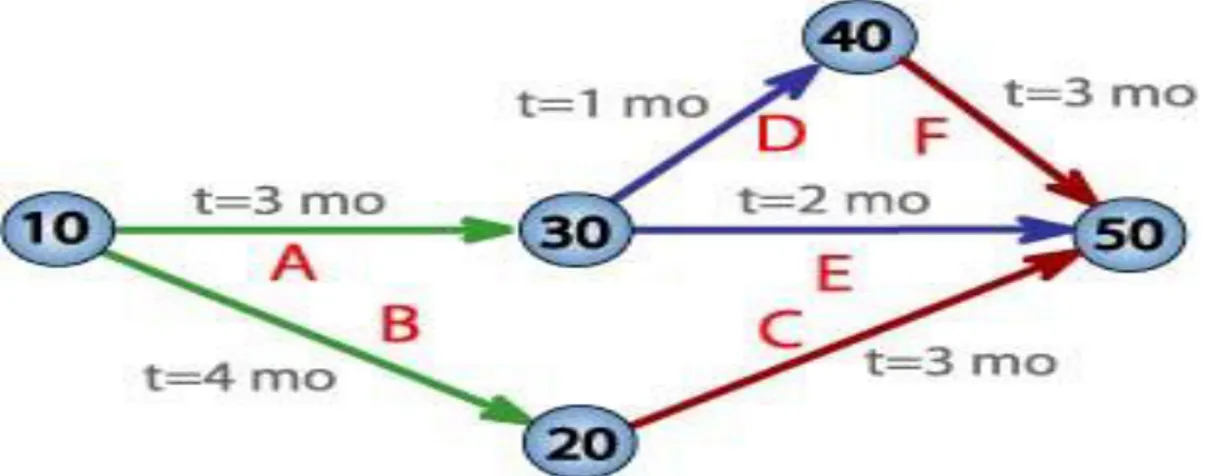
The Program Evaluation and Review Technique (PERT) was developed by Booz-Allen & Hamilton as part of the United States Navy's Polaris missile submarine program. PERT is basically a method for analyzing the tasks involved for completing a given project, especially the time needed to complete each task, the dependencies among tasks, and the minimum time needed to complete the total project (Figure 2.6).
The Critical Path Method (CPM) developed in a joint venture by both DuPont
Corporation and Remington Rand Corporation for managing plant maintenance projects. The critical path determines the float, or schedule flexibility, for each activity by calculating the earliest start date, earliest finish date, latest start date, and latest finish date for each activity. The critical path is generally the longest full path on the project. Any activity with a float time that equals zero is considered a critical path task. CPM can help you figure out how long your complex project will take to complete and which activities are critical; meaning they have to be done on time or else the whole project will take longer. These mathematical techniques quickly spread into many private enterprises.
Figure 2.6: An example of a PERT network chart for a seven-month project with five milestones. Illustration from Barron & Barron Project Management for Scientists and Engineers, http://cnx.org/content/col11120/1.4/
Chapter 3: What is a Project?
The starting point in discussing how projects should be properly managed is to first understand what a project is and just as importantly what it is not.
People have been undertaking projects since the earliest days of organized human activity. The hunting parties of our prehistoric ancestors were projects, for example; they were temporary undertakings directed at the goal of obtaining meat for the community. Large complex projects have also been with us for a long time. The pyramids and the Great Wall of China were in their day of roughly the same dimensions as the Apollo Project to send men to the moon. We use the term project frequently in our daily conversations. A husband, for example may tell his wife, "My main project for this weekend is to straighten out the garage." Going hunting, building pyramids, and fixing faucets all share certain features that make them projects.
A project has distinctive attributes, which distinguish it from ongoing work or business operations. Projects are temporary in nature. They are not an everyday business process and have definitive start dates and end dates. This characteristic is important because a large part of the project effort is dedicated to ensuring that the project is completed at the appointed time. To do this, schedules are created showing when tasks should begin and end. Projects can last minutes, hours, days, weeks, months or years.
Projects exist to bring about a product or service that hasn't existed before. In this sense, a project is unique. Unique means that this is new, this has never been done before. Maybe it's been done in a very similar fashion before but never exactly in this way. For example, Ford Motor Company is in the business of designing and assembling cars. Each model that Ford designs and produces can be considered a project. The models differ from each other in their features and are marketed to people with various needs. An SUV serves a different purpose and clientele than a luxury model. The design and marketing of these two models are unique projects. However the actual assembly of the cars is considered an operation, i.e., a repetitive process that is followed for most makes and models.
In contrast with projects, operations are ongoing and repetitive. They involve work that is continuous without an ending date and you often repeat the same processes and produce the same results. The purpose of operations is to keep the organization functioning while the purpose of a project is to meet its goals and to conclude. Therefore, operations are ongoing while projects are unique and temporary.
Page 33 of 135
3.1 A Formal Definition of a Project
Page 34 of 135
Chapter 4: Project Characteristics
When considering whether or not you have a project on your hands, there are some things to keep in mind. First, is it a project or ongoing operation? Next, if it is a project; who are the stakeholders? And third, what characteristics distinguish this endeavor as a project?
A project has several characteristics: Projects are unique.
Projects are temporary in nature and have a definite beginning and ending date. Projects are completed when the project goals are achieved or it's determined the project is no longer viable.
A successful project is one that meets or exceeds the expectations of the stakeholders. Consider the following scenario: The VP of Marketing approaches you with a fabulous idea. (Obviously it must be "fabulous" because he thought of it.) He wants to set up kiosks in local grocery stores as mini offices. These offices will offer customers the ability to sign up for car and home insurance services as well as make their bill payments. He believes that the exposure in grocery stores will increase awareness of the company's offerings. He told you that senior management has already cleared the project and he'll dedicate as many resources to this as he can. He wants the new kiosks in place in 12 selected stores in a major city by the end of the year. Finally, he has assigned you to head up this project.
Your first question should be "Is it a project?" This may seem elementary, but confusing projects with ongoing operations happens often. Projects are temporary in nature, have definite start and end dates, result in the creation of a unique product or service, and are completed when their goals and objectives have been met and signed off by the stakeholders.
Using these criteria, let's examine the assignment from the VP of marketing to determine if it is a project:
Is it unique? Yes, because the kiosks don't exist in the local grocery stores. This is a new way of offering the company's services to its customer base. While the service the company is offering isn't new, the way it is presenting its services is.
Page 35 of 135
Is there a way to determine when the project is completed? Yes, the kiosks will be installed and the services will be offered from them. Once all the kiosks are intact and operating, the project will come to a close.
Is there a way to determine stakeholder satisfaction? Yes, the expectations of the stakeholders will be documented in the form of requirements during the planning processes. These requirements will be compared to the finished product to determine if it meets the expectations of the stakeholder.
Chapter 5: What is Project Management?
You've determined that you have a project. What now? The notes you scribbled down on the back of the napkin at lunch are a start, but not exactly good project management practice. Too often, organizations follow Nike's advice when it comes to managing projects when they "just do it." An assignment is made and the project team members jump directly into the development of the product or service requested. In the end the delivered product doesn't meet the expectations of the customer. Unfortunately, many projects follow this poorly constructed path and that is a primary contributor to why a large percentage of projects don't meet their original objectives defined by performance, schedule, and budget.
In the United States, more than $250 billion dollars is spent each year on IT application development in approximately 175,000 projects. The Standish Group (a Boston-based leader in project and value performance research) released the summary version of their 2009 CHAOS Report that tracks project failure rates across a broad range of companies and industries (Figure 5.1).
Figure 5.1: Summary of 2009 Standish Group CHAOS report.
Illustration from Barron & Barron Project Management for Scientists and Engineers, http://cnx.org/content/col11120/1.4/
Jim Johnson, chairman of the Standish Group has stated that "this year's results show a marked decrease in project success rates, with 32% of all projects succeeding which are
delivered on time, on budget, with required features and functions, 44% were challenged which are late, over budget, and/or with less than the required features and functions and 24% failed which are cancelled prior to completion or delivered and never used."
When are companies going to stop wasting billions of dollars on failed projects? The vast majority of this waste is completely avoidable; simply get the right business needs
(requirements) understood early in the process and ensure that project management techniques are applied and followed and the project activities are monitored.
Page 37 of 135
value of good project management is that you have standard processes in place to deal with all contingencies.
Project Management is the application of knowledge, skills, tools, and techniques applied to project activities in order to meet the project requirements. Project management is a process that includes planning, putting the project plan into action, and measuring progress and
performance.
Managing a project includes identifying your project's requirements; writing down what everyone needs from the project. What are the objectives for your project? When everyone understands the goal, it's much easier to keep them all on the right path. Make sure you set goals that everyone agrees on to avoid team conflicts later on. Understanding and addressing the needs of everyone affected by the project means the end result of your project is far more likely to satisfy your stakeholders, and last but not least, as project manager you will also be balancing the many competing project constraints.
On any project, you will have a number of competing project constraints that are competing for your attention. They are cost, scope, quality, risk, resources and time.
Cost is budget approved for the project including all necessary expenses needed to deliver the project. Within organizations, project managers have to balance between not running out of money and not under spending because many projects receive funds or grants that have contract clauses with an "use it or lose it" approach to project funds. Poorly executed budget plans can result in a last minute rush to spend the allocated funds. For virtually all projects, cost is ultimately a limiting constraint; few projects can go over budget without eventually requiring a corrective action. Scope is what the project is trying to achieve. It entails all the work involved in delivering the project outcomes and the processes used to produce them. It is the reason and the purpose of the project.
Quality is the standards and criteria to which the project's products must be delivered for them to perform effectively. First, the product must perform to provide the functionality expected, and to solve the problem, and deliver the benefit and value expected of it. It must also meet other performance requirements, or service levels, such as availability, reliability and maintainability, and have acceptable finish and polish. Quality on a project is controlled through quality assurance (QA) that is the process of evaluating overall project's performance on a regular basis to provide confidence that the project will satisfy the relevant quality standards.
Page 38 of 135
Resources are required to carry out the project tasks. They can be people, equipment, facilities, funding, or anything else capable of definition (usually other than labor) required for the completion of a project activity.
Time is defined as the time to complete the project. Time is often the most frequent project oversight in developing projects. This is reflected in missed deadlines and incomplete deliverables. Proper control of the schedule requires the careful
identification of tasks to be performed, an accurate estimation of their durations, the sequence in which they are going to be done, and how people and other resources are allocated. Any schedule should take into account vacations and holidays.
You may have heard of the term "Triple Constraint" which traditionally only consisted of Time, Cost & Scope. These are the primary competing project constraints that you have to be aware of most. The triple constraint is illustrated in the form of a triangle to visualize the project work and to see the relationship between the scope/quality, schedule/time, and cost/resource (Figure 5.2).
Figure 5.2: A schematic of the triple constraint triangle.
Illustration from Barron & Barron Project Management for Scientists and Engineers, http://cnx.org/content/col11120/1.4/
In this triangle, each side represents one of the constraints (or related constraints) wherein any changes to any one side cause a change in the other sides. The best projects have a perfectly balanced triangle. Maintaining this balance is difficult because projects are prone to change. For example, if scope increases, cost and time may increase disproportionately. Alternatively, if the amount of money you have for your project decreases, you may be able to do as much, but your time may increase.
Page 39 of 135
resources to work on your project tasks you will have to extend your schedule because the resources you have take much longer to finish the work.
You get the idea; they are all dependent on each other. Think of all of these constraints as the classic carnival game of Whac-a-mole (Figure 5.3). Each time you try to push one mole back in the hole, another one pops out. The best advice is to rely on your project team to keep these moles in place.
Figure 5.3: Go to www.dorneypark.com/public/online fun/mole.cfm to play Whac-a-mole. Photo from Barron & Barron Project Management for Scientists and Engineers, http://cnx.org/content/col11120/1.4/
Here is an example of a project that cut quality because the project costs were fixed. The P-36 oil platform (Figure 5.4) was the largest footing production platform in the world capable of processing 180,000 barrels of oil per day and 5.2 million cubic meters of gas per day. Located in the Roncador Field, Campos Basin, Brazil the P-36 was operated by Petrobras.
Figure 5.4.: The Petrobras P-36 oil platform.
Page 40 of 135
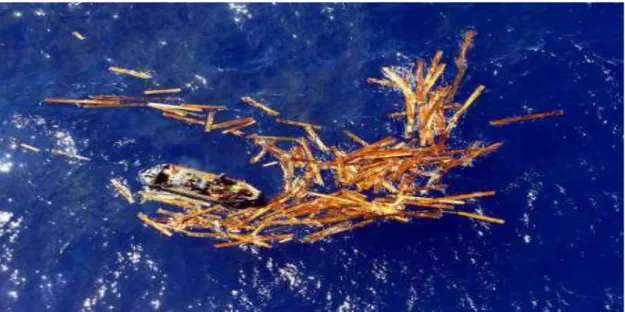
increased production led to corners being cut on safety procedures. It is listed as one of the most expensive accidents with a price tag of $515,000,000.
The following quote is from a Petrobras executive, citing the benefits of cutting quality assurance and inspection costs on the project, while the accompanying pictures are the result of this proud achievement in project management by Petrobras. The quotation is provided one sentence at a time and compared with pictures of the actual outcome
Figure 5.5: "Petrobras has established new global benchmarks for the generation of exceptional shareholder wealth through an aggressive and innovative program of cost cutting on its P36
production facility."
Page 41 of 135
Figure 5.6: "Conventional constraints have been successfully challenged and replaced with new paradigms appropriate to the globalized corporate market place."
Photo from Barron & Barron Project Management for Scientists and Engineers, http://cnx.org/content/col11120/1.4/
Figure 5.7: "Through an integrated network of facilitated workshops, the project successfully rejected the established constricting and negative influences of prescriptive engineering, onerous
Page 42 of 135
Figure 5.8: "Elimination of these unnecessary straitjackets has empowered the project's suppliers and contractors to propose highly economical solutions, with the win-win bonus of enhanced
profitability margins for themselves."
Photo from Barron & Barron Project Management for Scientists and Engineers, http://cnx.org/content/col11120/1.4/
Figure 5.9: "The P36 platform shows the shape of things to come in the unregulated global market economy of the 21st century."
Photo from Barron & Barron Project Management for Scientists and Engineers, http://cnx.org/content/col11120/1.4/
Page 43 of 135
Figure 5.10: A sign seen at an automotive repair shop.
Page 44 of 135
Chapter 6: Project Management Areas of Expertise
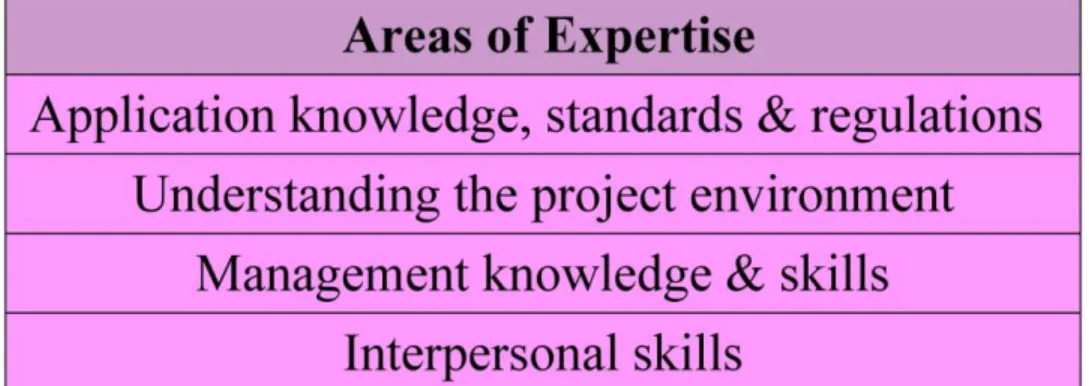
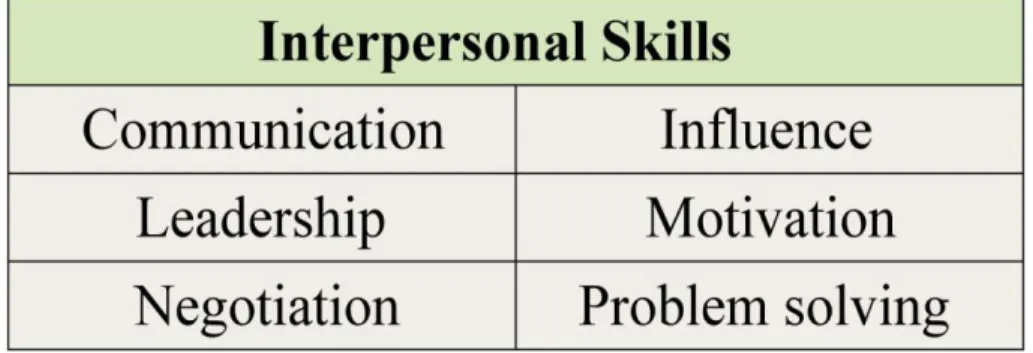
In order for you as the project manager to manage the competing project constraints and to manage the project as a whole, there are some areas of expertise that you should bring onto the project team (Figure 6.1). They are the application area of knowledge; standards and regulations in your industry, understanding the project environment, and you must have general management knowledge and interpersonal skills. It should be noted that the industry expertise is not in a certain field but the expertise in order to run the project. So while knowledge of the type of industry is important you will have a project team supporting you in this endeavor. For example, if you are managing a project that is building an oil platform, you would not be expected to have a detailed understanding of the engineering since your team will have mechanical and civil engineers who will provide the appropriate expertise, however, it would definitely help if you understand this type of work.
Let's take a look at each of these areas in more detail.
6.1 Application knowledge; standards & regulations
By standards, we mean guidelines or preferred approaches that are not necessarily mandatory. In contrast, when referring to regulations we mean mandatory rules that must be followed such as Government imposed requirements through laws. It should go without saying that as a professional, you're required to follow all applicable laws and rules that apply to your industry, organization, or project. Every industry has standards and regulations. Knowing which ones affect your project before you begin work will not only help the project to unfold smoothly, but will also allow for effective risk analysis.
Page 45 of 135
Some projects require specific skills in certain application areas. Application areas are made up of categories of projects that have common elements. They can be defined by: industry group (pharmaceutical, financial, etc), by department (accounting, marketing, legal, etc), by technical (software development, engineering, etc), or management (procurement, research, & development, etc) specialties. These application areas are usually concerned with disciplines, regulations and the specific needs of the project, the customer, or the industry. For example, most government agencies have specific procurement rules that apply to their projects that wouldn't be applicable in the construction industry. The pharmaceutical industry is interested in regulations set forth by the Food and Drug Administration, whereas the automotive industry has little or no concern for either of these types of regulations. You need to stay up-to-date regarding your industry so that you can apply your knowledge effectively. Today's fast paced advances can leave you behind fairly quickly if you don't stay abreast on current trends.
Having some level of experience in the application area you're working in will give you an advantage when it comes to project management. While you can call in experts who have the application area knowledge, it doesn't hurt for you to understand the specific aspects of the application areas of your project.
6.2 Understanding the Project Environment
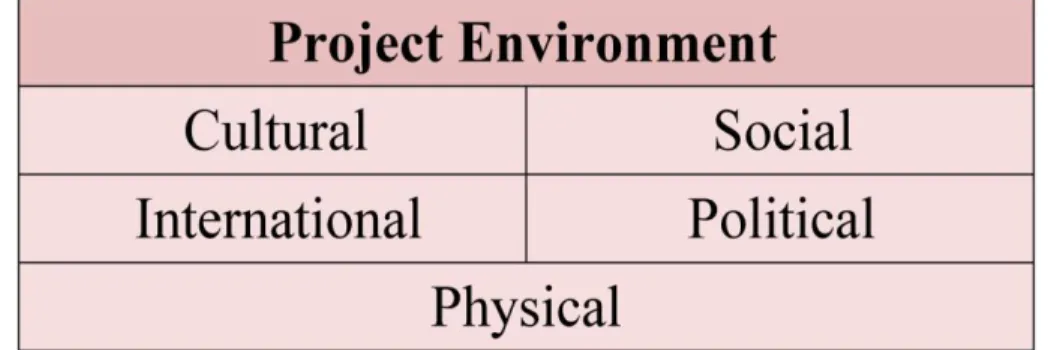
There are many factors that need to be understood within your project environment (Figure 6.2). At one level you need to understand your project environment by thinking in terms of the cultural and the social environment. In this region we think of people, demographics and education. The international and political environment is where you need to understand about different countries cultural influences. Then we move on to the physical environment; here we think about time zones, think about different countries and how differently your project will be executed whether it is just in your country or whether you have an international project team that is distributed throughout the world in five different countries.
Figure 6.2: The important factors to consider within the project environment. Table from Barron & Barron Project Management for Scientists and Engineers, http://cnx.org/content/col11120/1.4/
Of all the factors the physical ones are the easiest to understand, and it is the cultural and international factors that are often misunderstood or ignored. How we deal with clients,
Page 46 of 135
Americans tend to be informal and call each other by first names, even if having just met. Europeans tend to be more formal, using surnames instead of first names in a business setting, even if they know each other well. In addition, their communication style is more formal than in the US, and while they tend to value individualism, they also value history, hierarchy, and loyalty. The Japanese, on the other hand, tend to communicate indirectly and consider themselves part of a group, not as individuals. The Japanese value hard work and success, as most of us do.
How a product is received can be very dependent on the international cultural differences. For example, in the nineties, when many large American and European telecommunications companies were cultivating new markets in Asia, their customer's cultural differences often produced unexpected situations. Western companies planned their telephone systems to work the same way in Asia as they did in Europe and America. But the protocol of conversation was different. Call-waiting, a popular feature in the West, is considered impolite in some parts of Asia. This cultural blunder could have been avoided had the team captured the project environment requirements and involved the customer.
It is often the simplest things that can cause trouble since unsurprisingly in different countries people do things differently. One of the most notorious examples of this is also one of the most simple: date formats. What day and month is 2/8/2009? Of course it depends where you come from; in North America it is February 8th while in Europe (and much of the rest of the world) it is 2nd August. Clearly, when schedules and deadlines are being defined it is important that everyone is clear on the format used.
The diversity of practices and cultures and its impact on products in general and on software in particular, goes well beyond the date issue. You may be managing a project to create a new website for a company that sells products worldwide. There are language and presentation style issues to take into consideration; converting the site into different languages isn't enough. It is obvious to ensure that the translation is correct, however, the presentation layer will have its own set of requirements for different cultures. The left side of a web site may be the first focus of attention for an American; the right side would be the initial focus for anyone from the Middle East, as both Arabic and Hebrew are written from right to left. Colors also have different meanings in different cultures. White, which is a sign of purity in America (e.g., a bride's