Vaccine-derived Mutation in Motif D of Poliovirus
RNA-dependent RNA Polymerase Lowers Nucleotide
Incorporation Fidelity
*
Received for publication, May 9, 2013, and in revised form, September 27, 2013Published, JBC Papers in Press, September 30, 2013, DOI 10.1074/jbc.M113.484428
Xinran Liu‡1, Xiaorong Yang‡1, Cheri A. Lee§, Ibrahim M. Moustafa§, Eric D. Smidansky§, David Lum‡, Jamie J. Arnold§, Craig E. Cameron§, and David D. Boehr‡2
From the‡Department of Chemistry and the§Department of Biochemistry and Molecular Biology, The Pennsylvania State University, University Park, Pennsylvania 16802
Background:The motif D loop in poliovirus RNA-dependent RNA polymerase is important for catalysis and fidelity.
Results:A vaccine-derived mutation in motif D decreases RdRp fidelity by changing motif D conformational dynamics.
Conclusion:Non-conserved residues of motif D can alter RdRp function.
Significance:Motif D of the RdRp may be a universal target permitting creation of enzymes with perturbed fidelity and viruses with reduced virulence.
All viral RNA-dependent RNA polymerases (RdRps) have a conserved structural element termed motif D. Studies of the RdRp from poliovirus (PV) have shown that a conformational change of motif D leads to efficient and faithful nucleotide addi-tion by bringing Lys-359 into the active site where it serves as a general acid. The RdRp of the Sabin I vaccine strain has Thr-362 changed to Ile. Such a drastic change so close to Lys-359 might alter RdRp function and contribute in some way to the attenu-ated phenotype of Sabin type I. Here we present our character-ization of the T362I RdRp. We find that the T362I RdRp exhibits a mutator phenotype in biochemical experimentsin vitro. Using NMR, we show that this change in nucleotide incorporation fidelity correlates with a change in the structural dynamics of motif D. A recombinant PV expressing the T362I RdRp exhibits normal growth properties in cell culture but expresses a mutator phenotype in cells. For example, the T362I-containing PV is more sensitive to the mutagenic activity of ribavirin than wild-type PV. Interestingly, the T362I change was sufficient to cause a statistically significant reduction in viral virulence. Collec-tively, these studies suggest that residues of motif D can be tar-geted when changes in nucleotide incorporation fidelity are desired. Given the observation that fidelity mutants can serve as vaccine candidates, it may be possible to use engineering of motif D for this purpose.
Positive-strand RNA viruses cause a number of acute and chronic diseases, including the common cold, myocarditis, encephalitis, hepatitis, and paralytic poliomyelitis (1–7). The enzyme responsible for RNA genome replication is the virally
encoded RNA-dependent RNA polymerase (RdRp).3 RdRps belong to a superfamily of template-directed nucleic acid poly-merases, including dependent DNA polypoly-merases, DNA-dependent RNA polymerase, and RNA/DNA-DNA-dependent DNA polymerases (i.e.reverse transcriptases) (8 –11). A strategy to rationally design live, attenuated vaccine strains has been pro-posed based on modifying RdRps to change their nucleotide incorporation fidelity (12, 13); viral strains encoding RdRps with altered fidelity (either higher or lower fidelity) have been shown to lead to virus incapable of causing disease but capable of acting as vaccine strains to protect mice from a lethal chal-lenge from wild-type virus (12, 13). A better understanding of the fidelity determinants of RdRps would thus provide a frame-work for rational vaccine design.
The structure of viral RdRps has been described as a “cupped right hand” with fingers, thumb, and palm subdomains (11) (see Fig. 1A). Most of the catalytic machinery resides in the palm region, which can be further divided into five major structural motifs (A–E). Motifs A and C contain absolutely conserved Asp residues critical for binding Mg2⫹ions required for RdRp func-tion, and conserved residues in motif B are important for inter-acting with the sugar of the incoming nucleoside triphosphate (NTP) (15–22). Structures of RdRps bound with RNA and/or nucleotide have highlighted structural rearrangements within these palm motifs that are necessary before nucleotide incor-poration (23–27).
Our recent kinetic and solution-state nuclear magnetic res-onance (NMR) studies have also identified motif D as an impor-tant determinant of RdRp fidelity. Motif D contains an abso-lutely conserved Lys (Lys-359 in PV RdRp) that protonates the pyrophosphate leaving group in the nucleotide addition reac-tion (28, 29). NMR experiments have indicated that there are
*This work was supported, in whole or in part, by National Institutes of Health Grant R01 AI45818 (to C. E. C.). This work was also supported by startup funds from Pennsylvania State University (to D. D. B.).
1Both authors contributed equally to this work.
2To whom correspondence should be addressed: Dept. of Chemistry, The
Pennsylvania State University, 107 Chemistry Bldg., University Park, PA. Tel.: 814-863-8605; Fax: 814-863-0618; E-mail: [email protected].
3The abbreviations used are: RdRp, RNA-dependent RNA polymerase; cPVR,
important structural rearrangements in motif D when correct, but not incorrect, nucleotide binds (30, 31), which might be responsible for repositioning Lys-359 for catalysis. Computa-tional studies are also consistent with the motif D Lys acting as a general acid (32). Amino acid substitutions at Lys-359 (e.g. K359R) lead up to a 50-fold decrease in the maximum turnover rate constant (kpol), a 5-fold increase in RdRp fidelity (as deter-mined bykpol,correct/kpol,incorrect), and lead to the severe attenu-ation of the virus (29, 30, 33). We have suggested that the role of motif D in RdRp and reverse transcriptase fidelity is analogous to the function of the O/P helices in A/B family DNA poly-merases (30).
Amino acid substitutions in the O/P helices of DNA poly-merases appear to be able to tune polymerase fidelity (34 –38). Amino acid changes in motif D may likewise alter PV RdRp fidelity. One particularly noteworthy substitution is the T362I substitution that is encoded by the RdRp from the Sabin type I strain of PV. The T362I substitution may interfere with the structural dynamics of the motif D loop to disrupt RdRp cata-lytic function and may play a role in the attenuation of the Sabin vaccine.
In this article we demonstrate that the T362I substitution lowers RdRp fidelity by altering the conformational dynamics of motif D and other active-site regions for more efficient nucleotide misincorporation. The decrease in RdRp fidelity induced by the T362I substitution likely contributes to the reduced virulence of the strain carrying this genetic change. These studies highlight motif D as a potential, rational target for modifying viral RdRps to produce attenuated viruses for use as vaccine candidates.
EXPERIMENTAL PROCEDURES
Materials—[␥-32P]ATP (⬎7000 Ci/mmol) was from VWR-MP Biomedical; nucleoside 5⬘-triphosphates and 2⬘-deoxynucleoside 5⬘-triphosphates (all nucleotides were ultrapure solutions) were from GE Healthcare; 3⬘-deoxyadenosine 5⬘-triphosphate (cordyce-pin) was from Trilink Biotechnologies. All RNA oligonucleo-tides were from Dharmacon Research, Inc. (Boulder, CO); T4 polynucleotide kinase was from New England Biolabs, Inc; [methyl-13C]methionine was from Cambridge Isotope Laboratories. All other reagents were of the highest grade available from Sigma or Fisher.
Site-directed Mutagenesis, Protein Overexpression, and Puri-fication of PV RdRp—The T362I variant was generated using the QuikChange method (Stratagene) and appropriate primers. The mutation was confirmed by DNA sequencing (Nucleic Acid Facility, The Pennsylvania State University).
It should be noted that wild-type (WT) and T362I RdRp used in the kinetic and NMR studies also contain two inter-face I amino acid substitutions (L446D and R455D) to pre-vent polymerase dimerization. Overexpression and purifica-tion of PV RdRp were performed as described previously (31, 39 – 41). Both kinetic and NMR experiments involved pro-tein samples labeled by [methyl-13C]Met (31). The incorpo-ration of this isotope did not change RdRp kinetics (data not shown).
PV RdRp Kinetic Assays—Purifying, 5⬘-32P end labeling and reannealing of RNA templates 10-mer sym/subU (5⬘
-GCAUGGG-CCC-3⬘) and 11-mer sym/subUA (5⬘-GCAUGGGCCCA-3⬘) were carried out as described previously (31, 40).
Enzyme assays were conducted at 30 °C in reaction buffer consisting of 50 mMHEPES, pH 7.5, 10 mM2-mercaptoethanol, 5 mMMgCl2, and 60MZnCl2. Immediately before the reac-tion, RNA oligonucleotides were reannealed, and concentrated RdRps were diluted to the required concentration by reaction buffer (50 mMHEPES, pH 7.5, 10 mM2-mercaptoethanol, 20% glycerol, and 60MZnCl2). The volume of enzyme added into any reactions was never above1⁄10of the total volume.
For stopped flow experiments, the RdRp-RNA binary com-plexes were formed by incubating RdRp (0.5M) with sym/sub RNA (0.25Mduplex) for 2 min at room temperature. Experi-ments were initiated by rapidly mixing RdRp-RNA binary com-plexes in 50 mMHEPES, pH 7.5, 10 mM2-mercaptoethanol, 5 mMMgCl2, and 60MZnCl2with the equal volume of NTP solution in the same buffer. The utilized RNA templates sym/ subU and sym/subUA were substituted with 2-aminopurine and pyrrolo-cytosine at the 5⬘side of the template RNA respec-tively. These fluorescent bases create fluorescence changes to monitor the chain elongation reaction. For 2-aminopurine-modi-fied sym/sub-U RNA, excitation and emission wavelengths were 313 and 370 nm, respectively. For pyrrolo-cytosine-modified sym/ sub-UA RNA, the excitation and emission wavelengths were 350 and 450 nm, respectively.
For benchtop assays, the RdRp-RNA binary complexes were formed through incubating RdRp (0.5M) with RNA (0.25M duplex) for 3 min at room temperature followed by 2 min at 30 °C. The RNA template was32P end-labeled. After initiation, the reaction was quenched by adding an equal volume of quench buffer (50 mM EDTA, 85% formamide, 0.025% bro-mphenol blue, and 0.025% xylene cyanol). The quenched sam-ples were analyzed by denaturing PAGE, and products were quantitated by phosphorimaging as previously described (40).
NMR Sample Preparation and Spectroscopy—NMR sample preparation followed procedures previously described using [methyl-13C]Met-labeled PV RdRp (30, 31). 13C,1H HSQC (heteronuclear single quantum correlation) NMR spectra were collected at 293 K on a Bruker Avance III 600 MHz spectrometer equipped with a 5-mm “inverse detection” tri-ple-resonance (13C,1H,15N) single axis gradient TCI for the following samples: free RdRp, RNA complex, RdRp-RNA complex, and excess 3⬘-dATP, RdRp-RNA-3⬘-blocked complex after passage over the desalting column (RdRp-RNA binary complex), RdRp-(RdRp-RNA-binary complex and excess of second nucleotide (i.e. RdRp-RNA-NTP ternary complex), and RdRp-RNA-NTP ternary complex after pas-sage over a second de-salting column.
of at least 20 Å between any protein atom and the edge of the solvent box. MD simulation was carried out using SANDER/ PMEMD in AMBER10 package (43) using the AMBER99SB force field. Initial minimization of the modeled structure was done in multiple steps using SANDER; all subsequent steps of the MD simulation were carried out using PMEMD. The sol-vated system was heated stepwise from 0 to 300 K with an incre-ment of 50 K over a period of 10 ps under constant volume and temperature conditions (NVT) followed by 200 ps of NVT sim-ulation. Finally, the simulation was switched to constant pres-sure and temperature dynamics for the remainder of the MD simulation. An integration time step of 1 fs was used, and the cutoff distance for nonbonded interactions was set to 9 Å. The neighbor pair list was updated every 10 steps. The Berendsen thermostat (45) was applied with temperature and pressure coupling constants of 1 ps (weak coupling). Electrostatic inter-actions were calculated with the Particle Mesh Ewald method (46), and all bond lengths involving hydrogen atoms were con-strained using SHAKE algorithm (47).
Ribavirin Sensitivity Assay—50 plaque forming units of WT, G64S, or T362I PV were used to infect HeLa cell monolayers pretreated with the various concentrations of ribavirin and then washed and overlaid with agarose media containing the same concentration of ribavirin. Cells were incubated for 3– 4 days at 37 °C before being stained with crystal violet (48).
Mouse Infection Studies—Mice were bred and housed in standard ventilated caging for all experiments. Protocols for animal studies were approved by The Pennsylvania State University Institutional Animal Care and Use Committee
(IACUC). All experiments were performed in accordance to guidelines and regulations overseen by the IACUC. Viral stocks were generated in serum-free media and harvested, and genome copies were quantitated by quantitative PCR per-formed by the Genomics Core Facility of The Pennsylvania State University. 4 – 6-Week-old outbred (ICR) mice transgenic for the PV receptor (cPVR) were infected with PV at the indi-cated genome copy by intraperitoneal injection in 3 ml of serum-free media. Mice were observed for 10 days for signs of disease and were euthanized upon showing dual limb paralysis or paralysis such that their ability to obtain food and water was compromised; this was in accordance with approval by the IACUC at The Pennsylvania State University.
RESULTS
The T362I Substitution in Motif D Lowers RdRp Fidelity by Making the Pre-chemistry Conformational Change for Misin-corporation More Efficient—The T362I substitution as derived from the PV Sabin I vaccine strain is located in the motif D loop of the palm subdomain (Fig. 1A). Motif D also contains the highly conserved Lys (for PV RdRp, Lys-359), which has been shown to behave as a general acid to protonate the pyrophos-phate leaving group in the nucleotide incorporation reaction (28, 29). Pre-steady-state enzyme kinetics indicated that both a pre-chemistry conformational change and the chemistry step itself are partially rate-determining (in the presence of Mg2⫹)
and thus are both important fidelity checkpoints (50) (Fig. 1B). Our recent NMR studies have implicated structural rearrange-ments in motif D, likely to re-position Lys-359, as an important
component of the pre-chemistry conformational change(s) (30). The T362I substitution may thus interfere with the struc-tural rearrangements in motif D necessary for RdRp function, including changes to RNA/NTP affinity, catalytic activity, and/or RdRp fidelity.
To determine if the T362I substitution has an effect on RNA affinity and ternary RdRp-RNA-NTP complex formation, we compared the formation and stability of pre-chemistry RdRp-RNA reactant complexes by enzyme assembly and dissociation assays respectively (40) (Fig. 2). For our kinetic assays, we used two RNA templates (Fig. 2A), which contain a six (or seven)-base pair duplex flanked by two-, four-, (or three)-nucleotide 5⬘ overhangs. We have previously used these symmetrical primer/
template substrate (sym/sub) RNA templates in enzyme kinetic and solution-state NMR studies (30, 31, 40, 48, 50, 51). The rate and yield of competent RdRp-RNA complexes (Fig. 2,BandC) and the stability of the assembled RdRp-RNA complexes (Fig. 2,Dand E) were essentially identical for WT and T362I RdRp using either RNA template. These results indicate that the T362I substitution does not substantially affect RNA affinity or formation of catalyti-cally competent RdRp-RNA-NTP complexes.
We also performed kinetics experiments to compare the maximal rate constant for nucleotide incorporation,kpol, and the apparent dissociation constant for NTP,Kd,app, for WT and T362I RdRp (Fig. 3, Table 1). The T362I substitution did not substantially changekpolorKd,appvalues for correct NTP
incor-FIGURE 2.Formation and stability of RdRp-RNA complexes is not affected by the T362I substitution in motif D.A, RNA sequences for sym/subU (left) and sym/subUA (right).B, experimental design for RdRp-RNA-NTP assembly assay. Reactions were initiated by adding RdRp (1M) into sym/subU or sym/subUA (0.5 Mduplex) and its corresponding ATP or UTP (500M), which were incubated at 30 °C for 5 min. At the indicated times, reactions were quenched by adding 25 mMEDTA.C, the RdRp-RNA-NTP assembly assay for WT RdRp (●) and T362I RdRp (f) using both sym/subU and sym/subUA. There is essentially no difference in this assay between WT and T362I RdRp.D, experimental design for the RdRp-RNA dissociation assay. RdRp and RNA were incubated at 30 °C for 90 s at which time trap (100Munlabeled RNA) was added to the reaction buffer. After the indicated times, the reaction buffer was mixed with ATP or UTP (500M) and then quenched after 30 s by adding EDTA (25 mM).E, the RdRp-RNA dissociation assay for WT RdRp (●) and T362I RdRp (f) using both sym/subU and sym/subUA RNA. Thesolid lineis the data fit to a single exponential function. Thekdiss(obs)for sym/subU (sym/subUA) was 4.00⫾0.09⫻10⫺
4s⫺1(1.70⫾0.07⫻10⫺5s⫺1)
for WT RdRp and 3.90⫾0.02⫻10⫺4s⫺1(2.70⫾0.03⫻10⫺5s⫺1) for T362I RdRp, indicating that the RNA binding characteristics of WT and T362I RdRp are
nearly identical. Each data point is from the averages of at least two separate experiments on different days.
FIGURE 3.The T362I substitution in motif D lowers RdRp nucleotide incorporation fidelity in the presence of Mg2ⴙ.A, experimental design for nucleotide
incorporation assay. RdRp (0.5M) was incubated with sym/subU RNA (0.5M) at room temperature for 2 min and quickly mixed with various concentrations of NTP. The reactions were monitored by fluorescence changes with time. Thesolid linerepresents the data fit to a hyperbola function to give an apparent dissociation constant (Kd,app) and a maximal rate constant for nucleotide incorporation (kpol).B, kinetics of correct ATP incorporation into sym/subU RNA for WT
RdRp (●) and T362I RdRp (f) were very similar in the presence of Mg2⫹. Misincorporation (in Mg2⫹) of 2⬘dATP (C) and GTP (D) into sym/subU RNA was more efficient for T362I RdRp (f) compared with WT RdRp (●). Kinetic parameters are located in Table 1.
TABLE 1
Comparison of the kinetic constants of nucleotide incorporation for WT and T362I RdRp reveals that the T362I substitution decreases polym-erase fidelity
Variant NTP kpol KD,app kpol/KD,app kpol,correct/kpol,incorrect (kpol/KD)correct/(kpol/KD)incorrect
s⫺1
M M⫺1s⫺1
Correct NTP
Sym/Sub-U RNA
WT ATP 59⫾1 36⫾2 1.6
T362I ATP 67⫾1 33⫾2 2.0
Sym/Sub-UA RNA
WT UTP 130⫾7 142⫾36 0.91
T362I UTP 131⫾2 114⫾9 1.1
Incorrect sugar
Sym/sub-U RNA
WT 2’-dATP 0.89⫾0.01 134⫾4 6.7⫻10⫺3
66 240
T362I 2’-dATP 1.5⫾0.0 112⫾4 1.3⫻10⫺2
45 150
Sym/Sub-UA RNA
WT 2’-dUTP 8.8⫾0.3 925⫾85 9.5⫻10⫺3
15 96
T362I 2’-dUTP 12⫾0.4 748⫾77 1.6⫻10⫺2
11 69
Incorrect nucleobase
Sym/sub-U RNA
WT GTP 0.011⫾0.000 142⫾15 7.7⫻10⫺5 5400 21,000
T362I GTP 0.018⫾0.001 149⫾25 1.2⫻10⫺4 3700 17,000
WT RTPa
0.019⫾0.002 292⫾86 6.5⫻10⫺5 3100 25,000
T362I RTP 0.025⫾0.003 224⫾67 1.1⫻10⫺4 2700 18,000
a
poration using ATP for sym/subU RNA (Fig. 3B, Table 1) and UTP for sym/subUA (Table 1). However, the T362I substitu-tion led to more efficient misincorporasubstitu-tion of incorrect NTP either with 2⬘-dNTP (Fig. 3C) or incorrect nucleobase (Fig. 3D). This change resulted in lowered RdRp fidelity for both nucleo-base and sugar selection (as evaluated by either kpol,correct/ kpol,incorrect or (kpol/Kd,app)correct/(kpol/Kd,app)incorrect). For example, 2⬘-OH selection was decreased up to 2-fold for the T362I variant relative to WT RdRp (Table 1).
The T362I substitution may alter the conformational rear-rangements necessary to re-position Lys-359 and/or alter the final positioning of Lys-359 to affect nucleotide addition kinet-ics. The effect of Mn2⫹and D
2O on nucleotide incorporation kinetics can help to distinguish changes to the pre-chemistry conformational change and/or the chemistry step (Fig. 1B). In the presence of Mn2⫹, the pre-chemistry conformational
change becomes more efficient, andkpolis then fully rate-de-termined by the chemistry step (51). Solvent deuterium kinetic isotope effects (SDKIE; kpol,H2O/kpol,D2O), which arise from proton transfers within the chemistry step (28, 29), also report on the relative contribution of the chemistry step tokpol.
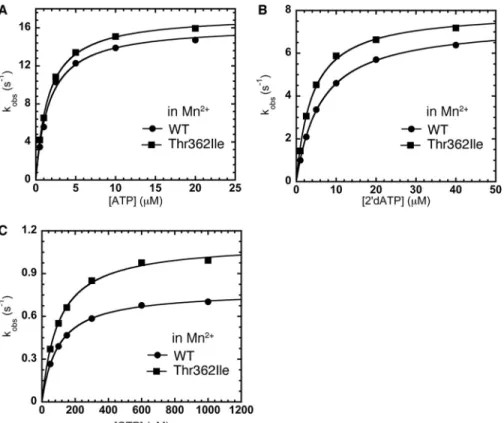
In the presence of Mn2⫹, the T362I substitution did not substantially alter correct NTP incorporation or misincor-poration of the 2⬘-dNTP compared with WT RdRp (Fig. 4,A andB); the RdRp fidelity for sugar selection in Mn2⫹is iden-tical for WT (kpol,correct/kpol,incorrect⫽2.2⫾0.1) and T362I RdRp (kpol,correct/kpol,incorrect ⫽ 2.2 ⫾ 0.1). This result
implies that the T362I alteration primarily impacts the step made more efficient by the presence of Mn2⫹. The pre-chemistry
conformational change is more efficient with Mn2⫹, such that it is
no longer rate-determining (51), and thus introduction of the T362I substitution to further enhance the pre-chemistry confor-mational change has no additional impact on the kinetic parame-ters as governed by the rate-determining step (i.e.in this case, the chemistry step).
For misincorporation of NTP with incorrect nucleobase in Mn2⫹, the T362I variant (k
pol⫽1.1⫾0.0 s⫺
1) was still more
efficient than WT RdRp (kpol⫽0.78⫾0.00 s⫺
1) (Fig. 4C). In the
case of GMP misincorporation, the pre-chemistry conforma-tional change is primarily rate-determining in Mg2⫹(30). The introduction of Mn2⫹ and the T362I substitution may both
enhance the rate of the pre-chemistry conformational change but not sufficiently to make the chemistry step rate-determin-ing for GTP misincorporation. To further test which step(s) is being affected, we also determined SDKIEs (i.e. kpol,H2O/ kpol,D2O) for WT and T362I RdRp for both correct and incorrect incorporation. The SDKIEs for T362I RdRp for correct (2.39⫾ 0.02) and incorrect (1.80⫾0.07) NTP incorporation were both higher than the corresponding SDKIEs for WT RdRp (correct, 2.18⫾0.02; incorrect, 1.51⫾0.06). These findings suggest that chemistry is more rate-determining for the T362I variant com-pared with WT RdRp, implying that the pre-chemistry confor-mational change is more efficient for T362I RdRp.
FIGURE 4.The T362I substitution in motif D lowers sugar and nucleobase selection by making the pre-chemistry conformational change more efficient.A, kinetics of correct ATP incorporation into sym/subU RNA in the presence of Mn2⫹is very similar for WT (●) and T362I (f) RdRp.B, in contrast to what occurs in the presence of Mg2⫹(see Fig. 3), misincorporation of 2⬘-dATP into sym/subU RNA in the presence of Mn2⫹is similar between WT (●) and T362I (f) RdRp. The metal dependence of the RdRp fidelity is consistent with the T362I substitution primarily impacting the pre-chemistry conformational change in 2⬘dATP misincorporation.C, the T362I substitution may also impact the chemistry step itself for misincorporation of NTP with incorrect nucleobase. The T362I (f) substitution leads to more efficient GTP misincorporation into sym/subU RNA even in the presence of Mn2⫹compared with WT RdRp (●). Kinetic parameters are located in Table 1.
Solution-state NMR Indicates That T362I Induces Structural Rearrangements within Motif D to Lower RdRp Fidelity— Our previous NMR experiments have been able to identify key chemical shift changes associated with Met residues in PV RdRp induced by the binding of RNA and the formation of ternary RdRp-RNA-NTP complexes (30, 31). In particu-lar, we identified a large chemical shift change to the Met-354 resonance and smaller chemical shift changes to the Met-6, Met-74, and Met-225 resonances upon formation of the correct RdRp-RNA-NTP complex for the WT enzyme (30, 31). We have suggested that these chemical shift pat-terns correspond to a “closed” conformation. These chemi-cal shift changes do not occur in the presence of the incor-rect NTP, either with incorincor-rect 2⬘-deoxy sugar (Fig. 5A) or with incorrect nucleobase (Fig. 5B). In fact, the resonances for WT RdRp bound with RNA and 2⬘-deoxy sugar or in-correct nucleobase essentially overlap (Fig. 5C), and we have
suggested that these complexes are in an “open”
conformation.
With the T362I substitution, there is a small chemical shift change to the Met-354 resonance in the absence (data not shown) and presence of RNA and NTP (Fig. 5). The most substantial change with the T362I RdRp spectra occurs in the presence of 2⬘-dNTP (red spectrumin Fig. 5D). In this case two sets of resonances were observed, especially for Met-354, indicating that the enzyme is exchanging between two conformations on the slow NMR chemical shift times-cale. This behavior is not observed in the presence of NTP with incorrect nucleobase (blue spectrum in Fig. 5E). It should be kept in mind that the concentrations of NTP (2⬘ -dUTP ⫽ 10 mM, CTP⫽ 8 mM) are identical for WT and T362I RdRp, and we would expect binding saturation given theKd,appof the incorrect NTP (Table 1), which is borne out by the small chemical shift changes observed compared with the enzymes bound with RNA alone (30) (i.e.incorrect NTP is bound to RdRp).
One set of resonances for the T362I variant bound to RNA and 2⬘-dUTP (red spectrum in Fig. 5F) overlaps that of the T362I variant bound to RNA and ATP (blue spectrumin Fig. 5F). The other set of resonances for the T362I variant bound to RNA and 2⬘-dNTP (red spectrumin Fig. 5D) overlaps the spec-trum of the T362I variant bound to RNA and correct UTP (black spectrumin Fig. 5D). These findings suggest that T362I RdRp exchanges between the closed and open conforma-tions of RdRp, such that the closed conformation is accessi-ble even in the presence of the 2⬘-dNTP. This result is con-sistent with the enzyme kinetic results, which also suggest that the T362I substitution increases 2⬘-dNTP misincorpora-tion rates through a more efficient pre-chemistry conformamisincorpora-tional change. The “open-closed” conformational equilibrium when RdRp is bound with NTP with incorrect nucleobase may also be altered, but the effect is unlikely to be observable in the NMR spectrum considering that the conformational equilibrium would still likely heavily favor the open state even in the T362I variant. This statement is consistent with the Mn2⫹effects and the
dimin-ished SDKIE (Table 1), which suggest that the pre-chemistry con-formational change from open to closed largely governskpolfor incorrect nucleobase incorporation.
The T362I Substitution in Motif D Results in Long-range Structural Changes That May Allow for More Efficient Misincorporation—To gain more insight into how the T362I substitution changes the structure and/or internal dynamics of RdRp to impact catalytic function and fidelity, we con-structed anin silicomodel for the T362I variant, as there is no crystal structure available for this protein, and conducted 20 ns of all-atom MD simulations. The intention of these studies was to focus on interactions that may be perturbed by the T362I substitution. The MD simulation of the T362I variant was com-pared with that of the WT enzyme from our previous study (42). It should be emphasized that these MD simulations are for RdRp enzymes without RNA and NTP bound. Nonetheless, previous MD simulations have given insight into the function and fidelity of RdRp enzymes and have been consistent with NMR studies (42).
MD simulations revealed that substitution of the solvent-exposed residue Thr-362 by a hydrophobic Ile in the T362I variant resulted in conformational changes nearby and distant from the mutation site (Fig. 6A). In the simulated T362I struc-ture, the side chain of Ile-362 is stabilized by van der Waals interactions with the side chain of the nearby Phe-363; the aver-age distance between the two side chains is 4.6 Å. The simula-tion revealed that the substitusimula-tion at posisimula-tion 362 disrupted the local environment observed in the WT enzyme, and the most perturbed residues were those of the motif D loop (i.e.amino acids 359 –365) (Fig. 6B). The side chain of Glu-364 adopts a completely different conformation in the T362I structure rela-tive to WT RdRp; in the WT enzyme, the Glu-364 side chain is engaged in electrostatic interactions with the Lys-228 preced-ing motif A (amino acids 229 –240), whereas in the T362I var-iant the side chain of Glu-364 is swung away from the WT position to a new position where it can form H-bonding inter-actions with Asn-370 and transient H-bonding interinter-actions with Thr-367. The negatively charged Glu-364 in the T362I variant is partly stabilized by the nearby side chain of Lys-359. Furthermore, side chains of residues Thr-365, Glu-337, Asp-339, and Ser-341, all belonging to motif D and located in the vicinity of Glu-364, are affected by the conformational change of Glu-364 side chain. Of note, the local conformational changes around the mutation site can be sensed by the nearby Met-354 as shown by NMR (Fig. 5). In addition to the local conformational changes in the vicinity of Ile-362, MD simula-tions showed propagation of the conformational changes from the mutation site to other, more distant residues at the active-site (Fig. 6,CandD). These conformational differences include residues Ser-288 of the loop 283–293, Asp-238 of motif A (both known to play a role in recognition of the sugar moiety of the nucleotide substrate), and the region encompassing the metal binding aspartates Asp-328 and Asp-329 of motif C.
consecutive passages, suggesting that there is no strong fitness consequence for this mutation in cell culture.
Ribavirin is a nucleoside analog that is a mutagen to PV and other RNA viruses (52–54). A high fidelity PV variant, G64S, exhibiting increased nucleotide incorporation fidelity exhibits reduced sensitivity to the antiviral nucleoside, ribavirin (48).
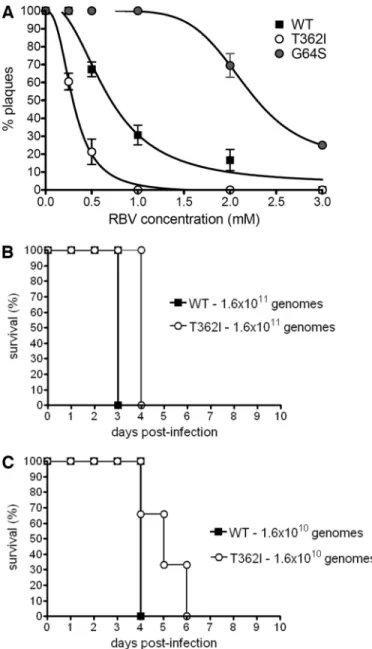
Therefore, to assess T362I fidelity in cells, we evaluated the sensitivity of T362I PV to ribavirin. By plaque assay, there was an increase in sensitivity of T362I PV to ribavirin when com-pared with WT PV in cells (Fig. 7A); a more than 2-fold decrease in the concentration of ribavirin needed to reduce the number of plaques by half compared with the untreated
popu-FIGURE 5.The T362I substitution in motif D alters the conformational equilibrium between open and closed states of PV RdRp as revealed by NMR spectra of [methyl-13C]Met-labeled RdRp.A–C, comparisons of HSQC spectra between WT RdRp bound with RNA lacking a 3⬘-OH and correct UTP nucleotide
(black), incorrect 2⬘-dUTP nucleotide (red), or incorrect ATP nucleotide (blue). The chemical shift patterns for the RdRp-RNA complexes bound with 2⬘-dUTP and ATP are strikingly similar (C), representing an open conformation, and are different from the chemical shift pattern when bound to UTP, representing a closed conformation (AandB).D–F, comparisons of HSQC spectra between T362I RdRp bound with RNA lacking 3⬘-OH and correct UTP nucleotide (black), incorrect 2⬘-dUTP (red), or incorrect ATP nucleotide (blue). T362I RdRp bound with RNA and 2⬘-dUTP displays two sets of resonances (DandF), where one set overlays with that from T362I RdRp bound with RNA and UTP (D) and the other with that from T362I RdRp bound with RNA and ATP (F). These results indicate that T362I RdRp bound with RNA and 2⬘-dUTP accesses both the open and closed conformations. This finding is consistent with the results presented in Figs. 3 and 4, which suggests that the T362I substitution makes the pre-chemistry conformational change (open to closed) more efficient. Spectra were collected at 293 K with 245MRdRp, 500MRNA, and 4 mMUTP, 10 mM2⬘-dUTP or 8 mMATP.
lation. This result is consistent with the kinetic results indicat-ing that the T362I substitution decreases RdRp fidelity and would, therefore, more readily incorporate the antiviral nucle-otide (Table 1).
The increased ribavirin sensitivity of T362I PV suggests that this mutant may be more attenuated in animals than WT PV,
similar to other mutants that lead to lower fidelity RdRps (55). To test this proposal, we compared the virulence of T362I and WT PVs in a mouse transgenic for the PV receptor (56). In this system, infection by WT PV is generally lethal. In the case of infection at the highest dose (1.6⫻1011genomes), T362I PV resulted in the delay of onset of double-limb paralysis by 1 day
compared with WT PV (Fig. 7,BandC). At the lower dose (1.6⫻1010genomes), onset of double-limb paralysis in all ani-mals showed an even more gradual progression. These results are consistent with T362I PV having reduced virulence in mice.
DISCUSSION
Previous studies provided evidence that mutations in the RdRp gene contribute to the attenuation of the Sabin I vaccine strain (57– 62). Here we have shown that the Sabin-derived
T362I substitution in PV RdRp induces a decrease in polymer-ase fidelity (Figs. 3 and 4) by making the pre-chemistry confor-mational change more efficient (Fig. 5), likely through disrupt-ing interactions in motif D and other regions of the active-site (Fig. 6), and PV strains expressing this variant have reduced virulence in mice (Fig. 7). These studies further highlight the functional roles for motif D, which until recently (29, 30) were only believed to play a structural role in maintaining the integ-rity of the palm region (16, 63). We have proposed that motif D in RdRps and reverse transcriptases play an analogous role to helix O/P in family A/B of DNA polymerases (30); both regions contain a conserved Lys that acts as a general acid in phos-phodiester bond formation (29), and both regions undergo fidelity-governing conformational changes (30, 64 –70). We have now demonstrated that amino acid substitutions else-where in motif D impact RdRp fidelity just as amino acid sub-stitutions in helix O/P can lower polymerase accuracy (34 –38). One way for RNA viruses to “tune” their fidelity may be to alter the conformational dynamics of motif D. In fact, it was previously shown that motif D in cystoviral6 RdRp undergoes conformational exchange on the same timescale as catalysis (71, 72). It has also been previously demonstrated that RdRp fidelity has a major impact on viral virulence; viral strains car-rying RdRp with reduced or enhanced fidelity are attenuated in mice (12–14, 33, 48, 55, 73). Thus, the general concept of mod-ifying the conformational dynamics of motif D to impact RdRp fidelity and virus biology may be a guiding principle in rational vaccine design. The highly conserved motif D Lys has already been identified as an important residue to modify to attenuate the virus and provide immunoprotective effects almost to the same level as Sabin I (33); viral attenuation is likely caused by the change in RdRp fidelity as proposed for other RdRp mutants (12, 13, 33, 48, 55).
In picornaviruses, similar interactions as those highlighted by the current MD simulations may govern the motion of motif D in other RdRps and hence be important for this fidelity check-point. Although Thr-362 is not conserved among picornoviral RdRps, the amino acid equivalent to this position is polar in coxsackievirus virus (CVB3; Cys-363), foot-and-mouth disease virus (Lys-372), and human rhinovirus serotype 16 (HRV16; Glu-361) RdRps (Fig. 8). Modifying these positions to some-thing more non-polar may allow them to interact with the well conserved motif D Phe and lead to similar structure and/or dynamic changes that we have proposed for T362I PV RdRp. The MD simulations predict that the T362I substitution per-turbs the interaction between Glu-364 and Lys-228, but a new interaction forms between Glu-364 and Asn-370. Again, these residues are not highly conserved, but similar interactions between equivalent positions (may) form in other RdRps. For example, there is an electrostatic interaction in HRV16 RdRp between Asp-228/Lys-363 comparable to the Lys-228/Glu-364 interaction in PV RdRp. Substituting Glu-361 in HRV16 RdRp to something more non-polar may perturb the Asp-228/Lys-363 interaction but then allow Lys-Asp-228/Lys-363 to interact with Asn-369. Based on our studies with T362I PV RdRp, we would pre-dict that such changes would decrease HRV16 RdRp fidelity and attenuate the virus.
FIGURE 7.PV encoding the T362I substitution in motif D expresses a mutator phenotype in cell culture and is attenuatedin vivo.A, ribavirin (RBV) sensitivity assay. 50 plaque forming units of WT, G64S, or T362I PV were used to infect HeLa cell monolayers pretreated with various concentrations of ribavirin. Plaque numbers were plotted against ribavirin concentration nor-malized to untreated (0 mM) control. Thesolid linerepresents the fit of the data to a sigmoidal dose response equation (four parameter logistic model), yielding IC50values of 0.67⫾0.06, 2.15⫾0.75, and 0.30⫾0.02 mMfor WT,
G64S, and T362I respectively. Data are the means from three independent experiments.Error barsrepresent⫾S.E.BandC, T362I PV is attenuated in the cPVR mouse model. cPVR mice (4 – 6 weeks old) were infected via the intra-peritoneal route with serum-free media containing WT or T362I PV at the indicated genome copy and observed for 10 days. Mice that developed the symptoms of two-limb paralysis or paralysis that compromised the ability to get food and water were euthanized. The number of mice per group wasn⫽3.
One intriguing feature of PV RdRp is that amino acid substi-tutions remote from the active site can alter polymerase catal-ysis and fidelity (48). This finding suggests that there are long-range interaction networks important for modulating RdRp function (31, 42). The T362I substitution also leads to long-range structural and dynamics changes (Fig. 6D), including a reduction in nanosecond dynamics around residues 46 –58, which encompasses the site of another Sabin substitution, D53N. This finding suggests that there may be communication pathways linking the Sabin sites, and modifications at these sites may act cooperatively to change RdRp function; previous MD simulations of WT RdRp have also indicated that the motions of the␣-helix containing Tyr-73 are anti-correlated with the motions of motif D containing Thr-362 (42). The Sabin amino acid substitutions may also contribute to different RdRp functions; the Y73H substitution has been shown to interfere with RdRp initiation (62), K250E may interfere with protein structure and/or long-range interactions with RNA through changes to electrostatic interactions, and T362I, in addition to its role in RdRp fidelity shown here, has been shown to contribute to temperature sensitivity of the Sabin I vaccine (59). The other Sabin substitutions may even compensate for the effects observed here with T362I. Teasing apart the func-tions of the other Sabin amino acid substitufunc-tions in PV RdRp may lead to a more thorough understanding of RdRp muta-tions in viral attenuation and immunoprotective effects and provide a framework for predicting similar mutations in other viral RdRps for rational vaccine design.
REFERENCES
1. Hayden, F. G. (1999) Update on influenza and rhinovirus infections.Adv. Exp. Med. Biol.458,55– 67
2. Hayden, F. G. (2006) Antivirals for influenza. Historical perspectives and lessons learned.Antiviral Res71,372–378
3. Hayden, F. G. (2006) Respiratory viral threats.Curr. Opin. Infect. Dis.19,
169 –178
4. Kim, W. R. (2002) The burden of hepatitis C in the United States. Hepa-tology36,S30 –S34
5. Weiss, S. R., and Navas-Martin, S. (2005) Coronavirus pathogenesis and the emerging pathogen severe acute respiratory syndrome coronavirus.
Microbiol. Mol. Biol. Rev.69,635– 664
6. Racaniello, V. R. (2006) One hundred years of poliovirus pathogenesis.
Virology344,9 –16
7. Howard, R. S. (2005) Poliomyelitis and the postpolio syndrome.BMJ330,
1314 –1318
8. Svarovskaia, E. S., Cheslock, S. R., Zhang, W. H., Hu, W. S., and Pathak, V. K. (2003) Retroviral mutation rates and reverse transcriptase fidelity.
Front. Biosci.8,d117– d134
9. Joyce, C. M., and Benkovic, S. J. (2004) DNA polymerase fidelity. Kinetics, structure, and checkpoints.Biochemistry43,14317–14324
10. Berdis, A. J. (2009) Mechanisms of DNA polymerases.Chem. Rev.109,
2862–2879
11. Ng, K. K., Arnold, J. J., and Cameron, C. E. (2008) Structure-function relationships among RNA-dependent RNA polymerases.Curr. Top. Mi-crobiol. Immunol.320,137–156
12. Vignuzzi, M., Stone, J. K., Arnold, J. J., Cameron, C. E., and Andino, R. (2006) Quasispecies diversity determines pathogenesis through coopera-tive interactions in a viral population.Nature439,344 –348
13. Vignuzzi, M., Wendt, E., and Andino, R. (2008) Engineering attenuated virus vaccines by controlling replication fidelity.Nat. Med.14,154 –161 14. Pfeiffer, J. K., and Kirkegaard, K. (2005) Increased fidelity reduces
poliovi-rus fitness and virulence under selective pressure in mice.PLoS Pathog.1,
e11
15. Poch, O., Sauvaget, I., Delarue, M., and Tordo, N. (1989) Identification of four conserved motifs among the RNA-dependent polymerase encoding elements.EMBO J.8,3867–3874
16. O’Reilly, E. K., and Kao, C. C. (1998) Analysis of RNA-dependent RNA polymerase structure and function as guided by known polymerase struc-tures and computer predictions of secondary structure.Virology252,
287–303
17. Lang, D. M., Zemla, A. T., and Zhou, C. L. (2013) Highly similar structural frames link the template tunnel and NTP entry tunnel to the exterior surface in RNA-dependent RNA polymerases. Nucleic Acids Res. 41,
1464 –1482
18. Zemla, A. T., Lang, D. M., Kostova, T., Andino, R., and Ecale Zhou, C. L. (2011) StralSV. Assessment of sequence variability within similar 3D structures and application to polio RNA-dependent RNA polymerase.
BMC Bioinformatics12,226
19. Gohara, D. W., Arnold, J. J., and Cameron, C. E. (2004) Poliovirus RNA-dependent RNA polymerase (3Dpol). Kinetic, thermodynamic, and struc-tural analysis of ribonucleotide selection.Biochemistry43,5149 –5158 20. Gohara, D. W., Crotty, S., Arnold, J. J., Yoder, J. D., Andino, R., and
Cam-eron, C. E. (2000) Poliovirus RNA-dependent RNA polymerase (3Dpol). Structural, biochemical, and biological analysis of conserved structural motifs A and B.J. Biol. Chem.275,25523–25532
21. Korneeva, V. S., and Cameron, C. E. (2007) Structure-function relation-ships of the viral RNA-dependent RNA polymerase. Fidelity, replication speed, and initiation mechanism determined by a residue in the
binding pocket.J. Biol. Chem.282,16135–16145
22. Garriga, D., Ferrer-Orta, C., Querol-Audí, J., Oliva, B., and Verdaguer, N. (2013) Role of motif B loop in allosteric regulation of RNA-dependent RNA polymerization activity.J. Mol. Biol.425,2279 –2287
23. Gong, P., and Peersen, O. B. (2010) Structural basis for active site closure by the poliovirus RNA-dependent RNA polymerase.Proc. Natl. Acad. Sci. U.S.A.107,22505–22510
24. Thompson, A. A., Albertini, R. A., and Peersen, O. B. (2007) Stabilization of poliovirus polymerase by NTP binding and fingers-thumb interactions.
J. Mol. Biol.366,1459 –1474
25. Thompson, A. A., and Peersen, O. B. (2004) Structural basis for proteoly-sis-dependent activation of the poliovirus RNA-dependent RNA polym-erase.EMBO J.23,3462–3471
26. Ferrer-Orta, C., Arias, A., Agudo, R., Pérez-Luque, R., Escarmís, C., Do-mingo, E., and Verdaguer, N. (2006) The structure of a protein primer-polymerase complex in the initiation of genome replication.EMBO J.25,
880 – 888
27. Zamyatkin, D. F., Parra, F., Machín, A., Grochulski, P., and Ng, K. K. (2009) Binding of 2⬘-amino-2⬘-deoxycytidine-5⬘-triphosphate to norovirus po-lymerase induces rearrangement of the active site.J. Mol. Biol.390,10 –16 28. Castro, C., Smidansky, E., Maksimchuk, K. R., Arnold, J. J., Korneeva, V. S., Götte, M., Konigsberg, W., and Cameron, C. E. (2007) Two proton trans-fers in the transition state for nucleotidyl transfer catalyzed by RNA- and DNA-dependent RNA and DNA polymerases. Proc. Natl. Acad. Sci. U.S.A.104,4267– 4272
29. Castro, C., Smidansky, E. D., Arnold, J. J., Maksimchuk, K. R., Moustafa, I., Uchida, A., Götte, M., Konigsberg, W., and Cameron, C. E. (2009) Nucleic acid polymerases use a general acid for nucleotidyl transfer.Nat. Struct. Mol. Biol.16,212–218
30. Yang, X., Smidansky, E. D., Maksimchuk, K. R., Lum, D., Welch, J. L., Arnold, J. J., Cameron, C. E., and Boehr, D. D. (2012) Motif D of viral RNA-dependent RNA polymerases determines efficiency and fidelity of nucleotide addition.Structure20,1519 –1527
31. Yang, X., Welch, J. L., Arnold, J. J., and Boehr, D. D. (2010) Long-range interaction networks in the function and fidelity of poliovirus RNA-de-pendent RNA polymerase studied by nuclear magnetic resonance. Bio-chemistry49,9361–9371
32. Shen, H., Sun, H., and Li, G. (2012) What is the role of motif D in the nucleotide incorporation catalyzed by the RNA-dependent RNA polym-erase from poliovirus?PLoS Comput. Biol.8,e1002851
33. Weeks, S. A., Lee, C. A., Zhao, Y., Smidansky, E. D., August, A., Arnold, J. J., and Cameron, C. E. (2012) A polymerase mechanism-based strategy for viral attenuation and vaccine development.J. Biol. Chem.287,31618 – 31622
34. Bell, J. B., Eckert, K. A., Joyce, C. M., and Kunkel, T. A. (1997) Base mis-coding and strand misalignment errors by mutator Klenow polymerases with amino acid substitutions at tyrosine 766 in the O helix of the fingers subdomain.J. Biol. Chem.272,7345–7351
35. Kaushik, N., Pandey, V. N., and Modak, M. J. (1996) Significance of the O-helix residues ofEscherichia coliDNA polymerase I in DNA synthesis. Dynamics of the dNTP binding pocket.Biochemistry35,7256 –7266 36. Ogawa, M., Tosaka, A., Ito, Y., Yoshida, S., and Suzuki, M. (2001)
En-hanced ribonucleotide incorporation by an O-helix mutant ofThermus aquaticusDNA polymerase I.Mutat. Res.485,197–207
37. Suzuki, M., Avicola, A. K., Hood, L., and Loeb, L. A. (1997) Low fidelity mutants in the O-helix ofThermus aquaticusDNA polymerase I.J. Biol. Chem.272,11228 –11235
38. Suzuki, M., Yoshida, S., Adman, E. T., Blank, A., and Loeb, L. A. (2000)
Thermus aquaticusDNA polymerase I mutants with altered fidelity. In-teracting mutations in the O-helix.J. Biol. Chem.275,32728 –32735 39. Arnold, J. J., Bernal, A., Uche, U., Sterner, D. E., Butt, T. R., Cameron, C. E.,
and Mattern, M. R. (2006) Small ubiquitin-like modifying protein isopep-tidase assay based on poliovirus RNA polymerase activity.Anal. Biochem. 350,214 –221
40. Arnold, J. J., and Cameron, C. E. (2000) Poliovirus RNA-dependent RNA polymerase (3D(pol)). Assembly of stable, elongation-competent com-plexes by using a symmetrical primer-template substrate (sym/sub).
J. Biol. Chem.275,5329 –5336
41. Gohara, D. W., Ha, C. S., Kumar, S., Ghosh, B., Arnold, J. J., Wisniewski, T. J., and Cameron, C. E. (1999) Production of “authentic” poliovirus RNA-dependent RNA polymerase (3D(pol)) by ubiquitin-protease-medi-ated cleavage inEscherichia coli.Protein Expr. Purif.17,128 –138 42. Moustafa, I. M., Shen, H., Morton, B., Colina, C. M., and Cameron, C. E.
(2011) Molecular dynamics simulations of viral RNA-dependent RNA polymerases link conserved and correlated motions of functional ele-ments to fidelity.J. Mol. Biol.410,159 –181
43. Case, D. A., Cheatham, T. E., 3rd, Darden, T., Gohlke, H., Luo, R., Merz, K. M., Jr., Onufriev, A., Simmerling, C., Wang, B., and Woods, R. J. (2005) The Amber biomolecular simulation programs.J. Comput. Chem.26,
1668 –1688
44. Jorgensen, W. L., Chandrasekhar, J., Madura, J. D., Impey, R. W., and Klein, M. L. (1983) Comparison of simple potential functions for simulat-ing liquid water.J. Chem. Phys.79,926 –935
45. Berendsen, H. J. C., Postma, J. P. M., van Gunsteren, W. F., DiNola, A., and Haak, J. R. (1984) Molecular dynamics with coupling to an external bath.
J. Chem. Phys.81,3684 –3690
46. Darden, T., York, D., and Pedersen, L. (1993) Particle mesh Ewald. An N [center-dot] log(N) method for Ewald sums in large systems.J. Chem. Phys.98,10089 –10092
47. Ryckaert, J.-P., Ciccotti, G., and Berendsen, H. J. C. (1977) Numerical integration of the cartesian equations of motion of a system with con-straints. Molecular dynamics of n-alkanes.J. Comput. Phys.23,327–341 48. Arnold, J. J., Vignuzzi, M., Stone, J. K., Andino, R., and Cameron, C. E. (2005) Remote site control of an active site fidelity checkpoint in a viral RNA-dependent RNA polymerase.J. Biol. Chem.280,25706 –25716 49. Deleted in proof
50. Arnold, J. J., and Cameron, C. E. (2004) Poliovirus RNA-dependent RNA polymerase (3Dpol). Pre-steady-state kinetic analysis of ribonucleotide incorporation in the presence of Mg2⫹.Biochemistry43,5126 –5137
51. Arnold, J. J., Gohara, D. W., and Cameron, C. E. (2004) Poliovirus RNA-dependent RNA polymerase (3Dpol). Pre-steady-state kinetic analysis of ribonucleotide incorporation in the presence of Mn2⫹.Biochemistry43,
5138 –5148
52. Cameron, C. E., and Castro, C. (2001) The mechanism of action of ribavi-rin. Lethal mutagenesis of RNA virus genomes mediated by the viral RNA-dependent RNA polymerase.Curr. Opin. Infect. Dis.14,757–764 53. Crotty, S., Cameron, C., and Andino, R. (2002) Ribavirin’s antiviral
mech-anism of action. Lethal mutagenesis?J. Mol. Med.80,86 –95
54. Crotty, S., Maag, D., Arnold, J. J., Zhong, W., Lau, J. Y., Hong, Z., Andino, R., and Cameron, C. E. (2000) The broad-spectrum antiviral ribonucleo-side ribavirin is an RNA virus mutagen.Nat. Med.6,1375–1379 55. Gnädig, N. F., Beaucourt, S., Campagnola, G., Bordería, A. V.,
Sanz-Ramos, M., Gong, P., Blanc, H., Peersen, O. B., and Vignuzzi, M. (2012) Coxsackievirus B3 mutator strains are attenuatedin vivo.Proc. Natl. Acad. Sci. U.S.A.109,E2294 –E2303
56. Crotty, S., Hix, L., Sigal, L. J., and Andino, R. (2002) Poliovirus pathogen-esis in a new poliovirus receptor transgenic mouse model. Age-dependent paralysis and a mucosal route of infection.J. Gen. Virol.83,1707–1720 57. Christodoulou, C., Colbere-Garapin, F., Macadam, A., Taffs, L. F.,
Mars-den, S., Minor, P., and Horaud, F. (1990) Mapping of mutations associated with neurovirulence in monkeys infected with Sabin 1 poliovirus rever-tants selected at high temperature.J. Virol.64,4922– 4929
58. Tardy-Panit, M., Blondel, B., Martin, A., Tekaia, F., Horaud, F., and Delpeyroux, F. (1993) A mutation in the RNA polymerase of poliovirus type 1 contributes to attenuation in mice.J. Virol.67,4630 – 4638 59. Georgescu, M. M., Tardy-Panit, M., Guillot, S., Crainic, R., and Delpeyroux,
F. (1995) Mapping of mutations contributing to the temperature sensitivity of the Sabin 1 vaccine strain of poliovirus.J. Virol.69,5278 –5286
60. McGoldrick, A., Macadam, A. J., Dunn, G., Rowe, A., Burlison, J., Minor, P. D., Meredith, J., Evans, D. J., and Almond, J. W. (1995) Role of mutations G-480 and C-6203 in the attenuation phenotype of Sabin type 1 poliovirus.
J. Virol.69,7601–7605
61. Baker, S., Richards, O. C., and Ehrenfeld, E. (1995) Elongation activity of poliovirus RNA polymerase derived from Sabin type 1 sequence is not temperature-sensitive.J. Gen. Virol.76,2081–2084
and Wimmer, E. (2000) Studies on the attenuation phenotype of polio vaccines. Poliovirus RNA polymerase derived from Sabin type 1 sequence is temperature-sensitive in the uridylylation of VPg.Virology272,72– 84 63. Hansen, J. L., Long, A. M., and Schultz, S. C. (1997) Structure of the RNA-dependent RNA polymerase of poliovirus.Structure5,1109 –1122 64. Beard, W. A., and Wilson, S. H. (2003) Structural insights into the origins
of DNA polymerase fidelity.Structure11,489 – 496
65. Franklin, M. C., Wang, J., and Steitz, T. A. (2001) Structure of the repli-cating complex of a pol alpha family DNA polymerase.Cell105,657– 667 66. Johnson, S. J., and Beese, L. S. (2004) Structures of mismatch replication
errors observed in a DNA polymerase.Cell116,803– 816
67. Kiefer, J. R., Mao, C., Braman, J. C., and Beese, L. S. (1998) Visualizing DNA replication in a catalytically activeBacillusDNA polymerase crystal.
Nature391,304 –307
68. Wu, E. Y., and Beese, L. S. (2011) The structure of a high fidelity DNA polymerase bound to a mismatched nucleotide reveals an “ajar” interme-diate conformation in the nucleotide selection mechanism.J. Biol. Chem.
286,19758 –19767
69. Yin, Y. W., and Steitz, T. A. (2004) The structural mechanism of trans-location and helicase activity in T7 RNA polymerase. Cell 116,
393– 404
70. Kirmizialtin, S., Nguyen, V., Johnson, K. A., and Elber, R. (2012) How conformational dynamics of DNA polymerase select correct substrates. Experiments and simulations.Structure20,618 – 627
71. Ren, Z., and Ghose, R. (2011) Slow conformational dynamics in the cysto-viral RNA-directed RNA polymerase P2. Influence of substrate nucleo-tides and template RNA.Biochemistry50,1875–1884
72. Ren, Z., Wang, H., and Ghose, R. (2010) Dynamics on multiple timescales in the RNA-directed RNA polymerase from the cystovirus phi6.Nucleic Acids Res.38,5105–5118
73. Pfeiffer, J. K., and Kirkegaard, K. (2003) A single mutation in poliovirus RNA-dependent RNA polymerase confers resistance to mutagenic nucle-otide analogs via increased fidelity. Proc. Natl. Acad. Sci. U.S.A.100,