P
h
o
to
:
A
k
ey
p
ar
t
of
p
ro
te
ct
in
g
w
ild
a
p
es
is
c
om
b
at
in
g
ill
eg
al
t
ra
ff
ic
ki
ng
t
o
p
ro
vi
d
e
ap
es
a
s
p
et
s,
a
s
p
er
fo
rm
er
s
in
e
xh
ib
its
a
nd
e
nt
er
ta
in
m
en
t,
a
nd
f
or
u
ns
cr
up
ul
ou
s
zo
os
. ©
J
ur
ek
W
aj
d
ow
ic
z,
E
W
Introduction
The lives of apes in their natural habitats and in captivity are inextricably intertwined. Policy and practice focused in one arena can and will have impacts in others. For example, allowing for the commercial uses of apes for entertainment purposes or as pets to private owners can create or sustain the illegal trade in these animals in range states and elsewhere in the world. Thus, the status of captive apes in non-range states bears upon efforts to conserve and manage apes globally, in terms of both public per-ception and the expansion of political will to save them from extinction. A key part of protecting wild apes is combating illegal traf-ficking in response to demands for apes as pets, as performers in exhibits and entertain-ment, and for unscrupulous zoos (Stiles et
CHAPTER 10
al., 2013). How apes are treated and por-trayed can influence public perceptions (Schroepfer et al., 2011), and thus markets driven by human choices.
The status of captive apes is not only a policy or conservation issue; the captive apes themselves are impacted directly as well. Apes in captive environments can suffer from a number of diseases, injuries, and other factors leading to poor welfare. Detrimental effects can be long lasting; studies have found that apes living in captivity are sensitive to trauma and stress, experiencing both acute and chronic effects that can impact their lives and need for specialized care (e.g. Brüne, Brüne-Cohrs, and McGrew, 2004; Brüne et al., 2006).
The association between extractive indus-tries, the illegal trade in apes, and demand for sanctuary care is widely appreciated – from sanctuary employees and law enforce-ment officials, to ministry officials and international leaders. In a 2012 statement, Mr. John Scanlon, the Secretary General of CITES (Convention on International Trade in Endangered Species of Wild Fauna and Flora) emphasized the severity of the prob-lem and the responsibility of industries: “Illegal trade is clearly a threat to great apes. [. . .] We must remain vigilant. Illicit trade is a problem particularly in respect to timber and minerals” (GRASP, 2013).
When extractive industries and associ-ated activities result in the deaths of adult apes either directly or indirectly, the subse-quent increase in the number of orphans drives demand for rescue centers and sanc-tuaries in which to home these apes. Just as regional and continental issues highlight the need for transboundary cooperation to protect ape populations, sanctuaries must be responsive to both local and national driv-ers as well as to other external pressures.
This chapter attempts to put ape welfare in the context of the global status of apes. It starts by providing a fundamental
back-ground on general issues of welfare and captivity, with results discussed in relation to the best available science on ape welfare and ethical considerations. It then focuses more explicitly on the impact of extractive industries on sanctuaries and rescue cent-ers. Case studies from Africa and Asia illus-trate evolving theory and practice on the linkages between apes in sanctuaries and rescue centers and ape conservation. The conclusions explore suggestions for engaging with the sector in ways that benefit extrac-tive industries and apes, and thus reduce the pressure on sanctuaries.
The welfare status of
captive apes: examples
from non-range states
and global implications
How and where are apes
in captivity?
Apes are found in a variety of captive settings in both range and non-range states. A sub-stantial number of international, national, state/regional, and municipal laws and reg-ulations that vary widely determine where, why, and how apes may be held in captivity. For example, EU law severely limits test-ing on apes to cases of unusual emergency [2010/63/EC Article 55(2)], and there are currently no apes in European laboratories. Non-range states generally allow captive apes in accredited zoos or similar public or private facilities subject to limits specified by international agreements such as CITES. Though apes are sometimes used in enter-tainment, appearing in live performances, advertisements, television, and movies in some jurisdictions, the legal status of this practice varies and is subject to on-going legal and policy challenges (Stiles et al., 2013). In some jurisdictions, apes are sold by com-mercial breeders and exotic animal dealers
“
The associa-tion between extractive industries, the illegal trade in apes, and demand for sanctuary care is widely appreciated.or are owned as private pets. Sanctuaries and rescue centers may be permitted to house captive apes for rehabilitation or mainte-nance care. Apes at such facilities are often confiscated by authorities, but can also be relinquished voluntarily.
Origins of captive apes in
non-range states
Most captive apes in non-range states were born in captivity. Where it is permitted by law, some captive breeding programs are for commercial purposes, while others were designed to manage captive populations of endangered species. These are typically oper-ated by zoos that maintain studbooks and manage the reproduction of captive apes according to conservation and genetic pri-orities as well as criteria such as funding and other resources (WAZA, n.d.).
A small proportion of captive apes in non-range states were captured in the wild and imported before CITES and national laws such as the US Endangered Species Act (ESA) restricted such trade. As a result, wild-caught apes in captivity are now generally over the age of 30. Younger, wild-caught apes can be associated with fraud or other illegal trade, as highlighted by recent cases involving China and Egypt (Ammann, 2012; Tanna, 2012; Stiles et al., 2013).
Status and welfare of captive
apes: policy and practice
Any form of captivity comes with some risks for ape welfare, which can vary in form and severity depending on species, captivity type, facilities, and what people do to and for the apes in their charge. The general con-cept of animal welfare informs a number of policies and practices that directly and indirectly influence captive apes. There have been many efforts to define adequately the
concept of welfare, ranging from broad and simple, such as the absence of debilitating disease, to the very specific, such as a wel-fare matrix with 15 dimensions (Broom and Kirkden, 2004). A general definition of welfare from the World Organisation for Animal Health (OIE – Office International des Epizooties), for all terrestrial mammals is:
how an animal is coping with the conditions in which it lives. An animal is in a good state of welfare if (as indicated by scientific evidence) it is healthy, comfortable, well nourished, safe, able to express innate behaviour, and if it is not suffering from unpleasant states such as pain, fear, and distress. (OIE, 2012, section 7.1)
Notably, the OIE definition includes both positive and negative criteria, i.e. cri-teria that must be present and others that must be absent in order to achieve the state of “welfare” or “wellbeing.”
Both social attitudes and science influ-ence animal welfare. For example, strong public support can influence funding, policy, and even the practices of private companies. Laws and other policies on animal welfare are common, ranging from international agreements to codes in a specific city or town. Examples noted elsewhere in this chapter highlight how welfare policies inform which captive settings are permitted for apes, what minimum standards are in place where apes are captive, and which organizations or people are responsible for the care and wel-fare of apes in captivity. A vital consideration is that welfare laws and other legal protec-tions and practices vary widely. Whether governed by laws or by organizational pol-icies and procedures, welfare practices can range from the most basic protections aimed at preventing abuse and neglect to exem-plary standards that aim for comprehensive individual welfare.
The law in a particular jurisdiction can impose positive and/or negative standards
“
Welfare practices can range from the most basic protections aimed at preventing abuse and neglect to exemplary standards that aim for compre-hensive individual welfare.Welfare concepts
A basic framework often used in animal welfare is the Five Freedoms (FAWC, 2009):
1. Freedom from hunger, thirst, or mal-nutrition;
2. Freedom from discomfort;
3. Freedom from pain, injury, and disease; 4. Freedom to express normal patterns of
behavior;
5. Freedom from fear and distress.
The Five Freedoms emphasize essential biological functions and physical health and are largely freedoms from environmental drivers of poor physical welfare. The devel-opment of the Five Freedoms has roots in industrial animal agriculture, where the social and psychological complexity of farmed animals has historically been less readily acknowledged than among primates or apes per se. While the Five Freedoms are necessary for welfare, they are not suffi-cient to ensure positive welfare for captive apes. With respect to good practices in ape welfare, the Five Freedoms are most useful and appropriate as one component in the foundation of a more comprehensive wel-fare framework.
Welfare indicators and standards
A first step toward good welfare practice is defining standards and metrics that can demonstrate legal compliance or other stand-ards of performance. Experts generally agree that injury, disease, malnourishment or other unhealthful states substantially decrease general welfare (e.g. Broom, 1991; Dawkins, 1998). The welfare of apes held in captivity depends partly on the current environment and the risks and protective factors it affords. For example, an evaluation of the suitabil-ity of primates as pets in terms of primate health and welfare reached a clear position
box 10.1
Positive and negative lists
Eighteen EU member states have negative lists of animals (including great apes) that are (un)suitable to be kept as pets, i.e. they identify prohibited rather than permitted species, usually based on health and safety reasons/risks or restrictions on international trade for conserva-tion purposes. However, these lists allow for unrestricted trade in the species that are not listed, until enough evidence is presented to elicit inclusion on the list and/or the implementation of additional controls. Negative lists can be long and need updating regularly as new species enter the pet trade.
Currently, Belgium is the only EU member state that has a positive list of animals that are suitable to be kept (mammals only). This is a concise list of 42 permitted species, which was developed using the following criteria:
the animal must be easy to keep in respect of its physiological, ethological, and ecological needs;
it must not be aggressive and/or dangerous nor represent any other public health hazard;
it must not be a threat to the native environment/indigenous fauna if it escapes or is released;
detailed information concerning the care of the species in captivity must be available;
and, where there is any doubt as to the suitability of the species as a “pet,” the benefit of the doubt must be given to the animal and it be excluded from the list.
In addition to this, each person must also prove s/he has the knowl-edge and equipment to care for the animal.
Implementation of the positive list has resulted in a significant reduc-tion in the illegal trade in wildlife, impulse purchases of exotic pets, and unwanted animals entering shelters. It has also gained support from the Belgian public who assist the government by reporting prohibited species being kept illegally (Endcap, 2012, p. 2).
In June 2013, the Dutch Minister for Agriculture presented a positive list of exotic and non-exotic mammals that may be kept by private indi-viduals. The list will come into force in January 2014.
Eurogroup for Animals, 2011; Endcap, 2012
TAblE 10.1
Potential welfare risks for the various forms of captivity where apes are found
Captivity type Examples of potential welfare risks
Zoos Varying quality of facilities and care programs (resources), contact with crowds of
people (noise, sanitation)
Sanctuary or rescue center Ape residents arrive with varying histories of injury, illness, abuse, and neglect that can be difficult to treat or manage. Varying quality of facilities and care programs (resources)
Exhibition and entertainment Maternal and social deprivation, untrained handlers/personnel, harsh physical training techniques, poor access to veterinary care, poor facilities, nutrition, and care programs. Unpredictable environment as apes are sold and traded. Apes abused/neglected after infancy because of aggression and other conflict, untrained handlers/personnel
Breeders and dealers Maternal and social deprivation, untrained handlers/personnel, poor access to veterinary care, poor facilities, nutrition, and care programs. Unpredictable environment as apes are sold and traded. Apes abused/neglected after infancy because of aggression and other conflict, untrained handlers/personnel
Pets Complete social isolation from conspecifics is common, animals abused/
neglected after infancy because of aggression and other conflict, untrained handlers/personnel, poor access to veterinary care, poor facilities, nutrition and care programs
Laboratories and testing facilities Maternal and social deprivation, induced illness or injury through experiments and testing procedures, illness or injury untreated as part of experiments and testing procedures, depauperate, sterile environments used for some testing
against the practice (Soulsbury et al., 2009). In addition to the welfare considerations for apes, there are a number of health and safety risks for humans who keep apes as pets, as well as for public safety. See Box 10.1 for information on “positive” and “negative” lists of animals that individuals may keep.
While some of the welfare risks docu-mented for apes kept as pets generalize to other forms of captivity, risk factors can vary owing to the resources committed to care and the knowledge of the people who are in charge of ape welfare. For example, some zoos have dedicated welfare staff and veterinary care, whereas circuses typically do not. Examples of potential welfare risks for the various forms of captivity where apes are found are given in Table 10.1.
In addition to needs that stem from basic biology, some individuals in captivity have special needs owing to past experience, for
example developmental conditions, injuries, or disease owing to natural causes or inten-tional exposure in a laboratory environment. It is important to emphasize the difference between sanctuaries and zoos, as sanctuaries have developed specialized services to deal with physically injured and psychologically traumatized animals. Those responsible for the welfare of these individuals must pro-vide for special needs requiring additional or individualized care.
Ethology and the welfare of
captive apes
Apes tend to show strong motivation and preference for certain behaviors and exhibit signs of stress when they cannot engage in these behaviors. Drawing from concepts of natural behavior, some wel-fare practices have refocused on how captive environments and practices can offer oppor-tunities suited to the needs and capabilities of a given species. Some environments fail to provide the means and opportunity for such behaviors. However, merely providing opportunities does not guarantee welfare, and detailed programs that specify prac-tices and outcomes are vital. For example, following a mandated review of US policy that began in 2010 (Altevogt et al., 2011b), a working group recently assembled by the US government defined ten recommenda-tions for ethologically and socially appro-priate environments, which included issues of group size, space requirements, outdoor access, diet, enrichment, and the appropri-ate training of personnel (NIH Chimpanzee Working Group, 2013).
Current and emerging practices that emphasize needs and opportunities are positive steps forward for the welfare of apes in captivity. Lingering limitations for an opportunities-based approach stem from the continued emphasis on environmental features such as furnishings and behavio-ral management. Where standards and performance are founded on the environ-ment rather than on the apes per se, mini-mum standards and box-ticking could take center stage for implementation and com-pliance. By incorporating animal-centric metrics and outcomes, standards and prac-tices can go beyond basic needs to account for supportive care and positive welfare for individual apes.
Another remaining challenge for the welfare of apes in captivity concerns the affective or emotional components of well-being. A comprehensive framework for ape welfare necessarily includes attention to the and trauma. Behavioral pathologies have
been reported among apes in captivity (Yerkes, 1943), and recent studies have found that these can range from common to nearly ubiquitous in some populations of captive apes (e.g. Hook et al., 2002; Birkett and Newton-Fisher, 2011). Behavioral and psycho-pathologies are not common among apes in the wild (Walsh, Bramblett, and Alford, 1982), and the natural behavioral repertoires of animals and behavioral diver-sity observed in the wild can act as bench-marks for creating and optimizing captive care programs.
affective realm that goes beyond “freedom from fear.” Not only does fear miss a full range of negative emotional states with legit-imate welfare implications, such as sadness or distress, fear fails to address any neutral and positive emotional states, which are important and oft-neglected components of wellbeing (Balcombe, 2006, 2009, 2010).
Comprehensive frameworks
for ape welfare: where do we
go from here?
Welfare policies and practices lag behind the evidence that has emerged from a range of disciplines. One valuable trend is a more holistic view; instead of thinking of each behavior or trait in isolation, a broader framework can be used for considering clusters of related behaviors that comprise wellbeing or the lack thereof. A synthetic, ape-centered welfare practice must draw from knowledge across many disciplines and achieve multiple aims as shown in Figure 10.1 and in the following list.
1. Specific behaviors or biomarkers of poor welfare (Walsh et al., 1982; Wobber and Hare, 2011; Lopresti-Goodman, Kameka, and Dube, 2012; Rosati et al., 2012); 2. Cognitive skills and capabilities
(Toma-sello, Call, and Hare, 2003; Hare, Call, and Tomasello, 2006; Savage-Rumbaugh
et al., 2007; Fay, 2011; Hill, Collier-Baker, and Suddendorf, 2011);
3. Normal and abnormal development (Bloomsmith, Pazol, and Alford, 1994; Nash et al., 1999; Van Noordwijk and Van Schaik, 2005; Matsuzawa, Tomonaga, and Tanaka, 2006);
4. The role of experience in behavior and social relationships (Reimers, Schwarzen-berger, and Preuschoft, 2007; Kalcher-Sommersguter et al., 2011);
5. Emotion and personality (Kano, Yama-nashi, and Tomonaga, 2012; Weiss et al., 2012);
6. Specific psychological symptoms and disorders (Brüne et al., 2004, 2006; Bradshaw et al., 2008, 2009; Ferdowsian et al., 2011, 2012);
7. Other indicators of wellbeing (Weiss, King, and Enns, 2002; King and Landau, 2003; Weiss, King, and Perkins, 2006).
Number and status of
captive apes in select
non-range states
Assessments of the number of apes in cap-tivity and the conditions under which they are captive are vital for understanding the status of captive apes globally. With respect to captive apes in non-range states, such information bears upon a range of issues
FiguRE 10.1
Schema showing a building-block system for welfare practices that starts with a minimal Prevent Harm block (left), adding core components with each block to the right for Provide Basics, Support Needs, Promote Wellbeing and Assure Welfare
PrEvENT HArm
Cruelty Neglect Exploitation Disease & injury
ProvIdE BASICS
Food Water Shelter Environment Care
SuPPorT NEEdS
Rehabilitation Treatment Training Equipment Accommodation
PromoTE WEllBEINg
Behavioral Emotional Social Developmental Cognitive
ASSurE WElfArE
Evaluation programs, individuals
from international policy and harmonizing captive care practices to bioethics and delib-erations regarding the funding of captive care.
Methods and reporting
The geographic sites used in the analysis were chosen because data on captive apes were available in government reports and other published sources. The type and amount of data available varied geographi-cally, and also by captivity type. Some data were voluntarily reported and published, while other data were drawn from compul-sory government reports that are available to the public. Other information has been aggre-gated from published studies and reports, media sources, or direct communications, which are cited accordingly. Where possible, multiple sources of information were cross-referenced to identify gaps in coverage and the reliability of figures reported, but some potential sources, such as legal cases or unpublished data, were not pursued. Thus, the information reported here represents best estimates based on the sources cited.
The best data coverage was found for the United States. Results from the United States are compared with figures available for the European Union (EU). Some sources were limited to a particular taxonomic group or to a particular type of captivity, which is noted in the text for each geographic region. For example, no figures are reported for non-accredited zoos, pets, or other forms of private ownership in the EU. Data were
not obtained for apes in any form of captiv-ity not mentioned explicitly.
Since some variation in the number of individuals or the types of captivity reported could reflect differences in the law, some basic legal context for each geographic region in the analysis is provided. Following a description of specific data sources, the number of apes is reported by taxonomic class. Generally, data were aggregated at the level of the genus. However, figures for all species of gibbons and the siamang were aggregated into a single class, Hylobatidae. The number of individuals is also reported by captivity type together with other vari-ables affecting welfare where applicable. The types of captivity found in each of the selected regions and data coverage are sum-marized in Table 10.2.
Captive apes in the EU, the
political context and lawful
types of captivity
The EU member states are parties to CITES and other multilateral agreements govern-ing trade and other activities involvgovern-ing apes. There are a number of EU laws related to compliance with CITES, especially as it per-tains to permitted uses and conditions for endangered fauna, including apes. For exam-ple, facilities must apply for exemptions under the law to pursue activities such as research, education or breeding for reintro-duction (Council of the European Union,
TAblE 10.2
Forms of ape captivity found in reviewed sites.
Zoos Ent Sanc other Test Pet deal
EU Y YND Y YND N ?ND ?ND
USA Y Y Y Y Y Y Y
1992, 1997). Zoos are further mandated under 1999/22/EC to meet standards including providing species-specific enclosures, suit-able veterinary care and nutrition, along with provisions for licensing and inspection by member states (Council of the European Union, 1999).
Though it has been 10 years since the zoo directive was to be fully implemented, a recent report found that many member states did not have laws that fully satisfied the mandates, that many zoos still failed to meet minimum standards in practice or were altogether unlicensed, and work is still being done on developing guidelines for this directive (Born Free Foundation, 2011). Variation in the standards of the national laws governing zoos is considerable, includ-ing provisions that directly impact apes. For example, the minimum outdoor enclo-sure space for chimpanzees is 400 m2 per five
chimpanzees in Austria versus 40 m2 per four
chimpanzees in Lithuania with considera-ble variation in between. In some member states there are no explicit standards at all (Born Free Foundation, 2011).
Enforcement and inspection are also an on-going concern. Analysis of zoo inspec-tion reports from 2005–08 found that approx-imately 9% of British zoos were graded as substandard, with another 8% lacking doc-umentation of an inspection for the period studied (Draper and Harris, 2012).
In 2006–08 the Environmental Direc-torate of the EU undertook a series of eval-uations regarding directive 86/609/EEC (Council of the European Union, 1986) gov-erning the use of animals, including apes, in experiments and testing. Citing excep-tional welfare risks for apes and finding no evidence for impact on competition or sci-entific capacity (Gramke et al., 2007, p. 237; see also Resolution 18, 2010/63/EC), new language on ape experiments was adopted in 2010. While the new language in 2010/63/ EC is not an outright ban, all future research
on great apes is prohibited (Article 8(3)) with the sole exception provided under a “safeguard clause” (Article 55(2)) that may be requested only to save an ape species from extinction or under exceptional circum-stances with an “unexpected outbreak” of disease among humans (European Parlia-ment and Council, 2010).
EU data by captivity type
LaboratoriesAs a consequence of both EU law and the national laws of member states, there are no apes used in laboratory testing at this time. Apes previously used in testing have been transferred to zoos or sanctuaries (see next section).
Sanctuaries
Zoos
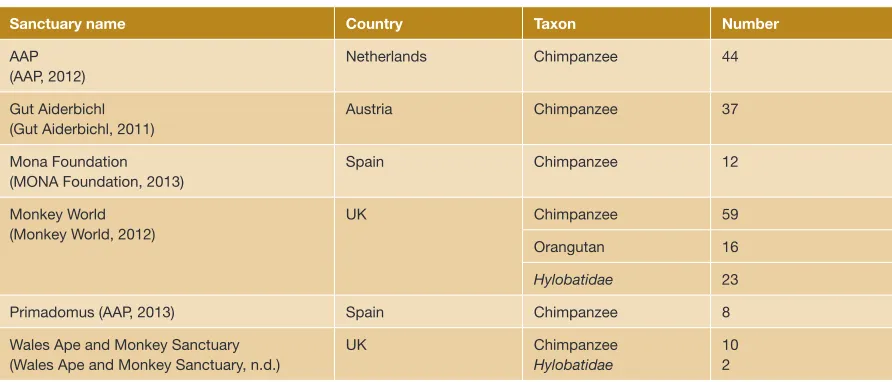
Between October and December 2012, cen-sus data were requested for all ape genera from the International Species Information System (ISIS), which aggregates census fig-ures voluntarily reported by member zoos (ISIS, 2012a). The ISIS website indicated that some data may be missing or out of date as they transition to a new software sys-tem (ISIS, 2012b). Since membership and reporting are voluntary, not all zoos are necessarily included. The ISIS data con-tained records for 2174 apes in Europe. The number of male, female, and unspecified sex individuals for each taxon is shown in Table 10.4.
Discussion and specific welfare
risks raised by EU data
Evidence of rescues and sanctuary transfers from circuses and other private ownership within the EU indicates on-going challenges with variation in legal standards and enforce-ment within the Union. There is a lack of animal welfare consideration in the EU for captive wild animals, as it is seen as a national and not regional issue for member states to implement. Adoption of EU-wide standards for zoos could address some of these problems, and coordinated reporting and law enforcement will also be critical. The political will and legal mechanisms for enforcement might benefit from advocacy
TAblE 10.3
Number of apes in EU sanctuaries by country and taxonomic group (where available)
Sanctuary name Country Taxon Number
AAP (AAP, 2012)
Netherlands Chimpanzee 44
Gut Aiderbichl (Gut Aiderbichl, 2011)
Austria Chimpanzee 37
Mona Foundation (MONA Foundation, 2013)
Spain Chimpanzee 12
Monkey World (Monkey World, 2012)
UK Chimpanzee 59
Orangutan 16
Hylobatidae 23
Primadomus (AAP, 2013) Spain Chimpanzee 8
Wales Ape and Monkey Sanctuary (Wales Ape and Monkey Sanctuary, n.d.)
UK Chimpanzee
Hylobatidae
10 2
TAblE 10.4
Number of apes in EU zoos based on figures reported by ISIS
Taxon male female unknown Taxon total
Orangutan 113 177 16 306
Gorilla 164 239 5 408
Chimpanzee 273 465 3 741
Hylobatidae 355 275 89 719
and other forms of public awareness, and the Euro pean Alliance of Rescue centers and Sanctuaries (EARS) is currently being devel-oped to support and represent rescue centers and sanctuaries in Europe (EARS, 2013).
A main concern arising from the ISIS data is the 77 solitary apes in the record. Most of the isolates were Hylobatidae (49, 63.6%), followed by 19 chimpanzees (24.7%, one bonobo), seven orangutans (9.1%) and just two gorillas. Six facilities with solitary apes exhibit no other ape taxon. As noted earlier, the legal standards and practices for zoos vary widely across the EU, with evidence that welfare is lacking at many locations, especially newer member states. National Geographic recently published an exten-sive report on the welfare of great apes in German zoos (Nakott, 2012), which included an infographic highlighting some key facts, including:
Of the 40 zoos exhibiting about 450 apes, ten of the zoos exhibited great ape iso-lates or pairs only.
Of the zoos considered, only six met the highest standards and international best practices consistent with the needs and capabilities of great apes.
Eleven chimpanzee exhibits and four other ape exhibits at 13 zoos were clas-sified inappropriate for on-going ape exhibition and recommended for closure. The remaining exhibits were found in need of varying degrees of improvement to realize minimum standards.
As the EU moves forward with a review of zoo standards, and member states evalu-ate policy and practice, a long-term view is critical, in part because of the long lifespan of apes. The National Geographic article, for example, pointed out that captive breed-ing could affect when individual zoos or countries could phase out ape exhibitions. Likewise, it suggested that a network of “havens” or sanctuaries could be a suitable
alternative for apes housed in isolation or other inappropriate settings (Nakott, 2012). For any system of sanctuaries or other “havens,” the age structure of the ape popu-lation to be served, including future births, strongly influences the demand for space and for care services over time.
The United States and its
legal context
The United States is also party to CITES and other treaties covering trade in apes. Testing on apes is subject to US regulations regarding housing and other conditions in laboratories and other standards under the Animal Welfare Act (AWA). What laborato-ries may do with individual apes once they are deemed “surplus to need” is governed by the Chimpanzee Health Improvement and Maintenance Act (CHIMP Act). In 2011, the US government undertook a formal review of ape testing with the National Academies of Science, which recommended several changes, including reducing the number of individuals used (Altevogt et al., 2011b). A working group recently evaluated the new requirements put forward by the Academies for biomedical and behavioral research using chimpanzees and suggested a number of standards for housing and care practices (Box 10.2).
box 10.2
Breakthrough NIH decision 2013
Although invasive biomedical research protocols have decreased in US laboratories over the past decade, a significant number of chimpan-zees have continued to be held in laboratories and holding facilities for potential future need. Signaling a major shift on the part of the govern-ment, on June 26, 2013 the National Institutes of Health (NIH) announced a decision to accept the vast majority of recommendations made in the Council of Councils Working Group on the Use of Chimpanzees in NIH supported Research Report.1
Among other things, the newly announced policy will permanently retire hundreds of chimpanzees now held in laboratories. The NIH decision stipulates that all but 50 chimpanzees owned and supported by the government shall be transferred to the federal sanctuary system in the near future. There, individuals will live the rest of their lives in special-ized sanctuary settings, with proper nutrition, preventative veterinary care, enriching stimulation, and a social environment appropriate for chimpanzees.
The new NIH plan followed from a review process that was initiated by members of Congress and culminated in a December 2011 report by the Institute of Medicine (IOM), entitled “Chimpanzees in biomedical and behavioral research: assessing the necessity” (Altevogt et al., 2011a). The IOM made strong recommendations after determining that the US chimpanzee research program was largely unnecessary. As a result of the IOM study, NIH Director Collins requested that a special Working Group of experts develop a plan to implement the IOM’s guiding prin-ciples and criteria for chimpanzee research, analyze the current use of chimpanzees in research, assess the placement and size of chimpan-zee populations, and review potential future use.
The NIH announcement came on the heels of a Proposed Rule by the United States Fish and Wildlife Service (USFWS) to list US captive chimpanzees as endangered, alongside their wild counterparts.2 (See sub-section entitled ‘Transparency and regulatory practices impact-ing ape welfare’ in the Discussion section below for further detail.)
Analysis of data sources,
limitations, and results
Data on ape sanctuaries were collated from external sources and from sanctuary mate-rials or direct communications. Some figures were drawn from government records, pub-lished sources and personal communications as cited. For chimpanzees only, independ-ently vetted data from the ChimpCARE project (ChimpCARE, 2013) served as the authoritative data source. Official USDA data for registrations for breeders, dealers, exhibitors, federal research, and research using captive apes were used to assess the
number of sites and number of individuals by taxon, and frequency of animal welfare citations were obtained from the agency’s public records database (USDA, 2012). Not all entities that house captive apes are required to register with the USDA. Data were obtained on December 28, 2012 for the period 2010–12.
The number of apes in US sanctuaries is shown by species in Table 10.5. A notation of where these data are also counted in other sections is indicated.
ChimpCARE, established by Lincoln Park Zoo, uses different categories than the USDA for most site types, and allows for
more nuanced consideration of patterns across site type. ChimpCARE does not geo-reference or break out distinct sites for private parties such as pet owners, provid-ing a total of 60 chimpanzees (3% PRIV) in this category. Chimpanzees were most fre-quently reported for laboratories (962, 49.3% LAB) followed by sanctuaries (522, 27.9% SANC), and AZA zoos (261, 13.4% AZA). Fewer chimpanzees are designated as being in non-accredited facilities (106, 5.4% NON) and entertainment (20, ~1% ENT). The number of chimpanzees by ChimpCARE site type is shown in Figure 10.2, and to facil-itate comparison with USDA figures and
interpretation of data, a matrix is also pro-vided in Figure 10.2.
From 2010–12, 239 bodies registered with the USDA were reported to hold captive apes. Accounting for registrants who held more than one certificate type, cancellations and revocations (1 only), 224 entities were active in 2012: 201 exhibitors, 8 research laboratories, 9 dealers, 4 breeders and 2 federal research facilities (see Figure 10.3).
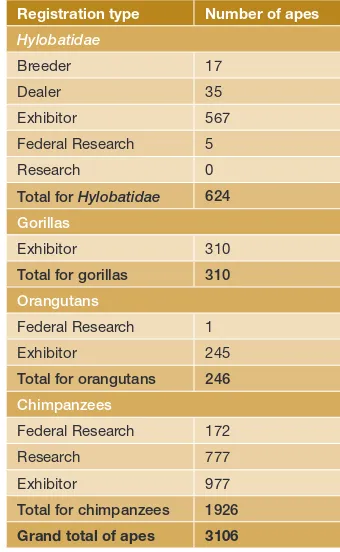
USDA data for inventory by taxonomic class were drawn from the most recent report for each ACTIVE registrant (see Table 10.6). If a registrant went from ACTIVE to CANCELLED status during 2012 AND had
TAblE 10.5
Apes in US sanctuaries by taxonomic group with reference to appearance in other sections of the report dataset
Sanctuary name
Taxonomic group
In other data?
B C g o H uSdA ChCare
Center for Great Apes
29 15 x x
Chimp Haven 123 x x
Chimpanzee Sanctuary NW
7 x x
Chimps Inc. 8 x x
CA Black Beauty Ranch
3 4 x x
Gorilla Haven 1 x
Great Ape Trust 6 x
International Primate Protection League
33
Primarily Primates
47 4 x
Primate Rescue Center
11 1 x x
Save the Chimps
267 x x
Wildlife Waystation
48 x
or species of animals impacted, except where certain sections of the law are themselves species specific.
At minimum, compliance failures at a site could represent increased risk for the apes, increasing in severity across a range of welfare effects. For example, some cases are merely administrative (e.g. out of date health certificates), while others involve poor welfare or even death (e.g. lack of routine veterinary care or treatment of acute injury resulting in premature death).
It is not always clear whether an NCI rep-resents acute or chronic welfare concerns, or some combination thereof.
Inspection data only provide some of the story on welfare: just as the absence of disease is distinct from excellent health, the absence of NCIs on an inspection is
FiguRE 10.2
Number of chimpanzees reported by Project ChimpCARE for six site types relative to those used by the USDA to classify official federal licenses and registrations. See text for abbreviations
FiguRE 10.3
Number of 2012 USDA registrations with apes, by certificate type. The single-letter code is assigned by the USDA for use in its official records
LAB SANC AZA NON PRIV ENT
Exhibitor (C) Research (R) Dealer (B) Breeder (A) Federal research facility (F)
TAblE 10.6
Apes inventory by taxonomic group*
registration type Number of apes
Hylobatidae
Breeder 17
Dealer 35
Exhibitor 567
Federal Research 5
Research 0
Total for Hylobatidae 624 Gorillas
Exhibitor 310
Total for gorillas 310
Orangutans
Federal Research 1
Exhibitor 245
Total for orangutans 246 Chimpanzees
Federal Research 172
Research 777
Exhibitor 977
Total for chimpanzees 1926
grand total of apes 3106
* As reported for USDA active registrants in 2012
a 2012 inspection, those data were included in the analysis. If an ACTIVE registrant had no 2012 inspection, the most recent, from 2011 or 2010, were used. Data are collated by certification type.
Discussion and specific welfare
risks and violations
The USDA enforces the AWA, but the agency does not technically issue “violations” when registrants do not meet AWA standards. The USDA calls such instances “non-compliance items” (NCIs). There are a number of caveats for interpreting what the USDA data mean for the health and welfare of apes.
distinct from a certification for welfare best practices or evidence of positive wel-fare status among apes.
During 2010–12, there were 1344 NCIs at USDA registered sites where captive apes were held. More than 42% of these were in reference to housing and facilities. The fre-quency of USDA inspections varied across sites; for example, not all sites were inspected in all years while other sites were inspected multiple times per year. This can pose a risk for welfare, in that pain and suffering or the risk thereof are not identified and mit-igated, or cited with the potential of punitive actions by the agency, as early as possible.
Apes as pets
Both the ChimpCARE and the USDA data revealed that apes are still kept in private ownership as companion animals, particu-larly chimpanzees and gibbons. The number of apes kept as pets varied by state, perhaps as a result of variation in legal requirements. As noted earlier, though this may be legal in some jurisdictions, the practice is subject to regulation under a number of federal laws. Public knowledge and opinions on the keeping of apes as pets varies considerably. For example, a recent experiment examined how people perceived the keeping of chim-panzees as pets after viewing either enter-tainment or educational videos (Schroepfer et al., 2011). Among those watching entertain-ment, 35% of people reported that they were in favor of the right to keep chimpanzees as pets. Even after viewing an educational video about chimpanzees, approximately 10% of people surveyed stated that they were in favor. In the entertainment group, the authors attributed greater support for allow-ing chimpanzees to be pets to misinforma-tion about factors such as “size, desirability, and abundance” of chimpanzees portrayed in entertainment settings (Schroepfer et al., 2011).
Discussion
The data that are available on the welfare of apes in captivity in these representative non-range states can, to an extent, aid in esti-mating welfare status elsewhere. As gaps regarding the number of apes in captivity are filled, there is no doubt that efforts are needed to expand the number of apes receiv-ing high-quality captive care. A scientific approach that is grounded in best-available evidence regarding ape ethology, natural history, needs, and capabilities will provide a critical foundation for future efforts both to establish welfare programs where they do not exist and to improve existing welfare practices globally. The use of strong evidence and vetted model programs can serve prac-tical implementation as well as monitoring and evaluation activities.
Transparency and regulatory
practices impacting ape welfare
protection in the wild. There could be analo-gous impacts for education and sensitization projects in range states that stem from local or international drivers.
These personal, albeit indirect experi-ences with apes have proven to be so influ-ential that it would be risky to ignore social practices and regulations that influence apes in captivity. Under the ESA, the US government has long considered the chim-panzee under a “split” listing where wild animals are Endangered, but captive indi-viduals are only recognized as Threatened. Under this lower risk designation, it is legal to use chimpanzees for a variety of com-mercial purposes within the United States so long as the proper permits are in place.
For example, chimpanzees can be forced to perform in circuses, film, and television and kept in commercial exhibit centers, zoos, and laboratories. To one extent or another, all of these practices hinge on the split-listing status under the ESA.
Some scientists and organizations con-tend that the split-listing status in the United States is harmful because it creates markets for chimpanzees and it sends contradictory messages about the impetus and urgency for protecting them (USFWS, 2013). Such a policy could undermine conservation and protection efforts, including those undertaken by sanctuaries in range states. Indeed, calling on range states to protect wild chimpanzees and enforce laws that prohibit keeping
panzees as pets or using them for private commercial exhibition is potentially less compelling when coming from a government that allows those same practices to occur within its own borders.
The US government announced, in June 2013, a Proposed Rule that would enable the FWS to address the inconsistency of the split-listing of chimpanzees(USFWS, 2013). The agency cited increased threats to chim-panzees throughout their range and a lack of evidence that these patterns would change in the near future. While the agency noted that domestic use of chimpanzees in enter-tainment or other commercial activity could lead to misperceptions that may impact conservation negatively, these practices were not deemed a “significant” driver for threats to the chimpanzee, where habitat loss, hunting, disease, and illegal trade have been on the rise and have direct effects on wild chimpanzee populations (Federal Register, 2013, pp. 35211–14). For these and other reasons detailed by the agency, the FWS determined that the ESA “does not allow for captive held animals to be assigned separate legal status from their wild counterparts on the basis of their captive state” (Federal Register, 2013, p. 35202). Following a mandatory public comment period, the FWS will make a final determination regarding the Proposed Rule and address remaining questions about its implementation.
More generally, and as both interna-tional and intergovernmental organizations implore private and public institutions to give funding for ape conservation, there are also calls on range states to adopt stronger legal frameworks and enforcement, account-ability, and even to fund these efforts. Wild chimpanzee populations are declining, and a unified, global effort is needed to save the species from extinction. Consistent conserva-tion policy at the naconserva-tional level is an integral part of the larger global efforts, a subject explored in greater detail in the next section.
The impacts of extractive
industries on sanctuaries
and rescue centers
Range state sanctuaries
and rescue centers
After the bushmeat trade, habitat loss and fragmentation, and disease, the illegal trade in live apes is considered to be one of the most pressing threats to the survival of apes in the wild. Orphaned apes may be seized from hunters, markets, or private dealers, whether obtained indirectly, as a second-ary effect of the bushmeat trade, or directly, as products for sale. The illegal trade in live apes, affecting thousands of apes each year, is currently growing (Stiles et al., 2013).
In range states, a number of different facilities may offer care to orphaned apes and other individuals that are taken into cap-tivity, including sanctuaries, rehabilitation centers, and rescue centers. Rescue centers and rehabilitation centers typically focus on shorter-term residency, for example for recovery from an injury or until a release site can be finalized. By contrast, sanctuar-ies typically house long-term residents and even provide lifetime care that can span decades in some cases. While some sanctu-aries do have reintroduction programs, these run in parallel with long-term housing. Zoos sometimes provide short- or long-term care in ape range states, and where no such facilities exist, such housing and care must be improvised. While there are distinctions between facility types, for the purposes of this chapter the term “sanctuary” shall be taken as an inclusive term that covers all such facil-ities, unless an exception is explicitly noted.
substantial since at least the 1990s (Farmer, 2002). A comparison of data from 2001 and 2009 (Faust et al., 2011) reveals that the total population size across 13 Pan African Sanctuaries Alliance (PASA) sanctuaries housing apes increased nearly 60% overall (479 to 855). A detailed analysis of arrivals at 11 PASA sanctuaries reported that the growth rate from 2000–06 was approxi-mately 15% (Faust et al., 2011), though it has slowed over time (Stiles et al., 2013). Models of future growth that account for various re-release and arrival scenarios estimate the population will grow to between 550 and 1800 individuals in the next 20 years (Faust et al., 2011). A summary of sanctuary infor-mation gathered from 2009 to 2012 is shown in Table 10.7 (Africa) and Table 10.8 (Asia). The number and location of ape sanctuaries and the number of present residents shown were drawn from a number of sources, including published articles, websites, and
personal communication. Although an effort has been made to update and confirm these data, figures might not account for the most recent rescue arrivals in residence, births, transfers, reintroductions, or deaths, espe-cially those taking place since March 2011. The pattern for ape sanctuaries in Asia is different (Figure 10.8). Not only is the sanctuary population substantially bigger, but growth due to arrival rates is accelerating (Stiles et al., 2013). For orangutans, the situ-ation has been especially dire for years. The Great Apes Survival Partnership (GRASP) sent a technical mission to Indonesia to evaluate the situation in 2006 (CITES and GRASP, 2006). Trade and weak CITES enforcement were viewed as significant drivers. The mission report concluded:
Whatever form the trade takes and whatever motivates it, the overwhelming evidence of the scale and seriousness of the problem is
TAblE 10.7
Number of apes in African sanctuaries in 2011 by country
Country range state? # Sanc B C g
Cameroon Yes 4 0 244 33
Congo (ROC) Yes 3 0 156 5
DRC Yes 6 55 85 30
Rwanda* Yes 0 0 0 0
Gabon Yes 3 0 20 9
Gambia Yes 1 0 77 0
Guinea Yes 1 0 38 0
Nigeria Yes 1 0 28 0
Sierra Leone Yes 1 0 101 0
Kenya No 1 0 44 0
Uganda Yes 1 0 45 0
Zambia No 1 0 120 0
South Africa No 1 0 33 0
the number of orangutans in “rescue” and “rehabilitation” centers. In Kalimantan alone, [. . .] Indeed, it is hard to view this figure as anything other than an indictment against the law enforcement efforts of the relevant agencies in Indonesia. (CITES and GRASP, 2006, p. 11)
In Africa and Asia, the demand for sanctuary space far exceeds both supply and funding. Furthermore, whilst reintroduc-tion might be a long-term goal for many facilities, arrival rates can outpace the reha-bilitation training and/or exceed the release capacity of sanctuaries and rescue centers. The sheer number of apes entering these centers is not the only challenge facilities face. Responsible reintroduction involves a variety of complex factors including finan-cial cost, disease risk, post-release monitor-ing, and securing suitable release sites (Beck, Rodrigues, and Unwin, 2007). Whether sanctuaries and rescue centers undertake reintroduction or not, essentially all of the work they do can be impacted by extrac-tive industries.
Potential impacts of extractive
industry on ape sanctuaries
In part, the impacts of extractive indus-tries on sanctuaries are shaped by complex ecological and socioeconomic factors, in
addition to the specifics of the industries themselves. Impacts can range in severity (mild to severe) and interval (immediate to delayed) and can be either positive or neg-ative for the sanctuaries and ape residents. The case studies presented later in this chap-ter illustrate how relationship building with the sector (in the case of Best Management Practices (BMPs) or other partnerships) can help to mitigate negative impacts. These voluntary practices are not, however, a complete solution; as long as competing economic interests for resources exist, wild apes will still face risks owing to industrial expansion, and sanctuaries will continue to be impacted.
Impacts to operations
By their nature, extractive industries clear land, convert land from one use to another, or otherwise modify landscapes. Habitat loss and degradation reduce the area that might be available for sanctuary locations, for sanctuary programs of managed reha-bilitation of semi-free ranging individu-als, as well as the creation or the expansion of reintroduction sites that can be used by sanctuaries.
Operational impacts can also be admin-istrative and logistical in nature. For example, if roads and vehicles operated by a private company facilitate the illegal transport of
TAblE 10.8
Number of apes in Asian sanctuaries in 2011 by country
Country range state? # Sanc o H
Cambodia Yes 1 0 9
Indonesia Yes 16 1208 293
Malaysia Yes 3 400 0
Taiwan No 1 0 0
Thailand Yes 4 0 182
Viet Nam Yes 2 0 17
apes from one country to another, seizing individual apes, transferring them to a res-cue facility, and potentially repatriating them to the country of origin becomes more complex legally and thus administratively. The laws of the country of seizure and the country of origin are involved, as well as CITES authorities. Some of these challenges have been recognized, and experts have called on CITES to be responsive to the special needs of such cases (Wolf, 2009). Where nationals of other countries are involved in illegal activities, those laws could come into play as well, as has been seen in a number of recent high-profile international cases in Egypt, Guinea, and China (Ammann, 2012; Stiles et al., 2013).
If the country of seizure is not a range state or is not equipped to handle the nec-essary testing for transport or to handle ape care during law enforcement, permitting or planning, outside experts or resources are usually necessary. For example, special expertise, testing equipment, and transport were necessary for sanctuary transfer to Uganda when four chimpanzees from the Democratic Republic of Congo (DRC) were seized in Sudan (CS and WCT, 2011; PASA, 2011). A charter flight was also necessary to airlift another chimpanzee from Sudan to a sanctuary in Kenya (Maina, 2009).
Impacts to resident ape health
and wellbeing
In extractive industries, work sites, roads, and other business activities often take place in remote areas where the natural resources are found. Some of these areas are also ape habitat. By nature, such sites and operations are difficult to police and illegal activity can thus be easier to conceal. Increased access and reduced risk could make illegal activities such as keeping apes as pets on private com-pany property easier or more attractive.
There are many health and welfare risks for apes kept as pets. Even in the absence of
abuse or neglect, inadequate nutrition or veterinary care, close confinement and other risks can impact health, welfare, and ultimately survival. For example, in April 2013, an orangutan rescued by a sanctuary in Indonesia was found at a plantation with no cage or other housing at all; the infant was simply kept tied up in a bag (SOS, 2013). Where there is frequent transport from industrial sites to urban centers or across borders, these apes could easily become victims of the illegal trade, transported under poor conditions with associated health risks. If these infants are ever seized or res-cued, they can require extensive veterinary care and rehabilitation that could last for many years. Specialized needs owing to injury or illness increase the pressure on sanctuary services and resources.
Impacts to rescue, rehabilitation,
and related community programs
Sanctuaries are often involved in programs that require the permission of, or coopera-tion with, government authorities or local communities – including conservation programs focused on wild apes. Where those same authorities and/or communities have relationships with industry and the needs of sanctuaries or rescue organizations are at odds with those interests, organizations involved with protection of apes in captivity and in the wild can face challenges work-ing with government and/or communities as well as with the industries themselves.
renting out land rights or extracting and selling natural resources to a commercial buyer, one or many landowners might forgo PES options. The government or its agents could also be involved in such scenarios by virtue of authority to grant or deny per-mits to sanctuaries and rescue centers or to private companies. Where interests differ greatly, there is the potential for legal action or other conflict between parties.
Spatial effects, the catchment
area, and law enforcement
For apes in their natural habitats, the impacts of extractive industries are expected to have strong spatial relationships, i.e. the strong-est impacts are more likely to come from extraction near them than distant from them. The same is not always true for the associa-tion between extractive industries and sanctuary populations. Sanctuaries and rescue centers can be influenced by both localized and distant drivers because they can serve as a “catchment” for other geographic areas, either (1) where orphaned apes arriv-ing at the sanctuaries originate or (2) where orphaned apes are confiscated. Catchment areas can be synonymous with the home country, or, in the case of sanctuaries in non-range states, such as South Africa, be exclusively outside the home country.
While customs, laws and other risks in catchment areas can differ from those operating locally, increasing arrests, pros-ecutions, and penalties are priorities for combating the illegal trade in apes (Stiles et al., 2013). One fundamental challenge is that law enforcement capacity is often insuffi-cient to counter the volume of the bushmeat and illegal live animal trades (Drori, 2012; Stiles et al., 2013). However, it has been rec-ognized that if there is no sanctuary in a given area then there is no real incentive for confiscations. Indeed a range of factors can delay the law enforcement needed to seize an
ape held captive illegally for months or years (Teleki, 2001). Even where enforcement challenges are largely administrative, such as coordination between government agen-cies, the availability of sanctuary space and services could impact enforcement actions.
Beyond a lack of incentives, confisca-tions could be disincentivized where stake-holders perceive potential costs for initiating enforcement owing to a lack of accessible sanctuary space. For example, informants or officers could be concerned that they might be compelled to provide care for or to obtain veterinary services for the confis-cated apes despite a lack of resources. The effect could also work the other way, where access to a sanctuary is a driver. The avail-ability of sanctuary capacity, funding, and political will for protecting apes theoreti-cally could prompt a surge in enforcement and confiscations. In so doing, initial access to a sanctuary could further increase demand for it, potentially beyond capacity. The evi-dence for a variety of enforcement–sanctuary interdependencies warrants careful consid-eration by those managing and financing the expansion of enforcement because sanc-tuary capacity can impact activities as well as outcomes.
The involvement of international law enforcement where repatriation is manda-tory or preferable provides a stark example of how broad a catchment area can be, from transcontinental to several continents away, and also sends a strong message to those involved in the trade (Stiles et al., 2013). Such confiscations can be local, where individu-als are found near the site where they once lived freely, or regional, where some cross-border coordination is required. However, enforcement actions can also involve a much larger geographic net spanning con-tinents, disparate legal frameworks, and complicated logistics that bear directly upon sanctuaries. Proving the provenance and origins of illegally traded animals has
“
Sanctuaries and rescue centers can be influenced by both localized and distant drivers because they can serve as a “catchment” for other geographic areas.become a sticking point, repatriating indi-viduals is controversial, and DNA testing may be required. Furthermore, if the apes are to be returned, they would require both sanctuary space and services, at least for rehabilitation, although possibly for life-time care.
Temporal relationships
Whether industry drivers have immediate or delayed repercussions for sanctuaries can be influenced by a number of factors, such as local cultural practices, corruption, and the history and capacity of law enforcement. Beyond arrival rates, the demographic traits of new residents can also be influenced, and sanctuaries have to respond accordingly. For example one analysis reported that 100% of gorillas and bonobos, as well as the majority of chimpanzees (80%), were estimated under 4 years of age upon arrival, while some chimpanzees were estimated to be 5–11 (16.6%) or even more than 12 years of age (2.8%) (Farmer, 2002). A subsequent analysis of demographics at sanctuaries indicates that average age at arrival decreases over time (Faust et al., 2011). Such a pattern appears to reflect the history of law enforcement and the population of apes being rescued.
When a sanctuary becomes operational, local rescues might include individuals used in exhibitions or privately owned for an extended time. As most animals in that category are successfully rescued, arrivals gradually shift towards newly orphaned apes and lower median age (Faust et al., 2011). Where catchment areas are large and enforcement is unpredictable, such a shift could take more time or result in periodic increases in median age at arrival. Likewise, with complex, lengthy repatriation cases, age at arrival would likely be above the median. Increased age at arrival is likely associated with both longer histories of cap-tivity and weaker temporal relationships
between sanctuary demands and their drivers, including extractive industries. Importantly, the longer histories of captiv-ity associated with illegal trade have direct implications for the health and welfare of individual apes and the care that they need after arrival at a sanctuary.
Socioeconomic factors
influencing extractive
industry impacts
The influence of extractive industries on ape sanctuaries and their residents is deter-mined by socioeconomic factors within their country and by variables associated with catchment countries. Some sanctuary programs are directly affected by poverty and other socioeconomic variables. For example, household poverty in an area could affect the motivation of stakeholders to participate in community programs such as PES or the sustainability of programs to reduce human–wildlife conflict (HWC) through insurance or incentives. Land con-version to cash crops or agroforestry might also impact sanctuary programs or the availability of land for facilities or release sites. In many countries where household poverty rates are high, the concentration of natural resources is also high, a phenome-non called the “resource curse” (Kolstad, Søreide, and Williams, 2008). Not surpris-ingly, these same countries and resources also attract extractive industries.
Governance
Poor governance and corruption are recog-nized risks with natural resources and may serve to weaken other governance struc-tures in the countries affected (Layden, 2010). Likewise, governance is also a critical variable that can influence how extractive industries impact sanctuaries. For example, when governments are corrupt, laws that are intended to protect apes and ensure that nongovernmental organizations (NGOs) and civil society organizations operate effec-tively can be undermined by competing inter-ests or ignored altogether.
The forestry sector has proven to be vul-nerable to corruption, though scale can be hard to estimate (Layden, 2010). Some evi-dence suggests there is a relationship between rate of deforestation, prevalence of illegal logging, and weak governance and cor-ruption; for example, at a time when illegal logging was estimated to account for more than half of all logging in Indonesia, the country also ranked high on the Corrup-tion PercepCorrup-tions Index (2009: 111 of 183 (Layden, 2010, p. 2)). Recognized risk factors may increase vulnerabilities in the natural resources sector and make it harder to combat the effects of corruption, including industries where existing corruption levels are high and existing governance and reg-ulation are poor (Kolstad et al., 2008, p. 4). With the complex relationships between governance and extractive industries in mind, it is clear that these are also risks for sanctuaries and rescue centers.
Potential for positive
impacts through private
sector partnerships
While there is ample evidence of the risks and negative impacts on ape populations and ape sanctuaries from the presence of extractive industries, it is vital to remember
Photo: Rescued chimpan-zees from within Uganda demonstrate that illegal trade is an on-going risk; whilst chimpanzees with origins outside Uganda reflect the regional risk associated with illegal trade and the significance of sanc-tuaries for transboundary enforcement and long-term chimpanzee care. © LAGA & The EAGLE Network
CAsE sTudy 1
Chimpanzee Sanctuary and Wildlife Conservation Trust, Entebbe and Ngamba Island, Uganda
In 2010, approximately 9.7% of Uganda’s land (19 981 km2) was officially protected (FAO, 2012). Wild populations of both chimpanzees and gorillas are found in Uganda, with chim-panzees living both within and outside of protected areas and gorillas ranging outside of protected areas. In addition to these ape populations, two facilities house rescued chimpanzees from both within and outside of the country. Rescued chim-panzees from within Uganda demonstrate that illegal trade has occurred in the recent past, and is an on-going risk. Similarly, chimpanzees with origins outside Uganda reflect the broader regional risk associated with illegal trade as well as the significance of sanctuaries for both transboundary enforcement and long-term chimpanzee care.
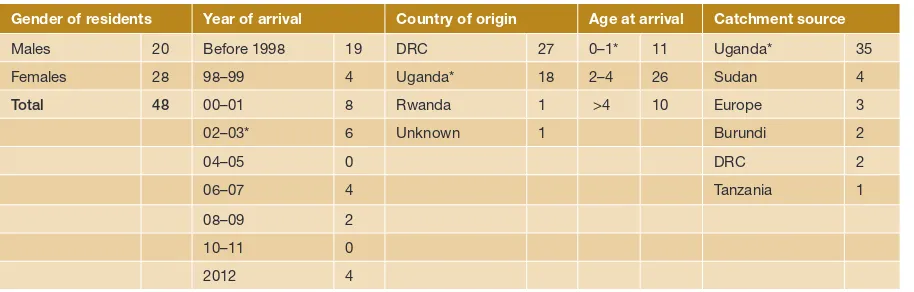
The Chimpanzee Sanctuary and Wildlife Conservation Trust (CS and WCT) established the Ngamba Island Sanctuary (NIS) in 1998, and is a founding member of PASA. The project was undertaken in cooperation with the Uganda Wildlife Education Center (UWEC) and the Uganda Wildlife Authority (UWA), both of which continue to serve as Trustees. The founding of NIS coincided with a wave of new enforcement actions that resulted in a number of chimpanzee confiscations and even some successful prosecutions. Since NIS was established, a greater number of confiscated and/or surrendered chimpanzees have been placed at Ngamba Island (28) than the original facility at Uganda Wildlife Education Centre (UWEC) (12). Most individuals arrived at Ngamba when they were 2–4 years of age (26; see Table 10.9). The number of very young indi-viduals under 2 years of age at arrival is over 20% overall, with the average age of new arrivals decreasing over time. As NIS has approached maximum physical capacity, annual arrival
rates have also declined, with approximately ten arrivals since 2004. Though some chimpanzee residents at NIS are of Ugandan origin (18), the majority are from the DRC (27). The precise origins of the residents belie a much larger area in terms of catchments, as some residents arrived following enforce-ment efforts in Burundi (2), Tanzania (1), and Sudan (4). Natural forest accounts for a relatively small (29 880 km2), rapidly declining (-2.3% p.a. 2000–10 (FAO, 2010b)) propor-tion of land in Uganda. Although forest extracpropor-tion and export-ing of timber and other forest products is limited under law, the Ugandan government has acknowledged illegal logging as a major challenge, noting that constraints on measuring or estimating these activities are impediments to enforcement and to realizing sustainable development objectives linked to forestry (Ssekika, 2012). In the context of impacts for chim-panzees, CS and WCT, together with partners and collabo-rators, have undertaken a number of activities to slow rates of loss through protection and to accelerate reforestation. The project has contracted 342 forest owners who are conserv-ing and reforestconserv-ing a total of 15.9 km2 in designated areas within the Semliki-Murchison landscape (P. Hatanga, personal communication, 2013). While this is a fraction of the total private forestland in the area, the pilot project has gained traction in the community and has achieved important milestones for the project plan (P. Hatanga, personal communication, 2013). Oil exploration is also on-going in the area around CS and WCT forest projects that include a PES component. The CS and WCT and its partners have taken an active role in engag-ing representatives of the sector, addengag-ing Tullow Oil to the technical steering committee that guides and monitors PES implementation (P. Hatanga, personal communication, 2013). Through this partnership, Tullow Oil has expressed interest in conservation initiatives, specifically buying carbon credits, supporting biomass energy efficiency projects, and other potential forms of financial support (P. Hatanga, personal com-munication, 2013).
TAblE 10.9
Summary data for chimpanzee residents at Ngamba Island Sanctuary, 2012
gender of residents Year of arrival Country of origin Age at arrival Catchment source
Males 20 Before 1998 19 DRC 27 0–1* 11 Uganda* 35
Females 28 98–99 4 Uganda* 18 2–4 26 Sudan 4
Total 48 00–01 8 Rwanda 1 >4 10 Europe 3
02–03* 6 Unknown 1 Burundi 2
04–05 0 DRC 2
06–07 4 Tanzania 1
08–09 2
10–11 0
2012 4