1
Micropower
DC/DC Converter
Adjustable and Fixed 5V, 12V
VOUT 5V/DIV 0V PROGRAM 5V/DIV 5ms/DIV 1173 TA02 L1* 100µH LT1173 • TA01 + GND SW2 FB SW1 LIM I VIN LT1173 10 F SANYO OS-CON 100 Fµ 12V 100mA 1N5818 µ + 5V IN 1N4148 PROGRAM 47Ω *L1 = GOWANDA GA20-103K COILTRONICS CTX100-4 1.07M† 124k† NO OVERSHOOT EFFICIENCY = 81% † = 1% METAL FILM
Logic Controlled Flash Memory VPP Generator VPP Output
D
ESCRIPTIO
U
S
FEATURE
U
S
A
PPLICATI
O
and LTC are registered trademarks and LT is a trademark of Linear Technology Corporation.
■ Operates at Supply Voltages From 2.0V to 30V ■ Consumes Only 110µA Supply Current
■ Works in Step-Up or Step-Down Mode ■ Only Three External Components Required ■ Low Battery Detector Comparator On-Chip ■ User-Adjustable Current Limit
■ Internal 1A Power Switch
■ Fixed or Adjustable Output Voltage Versions ■ Space Saving 8-Pin MiniDIP or SO8 Package
The LT1173 is a versatile micropower DC-DC converter. The device requires only three external components to deliver a fixed output of 5V or 12V. Supply voltage ranges from 2.0V to 12V in step-up mode and to 30V in step-down mode. The LT1173 functions equally well in up, step-down or inverting applications.
The LT1173 consumes just 110µA supply current at standby, making it ideal for applications where low quies-cent current is important. The device can deliver 5V at 80mA from a 3V input in step-up mode or 5V at 200mA from a 12V input in step-down mode.
Switch current limit can be programmed with a single resistor. An auxiliary gain block can be configured as a low battery detector, linear post regulator, under voltage lock-out circuit or error amplifier.
For input sources of less than 2V, use the LT1073.
■ Flash Memory Vpp Generators ■ 3V to 5V, 5V to 12V Converters ■ 9V to 5V, 12V to 5V Converters ■ LCD Bias Generators
■ Peripherals and Add-On Cards ■ Battery Backup Supplies
■ Laptop and Palmtop Computers ■ Cellular Telephones ■ Portable Instruments
U
S
A
PPLICATI
O
TYPICAL
2
W
U
U
PACKAGE/ORDER I FOR ATIO
LT1173CN8 LT1173CN8-5 LT1173CN8-12
A
BSOLUTE
A
W
XI
U
W
W
R
A
TI
U
G
S
Supply Voltage (VIN) ... 36V SW1 Pin Voltage (VSW1) ... 50V SW2 Pin Voltage (VSW2) ... – 0.5V to VIN Feedback Pin Voltage (LT1173) ... 5V Sense Pin Voltage (LT1173, -5, -12) ... 36V Maximum Power Dissipation ... 500mW Maximum Switch Current ... 1.5A Operating Temperature Range ... 0°C to 70°C Storage Temperature Range ... –65°C to 150°C Lead Temperature, (Soldering, 10 sec.)... 300°CConsult factory for Industrial and Military grade parts
SYMBOL PARAMETER CONDITIONS MIN TYP MAX UNITS
IQ Quiescent Current Switch Off ● 110 150 µA
IQ Quiescent Current, Boost No Load LT1173-5 135 µA
Mode Configuration LT1173-12 250 µA
VIN Input Voltage Step-Up Mode ● 2.0 12.6 V
Step-Down Mode ● 30 V
Comparator Trip Point Voltage LT1173 (Note 1) ● 1.20 1.245 1.30 V
VOUT Output Sense Voltage LT1173-5 (Note 2) ● 4.75 5.00 5.25 V
LT1173-12 (Note 2) ● 11.4 12.0 12.6 V
Comparator Hysteresis LT1173 ● 5 10 mV
Output Hysteresis LT1173-5 ● 20 40 mV
LT1173-12 ● 50 100 mV
fOSC Oscillator Frequency ● 18 23 30 kHz
Duty Cycle Full Load ● 43 51 59 %
tON Switch ON Time ILIM tied to VIN ● 17 22 32 µs
Feedback Pin Bias Current LT1173, VFB = 0V ● 10 50 nA
Set Pin Bias Current VSET = VREF ● 20 100 nA
VOL Gain Block Output Low ISINK = 100µA, VSET = 1.00V ● 0.15 0.4 V
Reference Line Regulation 2.0V ≤ VIN≤ 5V ● 0.2 0.4 %/V
5V ≤ VIN ≤ 30V ● 0.02 0.075 %/V
VSAT SWSAT Voltage, Step-Up Mode VIN = 3.0V, ISW = 650mA ● 0.5 0.65 V
VIN = 5.0V, ISW = 1A 0.8 1.0 V
● 1.4 V
TA = 25°C, VIN = 3V, unless otherwise noted.
ELECTRICAL C
HARA TERISTICS
C
1 2 3 4 8 7 6 5 TOP VIEW ILIM VIN SW1 SW2 FB (SENSE)* SET AO GND N8 PACKAGE 8-LEAD PLASTIC DIP
*FIXED VERSIONS TJMAX = 90°C, θJA = 130°C/W
TOP VIEW
S8 PACKAGE 8-LEAD PLASTIC SOIC
*FIXED VERSIONS 1 2 3 4 8 7 6 5 ILIM VIN SW1 SW2 FB (SENSE)* SET AO GND TJMAX = 90°C, θJA = 150°C/W LT1173CS8 LT1173CS8-5 LT1173CS8-12 ORDER PART NUMBER S8 PART MARKING 1173 11735 117312
3
VSAT SWSAT Voltage, Step-Down Mode VIN = 12V, ISW = 650mA 1.1 1.5 V
● 1.7 V
AV Gain Block Gain RL = 100kΩ (Note 3) ● 400 1000 V/V
Current Limit 220Ω to ILIM to VIN 400 mA
Current Limit Temperature Coeff. ● – 0.3 %/°C
Switch OFF Leakage Current Measured at SW1 Pin 1 10 µA
VSW2 Maximum Excursion Below GND ISW1 ≤ 10µA, Switch Off – 400 – 350 mV
SYMBOL PARAMETER CONDITIONS MIN TYP MAX UNITS
Note 2: The output voltage waveform will exhibit a sawtooth shape due to
the comparator hysteresis. The output voltage on the fixed output versions will always be within the specified range.
Note 3: 100kΩ resistor connected between a 5V source and the AO pin. The ● denotes the specifications which apply over the full operating
temperature range.
Note 1: This specification guarantees that both the high and low trip points
of the comparator fall within the 1.20V to 1.30V range.
ELECTRICAL C
HARA TERISTICS
C
TA = 25°C, VIN = 3V, unless otherwise noted.Maximum Switch Current vs Set Pin Bias Current vs Feedback Pin Bias Current vs
RLIM Step-Down Mode Temperature Temperature
C
HARA TERISTICS
C
U
W
A
TYPICAL PERFOR
CE
I (A) 0 0 V (V) 0.2 0.4 0.6 1.0 1.2 0.2 0.4 0.6 0.8 LT1173 • TPC01 0.8 1.0 1.2 SWITCH CESAT V = 5.0VIN V = 3.0VIN V = 2.0VIN I (A) 0 0.7 SWITCH ON VOLTAGE (V) 0.8 0.9 1.1 1.3 1.4 0.1 0.2 0.3 0.4 LT1173 • TPC02 1.2 0.5 0.6 SWITCH 0.7 0.8 1.0 Switch ON VoltageSaturation Voltage Step-Up Mode Step-Down Mode Maximum Switch Current vs
(SW2 Pin Grounded) (SW1 Pin Connected to VIN) RLIM Step-Up Mode
TEMPERATURE (°C) –50
SET PIN BIAS CURRENT (nA)
10 15 20 –25 0 25 50 LT1173 •TPC04 75 100 125 V = 3VIN 5 TEMPERATURE (°C) –50
FEEDBACK PIN BIAS CURRENT ( A)
14 16 18 –25 0 25 50 LT1173 •TPC05 75 100 125 V = 3VIN µ 12 10 8 R ( ) 100 0
SWITCH CURRENT (mA)
400 800 1000 LT1173 • TPC09 Ω 900 700 600 500 300 200 LIM 1000 VOUT = 5V 100 VIN = 24V L = 500µH VIN = 12V L = 250µH R ( ) 10 100 SWITCH CURRENT (mA) 400 800 1200 100 LT1173 • TPC03 Ω 1000 900 700 600 500 300 200 LIM 1000 1100 2V ≤ VIN≤ 5V
4
C
HARA TERISTICS
C
U
W
A
TYPICAL PERFOR
CE
LT1173 • BD02 IN V GND SET AO A2 1.245V REFERENCE A1 OSCILLATOR DRIVER R1 SW1 SW2 LIM I Ω R2 753k SENSE LT1173-5: LT1173-12: R1 = 250k R1 = 87.4kΩΩ GAIN BLOCK/ ERROR AMP COMPARATOR LT1173 • BD01 IN V GND SET AO 1.245V REFERENCE A1 A2 DRIVER FB SW1 SW2 LIM I OSCILLATOR GAIN BLOCK/ ERROR AMP COMPARATOR LT1173 LT1173-5, -12W
I
D AGRA
BLOCK
S
ILIM (Pin 1): Connect this pin to VIN for normal use. Where
lower current limit is desired, connect a resistor between ILIM and VIN. A 220Ω resistor will limit the switch current to approximately 400mA.
VIN (Pin 2): Input supply voltage.
SW1 (Pin 3):Collector of power transistor. For step-up
mode connect to inductor/diode. For step-down mode connect to VIN.
SW2 (Pin 4):Emitter of power transistor. For step-up
mode connect to ground. For step-down mode connect to inductor/diode. This pin must never be allowed to go more than a Schottky diode drop below ground.
GND (Pin 5): Ground.
AO (Pin 6): Auxiliary Gain Block (GB) output. Open collec-tor, can sink 100µA.
SET (Pin 7): GB input. GB is an op amp with positive input connected to SET pin and negative input connected to 1.245V reference.
FB/SENSE (Pin 8): On the LT1173 (adjustable) this pin goes to the comparator input. On the LT1173-5 and LT1173-12, this pin goes to the internal application resis-tor that sets output voltage.
PI
U
FU
U
C
TI
O
U
S
Quiescent Current vs Temperature Supply Current vs Switch Current Oscillator Frequency
SWITCH CURRENT (mA) 0
SUPPLY CURRENT (mA)
30 40 50 400 600 800 LT1173 •TPC07 1000 V = 5VIN 20 10 0 V = 2VIN 200 TEMPERATURE (°C) –50 I ( A) 100 110 120 –25 0 25 50 LT1173 •TPC06 75 100 125 V = 3VIN IN µ 90 VIN(V) 0 22.0 FOSC (kHz) 22.5 23.0 23.5 24.5 25.0 5 10 15 20 LT1173 • TPC08 24.0 25 30 25.5 26.0
5
The LT1173 is a gated oscillator switcher. This type archi-tecture has very low supply current because the switch is cycled only when the feedback pin voltage drops below the reference voltage. Circuit operation can best be under-stood by referring to the LT1173 block diagram. Compara-tor A1 compares the feedback pin voltage with the 1.245V reference voltage. When feedback drops below 1.245V, A1 switches on the 24kHz oscillator. The driver amplifier boosts the signal level to drive the output NPN power switch. An adaptive base drive circuit senses switch current and provides just enough base drive to ensure switch saturation without overdriving the switch, resulting in higher efficiency. The switch cycling action raises the output voltage and feedback pin voltage. When the feed-back voltage is sufficient to trip A1, the oscillator is gated off. A small amount of hysteresis built into A1 ensures loop stability without external frequency compensation. When the comparator is low the oscillator and all high current circuitry is turned off, lowering device quiescent current to just 110µA, for the reference, A1 and A2.
The oscillator is set internally for 23µs ON time and 19µs OFF time, optimizing the device for circuits where VOUT andVIN differ by roughly a factor of 2. Examples include a 3V to 5V step-up converter or a 9V to 5V step-down converter.
U
LT1173 OPER
ATI
O
A2 is a versatile gain block that can serve as a low battery detector, a linear post regulator, or drive an under voltage lockout circuit. The negative input of A2 is internally connected to the 1.245V reference. A resistor divider from VIN to GND, with the mid-point connected to the SET pin provides the trip voltage in a low battery detector applica-tion. The gain block output (AO) can sink 100µA (use a 47k resistor pull-up to + 5V). This line can signal a microcon-troller that the battery voltage has dropped below the preset level.
A resistor connected between the ILIM pin and VIN sets maximum switch current. When the switch current ex-ceeds the set value, the switch cycle is prematurely terminated. If current limit is not used, ILIM should be tied directly to VIN. Propagation delay through the current limit circuitry is approximately 2µs.
In step-up mode the switch emitter (SW2) is connected to ground and the switch collector (SW1) drives the induc-tor; in step-down mode the collector is connected to VIN and the emitter drives the inductor.
The LT1173-5 and LT1173-12 are functionally identical to the LT1173. The -5 and -12 versions have on-chip voltage setting resistors for fixed 5V or 12V outputs. Pin 8 on the fixed versions should be connected to the output. No external resistors are needed.
U
S
A
PPLICATI
O
I FOR ATIO
U
W
U
Measuring Input Current at Zero or Light Load
Obtaining meaningful numbers for quiescent current and efficiency at low output current involves understanding how the LT1173 operates. At very low or zero load current, the device is idling for seconds at a time. When the output voltage falls enough to trip the comparator, the power switch comes on for a few cycles until the output voltage rises sufficiently to overcome the comparator hysteresis. When the power switch is on, inductor current builds up to hundreds of milliamperes. Ordinary digital multimeters are not capable of measuring average current because of bandwidth and dynamic range limitations. A different
approach is required to measure the 100µA off-state and 500mA on-state currents of the circuit.
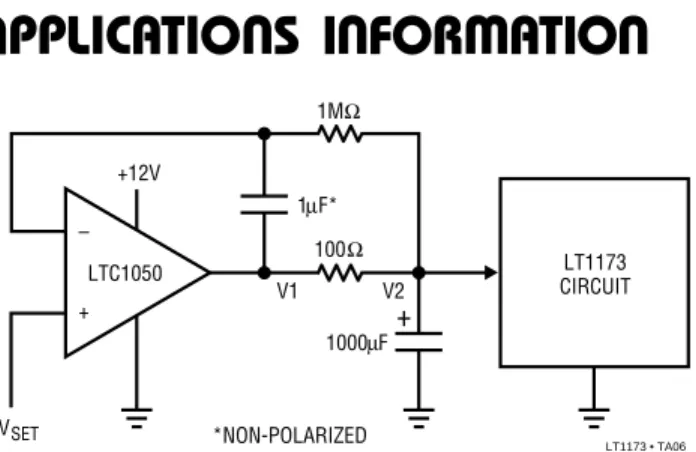
Quiescent current can be accurately measured using the circuit in Figure 1. VSET is set to the input voltage of the LT1173. The circuit must be “booted” by shorting V2 to VSET. After the LT1173 output voltage has settled, discon-nect the short. Input voltage is V2, and average input current can be calculated by this formula:
II N = V2−V1
( )
6
U
S
A
PPLICATI
O
I FOR ATIO
U
W
U
LT1173 • TA06 + – Ω SET V +12V + µ 1 F* µ 1000 F 100 V1 V2 LTC1050 Ω 1M LT1173 CIRCUIT *NON-POLARIZED
Figure 1. Test Circuit Measures No Load Quiescent Current of LT1073 Converter
Inductor Selection
A DC-DC converter operates by storing energy as mag-netic flux in an inductor core, and then switching this energy into the load. Since it is flux, not charge, that is stored, the output voltage can be higher, lower, or oppo-site in polarity to the input voltage by choosing an appropriate switching topology. To operate as an efficient energy transfer element, the inductor must fulfill three requirements. First, the inductance must be low enough for the inductor to store adequate energy under the worst case condition of minimum input voltage and switch ON time. The inductance must also be high enough so that maximum current ratings of the LT1173 and inductor are not exceeded at the other worst case condition of maxi-mum input voltage and ON time. Additionally, the inductor core must be able to store the required flux; i.e., it must not saturate. At power levels generally encountered with LT1173 based designs, small axial leaded units with saturation current ratings in the 300mA to 1A range (depending on application) are adequate. Lastly, the in-ductor must have sufficiently low DC resistance so that excessive power is not lost as heat in the windings. An additional consideration is Electro-Magnetic Interference (EMI). Toroid and pot core type inductors are recom-mended in applications where EMI must be kept to a minimum; for example, where there are sensitive analog circuitry or transducers nearby. Rod core types are a less expensive choice where EMI is not a problem.
Specifying a proper inductor for an application requires first establishing minimum and maximum input voltage, output voltage, and output current. In a step-up converter,
the inductive events add to the input voltage to produce the output voltage. Power required from the inductor is deter-mined by
PL = (VOUT + VD – VIN) (IOUT) (02)
where VD is the diode drop (0.5V for a 1N5818 Schottky). Energy required by the inductor per cycle must be equal or greater than P F L OSC 03
( )
in order for the converter to regulate the output.
When the switch is closed, current in the inductor builds according to I t V R e L IN R t L
( )
= ( )
' – – ' 1 04where R' is the sum of the switch equivalent resistance (0.8Ω typical at 25°C) and the inductor DC resistance. When the drop across the switch is small compared to VIN, the simple lossless equation
I t V L t
L
( )
= IN( )
05can be used. These equations assume that at t = 0, inductor current is zero. This situation is called “discon-tinuous mode operation” in switching regulator parlance. Setting “t” to the switch ON time from the LT1173 speci-fication table (typically 23µs) will yield iPEAK for a specific “L” and VIN. Once iPEAK is known, energy in the inductor at the end of the switch ON time can be calculated as
EL= 1LiPEAK
( )
2 06
2
EL must be greater than PL/FOSC for the converter to deliver the required power. For best efficiency iPEAK should be kept to 1A or less. Higher switch currents will cause excessive drop across the switch resulting in reduced efficiency. In general, switch current should be held to as low a value as possible in order to keep switch, diode and inductor losses at a minimum.
7
As an example, suppose 9V at 50mA is to be generated from a 3V input. Recalling Equation 02,
PL = (9V + 0.5V – 3V) (50mA) = 325mW. (07) Energy required from the inductor is
P F mW kHz J L OSC = 325 =
( )
24 13 5. µ . 08 Picking an inductor value of 100µH with 0.2Ω DCR results in a peak switch current ofiPEAK V e m A s H = =
( )
• 3 1 1 616 09 1 23 100 Ω Ω – . – µ µSubstituting iPEAK into Equation 04 results in
EL= 1
(
H)(
A)
= J( )
2 100 0 616 19 0 10
2
µ . . µ .
Since 19µJ > 13.5µJ the 100µH inductor will work. This trial-and-error approach can be used to select the opti-mum inductor. Keep in mind the switch current maxiopti-mum rating of 1.5A. If the calculated peak current exceeds this, consider using the LT1073. The 70% duty cycle of the LT1073 allows more energy per cycle to be stored in the inductor, resulting in more output power.
An inductor’s energy storage capability is proportional to its physical size. If the size of the inductor is too large for a particular application, considerable size reduction is possible by using the LT1111. This device is pin compat-ible with the LT1173 but has a 72kHz oscillator, thereby reducing inductor and capacitor size requirements by a factor of three.
For both positive-to-negative (Figure 7) and negative-to-positive configurations (Figure 8), all the output power must be generated by the inductor. In these cases
PL = ( VOUT + VD) (IOUT). (11) In the positive-to-negative case, switch drop can be mod-eled as a 0.75V voltage source in series with a 0.65Ω resistor so that
VL = VIN – 0.75V – IL (0.65Ω). (12)
In the negative-to-positive case, the switch saturates and the 0.8Ω switch ON resistance value given for Equation 04 can be used. In both cases inductor design proceeds from Equation 03.
The step-down case is different than the preceeding three in that the inductor current flows through the load in a step-down topology (Figure 6). Current through the switch should be limited to ~650mA in step-down mode. This can be accomplished by using the ILIM pin. With input voltages in the range of 12V to 25V, a 5V output at 300mA can be generated with a 220µH inductor and 100Ω resistor in series with the ILIM pin. With a 20V to 30V input range, a 470µH inductor should be used along with the 100Ω resistor.
Capacitor Selection
Selecting the right output capacitor is almost as important as selecting the right inductor. A poor choice for a filter capacitor can result in poor efficiency and/or high output ripple. Ordinary aluminum electrolytics, while inexpensive and readily available, may have unacceptably poor equiva-lent series resistance (ESR) and ESL (inductance). There are low-ESR aluminum capacitors on the market specifi-cally designed for switch mode DC-DC converters which work much better than general-purpose units. Tantalum capacitors provide still better performance at more ex-pense. We recommend OS-CON capacitors from Sanyo Corporation (San Diego, CA). These units are physically quite small and have extremely low ESR. To illustrate, Figures 2, 3, and 4 show the output voltage of an LT1173 based converter with three 100µF capacitors. The peak switch current is 500mA in all cases. Figure 2 shows a Sprague 501D, 25V aluminum capacitor. VOUT jumps by over 120mV when the switch turns off, followed by a drop in voltage as the inductor dumps into the capacitor. This works out to be an ESR of over 240mΩ. Figure 3 shows the same circuit, but with a Sprague 150D, 20V tantalum capacitor replacing the aluminum unit. Output jump is now about 35mV, corresponding to an ESR of 70mΩ. Figure 4 shows the circuit with a 16V OS-CON unit. ESR is now only 20mΩ.
U
S
8
U
S
A
PPLICATI
O
I FOR ATIO
U
W
U
Figure 2. Aluminum Figure 3. Tantalum Figure 4. OS-CON
Note 1: This simple expression neglects the effect of switch and coil
resistance. This is taken into account in the “Inductor Selection” section.
In very low power applications where every microampere is important, leakage current of the capacitor must be considered. The OS-CON units do have leakage current in the 5µA to 10µA range. If the load is also in the microam-pere range, a leaky capacitor will noticeably decrease efficiency. In this type application tantalum capacitors are the best choice, with typical leakage currents in the 1µA to 5µA range.
Diode Selection
Speed, forward drop, and leakage current are the three main considerations in selecting a catch diode for LT1173 converters. General purpose rectifiers such as the 1N4001 are unsuitable for use in any switching regulator applica-tion. Although they are rated at 1A, the switching time of a 1N4001 is in the 10µs-50µs range. At best, efficiency will be severely compromised when these diodes are used; at worst, the circuit may not work at all. Most LT1173 circuits will be well served by a 1N5818 Schottky diode. The combination of 500mV forward drop at 1A current, fast turn ON and turn OFF time, and 4µA to 10µA leakage current fit nicely with LT1173 requirements. At peak switch currents of 100mA or less, a 1N4148 signal diode may be used. This diode has leakage current in the 1nA-5nA range at 25°C and lower cost than a 1N5818. (You can also use them to get your circuit up and running, but beware of destroying the diode at 1A switch currents.) In situations where the load is intermittent and the LT1173 is idling most of the time, battery life can sometimes be extended by using a silicon diode such as the 1N4933, which can handle 1A but has leakage current of less than 1µA. Efficiency will decrease somewhat compared to a 1N5818 while delivering power, but the lower idle current may be more important.
Step-Up (Boost Mode) Operation
A step-up DC-DC converter delivers an output voltage higher than the input voltage. Step-up converters are not short circuit protected since there is a DC path from input to output.
The usual step-up configuration for the LT1173 is shown in Figure 5. The LT1173 first pulls SW1 low causing VIN – VCESAT to appear across L1. A current then builds up in L1. At the end of the switch ON time the current in L1 is1:
i V L t PEAK= I N ON
( )
13 L1 LT1173 • TA10 GND SW2 SW1 LIM I VIN D1 R3* LT1173 + VOUT R2 R1 C1 * = OPTIONAL VIN FBFigure 5. Step-Up Mode Hookup. Refer to Table 1 for Component Values
Immediately after switch turn off, the SW1 voltage pin starts to rise because current cannot instantaneously stop flowing in L1. When the voltage reaches VOUT + VD, the inductor current flows through D1 into C1, increasing VOUT. This action is repeated as needed by the LT1173 to
5 s/DIV 50mV/DIV LT1173 • TA09 µ 5 s/DIV 50mV/DIV LT1173 • TA07 µ 5 s/DIV 50mV/DIV LT1173 • TA08 µ
9
keep VFB at the internal reference voltage of 1.245V. R1 and R2 set the output voltage according to the formula
V R R V OUT = +
(
)
( )
1 2 1 1 245. . 14Step-Down (Buck Mode) Operation
A step-down DC-DC converter converts a higher voltage to a lower voltage. The usual hookup for an LT1173 based step-down converter is shown in Figure 6.
LT1173 • TA11 GND SW2 SW1 LIM I VIN R3 100 FB VOUT + C2 + C1 D1 1N5818 VIN R2 R1 L1 Ω LT1173
Figure 6. Step-Down Mode Hookup
When the switch turns on, SW2 pulls up to VIN – VSW. This puts a voltage across L1 equal to VIN – VSW – VOUT, causing a current to build up in L1. At the end of the switch ON time, the current in L1 is equal to
i V V V L t PEAK I N SW OUT ON = − − .
( )
15When the switch turns off, the SW2 pin falls rapidly and actually goes below ground. D1 turns on when SW2 reaches 0.4V below ground. D1 MUST BE A SCHOTTKY DIODE. The voltage at SW2 must never be allowed to go below –0.5V. A silicon diode such as the 1N4933 will allow SW2 to go to – 0.8V, causing potentially destructive power dissipation inside the LT1173. Output voltage is deter-mined by V R R V OUT = +1
(
)
( )
2 1 1 245. . 16R3 programs switch current limit. This is especially im-portant in applications where the input varies over a wide range. Without R3, the switch stays on for a fixed time each cycle. Under certain conditions the current in L1 can build up to excessive levels, exceeding the switch rating and/or saturating the inductor. The 100Ω resistor pro-grams the switch to turn off when the current reaches approximately 800mA. When using the LT1173 in step-down mode, output voltage should be limited to 6.2V or less. Higher output voltages can be accommodated by inserting a 1N5818 diode in series with the SW2 pin (anode connected to SW2).
Inverting Configurations
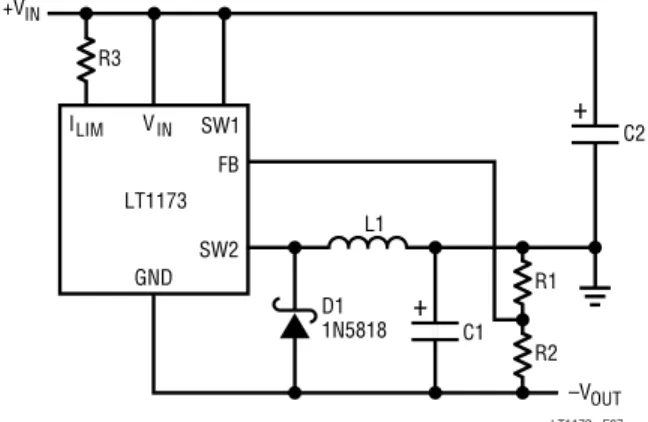
The LT1173 can be configured as a positive-to-negative converter (Figure 7), or a negative-to-positive converter (Figure 8). In Figure 7, the arrangement is very similar to a step-down, except that the high side of the feedback is referred to ground. This level shifts the output negative. As in the step-down mode, D1 must be a Schottky diode, and VOUTshould be less than 6.2V. More nega-tive output voltages can be accomodated as in the prior section.
Figure 7. Positive-to-Negative Converter
In Figure 8, the input is negative while the output is positive. In this configuration, the magnitude of the input voltage can be higher or lower than the output voltage. A level shift, provided by the PNP transistor, supplies proper polarity feedback information to the regulator.
U
S
A
PPLICATI
O
I FOR ATIO
U
W
U
LT1173 • F07 –VOUT C2 + C1 D1 1N5818 +VIN R1 R2 L1 GND SW2 SW1 LIM I VIN R3 FB LT1173 +
10
L1 LT1173 • TA13 GND SW2 FB SW1 LIM I VIN D1 AO +VOUT R2 V = 1.245V + 0.6V OUT R1 R2( )
R1 2N3906 –VIN + C1 LT1173 + C2Figure 8. Negative-to-Positive Converter
Using the ILIM Pin
The LT1173 switch can be programmed to turn off at a set switch current, a feature not found on competing devices. This enables the input to vary over a wide range without exceeding the maximum switch rating or saturating the inductor. Consider the case where analysis shows the LT1173 must operate at an 800mA peak switch current with a 2.0V input. If VIN rises to 4V, the peak switch current will rise to 1.6A, exceeding the maximum switch current rating. With the proper resistor selected (see the “Maxi-mum SwitchCurrent vs RLIM” characteristic), the switch current will be limited to 800mA, even if the input voltage increases.
Another situation where the ILIM feature is useful occurs when the device goes into continuous mode operation. This occurs in step-up mode when
V V V V DC OUT DIODE I N SW + − < −
( )
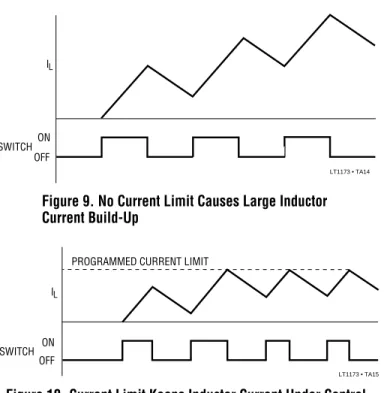
1 1 . 17When the input and output voltages satisfy this relation-ship, inductor current does not go to zero during the switch OFF time. When the switch turns on again, the current ramp starts from the non-zero current level in the inductor just prior to switch turn on. As shown in Figure 9, the inductor current increases to a high level before the comparator turns off the oscillator. This high current can cause excessive output ripple and requires oversizing the output capacitor and inductor. With the ILIM feature, however, the switch current turns off at a programmed level as shown in Figure 10, keeping output ripple to a minimum.
U
S
A
PPLICATI
O
I FOR ATIO
U
W
U
LT1173 • TA14 I OFF L ON SWITCH
Figure 9. No Current Limit Causes Large Inductor Current Build-Up LT1173 • TA15 I ON L OFF SWITCH
PROGRAMMED CURRENT LIMIT
Figure 10. Current Limit Keeps Inductor Current Under Control
Figure 11 details current limit circuitry. Sense transistor Q1, whose base and emitter are paralleled with power switch Q2, is ratioed such that approximately 0.5% of Q2’s collector current flows in Q1’s collector. This current is passed through internal 80Ω resistor R1 and out through the ILIM pin. The value of the external resistor connected between ILIM and VIN sets the current limit. When suffi-cient switch current flows to develop a VBE across R1 + RLIM, Q3 turns on and injects current into the oscillator, turning off the switch. Delay through this circuitry is approximately 2µs. The current trip point becomes less accurate for switch ON times less than 4µs. Resistor values programming switch ON time for 2µs or less will cause spurious response in the switch circuitry although the device will still maintain output regulation.
LT1173 • TA28 SW2 SW1 Q2 DRIVER OSCILLATOR VIN ILIM R1 80Ω (INTERNAL) RLIM (EXTERNAL) Q1 Q3
11
U
S
A
PPLICATI
O
I FOR ATIO
U
W
U
Using the Gain Block
The gain block (GB) on the LT1173 can be used as an error amplifier, low battery detector or linear post regulator. The gain block itself is a very simple PNP input op amp with an open collector NPN output. The negative input of the gain block is tied internally to the 1.245V reference. The posi-tive input comes out on the SET pin.
Arrangement of the gain block as a low battery detector is straightforward. Figure 12 shows hookup. R1 and R2 need only be low enough in value so that the bias current of the SET input does not cause large errors. 100kΩ for R2 is adequate. R3 can be added to introduce a small amount of hysteresis. This will cause the gain block to “snap” when the trip point is reached. Values in the 1M-10M range are optimal. The addition of R3 will change the trip point, however.
Table 1. Component Selection for Common Converters
INPUT OUTPUT OUTPUT CIRCUIT INDUCTOR INDUCTOR CAPACITOR
VOLTAGE VOLTAGE CURRENT (MIN) FIGURE VALUE PART NUMBER VALUE NOTES
2.0-3.1 5 90mA 5 47µH G GA10-472K, C CTX50-1 100µF * 2.0-3.1 5 10mA 5 220µH G GA10-223K, C CTX 22µF 2.0-3.1 12 50mA 5 47µH G GA10-472K, C CTX50-1 47µF * 2.0-3.1 12 10mA 5 150µH G GA10-153K 22µF 5 12 90mA 5 120µH G GA10-123K 100µF 5 12 30mA 5 150µH G GA10-153K 47µF ** 5 15 50mA 5 120µH G GA10-123K C CTX100-4 47µF 5 30 25mA 5 100µH G GA10-103K, C CTX100-4 10µF, 50V 6.5-9.5 5 50mA 6 47µH G GA10-472K, C CTX50-1 100µF ** 12-20 5 300mA 6 220µH G GA20-223K 220µF ** 20-30 5 300mA 6 470µH G GA20-473K 470µF ** 5 –5 75mA 7 100µH G GA10-103K, C CTX100-4 100µF ** 12 –5 250mA 7 470µH G GA40-473K 220µF ** –5 5 150mA 8 100µH G GA10-103K, C CTX100-4 220µF –5 12 75mA 8 100µH G GA10-103K, C CTX100-4 47µF G = Gowanda C = Coiltronics
* Add 68Ω from ILIM to VIN ** Add 100Ω from ILIM to VIN
LT1173 • TA16 VBAT R1 R2 1.245V REF SET GND IN V LT1173 100k +5V TO PROCESSOR R1 = VLB – 1.245V 11.7µA VLB + – AO R3
= BATTERY TRIP POINT R2 = 100kΩ
R3 = 4.7MΩ
12
U
S
A
PPLICATI
O
I FOR ATIO
U
W
U
Table 2. Inductor Manufacturers
MANUFACTURER PART NUMBERS
Gowanda Electronics Corporation GA10 Series
1 Industrial Place GA40 Series
Gowanda, NY 14070 716-532-2234
Caddell-Burns 7300 Series
258 East Second Street 6860 Series Mineola, NY 11501
516-746-2310
Coiltronics International Custom Toroids
984 S.W. 13th Court Surface Mount
Pompano Beach, FL 33069 305-781-8900
Renco Electronics Incorporated RL1283 60 Jefryn Boulevard, East RL1284 Deer Park, NY 11729
800-645-5828
Table 3. Capacitor Manufacturers
MANUFACTURER PART NUMBERS
Sanyo Video Components OS-CON Series 2001 Sanyo Avenue
San Diego, CA 92173 619-661-6835
Nichicon America Corporation PL Series 927 East State Parkway
Schaumberg, IL 60173 708-843-7500
Sprague Electric Company 150D Solid Tantalums
Lower Main Street 550D Tantalex
Sanford, ME 04073 207-324-4140 IN V SW2 SW1 LT1173 • TA19 LIM I GND R1 100Ω LT1173 1N5818 4.7µF L1* 100µH + –22V OUTPUT 7mA AT 2.0V INPUT 70% EFFICIENCY * L1 = GOWANDA GA10-103K COILTRONICS CTX100-4 FOR 5V INPUT CHANGE R1 TO 47Ω. CONVERTER WILL DELIVER –22V AT 40mA. 2 X 1.5V CELLS 3V FB 1N5818 22µF + 220k 0.1µF 1N4148 118k 1% 2.21M 1%
U
S
A
PPLICATI
O
TYPICAL
3V to –22V LCD Bias Generator13
U
S
A
PPLICATI
O
TYPICAL
Telecom Supply+5V to –5V Converter +20V to 5V Step-Down Converter
IN V SW2 SW1 LT1173 • TA20 LIM I SENSE GND 100 LT1173-5 1N5818 100 Fµ L1* 100µH Ω + –5V OUTPUT 75mA 22µF + +VIN 5V INPUT * L1 = GOWANDA GA10-103K COILTRONICS CTX100-1 IN V SW2 SW1 LT1173 • TA21 LIM I SENSE GND 100 LT1173-5 1N5818 100 Fµ L1* 220µH Ω + 5V OUTPUT 300mA * L1 = GOWANDA GA20-223K +VIN 12V-28V 3V to 5V Step-Up Converter IN V SW2 SW1 LT1173 • TA17 LIM I SENSE GND 2 X 1.5V CELLS LT1173-5 1N5818 5V OUTPUT 150mA AT 3V INPUT 60mA AT 2V INPUT 100 Fµ * L1 = GOWANDA GA10-103K
COILTRONICS CTX100-1 (SURFACE MOUNT) L1* 100 Hµ + 9V to 5V Step-Down Converter IN V SW2 SW1 LT1173 • TA18 LIM I SENSE GND 100 9V BATTERY LT1173-5 1N5818 100 Fµ L1* 47µH Ω + 5V OUTPUT 150mA AT 9V INPUT 50mA AT 6.5V INPUT * L1 = GOWANDA GA10-472K COILTRONICS CTX50-1
FOR HIGHER OUTPUT CURRENTS SEE LT1073 DATASHEET
LIM I FB GND LT1173 IRF530 1N4148 + 10µF 16V VN2222 1N965B 10nF 10k 3.6MΩ + 47µF 100V 390kΩ + 220µF 10V 44mH 44mH 48V DC *L1 = CTX110077 + – ~ ~ L1* 500µH MUR110 +5V 100mA 2N5400 LT1173 • TA22 IN V SW1 SW2 110kΩ 15V 12V 100Ω IQ = 120µA
14
U
S
A
PPLICATI
O
TYPICAL
“5 to 5” Step-Up or Step-Down Converter
2V to 5V at 300mA Step-Up Converter with Under Voltage Lockout
LIM I FB GND LT1173 + 56Ω 470µF L1* 100µH +5V OUTPUT LT1173 • TA23 470k 75k 240Ω 24k + 470µF 1N5818 SI9405DY 4 X NICAD OR ALKALINE CELLS 5 7 SET AO 4 8 6 3 2 1 *L1 = COILTRONICS CTX100-4 GOWANDA GA20-103K + 470µF IN V SW2 SW1 VOUT = 5V AT 100mA VIN = 2.6V TO 7.2V LIM I FB GND LT1173 100k L1* 20µH, 5A +5V OUTPUT 300mA LOCKOUT AT 1.85V INPUT LT1173 • TA24 5Ω 47Ω 100µF OS-CON 2 X NICAD SET AO *L1 = COILTRONICS CTX-20-5-52 100 100k 2.2M 47k 100k 100k† 301k† 220 MJE200 1N5820 + IN V SW2 SW1 2N4403 2N3906 †1% METAL FILM
15
U
S
A
PPLICATI
O
TYPICAL
Information furnished by Linear Technology Corporation is believed to be accurate and reliable. However, no responsibility is assumed for its use. Linear Technology Corporation makes no represen-tation that the interconnection of its circuits as described herein will not infringe on existing patent rights.
Voltage Controlled Positive-to-Negative Converter
LT1173 • TA25 FB GND 220 LT1173 * L1 = GOWANDA GT10-101 VIN 5V-12V 1N5818 150 L1* 50µH, 2.5A – + IN V LT1006 + 100µF 39k 200k –VOUT = –5.13 • VC 2W MAXIMUM OUTPUT VC (0V TO 5V) 0.22 1N5820 IN V SW2 SW1 LIM I MJE210 LT1173 • TA27 LIM I FB GND LT1173 *TOKO 262LYF-0100K L1* 470µH 0.02µF NE-2 BLINKS AT 0.5Hz 1N4148 1.3M 100M IN V SW1 SW2 0.02µF 0.68µF 200V 3.3M 95V REGULATED 1N4148 3V 0.02µF 1N4148
2 Cell Powered Neon Light Flasher
High Power, Low Quiescent Current Step-Down Converter
LT1173 • TA26 LIM I FB GND LT1173
EFFICIENCY ≥ 80% FOR 10mA ≤ ILOAD≤ 500mA
STANDBY IQ≤ 150µA VIN 7V-24V 1N5818 L1* 25µH, 2A + 470µF 5V 500mA 0.22Ω 51Ω 18V 1W 2k 1N4148 40.2k 121k OPERATE STANDBY IN V SW1 SW2 MTM20P08 2N3904 1N5820 * L1 = GOWANDA GT10-100 100Ω 1/2W
16
Linear Technology Corporation
1630 McCarthy Blvd., Milpitas, CA 95035-7487 (408) 432-1900● FAX: (408) 434-0507●TELEX: 499-3977LT/GP 0894 2K REV B • PRINTED IN USA
U
PACKAGE DESCRIPTIO
Dimensions in inches (milimeters) unless otherwise noted. N8 Package8-Lead Plastic DIP
S8 Package 8-Lead Plastic SOIC
N8 0694 0.045 ± 0.015 (1.143 ± 0.381) 0.100 ± 0.010 (2.540 ± 0.254) 0.065 (1.651) TYP 0.045 – 0.065 (1.143 – 1.651) 0.130 ± 0.005 (3.302 ± 0.127) 0.015 (0.380) MIN 0.018 ± 0.003 (0.457 ± 0.076) 0.125 (3.175) MIN 1 2 3 4 8 7 6 5 0.255 ± 0.015* (6.477 ± 0.381) 0.400* (10.160) MAX 0.009 – 0.015 (0.229 – 0.381) 0.300 – 0.325 (7.620 – 8.255) 0.325+0.025–0.015 +0.635 –0.381 8.255
(
)
*THESE DIMENSIONS DO NOT INCLUDE MOLD FLASH OR PROTRUSIONS. MOLD FLASH OR PROTURSIONS SHALL NOT EXCEED 0.010 INCH (0.254mm).
1 2 3 4 0.150 – 0.157* (3.810 – 3.988) 8 7 6 5 0.189 – 0.197* (4.801 – 5.004) 0.228 – 0.244 (5.791 – 6.197) 0.016 – 0.050 0.406 – 1.270 0.010 – 0.020 (0.254 – 0.508)× 45° 0°– 8° TYP 0.008 – 0.010 (0.203 – 0.254) SO8 0294 0.053 – 0.069 (1.346 – 1.752) 0.014 – 0.019 (0.355 – 0.483) 0.004 – 0.010 (0.101 – 0.254) 0.050 (1.270) BSC *THESE DIMENSIONS DO NOT INCLUDE MOLD FLASH OR PROTRUSIONS.
MOLD FLASH OR PROTRUSIONS SHALL NOT EXCEED 0.006 INCH (0.15mm).