Improving Project Governance
By Phil Mann
31 October 2012
Overview
This whitepaper provides a synopsis of the Victorian Government’s Ombudsman’s Own motion investigation into ICT-enabled projects, November 2011.
This Whitepaper references the Ombudsman’s Own motion investigation into ICT-enabled projects, November 2011, report, which is available on the following link: http://www.ombudsman.vic.gov.au/resources/documents/In vestigation_into_ICT_enabled_projects_Nov_2011.pdf Covered in this paper is an explanation of “what” is project governance and “how” governance relates to the 5 themes identified in the ombudsman’s, above mentioned report. The paper includes a “120 second health check” for Project Sponsors to identify if their project needs help to get back on track.
Author
Phil Mann is a Senior Consultant with Core Consulting Group, specialising in project rectification. His 30 years of project management experience includes, Project Engineering, General Management as well as Project Management roles, Portfolio General Manager and Project Management Consultant. These roles include expertise in organisational governance compliance in particular.
Phillip also has extensive lecturing experience in project management and business at RMIT, Swinburne, Victoria University and Ascet TAFE.
Introduction
The term “Project Governance” is often misunderstood. With the development of project management as a distinct management discipline and subsequently the development of Portfolio, Program and Project Management, the concept of Project Governance is often mentioned as a criticism of many a project’s management.
This has become evident in the Victorian Government Project Management Sector as a result of the 2011 Victorian Ombudsman’s “Own motion investigation into ICT-enabled projects of November 2011”1 which found Project Governance as one of the main recurring problems. The Ombudsman has raised interest within the state government in how projects are managed, particularly with the current State Governments focus on cost reduction and value. In effect the Ombudsman’s report will lead project management personnel into a new phase of project management accountability within the State Government.
The Ombudsman identified 5 common themes, they are:
1. Leadership, accountability and governance 2. Planning
3. Funding
4. Probity and procurement 5. Project management
It is the author’s opinion, based on many years of project rectification experience, that similar results would be generated if the same scrutiny was applied to many corporate organisations’ projects.
So what is Governance?
Professor Ralf Muller from PM Concepts2, Sweden is a noted researcher on project governance. In his book “Project Governance” he answers the “so what is Governance” question.
“Governance provides a framework for ethical decision making and managerial action within an organisation that is based on transparency,
1 Victorian Ombudsman’s Own motion investigation into ICT-enabled projects, November 2011
2 PM Concepts AB, Sjöbogatan 10, 21228 Malmö, Sweden: www.pm-concepts.com
accountability and defined roles. It also provides a clear distinction between ownership and control of tasks. It sets the boundaries for management action, by defining the goals of the organisation and the means by which they should be attained, as well as the processes that managers should use to run their areas of responsibility.”
In this book Muller also addresses the failure of projects with poor or missing governance structures as;
“Without a governance structure, an organisation runs the risk of conflicts and inconsistencies between the various means of achieving organisational goals, the processes and resources, thereby causing costly inefficiencies that impact negatively on both smooth running and bottom line profitability.”3
Often “Governance” is misunderstood to be compliance with Governance systems such as Finance. Governance is a holistic notion of which compliance is only one part. Governance includes the policies, procedures and culture that allow an organisation to achieve the desired results.
In this article I will try to expand the main points of Muller’s quote and direct the application in regard to the 5 common themes, as identified by the Victorian Ombudsman.
1. Leadership, accountability and governance In the Vic Ombudsman’s report paragraph 18, page 5 the following comment defines the lack of accountability and leadership which contributes to poor governance practices;
“Too often, there was muted acceptance that all ICT-enabled projects go wrong; responsibilities were so diffused that it was difficult to identify who was accountable; or there was a tendency to blame those previously involved. Leadership from the top is required if this is to change.”
The Office of Government Commerce-UK (OGC-UK, now Office of Cabinet UK) developed PRINCE2 with a specific intention to resolve these issues.
The Office of Cabinet (UK) PRINCE2 materials have defined seven principles relating to governance within projects.
3 Project Governance, Ralf Muller Gower, Publishing Limited, Surrey, England 2009.
Page 3 of 9
“PRINCE2’s seven principles are that a project must: 1. Have continued business justification
(business justification principle)
2. Learn from previous experience: lessons are sought, recorded and acted upon throughout the life of the project (learning from experience principle)
3. Have defined and agreed roles and responsibilities within an organization structure that engages the business, user and supplier stakeholder interests (defined roles and responsibilities principle)
4. Be planned, monitored and controlled on a stage-by-stage basis (manage by stages principle)
5. Have defined tolerances for each project objective to establish limits of delegated authority (management by exception principle)
6. Focus on the definition and delivery of products, in particular their quality requirements (focus on products principle) 7. Be tailored to suit the project’s
environment, size, complexity, importance, capability and risk (tailoring principle).
Using PRINCE2 in accordance with its seven principles will provide a basis of good project governance.”4
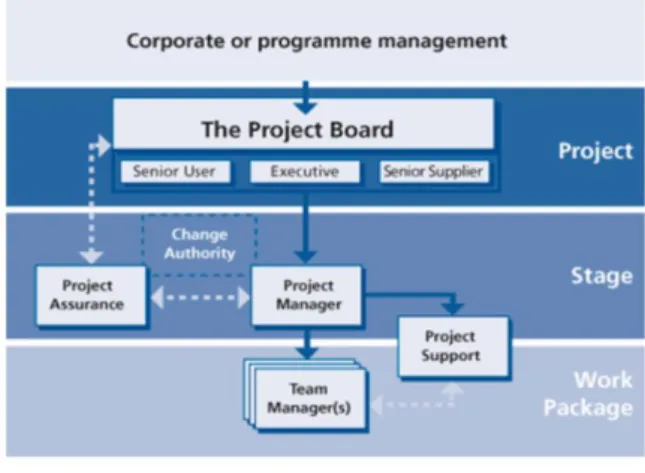
If we review the third principle of Defined roles and responsibilities, there are four levels of responsibility of;
Those responsible for commissioning the Project
Those responsible for setting direction.
Those responsible for the day-to-day management of the Project.
Those responsible for producing the project’s deliverables (products).
4
PRINCE2® and governance Whitepaper, Andy Murray,
The Stationary Office, UK, 2011 Figure. 1 Levels of Responsibilities and Examples
Those responsible for commissioning the Project
If we understand those who are responsible for commissioning the project sit outside the project, typically in an investment management role, the project “Directing Level” is typically the Project Board.
This level “Owns” the investment as detailed in the Business Case. The Business Case is a document that details the benefits of the investment and the cost of the investment. As such, Business Cases should also be updated and reviewed by the “Commissioning” body for ongoing acceptance. An updated Business Case reflects change in the project.
Those responsible for setting direction
The Project Board, or commonly known in some projects in Australia as the Steering Committee is the “Directing” body of the Project.
“The terms ‘steering committee’ and ‘project board’ are used interchangeably, but both refer to a governing body. I have used the term ‘steering committee’ throughout this report.”5
The term “Steering Committee” seems to be confusing to some organisations and in particular some members of these Steering Committees. This is reflected as one of the Key Issues of the Ombudsman’s report.
5 Footnote “2’ Page 5, Ombudsman’s investigation into ICT-enabled projects
“Many of the project steering committees did not have the requisite expertise.”6
This has resulted in ineffective governance of projects and lack of decision making within projects.
“Senior officers appeared reluctant to make critical decisions about projects.”7
This has resulted in the recommendation of the Ombudsman’s “Framework to better manage ICT-enabled projects” to state:
“Agency executives are to show stronger leadership; robust governance practices are to be implemented; and project staff are to be held to account for the performance of ICT-enabled projects.”8
How do we improve leadership, accountability and governance?
In the Cabinet Office’s “Best Practice” documents, a Project Board made up of 3 representatives is optimum. Figure 2 represents this model. Central to this theme is the fact that one of the three is deemed as the person responsible for the project success. While the technical term for this is the “Senior Responsible Owner”, this role is often known by a range of names such as Project Executive, Project Sponsor, and Steering Committee Chair.
This role’s accountability is to ensure project success. While a detailed discussion can be held about the notion of project success, we also need to consider the notion of Project Management success. In brief, project success is about delivering the investment as authorised by the investment decision makers. Project Management success is about ensuring the project is delivered as planned in the project management planning. This is what Muller is alluding to in his reference of “a clear distinction between ownership and control of tasks”.
6 Page 5 Ombudsman’s investigation into ICT-enabled projects
7 Key Issues Page 5Ombudsman’s investigation into ICT-enabled projects
8 Framework to better manage ICT-enabled projects, Page 8Ombudsman’s investigation into ICT-enabled projects
Page 5 of 9
“Having a well-functioning steering committee (the committee) is integral to the success of a project and should include a committee chairperson who is ultimately responsible for the project with the advice of the committee. The committee must have people with relevant experience to provide advice.”9 Some Steering Committees have become stakeholder representative or consultation groups which try to guide the project. This is counter intuitive to the notion of the Project Board, which is made up of the Senior Responsible Office (Project Sponsor), Senior User (Representative of the stakeholders who will use the deliverables of the project) and Senior Supplier (representative of the stakeholders providing the deliverables) who direct the project.
This often results in ineffective project management as the controlling body is conflicted between stakeholder interests and management requirements.
9 Page 18, Ombudsman’s investigation into ICT-enabled projects
2. Planning
The Planning of projects is part of the integrated Portfolio, Program and Project development that starts with strategy and business planning.
This Whitepaper will only deal with the planning in respect to Projects. A separate Whitepaper in this series from Core Consulting Group is currently being written dealing with Portfolio, Program and Project planning as an integrated process.
Project Management Plan
If the Project Manager controls the management of tasks for the project, who authorises the tasks? Planning results in the scheduling of tasks according to project authorisation. Typically Planning shows the thought process behind the plan by the depth the planning goes into. In the author’s opinion, a project that lacks planning artefacts is feared to have little thought invested in the delivery of project. In best practice, a detailed Project
Management Plan (PMBOK) or Project Initiation Figure 3. Integrated Portfolio, Program and Project Development
Document (PRINCE2) is presented to the Project Executive for authorisation. This Project Management Plan includes controls such as the schedule, Risk log and Cost model. Through Base-lining the plan, the Project team, represented by the Project Manager commits to their plan. It is now the Project Manager’s responsibility to manage according to this plan. It is a critical fundamental for business executives to hold the stance that the Project Management Plan is the authority for the Project Manager to act. Those decisions outside the Scope of this Plan or deviations from this plan are not the Project Manager’s responsibility to accept.
This fundamental understanding about the difference in responsibilities between the Project Executive and the Project Manager will reduce many project governance issues.
Planning Standards
The adage of “Failing to Plan is a plan for failure”
could have been written for project management. This raises another key issue. To what standard do we conduct planning? Martin Vaughan of Core Consulting Group, in his white paper on “Lamenting the loss of Planning/Scheduling skills”10, discusses the standards (or lack of) within the industry. As scheduling is only one part of the Project Plan, we can expand this concept, of the need for standards, into all aspects of the Project Plan.
Referring to Muller again, “Without a governance structure, an organisation runs the risk of conflicts and inconsistencies between the various means of achieving organisational goals, the processes and resources, thereby causing costly inefficiencies that impact negatively on both smooth running and bottom line profitability”
This can be reflected upon the concept of Governance and is related to Muller’s comments of “It sets the boundaries for management action, by defining the goals of the organisation and the means by which they should be attained, as well as the processes that managers should use to run their areas of responsibility”
10 Lamenting the loss of Planning/Scheduling skills, Vaughan, Core Consulting White Paper, Melb., Australia, 2009
In short we need to apply planning methodology to best practice standards, have the Plan authorised by the Project Executive and then monitor it during delivery.
In the author’s opinion, many Enterprise Project Management Offices (EPMOs), which have responsibility for organisational methodology, do not detail the standards or acceptance criteria for Planning. A recent study into State funded Construction Projects identified the issue that lack of organisational governance was resolved by employing contract Project Managers in the hope they will bring the necessary governance procedures in particular, Project Organisational governance and Project Management methodology.
“It seems to be industry accepted behaviour that appointing a “Project Manager” will bring the necessary knowledge to ensure compliant project governance.” Commander Mick Coombes, Personal conversation, May 2012.11
If an essential part of our governance requirements is responsibility for compliance to set standards, then project planning that does not relate to the organisations standards can be perceived as poor governance. To resolve this, acceptable standards of planning need to be determined pre-project and compliance with these requirements assessed throughout the project.
Industry Project Management Standards
The main 2 Project Management standards are considered to be, the USA Project Management Institute (PMI) which publishes the ANSI Standard a Guide to the Project Management Body of Knowledge (PMBOK Guide). Currently in its 4th edition, this is a standard for many project management organisations. Also used in over 40 countries is the Cabinet Office (UK) suite of standards, including PRINCE2. While both these published standards are excellent basis for a governance system, both the standards need organisational contextualisation. This is a more complex issue than using a mature system.
11 MFB Commander Michael Coombes, personal conversation, May 2012
Page 7 of 9
Change Management
One area that the Ombudsman has not discussed in depth in Project Management is that Change Control needs to be better managed. By definition Change Control, specifically scope and budget, includes the approval of requested changes and reflecting them through a revised Business Case. The Ombudsman found that;
“Business cases for many of the projects were not updated throughout the life of the projects. In some cases, they were not read by key people.”12
Updating of Business Cases should occur when there has been a change to the Business Case principles. As such best practice dictates that Change Management is part of this process and in most cases the warning that change to the business case is occurring.
Developments in the Victorian State Government
A Department of Treasury and Finance Draft Standard, Project Governance, was released in June 2012.
This standard is a start in the defining of Project Governance and Steering Committee requirements for leadership, accountability and governance. It is a colloquialised standard based on PRINCE2.
Funding
The issue of funding is a reflection of the poor organisational governance applied in the Portfolio Planning and Investment phases. Having to extend funding to projects is always a Risk, if the standards for the development of Investment analysis are suspect, or the standards for the planning of the project execution are not mature.
The Victorian Government has invested significantly in the Department of Treasury and Finance’s (DTF) Investment Management Standard. This standard details the requirements for a project to justify the investment and receive funding. What this doesn’t do is account for “optimism bias” in the project proposer’s eyes. If the project is costed with the aim of being approved through an Investment Management process, then a shortfall in funding is
12 Key Issues, Page 22,Ombudsman’s investigation into ICT-enabled projects.
always a Risk. Significant research and the introduction of project costing standards within the USA military has been conducted to resolve these types of issues.
Part of DTF’s approach includes the Gateway Review team, an independent review of State Government projects funded from DTF at various key decision gates on High Risk and High Value projects. It is felt by many that the small investment by DTF in funding the team provides benefits far outweighing its cost, particularly with the culture of maximising success rather than being critical. One of the key questions asked by Gateway Review teams is in respect to Governance, the other is Probity.
3. Probity and procurement
Probity and procurement are related issues for all organisations, particularly Government. Mature organisations apply their standard company probity and procurement policies contextualised for the project procurement. Part of good governance, relating to procurement policies is that staff are trained to recognise when to use these policies and procedures. Less mature organisations can have issues in either the governance requirements or in the area of compliance with the expected governance requirements.
The Ombudsman in his report identifies;
Agencies appeared to pay limited regard and expended minimal funds on probity advice and audit.
Agency and probity practitioner responses to conflict of interest sometimes failed to recognise the importance of the perception of a conflict of interest. – Key Issues, Page 4, Ombudsman’s investigation into ICT-enabled projects
This shows a lack of procurement process maturity in dealing with probity issues. Either a probity standard has not been used or the probity audit was not conducted.
Again this is the issue of Muller’s statement “It sets the boundaries for management action, by defining the goals of the organisation and the means by which they should be attained, as well as the processes that managers should use to run their areas of responsibility”
4. Project Management
The State Government lacks a “Whole of Government” approach to Project Management methodology. Many departments have hybrid Project Management frameworks and lack of consistency in Project Management framework appears to be an influence here.
The other reference here is that there is a lack of suitably qualified and experienced Project Managers undertaking projects that were reviewed by the Ombudsman.
“There is a shortage of skilled senior project managers with relevant ICT experience in government. To compensate, agencies often appoint expensive contractors or inexperienced public sector staff.” - Key Issues, Page 4, Ombudsman’s investigation into ICT-enabled projects
Effective Project Management is a mixture of; 1. Experienced personnel
2. Qualified personnel
3. Supporting Project Management framework
4. Organisational policies for governance of projects
While projects can tolerate a mixture of influence on any of these four points, a significant deficit in any of these points will result in an increased risk to the successful delivery of the project.
To many less experienced personnel working on projects, following project management requirements is perceived as “compliance”. These personnel do not value the strategy behind the project management “Tools” and treat the tools as “Bureaucracy” rather than analytical tools for managing projects.
Muller’s comment of “Governance provides a framework for ethical decision making and managerial action within an organisation that is based on transparency, accountability and defined roles” implies that the necessary framework compliance must be completed to ensure good governance. Hence not only should the governance tools be used, they must be used correctly showing the thought process in the tool by the depth of the tool’s detail.
Compliance to Governance Requirements
A significant issue with governance compliance occurs when the governance standards within the project are not defined and are not measured for compliance to.
It would appear that many projects, as evaluated by the Ombudsman, fail in the setting of project governance standards, let alone compliance. The resolution to this is to ensure that;
1. The Project Executive (Sponsor) ensures correct project governance is set, in accordance with the organisational requirements for governance, prior to the commencement of the project.
2. A compliance program is set pre project and compliance to this program is maintained and reported to the Project Executive
3. Independent Review is conducted by suitably skilled people
Conclusion
The confusion around Governance and what is governance is a main issue with ICT projects within the Victorian State Government. To resolve this, Leadership which promotes accountability and compliance to governance requirements is needed. Governance needs to be recognised as the policies and procedures to create a successful environment that will foster successful project management. This can be simply explained as;
The right people in the required roles with defined standards of management with compliance to these requirements maintained.
So, if your project has symptoms similar to those mentioned above such as:
Poor planning or inadequate reporting
Inefficient or ineffective Steering Committees
Funding issues
Low Project Management maturity
Lack of governance standards
Then your project may need help! Try a quick review based on the following questions.
Page 9 of 9 Attachment 1 – Questions you could ask relating
to Governance Leadership
1. Does your project have an “up to date” Organisational Chart?
2. Does the Organisational Chart specify a single line of decision making?
3. Is someone genuinely responsible for the outcome of the project?
4. Is that person providing leadership? Accountability
1. Do all the roles in the Organisational Chart have role descriptions with clear areas of responsibility?
2. Have all personnel appointed to these positions accepted and agreed to these requirements?
3. Has there been an evaluation of the capability and capacity of the individuals to fulfil those requirements?
Governance
1. Is a Project Board (or equivalent) in place? 2. Are there established policies and
procedures for the project to be managed by?
3. Has compliance to these policies and procedures been evaluated?
4. Are decision makers fully informed on plans, progress and risks?
5. Are proposed changes to plans documented and authorised?
6. Are the right people making the “should we” decisions?
Planning
1. Is there an agreed and authorised Project Management Plan (or equivalent)?
2. Has the project planning been conducted according to established and accepted standards?
3. Is there an “updated” Risk management Plan? Does it include all the known risks?
4. Is there a Baseline Gantt chart of scheduled tasks? Does it reflect the expected dates of key milestones?
5. Is there an “updated” Gantt chart showing actual dates and revised forecast dates compared to that Baseline?
Funding
1. Has full funding been secured?
2. Is there adequate contingency in the budget?
3. Is there a Baseline/Budget Resource/Cost model which aligns with the Baseline schedule and funding?
4. Is there an “updated” Resource/Cost model showing actual costs and revised forecasts vs. Baseline/Budget?
Probity and procurement
1. Has a probity plan been developed in accordance with organisational standards? 2. Has a Procurement plan been developed
as part of the Planning?
3. Has the Procurement activity been conducted according to established and accepted standards?
4. Have suitably legal qualified people been consulted for complex procurement? 5. For fixed price contracts, has the
acceptance process and responsibilities been determined?
Project Management
1. Does the organisation have a published Project Management framework?
2. Has compliance to this framework been evaluated?
3. Is the Project Manager suitably experienced and qualified?
4. Are independent Project Health checks conducted?