ibm.com/redbooks
IBM
®Information Management Software
A Practical Guide to Managing Reference Data
with IBM InfoSphere Master Data Management
Reference Data Management Hub
Whei-Jen Chen John Baldwin Thomas Dunn Mike Grasselt Shabbar Hussain Dan Mandelstein Ivan Milman Erik A O’Neill Sushain Pandit Ralph Tamlyn Fenglian Xu
Gain insight into governance, process, and
security of managing reference data
Understand the RDM reference
solution architectures
Learn RDM solution
implementation
A Practical Guide to Managing Reference Data with
InfoSphere MDM Ref DM Hub
May 2013
International Technical Support Organization
First Edition (May 2013)
This edition applies to IBM InfoSphere Master Data Management Reference Data Management Hub Version 10.
Note: Before using this information and the product it supports, read the information in
© Copyright IBM Corp. 2013. All rights reserved. iii
Contents
Notices . . . vii
Trademarks . . . viii
Preface . . . ix
The team who wrote this book . . . ix
Acknowledgement . . . xvi
Now you can become a published author, too! . . . xvi
Comments welcome . . . xvii
Stay connected to IBM Redbooks . . . xvii
Chapter 1. Reference data management . . . 1
1.1 What is reference data . . . 2
1.2 Structure in reference data: Hierarchies and relationships . . . 5
1.2.1 Tree hierarchies . . . 6
1.2.2 Level-based hierarchies . . . 6
1.2.3 Poly hierarchies. . . 8
1.3 Challenges of managing reference data . . . 8
1.4 The cost of unmanaged reference data . . . 13
1.4.1 Costs related to business risk . . . 14
1.4.2 Increased IT cost. . . 15
1.4.3 Cost of business inflexibility . . . 15
1.5 Reference data governance with master data management approach. . . 15
1.6 InfoSphere MDM Ref DM Hub feature overview . . . 18
1.6.1 Key functions of the InfoSphere MDM Ref DM Hub . . . 19
1.6.2 Understanding reference data sets . . . 21
1.6.3 Understanding reference data types . . . 28
1.6.4 Mapping reference data sets. . . 30
1.6.5 Managed systems . . . 31
1.6.6 Batch export . . . 31
Chapter 2. Solution reference architecture. . . 35
2.1 Base reference architecture . . . 36
2.1.1 InfoSphere MDM Ref DM Hub . . . 37
2.1.2 InfoSphere MDM Ref DM Hub services and user interface . . . 37
2.1.3 Core reference data domain objects . . . 37
2.1.4 Supporting domain objects . . . 42
2.1.5 Supporting services. . . 43
2.1.6 Supporting Custom Domain Hub services . . . 45
2.2 Enterprise system integration . . . 45
2.2.1 InfoSphere Master Data Management . . . 45
2.2.2 MDM and SAP . . . 46
2.2.3 Taxonomy management for ECM pattern . . . 48
2.2.4 Data warehouse . . . 51
Chapter 3. Planning a RDM project . . . 53
3.1 RDM methodology overview . . . 54 3.1.1 Analyze . . . 54 3.1.2 Design . . . 56 3.1.3 Configure. . . 56 3.1.4 Deploy . . . 57 3.1.5 Operate . . . 57
3.2 Iterative implementation of InfoSphere MDM Ref DM Hub . . . 58
3.3 Business requirements . . . 60
3.4 Analysis of data . . . 62
3.4.1 Discovering reference data . . . 63
3.4.2 Transforming business roles to RDM roles . . . 63
3.5 Model design for planning . . . 66
3.6 Implementation . . . 76
Chapter 4. Requirement analysis. . . 81
4.1 Discovering reference data . . . 82
4.1.1 Data model . . . 82
4.1.2 Profiling tools. . . 82
4.1.3 Reference data is already known . . . 83
4.2 Data requirements . . . 83
4.3 Data quality . . . 88
4.4 Discovering business rules . . . 89
4.5 Use cases . . . 90
4.6 Security requirements . . . 91
4.7 Integration requirements . . . 93
4.7.1 Business process integration . . . 93
4.7.2 System integration . . . 94
4.8 Test cases . . . 95
4.8.1 Configuration testing . . . 95
4.8.2 System integration testing . . . 96
4.9 Deliverables. . . 96
Chapter 5. InfoSphere RDM model design . . . 99
5.1 InfoSphere MDM Ref DM Hub model . . . 100
5.1.1 Managed entities . . . 100
Contents v
5.2 InfoSphere MDM Ref DM Hub model design considerations . . . 106
5.2.1 Versioning and implicit versus explicit relationships . . . 106
5.2.2 Versioning strategy . . . 106
5.2.3 Versioning mapping relationships . . . 109
5.2.4 Version strategy state machines . . . 109
Chapter 6. Integration . . . 111
6.1 Data loading and import . . . 112
6.1.1 Input transformation . . . 112
6.1.2 Import interfaces . . . 113
6.2 Data distribution and export . . . 121
6.2.1 Downstream system challenges consuming reference data . . . 121
6.2.2 Export interfaces . . . 122
6.2.3 Output transformation . . . 124
6.3 Transcoding. . . 134
6.3.1 Simple transcoding . . . 135
6.3.2 Complex transcoding using multiple maps . . . 137
6.4 Attribute-level permissions . . . 138
6.5 IBM InfoSphere Information Server . . . 139
6.5.1 InfoSphere Business Glossary . . . 139
6.5.2 InfoSphere Information Analyzer. . . 143
6.5.3 Conversion workbench . . . 149
6.6 Workflow . . . 155
6.6.1 Basic workflow using lifecycle processes . . . 155
6.6.2 Advanced workflow using integration with external tooling . . . 156
6.6.3 Reference data workflow example . . . 156
Chapter 7. Implementation . . . 159
7.1 Installation . . . 160
7.1.1 Product download . . . 161
7.1.2 Installation with IBM Installation Manager . . . 161
7.1.3 InfoSphere MDM Ref DM Hub server installation . . . 163
7.1.4 RDM client installation. . . 164
7.2 Configuration . . . 165
7.2.1 Configure security and authorization. . . 165
7.2.2 Lifecycle and state machine . . . 170
7.2.3 Regular expression validation . . . 170
7.3 Implementing InfoSphere MDM Ref DM Hub model . . . 172
7.3.1 Creating reference data sets . . . 172
7.3.2 Creating mappings . . . 188
7.3.3 Distributing reference data sets . . . 200
7.3.4 Distributing mappings . . . 208
7.4.1 Notification . . . 212
7.4.2 Services . . . 219
7.4.3 Callout and user exits . . . 222
7.4.4 User interface . . . 226
Chapter 8. Operation and administration . . . 227
8.1 Managing InfoSphere MDM Ref DM Hub with multiple user groups . . . . 228
8.1.1 Initial model design for a new user group . . . 228
8.1.2 Managing ongoing changes . . . 229
8.1.3 Engaging new user groups . . . 230
8.2 New user group setup process . . . 230
8.2.1 Access control groups and roles . . . 231
8.2.2 Customized training materials for each role defined . . . 232
8.3 Reporting. . . 234
Related publications . . . 241
IBM Redbooks . . . 241
Online resources . . . 242
© Copyright IBM Corp. 2013. All rights reserved. vii
Notices
This information was developed for products and services offered in the U.S.A.
IBM may not offer the products, services, or features discussed in this document in other countries. Consult your local IBM representative for information on the products and services currently available in your area. Any reference to an IBM product, program, or service is not intended to state or imply that only that IBM product, program, or service may be used. Any functionally equivalent product, program, or service that does not infringe any IBM intellectual property right may be used instead. However, it is the user's responsibility to evaluate and verify the operation of any non-IBM product, program, or service.
IBM may have patents or pending patent applications covering subject matter described in this document. The furnishing of this document does not grant you any license to these patents. You can send license inquiries, in writing, to:
IBM Director of Licensing, IBM Corporation, North Castle Drive, Armonk, NY 10504-1785 U.S.A. The following paragraph does not apply to the United Kingdom or any other country where such provisions are inconsistent with local law: INTERNATIONAL BUSINESS MACHINES CORPORATION PROVIDES THIS PUBLICATION "AS IS" WITHOUT WARRANTY OF ANY KIND, EITHER EXPRESS OR IMPLIED, INCLUDING, BUT NOT LIMITED TO, THE IMPLIED WARRANTIES OF NON-INFRINGEMENT, MERCHANTABILITY OR FITNESS FOR A PARTICULAR PURPOSE. Some states do not allow disclaimer of express or implied warranties in certain transactions, therefore, this statement may not apply to you.
This information could include technical inaccuracies or typographical errors. Changes are periodically made to the information herein; these changes will be incorporated in new editions of the publication. IBM may make
improvements and/or changes in the product(s) and/or the program(s) described in this publication at any time without notice.
Any references in this information to non-IBM websites are provided for convenience only and do not in any manner serve as an endorsement of those websites. The materials at those websites are not part of the materials for this IBM product and use of those websites is at your own risk.
IBM may use or distribute any of the information you supply in any way it believes appropriate without incurring any obligation to you.
Any performance data contained herein was determined in a controlled environment. Therefore, the results obtained in other operating environments may vary significantly. Some measurements may have been made on development-level systems and there is no guarantee that these measurements will be the same on generally available systems. Furthermore, some measurements may have been estimated through extrapolation. Actual results may vary. Users of this document should verify the applicable data for their specific environment. Information concerning non-IBM products was obtained from the suppliers of those products, their published announcements or other publicly available sources. IBM has not tested those products and cannot confirm the accuracy of performance, compatibility or any other claims related to non-IBM products. Questions on the capabilities of non-IBM products should be addressed to the suppliers of those products.
This information contains examples of data and reports used in daily business operations. To illustrate them as completely as possible, the examples include the names of individuals, companies, brands, and products. All of these names are fictitious and any similarity to the names and addresses used by an actual business enterprise is entirely coincidental.
COPYRIGHT LICENSE:
This information contains sample application programs in source language, which illustrate programming techniques on various operating platforms. You may copy, modify, and distribute these sample programs in any form without payment to IBM, for the purposes of developing, using, marketing or distributing application programs conforming to the application programming interface for the operating platform for which the sample programs are written. These examples have not been thoroughly tested under all conditions. IBM, therefore, cannot guarantee or imply reliability, serviceability, or function of these programs. You may copy, modify, and distribute these sample programs in any form without payment to IBM for the purposes of developing, using, marketing, or distributing application programs conforming to IBM's application programming interfaces.
Trademarks
IBM, the IBM logo, and ibm.com are trademarks or registered trademarks of International Business Machines Corporation in the United States, other countries, or both. These and other IBM trademarked terms are marked on their first occurrence in this information with the appropriate symbol (® or ™), indicating US registered or common law trademarks owned by IBM at the time this information was
published. Such trademarks may also be registered or common law trademarks in other countries. A current list of IBM trademarks is available on the Web at http://www.ibm.com/legal/copytrade.shtml
The following terms are trademarks of the International Business Machines Corporation in the United States, other countries, or both:
DataStage® DB2®
developerWorks®
Global Business Services® IA® IBM® InfoSphere® Passport Advantage® Rational® Redbooks® Redbooks (logo) ® Tivoli® WebSphere®
The following terms are trademarks of other companies:
Microsoft, Windows, and the Windows logo are trademarks of Microsoft Corporation in the United States, other countries, or both.
Java, and all Java-based trademarks and logos are trademarks or registered trademarks of Oracle and/or its affiliates.
UNIX is a registered trademark of The Open Group in the United States and other countries. Other company, product, or service names may be trademarks or service marks of others.
© Copyright IBM Corp. 2013. All rights reserved. ix
Preface
Reference data is a key aspect of any application integration. Today, many enterprises have no centralized enterprise governance and management over reference data. Reference data variations and inconsistencies can be a major source of data quality issues within the enterprise and cause business losses through system downtime, incorrect transactions, and incorrect reports. IBM® InfoSphere® Master Data Management Reference Data Management Hub (InfoSphere MDM Ref DM Hub) is designed as a ready-to-run application that provides the governance, process, security and audit control for managing reference data as an enterprise standard, resulting in fewer errors, reduced business risk and cost savings.
This IBM Redbooks® publication describes where InfoSphere MDM Ref DM Hub fits into information management reference architecture. It explains the
end-to-end process of an InfoSphere MDM Ref DM Hub implementation including the considerations of planning a reference data management project, requirements gathering and analysis, model design details, and integration considerations and scenarios. It shows implementation examples and the ongoing administration tasks.
This book can help IT professionals who are interested or have a need to manage reference data efficiently and implement an InfoSphere MDM Ref DM Hub solution with ease.
The team who wrote this book
This book was produced by a team of specialists from around the world working at the International Technical Support Organization, Austin Center.
Whei-Jen Chen is a Project Leader at the International Technical Support
Organization, San Jose Center. She has extensive experience in application development, database design and modeling, and IBM DB2® system administration. Whei-Jen is an IBM Certified Solutions Expert in Database Administration and Application Development, and an IBM Certified IT Specialist.
John Baldwin has over 20 years of experience in
data modelling and database design. Since 2007, John has worked for the IBM Software Group in the UK and in the worldwide MDM Centre of Excellence. As a Solution Architect, he has implemented many Master Data Management and Reference Data Management solutions, principally in the banking and insurance sectors. He has created and contributed to best practices pertaining to MDM and to creating an MDM implementation methodology within IBM frameworks.
Before joining IBM, he worked in the
Transportation and Logistics sector designing and managing real-time messaging systems and tracking systems; in the Broadcast Media sector building systems for capturing programming metadata; and in the Public sector designing and building screen-based examination systems and configuring and implementing accounting and payroll packages.
Thomas Dunn is an IT Architect in the IBM CIO
office focused on enterprise content and taxonomy management solutions. He has been with IBM for 17 years. Most of that time has been spent designing and developing web content
management systems and supporting product master data management tools. These systems deliver much of www.ibm.com marketing content and the master data is used by product
development, sales, and support sites. For the last two years, he focused on developing processes and tools that improve management of taxonomies that are used to tag content. This solution has InfoSphere MDM Ref DM Hub as a core component and uses other software in the InfoSphere MDM family. Tom graduated from Rutgers University with a degree in technical theater.
Preface xi Mike Grasselt is a Senior Software Engineer in
the IBM Information Management Development organization in Germany. Mike is currently the Architect and Team Lead for various assets that support data integration tasks for large SAP migrations and consolidation projects. Prior to this role, he was responsible for integrating IBM Master Data Management products into SAP system landscapes and for integrating InfoSphere Information Server with IBM WebSphere® Portal, IBM Business Process Manager, and InfoSphere MDM Server in the context of a broader
service-oriented architecture effort. Mike also developed an SQL extension for the Business Processes Execution Language (BPEL) and published several papers about data-aware business processes and web services. He has integrated text analysis technology with content management systems and was an author of an IBM Redbooks publication on this topic. Mike collaborates with several universities in Germany to define integration architectures, and gives lectures on IBM mainframe concepts. In addition to his technical responsibilities, he is a mentor in the IBM technical community.
Shabbar Hussain is an MDM Business Architect
with IBM Software Lab Services, based in Toronto, Canada and member of a worldwide team that provides subject matter expertise, best practices, solution architecture, and design during client engagements. He has helped implement MDM solutions across various industry verticals which involved customer, product, and reference data domains. His expertise includes business
intelligence and data warehousing. Shabbar holds a Master in Computer Applications degree from University of Pune, India.
Dan Mandelstein is an IBM Certified IT Architect,
with over 20 years of working in the IT industry. Currently, he is working in the Master Data Management portfolio and is the Architect and Development Manager for IBM InfoSphere Master Data Management Reference Data Management Hub. He has a Bachelor of Science degree in computer science from the University of Texas and a Master degree in computer science from the University of Texas at Dallas.
Ivan Milman is a Senior Technical Staff Member at
IBM, working as a Security and Governance Architect for IBM Master Data Management (MDM) and InfoSphere product groups. Ivan co-authored the leading book on MDM: Enterprise Master Data Management: An SOA Approach to Managing Core Information. Ivan was on the original team that created the IBM InfoSphere Master Data Management Reference Data Management (RDM) product, and Ivan is working on integrating RDM with other IBM products. During his career, Ivan has worked on a variety of distributed systems and security technology, including OS/2 Networking, DCE, IBM Global Sign-On, and Tivoli® Access Manager. Ivan has also represented IBM to standards bodies, including The Open Group and IETF. Prior to his current position, Ivan was the Lead Architect for the IBM Tivoli Access Manager family of security products. Ivan is a member of the IBM Security Architecture Board and the IBM Data Governance Council. Ivan is a Certified Information Systems Security Professional and a Master Inventor at IBM, and has been granted 14 US patents.
Preface xiii Erik A O’Neill is the Product Manager responsible
for the InfoSphere MDM Ref DM Hub and an evangelist on the merits of a master data management approach for the governance and stewardship of enterprise reference data. Erik helped grow the InfoSphere MDM Ref DM Hub from being a concept to being a fully supported product within the InfoSphere MDM product family. Erik has been with IBM in senior product
management roles for nine years, and worked on the Master Data Management team for most of that time. Prior to IBM, Erik worked in sales and product management roles for both startups and established enterprise software companies in US, Europe and SE Asia.
Erik graduated from Trinity College Dublin, Ireland, with MA and BA degrees in Experimental Physics.
Sushain Pandit is a Lead Engineer in the
InfoSphere segment of the Information
Management division in the IBM Software Group. His background is primarily in enterprise
information management. His recent experience includes key contributions to development, architecture, and technical leadership of InfoSphere MDM Ref DM Hub. His experience also includes core feature development contributions to InfoSphere MDM Server and several advanced platform integration projects in the InfoSphere Information Server suite in the areas of semantics, federation, and linking. He is an IBM Master Inventor with approximately 20 US patent applications, has written several published papers, presented at conferences such as Americas Conference on Information Systems (AMCIS), International Conference on Tools with Artificial Intelligence (ICTAI) and IBM Information On Demand (IOD). Sushain holds a Master degree in Computer Science.
Ralph Tamlyn is a Consulting Senior It Architect
at IBM. Ralph has worked with content
management and delivery systems for most of the last 15 years. His focus has been the taxonomies and user-facing hierarchies to classify, manage, organize, integrate, and deliver that content efficiently and seamlessly. This focus has led him to develop a set of best practices for managing taxonomies and a complementary set of best practices for the classification metadata in which the taxonomies are used. Ralph is currently Lead Taxonomist for the IBM CIO Enterprise Solutions and Web Enablement team. In that role, he is responsible for unifying IBM taxonomies for all internal and external web content. He and his teammates are responsible for establishing the larger strategy to develop processes, governance, and tools to reach that unification goal.
Preface xv Fenglian Xu is a Lead Software Engineer and a
Senior Inventor in InfoSphere Reference Data Management at the IBM UK Hursley lab. She has 16 years of experience in IT research and
development field. She worked as a lead developer in IBM WebSphere Service Registry and Repository, WebSphere Enterprise Service Bus, and WebSphere Process Server for the last seven years. Prior to joining IBM, she worked in various IT industries such as grid computing and information management, and did research in e-Science and image processing for large stack of neuron images.
Fenglian holds a PhD degree in Computer Science from University of Southampton. Her areas of expertise include information management, service-oriented architecture (SOA), and cloud computing. She also has expertise in service registry and management, Java Messaging Service (JMS), Service Component Architecture (SCA), web services, and XML technologies. She contributes to IBM developerWorks®, to which she was invited twice to be a featured author. She has over 20 publications about IBM products and her research in IBM developerWorks, International conference proceedings, and
Acknowledgement
Thanks to the following people for their contributions to this project. From IBM locations worldwide:
Subramanian Palaniappan IBM Software Developer, IBM Software Group Dan Wolfson IBM Distinguished Engineer, Chief Architect, InfoSphere and
Information Management Integration and Solutions of IBM Software Group.
Conor P Beverland Technical Sales Manager, MDM, North America, IBM
From the International Technical Support Organization, San Jose Center: Mary Comianos: Operations and Communications
Tamikia Barrow: Residency Administration Emma Jacobs: Graphics
Now you can become a published author, too!
Here’s an opportunity to spotlight your skills, grow your career, and become a published author—all at the same time! Join an ITSO residency project and help write a book in your area of expertise, while honing your experience using leading-edge technologies. Your efforts will help to increase product acceptance and customer satisfaction, as you expand your network of technical contacts and relationships. Residencies run from two to six weeks in length, and you can participate either in person or as a remote resident working from your home base.
Find out more about the residency program, browse the residency index, and apply online at:
Preface xvii
Comments welcome
Your comments are important to us!
We want our books to be as helpful as possible. Send us your comments about this book or other IBM Redbooks publications in one of the following ways:
Use the online Contact us review Redbooks form found at:
ibm.com/redbooks
Send your comments in an email to: [email protected]
Mail your comments to:
IBM Corporation, International Technical Support Organization Dept. HYTD Mail Station P099
2455 South Road
Poughkeepsie, NY 12601-5400
Stay connected to IBM Redbooks
Find us on Facebook:http://www.facebook.com/IBMRedbooks Follow us on Twitter:
http://twitter.com/ibmredbooks Look for us on LinkedIn:
http://www.linkedin.com/groups?home=&gid=2130806
Explore new Redbooks publications, residencies, and workshops with the IBM Redbooks weekly newsletter:
https://www.redbooks.ibm.com/Redbooks.nsf/subscribe?OpenForm Stay current on recent Redbooks publications with RSS Feeds:
© Copyright IBM Corp. 2013. All rights reserved. 1
Chapter 1.
Reference data management
Reference data
refers to data that is used to categorize other data withinenterprise applications and databases. Reference data includes the lookup table and code table data that is found in virtually every enterprise application: data such as country codes, currency codes, and industry codes.
Reference data is distinct from transactional data and master data.
Transactional
data
is the data that is produced by transactions within applications;master data
is the data that represents the key business entities that participate within transactions. Reference data is also distinct frommetadata
, which describes the structure of an entity. Transactional data, master data, and reference data when combined, comprise the key business data within an enterprise. Reference data is a part of enterprise applications from the beginning of the modern computing era. However, despite this fact and the fact that it constitutes a fundamental class of enterprise data, there is relatively little focus on reference data and itsimportance as an enterprise data asset.
Most enterprise applications contain reference data, built into code tables, to classify and categorize product information, customer information, and transaction data. Reference data changes relatively infrequently, but it does change over time, and given its ubiquity, synchronizing reference data values and managing changes across the enterprise is a major challenge.
Ad-hoc management of reference data without a formal governance policy can create significant operational risk. For many enterprises, reference data is a major contributor to enterprise data quality problems and has a high support
cost. The demands of complying with national and international industry regulations are causing industry to rethink reference data management, and compelling the enterprises to manage and control their reference data by using sound data governance principles.
This chapter provides a definition of reference data, describes the problems that are associated with managing reference data, and provides an introduction and functional overview of the InfoSphere Master Data Management Reference Data Management Hub (InfoSphere MDM Ref DM Hub). The InfoSphere MDM Ref DM Hub is designed specifically to support centralized management and governance of enterprise reference data.
1.1 What is reference data
A simple definition of reference data is that
reference data is data that is used to
categorize other data within enterprise applications and databases
. The database tables that store reference data within enterprise applications are usually referred to as lookup, code, check, or domain tables. Reference data is typically defined with a code and a description, and has a set of domain values, that is, a list of allowed values. Reference data is read-only data that is used by transactions but not changed or modified by those transactions.Reference data can take the form of a flat list, for example, the list of US states, or can have a hierarchical structure over the code values, for example, a geographic hierarchy that includes country, state, and city. Reference data is used to classify and categorize transaction and master data.
Reference data is widely used within enterprise applications. Typically, both transaction data and master data have many types of reference data associated with them. Business application users see reference data populating the
drop-down menus and selection lists within software application user interfaces. These selection lists constrain the user’s choice to one item from a list of allowed values, thus speeding data entry and reducing errors.
Reference data can range from general to being specific to industry, company, department, or even application as in the following examples:
ISO 3166-1 Country Code has applications across many industries.
ICD-10, the international standard for classification of diseases, is related to healthcare.
“
Fictional IBM Redbooks Company
employee expense codes” might be specific to enterprise or application.Chapter 1. Reference data management 3
Many reference data standards are established to support interoperability between applications and organizations, for general commerce, and to support statistical analysis of data across organizations. A wide range of organizations maintain various reference data standards and publish standard code sets and classifications, and the updates to them, in a range of formats.
The standard code tables that are published by the European Union for statistical reporting and hosted on the RAMON Metadata Server illustrate the range of common types of reference data that are used for government and statistical reporting in Europe. See the standard code tables:
http://ec.europa.eu/eurostat/ramon/nomenclatures/index.cfm?TargetUrl=LST_NOM&St rGroupCode=SCL&StrLanguageCode=EN
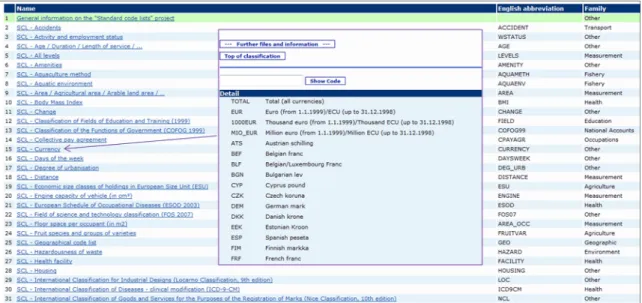
Figure 1-1 shows an example of the standard code lists that are hosted on Eurostat Metadata Server, RAMON.
Figure 1-1 Standard code lists (partial) hosted on Eurostat Metadata Server - RAMON
The standard code lists span a range of reference data domains, from the general, such as SCL-Languages, SCL-Currency, SCL-Days of the week, to industry-specific, such as SCL - Loading status [Transport-specific]; ICD -10 2007 [Health-specific]. Some of these lists are flat lists; others have hierarchical relationships between the codes. For example, SCL- Classification of Fields of Education and Training (1999) is hierarchical.
Standard classifications and nomenclatures such as NACE, SIC, NAICS, and many others are also listed on RAMON and are also reference data under the definition that was provided previously:
reference data is data used to categorize
other data within enterprise applications and databases
.A general characteristic of reference data is that it changes slowly relative to master data or transaction data. The list of countries in the ISO 3166-1 country code list does not change often. Changes to larger more complex sets such as ICD-10-CM are published on annual basis so they can be easily consumable. The relatively static and unchanging nature of reference data is one of the reasons that formal governance over this class of data within the enterprise is so often neglected.
A set of common-sense questions can be used to determine whether something should be treated as reference data, from a data governance perspective:
Does it categorize other data?
Is there a well-defined list of allowed values?
Is it unchanged by the transactions that use it?
Is it relatively static and slow changing?
Is there a requirement to manage a lot of additional properties along with the value?
For reference data, the answer to the first four bullets is
yes
; for the fifth bullet, that answer is typicallyno
. Although data that does not meet these criteria might also benefit from centralized governance and stewardship, such data usually has governance concerns and characteristics that differ from those compared to reference data, and usually requires separate processes, policies, and tooling for its governance.In fact, the answers to these questions are the key characteristics that differentiate
reference data
frommaster data
under the usual definition of the terms.Chapter 1. Reference data management 5
Figure 1-2 shows the key differences between master data and reference data.
Figure 1-2 The key differences between master data and reference data
Variables are one type of data that falls outside of our definition of reference data and are used across the organization, such as tax rates and daily currency exchange rates. Such
reference variables
do not categorize other data and do not have a predefined list of allowed values. However, similar to reference data, they are used by transactional applications in a read-only fashion. Reference variables are typically authored and defined externally to the enterprise and might be used across many enterprise applications. Managing reference variables and reference data presents similar problems. In designing agovernance program for reference data, including reference variables as a type of reference data usually makes sense. However, reference variables have slightly different characteristics compared to reference data, and can change more frequently. For example, currency exchange rates can change daily or more frequently.
1.2 Structure in reference data: Hierarchies and
relationships
Reference data often has a hierarchical structure that is defined over the
reference data values. Hierarchies are created by defining relationships between the values within an individual set. You can create a hierarchy by defining relationships over the nodes of an individual set, or you can create hierarchies by
Reference Data Master Data
Categorizes other data. Reference values qualify/classify master data and transaction data
Key business entities that participate within transactions – the who, what and where of business transactions: Party (eg customer, business partner, employee) Product, Account, Location
Well defined set of allowed values No predefined set of allowed values.
Unchanged by the transactions and application
processes that use it. Used in read only mode Can be created, changed and modified within business applications – eg
customer and product updates
Relatively static and slow changing data Can change frequently reflecting the fact that master data evolves and changes as a normal part of application and business processes
Relatively flat data structure and does not include many associated properties (attributes)
Can have complex data structure and many properties
Reference Data Master Data
Categorizes other data. Reference values qualify/classify master data and transaction data
Key business entities that participate within transactions – the who, what and where of business transactions: Party (eg customer, business partner, employee) Product, Account, Location
Well defined set of allowed values No predefined set of allowed values.
Unchanged by the transactions and application
processes that use it. Used in read only mode Can be created, changed and modified within business applications – eg
customer and product updates
Relatively static and slow changing data Can change frequently reflecting the fact that master data evolves and changes as a normal part of application and business processes
Relatively flat data structure and does not include many associated properties (attributes)
Can have complex data structure and many properties
defining relationships between the values in different reference data sets. The topology of these hierarchies has different implications for the data stewardship processes.
1.2.1 Tree hierarchies
A tree hierarchy is a hierarchical structure over some or all reference data values within a set. A tree hierarchy has a parent-child relationship between the values. where each value is a node within the hierarchy. For example, within the NACE Industry codes, you see a hierarchy structure implicit within the code values themselves, representing the subcategorization of industry activities, as shown in Figure 1-3.
Figure 1-3 NACE Rev 2 hierarchy (partial)
1.2.2 Level-based hierarchies
With InfoSphere MDM Ref DM Hub, you can create hierarchies by defining relationships across various reference sets. Each level of the hierarchy is represented by a separately managed reference data set.
Chapter 1. Reference data management 7
These hierarchies are referred to as
level-based
hierarchies. Level-based hierarchies are similar to tree hierarchies except that each level within the hierarchy is managed and defined as a reference data table or set in its own right. For example, Country State is a geographic hierarchy where Country and State are usually managed as independent reference data sets.Figure 1-4 shows the independent set structure of a level-based hierarch.
Figure 1-4 Independent sets structure of a level-based hierarchy
From a structure perspective, both tree and level-based hierarchies are the same. However, from a management and governance perspective, the two types of hierarchies have governance considerations that differ slightly. With a
level-based hierarchy, changes can be made independently to the sets at each level as each set goes through its own change lifecycle. There might even be separate stewardship teams managing separate sets at each level. For level-based hierarchies, the stewardship process must take into account how changes to the underlying sets at each level are reflected in the hierarchies based on the values of the sets at each level.
A geographic hierarchy can be represented within InfoSphere MDM Ref DM Hub application as either a tree hierarchy or a level-based hierarchy. The distinction between them is how the relationships are defined between the terms and sets. A hybrid hierarchy structure can also be created where the hierarchy is defined using parent-child relationships within the values of a set and also between values of separate sets as in a level-based hierarchy. For example, a client might want to manage the nodes of the first three levels of a five-level hierarchy as a single set and use individual sets for the subsequent fourth and fifth levels.
1.2.3 Poly hierarchies
In some cases, a requirement might exist to create more complex relationships between reference sets and the values within those sets, to represent an ontology for example. Within IBM, the IBM Office of Chief Information Officer (CIO) uses the IBM Reference Data Management Hub to manage taxonomies of standard terms used within IBM internal and external facing applications. There is a business need to define relationships between the individual reference sets and values within those sets. The relationships are not always parent-child relationships, rather, they define a complex network, or poly-hierarchy structure. The InfoSphere MDM Ref DM Hub mapping capability supports creating these more complex cross-set relationships.
1.3 Challenges of managing reference data
Reference data is relatively static and managing the reference data in a single table over time might not seem to be a lot of work. This section outlines several reasons why the sum of managing reference data across all applications in the enterprise and coordinating changes and mappings across these applications is a major challenge.
Multiplicity of code tables and code table variations
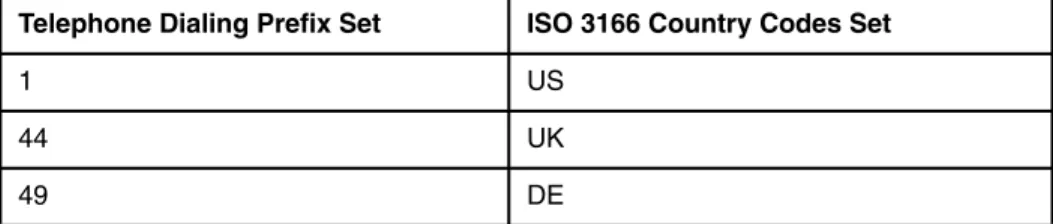
Many of the same types of reference data are used across industries and applications and the reference data is commonly used and often defined in the limited context of a particular application. The result is that, within an enterprise, there are many different code set variations describing the same domain. The differences between reference data sets across various systems can include semantic differences, coding scheme differences, format differences, and value differences. Even within well-established standards, there might be different representations for the same values. For example, the ISO 3166-1 standard defines three sets of country codes: ISO 3166-1 alpha-2: two-letter country codes
ISO 3166-1 alpha-3: three-letter country codes, which allow a better visual association between the codes and country names
ISO 3166-1 numeric: three-digit country codes, which are identical to those developed and maintained by the United Nations Statistics Division
In addition to ISO 3166-1, many other country code lists are defined and used by other international organizations. Some differ completely from the ISO standard
Chapter 1. Reference data management 9
both in how the values are coded and the list of country code values contained in the set.
Another example of variability within a standard code set is demonstrated by NACE codes. The Statistical Classification of Economic Activities in the
European Community, commonly referred to as NACE (acronym derived from its French name), is a European industry standard classification system consisting of a six-digit code. It is similar in function to the Standard Industry Classification (SIC) and North American Industry Classification System (NAICS) codes that are used in the US. The codes enable standard statistical reporting across industries and use of the standard is required in regulatory reporting. The first four digits of the NACE code, which is the first four levels of the classification system, are the same in all European countries. The fifth digit might vary from country to country and further digits are sometimes placed by suppliers of databases. Enterprises with operations in multiple countries often have to manage the different variations of the codes by creating reports within each country using the country specific standard version and then rolling up results to a single corporate version of NACE for its corporate level reporting. In addition, various versions of the NACE standard exist, and older data within a data warehouse might be classified according to earlier schemes:
NACE Revision 1, the first revision of the original NACE (1970)
NACE Revision 1.1, a minor revision of NACE Rev. 1
NACE Revision 2, adopted end 2006
Similarly in the US, NAICS is a different but analogous industry classification scheme that superseded the earlier SIC standard in 1997. However, some types of business are still required to provide regulatory reports that use the older SIC scheme so both SIC and NAICS are actively used in the US. A global
organization with operations in both US and Europe might need to translate between NACE, NAICS, and SIC codes to meet various regulatory reporting requirements.
In summary, even for something as commonly used as country codes or industry classification codes, where well established standards are available, the
variability among the standards and versions of the standards means that an organization might need to handle and reconcile data across multiple versions and representations as a matter of course. Moreover, the mapping between the codes in separate code-set variations are often not one-to-one. NACE and NAICS represent completely separate code schemes. Although the end purpose is similar, the industry categories within NACE do not correspond one-to-one with the industry codes in NAICS. The categorization structure differs, the coding structure differs, and the number of values within the code sets also differs. One NACE code might map to multiple NAICS categorizations and vice versa, making it difficult to determine how a piece of transaction data categorized in NACE should be categorized against NAICS.
To accurately map data across dissimilar code sets on a one to one basis, it might be necessary to use rules and additional information beyond the source code value itself to determine how to map the value.
Just as the reference data sets are published as standards, so the mapping tables that map between similar sets are also often published as related
standards by the standards organizations. For example, the EU RAMON Server lists a large number of correspondence tables (that is, mapping tables) between various versions of code lists and classifications that are used in European statistical reporting. See the tables at the following website:
http://ec.europa.eu/eurostat/ramon/relations/index.cfm?TargetUrl=LST_REL&StrLan guageCode=EN&IntCurrentPage=1
Although variations exist in and within industry standard code sets, the greatest source of code table variation within the enterprise is the enterprise applications where the code tables are defined and used. Reference data is typically created and managed in a siloed fashion within each individual IT application. In many cases, application developers implement code tables within an application with purely the local processing needs of that application in mind. Thus a hundred enterprise applications might have a hundred ways of representing a country code list, with various coding schemes and even various sets of country values within each.
Because each application typically has many code tables, the larger the enterprise, the greater the number of code table variations.
Maintaining mappings between reference data representations
If data and reference data were confined to individual applications, the problem of managing reference data within the enterprise would simply be the problem of how to manage the changes to reference data over time within each individual application. In reality, few applications work in isolation and data must cross application boundaries. Data is consolidated in master data hubs and data warehouses. Data passes from application to application in cross-business processes. Data that is entered in a web application by a client might result in transactions and processes in multiple back-end applications. Data with coded reference data values is received from suppliers, business partners, and customers as part of business transactions. Wherever transaction and master data flows between applications, so must the related reference data. Code tables that are used to categorize transaction data might have different formats and content within source and target applications for data movement. Whentransaction data flows from a source application to a target application, the code values of the source must be mapped to the corresponding code table values of the target if the categorization information that is associated with the reference data will be correctly carried also.
Chapter 1. Reference data management 11
Typical use cases, where reference data mappings are key to the business, include data warehouse data load and master data hub data load.
Data warehouse load
Transaction and master data are consolidated and sent from back-end applications to the data warehouse. The data warehouse data is the source of business intelligence (BI) reports, financial reports, statutory reports, and so on. The data warehouse dimensions contain reference data and the reference data that is related to incoming fact data supports statistical analysis of the fact data. A common approach is to run a daily batch load job by using standard extract, transform, and load (ETL) tools, which use mapping tables to map the reference data codes from the source application format to the corresponding data
warehouse format, so that the transaction data from back-end applications can be categorized correctly. The accuracy and completeness of the mapping tables might directly affect the accuracy of how fact data is mapped to dimensional data. Without centralized management and coordination of reference data changes, the code table maps between the source application and data warehouse reference data representations are difficult to maintain in an ongoing basis and quickly become outdated. When reference data maps are incorrect or
incomplete, the transaction data might not be posted correctly, or might not be posted at all. A common pattern for managing the case where a source reference code is not found in the map by an ETL job is to map the transaction data to a default “unknown” code for the particular dimension within the data warehouse. With this approach the quality of the categorization within the data warehouse declines over time, because the percentage of data that is correctly mapped to the respective dimensions declines.
Master data hub load and transactions
Master data encompasses the key business entities that participate in business transactions and operations including customers, products, and accounts. A master data entity, such as a customer, has reference data associated with it, and a typical master data management system has hundreds of code tables associated with the master data. A master data hub can be both a consolidation point and a distribution point for data relating to master data entities. Just as for the data warehouse, map tables allow reference data defined in external
applications to be mapped to the code tables within the MDM hub so that master data that is sourced from those external applications can be loaded correctly into the MDM application. In addition, there might be a need to distribute data from the master data hub to other applications that require a reverse mapping.
The difficulty of managing reference data change
An enterprise has many variations of the same code set within the various enterprise applications and many code tables to manage. Although reference data is relatively static, it is not completely static, and managing changes to code tables across the enterprise can be a significant challenge. Many enterprise applications were never designed to accommodate changes to the code tables over time, and changing the tables will often require application development and testing.
Unlike master data management, reference data management is not an established discipline; many organizations have no central management of reference data.
Separate lines of business, application owners, and departments manage their own sets of reference data; there is often little communication or coordination between the various business areas. Rolling out a change across the enterprise is difficult. Also difficult is to understand or manage what individual changes are being made by the different reference data owners to their code tables.
Examples of changes to reference data are described next.
Changes to a standard
An example of changes to a standard is that a new country code is added to the ISO 3166-1 standard. When a standard is changed, an enterprise has to assess the following questions:
What applications does this change affect?
What will be the impact of adding the new code to each application and how will this be effected and coordinated?
What mappings are affected and need to be updated?
What is the contingency for managing data from applications that cannot be changed or that need to be changed on a staggered timeline?
How will this change be reconciled with data recorded prior to the change?
How will adoption of the changed standard by application owners be tracked and managed over time?
The impending healthcare industry change from ICD-9 to ICD-10 codes in the US is an extreme case of a code standard change. Healthcare organizations are currently engaged in major projects to ensure that their systems are ready for the change in October 2014.
However, even relatively small changes to reference data can cause problems because few organizations have a good understanding of how reference data is
Chapter 1. Reference data management 13
being used in each application and what the inter-dependencies are. The impact of making a code change in one or more applications can be difficult to assess.
Changes to an application-specific code set
When an application-specific code set is changed, an enterprise has to assess the following questions:
What other applications does this change affect?
What external mappings are affected and need to be updated?
How is this change coordinated across other application owners
Changes to mappings between sets
As an enterprise makes changes to reference data sets that are used within the application ecosystem, it must also update the cross-application reference data maps that are affected by a reference data change. These maps are used to drive mapping between one reference data representation and another and basically support interoperability between applications. Without governance over who is making changes to what reference data, coordinating changes to the related maps is difficult. As a result, the reference data maps that are used in ETL jobs and so on often become outdated.
Today, enterprises often catalog their reference data and the mappings between them by using Microsoft Excel spreadsheets and similar manual methods. Using a manual spreadsheet approach is error-prone and enforcing good data
governance practices and policy around security, audit, and history is difficult.
1.4 The cost of unmanaged reference data
Today, many enterprises have no centralized enterprise governance over reference data; critical reference data is managed using spreadsheets and manual ad-hoc methods. The difficulty of managing change across the complex web of reference data variations is not systematically addressed; errors in reference data mappings and inconsistencies are accepted and tolerated as an everyday reality. Reference data variations and inconsistencies can be a major source of data quality issues within the enterprise and cause business losses through system downtime, incorrect transactions, and incorrect reports.
1.4.1 Costs related to business risk
The following business risks result from unmanaged reference data:
Operational risk
If incorrect reference data is used, transactions or applications might not function correctly and the outputs and results might not be as expected. Reference data often plays a key role in transactional applications and business processes so the potential business impact can be major.
Compliance risk
Regulatory compliance is increasingly a driver for adopting new approaches to managing reference data. More than ever, enterprises must be able to prove through internal and external audits about how their business
processes work; that they work appropriately; that the data they incorporate is accurate; and that only authorized employees had access to the data. There has to be a clear audit trail and provenance for data used in regulatory reports.
Frequently, enterprises have only the most rudimentary ways of handling governance over reference data and the common approach of tracking reference data in spreadsheets and doing manual reconciliation is both time-consuming and prone to human error. Because the data stored within data warehouse and financial systems is used to generate financial and regulatory reports the accuracy of this data is a critical requirement.
Incorrectly mapped reference data can have a direct impact on the quality and integrity of data that is stored within the data warehouse
Analytical risk
In addition to regulatory reporting, the data warehouse is used to drive business intelligence analysis and reporting. Reference data is fundamental to reporting because it defines the dimensions underpinning BI analysis. As BI reports are increasingly used to drive business decisions, business decisions might be made based on faulty analysis if transaction data that is mapping to dimensions is incomplete or incorrect.
Distribution risk
Reference data changes might not be correlated across related applications, causing data transfer problems, and reporting inconsistencies between applications.
Chapter 1. Reference data management 15
1.4.2 Increased IT cost
Usually IT has the task of managing the reference data mappings, and there is little involvement from the business. Because reference data might be
independently changed within source applications, data transfer mappings that are used to map reference data from one application to another become inaccurate and incomplete over time, potentially resulting in failed transactions, missing data, or incorrectly categorized transactions. IT often remains in a reactive mode, only recognizing and reacting to changes in back-end application reference data by the failures caused mapping and transaction problems.
Separate application owners make their own changes without addressing the implications of those changes on business processes or other parts of the organization.
1.4.3 Cost of business inflexibility
Reference data is a key aspect of any application integration, and the speed with which an enterprise can integrate the reference data from new applications and correctly map that new reference data to existing reference data standards has a bearing on business flexibility. Whether new applications are introduced through ongoing application acquisition or organizational mergers, the ability to
accommodate new reference data can directly affect the speed with which the IT infrastructure of an organization can change. Without a formal governance program and the support of a reference data management application
integration, reconciliation and ongoing management of new data and reference data sources is slowed.
1.5 Reference data governance with master data
management approach
Master data management has become the best practice approach to address the problems that are caused by master data being defined and managed in many separate application and data silos within an enterprise. The goal of master data management applications is to support identification and reconciliation of master data records across an organization, and to provide well defined processes for managing the stewardship of the master data over time.
Master data management systems support identification and maintenance of a gold record for master data entities within the enterprise. Reference data by definition is not master data but it presents a similar problem: Reference data is defined and used independently across many applications and tends to be
maintained in a siloed fashion on an application-by-application basis. Just as master data management systems can support formal, centralized governance and management of master data at an enterprise level, the same approach can be used to manage reference data. The emerging best practice is to treat reference data like a master domain in its own right and to provide centralized management and stewardship of reference data using a standard set of processes, policies and tools.
Master data management software provides the tooling foundation for building a specialized reference data management governance solution. IBM has designed a dedicated stewardship and hub application for the centralized management of enterprise reference data using a master data management approach. The IBM InfoSphere Master Data Management Reference Data Management Hub, first launched as a component of IBM InfoSphere Master Data Management Platform in July 2012, provides the repository, services, and stewardship user interface to support a complete governance program for enterprise reference data.
Managing reference data is a key aspect of an enterprise data governance program. The industry best practice for enterprise data governance in general is to establish a Project Management Office (PMO) with oversight of data
governance projects. If a data governance PMO already exists, then reference data management project might fall under the auspices of that PMO. If not, then a reference data management project can be a good starting point for
implementing a broader master data management initiative and data governance structure. IBM Lab Services and IBM Global Business Services® have plans and details for how to establish a data governance program so only certain key elements are covered here.
A data governance initiative for managing reference data should address four key elements:
People
: Who owns the reference data and who is responsible for the data, both on the business side and within IT? The answer to this question will establish liaison relationships and simplify communication regarding questions and updates. Separate lines of business might have separate reference data requirements and typically, there will be one or morestewardship teams managing separate reference data sets and mappings. As with master data management, a centralized stewardship approach simplifies implementation at an enterprise level.
The requirements for how the data stewardship team is structured and how individual stewards can change what reference data will vary from
organization to organization. One approach is to organize reference data stewards by business area: assigning a steward responsibility for reference standards for a particular business area. Business users should be able to raise change requests for additions or changes to reference data and the
Chapter 1. Reference data management 17
change management process should include routing the request to the appropriate steward who is then responsible for evaluating the change request and for ensuring the collaborative review and approval process depending on the type of reference data, and the type of change requested.
Process
: What are the processes for stewardship and governance of thedata? What are the processes for change management over the data? What are the processes for using the data in business scenarios?
– Publishing of standards. At its heart, an RDM strategy must create the foundation for reference data standards across the enterprise, taking corporate, industry, and global standards into account. The process should support publishing reference data standards, and active and passive distribution of changes in reference data to the community of subscribing applications.
– Change management: One of the key precepts underlying an RDM strategy is the ability to accommodate change. While some reference data remains static and changes relatively infrequently, other data might fluctuate on a daily or more frequent basis, for examples, currency exchange rates. For that reason, the enterprise must establish a
procedure for accommodating change and updates. What are the change request processes? Who will manage the publication and dissemination of changes to systems that subscribe to the data? How will bidirectional changes between systems and applications be monitored and confirmed? Who among business and IT owners should be notified or consulted about changes? A typical process allows business users to direct the change requests that relate to the reference standards to the steward team and support a collaborative evaluation, review, and approval process for agreed changes.
– Deployment and test strategies: How are changes to reference data coordinated across multiple applications? What is the deployment and test cycle for applications affected by reference data change? Publishing of changes to standards should include notification to business and
application owners and can be scheduled in such a way as to allow those applications time to be changed to adopt the new standard (for example, monthly publish of standards changes).
– Discover: Although reference data might be ubiquitous, it is not always obvious. An RDM strategy should include a way to discover reference data wherever it appears within an enterprise’s applications and spreadsheets. The result of the discovery process should be a catalog that profiles all existing applications, and there should be a process for bringing discovered reference data under centralized governance.
Policies
: Organizations should establish policies around security, data ownership, audit, history, data retention, and other non-functional requirements for the reference data under management.
Tools
: Technology provides the automation to help manage and implement the governance program. The IBM Reference Data Management hub is designed specifically to support governance, and stewardship of reference data including enforcement of data management policies. The InfoSphere MDM Ref DM Hub supports defining, managing, and publishing the “gold” or canonical reference data standards for the enterprise while managing synchronization and mapping of application specific reference data representations to the canonical representation and to each other. The InfoSphere MDM Ref DM Hub supports import and onboarding of reference data into the hub, and publishing of reference data and related changes to consuming and subscribing applications. The InfoSphere MDM Ref DM Hub works in conjunction with ETL tools, MDM applications, and many other data quality and data management tools. IBM RDM also integrates with IBM InfoSphere Business Glossary IBM business data dictionary. IBM InfoSphere Information Analyzer supports discovery and profiling of reference data in back-end applications so that the reference data can then be easily brought under management in the InfoSphere MDM Ref DM Hub.1.6 InfoSphere MDM Ref DM Hub feature overview
The IBM InfoSphere Master Data Management Reference Data Management Hub (InfoSphere MDM Ref DM Hub) was released as a separately chargeable component under the IBM Master Data Management Product ID (PID) in July 2012. The hub was developed as a stand-alone reference data domain on the InfoSphere MDM Custom Domain Hub Platform which itself is the foundation for the InfoSphere MDM Advanced Edition. The InfoSphere MDM Ref DM Hub implements its own specialized domain model specifically for reference data, that is, reference data is supported as a first-class domain entity. The InfoSphere MDM Ref DM Hub includes a dedicated stewardship interface that is designed for managing reference data. The web-based user interface (UI) runs in the browser and no special code is required on the client. The UI is designed for business users, with intuitive and familiar navigation and controls. A flexible data model supports dynamic modelling of reference data properties through the UI ensuring a quick implementation and minimizing the need for IT involvement on an ongoing basis.
InfoSphere MDM Ref DM Hub is deployed as a stand-alone hub to provide a single point of management and governance for enterprise reference data.
Chapter 1. Reference data management 19
InfoSphere MDM Ref DM Hub provides a robust solution for centralized management, stewardship, and distribution of enterprise reference data. It supports defining and managing reference data as an enterprise standard. It also supports maintaining mappings between the various application-specific
representations of reference data that are used within the enterprise. The InfoSphere MDM Ref DM Hub supports formal governance of reference data, putting management of the reference data in the hands of the business users, reducing the burden on IT, and improving the overall quality of data used across the organization.
1.6.1 Key functions of the InfoSphere MDM Ref DM Hub
InfoSphere MDM Ref DM Hub is designed as a ready-to-run application. It can be quick to install, easy to use and understand, and delivers real value for immediate use without requiring extensive customization. The key functions include the following items:
Role-based user interface with security and access control including integration with LDAP
Management of reference data sets and values
Management of mappings and relationships between reference data sets
Importing and exporting of reference data in CSV and XML format through both batch and user interface
Versioning support for reference data sets and mappings
Change process controlled through configurable lifecycle management
Hierarchy management
InfoSphere MDM Ref DM Hub is built on the proven InfoSphere MDM platform and delivers a master data management approach to managing enterprise reference data. It helps to reduce business risk, improve enterprise data quality, and enhance operational efficiency. InfoSphere MDM Ref DM Hub is based on a three-tiered component architecture, comprising a client and a server application interacting with a back-end database that hosts the application-specific data and required metadata.
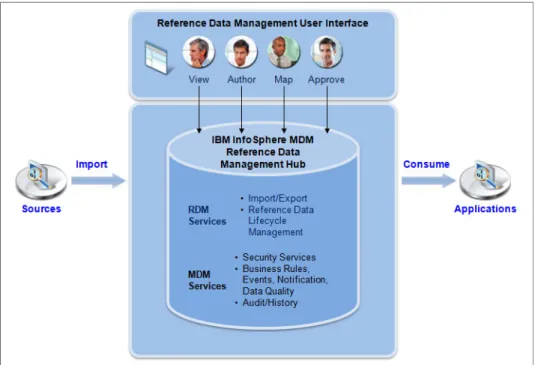
Figure 1-5 depicts a high-level component architecture of InfoSphere MDM Ref DM Hub.
Figure 1-5 InfoSphere MDM Ref DM Hub logical architecture
The InfoSphere MDM Ref DM Hub user interface is a web application UI that supports collaborative authoring of reference data. Reference Data Stewards use the RDM web UI for the importing, managing, and publishing of reference data sets. The role-based UI allows a stewardship team to view, author, map, and approve reference data sets within a central repository. With this approach reference data sets can be created and managed in a controlled manner. User actions on the web UI trigger requests, which are handled by appropriate service controllers present in the REST layer. The REST layer services invoke the server-side transactions to manage CRUD procedures on RDM database. The server-side is implemented on the proven InfoSphere Custom Domain Hub engine (the same engine that powers InfoSphere MDM Server and InfoSphere MDM Advanced Edition).
The reference data domain model elevates reference data to be a first class domain entity within MDM. By implementing the InfoSphere MDM Ref DM Hub as a new domain on the InfoSphere MDM platform, the InfoSphere MDM Ref DM Hub benefits from a wide range of base services and ready-to -use frameworks that InfoSphere MDM provides such as business rules, event notification, data