How Secure are Secure Interdomain Routing Protocols?
.
Full version from February 23, 2010
Sharon Goldberg
Microsoft Research
Michael Schapira
Yale & UC Berkeley
Peter Hummon
Princeton
Jennifer Rexford
Princeton
ABSTRACT
In response to high-profile Internet outages, BGP security variants have been proposed to prevent the propagation of bogus routing information. To inform discussions of which of these variants should be deployed in the Internet, we quan-tify the ability of the main protocols (origin authentication, soBGP, S-BGP, and data-plane verification) to blunt traffic-attraction attacks;i.e.,, an attacker that deliberately attracts traffic to drop, tamper, or eavesdrop on packets.
Intuition suggests that an attacker can maximize the amount of traffic he attracts bywidelyannouncing ashortpath that is not flagged as bogus by the secure protocol. Through simulations on an empirically-determined AS-level topol-ogy, we show that this strategy is surprisingly effective, even when the network uses an advanced security solution like S-BGP or data-plane verification. Worse yet, we show that these resultsunderestimatethe severity of attacks. We prove that finding the most damaging strategy is NP-hard, and show how counterintuitive strategies, like announcing longer paths, announcing to fewer neighbors, or triggering BGP loop-detection, can be used to attract even more traffic the strategy above. These counterintuitive examples are not merely hypotheti-cal; we searched the empirical AS topology to identify spe-cific ASes that can launch them. Finally, we find that a clever export policy can often attract almost as much traffic as a bo-gus path announcement. Thus, our work implies that mech-anisms that police export policies (e.g.,defensive filtering) are crucial, even if S-BGP is fully deployed.
1.
INTRODUCTION
The Internet is notoriously vulnerable to traffic at-traction attacks, where Autonomous Systems (ASes) manipulate BGP to attract traffic to, or through, their networks. Attracting extra traffic enables the AS to increase revenue from customers, or drop, tamper, or snoop on the packets [1, 2, 3]. While the proposed ex-tensions to BGP prevent many attacks (see [4] for a survey), even these secure protocols are susceptible to a strategic manipulator who deliberately exploits their weaknesses to attract large volumes of traffic to its net-work. Given the difficulty of upgrading the Internet to a new secure routing protocol, it is crucial to
un-derstand how well these protocols blunt the impact of traffic attraction attacks.
1.1
Quantifying the impact of attacks.
We evaluate the four major extensions to BGP, or-dered from weakest to strongest: origin authentication [5], soBGP [6], S-BGP [7], and data-plane verification [4, 8]. While the stronger protocols prevent a strictly
larger set of attacks then the weaker ones, these security gains often come with significant implementation and deployment costs. To inform discussions about which of these secure protocols should be deployed, we would like to quantitatively compare their ability to limit traffic attraction attacks. Thus, we simulate attacks on each protocol on an empirically-measured AS-level topology [9, 10, 11], and determine the percentage of ASes that forward traffic to the manipulator.
Performing a quantitative comparison requires some care. It does not suffice to say that one protocol, say S-BGP, is four times as effective as another protocol, say origin authentication, at preventing a specific type of attack strategy; there may beother attack strategies
for which the quantitative gap between the two pro-tocols is significantly smaller. Since these more clever attack strategies can just as easily occur in the wild, our comparison must be in terms of the worst possible attack that the manipulator could launch on each pro-tocol. To do this, we put ourselves in the mind of the manipulator, and look for the optimal strategy he can use to attract traffic from as many ASes as possible.
However, before we can even begin thinking about optimal strategies for traffic attraction, we first need a model for the way traffic flows in the Internet. In practice, this depends on complex local routing policies used by each AS, which are not publicly known. How-ever, the BGP decision process breaks ties by selecting shorter routes over longer ones, and it is widely believed [12] that policies depend heavily on economic consider-ations. Thus, conventional wisdom and prior work [13, 12, 14] suggests basing routing policies on business rela-tionships and AS-path lengths. While this model (used in many other studies, e.g., [1, 15]) does not capture all the intricacies of interdomain routing, it is still very
useful forgaining insight into traffic attraction attacks. All of our results are attained within this model.
1.2
Thinking like a manipulator.
If routing policies are based on AS path lengths, then intuition suggests that it is optimal for the manipulator to announce theshortest paththat the protocol does not reject as bogus, toas many neighbors as possible. De-pending on the security protocol, this means announc-ing a direct connection to the victim IP prefix, a fake edge to the legitimate destination AS, a short path that exists but was never advertised, a short path that the manipulator learned but is not using, or even a legiti-mate path that deviates from normal export policy. In-deed, we use simulations on a measured AS-level topol-ogy to show that this “smart” attack strategy is quite effective, even against advanced secure routing proto-cols like S-BGP and data-plane verification.
Worse yet, we show that our simulations underesti-mate the amount of damage manipulator could cause. Through counterexamples, show that the “smart” at-tack is surprisingly not optimal. In fact, the follow-ing bizarre strategies can sometimes attract even more traffic than the “smart” attack: announcing a longer
path, exporting a route tofewer neighbors, or trigger-ing BGP’sloop-detection mechanism. In fact, we show that prefix hijacking (i.e., originating a prefix you do not own) isnotalways the most effective attack against today’s BGP! These counterexamples are not merely hypothetical—we identify specific ASes in the measured AS-level topology that could launch them. Moreover, we prove that it is NP-hard to find the manipulator’s optimal attack, suggesting that a comprehensive com-parison across protocols must remain elusive.
1.3
Our findings and recommendations.
While we necessarily underestimate the amount of damage a manipulator could cause, we can make a num-ber of concrete statements. Our main finding is that secure routing protocols only deal with one half of the problem: while they do restrict thepaths the manipula-tor can announce, they fail to restrict hisexport policies. Thus, our simulations did show that, when compared to as BGP and origin authentication, soBGP signifi-cantly limits the manipulator’s ability to attract traffic by announcing bogus short paths to all its neighbors. However, even in a network with advanced security so-lutions like S-BGP or even data-plane verification, we found that a manipulator can still attract large volumes of traffic by cleverly manipulating his export policies. Indeed, we found that announcing ashort path is often less important than exporting that path to theright set of neighbors. Thus:
• Advanced security protocols like S-BGP and data-plane verification do not significantly outperform
soBGP for the “smart” attacks we evaluated. • Defensive filtering of paths exported by stubs
pro-vides a level of protection that is at least compa-rable to that provided soBGP, S-BGP and even data-plane verification.
• Tier 2 ASes are in the position to attract the largest volumes of traffic, even in the presence data-plane verification and defensive filtering (of stubs). • Interception attacks[2, 1]—where the manipulator
both attracts traffic and delivers it to the destination— are easy for many ASes, especially large ones.
We could quibble about whether or not manipulating export policies even constitutes anattack; after all, each AS has the right to decide where it announces paths. However, our results indicate that a clever export pol-icy can attract almost as much traffic as a bogus path announcement. Indeed, Section 6.1 presents an exam-ple where an AS in the measured topology gains almost as much exporting a provider-learned path to another provider, as he would by a prefix hijack (announcing that he owns the IP prefix). Thus, our results suggest that addressing traffic attraction attacks requires both mechanisms that prevent bogus path announcements (e.g., soBGP or S-BGP) as well as mechanisms that police export policies (e.g.,defensive filtering).
1.4
Roadmap.
Section 2 presents the routing model, threat model, and our experimental setup. Section 3 describes the vul-nerabilities of the secure routing protocols and presents an example of how a manipulator can attract traffic by exploiting them. Section 4 describes and evaluates the “smart”attraction attacks, and Section 5 uses both theory and simulation to analyze interception attacks. Section 6 presents counterexamples, found in real net-work data, that prove that the “smart” attacks are not optimal. Section 7 shows that finding the optimal at-tack strategy is NP hard. Section 8 presents related work, and Section 9 discusses the effect of our mod-eling assumptions on our results and provides further recommendations.
This full version also contains a variety of supplemen-tary information in the appendix. Appendix A has our treatment of sibling relationships, and Appendix B has the details of our simulation methodology. Appendix D presents a counterexample from Section 6 in more de-tail, and Appendix E presents a supplementary exam-ple that shows how an interception attack can fail, and correct an error in [1]. Proofs of our theorems are in Ap-pendices F-G. Finally, Appendix H presents versions of all the graphs in the body of this paper, computed from a different AS topology datasets [10, 11] than the graphs in the body [9], showing the remarkable agreement in the trends we report.
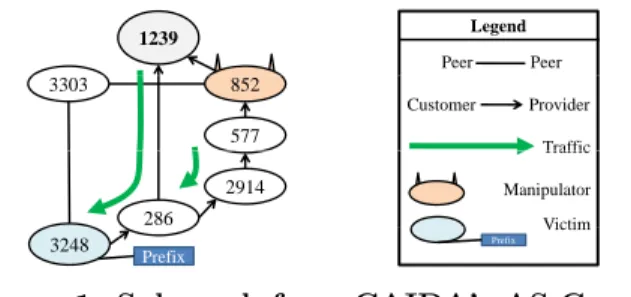
1239 852 3303 577 2914 286 3248 Prefix Legend Peer Peer Customer Provider Traffic Traffic Manipulator Victim Victim Prefix
Figure 1: Subgraph from CAIDA’s AS Graph.
2.
MODEL AND METHODOLOGY
We first present a model of interdomain routing and routing policies, based on the standard models in [16] and the Gao-Rexford conditions [13], followed by our threat model for traffic attraction, and finally overview our experimental setup.
2.1
Modeling interdomain routing.
The AS graph. The interdomain-routing system is modeled with a labeled graph called an AS graph, as in Figure 1. Each AS is modeled as a single node and denoted by its AS number. Edges represent direct physical communication links between ASes. Adjacent ASes are called neighbors. Since changes in topology typically occur on a much longer timescale than the execution of the protocol, we follow [16] and assume the AS-graph topology is static. BGP computes paths to each destination IP prefix separately, so we assume that there is a uniquedestination IP prefix to which all other nodes attempt to establish a path. As shown in Figure 1, there is a single AS (AS 3248) that rightfully ‘owns’ the destination IP prefix under consideration.
Establishing paths. In BGP, an AS first chooses an outgoing edge on which it forwards traffic based on a local ranking on outgoing paths, and then announces this path to some subset of its neighbors. To model this, we assume that each nodenhas a set ofrouting policies, consisting of (a) a ranking on outgoing paths from n
to the destinationd, and (b) a set of export policies, a mapping of each pathP to the set of neighbors to which
nis willing to announce the pathP. We say that node
nhas anavailable pathaP difn’s neighboraannounced the path “aP d” ton. If an available pathaP dis ranked higher than the outgoing path that nodenis currently using, then an normal node n will (a) forward traffic to nodea, and (b) announces the pathnaP d to all his neighbors as specified by his export policies.
Business relationships. We annotate the AS graph with the standard model for bilateral business relationships in the Internet [13]; while more compli-cated business relationships may exists in practice, the following is widely believed to capture the majority of the economic relationships. As shown in Figure 1, there are two kinds of edges: customer-provider edges (where the customer pays the provider for connectivity,
repre-sented with an arrow from customer to provider), and
peer-to-peer edges (where two ASes owned by different organizations agree to transit each other’s traffic at no cost, represented with an undirected edge). Because we some of our results are based on CAIDA’s AS graph [9], we also considersibling-to-sibling edges. Details about our treatment of siblings is in Appendix A. Finally, our theoretical results sometimes use an assumption from [13] that captures the idea that an AS cannot be its own customer:
GR1 AS graph contains no customer-provider cycles.
2.2
Modeling routing policies.
In practice, the local routing policies used by each AS in the Internet are arbitrary and not publicly known. However, because we want to understand how false rout-ing information propagates through the Internet, we need to concretely model routing policies. Since it is widely believed that business relationships play a large role in determining the routing policies of a given AS [12, 13], and we have reasonably accurate empirical maps of the business relationships between ASes [9, 10, 11], these relationships will form the basis of our model.
Rankings. BGP is first and foremost designed to prevent loops. Thus, we assume that nodearejects an announcement from its neighborbif it contains aloop; if node aappears on the path that node b announces. Beyond that, we can think of the process ASes use to select routes as follows; first applying local preferences, then choosing shortest AS paths, and finally applying a tie break. Since the local preferences of each AS are un-known, and are widely believed to be based (mostly) on business relationships, we model the three step process as follows:
LP Local Preference. Prefer outgoing paths where the next hop is a customer over outgoing paths where the next hop is a peer over paths where the next hop is a provider.
SP Shortest Paths. Among the paths with the high-est local preference, chose the shorthigh-est ones.
TB Tie Break. If there are multiple such paths, choose the one who’s next hop has lowest AS number.1
Our model of local preferences is based on on Gao-Rexford conditionGR3, and captures the idea that an AS has an economic incentive to prefer forwarding traf-fic via customer (that pays him) over a peer (where no money is exchanged) over a provider (that he must pay). Notice that this implies that can sometimes prefer
1
We need a consistent way to break ties. In practice, this is done using the geographic distance between routers and router IDs. Since our model does not incorporate geographic distance or individual routers, we use AS number instead.
alonger path! (e.g., Figure 1, AS 852 prefers the five-hop customer path through AS 577 over the four-five-hop provider path through AS 1239.)
Export Policies. Our model of export policies is based on the Gao-Rexford conditionGR2:
GR2 ASbwill only announce a path via AScto ASa
if at least one of aandcare customers ofb.
GR2captures the idea that an AS should only willing to load his own network with transit traffic if he gets paid to do so. However, because GR2 does not fully specify the export policies of every AS (for instance, an AS could decide to export paths to only asubset of his customers), it does not suffice for our purposes. Thus, we model normal export policies as follows:
NE An AS will announce all paths to all neighbors
except whenGR2forbids him to do so.
2.3
Threat model.
One strategic manipulator. We assume that all ASes in the AS graph behavenormally, i.e.,according the policies in Section 2.1 - 2.2, except for asingle ma-nipulator (e.g., AS 852 in Figure 1). We leave models dealing with colluding ASes for future work.
Normal ASes and normal paths. We assume that every normal AS uses the routing policies Section 2.2; thus, thenormal path is the path an AS (even the ma-nipulator) would chose if he used the normal rankings of Section 2.2, andnormal export is defined analogously. (e.g.,In Figure 1, the manipulator AS 852’snormal path
is through his customer AS 577.) We shall assume that every normal AS knows its business relationship with his neighbors, and also knows the next hop it chooses for forwarding traffic to a given destination. In order to evaluate the effectiveness of each secure routing proto-col, we assume that ASes believe everything they hear,
except when the secure routing protocol tells them oth-erwise. As such, we do not assume that ASes use auxil-iary information to detect attacks, including knowledge of the network topology or business relationships be-tween distant ASesetc., unless the secure routing pro-tocolspecifically provides this information.
Attraction v.s. Interception attacks. In an at-traction attack, the manipulator’s goal is to attract traf-fic, i.e., to convince the maximum number of ASes in the graph to forward traffic that is destined to the vic-tim IP prefix via the manipulator’s own network.2 To model the idea that a manipulator may want to eaves-drop or tamper with traffic before forwarding it on to
2
We acknowledge that a manipulator may want to attract traffic from only aspecific subset of ASes. However, since we lack empirical data to quantify that subset of ASes that a given manipulator may want to attract, in this paper we assume that the manipulator would like to maximize the volume of traffic that he attracts.
the legitimate destination, we also considerinterception attacks. In an interception attack, the manipulator has the additional goal of ensuring that he has anavailable path to the victim. This is in contrast to a attraction attack, where the manipulator is allowed, but not re-quired, to create a blackhole where he has no working path to the victim IP prefix (e.g., Figure 8).
Attack strategies. To capture the idea that the manipulator is strategic, we allow him to be more clever than the normal ASes; specifically, we allow him to use knowledge of the global AS graph and its business rela-tionships in order to launch his attacks. (However,the strategies we consider usually require only knowledge this available locally at each AS.) An attack strategy is a set of routing announcements and forwarding choices that deviates from the normal routing policies specified in Section 2.2. An attack strategy may include, but is not limited to:
• Announcing an unavailable or non-existent path. • Announcing different paths to different neighbors. • Announcing an legitimate available path that is
different from thenormal path.
• Exporting a path (even the legitimate normal path) to a neighbor to whichno pathshould be announced to according to the normal export policies. Indeed, one might argue that some of these strategies do not constitute ‘dishonest behavior’. However, it is im-portant to consider these strategies in our study, since we shall find that they can sometimes be used to attract as much traffic as the traditional ‘dishonest’ strategies (e.g., announcing non-existent paths).
Attacks outside our model. This paper focus on traffic attraction attacks; we do not consider other rout-ing security issues, for instance, mismatches between the control- and data-plane [3, 8], or traffic deflection at-tacks, where a manipulator wants to divert traffic from himself or some distant, innocent AS [4].
2.4
Experiments on empirical AS graphs.
All the results and examples we present are based em-pirically obtained snapshots of the Internet’s AS graph annotated with business relationships between ASes.
Algorithmic simulations. At the core of our ex-periments is our routing tree algorithm (presented in Appendix B.1) that determines the paths that each AS uses to reach the destination prefix under the assump-tion that each AS ‘normally’ uses the routing policies of Section 2.2. Because we run a large number of ex-periments over the full ( 30K node) AS graph, we avoid the heavy message-passing approach used by standard BGP simulators; instead, we use lightweight algorith-mic approach based on breadth-first search. The rout-ing tree algorithm also is also used to simulatrout-ing the
result of a manipulator’s attack strategy. As discussed in Appendix B.1, we simulate a bogus path announce-ments by ‘seeding’ the routing tree algorithm with the bogus path, and simulate strategic export policies by re-moving certain links between the manipulator and his neighbors.
Average case analysis. Since the influence of an attack strategy depends heavily on the locations of the manipulator and the victim in the AS graph, we run simulations across many (manipulator, victim) pairs. Rather than reporting average results, we plot the dis-tribution of the fraction of ASes that direct traffic to the manipulator. We by no means believe that a ma-nipulator would select its victim at random; however, reporting distributions allows us to measure the extent to which a secure protocol can blunt the power of the manipulator, determine the fraction of victims that a manipulator could effectively target, and identify posi-tions in the network that are effective launching points for attacks. Ideally, to determine how damaging a given attack strategy can be, we would have liked to run sim-ulations overevery(manipulator,victim) pair in the AS graph. However, this would require (30K)2 simulations per dataset, which would be prohibitive. Instead, we run experiments a randomly-chosen (manipulator, vic-tim) pairs. We found that running 60K experiments of each type was sufficient for our results to stabilize.
Realistic examples. Rather than providing con-trived counterexamples, every example we present comes from real data. To finds these examples, we (algorith-mically) searched the empirically-measured AS graph for specific subgraphs that could induce specific coun-terexamples, and then simulated the attack strategy.
Multiple datasets. Because the actual AS-level topology of the Internet remains unknown, and infer-ring AS relationships is still an active area of research, we run simulations on a number of different datasets: multiple years of CAIDA data [9], and Cyclops data [10] augmented with 21,000 peer-to-peer edges from [11]’s IXP dataset. Even though these datasets use differ-ent relationship-inference algorithms, the trends we ob-served across datasets were remarkably consistent. Thus, all the results and examples we present are from CAIDA’s November 20, 2009 dataset (with slight modifications to the sibling relationships, see Appendix A.2); coun-terparts of these graphs, computed from Cyclops and IXP data [10, 11] are in Appendix H.
3.
FOOLING BGP SECURITY PROTOCOLS
This section overviews the security protocols we con-sider, and presentsthe set of (possibly) bogus paths that a manipulator can announce to each without getting caught. We use Figure 1 to demonstrate the fraction of traffic a manipulator could attract by announcing one of these (possibly) bogus paths to all its neighbors.
Our focus is on protocols with well-defined security guarantees. Thus, we consider the five major BGP curity variants, ordered from weakest to strongest se-curity, as follows: (unmodified) BGP, Origin Authenti-cation, soBGP,SBGP, anddata-plane verification. Be-cause we focus on security guarantees and not protocol implementation, we use these as an umbrella for many other proposals (see [4] for a survey) that provide sim-ilar guarantees using alternate, often lower-cost, imple-mentations. Furthermore, our ordering of protocols is strict: if a manipulator launches an attack that succeeds against a strong security protocol, then that same at-tack will also succeed against the weaker security proto-col. We also consider an orthogonal mechanism, called
defensive filtering.
BGP. BGP does not include mechanisms for validat-ing information in routvalidat-ing announcements. Thus, the manipulator can get away with announcing any path he wants, including (falsely) claiming that he is the owner of the victim’s IP prefix. Indeed, when the manipulator AS 852 launches this attack on victim AS 3248’s IP pre-fix, our simulations show that he attracts traffic from 75% of the Internet.3
Origin Authentication. Origin authentication [5] uses a trusted database to guarantee that an AS cannot falsely claim to be the rightful owner for an IP prefix. However, the manipulator can still get away with an-nouncing any path that ends at the AS that rightfully owns the victim IP prefix. For instance, in Figure 1, the manipulator AS 852 can attract traffic from 25% of the Internet by announcing the path (852, 3248, Prefix), even though no such path physically exists.
soBGP. Secure Origin BGP (soBGP) [6] provides ori-gin authentication as well as a trusted database that guarantees that any announced path physically exists
in the AS-level topology of the Internet. However, a manipulator can still get away with announcing a path thatexistsbut is not actuallyavailable. In Figure 1, the manipulator AS 852 can attract traffic from 10% of the Internet by announcing the path (852, 3303, 3248, Pre-fix). Notice that this path is unavailable;GR2forbids AS 3303 to announce a peer path to another peer.
Of course, finding paths that exist in the AS graph re-quires the manipulator to have knowledge of the global topology of the network. However, obtaining this infor-mation is not especially difficult; an industrious manip-ulator might even obtain this information from the AS graph datasets [9, 10, 11] that we used in this paper, or
3
In fact, another strategy, called asubprefix hijack, is avail-able to manipulator; by announcing a longer, more specific subprefix of the victim’s IP prefix, he can attract traffic from 100% of the Internet. This work does not consider subpre-fix hijacks, both because these attacks are well understood, and because they can be prevented by the filtering practices discussed in [4].
even (ironically) from the soBGP database itself!
S-BGP. In addition to origin authentication, Secure BGP [7] also uses cryptographically-signed routing an-nouncements to provides a property calledpath verifica-tion. Path verification guarantees that every AS acan only announce a pathabPto its neighbors if has a neigh-borbthat announced the pathbP toa. Thus, it effec-tively limits a single manipulator to announcing avail-able paths. For instance, in Figure 1, the manipulator’s
normal path (see Section 2.3) is the five-hop customer path (852, 577, 2914, 286, 3248, Prefix); announcing that path allows him to attract traffic from 0.9% of the ASes in the Internet. However, with S-BGP the ma-nipulator could instead announce theshorter four-hop provider path (852, 1239, 286, 3248, Prefix), thus dou-bling attracted traffic to 1.7%. Indeed, S-BGP doesnot
prevent the manipulator fromannouncing the shorter, more expensive, provider path, while actually forward-ing on the cheaper, longer customer path.
Data-plane verification. Data-plane verification [8, 4] prevents an AS from announcing one path, while forwarding on another. Thus, if the manipulator in Fig-ure 1 wants to maximize his attracted traffic, he must also forward traffic on the provider path.
Defensive Filtering. Defensive filtering polices the BGP announcements made by stub ASes. Thus, defen-sive filtering requireseach provider to keep track of the IP prefixes owned by it’s stub customers. If a stub an-nounces a path toany IP prefix that it does not own, the provider drops/ignores the announcement. Defen-sive filteringcompletely eliminates attacks by stubs; in our model, since a stub has no customers, by GR2it should never announce paths to prefixes that it does not own. However, it does not prevent attacks by non-stubs.
Anomaly Detection. Anomaly detection mecha-nisms are outside our scope. Firstly, many of these provide functionalities that approximate the security guarantees described above, so their effectiveness is up-perbounded by the schemes we evaluate. Secondly, the remaining protocols usually do not have well-defined guarantees; e.g., [15, 17] flag suspicious routes as po-tential export policy violations, but do not guarantee
the detection ofevery export policy violation.
4.
SMART ATTRACTION ATTACKS
We simulate attraction attacks on measured graphs of the Internet’s AS-level topology [9, 10, 11] to de-termine how much traffic a manipulator can attract in theaverage case. This section first presents the attack strategies we simulated, and then reports our results.
4.1
A smart-but-suboptimal attack strategy.
We assumed that ASes make routing decisions based
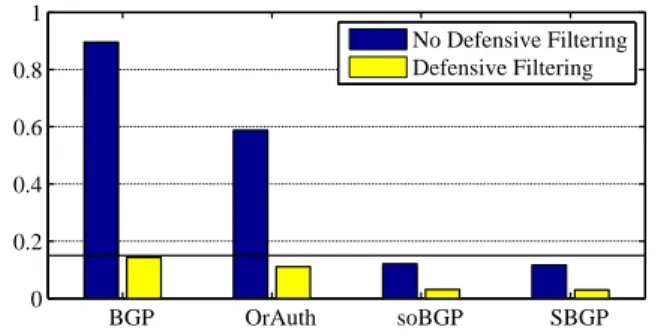
BGP OrAuth soBGP SBGP 0 0.2 0.4 0.6 0.8 1 No Defensive Filtering Defensive Filtering
Figure 2: Lower bounds on the probability of attracting at least 10% of ASes in the Internet.
on business relationships and path length, and that a manipulatormcannot lie to his neighboraabout their business relationship (i.e., between m and a). Thus, intuition suggests that the manipulator’s best strategy is to widely announce the shortest possible path:
“Shortest-Path Export-All” attack strategy. An-nounce to every neighbor, the shortest possible path that isnot flagged as bogus by the secure routing proto-col.
Every “Shortest-Path Export-All” attack strat-egy on S-BGP is also an attack on data-plane verification. The “Shortest-Path Export-All” attack strategy on S-BGP has the manipulator announce his shortestlegitimate available path to the victim, instead of hisnormal path (see Sections 2.3 and 3). Notice that if the manipulator actually decides toforward his traf-fic over the announced path, he has a successful attack data-plane verification as well! Thus, the “Shortest-Path Export-All” attack strategy on data-plane verifi-cation is identical to the attack on S-BGP. (To reduce clutter, the following mostly refers to the attack on S-BGP.)
We underestimate damage. Section 6 shows that the “Shortest-Path Export-All” attack strategy is not
actually optimal for the manipulator, and in Section 7 shows that finding the optimal attack strategy is NP-hard. Thus, we give up on finding the optimal attack strategy, and run simulations assuming that the ma-nipulator uses this smart-but-suboptimal attack. This means that the results reported in this section under-estimate the amount of damage a manipulator could cause, and we usually cannot use these results to di-rectly compare different secure routing protocols. In spite of this, our simulations do provide both (a) useful lower bounds on the amount of damage a manipulator could cause, and (b) a number of surprising insights on the strategies a manipulator can use to attract traffic to his network.
4.2
Defensive filtering is crucial.
Our first observation is that defensive filtering is a crucial part of any Internet security solution:
Figure 2: We show the probability that, for a ran-domly chosen (manipulator,victim) pair, the manipula-tor can attract traffic destined for the victim from at least 10% of the ASes in the Internet. The manipula-tor uses the “Shortest-Path Export-All” attack strat-egy. The first four bars on the left assume that network doesnot use defensive filtering. We show the success of the manipulator’s strategy on each of the four BGP se-curity variants, in network with and without defensive filtering of attacks by stubs. The horizontal line in Fig-ure 2 shows the fraction of attacks that are completely eliminated by defensive filtering; since 85% of ASes in the CAIDA graph are stubs, properly-implemented de-fensive filtering guarantees that only 15% of manipula-tors can successfully attack any given victim.
Despite the fact that our experiments usedsub-optimal
strategies for the manipulator, Figure 2 leads to two concrete observations:
1. Even if we assume the manipulator runs the sub-optimal“Shortest-Path Export-All” attack strategy on a network that has S-BGP (or data-plane verification) but not defensive filtering, he can still attract 10% of the Internet with probability 10%; furthermore, it may be possible that more clever strategies for S-BGP (e.g.,
Figure 11-Figure 12) can increase the manipulator’s prob-ability of success to the point where simple defensive filtering, which is guaranteed to eliminate all but 15% of attacks, performs even better than S-BGP.
2. Even if both S-BGP (or data-plane verification)
and defensive filtering are used, there is still a non-trivial 2% probability that the manipulator can attract 10% of the Internet. Better attack strategies could in-crease this probability even further. This is particularly striking when we compare with the normal case, where the manipulator manages to attract 10% of the Internet with about 10−4probability.
4.3
Attack strategy on different protocols.
The reader may wonder why we chose to focus specifi-cally on the probability of attracting 10% of the Internet in Figure 2. In the interest of full disclosure, we now present the full picture:
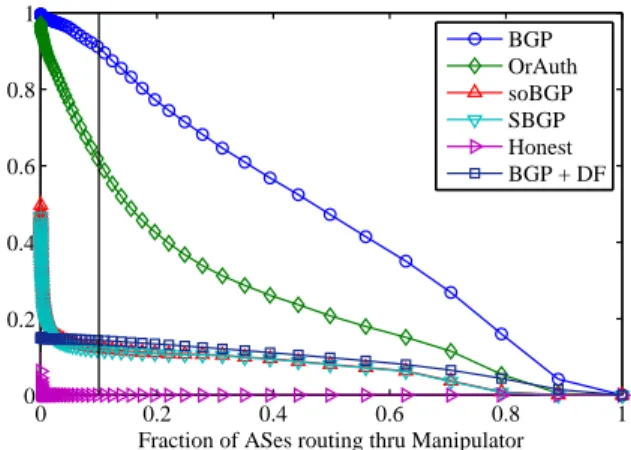
Figure 3: We show the complimentary cumulative distribution function (CCDF) of the probability that at least a x-fraction of the ASes in the Internet forward traffic to the manipulator when he uses the “Shortest-Path Export-All” attack strategy. Probability is taken over the uniform random choice of a victim and manipu-lator, and observe that Figure 2 simply presents a cross-section of these results at the x-axis value ofx= 10%. Because this figure carries quite a lot of information, we walk through a few interesting points:
BGP curve. Here, the manipulatororiginates, i.e.,
announces that he is directly connected to, the victim
0 0.2 0.4 0.6 0.8 1 0 0.2 0.4 0.6 0.8 1
Fraction of ASes routing thru Manipulator
Announce All Attacks from dataset caida2009 manipAny____ Number of samples: 6000
BGP OrAuth soBGP SBGP Honest BGP + DF
Figure 3: CCDF for the “Shortest-Path Export-All” attack strategy.
prefix. This curve looks almost like the CCDF of a uni-form distribution; this makes sense, because the ma-nipulator, and the AS that legitimately owns the vic-tim prefix, both announce one-hop paths to the prefix. Thus, they are on equal footing in a ‘tug-of-war’ to at-tract traffic from the rest of the Internet.
Origin Authentication curve. This time the ma-nipulator announces that he has a direct link to the AS that legitimately owns the victim prefix. Because the manipulator’s path is now two hops long, the amount of traffic he can attract on average is reduced.
soBGP and S-BGP/data-plane verification curves.
For the attack on soBGP, the manipulator announces the shortest path thatexists in the AS graph. For the attack on S-BGP (and data-plane verification), the ma-nipulator announces the shortest available path that he learned from his neighbors. The soBGP and S-BGP curves are almost identical, which seems strange, since S-BGP provides stronger security guarantees than soBGP. We discuss this further in Section 4.4. For now, however, notice that both curves drop off sharply, with a knee aroundx= 2%,y= 15%. This means that 85% of manipulations do not manage to attract more than 2% of the Internet; these numbers roughly correspond to the fact that 85% of ASes in the graph are stubs that fail to attract much traffic with the “Shortest-Path Export-All” attack strategy on soBGP and S-BGP. Meanwhile, betweenx= 2% tox= 60%, both curves tend to flatten out, suggesting that if a manipulator is able to attract at least 2% of the Internet, he is almost equality likely to be able to attract 60%. We spend more time on this observation in Section 4.5.
Honest curve. Here the manipulator behaves ‘nor-mally’; that is, using the ranking and export policies de-scribed in Section 2.2. Observe that this curve looks al-most like a delta-function atx= 0. That is, a randomly-chosen AS is likely to attract only a negligible fraction of the Internet by behaving normally.
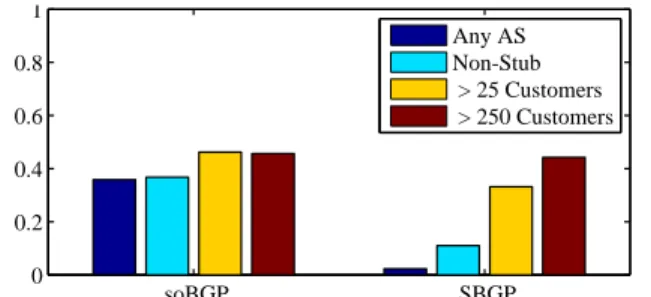
soBGP SBGP 0 0.2 0.4 0.6 0.8 1
Announce All Attack. Pr[Manipulator finds a shorter path]caida2009
Any AS Non-Stub > 25 Customers > 250 Customers
Figure 4: Probability of finding a shorter path. BGP+Defensive Filtering curve. Here, defen-sive filtering is used to eliminate all the “Shortest-Path Export-All” attack strategies on BGP launched by stubs,
i.e., by 85% of ASes. Thus, the ‘BGP+DF’ curve is simply the ‘BGP’ curve scaled down to about 15%.
4.4
S-BGP forces long path announcements.
Figure 2 - 3 shows that S-BGP isnot much more ef-fective in preventing “Shortest-Path Export-All” attack strategies than the less-secure soBGP. To understand why, let’s compare the lengths of the path that the ma-nipulator can announce with soBGP and S-BGP:
Figure 4: We show the probability that the manipula-tor can announce a path that is shorter than thenormal path, i.e., that path he would have chosen if had used the rankings in Section 2.2. Probability is taken over a randomly-chosen victim, and a manipulator that is randomly chosen from one of the following fourclasses: (a) Any AS in the graph, (b) Non-stubs, or ASes with at least one customer (c) Medium-sized ASes with at least 25 customers, and (c) Large ASes with at least 250 customers. If we focus on the results for S-BGP, it is clear thatlarger ASes are more likely to findshorter
paths through the network; this follows from the fact that these ASes are both more richly connected (i.e.,
they have large degree), as well more central (i.e.,they are closer to most destinations in the Internet). Fur-thermore, we can also see that ASes (especially small ASes) are more likely to find short paths with soBGP than they are with S-BGP.
From Figure 4, we can conclude that S-BGP is doing exactly what it is designed to do: it is limiting the set of paths from which the attacker can announce, forcing him to announce longer paths. However, in light of the results in Figures 2-3, we must ask ourselves why forc-ing the manipulator to announce longer paths does not seem to significantly limit the amount of traffic he at-tracts. We could explain by arguing that path lengths in the Internet are fairly short, (averaging about 5 hops in our simulations, see Appendix C); else (averaging about 5 hops in our simulations); so the paths that the manipulator can get away with announcing in soBGP are only a few hops shorter than the paths he can an-nounce with S-BGP. While this is true, the next section
0 0.2 0.4 0.6 0.8 1 0 0.2 0.4 0.6 0.8 1
nnounce All Attacks from dataset data.caida2009.manip250cust.csv Number of samples: 6
Fraction of ASes routing through Manipulator Shortest available path. Export all. Normal path. Export All. Normal path. Normal export.
Figure 5: Aggressive export policies.
shows that there is an even deeper issue here; namely, that the length of the manipulator’s path often plays less of a role than the set of neighbors that he exports to.
4.5
Length matters less than export policy.
We now show that the attacker’s export policy can play a more important role than the length of the path he announces:
Figure 5: We show another CCDF of the probability that at least a x-fraction of the ASes in the Internet forward traffic to the manipulator; probability is taken over a randomly-chosen victim, and a manipulator cho-sen randomly from the class of ASes that have at least 25 customers. We consider three different strategies: (a) Announce the shortest available path to all neigh-bors (equivalent to the “Shortest-Path Export-All” at-tack strategy on S-BGP) (b) Announce the normal path to all neighbors (c) Announce the normal path using the normal (GR2andNE) export policy.
This figure clearly shows that, on average, announc-ing a shorter path is much less important than an-nouncing a path to more neighbors (i.e., the curves for (a) and (b) are very close, while the curves for (b) and (c) are quite far apart). Indeed, when we consid-ered at smaller manipulators (not shown), the curves for (a) and (b) are even closer together. To explain this, consider the following: by violating the normal ex-port policy, the manipulator can announce paths to his providers, even when he does not forward traffic over a customer path. The providers are more likely to choose the customer path through the manipulator, over some possibly shorter, non-customer path that they might have, and so the number of customer paths through the network that are incident on the manipulator in-creases. Since every AS prefers a customer path over a non-customer path, customer paths tend to carry a large volume of traffic to the manipulator.
Thus, Figure 5 teaches us that it is often more im-portant for the manipulator to create customer paths than to createshort paths.
4.6
Tier 2s usually cause the most damage.
de-0 0.2 0.4 0.6 0.8 1 0 0.2 0.4 0.6 0.8 1
Announce to All Attack on BGP
Fraction of ASes routing thru Manipulator Non-Stub
> 25 Customers > 250 Customers
Figure 6: “Shortest-Path Export-All” attack strategy on BGP by different manipulators.
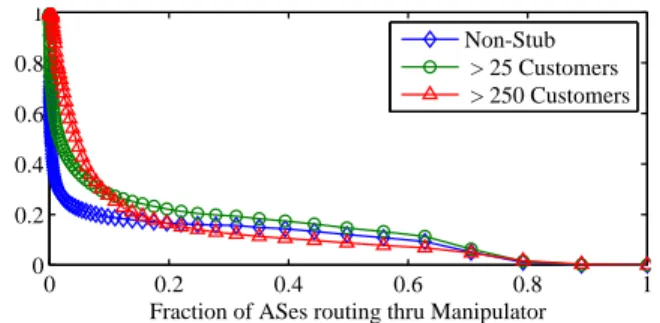
termine which ASes in the Internet are likely to be the most successful manipulators. We consider non-stub manipulators from three different classes: (a) ASes with at least one customer (b) ASes with at least 25 cus-tomers, (roughly modeling “Tier 2 ASes”) and (c) Large ASes with at least 250 customers (“Tier 1 ASes”):
Figure 6: We once again show a CCDF of the proba-bility that at least ax-fraction of the ASes in the Inter-net forward traffic to the manipulator, when the manip-ulator launches the “Shortest-Path Export-All” attack strategy on BGP. Despite the fact that the “Tier 1” manipulators are more central than the “Tier 2s”, we make the surprising observation that “Tier 2s” manage to attract more traffic than than “Tier 1s”. In fact, for certain regimes, even smaller non-stub ASes tend to attract more traffic than the “Tier 1s”!
This bizarre observation is actually easy to explain. In the “Shortest-Path Export-All” attack strategy on BGP, every manipulator (regardless of its size or loca-tion in the network) announce a single-hop path to the victim prefix. Thus, announced path length does not
play a role when we compare across classes of manipu-lators. On the other hand, despite their centrality, Tier 1 ASes are more expensive to route through than every other AS in the Internet; a Tier 1 is always a provider or peer of its neighbors, so even if those neighbors learn a short path through the Tier 1, they will prefer to route over a (potentially longer) path through one of their own customers. Furthermore, Tier 2’s more central and richly connected than smaller ASes on the edge of the Internet, and thus they tend to attract more on average then the smaller non-stub.
The reader may be troubled by the fact that the (red triangle) curve for the manipulators with at least 250 customers has a different shape than the other curves in Figure 6. We saw exactly this effect on all our exper-iments across different datasets, and one main reason it occurs is because the AS graph we used only has 34 ASes (out of a total of 33K ASes) that have at least 250 customers; this is consistent with the idea that are about 12 (or so) Tier 1 ASes in the Internet. Because we had so few manipulators to choose from, the effect
0 0.2 0.4 0.6 0.8 1 0 0.2 0.4 0.6 0.8 1
Fraction of ASes routing thru Manipulator Announce All Attack on SBGP
Non-Stub > 25 Customers > 250 Customers
Figure 7: “Shortest-Path Export-All” attack strategy on S-BGP/data-plane verification by different manipulators.
of individual manipulators on the results become more pronounced, and the curves become less ‘smooth’.
4.7
S-BGP is vulnerable to non-stubs.
The picture for origin authentication looks about the same Figure 6. However, the results change when we look at soBGP and S-BGP/data-plane verification. Since, as usual, our results for soBGP and S-BGP look about the same, we only discuss S-BGP:
Figure 7: This is the CCDF for S-BGP/data-plane verification (cf., to Figure 6). “Tier 2” manipulators usually come out on top, except when we consider ma-nipulations that attract 10% of the Internet or less. In this regime, the Tier 1 ASes come out on top, so that the S-BGP curve mimics normal behavior (not shown). Tier 1s tend to attract more traffic than others when ev-eryone is normal, because they are likely to have short customer paths they can announce to all of their (many) neighbors.
4.8
Summary.
In some sense, the results of this section suggest that secure routing protocols like S-BGP and soBGP are only dealing with one half of the problem: while they do restrictthe path the manipulator can choose to an-nounce, they fail to restrict his export policies. Indeed, this observation has a number of implications:
1. Because defensive filtering restricts both the export policies and the paths announced by stubs, we find that it provides a level of protection that is at least compa-rable to that provided by S-BGP, and even data-plane verification, alone.
2. Even if we eliminate attacks by stubs, Figures 6 -7 show that the Internet is still vulnerable to non-stub ASes that both (a) deviate from normal routing policies by announcing shorter paths, and (b) deviate from nor-mal export policies by announcing non-customer paths toall their neighbors. Furthermore, more clever export policies (rather than simply exporting to all) to could lead to better attacks, (e.g.,Figure 12).
Blackhole counterexample
Manip loses both his provider paths by announcing to a provider
209 3356 174 8999 Prefix 26895 47005 Prefix Honest Honest Blackhole counterexample
Manip loses both his provider paths by announcing to a provider
209 3356 174 8999 Prefix 26895 47005 Prefix Announce all Announce all Blackhole counterexample
Manip loses both his provider paths by announcing to a provider
209 3356 174 8999 Prefix 26895
X
47005 Prefix Don’t announce to 3356 Don t announce to 3356 Blackhole counterexampleManip loses both his provider paths by announcing to a provider
209 3356 174 8999 Prefix 26895 47005 Prefix Don’t announce to 26895 Don’t announce to 26895
Figure 8: (a) Normal outcome. (b)-(d) Black-hole.
can launch the most effective “Shortest-Path Export-All” attack strategies.
5.
SMART INTERCEPTION ATTACKS
We now turn our attention to traffic interception at-tacks [1, 2, 4]. In an interception attack, the manipu-lator would like to attract as much traffic as possible to his network (in order to eavesdrop or tamper with traffic) before forwarding it on to the victim IP prefix. Thus, we require that an interception attackpreserves an available path from the manipulator to victim.
5.1
A stub that creates a blackhole.
To provide some intuition, we first show how a ma-nipulator could lose a working path to a victim:
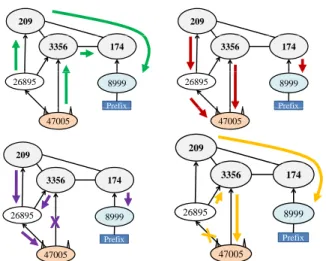
Figure 8: For simplicity, let’s consider an attack on BGP where the manipulator falsely originates the victim’s prefix. The manipulator, AS 47005, a web-hosting company in Illinois, wants to attract traffic des-tined for the victim, AS 8999, a web-hosting company in France. The manipulator is a multi-homed stub with two providers, Level 3 Communication’s AS 3356, and AS 26895, a Chicago-area telecom provider. The left figure shows the normal outcome, where the manipula-tor has a path to victim available through each of his providers. The right figure shows what happens when the manipulator announces the victim’s prefix to each of his providers; since each of them prefer short cus-tomer paths, they will forward their traffic through the manipulator. The manipulator has now created a black-hole; he has no available path to the victim AS 8999 through either of his providers. Suppose now that the manipulator tried to be a little more clever, and didnot
announce the victim’s prefix to his Tier 1 provider AS 3356. Unfortunately for the manipulator, this strategy still creates a blackhole. As show in the bottom left (purple) figure, AS 3356 will prefer his customer path
through manipulator (3356, 26895, 47009, Prefix) over his peer path to the legitimate prefix (3356, 174, 8999, Prefix). Thus, both the manipulator’s providers will still forward their traffic to the manipulator, and the blackhole remains. It is easy to see that a blackhole also occurs when the manipulator only announces the victim prefix to his local provider AS 26895 (see the bottom right (orange) figure).
5.2
When do interception attacks succeed?
The reader may be surprised to learn that are many situations in which blackholes are guaranteed not to occur. We can prove that, within our model of rout-ing policies, the manipulator can aggressively announce paths to certain neighbors while still preserving a path to the victim:
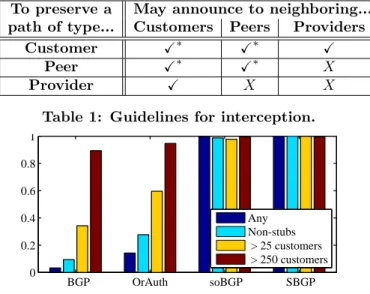
Theorem 5.1. Assume thatGR1holds, and that all
ASes use the routing policies in Section 2.2. Suppose the manipulator has an available path through a neigh-bor of a typexin the normal outcome. If there isX in entry(x, y)of Table 1, then a path through that neighbor will still be available, even if the manipulator announces
any path to any neighbor of typey.
Appendix G presents the proofs, and we note that the results marked with X∗ do not require GR1 to hold. This theorem is ‘sharp’, in the sense that if there is an
X in entry (x, y) of Table 1, we can show that manipu-latorcan sometimes lose an available path of typexif he announces certain paths to a neighbor of type y; in-deed, Figure 8 is proof of theX in the lower-right entry of Table 1. While results of this form were presented in an earlier work [1], their work claims that a peer-path
cannot be lost by announcing to a provider (and vice versa). Appendix E presents an example contradict-ing [1]’s claim, and provcontradict-ing the remaincontradict-ing X entries in Table 1.
Tier 1s and Stubs. Theorem 5.1 leads to a number of observations, also noted by [1]. First, interception is easy for Tier 1s. Since Tier 1s have no providers, they need only concern themselves with the four upper-left entries in Table 1, which indicate that they can announce paths to all their neighbors. Secondly, inter-ception is hard for stubs. A stub’s neighbor is always a provider, putting it in the bottom-right entry of Ta-ble 1, indicating that aggressive announcements could cause a blackhole (e.g.,Figure 8).
5.3
When do “Shortest-Path Export-All”
at-tack strategies cause a blackhole?
The observations of Section 5.2-5.4 are borne out by our experiments. Recall that in the “Shortest-Path Export-All” attack strategy on a BGP security variant, the manipulator announces his shortest (non-rejected) to all of his neighbors. We now show, that this simple
To preserve a May announce to neighboring... path of type... Customers Peers Providers
Customer X∗ X∗ X
Peer X∗ X∗ X
Provider X X X
Table 1: Guidelines for interception.
BGP OrAuth soBGP SBGP 0 0.2 0.4 0.6 0.8 1
Announce All Attack. Pr[isAnyDataPlanePathAvailable== TRUE]
Any Non-stubs > 25 customers > 250 customers
Figure 9: Probability that the “Shortest-Path Export-All” attack strategy does not create a blackhole.
attack strategy often allows the manipulator to inter-cept traffic without creating a blackhole:
Figure 9: We show the probability that the manipu-lator has some available path to the victim if he uses the “Shortest-Path Export-All” attack strategy for each of the four BGP security variants. We present results for a randomly-chosen victim, and a manipulator chosen from the usual four classes (see Figure 4). We assume that manipulator runs the “Shortest-Path Export-All” attack strategy on each BGP security variant. We can make a number of observations:
1. Manipulators with the most customers are least
likely to create a blackhole. As discussed in Section 5.2, these manipulators are most likely to have an available customer path to the victim, and as shown in the first row of Table 1, can get away with announcing to all
their neighbors without creating a blackhole.
2. The attack on BGP is most likely to cause a blackhole (cf., the attack on origin authentication, or soBGP). Because the manipulator announces a more attractive (i.e.,short) path in his attack on BGP, he is more likely to convinceall of his neighbors to forward traffic to him, and thus create a blackhole.
We note that our empirical results generally agree with Theorems 5.1; whenever there was a gap between the two, we found a customer-provider loop (i.e., a vi-olation of GR1) in the AS graph that we used for run-ning our simulations. We are not particularly troubled by this gap, since the algorithms used to produce AS re-lationship graphs from empirical data [9, 10] sometimes introduce artifacts like customer-provider loops.
5.4
Interception by announcing available paths.
Figure 9, and other simulation results (not shown)
also indicates that the “Shortest-Path Export-All” at-tack strategy on S-BGP,never creates a blackhole (as long as the manipulator had a path to the victim in the normal outcome). This observation matches intu-ition; since S-BGP forces the manipulator to announce an available path, the manipulator must of course have an available path to the victim! Indeed, we conjecture that is is possible to prove a more general statement that impliesevery successful attraction attack strategy on S-BGP is also an interception attack. That is, sup-pose ASes use the routing policies in Section 2.2 and
GR1 holds, and considerany pathP that is available to the manipulator in the normal outcome. Then path
P remains available if the manipulator announcesP to
any subset of his neighbors. We leave the proof of such a statement to future work.
5.5
Two interception strategies.
Figure 9 immediately suggests a simple interception strategy that seems to work every time:
“Shortest-Available-Path Export-All” attack strat-egy: The manipulator should announces his shortest
availablepath from the normal outcome to all his neigh-bors. Recall that this is exactly the “Shortest-Path Export-All” attack strategy on S-BGP.
Figure 3, shown that this strategy attracts more traf-fic than the normal strategy, but also suggests that when the network doesnotuse S-BGP, there may better interception attack strategies. Indeed, Figure 9 shows that there is a non-trivial probability that the manip-ulator has an available path to the victim, even if he launches the “Shortest-Path Export-All” attack egy on the BGP. This suggest the following simple strat-egy:
“Hybrid Interception” attack strategy: First, run the “Shortest-Path Export-All” attack strategy on the secure routing protocol, and check if there is an available path to the victim. If no such path is available, announces the shortest path that was available in the normal outcome to all neighbors.
By no means do we believe that these two strategies are optimal; indeed, we evaluated more clever attack strategies, but decided to omit them from this paper in the interest of brevity and simplicity. What is surprising is that even these trivial strategies can be quite effective for certain manipulators.
5.6
Evaluating interception strategies.
From the discussion above (Figures 8- 9, Section 5.2), it is clear that ASes with very few customers are unlikely to attract large volumes of traffic without blackholing themselves. For this reason, we focus our evaluation on manipulators with at least 25 customers, and for brevity only present attacks on BGP:
0 0.2 0.4 0.6 0.8 1 0 0.2 0.4 0.6 0.8 1
BGP from dataset .caida2009.manip25cust
. Number of samples:172722
Fraction of ASes routing thru Manipulator Announce All
Hybrid Interception
Shortest Available Path Announce All Honest
Figure 10: Interception attacks on BGP. Figure 10: This is a CCDF of the probability that at least ax-fraction of the ASes in the Internet forward traffic to the manipulator, under the assumption that the network uses BGP. We compare the (a) “Shortest-Path Export-All” attack strategy strategy where the manipulator is allowed to create a blackhole, with (b) the two interception strategies above, as well as (c) the normal strategy. Our key observation here is that the “Hybrid Interception” attack strategy manages to in-tercept a large fraction of traffic; e.g., at least 10% of the Internet with probability over 50%!
5.7
Summary.
On average, traffic interception is difficult for stubs, but a manipulator with many customers can quite eas-ily launch an interception attack. Indeed, manipulators with many customers can intercept a large volume of traffic with even the highly non-optimal “Hybrid In-terception” attack strategy. Furthermore, as we shall discuss in Section 6, there may be more clever traffic in-terception attacks that allow the manipulator to attract even larger portions of the Internet, and some of these strategies may even work for stubs (e.g., Figure 11)!
6.
SMART ATTACKS ARE NOT OPTIMAL
We now prove that the “Shortest-Path Export-All” attack strategy isnot optimal for the manipulator. We present three surprising counterexamples4, found in CAIDA’s
AS graph, that show that (a) announcinglonger paths can be better than announcing shorter ones, (b) an-nouncing to less neighbors can be better than to an-nouncing to more, and (c) theidentity of the ASes on the announced path matters, since it can be used to
strategically trigger BGP loop detection. In fact, (c) also proves that announcing a longer path can be better than a prefix hijack (where the manipulator originates a prefix he does not own)!
4
Notice how each example was chosen to contradict the op-timality of one aspect of the “Shortest-Path Export-All” attack strategy. scriptCtrexLongPaths.txt NAÏVE (green) : 5569 nodes routing thru manip CLEVER (purple) : 18663 nodes routing thru manip 3356 Prefix 2546 AS 6830 3320 2914 ASes 702 13030 7 providers 464 customers 46 peers 3 providers 960 customers 106 peers 3 providers 43284 p 20984 scriptCtrexLongPaths.txt NAÏVE (green) : 5569 nodes routing thru manip CLEVER (purple) : 18663 nodes routing thru manip 3356 3236 Prefix ASes 6830 3320 2914 702 13030 7 providers 464 customers 46 peers 3 providers 960 customers 106 peers 3 providers 43284 p 1682 20984 1682 peer & customer
Figure 11: Announcing a longer path.
6.1
Attract more by announcing longer paths!
Our first example is for a network with soBGP, S-BGP or data-plane verification. We show a manipulator that triples his attracted traffic by announcing a legit-imate path to the victim, that is not his shortest path. In fact, this strategy is so effective, that it attracts al-most as much traffic as an aggressive prefix hijack on unmodified BGP!
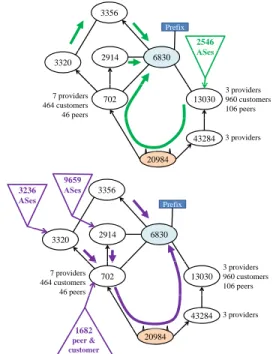
Figure 11: The manipulator, AS 20984, is a small stub AS in Basel, Switzerland, that has one large provider, AS 702 owned by Verizon and having degree over 500, and one small provider, AS 43284 owned by Industrielle Werke Basel and having degree only four. The victim is European broadband provider AS 6830.
Prefix hijack. In a network with (unmodified) BGP, the manipulator could run a simple prefix hijack, an-nouncing “20984, Prefix” to both his providers, and at-tract traffic from 62% of the Internet, exactly 20550 ASes. However, this strategy both creates a blackhole at the manipulator, and fails against soBGP or S-BGP.
Naive strategy. The upper (green) figure shows the “Shortest-Path Export-All” attack strategy, where the manipulator naively announces athree-hopavailable path, (20984, 702, 6830, Prefix) to his provider 43284. Since ASes 43284 and 13030 prefer the customer path to that manipulator, over their existing peer paths, both will forward traffic to the manipulator. He intercepts traffic from 16% of the Internet, or exactly 5569 ASes.
Clever strategy. The lower (purple) figure shows the manipulator cleverly announcing a four-hop avail-able path (20984, 43284, 13030, 6830, Prefix) to his provider AS 702. AS 702 will prefer the longer
cus-tomer path through the manipulator over his shorter peer connection to AS 6830, but this time, the manip-ulator triples the amount of traffic he attracts, inter-cepting traffic from a total of 56% of the Internet, or exactly 18664 ASes. In fact, by announcing a longer path, the manipulator earns almost as much traffic as the aggressive prefix hijack.
Why it works. Notice that the manipulator’s provider Verizon’s AS 702 has hundreds more neighbors then his other provider, AS 43284, and that the clever strategy attracts Verizon’s AS 702 while the naive strategy at-tracts AS 43284. Attracting traffic from the larger AS is crucial to the manipulator’s success; in fact, it is more important than announcing short paths.
Details. Figure 11 shows that in the naive (green) strategy, Verizon’s two providers AS 3320 and AS 2914 route alongpeer paths that do not go through the ma-nipulator, and can thus announce paths to their cus-tomers only. On the other hand, in the clever strategy, Verizon’s two providers, use customer paths through the manipulator; as such, they can announce paths to their customers, peers and providers, and each carry a large volume of traffic (from almost 13K ASes). Thus, in clever (purple) strategy, the manipulator attracts traffic from almost 1.7K ASes that route through Ver-izon’s AS 702 along customer or peer paths, as well as 13K ASes that route through Verizon’s providers, ASes 3320 and 2914. On the other hand, in the naive (green) strategy, the manipulator attracts traffic from about 2.5K ASes that are AS 13030’s customers, peers and providers; these 2.5K ASes do not route through the manipulator when he uses the clever (purple) strat-egy. Thus, in the naive (green) strategy, the attacker gains traffic from 2.5K ASes, while in the clever (pur-ple) strategy on the right, the manipulator gains traffic from about 3.2K + 9.6K + 1.7K ASes, for a difference of 3.2K + 9.6K + 1.7K - 2.5K = 12K ASes. The ba-sically accounts for the fact that the naive strategy on the right attracts traffic from only 5K nodes, while the clever strategy attracts traffic from 18K nodes.
When it works. This strategy only involves deviat-ing from normal export policy, rather thanlying about paths. Thus, it succeeds againstanysecure routing pro-tocol (except when it is launched by stubs in a network with defensive filtering).
6.2
Attract more by exporting less!
This example is for a network with origin authenti-cation, soBGP, S-BGP, data-plane verifiauthenti-cation, and/or defensive filtering. We show a manipulator that inter-cepts 25%more traffic by exporting toless neighbors.
Figure 12: The victim is AS 29993, a stub serving a liberal arts college in Illinois. The manipulator is AT&T’s AS 7132, and is in competition with the vic-tim’s other provider AS 6325, a local ISP in Illinois.
scriptCtrexFilter.txt
NAÏVE (green) : 13463 nodes thru manip CLEVER (purple) : 16658 nodes thru manip
466 ASes 1527 ASes 2055 ASes 6399 ASes 174 1299 Tier 1 ASes 1299 174 1597 ASes ASes308 174 1299 2828 1239 174 1299 2828 1239 2828 1239 1239 2828
X
7132 6325 6325 7132 29993 29993 Prefix PrefixFigure 12: Exporting less.
The manipulator wants all the traffic destined for the victim to flow through his own AS.
Naive strategy. The “Shortest-Path Export-All” attack strategy requires the manipulator to announce his path to all his neighbors. On the left, when the ma-nipulator announces a path to provider AS 2828, both AS 2828 and its two Tier 1 providers will route through the manipulator. As a result, the two Tier 1’s use four-hop paths to the victim, and the manipulator attracts traffic from 40% of the Internet,i.e., 13463 ASes.
Clever strategy. On the right, the manipulator in-creases his traffic volume by almost 25%, by not ex-porting to his provider AS 2828. Because AS 2828 no longer has a customer path to the victim, he is forced to use a peer path through AS 1239. Because AS 2828 now uses a peer path, he will not export a path to to the two Tier 1 ASes 1299 and 174. The Tier 1s are now forced to choose a shorter three-hop peer path to vic-tim through the manipulator. Because the two Tier 1’s now announce shorter paths to their customers, they become more attractive to the rest of the Internet, the volume of traffic they send to the manipulator quadru-ples, and the manipulator attracts 50% of the Internet,
i.e.,16658 ASes.
Why it works. The manipulator’s strategy forces influential ASes (i.e., Tier 1s) to choose shorter peer paths over longer customer paths. He does this by
suppressing announcements to certain providers, thus eliminating certain customer paths from the Internet.
Details. To account for change in traffic through the manipulator, notice that in the naive (green) strat-egy, AS 7132 attracts traffic from about 0.5K ASes that route through Tier 1 AS 1299 and 1.5K ASes that route through Tier 1 AS 174, and 1.6K other ASes that route through AS 2828. In the clever (purple) strategy on the right, the two Tier 1’s announce shorter paths and attract traffic from a total 8.4K ASes. Meanwhile, AS 2828, who no longer forwards traffic through the manip-ulator, only attracts traffic from about 300 ASes; this sharp decrease in traffic flowing through AS 2828 fol-lows from the fact that in the clever strategy, AS2828 uses a peer path to the victim, and thus will no longer
NAÏVE Prefix Hijack (green) : 32010 nodes FILTER Break link to 25953 (red) : 30028 nodes CLEVER False Loop Prefix Hijack (purple): 32370 nodes
3561 209 852 721 4436 27064 25653 27085 25885 745 Prefix
NAÏVE Prefix Hijack (green) : 32010 nodes FILTER Break link to 25953 (red) : 30028 nodes CLEVER False Loop Prefix Hijack (purple): 32370 nodes
209 3561 721 852 27064 4436 27085 25653 25885 745 Prefix “25885, 4436, Prefix”
Figure 13: False loop prefix hijack.
accept traffic from its peers and providers. Thus, in the clever strategy, the attacker gains traffic from 8.4K -.3K ASes, and in the naive strategy the attacker gains traffic from .5K + 1.5K + 1.6K ASes, for a difference of 4.5K ASes; this roughly accounts for the 25% increase in traffic that the manipulator attracts by using the clever strategy.
When it works. This strategy only involves using a clever export policy, rather than lying about paths, and therefore succeeds againstany protocol, including data-plane verification.
6.3
Attract more by gaming loop detection!
To show that the identity of the ASes on the an-nounced path can affect the amount of attracted traf-fic, our last example involves gaming BGP loop detec-tion. While gaming loop detection was explored in other works,e.g., [2, 4, 3], what is remarkable about this ex-ample is that it proves that this attack strategy can attract more traffic than an aggressive prefix hijack.
Figure 13: The manipulator is AS 25885, a stub in Clifton, NJ with two providers. This figure only depicts his NJ-area provider, Fortress ITX AS 25653. The ma-nipulator wants to blackhole traffic destined for AS 745, a stub in Alabama.
Standard prefix hijack. The manipulator announces the path (25885, Prefix) and attracts traffic from the most of the Internet, exactly 32010 ASes. Notice also that because AS 3561 prefers customer paths, this large AS will chose to forward his traffic along the five-hop
customer path through the manipulator.
False loop prefix hijack. The manipulator claims that innocent AS 4436 originates the prefix, announc-ing (25885, 4436, Prefix) to Fortress ITX AS 25653. However, when thisfalse loopis announced to AS 4436, BGP loop detection will cause AS 4436 to reject the path through Fortress ITX AS 25653. As a result, AS 3561 has no customer path to the prefix, and instead chooses to forward traffic along the shorter peer path. Now, AS 3561 announces a shorter, four-hop path to his neighbors (3561, 25653, 25885, 4436, Prefix), mak-ing him more attractive to the rest of the Internet, and attracting more traffic to the manipulator. For this, and other reasons that are discussed in Appendix D, the manipulator attracts 360 more ASes than standard
c2
m
Prefix d
c2
Figure 14: DILEMMA for proving hardness.
prefix hijack,i.e.,32370 ASes.
Why it works. The manipulator games BGP loop detection, effectively ‘removing edges’ from the network, to force influential ASes (i.e.,Tier 1s) to chose shorter peer paths over longer customer paths.
When it works. This strategy involves lying about the path an innocent AS announces to the victim, in or-der to trigger BGP loop detection. Because S-BGP and data-plane verification prevent lying about the paths, this strategy only works with BGP, origin authentica-tion, or soBGP.
7.
FINDING OPTIMAL ATTACKS IS HARD
After all the bizarre attack strategies in Section 6, the reader might not be surprised by the following:
Theorem 7.1. If ASes use the routing policies of
Sec-tion 2.2, then finding a manipulator’s optimal traffic attraction attack strategy is NP-hard.
This theorem holds for (a) any of secure protocols vari-ants and (b) also extends to interception attacks; our proof, which is sadly relegated to Appendix F, uses a reduction to the problem of finding the maximum inde-pendent set in a graph.
In Appendix F, we also show that it is hard to even
approximate the optimal attack within a constant fac-tor; thus we cannot even design an algorithm that gets “close” to the optimal attack on a general AS graph. These results imply that we are unlikely to be able to fully characterize the manipulator’s optimal attack strategy. Thus, any analysis of traffic attraction at-tacks will have to resort the techniques we used here — investigating smart but suboptimal attacks via specific observations about about the Internet AS graph.
Proof technique (Fig. 14). Our proof proceeds in two stages: we first use a special network gadget we call DILEMMA to reduce our problem to the problem of finding the maximum independent set in a graph. We then show how a DILEMMA can exist for different secure routing protocols and types of attacks we con-sidered in this paper. In DILEMMA, the manipulator
mwants to attract the traffic for the victimdfrom two influential ASesc1 andc2, whose carry traffic from the
majority of the network. A DILEMMA construction must guarantee that m can attract each of the ASes individually, but cannot attract both ASes simultane-ously. Details are in Appendix F.