VOLUME 18 ISSUE 3 (2020), Page 326 – 337
THE ATTRIBUTES OF FUTURE SOCIAL LEARNING BUILT
ENVIRONMENTS TOWARDS 21st CENTURY EDUCATION IN
TERTIARY EDUCATION
V. Ramu1, Nooriati Taib2, Nor Fadzila Aziz3
1,2,3 School of Housing, Building and Planning
UNIVERSITI SAINS MALAYSIA
Abstract
In the past two decades, the transformation that has captured tertiary education worldwide is a significant task mentioned as “academic evolution”. Whereby, the vast exploitation of Information and Communication Technology (ICT) explicitly mentioned as artificial intelligence (AI), digitisation, automation and Internet of Things (IoT) articulate the term Industry 4.0. Furthermore, the application of ICT in teaching and learning foster a new learning theory designated as Connectivism. Hence, there are needs in the formulation of an ideal and compatible classification of a social learning environment to accommodate the new learning theory, which enhances the informal learning undertaken by learners besides their formal lecture hours. Therefore, this study aims to seek factors that influenced learners’ preferences toward social learning spaces. A qualitative study was adapted to investigate the learner’s preferences attributes on social learning spaces at Polytechnics. An adapted questionnaire consisting of 39 items was administered to 300 Polytechnic students from three Polytechnics in Malaysia. In particular, data were analysed using exploratory factor analysis (EFA) with IBM SPSS version 22. The results from this research recommended a typology of six social learning space preferences attributes as a multidimensional construct with its two underlying dimensions: physical preferences and social preferences. The findings can help in redesigning and planning of social academic learning space in tertiary education institutions to enhance education towards 21st Century Education.
INTRODUCTION
In considering upcoming education trend disciplines, current learners and graduates shall be developed to face the challenges towards Industrial Revolution 4.0 and academic revolutions (Mohayidin et al., 2014). Imperatively, the extensive consumption of the Information and Communication Technology (ICT) and rapid developments in technologies such as artificial intelligence (AI), digitalisation, automation, big data, data sciences, robotics and Internet of Things (IoT), coining the term of Industry 4.0 (Freigang et al., 2018; Ministry of Higher Education, 2018; Puncreobutr, 2016). Therefore, the emerging technological breakthrough emphasises the urge to redesign an ideal and compatible academic learning space and has been a crucial debate topic among academician across the globe (Ibrahim, Fadzil, & Saruwono, 2013; Nenonen, 2015; Yap, Neo, & Neo, 2016). Thus, tertiary education is now moving ahead from boundaries looking into the requirements and compatibility of Next-Generation Learning Space whereby, merged by different types of the learning environment.
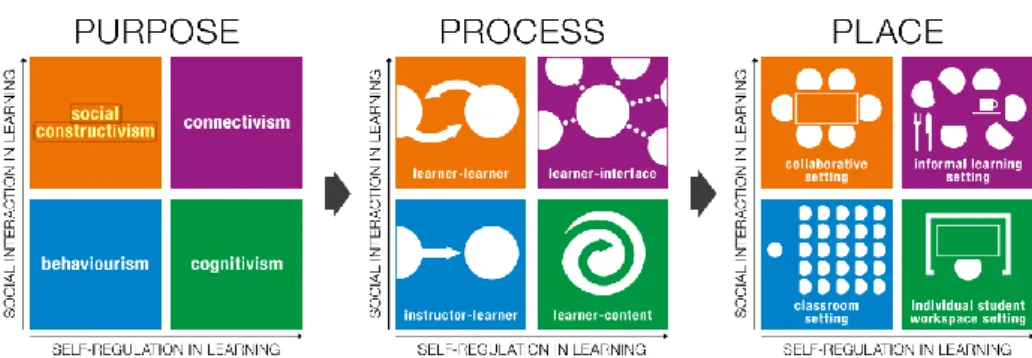
In this study, the focus will be distinguishing the impact factors that have influenced on learner’s learning space preferences attributes towards social learning spaces. Pointed out in the literature, traditional learning theories named as behaviourism, cognitivism, and social constructivism occurred without technology in teaching and learning in schools (Beckers, 2016) (refer figure 1). Consequently, the application of ICT in teaching and learning produced a new learning theory, termed as Connectivism (Goldie, 2016; Marais, 2011; Siemens, 2005). According to Siemens (2005), connectivism is not only learning from peers but learning in the contacts as well, especially from social, digital or virtual networking. Hence, an active social learning space is needed.As coined by Downes (2007), connectivism consummate the needs of 21st-century learner’s skills where learners progress far away from content expenditure into critical thinking, collaboration, and content formulation.
Figure 1: Purpose-process-place framework for education
LITERATURE REVIEW
As mentioned by Brown & Lippincott (2003), at present more learning activities accorded out-of-classroom learning than ever before. The statement above emphasises the foremost part of social learning spaces in learner’s daily life on urban campus. This point of view directs that it is crucial to explore the new concept of informal learning space which is synonymous to social learning space. No doubt, informal learning has been appearing at all levels (Cunningham & Walton, 2016) and promotes and enhances student’s engagement, learning experiences, self-regulated learning and collaborative learning as well (Amit Kumar, 2015; Dole et al., 2016; Wilson & Cotgrave, 2016). Currently, students in higher education are utilising transitional spaces such as foyers, internal corridors, hallway, external corridors, gazebo, pavilion, terrace and square as their social learning space in managing their learning activities. Pointed out in the literature, the behavioural factors of students and the functional attributes of learning space are influencing the selection of social learning space (Baker, 1968). Therefore, this scenario urges the researchers and academicians around the globe to explore the importance of social learning built environments towards 21st-century education.
Imperatively, how learners utilise the social learning space and how it can be a redesign for future educational planning need to take into consideration so that can be aligned with education 4.0 (Hunter & Cox, 2014).The recent trend of online learning results in possibilities of learning anywhere with regards to the support of wireless internet connection. The long hours of online learning will now require a conducive environment to support learner’s concentration on the dependency on electronic gadgets, commonly laptops and smartphones. Cunningham & Walton (2016) explained that social learning space as a third space and blend area where learners able to concentrate autonomously and mingle with peers. The nature of informal learning style should encourage connectivity and conversation through social activities and sometimes spontaneous acts within the environment setting itself. Boys (2010), claimed that there were “almost” no records regarding this research on this area. Therefore, research needs to be done in order to explore the usefulness and effectiveness of the new emerging learning built environment.
METHOD
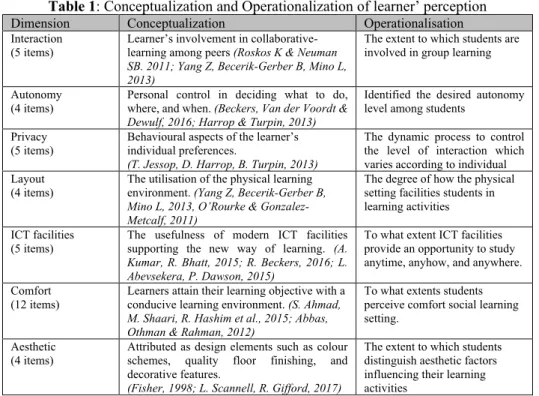
pathways are equally valued and cultivated (Kementerian Pendidikan Malaysia, 2015). The focus population in this research is Malaysian Polytechnic students who studying in three Polytechnics: Ungku Omar Polytechnic established in 1969, Sultan Abdul Halim Mu’Adzam Shah Jitra Kedah established in 1987, and Seberang Prai Polytechnic established in 1999. In addition, several institutions in Malaysia are located in sub- urban areas where accessibility to public facilities such as parks or open space may be limited. In addressing this limitation, research needs to be executed in order to explore the learners social learning space preferences attributes. This survey research involves (N=300) full-time diploma students which comprise technical and non-technical academic programmes. In detail, the technical academic programme consists of diploma in Architecture, diploma in Electrical, diploma in Marine Engineering, and diploma in Mechanical Engineering. Meanwhile, the non-technical academic programme consists of diploma in commerce, diploma in Islamic Banking, diploma in accounting, and diploma in Marketing. The questionnaire that developed to acquire research data which encompasses two parts- Part A and B. Part A involves questions associated with learners’ demographics. Part B of the survey related to learner’s preferences on social learning space entailing of seven constructs adapted from Beckers, van der Voordt, & Dewulf (2016); Yang, Becerik-Gerber & Mino (2013); Kumar & Bhatt (2015); Beckers et al., (2016); Wilson & Cotgrave (2016); Kamis et al. (2015); Ibrahim, Fadzil & Saruwono (2013). The students were clustered based on the semester for each department from three selected polytechnic and a consensus number of 100 students (4 semesters) were randomly selected from each polytechnic. In sum, a total of 300 students were chosen for the Exploratory Factor Analysis (EFA).
INSTRUMENTATION
Table 1: Conceptualization and Operationalization of learner’ perception
Dimension Conceptualization Operationalisation
Interaction
(5 items) Learner’s involvement in collaborativelearning among peers (Roskos K & Neuman -SB. 2011; Yang Z, Becerik-Gerber B, Mino L, 2013)
The extent to which students are involved in group learning
Autonomy
(4 items) Personal control in deciding what to do, where, and when. (Beckers, Van der Voordt & Dewulf, 2016; Harrop & Turpin, 2013)
Identified the desired autonomy level among students
Privacy (5 items)
Behavioural aspects of the learner’s individual preferences.
(T. Jessop, D. Harrop, B. Turpin, 2013)
The dynamic process to control the level of interaction which varies according to individual Layout
(4 items)
The utilisation of the physical learning environment. (Yang Z, Becerik-Gerber B, Mino L, 2013, O’Rourke & Gonzalez-Metcalf, 2011)
The degree of how the physical setting facilities students in learning activities
ICT facilities (5 items)
The usefulness of modern ICT facilities supporting the new way of learning. (A. Kumar, R. Bhatt, 2015; R. Beckers, 2016; L. Abevsekera, P. Dawson, 2015)
To what extent ICT facilities provide an opportunity to study anytime, anyhow, and anywhere.
Comfort (12 items)
Learners attain their learning objective with a conducive learning environment. (S. Ahmad, M. Shaari, R. Hashim et al., 2015; Abbas, Othman & Rahman, 2012)
To what extents students perceive comfort social learning setting.
Aesthetic (4 items)
Attributed as design elements such as colour schemes, quality floor finishing, and decorative features.
(Fisher, 1998; L. Scannell, R. Gifford, 2017)
The extent to which students distinguish aesthetic factors influencing their learning activities
Source: Author
ANALYSIS
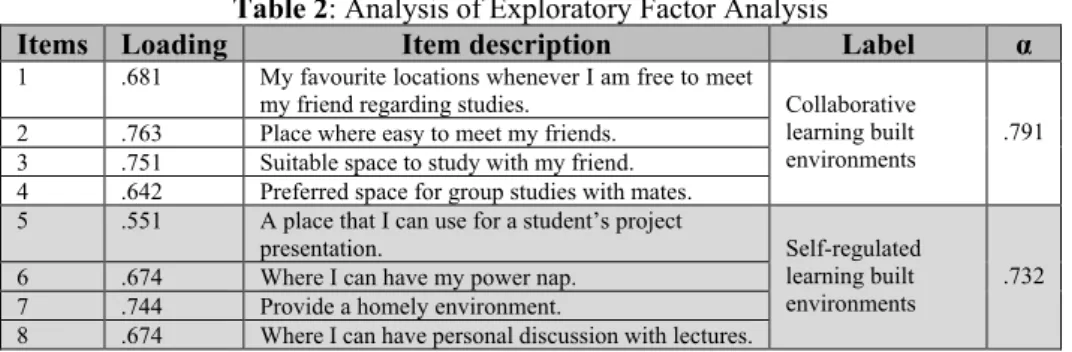
SPSS Version 22.0 is used to enter all the data from the questionnaire. Principal components extraction method and varimax orthogonal rotation were implemented in order to attain the uncorrelated extracted factors with the eigenvalues greater than 1.0. More concisely, standardised factor loading and Cronbach’s alpha are two statistical measures used to examine the extracted factor structures of each variable. The cut-off value for standardised factor loading is .50 (Hair et al., 2014) and above whereas Cronbach’s alpha is .70 and above (Peterson, 2013; Thien et al., 2014)
RESULTS
learner’s preferences towards social learning spaces namely (a) collaborative learning space, (b) self-regulated learning space, (c) private space, (d) ICT provision conducive space, (e) adequate amenities space, and (f) appealing design and layout space. Based on table 2, the loading factor for each item fluctuated from .81 to .55, which above the cut-off value of .50 (Hair et al., 2014). Meanwhile, those items loaded below the cut-off value of .50 were excluded namely item 12, item 18, item 32, and item 35. In addressing this limitation, item 15, item 16, and item 17 were forced to be deleted due to the Cronbach’s Alpha .224 below the permissible level after running the reliability analysis.
As a result, the first factor encompassed items 19, 20, 21, 22, 23,30, 33, and 34. In other words, those items principally designated the ICT provision conducive learning space. Subsequently, the second factor described adequate amenities space comprising five items, namely, items 24, 25, 26, 27 and 28. The third factor represented appealing design and layout space, which comprised items 36, 37, 38, 39 and 31. Factor fourth explained about the privacy which encompassed 5 items, listed as items 9,10,11,13 and 14. The fifth factor detailed about the self-regulated learning space covered items 5,6,7, and 8. Finally, the sixth factor explained collaborative learning space which indicated in items no 1, 2, 3 and 4.
DISCUSSION AND CONCLUSION
The finding reveals that the learner’s preferences towards social learning built environments are a multidimensional construct consist of six fundamental dimensions: (a) collaborative learning space, (b) self-regulated learning space, (c) privacy learning space, (d) ICT provision conducive learning space, (e) adequate amenities learning space, and (f) appealing design and layout learning space. Imperatively, one novel feature of this research is the learner’s utilisation and preferences on social learning built environments towards 21st education and the
attributes as well. In relation to this, those six dimensions are perceived as an explicit social learning space attributes which need to take into consideration during the early stage in the urban campus ecosystem design.
Table 2: Analysis of Exploratory Factor Analysis
Items Loading Item description Label α
1 .681 My favourite locations whenever I am free to meet
my friend regarding studies. Collaborative
learning built
environments .791 2 .763 Place where easy to meet my friends.
3 .751 Suitable space to study with my friend. 4 .642 Preferred space for group studies with mates. 5 .551 A place that I can use for a student’s project
presentation. Self-regulated
learning built
environments .732 6 .674 Where I can have my power nap.
7 .744 Provide a homely environment.
9 .759 Place where I can get more personal.
Privacy learning built environments
.856 10 .546 A place where can provide more peaceful mind.
11 .586 Privacy spot which no disturbance from others. 13 .572 Place with noise- free area.
14 .807 Place where I can get more privacy. 19 .718 Have good access to the wireless network
ICT provision conducive built environments
.913 20 .813 3 pin electrical power supply is available.
21 .772 Computer is available for quick online access. 22 .809 Printing services are available.
23 .551 Student centre that opens 24 hours, which provide facilities such as space for group and individual studies, printing services, cafe, and computer lab. 30 .504 A place that provides a comfortable and appropriate
chair and table.
33 .511 Very good shading on the study area.
34 .521 Good ventilation.
24 .606 Ergonomically/comfort moveable tables and chairs for the students
Adequate amenities built environments
.854 25 .711 Provide sufficient water dispenser and vending
machine.
26 .762 Provide food and beverage take-away service. 27 .528 A place that can be used for an exhibition venue. 28 .579 Have access to food and drink.
31 .556 Prefer to have a natural environment.
Appealing design and layout built
environments .873 36 .769 Very attractive colour scheme and decorative space
design.
37 .780 Nice landscape and plants.
38 .795 Good floor finishing and wall decorative. 39 .769 Good lighting is required.
Source: Author
As defined by Cleveland & Fisher (2014), informal learning setting is a group learning space, and it is revealed based on research findings. The first social learning space attributes itemised as collaborative learning built-environments. This construct explained learners’ preferences towards collaboration and interpersonal interaction with the peer, course mates, and even with lecturers (Harrop & Turpin, 2013). In fact, this location can be learners’ favourite location, and this is supported by a very good factor loading which is above .60 (Hair et al., 2014). Evidence shows that learners learn more outside the classroom compared inside the classroom (Maheran, Fadzidah, Nur Fadhilah & Farha, 2017; Yang, Becerik-Gerber, & Mino, 2013) and conversation is the critical factor for “significant learning can occur.
an isolated and silent spot where they don’t want to be focused on by others and listen to their own music. The third attributes fixated on privacy, and sometimes the preference for privacy and self-regulated go hand in hand. In fact, those learning settings can be found mostly located in the library (Cunningham & Walton, 2016). Basically, this space is a fully enclosed space which needs concentration. This informal learning setting is providing less disturbance and less noise from the surrounding. Thus, the entire university campus would be better to be planned not in an urban area but more too semi-urban. Whereby, the learners can concentrate on their studies. In sum, those three attributes (a) collaborative learning space, (b) Self-regulated learning space, and (c) privacy learning space is driven under social dimension (Beckers, 2016; Beckers, Van Der Voordt, et al., 2016; Harrop & Turpin, 2013).
Pointed out in the literature, new modern technology has influenced the learning space from traditional classrooms to various and diverse learning settings (Yun et al., 2016). In addressing this issue, ICT provision conducive space is very much paramount in 21st-century universities campus planning and
design. Therefore, during the preliminary university campus design, site investigation plays an important role. The planner needs to know the capacity of internet coverage. Therefore, the entire campus has to situate at an urban area in which the coverage is robust (Walton & Matthews, 2018). ICT provision is referring to efficient wireless internet coverage in urban campus, adequate 3pin power supply, twenty-four-seven student centre and quick online access which is associated with item no 19-23 with factor loading very high .8 and with Cronbach’s Alpha .91 which is very reliable.
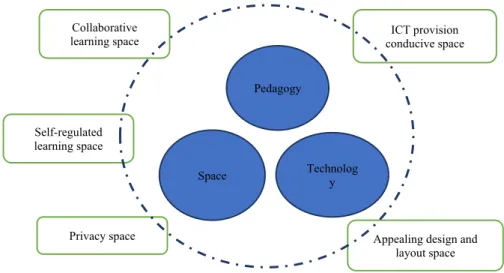
(Computer science) and familiarised as “The Pedagogy-Space-Technology” (PST) (Ng, 2015).
Figure 2
:
Social learning Environment preferences attributes.Source: Author
Therefore, as mentioned by Maheran et al., (2017), appropriate design of social learning space in higher education institutions promotes and contributes to the learner’s education performance and enhances improved learning outcomes. As stated by Walton & Matthews (2018), before deciding on the strategic approach, it would be wise to evaluate what the surrounding city or urban area provides in terms of the spectrum of informal learning space. For instance, many institutions in Malaysia are situated in the sub- urban areas where informal learning relies mostly on the facilities offered by the institutions alone. In fact, those campuses in the cities or urban areas will have better accessibility of facilities, particularly the ICT provision which is one of the major learning space attributes from this study. At present, universities still predominate by the conventional instructional method without taking into account the affordance of social learning-built environments (Ibrahim et al., 2013). Therefore, in order to bridge the gap, it is vital for a partnership between university stakeholders to take into account those five social learning space attributes during the urban campus planning. The main reason here is, to form a joined-up plan and approach to deliberate the suitability of social learning built-environments in 21st century education urban campus
planning.
Pedagogy
Space Technology
Collaborative learning space
Privacy space
ICT provision conducive space
Appealing design and layout space Self-regulated
ACKNOWLEDGEMENT
This research was funded by MOHE and USM under Fundamental Research Grant Scheme (FRGS) 1001/PPBGN/6711669.
REFERENCES
Amit kumar. (2015). A Study of Using Informal Learning Spaces at Indian Institute of Technology, Delhi. Digital Commons@University of Nebraska - Lincoln, August. Baker, R. (1968). Ecological Psychology: Concept and Methods for Studying the environment of human Behavior. STANFORD UNIVERSITY PRESS, STANFORD, CALIFORNIA.
Beckers, R. (2016). A Learning Space Odyssey. Brighton: University of Brighton Press. ISBN 978-90-365-4105-3
Beckers, R., Van Der Voordt, T., & Dewulf, G. (2016). Learning space preferences of higher education students. Building and Environment, 104, 243–252. https://doi.org/10.1016/j.buildenv.2016.05.013
Boys, J. (2010). Towards Creative Learning Spaces: Re-thinking the Architecture of Post-Compulsory Education. Routledge, Oxford.
Brown, M. B., & Lippincott, J. K. (2003). Learning Spaces : More than Meets the Eye.
EDUCAUSE QUARTERLY, 1, 14–16.
Cleveland, B., & Fisher, K. (2014). The evaluation of physical learning environments : A
critical review of the literature. Learning Environ Res, 17(April), 1–28. https://doi.org/10.1007/s10984-013-9149-3
Cunningham, M., & Walton, G. (2016). Informal learning spaces (ILS) in university libraries and their campuses. New Library World, 117(1/2), 49–62. https://doi.org/10.1108/NLW-04-2015-0031
Dole, S., Bloom, L., Kowalske, K., Dole, S., Bloom, L., Kowalske, K., & Carolina, W.
(2016). Transforming Pedagogy : Changing Perspectives from Teacher-Centered to Learner-Centered. Interdisciplinary Journal of Problem-Based Learning Volume, 10(1).
Downes, S. (2007). Learning networks in practice. Emerging Technologies for Learning, 2, 19–27. https://doi.org/10.1039/B910216G
Freigang, S., Schlenker, L., & Köhler, T. (2018). A conceptual framework for designing smart learning environments. Smart Learning Environments, 8.
Goldie, J. G. S. (2016). Connectivism : A knowledge learning theory for the digital age ?
Medical Teacher, 38(No. 10), 1064–1069.
https://doi.org/10.3109/0142159X.2016.1173661
Hair, J. F., Black, W. c, Babin, B. J., & Anderson, R. E. (2014). Multivariate Data Analysis Seventh Edition.
Harrop, D., & Turpin, B. (2013). A Study Exploring Learners’ Informal Learning Space
Behaviors, Attitudes, and Preferences A Study Exploring Learners’ Informal
Learning. New Review of Academic Librarianship. https://doi.org/10.1080/13614533.2013.740961
Ibrahim, N., Fadzil, N. H., & Saruwono, M. (2013). Learning Outside Classrooms on
Campus Ground : Malaysia. Asian Journal of Environment-Behaviour Studies, 4(13), 97–110.
Kamis, M., Muhamad, M., Junoh, A. M., Asmuni, A., & Idris, K. (2015). Informal Learning in Malaysia. May.
Kumar, A., & Bhatt, R. K. (2015). A Study of Using Informal Learning Spaces at Indian Institute of Technology, Delhi. Library Philosophy and Practice (e-Journal). http://digitalcommons.unl.edu/libphilprac
Maheran, Y., Fadzidah, A., Nur Fadhilah, R., & Farha, S. (2017). A Review of Criteria for Outdoor Classroom in Selected Tertiary Educational Institutions in Kuala Lumpur. IOP Conference Series: Materials Science and Engineering, 291(1). https://doi.org/10.1088/1757-899X/291/1/012014
Marais, N. (2011). Connectivism as Learning Theory: The Force behind Changed Teaching Practice in Higher Education. Education, Knowledge & Economy: A Journal for Education and Social Enterprise, V4(N3), p173-182.
Ministry of Higher Education, M. (2018). Framing Malaysian Higher Education 4.0. Department of Higher Education Malaysia.
Mohayidin, M. G., Suandi, T., Mustapha, G., Adam, A., Man, N. A., Konting, M. M., & Abdullah, S. N. (2014). Implementation of Outcome-Based Education in
Universiti Putra Malaysia: A Focus on Students’ Learning Outcomes.
International Education Studies, 1(4). https://doi.org/10.5539/ies.v1n4p147 Nenonen, E. B. Y. (2015). How to CO-CRATE campus ?
Peterson, R. A. (2013). A Meta-analysis of Alpha Cronbach ’ s Coefficient. 21(2), 381–
391.
Puncreobutr, V. (2016). Education 4.0: New Challenge of Learning. St. Theresa Journal of Humanities and Social Sciences, 2(2), 92–97.
Siemens, G. (2005). Connectivism : A Learning Theory for the Digital Age.
http://connectivism.ca
Thien, L. M., Abd Razak, N., & Ramayah, T. (2014). Validating Teacher Commitment Scale Using a Malaysian Sample. SAGE Open, 4(2). https://doi.org/10.1177/2158244014536744
Walton, G., & Matthews, G. (2018). Exploring Informal Learning Space in the University. Routledge.
Wilson, H. K., & Cotgrave, A. (2016). Factors that influence students’ satisfaction with
their physical learning environments. Structural Survey, 34(3), 256–275. https://doi.org/10.1108/SS-01-2016-0004
Yang, Z., Becerik-Gerber, B., & Mino, L. (2013). A study on student perceptions of higher education classrooms: Impact of classroom attributes on student satisfaction and performance. Building and Environment, 70, 171–188. https://doi.org/10.1016/j.buildenv.2013.08.030
Yap, W. L., Neo, M., & Neo, T. K. (2016). The impact of the role of teacher and balance of power in transforming conventional teaching to learner-centered teaching in Malaysian institution of higher education. Pertanika Journal of Social Sciences and Humanities, 24(4), 1849–1868.
Yun, Z., Anan, L., Huiping, S., Lan, L., & Fengkuang, C. (2016). The design reserach of
University Library. 19th International Conference on Knowledge-Based and Intelligent Information & Engineering Systems, May 2015. https://doi.org/10.1007/978-3-319-19875-0