Benchmark Problems for Exhaustive Exact Maximum Clique Search
Algorithms
Sándor Szabó
Institute of Mathematics and Informatics, University of Pécs Ifjuság utja 6, H-7624 Pécs, Hungary
E-mail: [email protected]
Bogdán Zaválnij
Alfréd Rényi Institute of Mathematics, Hungarian Academy of Sciences Reáltanoda u. 13–15, H-1053 Budapest, Hungary
E-mail: [email protected]
Keywords:clique, maximal clique, maximum clique, graph coloring, random graph, Mycielski graph
Received:February 12, 2019
There are well established widely used benchmark tests to assess the performance of practical exact clique search algorithms. In this paper a family of further benchmark problems is proposed mainly to test exhaus-tive clique search procedures.
Povzetek: Podanih je nekaj novih standardnih problemov za testiranje algoritmov za iskanje klik.
1
Preliminaries
LetG = (V, E)be a finite simple graph. HereV is the set of vertices ofGandE is the set of edges of G. The finiteness ofGmeans thatGhas finitely many nodes and finitely many vertices, that is,|V| < ∞,|E| < ∞. The simplicity ofGmeans thatGdoes not have any loop and it does not have double edges.
LetCbe a subset ofV. If two distinct nodes inC are always adjacent inG, thenCis called a clique inG. When
C haskelements, then we talk about ak-clique. We in-clude the casesk= 0andk= 1as well when|C|= 0and |C| = 1, respectively. Though in these casesC does not have two distinct elements.
A clique is maximal inGif it is not part of any larger clique inG. In other words a clique is maximal clique of the graphGif it cannot be extended to a larger clique by adding a new node of the graphG. Ak-clique is a maxi-mum clique inGifGdoes not contain any(k+ 1)-clique. All the maximum cliques of a graphGhave the same num-ber of nodes. We call this well defined numnum-ber the clique number ofGand we denote it byω(G).
A number of problems is referred as clique search prob-lems [1].
Problem 1. Given a finite simple graphG. List all maxi-mal cliques ofGwithout repetition.
Problem 2. Given a finite simple graphGand given a pos-itive integerk. Decide ifGhas ak-clique.
Problem 3. Given a finite simple graph G. Determine
ω(G).
Problem 4. Given a finite simple graphG. List all maxi-mum cliques ofGwithout repetition.
An algorithm to solve Problem 1 can be found in [2]. The algorithm is commonly known as Bron-Kerbosch al-gorithm. Obviously, the Bron-Kerbosch algorithm can be used to solve Problems 2, 3 and 4. A more efficient algo-rithm to solve these problems was first given in [3]. The algorithm is known under the name Caraghan-Pardalos gorithm. The Bron-Kerbosch and Carraghan-Pardalos al-gorithms are the classical alal-gorithms that form the base of many further clique search procedures. These algorithms are presented in [14], [26], [24], [10], [9]. But this list is not intended to be complete.
The complexity theory of the algorithm tells us that Problem 2 is in the NP-complete complexity class. (See for instance [6].) Consequently, Problem 3 must be NP-hard.
We color the vertices ofGsuch that the following con-ditions are satisfied.
(1) Each vertex ofGis colored with exactly one color. (2) Vertices of Gconnected by an edge receive distinct
colors.
A coloring of the nodes ofGthat satisfies conditions(1), (2)is called a legal coloring or well coloring of the nodes ofG.
Suppose that the nodes ofGcan be colored legally using
kcolors. We may use a mapf : V → {1, . . . , k} to de-scribe a coloring of the nodes ofG. The numbers1, . . . , k
the equationf(u) =f(v)impliesu=v, then the coloring defined by the mapf is a legal coloring.
There is a number of the colors k such that the nodes of Gcan be colored legally using kcolors and the nodes of Gcannot be colored legally usingk−1 colors. This well defined number kis called the chromatic number of the graphGand it is denoted byχ(G).
Graph coloring is a vast subject and we cannot make jus-tice to this venerable field. In this paper we take a very narrow view. We are interested in only one particular ap-plication. Note that ω(G) ≤ χ(G) holds for each finite simple graphGand so coloring of the nodes can be used to estimate the size of a maximum clique. However, the gap betweenω(G)andχ(G)can be arbitrarily large. J. Myciel-ski [13] exhibited a graphM(k)for whichω(M(k)) = 2
andχ(M(k)) =kfor each integerk≥2.
In order to find bounds forω(G)the following node col-oring was proposed in [21]. Let us choose an integers≥2 and consider a coloring of the nodes ofGthat satisfies the following conditions.
(10) Each vertex ofGis colored with exactly one color. (20) If the verticesv1, . . . , vsare vertices of a clique inG,
then all the verticesv1, . . . , vscannot receive the same color.
A coloring of the nodes ofGsatisfying the conditions (10), (20), is called a monochrome s-clique free coloring. In short we will talk abouts-clique free coloring. Fors = 2 the monochromes-clique free coloring of the nodes gives back the legal coloring of the nodes. There is a well de-fined minimum numberksuch that the nodes ofGhave an
s-clique free coloring usingkcolors. Thiskis referred to as the thes-clique free chromatic number ofGand it is de-noted byχ(s)(G). The inequalityω(G)≤(s−1)χ(s)(G)
shows thats-clique free coloring of the nodes can be used to establish upper bound for the clique number.
A number of problems is considered in connection with coloring the nodes of a graph customarily.
Problem 5. Given a finite simple graphGand given a pos-itive integerk. Decide whether the nodes ofGadmit a legal coloring usingkcolors.
Problem 6. Given a finite simple graph G. Determine
χ(G).
It is a well known result of the complexity theory of al-gorithms that Problem 5 belongs to the P complexity class for k = 2and it belongs to the NP-complete complexity class fork≥3. (See for example [15].) It follows that for
k≥3Problem 6 is NP-hard.
Problem 7. Given a finite simple graphGand two positive integerss,k. Decide if the nodes ofGhave a legals-clique free coloring withkcolors.
It was established in [23] that fork= 3,s≥3Problem 7 is NP-complete.
2
A Mycielski type result
As we have already mentioned the chromatic number can be a poor upper estimate of the clique number. By My-cielski’s construction there are 3-clique free graphs with arbitrarily large chromatic number. P. Erd˝os [5] general-ized this result. Let us call the length of a shortest cordless circle in a graph the girth of the graph. Clearly, the girth of a3-clique free graph must be at least4. Erd˝os has proved that for given positive integerskandl, there is a finite sim-ple graphGwithgirth(G)≥l,χ(G)≥k. Erd˝os’s proof is not constructive and so it is not at all straight forward how the resulting graphs could be used in constructing test instances.
In this section we present another extension of Myciel-ski’s result. We replace the legal coloring of the nodes of a graph by a legals-clique free coloring of the nodes of the graph. Consequently, thes-clique free chromatic number
χ(s)(G)will play the role of the chromatic numberχ(G).
The result is motivated by the fact that one might try to construct clique search test instances by replacing the Mycielski graph by the graph emerging from the proof the generalized version.
Theorem 1. Let us choose two positive integerssand k
with s ≥ 3 and k ≥ 2(s−1)/(s−1). There is a finite simple graph L(s,k) such that ω(L(s,k)) ≤ 2(s−1) and χ(s)(L(s,k))≥k.
The reader may notice that the graphL(2,k) is
isomor-phic to the Mycielski graphM(k).
Proof. The proof will be constructive. We start with the special case s = 3. We choose an integer k for which
k≥2(3−1)/(3−1) = 2. LetM(k)be the Mycielski graph
with parameterk. Letu1, . . . , un be the nodes of M(k). We substitute the nodeuiofM(k)by an isomorphic copy
Mi(k)of the Mycielski graph for eachi,1 ≤ i ≤ n. Let
vi,1,, . . . , vi,n be the nodes ofM
(k)
i . We assume that the nodes
v1,1, . . . , v1,n, . . . , vn,1, . . . , vn,n
are pair-wise distinct. These nodes will be the nodes of the graphL(3,k).
The edges ofMi(k) are going to be edges ofL(3,k) for each i, 1 ≤ i ≤ n. Further, whenever the unordered pair {ui, uj} is an edge of M(k), then we add the edge {vi,α, vj,β}toL(3,k)for eachα,β,1≤α, β≤n.
The dedicated reader will not fail to notice that the con-struction we just presented is the so called lexicographic product of the graphsM(k)andM(k).
We claim thatω(L(3,k))≤4.
In order to verify the claim we assume on the con-trary that ω(L(3,k)) ≥ 5. LetC be a 5-clique in L(3,k).
Set Vi = {vi,1,, . . . , vi,n}. Note that the setVi induces
Mi(k)inL(3,k)as a subgraph ofL(3,k). From the fact that ω(Mi(k))≤2it follows thatCmay have at most2nodes inVifor eachi,1≤i≤n. ThereforeChas nodes in some
Suppose that i and j are distinct numbers in the set {1, . . . , n}. A node inMi(k) and a node inMj(k) can be adjacent only if the unordered pair{ui, uj} is an edge of
M(k). This means thatM(k)contains a3-clique. ButM(k)
does not contain any 3-clique. This contradiction com-pletes the verification of the claim.
We claim thatχ(3)(L(3,k))≥k.
In order to prove the claim let us assume on the contrary thatχ(3)(L(3,k))≤k−1. Set
V = V1∪ · · · ∪Vn
= {v1,1, . . . , v1,n, . . . , vn,1, . . . , vn,n}.
Suppose that the mapf : V → {1, . . . , k−1}defines a 3-clique free coloring of the nodes ofL(3,k).
The restriction of f to the setVi is a map gi : Vi → {1, . . . , k−1}. Clearly, the mapgidefines a coloring of the nodes of the graphMi(k). From the fact thatχ(Mi(k))≥
k it follows that there are two distinct adjacent nodes of
Mi(k) such that the two nodes receive the same colorci. SetU ={u1, . . . , un}. Using the colorciwe define a map
h : U → {1, . . . , k−1}. We seth(ui) = ci for eachi, 1≤i≤n.
Note that the maphdefines a legal coloring of the nodes of the graphM(k). The only thing which needs verification
is that ifuiandujare distinct adjacent nodes ofM(k), then
ci6=cj.
Let us assume on the contrary thatuiandujare distinct adjacent nodes ofM(k)andci =cj. The graphM
(k)
i has two distinct adjacent nodesvi,i(1)andvi,i(2)such that
f(vi,i(1)) =f(vi,i(2)) =ci.
Similarly, the graphMj(k)has two distinct adjacent nodes
vj,j(1)andvj,j(2)such that
f(vj,j(1)) =f(vj,j(2)) =cj.
Note that the nodes vi,i(1), vi,i(2), vj,j(1), vj,j(2) are the
nodes of a4-clique inL(3,k). This means that the coloring defined by the mapf is not a3-clique free coloring of the nodes of L(3,k). This shows that the coloring defined by the maphis a legal coloring of the nodes ofM(k).
The coloring defined byhis using at mostk−1colors. This contradicts the fact thatχ(M(k))≥k. Thus we may
conclude thatχ(3)(L(3,k))≥kas we claimed.
Let us turn to the special cases= 4. We choose a integer
kfor whichk≥2(4−1)/(4−1), that is,k≥3. LetM(k)
be the Mycielski graph with parameterk. Letu1, . . . , un be the nodes ofM(k). We substitute the nodeu
iofM(k) by an isomorphic copyL(3i ,k)of the graphL(3,k)for each i,1≤i≤n. Letvi,1,, . . . , vi,mbe the nodes ofL
(3,k)
i . We assume that the nodes
v1,1, . . . , v1,m, . . . , vn,1, . . . , vn,m
are pair-wise distinct. These nodes will be the nodes of the graphL(4,k).
The edges ofL(3i ,k)are going to be edges ofL(4,k)for
each i, 1 ≤ i ≤ n. Further, whenever the unordered pair {ui, uj} is an edge of M(k), then we add the edge {vi,α, vj,β}toL(4,k)for eachα,β,1≤α, β≤m.
We claim thatω(L(4,k))≤8.
In order to verify the claim we assume on the contrary that ω(L(4,k)) ≥ 9. LetC be a9-clique inL(4,k). Note
that the setVi={vi,1,, . . . , vi,m}inducesL
(3,k)
i inL
(4,k)
as a subgraph ofL(4,k). From the fact thatω(L(3,k)
i )≤4 it follows thatCmay have at most4nodes inVi for each
i,1≤i≤n. ThereforeChas nodes in someL(3i ,k)for at least3distinct values ofi.
Suppose that i and j are distinct numbers in the set {1, . . . , n}. A node in Li(3,k) and a node in L(3j,k) can be adjacent only if the unordered pair{ui, uj}is an edge of M(k). This means thatM(k)contains a 3-clique. But M(k) does not contain any 3-clique. This contradiction
completes the proof of the claim. We claim thatχ(4)(L(4,k))≥k.
In order to prove the claim let us assume on the contrary thatχ(4)(L(4,k))≤k−1. Set
V = V1∪ · · · ∪Vn
= {v1,1, . . . , v1,n, . . . , vn,1, . . . , vn,n}.
Suppose that the mapf : V → {1, . . . , k−1}defines a 4-clique free coloring of the nodes ofL(4,k).
The restriction of f to the setVi is a map gi : Vi → {1, . . . , k −1}. Clearly, the map gi defines a coloring of the nodes of the graph L(3i ,k). From the fact that
χ(3)(L(3i ,k))≥kit follows that there is a3-clique inL(3i ,k)
such that the3nodes of the clique receive the same color
ci. SetU ={u1, . . . , un}. Using the colorciwe define a maph:U → {1, . . . , k−1}. We seth(ui) =cifor each
i,1≤i≤n.
Note that the maphdefines a legal coloring of the nodes of the graphM(k). The only thing which needs verification
is that ifuiandujare distinct adjacent nodes ofM(k), then
ci6=cj.
Let us assume on the contrary thatci =cj. The graph
L(3i ,k)has3distinct pair-wise adjacent nodesvi,i(1),vi,i(2), vi,i(3)such that
f(vi,i(1)) =f(vi,i(2)) =f(vi,i(2)) =ci.
Similarly, the graphL(3i ,k)has3distinct pair-wise adjacent nodesvj,j(1),vj,j(2),vj,j(2)such that
f(vj,j(1)) =f(vj,j(2)) =f(vj,j(3)) =cj.
Note that the nodes
vi,i(1), vi,i(2), vi,i(3), vj,j(1), vj,j(2), vj,j(3)
are the nodes of a6-clique inL(4,k). This means that the
In the coloring defined by hmost k−1 colors occur. This contradicts the fact thatχ(M(k))≥k. Thus we may draw the conclusion thatχ(4)(L(4,k))≥kas we claimed.
Continuing in this way we can complete the proof of the
theorem. 2
3
Test problems
Problems 2 and 3 are commonly referred ask-clique and maximum clique problems, respectively. As we have pointed out it is a well known result of the complexity the-ory of algorithms that the maximum clique problem is NP-hard. Loosely speaking it can be interpreted such that the maximum clique problem is computationally demanding.
As at this moment there are no readily available mathe-matical tools to evaluate the performance of practical clique search algorithms, the standard procedure is to carry out numerical experiments on a battery of well selected bench-mark tests.
The most widely used test instances are the Erd˝os–Rényi random graphs, graphs from the the second DIMACS chal-lenge1[8], combinatorial problems of monotonic matrices [25, 22], and hard coding problems of Deletion-Correcting Codes2[20].
Evaluating the performances of various clique search al-gorithms is a delicate matter. On one hand one would like to reach some practically relevant conclusion about the competing algorithms. On the other hand this conclusion is based on a finite list of instances.
One has to be ever cautious not to draw overly sweep-ing conclusions from these inherently limited nature ex-periments. (We intended to contrast this approach to the asymptotic techniques which are intimately tied to infinity.) The situation is of course not completely pessimistic. Af-ter all, these benchmarks were successful at shedding light on the practicality of many of the latest clique search pro-cedures. However, we should strive for enhancing the test procedures. The main purpose of this paper is to propose new benchmark instances.
There are occasions when we are trying to locate a large clique in a given graph such that the clique is not necessar-ily optimal. This approach is referred as non-exact method to contrast it to the exhaustive search. For instance con-structing a large time table in this way can be practically important and useful even without a certificate of optimal-ity.
The benchmark tests are of course relevant in connec-tion with non-exact procedures too. In order to avoid any unnecessary confusion we would like emphasize that in this paper we are focusing solely on the exact clique search methods.
Let nbe a positive integer and letpbe a real number such that0≤p≤1. An Erd˝os-Rényi random graph with
1ftp://dimacs.rutgers.edu/pub/challenge/ 2http://neilsloane.com/doc/graphs.html
parametersn,pis a graphGwith vertices1,2, . . . , n. The probability that the unordered pair{x, y}is an edge ofG
is equal topfor eachx,y,1≤x < y≤n. The events that the distinct pairs
{xi(1), yi(1)}, . . . ,{xi(s), yi(s)}
are edges ofGare independent of each other for each sub-set{i(1), . . . , i(s)}of{1,2, . . . , n}, wheres≥2.
In a more formal way the Erd˝os-Rényi random graph of parametersn,pis a random variable whose values are all the simple graphs withnvertices. The probability distribu-tion over these graphs is specified in the manner we have described above. In this paper we can work safely in a more intuitive level. We start with a complete graph onn
vertices and we decide the fate of each edge by flipping a biased coin.
In the casep= 0we end up with a graph consisting of
nisolated nodes. In the casep= 1we end up with a com-plete graph onnnodes. (Paper [4] is the basic reference on Erd˝os-Rényi random graph.)
Let l, m be positive integers. Let Hi = (Vi, Ei) be a graph consisting of l isolated nodes. This means that |Vi| = l andEi = ∅for eachi,1 ≤ i ≤ m. LetVi = {vi,1, . . . , vi,l}. We construct a new graphG = (V, E). We setV =V1∪ · · · ∪Vm. The nodesvi,r,vj,sare con-nected by an edge inGwheneveri6=j. We may say that the graphGis isomorphic to the lexicographic product of the graphsHandKm, whereHconsists oflisolated nodes andKmis the complete graph onmnodes. (For further de-tails of graph products see [7].)
Clearly,Viis an independent set inGfor eachi,1≤i≤
m. The subgraph induced byVi∪Vj inGis a complete bipartite graph for eachi,j,1≤i < j ≤m. Obviously,
χ(G) = mandω(G) = mhold. In factGcontainslm distinctm-cliques.
At this stage we choose a real numberpsuch that0 ≤
p≤1. At each edge ofGwe flip a biased coin. The edge stays with probabilityp. We call this step randomizingG. The resulting random graphG0belongs to the parametersl,
m,p. Thel= 1particular case corresponds to the Erd˝os-Rényi random graph of parametersm,p.
It is clear thatχ(G0) ≤ mandω(G0) ≤ m. In order to guarantee that ω(G0) = n holds we will plant an m
-clique intoG0. One can achieve this by pickingxi∈Vifor eachi,1 ≤i ≤mand connect each distinct pairs among
x1. . . , xmby an edge inG0.
Benchmark tests based on these random graphs are col-lected in the BHOSLIB library.3 (The acronym BHOSLIB stands for Benchmarks with Hidden Optimum Solutions Library.)
After all these preparations we are ready to describe the graphs we would like to propose for testing clique search algorithms. Let k, mbe positive integers. Let Mi(k) = (Vi, Ei)be the Mycielski graph of parameterk. LetVi =
3http://www.nlsde.buaa.edu.cn/~kexu/
{vi,1, . . . , vi,n} for eachi, 1 ≤ i ≤ m. We construct a new graphG= (V, E). We setV =V1∪ · · · ∪Vm. Let vi,r, vi,s ∈Vi. If the unordered pair{vi,r, vi,s}is an edge ofMi(k), then we add this pair as an edge toG. These edges will be the blue edges ofG. In other words the subgraph induced byViinGis isomorphic toM
(k)
i for eachi,1≤
i≤m.
Pickvi,r ∈ Vi,vj,s ∈ Vj. We connect the nodes vi,r,
vj,sby an edge inGwheneveri6=j. These edges will be the red edges ofG.
Note that the graphGis isomorphic to the lexicographic product of the graphsM(k)and Km, whereM(k)is the
Mycielski graph of parameter kandKmis the complete graph onm nodes. One can verify thatχ(G) = (k)(m) andω(G) = (2)(m).
We choose a real numberpsuch that0 ≤ p ≤ 1. We randomize the red edges of G. We flip a biased coin and keep each red edge with probabilityp. The resulted random graph is denoted byG0. It is obvious thatχ(G0)≤(k)(m) andω(G0) ≤(2)(m). By planting a(2m)-clique intoG0
we can guarantee thatω(G0) = (2)(m). We pickxi, yi ∈
Visuch that the unordered pair{xi, yi}is an edge inG0for each i,1 ≤ i ≤ m. Finally, we construct a(2m)-clique whose nodes arex1, y1, . . . , xm, ym.
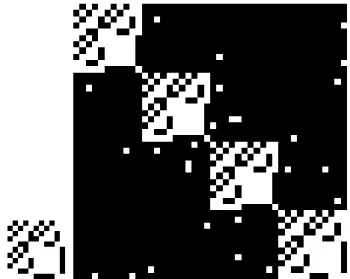
Figure 1: The adjacency matrices of the Mycielski graph
M(4)and the random graphG0.
4
Numerical experiments
The proposed new collection of test graphs can be found on the site clique.ttk.pte.hu/evil. The source code of the program that generates the adjacency matrices of these graphs are also available on this site.
As an illustration Figure 1 exhibits the adjacency ma-trix of the Mycielski graph of parameter4. Further it de-picts the adjacency matrix of the randomized version of the
lexicographic product ofM(4)andK4, whereM(4) is the
Mycielsky graph of parameter 4 andK4 is the complete
graph on4vertices. As the number of vertices ofM(4)and K4 are equal to11and4, respectively, the product graph
has44nodes. The probability we used for randomizing is
p= 0.98.
In the constructions we systematically replaced the My-cielski graphM(k)by the graphL(s,k)that appeared in the
proof of Theorem 1 for small values of the parameters s
andk. The graphM(4) has11nodes. Its chromatic and
clique numbers are4and2, respectively. There is a graph with the same chromatic and clique numbers the so-called Chvatal graph. The Chvatal graph has12vertices but more symmetric thanM(4). We replacedM(4) by the Chvatal graph systematically when we constructed test instances. Note that other graphs also can be used instead of these two examples. Presumably the kind of graphs where the clique number is far from the chromatic number. As the last step we randomly permuted the nodes of the graphs.
We carried out a large scale numerical experiment to check the proposed EVIL benchmark problems. We used 55test graphs. We took35BHOSLIB graphs and20EVIL graphs. The experiment involved7 programs implement-ing12different algorithms and so we are able to compare the running times of660clique searches. The processor of the computer we used was a 2.3 GHz, Xeon E5-2670v3.
The12clique search algorithms we used are the follow-ing.
(1) Östergård4[14] (cliquer),
(2) Li5[11], [12] (M-cql 10, M-cql 13-1 and M-cql 13-2).
(3) Konc6[9] (mcqd and mcqd-dyn)
(4) Prosser7 (who implemented Tomita’s algorithm [24]) (MCR)
(5) San Segundo8[16], [17], [18], [19] (BBMC, BBMC-R, BBMC-L and BBMC-X).
There are three ways to use the 2013 version of C.-M. Li program. A switch can be set to either “1” or “2” to select between two built in orderings of the nodes of the graph. In case no value of the switch is specified the program chooses between the “1” and “2” possibilities. During our test we explicitly used the switch “1” and “2” ( M-cql 13-1 and M-cql 13-2).
The above programs are high quality state of art pro-grams. It seemed reasonable to enter an unsophisticated program to the competion. The program can be found on the same site as the EVIL instances and goes under the name antiB. The brief description of the program is the fol-lowing.
4http://users.aalto.fi/~pat/cliquer.html 5http://home.mis.u-picardie.fr/~cli/
EnglishPage.html
6http://www.sicmm.org/konc/maxclique/ 7http://www.dcs.gla.ac.uk/~pat/maxClique/
distribution/
8https://www.biicode.com/pablodev/examples_
1) Using the simplest sequential greedy algorithm color legally the nodes of the graph and save the colors of the nodes.
2) Setkto be the number of colors of the legal coloring we have located.
3) Carry out ak-clique search.
4) If ak-clique is found, then it is a maximum clique of the graph. Otherwise reduce the value ofkand go to step3.
Thek-clique search is based on the Carraghan-Pardalos algorithm, where we utilized original coloring of the nodes. The ordering of the nodes was done by the size of the color classes and the node degrees.
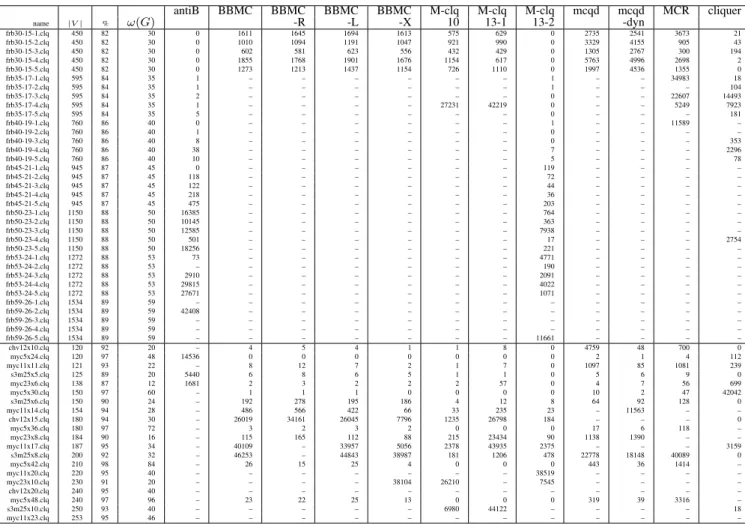
The results of the experiment are summarized in Table 1.
The running times on the BHOSLIB instances are shown in the first part of the table. The evaluation of the results shows that the 2013 version of Li’s program with the “2” switch is on is performing unexpectedly well. The running times of he cliquer and the antiB programs are outliers as well.
Our possible explanation is that although the BHOSLIB tests are excellent for heuristic big clique search programs however they are not so good for evaluating exact maxi-mum clique search algorithms. One problem with these instances is that the nodes of these graphs are not randomly permuted. This means that a simple sequential greedy col-oring will find the chromatic number at once, as the color classes are laid out consecutively. This can be remedied easily. An other possible problem is that most maximum clique search programs use coloring as an auxiliary algo-rithm. For these graphs the chromatic number is equal to the clique size leaving a zero optimality or duality gap. So specially designed programs, as the presented antiB, are able to take advantage of this.
The running times for the EVIL benchmark problems are shown in the second part of the table. Here the running times are more evenly distributed.
One particular result was that there is a test graph with 220nodes – 20 copies of theM(4) graph,p= 98%edge probability – whose clique number could be determined by only one program in slightly less than12hours. We sup-pose that this problem is the hardest one of such small size. For certain graph the running times of the cliquer pro-gram are again outliers. These short running times could be explained by the fact that the cliquer does not rely on legal coloring of the nodes as do the other programs. Af-ter all, we constructed the tests to widen the gap between the chromatic number and the clique number. On the same graphs but with non-permuted nodes the cliquer runs even faster. This again points out the importance of randomly permuting the nodes of the test graphs. The antiB program finishes at the last place as one would expect.
We would like to close this section with a few remarks on why the reader should appreciate the proposed benchmark problems. Although it seems that there is a large number
of benchmark problems for maximum clique search algo-rithms the plain fact is that there are not enough of them. Many of these test problems are too easy for the modern solvers as the sizes of these problems are small. On the other hand there are test instances that are overly hard for the contemporary clique solvers. The proposed EVIL test graphs are forming parameterized families. The parameters can be tuned to produce benchmark problems in various de-grees of difficulty.
5
A historical thread
The graphs that are used for benchmarking clique search al-gorithms are coming from various walks of discrete math-ematics and its applications. In this section we will follow a particular thread in order to shed some light on the forces and demands that shaped the evolution of certain bench-mark problems.
By the lack of other possibilities the performance of clique search algorithms are commonly evaluated by car-rying out large scale numerical experiments. Historically the first clique search procedures were tested almost exclu-sively on random graphs. The Erd˝os-Rényi random graphs are readily available with any specified number of nodes and with any specified edge densities. These random graph are popular and useful test instances.
Since the clique size and the chromatic number of a ran-dom graph is unknown at the moment of generating them, these test graphs are not the ideal choices to testk-clique search algorithms or for algorithms to list all maximum cliques.
Let G = (V, E) be a complete k-partite graph with
n nodes. For the sake of definiteness we assume thatV
is partitioned into the sets V1, . . . , Vk such that |V1| = · · · = |Vk| = s. Consequently n = ks. Suppose
Vi = {vi,1, . . . , vi,s}. If i 6= j, then we connect each node vi,α in Vi with each node vj,β in Vj. Thus Ghas (1/2)k(k−1)s2edges, that is,|E|= (1/2)k(k−1)s2.
The nodes of Gcan be legally colored usingk colors. The setsV1, . . . , Vk can play the roles of the color classes. It is clear thatω(G) =k. Picking exactly one node from eachViwe get mutually adjacent nodes that form the nodes of ak-clique inG. The number of the maximum cliques inGis equal tosk. These benchmark problems are good candidates to test clique search algorithms that list all max-imum cliques. These benchmark problems painfully lack the unpredictability of random graphs.
Therefore when we connect the nodes of the setsViand
Vj we should do it in a randomized manner. Each of the
s2edges of the bipartite graph induced by the setV
These graphs are the BHOSLIB instances. The develop-ment of these graphs greatly enhanced the utility of random graphs in testing clique search algorithms.
A graph whose chromatic number is equal to its clique number is by no means is a typical graph. This is why we propose a family of test graphs that have all the desired properties of the BHOSLIB graph and in the same time the gap between the clique and chromatic numbers can be set in a more flexible manner.
Let G = (V, E)be the graph we intend to construct. Let us start with a graphM = (W, F)such thatω(M) =
r,χ(M) =sare known. SupposeW = {w1, . . . , wm}. We considerkisomorphic copiesM1, . . . , MkofM. Let
Mi= (Wi, Fi), whereWi ={wi,1, . . . , wi,m}.
In order to construct the graph Gwe set V = W1∪ · · · ∪Wk. Here we assume that the setsW1, . . . , Wk are pair-wise disjoint. ConsequentlyGhaskmnodes. Let us pick two distinct Wi andWj. We connectwiα andwj,β for eachα,β,1 ≤α, β ≤m. The resulting graphGhas
km nodes andk|F|+ (1/2)k(k−1)m2edges. Clearly, ω(G) =kω(M) =krandχ(G) =kχ(M) =ks.
As a next step we randomizeG. Namely, we pick each of them2edges running betweenW
iandWj with a fixed probabilitypi,j. (In many cases we choose allpi,j to be equal.) Because we drop edges from the graphG, the quan-titiesω(G),χ(G)may change. By planting a random(kr )-clique we may restore the original ω(G). The chromatic number of the new random graph may decrease. If the probabilitypi,jis close to one then most likely the decrease in the chromatic number is small. When we choose a graph
M for whichω(M)is much smaller thanχ(M), then for the resulted random graph the gap between the clique and chromatic numbers most likely does not disappear.
The resulting random graphs are the test instances pro-posed in this paper.
The Szemerédi regularity lemma teaches us that a large dense graph can be transformed into a form which is very much similar to our proposed graph. So the proposed graph in a sense is not overly artificial.
6
Reducing the number of nodes
We use the graphsL(s,k)defined in the proof of Theorem
1 to construct benchmark instances. It is imperative to con-struct hard benchmark instances with as few nodes as possi-ble. In this section we will show that with a little extra care we can reduce the number of the nodes and still get a graph which has the required properties of the graphsL(s,k). For
the sake of simplicity we will restrict our attention to the special cases= 3.
LetG= (V, E)be a finite simple graph. A subsetCof
V is called an edge covering set ofGif each edge ofGhas at least one end point inC.
Letµ(k) be the number of the nodes of the Mycielski graphM(k)of parameterk. The Mycielski graphM(3)is a circle consisting of5nodes and 5edges. Thusµ(3) =
5. The Mycielski graphM(k+1) is constructed from the Mycielski graphM(k)in the following way.
SupposeU ={u1, . . . , un}is the set of nodes ofM(k). Here of coursen = µ(k). In order to constructM(k+1)
from M(k) we add new nodes v
1, . . . , vn to the existing nodesu1, . . . , un. We setV ={v1, . . . , vn}. We assume that the nodesu1, . . . , unandv1, . . . , vnare pair-wise dis-tinct. In other words we assume thatU ∩V =∅. We draw an edge between the nodeviand each neighbor of the node
uifor eachi,1≤i≤n. Finally we add a new nodewto the set of nodesU∪V and draw an edge between the node
wandvifor eachi,1≤i≤n.
Note that the equationµ(k+ 1) = 2µ(k) + 1holds and usingµ(3) = 5one can compute the number of nodes of the Mycielski graphM(k).
Lemma 1. The Mycielski graphM(k)has an edge
cover-ing set of sizeµ(k−1) + 1for eachk≥3.
Proof.Fork= 3the Mycielski graph is a circle consisting of 5vetices and5 edges. Two adjacent nodesx,y and a node z that is not adjacent to any ofx, y form an edge covering set inM(3). This proves the lemma in the special
casek= 3.
For the remaining part of the proof we may assume that
k ≥ 4. We proceed by an induction on k. The My-cielski graphM(k) has some nodesu
1, . . . , un such that
n=µ(k−1)and the subsetU ={u1, . . . , un}induces a subgraph that is isomorphic toM(k−1).
The Mycielski graphM(k)has some nodes v1, . . . , vn such thatvi is adjacent to each neighbor ofui for eachi, 1 ≤i≤n. Finally,M(k)has a nodewwhich is adjacent
tovifor eachi,1≤i≤n.
The setC=U ∪ {w}is an edge covering set inM(k).
This completes the proof of the lemma. 2 We do not claim that this edge covering set has the smallest possible number of nodes.
Lemma 2. For each integerk ≥3there is a graphN(k)
such that it has [µ(k−1) + 1]µ(k) +µ(k −1) nodes
ω(N(k))≤4andχ(3)(N(k))≥k.
Proof.We start the construction ofN(k)with the Mycielski
graphM(k). We assume thatU ={u
1, . . . , un}is the set of nodes of M(k). By Lemma 1, the graph M(k) has an
edge covering setC, wheren = µ(k)and|C| = µ(k− 1) + 1.
We will assign a subgraphLito the nodeuiof the graph
M(k)for eachi,1≤i≤n. The graphLiis either a graph consisting of one single nodevi,1 orLi is an isomorphic copy of the Mycielski graphM(k). In this second case the set of nodes ofLiis equal toVi ={vi,1, . . . , vi,r}, where
r=µ(k).
Ifui 6∈ C, then to the nodeui we assign the graphLi which consists of a single node. Ifui ∈C, then to the node
uiwe assign the graphLiwhich hasµ(k)nodes.
ofLiand each node ofLj. The result of repeating this pro-cedure for each edges of the graphM(k)will be the graph
N(k). Clearly,N(k)has
[µ(k−1) + 1]µ(k) +µ(k)−µ(k−1)−1 =
[µ(k−1) + 1]µ(k) + 2µ(k−1) + 1−µ(k−1)−1 =
[µ(k−1) + 1]µ(k) +µ(k−1)
nodes. It remains to show that ω(N(k)) ≤ 4 and χ(3)(N(k))≥k.
In order to prove thatω(N(k)) ≤ 4we assume on the
contrary thatω(N(k))≥ 5. Let∆be a5-clique inN(k).
Note that
ω(Li) =
1, if |Vi|= 1, 2, if |Vi|=µ(k).
The clique∆ may contain at most one node fromLi for which|Vi| = 1. The clique∆ may contain at most two nodes from Li when |Vi| = µ(k). It follows that there must be at least three distinct values of i for which the graphLicontains a node from the5-clique∆. This gives at least three distinct values of i for which the nodes ui pair-wise adjacent. ButM(k) does not have any3-clique asω(M(k))≤2.
In order to prove thatχ(3)(N(k))≥kwe assume on the
contrary thatχ(3)(N(k))≤k−1. LetV =V
1∪· · ·∪Vnbe the set of nodes ofN(k)and letf :V → {1, . . . , k−1}be a
map that describes the monochrome3-clique free coloring of the nodes ofN(k).
Consider a subgraph Li of N(k). Let gi be the re-striction of f to Vi = {vi,1, . . . , vi,r}. Plainly, the map
gi:Vi→ {1, . . . , k−1}describes a coloring of the nodes of the graphLi. Using the facts thatLi is isomorphic to
M(k)andχ(M(k)) ≥kwe can draw the conclusion that
there must be two distinct adjacent nodes ofM(k)that re-ceive the same color.
Remember thatU ={u1, . . . , un}is the set of nodes of the Mycielski graphM(k)we used in the construction of
N(k). We define a maph:U → {1, . . . , k−1}.
If the subgraphLi ofN(k)has only one node, then we seth(ui)to bef(vi,1). In plain English we assign the color
of the only node of the graphLito the nodeuiof the graph
M(k).
If the subgraphLiofN(k)hasµ(k)nodes, then there are two distinct adjacent nodes ofLi, say vi,i(1),vi,i(2) such
thatf(vi,i(1)) =f(vi,i(2)). In this case we seth(ui)to be f(vi,i(1)). In simple English assign the common color of
the adjacent nodesvi,i(1),vi,i(2)ofN(k)to the nodeui of
M(k).
We claim that the maph:U → {1, . . . , k−1}describes a legal coloring of the nodes ofM(k). The only thing we
should check is that ifui,ujare distinct adjacent nodes of
M(k), thenh(ui)6=h(uj)must hold.
Let us start with the case whenui 6∈ C,uj 6∈ C. The assumption thatui,ujare distinct adjacent nodes ofM(k) contradicts the fact thatCis an edge covering set inM(k). Therefore this case cannot occur.
Ifui ∈C,uj ∈ C, then the subgraphsLi,Lj ofN(k) both haveµ(k) nodes. There are distinct adjacent nodes
vi,i(1), vi,i(2) in Li such that f(vi,i(1)) = f(vi,i(2)) = h(ui). Similarly, there are distinct adjacent nodesvj,j(1), vj,j(2) inLj such that f(vj,j(1)) = f(vj,j(2)) = h(uj). Hereh(ui)6=h(uj)must hold since otherwise we have a 4-clique inN(k)whose nodes receive the same color. This
cannot happen as the mapf : V → {1, . . . , k−1} de-scribes a monochrome3-clique free coloring of the nodes ofN(k).
If ui 6∈ C, uj ∈ C, then the subgraph Li of N(k) has only one node and the subgraph Lj of N(k) has
µ(k) nodes. Now f(vi,1) = h(ui). There are
dis-tinct adjacent nodes vj,j(1), vj,j(2) in Lj such that
f(vj,j(1)) =f(vj,j(2)) =h(uj). This timeh(ui)6=h(uj)
must hold since otherwise we have a 3-clique in N(k)
whose nodes receive the same color. This cannot happen as the mapf :V → {1, . . . , k−1}describes a monochrome 3-clique free coloring of the nodes ofN(k). 2
Acknowledgments
This research was supported by National Research, Devel-opment and Innovation Office – NKFIH Fund No. SNN-117879.
References
[1] I. M. Bomze, M. Budinich, P. M. Pardalos, M. Pelillo (1999) The Maximum Clique Problem, Handbook of Combinatorial OptimizationVol. 4, Kluwer Aca-demic Publisher.https://doi.org/10.1007/ 978-1-4757-3023-4_1
[2] C. Bron and J. Kerbosch (1973) Finding all cliques of an undirected graph, Communications of ACM 16, 575–577. https://doi.org/10. 1145/362342.362367
[3] R. Carraghan, P. M. Pardalos (1990) An exact al-gorithm for the maximum clique problem, Opera-tion Research Letters9, 375–382.https://doi. org/10.1016/0167-6377(90)90057-C
[4] P. Erd˝os, A. Rényi (1960) On the evolution of random graphs,Magyar Tud. Akad. Mat. Kutató Int. Közl.5, 17–61.
[5] P. Erd˝os (1959), Graph theory and probability,Canad. J. Math.11, 34–38.
[6] M. R. Garey and D. S. Johnson (2003), Computers and Intractability: A Guide to the Theory of NP-completeness, Freeman, New York.
[8] J. Hasselberg, P. M. Pardalos, and G. Vairak-tarakis (1993) Test case generators and com-putational results for the maximum clique problem, Journal of Global Optimization 3 , 463–482. http://www.springerlink. com/content/p2m65n57u657605n
https://doi.org/10.1007/bf01096415
[9] J. Konc and D. Janežiˇc (2007) An improved branch and bound algorithm for the maximum clique prob-lem,MATCH Communications in Mathematical and Computer Chemistry58, 569–590.
[10] D. Kumlander (2005) Some Practical Algorithms to Solve the Maximum Clique problem PhD. Thesis, Tallin University of Technology.
[11] C.-M. Li, Z. Quan (2010) An efficient branch-and-bound algorithm based on MaxSAT for the maximum clique problem, Proceedings of the Twenty-Fourth AAAI Conference on Artificial Intelligence. (AAAI-10), pp. 128–133.
[12] C.-M. Li, Z. Fang, K. Xu (2013) Combining MaxSAT reasoning and incremental upper bound for the max-imum clique problem,Proceedings of the 2013 IEEE 25th International Conference on Tools with Artificial Intelligence.(ICTAI2013), pp. 939–946.https:// doi.org/10.1109/ictai.2013.143
[13] J. Mycielski (1955) Sur le coloriage des graphes, Col-loq. Math.3, 161–162.
[14] P. R. J. Östergård (2002) A fast algorithm for the maximum clique problem, Discrete Applied Math-ematics 120, 197–207. https://doi.org/10. 1016/S0166-218X(01)00290-6
[15] C. H. Papadimitriou (1994)Computational Complex-ity, Addison-Wesley Publishing Company, Inc.
[16] P. San Segundo, D. Rodriguez-Losada, A. Jimenez (2011) An exact bit-parallel algorithm for the max-imum clique problem, Computers & Operations Research.38, 571–581.https://doi.org/10. 1016/j.cor.2010.07.019
[17] P. San Segundo, F. Matia, D. Rodriguez-Losada, M. Hernando (2013) An improved bit parallel ex-act maximum clique algorithm, Optimization Let-ters.7, 467–479.https://doi.org/10.1007/ s11590-011-0431-y
[18] P. San Segundo, C. Tapia (2014) Relaxed approx-imate coloring in exact maximum clique search, Computers & Operations Research. 44, 185–192.
https://doi.org/10.1016/j.cor.2013. 10.018
[19] P. San Segundo, A. Nikolaev, M. Batsyn (2015) Infra-chromatic bound for exact maximum clique
search, Computers & Operations Research. 64, 293–303. https://doi.org/10.1016/j. cor.2015.06.009
[20] N. J. A. Sloane, Challenge Problems: Indepen-dent Sets in Graphs.http://neilsloane.com/ doc/graphs.html
[21] S. Szabó (2011) Parallel algorithms for finding cliques in a graph,Journal of Physics: Conference Se-ries268012030https://doi.org/10.1088/ 1742-6596/268/1/012030
[22] S. Szabó (2013) Monotonic matrices and clique search in graphs,Annales Univ. Sci. Budapest., Sect. Computatorica41, 307–322.
[23] S. Szabó and B. Zaválnij (2012) Greedy algorithms for triangle free coloring,AKCE International Jour-nal of Graphs and Combinatorics9No. 2, 169–186. [24] E. Tomita and T. Seki (2003) An efficient
branch-and-bound algorithm for finding a maximum clique, Lec-ture Notes in Computer Science2731, 278–289.
[25] E. W. Weisstein, Monotonic Matrix, In: MathWorld– A Wolfram Web Resource. http://mathworld. wolfram.com/MonotonicMatrix.html
antiB BBMC BBMC BBMC BBMC M-clq M-clq M-clq mcqd mcqd MCR cliquer
name |V| % ω(G) -R -L -X 10 13-1 13-2 -dyn
frb30-15-1.clq 450 82 30 0 1611 1645 1694 1613 575 629 0 2735 2541 3673 21
frb30-15-2.clq 450 82 30 0 1010 1094 1191 1047 921 990 0 3329 4155 905 43
frb30-15-3.clq 450 82 30 0 602 581 623 556 432 429 0 1305 2767 300 194
frb30-15-4.clq 450 82 30 0 1855 1768 1901 1676 1154 617 0 5763 4996 2698 2
frb30-15-5.clq 450 82 30 0 1273 1213 1437 1154 726 1110 0 1997 4536 1355 0
frb35-17-1.clq 595 84 35 1 – – – – – – 1 – – 34983 18
frb35-17-2.clq 595 84 35 1 – – – – – – 1 – – – 104
frb35-17-3.clq 595 84 35 2 – – – – – – 0 – – 22607 14493
frb35-17-4.clq 595 84 35 1 – – – – 27231 42219 0 – – 5249 7923
frb35-17-5.clq 595 84 35 5 – – – – – – 0 – – – 181
frb40-19-1.clq 760 86 40 0 – – – – – – 1 – – 11589 –
frb40-19-2.clq 760 86 40 1 – – – – – – 0 – – – –
frb40-19-3.clq 760 86 40 8 – – – – – – 0 – – – 353
frb40-19-4.clq 760 86 40 38 – – – – – – 7 – – – 2296
frb40-19-5.clq 760 86 40 10 – – – – – – 5 – – – 78
frb45-21-1.clq 945 87 45 0 – – – – – – 119 – – – –
frb45-21-2.clq 945 87 45 118 – – – – – – 72 – – – –
frb45-21-3.clq 945 87 45 122 – – – – – – 44 – – – –
frb45-21-4.clq 945 87 45 218 – – – – – – 36 – – – –
frb45-21-5.clq 945 87 45 475 – – – – – – 203 – – – –
frb50-23-1.clq 1150 88 50 16385 – – – – – – 764 – – – –
frb50-23-2.clq 1150 88 50 10145 – – – – – – 363 – – – –
frb50-23-3.clq 1150 88 50 12585 – – – – – – 7938 – – – –
frb50-23-4.clq 1150 88 50 501 – – – – – – 17 – – – 2754
frb50-23-5.clq 1150 88 50 18256 – – – – – – 221 – – – –
frb53-24-1.clq 1272 88 53 73 – – – – – – 4771 – – – –
frb53-24-2.clq 1272 88 53 – – – – – – – 190 – – – –
frb53-24-3.clq 1272 88 53 2910 – – – – – – 2091 – – – –
frb53-24-4.clq 1272 88 53 29815 – – – – – – 4022 – – – –
frb53-24-5.clq 1272 88 53 27671 – – – – – – 1071 – – – –
frb59-26-1.clq 1534 89 59 – – – – – – – – – – – –
frb59-26-2.clq 1534 89 59 42408 – – – – – – – – – – –
frb59-26-3.clq 1534 89 59 – – – – – – – – – – – –
frb59-26-4.clq 1534 89 59 – – – – – – – – – – – –
frb59-26-5.clq 1534 89 59 – – – – – – – 11661 – – – –
chv12x10.clq 120 92 20 – 4 5 4 1 1 8 0 4759 48 700 0
myc5x24.clq 120 97 48 14536 0 0 0 0 0 0 0 2 1 4 112
myc11x11.clq 121 93 22 – 8 12 7 2 1 7 0 1097 85 1081 239
s3m25x5.clq 125 89 20 5440 6 8 6 5 1 1 0 5 6 9 0
myc23x6.clq 138 87 12 1681 2 3 2 2 2 57 0 4 7 56 699
myc5x30.clq 150 97 60 – 1 1 1 0 0 0 0 10 2 47 42042
s3m25x6.clq 150 90 24 – 192 278 195 186 4 12 8 64 92 128 0
myc11x14.clq 154 94 28 – 486 566 422 66 33 235 23 – 11563 – –
chv12x15.clq 180 94 30 – 26019 34161 26045 7796 1235 26798 184 – – – 0
myc5x36.clq 180 97 72 – 3 2 3 2 0 0 0 17 6 118 –
myc23x8.clq 184 90 16 – 115 165 112 88 215 23434 90 1138 1390 – –
myc11x17.clq 187 95 34 – 40109 – 33957 5056 2378 43935 2375 – – – 3159
s3m25x8.clq 200 92 32 – 46253 – 44843 38987 181 1206 478 22778 18148 40089 0
myc5x42.clq 210 98 84 – 26 15 25 4 0 0 0 443 36 1414 –
myc11x20.clq 220 95 40 – – – – – – – 38519 – – – –
myc23x10.clq 230 91 20 – – – – 38104 26210 – 7545 – – – –
chv12x20.clq 240 95 40 – – – – – – – – – – – –
myc5x48.clq 240 97 96 – 23 22 25 13 0 0 0 319 39 3316 –
s3m25x10.clq 250 93 40 – – – – – 6980 44122 – – – – 18
myc11x23.clq 253 95 46 – – – – – – – – – – – –