1
A
WRITING-ABOUT-WRITING:
SYLLABUS
FOR
FIRST-YEAR
COMPOSITION
Daniel V. Bommarito, Bowling Green State University
Brent D. Chappelow, University of Southern California
INTRODUCTORY ESSAY
This curriculum, which was collaboratively designed by the authors and delivered to multiple sections of first-year composition, positions students to adopt the role of researchers as they investigate the complex demands of college-level writing. Throughout the course, students deploy a variety of methods that enable the systematic study of their own writing practices, the revision practices of other first-year writers, and the process of surveying large amounts of scholarship on a particular writing-related topic. These guided investigations of writing, coupled with substantive readings in composition theory and research, provide students with a deep sense of how writing mediates intellectual work, especially in academic settings. Ultimately, this course prepares students to tackle writing with heightened sophistication and confidence as they enter novel contexts throughout their undergraduate careers. A key assumption underlying ENG 101: First-Year Composition is that writing is not only something people do but also something people study (Adler-Kassner and Wardle). A pedagogical implication of this assumption is that learning about writing as a content area will help students do writing as a literate practice. These ideas are the basis for an approach to teaching composition known as “writing about writing” (WAW), popularized by Douglas Downs and Elizabeth Wardle. For Downs and Wardle, a perennial challenge in the teaching of writing is countering the widely-held assumption that writing is a discrete, mechanical skill governed by universal rules that hold in all situations. David Russell, an intellectual precursor to WAW, refers to this assumption as a commitment to “general writing skills instruction” (GWSI), or the mistaken belief that students can learn an all-purpose form of writing irrespective its context of use (51). Russell resists the idea of GWSI, arguing instead that rules of writing are dependent on the activities they mediate and are therefore context-sensitive and highly variable. On this view, learning to write involves not only gaining procedural knowledge needed to produce effective texts, but also declarative knowledge needed to understand how writing emerges and operates in particular contexts for particular purposes. A writing course that encourages students to investigate the concepts and purposes that underlie writing practices, according to Barbara Bird, “produces learning experiences that align with deep learning” (7).
2 As Downs and Wardle put it: “The shared overall goal among WAW variants seems to be to change students’ awareness of the nature of writing and literacy in order to shape the way they think about writing, with the expectation that how they write may change in turn” (“Re-imagining” 139). According to Jonikka Charlton, these goals and expected outcomes bear out strikingly well in practice, as she writes, “The ways [students] see writing, reading, and researching are fundamentally changed […]. [S]eeing the differences in student engagement, confidence, and writing is certainly believing” (8).
Translated into pedagogical practice, WAW involves three signal features: course readings about writing-related topics, authentic research-writing tasks, and frequent reflective-writing tasks (Downs & Wardle “Teaching”). First, course topics and readings focus directly on writing, rhetoric, literacy, language, or discourse. Such topics might include, say, representations of writing in popular media, writing practices with the rise of digital technologies, or the development of literacy through childhood socialization. The key is to put students in touch with the body of knowledge produced by scholars in disciplines related to writing studies. Second, students engage in authentic writing activities, often in the form of hands-on research. This means students take on realistic writing tasks, address real audiences, and engage with the messy revision process that comes with constructing knowledge that can be of genuine use to a particular audience. Third, students engage in reflection consistently throughout the semester. Reflective writing is used primarily to cue students to their own learning over the semester, which research suggests will aid in the transfer of knowledge to contexts beyond the writing class itself (“Elon Statement on Writing Transfer”).
With this WAW framework in mind, we set out to design a sequence of assignments that introduced students to scholarship on writing-related topics and that allowed students to adopt the role of researchers. Additionally, we provided many opportunities for critical reflection, both in formal and informal assignments, to heighten students’ meta-awareness of their own learning. To amplify this emphasis on growth, we used the idea of “process” as an overarching theme for the course—the writing process, process of revision, process of research, and process of learning. In these various senses, “process” served as a touchstone for class members throughout the semester.
We first delivered the following syllabus to two different face-to-face sections of first-year composition, each capped at 23 students. The syllabus presented here represents the authors’ collaborative work in developing this initial curriculum. In subsequent semesters, the syllabus has been adapted for different semester durations and student populations, but a common element across each variation has been a relatively small, workshop-based classroom environment. The outcomes for the course derive from the WPA Outcomes Statement published by the Council of Writing Program Administrators, which seek to capture students’ developing rhetorical knowledge, critical thinking, reading abilities, writing processes, and knowledge of writing conventions. We have elected to omit our specific assessment criteria for each of the formal assignments included below; we do so recognizing that any assessment is highly responsive to institutional context and thus best developed locally. Below, after describing the major writing projects on the syllabus, we will discuss in more detail the unique outcomes of the course and practical tips for implementation.
D
ESCRIPTIONS OFM
AJORW
RITINGP
ROJECTS3
P
ROJECT#1:
W
HOA
REY
OU AS AW
RITER?
(W
EEKS1-5)
This project asks students to interrogate the habits and assumptions that underlie their writing practices and to compose an essay in which they articulate an evidence-based theory of themselves as writers. This theory is based in data collected from three sources:
1. Students are introduced to various writing myths related to grammar, style, and arrangement (National Council of Teachers of English). Students interrogate these myths and then use them to critique their own assumptions about writing.
2. Students conduct think-aloud protocols, a research procedure used to elicit the one’s thinking process during the act of writing. Data produced in the think-aloud protocol is then analyzed and used as additional information with which to uncover students’ own writing habits and assumptions. (Bommarito and Chappelow, “Conducting”)
3. Using a mini-autoethnographic approach, students take field notes describing their own typical writing space.
Using these three sources of data—the myths of writing, think-aloud protocol data, and autoethnographic data—students then draft an evidence-based essay about themselves as writers.
P
ROJECT#2:
H
OWD
OESW
RITINGE
VOLVE THROUGHR
EVISIONS?
(W
EEKS6-10)
This project asks students to conduct a small-scale empirical study of the revision process. Students are provided by their instructor a sequence of drafts produced by a first-year writer from a prior semester (obtained with permission). By examining a sequence of revised drafts, students in ENG 101 identify, code, and interpret the revisions, and then draw conclusions about the writer’s process based on those findings. Insights from this research process are then documented in a research report. There, students articulate an exigency for their study, contextualize their project using readings from class, and describe methods, findings, and implications (Bommarito and Chappelow, “WP2 Data Collection” is used to facilitate this work).
P
ROJECT#3:
H
OWI
S“P
ROCESS”
R
ELATED TOR
ESEARCH?
(W
EEKS11-14)
This project asks students to survey existing scholarship on a particular topic related to writing studies, composition, and/or rhetoric and to produce a narrative essay—a “process annotation” essay—that describes the student’s choices throughout the research process. Students are asked to focus on a writing-related topic of their choosing, to demonstrate thoughtful engagement with multiple interwriting-related sources through summary and analysis, and to pay close attention to any questions or issues that arise throughout the research process. This project supports multiple course goals. First, it helps familiarize students with an area of study within the discipline. Second, it asks students to engage with and coordinate large amounts of information found in library databases, particularly insofar as students are asked to find a genuine question emerging from their reading rather than arguing a “thesis.” Third, it flexes students' metacognitive muscles as they are asked to be aware of their own thinking as their knowledge about the topic increases.
P
ROJECT#4:
H
OWH
AVEY
OUD
EVELOPED AS AW
RITER?
(W
EEKS15-16)
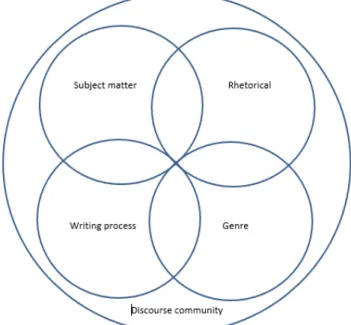
4 semester. Using prior reflective writing from throughout the semester, students write a reflective essay in which they describe their learning and developing expertise. Students conduct a small-scale content analysis of their reflective writing, develop themes, and articulate a theory of their own learning. The aim of this project is to help students transfer their learning beyond the semester. Crucially, this project is built upon the work of Anne Beaufort in College Writing and Beyond: A New Framework for University Writing Instruction. There, Beaufort offers a model of expert performance in writing, which involves the formation and integration of five types of knowledge: subject matter knowledge, genre knowledge, rhetorical knowledge, writing process knowledge, and discourse community knowledge. In Project #4, students classify their learning according to these knowledge domains and work toward setting writing goals for continued learning beyond the end of the term.
R
EFLECTION ONO
UTCOMESThe first time we taught this curriculum, we entered the semester with a modicum of trepidation, fearing that students may not be interested in writing enough to find the WAW course compelling. (In fact, we were warned by colleagues going into that first semester that the course would be a bore and would likely flop.) However, we were very pleased to find that students were engaged in the course topics and showed impressive gains. In surveys administered at the end of the semester, students indicated that they felt much more informed about writing as a result of the course. Specifically, students felt most informed about the processes involved with writing and revision, about their own writing practices, and about different genres of writing, such as the research article. This increase in knowledge, students said, was due in large part to the course readings and the focus of the major assignments.
On a deeper level, students also indicated that the course helped initiate a change in how they perceived of themselves as college-level thinkers and learners. Specifically, students said they gained confidence in their abilities and heightened self-awareness. Some students even seemed to see course as a gateway to think more broadly about higher education and their role within it. As one student put it, “In a class dedicated to writing, I was highly surprised that I learned the most about myself.” Since the course aimed to set students up for long term learning, such comments from students are quite promising.
P
RACTICALC
ONSIDERATIONSFor those using this curriculum, or portions of it, we offer the following considerations and suggestions regarding readings, audiences for writing projects, technologies needed to complete projects, and rigor of the course.
R
EADINGSA most helpful collection of readings comes from Writing Spaces: Readings on Writing, an open access, two-volume collection of essays about topics in rhetoric and composition, written by rhetoric and composition scholars for an undergraduate audience (Lowe and Zemliansky). A related site that is similarly useful, but with shorter, encyclopedia-style entries, is Writing Commons. The textbook reader Writing about Writing: A College Reader is another helpful collection of important scholarship in rhetoric and composition (Wardle and Downs).
5 right reading level.
A
UDIENCESA key aspect of the curriculum is creating real rhetorical situations involving real audiences. Showing students scholarship from journals that produce undergraduate research is a great way to provide a concrete audience and to give students a sense of the kind of work that other undergraduates around the country are producing. Journals such as Young Scholars in Writing, Locutorium, and Journal of Undergraduate Research and Scholarly Excellence are just a few examples of real undergraduate communities sharing knowledge about writing in public venues.
T
ECHNOLOGY ANDP
REPARATIONSSome of the projects require digital technologies and may call for a plan about access. For "Project 1: Who Are You as a Writer?" students conduct a think-aloud protocol (Bommarito and Chappelow, “Conducting”). For this assignment, students will need an audio recorder so they can record their thinking process as they write. The voice recorder on a smart phone works well for this task. We have found it helpful for students to conduct their preparation and analysis of the data in class with the teacher close by. To do this in class, though, students will have to bring headphones along with their smart phones. We recommend practicing this deliberately with students before letting students try the think-aloud protocol on their own.
For "Project 2: How Does Writing Evolve through Revisions?" teachers will have to provide students with a student essay that has been revised over multiple drafts. For us, this required getting permission from other first-year student writers whom we had taught and were willing to let other students critique their work anonymously. We found that three drafts of an essay work well. We also found that Microsoft Word offers a “Compare Documents” tool that helps students compare multiple documents and identify changes easily.
O
NGOINGW
RITINGP
ROMPTSBecause so much of the semester builds on what came before, it is helpful to encourage students to keep all of their writing from the semester and to organize it in some way. We recommend having students store all drafted writing in a digital folder, so that writing is easy to access later in the semester. The Individual Writer Development Log (Bommarito and Chappelow) is one way to begin working with students to make a plan for keeping track of the semester's work. Students should be asked to write often, every class session if possible. The purpose of the writing is informal exploration of the readings, connecting to own experience.
R
IGOR6 methods. Similarly, instructors can determine the degree of polish needed for a final submission of each of the writing projects. If the aim of the instructor is to give students a glimpse of research methods and of the demands of research writing, then pristine final products may not be of utmost importance. The rigor of the course will be determined by the individual instructor’s aims, and there are ample opportunities in the curriculum for making appropriate adjustments.
SYLLABUS: FIRST-YEAR COMPOSITION
C
OURSED
ESCRIPTION ANDO
BJECTIVESIn most writing classes, students are asked to complete writing assignments about topics that are unrelated to writing. In this class, our focus will be directly on writing—what it is, how it works, and how we produce it in academic contexts. For that purpose, our course readings will be drawn from scholarship in the discipline of Rhetoric and Composition. This discipline has for decades studied a wide range of topics focused on the teaching and learning of writing: writing and revision processes, the effectiveness of corrective feedback, the relationship between writing and context, writing and identity, writing and community membership, how genres give shape to ideas and change over time. The topics covered by this body of scholarship are wide-ranging and illuminating. In this class, we will be looking at some of these ideas, and you will be invited to offer your expert opinion as a writer.
Most people write to do something—to enter the “conversations” of various communities and to share ideas and perspectives that may shape or change what is already known. In ENG 101, we will analyze and practice the different skills and strategies that writers use to fulfill such writing goals in different contexts and for different audiences. Instead of focusing only on your final texts, we will focus on exploring and using the processes of writing, including how to find and develop ideas that might be of interest and value to certain communities (invention strategies, research strategies, and audience analysis); how to explore such ideas in writing, experimenting with a variety of writing features and techniques (drafting); how to adjust or change our drafts based on others’ responses to our texts (revision); and how to present our ideas in the forms that our readers expect and value (documentation, editing and proofreading). We will discuss and practice each process, and explore how such processes overlap and double back and repeat.
C
OURSEG
OALSThrough this course, students will:
develop a better understanding of one’s own writing process, recognize the value of participating in a writing community, synthesize and analyze multiple points of view,
articulate and support one's own position regarding various issues, adjust writing to multiple audiences, purposes, and conventions,
become conscientious and responsible writers, both for college and beyond,
7
R
EQUIREDT
EXTBOOKSLowe, Charles and Pavel Zemliansky, editors. Writing Spaces: Readings on Writing, vol. 1. Parlor Press, 2010, www.writingspaces.org/volume1.
---. Writing Spaces: Readings on Writing, vol. 2. Parlor Press, 2011, www.writingspaces.org/volume2. Additional readings available on the course Blackboard site. You are required to print these documents
and bring them with you to class on the days we discuss them.
C
OURSES
CHEDULEW
RIT
IN
G
P
ROJ
ECT
#1
(
W
EE
KS
1-5)
TOPIC FOR CLASS DISCUSSION:
• Why do we write? What do we mean by rhetoric, language, and discourse?
• Readings:
“Backpacks vs. Briefcases: Steps toward Rhetorical Analysis” (Carroll) “10 Myths about Learning to Write” (NCTE)
TOPIC FOR CLASS DISCUSSION:
• Introduction of Writing Project #1
• Readings:
“So You’ve Got a Writing Assignment. Now What?” (Hinton) “Conducting a Think-Aloud Protocol” (Bommarito and Chappelow) TOPIC FOR CLASS DISCUSSION:
• Writing Myth #1: “Some got it; I don’t”
• Readings:
“The Inspired Writer vs. The Real Writer” (Allen) TOPIC FOR CLASS DISCUSSION:
• Writing Myth #2: “Good grammar = good writing”
• Readings:
“What Is Academic Writing” (Irvin) TOPIC FOR CLASS DISCUSSION:
• Writing Myth #3: “Good writing = filling out a formula”
• Readings:
“Unteaching the Five-Paragraph Essay” (Foley) TOPIC FOR CLASS DISCUSSION:
• Writing Myth #4: “Good writers produce pristine first drafts”
• Readings:
“Shitty First Drafts” (Lamott) WRITING WORKSHOPS:
8 W RIT IN G P ROJ ECT #2 ( W EE KS 6-10)
TOPIC FOR DISCUSSION:
• Revision vs. editing
• Introduction of Writing Project #2
• Readings:
“How to Read Like a Writer” (Bunn) TOPIC FOR DISCUSSION:
• Research methods for studying revision
• Readings:
“Revision Strategies of Student Writers and Experienced Adult Writers” (Sommers) (Students will follow the research methods described in this article as the basis for completing Writing Project #2)
TOPIC FOR DISCUSSION:
• Process-centered writing vs. product-centered writing
• Readings:
“Teaching Writing as a Process Not Product” (Murray) TOPIC FOR DISCUSSION:
• Genre of the research article
• Readings:
“Revision Strategies of Student Writers and Experienced Adult Writers” (Sommers)
Examine the structure of two articles of your choosing from Young Scholars of Writing
WRITING WORKSHOPS:
• Peer review workshop of first and second full drafts of WP2
W RIT IN G P ROJ ECT #3 ( W EE KS 11 -14 )
TOPICS FOR DISCUSSION:
• Rhetorical invention and constructing “problems” in academic inquiries
• Readings:
Selections from Problems into PROBLEMS: A Rhetoric of Motivation (Williams)
TOPICS FOR DISCUSSION:
• Library resources for using databases and scholarly journals TOPICS FOR DISCUSSION:
• Students bring in information about the topics they are investigating for WP3; troubleshoot any issues that arise
• Readings:
Select a topic from Rebecca Moore Howard’s “Bibliographies” in writing studies that piques your interest and that you want to write about WRITING WORKSHOPS:
9
W
RIT
IN
G
P
ROJ
ECT
#4
(
W
EE
KS
15
-16
)
TOPICS FOR DISCUSSION:
• Reflection, metacognition, transfer, and writing development
• Introduce WP4
• Readings:
CWPA Outcomes Statement
Research on reflection, metacognition, and transfer TOPICS FOR DISCUSSION:
• Content analysis as strategy to identify key themes
• Teach strategy for reviewing students’ writing from the semester to identify themes that can become the basis for an end-of-semester reflection
TOPICS FOR DISCUSSION:
• Knowledge domains of expert writing performance: rhetorical knowledge, subject matter knowledge, genre knowledge, writing process knowledge, and discourse community knowledge
• Readings:
Selections from College Writing and Beyond (Beaufort) WRITING WORKSHOPS:
• Peer review workshop of first full draft of WP4
A
SSIGNMENTSWRITING PROJECT #1: WHO ARE YOU AS A WRITER?
In the many years of schooling leading up to your freshman year of college, you are likely to have spent a large amount of classroom time learning about writing. In elementary school, you learned to hand-write individual letters and words, and then to compose sentences, paragraphs, and entire essays. In high school, you probably saw that writing became much more complex (and more difficult) as teachers emphasized thesis-driven arguments and research. With each different stage of your writing education came a whole new set of rules, attitudes, and assumptions that played some role in shaping your views on writing and your unique writing practices.
Your assignment: through a meticulous examination of your own writing practices, you will write a reflective, analytical essay in which you investigate your knowledge of and assumptions about writing in order to arrive at a new understanding of yourself as a writer.
The goals of this assignment are to learn about your own writing practices, to identify and articulate assumptions you have about writing, to investigate the origins of those assumptions, and to create a heightened sensitivity toward writing issues. Furthermore, you will draw on your own personal experiences to support your argument and employ established conventions of academic writing.
10 Important questions to consider include the following:
• What kinds of school-based writing have you done or do you do? (e.g., personal essays, informal response writing, fiction, poetry, lab reports, researched writing, etc.)
• What kinds of non-school-based writing have you done or do you do? (e.g., fiction, poetry, newsletters, blogging, texting, tweeting, journaling, etc.)
• How do you approach a writing assignment?
• What do you do before ever putting pen to paper?
• What kinds of “prewriting” or planning do you do?
• How many "drafts" do you write before submission?
• What does the act of writing look like for you?
• When do you feel comfortable or uncomfortable while writing? Why? What insights can you draw from this knowledge?
• In what ways is your process of writing similar to or different from that of other writers?
WRITING PROJECT #2: HOW DOES WRITING EVOLVE THROUGH REVISIONS?
In Writing Project One, you examined who you are as a writer and your own writing practices. During the course of that project, you were required to write multiple drafts, provide response to your peers’ writing, integrate feedback from your instructor and peers, and use revision practices to produce a more effective piece of writing.
In Writing Project Two, we will be examining revision processes in much more depth. During this project, we will be working with Nancy Sommers’ definition of revision as “a sequence of changes in composition— changes which are initiated by cues and occur continually throughout the writing of a work” (380). We will also be working with other students’ writing in order to gain a better understanding of how writers revise to create better writing.
Your assignment: Using Sommers’ research on the revision practices of different writers, you will observe how another student has employed different revision techniques through the course of multiple drafts and then write an analysis of these observations to arrive at new knowledge about revision.
This project asks you to do primary research on another student’s text. Analysis of student writing is one of the mainstays of the field of writing studies; you will be engaging in research that will produce new knowledge that can be applied to the field. Although you are encouraged to discuss articles related to the revision process, your primary concern for discussion is to write about the revision strategies that the student used in creating each draft. You may elect to use the WP2 Data Revision Collection Instrument to help organize your observations (Bommarito and Chappelow).
11 assignment to practice the critical thinking and writing skills needed to learn to be thorough observers and analysts.
WRITING PROJECT #3: HOW IS “PROCESS” RELATED TO RESEARCH?
Throughout the semester, you have investigated “process” writing—in your own writing practices and in those of other students. In Writing Project One, using reflective writing and empirical data, you analyzed your own writing process and gained insight into who you are as a thinker and writer. In Writing Project Two, through a case study of undergraduate writing, you acquired the tools and sensitivity to analyze and discuss the complex practice of revision and its role in shaping quality “final” drafts. In a very real sense, you have participated in the kinds of academic work that professional writing scholars perform every day. Furthermore, you have gained valuable insights into how real writers of all kinds discover ideas and shape them into texts that are meaningful and important to readers.
The next step in our course will show how “process” writing fits within the larger process of research. While it is no doubt valuable to craft a thoughtful and moving piece of writing without ever stepping foot in a library or scanning a research database, the writing done in college, generally speaking, is used to investigate the ideas of other writers and to engage in extended conversations with those writers. In other words, writing is not an “end” in itself; it is a tool to develop and share ideas. Like the writing process, the research process is highly (and often maddeningly) complex and consists of many “recursive” steps. This writing project asks you to begin the process of research.
Your assignment: write a reflective, analytical essay in which you (1) survey existing research on a particular topic (of your choosing) related to writing studies; (2) demonstrate thoughtful engagement with each source through summary and analysis; and (3) show how each source affects your thinking on the topic.
As we have discussed throughout the course and especially on Genius Days, there are multiple scholarly conversations about writing that have a direct impact on students at all grade levels. Often, these conversations are initiated and discussed among writing instructors, school administrators, and educational standards committees with very little direct input from the students who are directly affected by those changes.
You will need to do some research in the library databases, online, and possibly some firsthand inquiry in the form or surveys or interviews to produce an effective discussion of the scholarly conversation. Please keep in mind all of the articles we have discussed in class as potential sources for your analysis. We will discuss research strategies in preparation of your first draft for this paper.
Possible topics for Writing Project #3 can include (but are not limited to):
Professional/technical writing
Gaming, play, and principles of learning Multimodal composition
Writing in online environments
Literacy crises as represented in popular media Ecocomposition
Visual Literacy Service Learning
12 WRITING PROJECT #4: HOW HAVE YOU DEVELOPED AS A WRITER THIS SEMESTER?
As you have likely noticed by now, the terms writing and writer are often more expansive than we tend to recognize. There are many different types of writing that we encounter even in a single day— newspaper writing, business writing, personal writing, academic writing, grant writing, social media writing, editorial writing. The list goes on
and on. And for each one of the items on this list we could identify even more nuanced “sub-types” of writing. Take academic writing, for instance. Though we often think of academic writing as a general, monolithic type of writing, there are any number of subtleties that distinguish, say, writing in the sciences from writing in an English class or an Engineering class or a Business class. The ways we write and the rules that govern our approach are as dynamic as the contexts in which we find ourselves working.
In light of this complexity, what, then, does it mean to be a writer? Scholars in writing studies, rhetoric and composition, and literacy studies have worked for years to understand what it means to be a writer
and to theorize just what kind of knowledges expert writers possess. The image to the right is an attempt by Anne Beaufort, a writing scholar who has written multiple books on the subject, to map the range of knowledges expert writers draw on as they move from one context to the next. She identifies five knowledge “domains,” or areas, that writers draw on in their writing, regardless of the context: writing process knowledge, subject matter knowledge, rhetorical knowledge, genre knowledge, and discourse community knowledge.
Your assignment: Locate yourself—what you know about writing and what you know about your own writing practices—on this map. That is, using the terminology reflected in the diagram above, classify what you have learned this semester about writing.
The purpose is two-fold. First, by articulating and categorizing what you know about writing, you will begin to “own” your writing expertise with increasing authority. Second, as you continue to develop authority over your writing knowledge, it is more likely that you will be able to transfer that knowledge to other writing contexts. It’s worth pointing out that what you will be transferring is not be a set of discreet skills or universal rules about writing, but rather a conceptual framework that will help you analyze a broad range of writing tasks—in and out of your English composition class—and help you learn to navigate new contexts successfully.
13
Bibliography
Adler-Kassner, Linda, and Elizabeth Wardle. Naming What We Know: Threshold Concepts of Writing Studies. University Press of Colorado, 2015.
Allen, Sarah. “The Inspired Writer vs. the Real Writer.” Writing Spaces: Readings on Writing, vol. 1, edited by Charles Lowe and Pavel Zemliansky, Parlor Press, 2010, pp. 34-44.
Beaufort, Anne. College Writing and Beyond: A New Framework for University Writing Instruction. Utah State University Press, 2008.
Bird, Barbara. “Meaning-Making Concepts: Basic Writer’s Access to Verbal Culture.” Conference on Basic Writing, vol. 8-9, 2009/2010, pp. 1-18.
Bommarito, Daniel V., and Brent D. Chappelow. “Conducting a Think Aloud Protocol.” Brent D. Chappelow, 2017,
www.bchappelow.com/wp-content/uploads/2017/10/Bommarito_Chappelow_Conducting_TAP.pdf.
---. “WP2 Revision Data Collection Instrument.” Brent D. Chappelow, 2017, www.bchappelow.com/wp-content/uploads/2017/10/Bommarito_Chappelow_WP2_Data_Collection_Instrument.pdf. ---. “Individual Writer Development Log.” Brent D. Chappelow, 2017,
www.bchappelow.com/wp-content/uploads/2017/10/Bommarito_Chappelow_Individual_Writer_Development_Log.pdf. Bunn, Mike. “How to Read Like a Writer.” Writing Spaces: Readings on Writing, vol. 2, edited by Charles
Lowe and Pavel Zemliansky, Parlor Press, 2011, pp. 71-86.
Carroll, Laura Bolin. (2010). “Backpacks vs. Briefcases: Steps Toward Rhetorical Analysis.” Writing Spaces: Readings on Writing, vol. 1, edited by Charles Lowe and Pavel Zemliansky, Parlor Press, 2010, pp. 45-58.
Charlton, Jonikka. “Seeing is Believing: Writing Studies with ‘Basic Writing’ Students.” Conference on Basic Writing, vol. 8-9, 2009/2010, pp. 1-9.
Council of Writing Program Administrators. Outcomes Statement for First-Year Composition (3.0), 17 July 2014, www.wpacouncil.org/positions/outcomes.html.
Downs, Douglas, and Elizabeth Wardle. “Teaching about Writing, Righting Misconceptions: (Re)envisioning ‘First-Year Composition’ as ‘Introduction to Writing Studies.’” College
Composition and Communication, vol. 58, no. 4, 2007, pp. 552-584.
---. (2012). “Re-imagining the Nature of FYC: Trends in Writing-about-Writing Pedagogies.” Exploring Composition Studies: Sites, Issues, Perspectives, edited by Kelly Ritter and Paul Kei Matsuda, Utah State University Press, 2012, pp. 123-144.
“Elon Statement on Transfer,” 29 July 2013,
14 Foley, Marie. “Unteaching the Five-Paragraph Essay.” Teaching English in the Two-Year College, vol. 16,
no. 4, 1989, pp. 231-235.
Hinton, Corrine E. “So You’ve Got a Writing Assignment. Now What?” Writing Spaces: Readings on Writing, vol. 1, edited by Charles Lowe and Pavel Zemliansky, Parlor Press, 2010, pp. 18-33. Howard, Rebecca Moore. “Bibliographies.” Rebecca Moore Howard: Writing Matters, 2017,
www.rebeccamoorehoward.com/bibliographies.
Journal of Undergraduate Research and Scholarly Excellence, jur.colostate.edu/.
Lamott, Anne. “Shitty First Drafts.” Bird by Bird: Some Instructions on Writing and Life, Anchor Books, 1994, pp. 21-27.
Locutorium, locutorium.byu.edu/.
Lowe, Charles, and Pavel Zemliansky. Writing Spaces: Readings on Writing, vol. 1, Parlor Press, 2010, www.writingspaces.org/volume1.
Lowe, Charles and Pavel Zemliansky. Writing Spaces: Readings on Writing, vol. 2, Parlor Press, 2011, www.writingspaces.org/volume2.
Murray, Donald M. “Teaching Writing as a Process Not Product.” Learning by Teaching: Selected Articles on Writing and Teaching, Boynton/Cook Publishers, 1982, pp. 14-32.
National Council of Teachers of English. “10 Myths about Learning to Write,” www.ncte.org/library/NCTEFiles/Resources/Positions/10WritingMyths.pdf.
Russell, David. “Activity Theory and Its Implications for Writing Instruction.” Reconceiving Writing, Rethinking Writing Instruction, edited by Joseph Petraglia, Lawrence Erlbaum Associates, 1995, pp. 51-77.
Sommers, Nancy. “Revision Strategies of Student Writers and Experienced Adult Writers.” College Composition and Communication, vol. 31, no. 4, 1980, pp. 378-388.
Wardle, Elizabeth, and Douglas Downs. Writing about Writing: A College Reader, 2nd ed., Bedford/St. Martin’s, 2014.
Williams, Joseph M. Problems into PROBLEMS: A Rhetoric of Motivation, WAC Clearinghouse, 2004. Writing Commons, www.writingcommons.org.