p 1 East Midlands Research into Ageing Network (EMRAN) Discussion Paper Series
ISSN 2059-3341
Issue 21, July 2018
A logic model for the implementation of a falls management exercise programme
Timblin C
1, Audsley S
1,Carpenter H
1, Coupland C
1, Gladman JRF
2, Kendrick D
1, Lafond N
1, Logan PA
2,
Orton E
1,Skelton DA
3, Timmons S
4, Ward D
5Address for correspondence: Clare Timblin, School of Medicine, Tower Building,
University of Nottingham, NG7 2RD. Email: [email protected].
Affiliations
1.
Division of Primary Care, School of Medicine, University of Nottingham, Nottingham, UK
2.
Division of Rehabilitation and Ageing, School of Medicine, University of Nottingham,
Nottingham, UK
3.
School of Health and Life Sciences, Glasgow Caledonian University, Glasgow, UK
4.
Centre for Health Innovation, Leadership and Learning, Business School, University of
Nottingham, Nottingham, UK
5.
College of Health and Social Care, University of Derby, Derby, UK
East Midlands Research into Ageing Network (EMRAN) is a research collaboration across the East Midlands to facilitate collaborative applied clinical research into ageing and the care of older people. EMRAN was set up with support from NIHR
INTRODUCTION
Falls in the over 65s are an important public health issue and present a significant burden for individuals, families and health and social care services. Almost a third of people aged over 65 and half of those aged over 80 experience at least one fall every year(1) and the number of injuries caused by falls increase with age(2). Most injuries resulting from a fall are minor(3), however, one tenth lead to fractures(4)(5) which are
a major cause of mortality and morbidity among the over 65s.(6) Individuals can also
experience pain, distress, loss of confidence and loss of independence after a fall (1)(7) which can have a significant impact on their health and quality of life. In the East
Midlands in 2015/2016, there were 18,053 emergency hospital admissions due to falls in people aged 65 and over.(8) At a national level, falls are also resource intensive for the
NHS, costing £47 million in 2012/2013 for the over 65s.(9) This burden is expected to
rise as the over 65 population is estimated to increase by 23% to 8 million, the over 75s by 74% to 6.5 million and the over 85s is expected to double to 3.2 million by 2041. (10)
To prevent falls, NICE and NHS Right Care recommend the provision of strength and balance exercise programmes for community dwelling older adults who are at a higher risk of falling. (1, 11) The Chief Medical Office (CMO) also recommends that adults aged over 65 undertake exercise to strengthen muscles and improve balance at least two days per week in order to maintain good health as they age.(12)
Encouraging physical activity can also help to prevent the onset or progression of non-communicable diseases and reduce mortality.(13)(14) It also has wider social benefits
helping older people to remain independent and engaged with their community.(15)
FaME (Falls Management Exercise) is an evidence-based, community based postural stability programme aiming to improve strength and balance. Clinical trials have shown that the programme can increase physical activity and prevent falls(16) (17)and is recognised as an effective falls prevention programme by Age UK and Public Health England
.
(18)(19) Despite this, the intervention has not been widely implemented across the UK and only 39% of areas report having a postural stability falls preventionprogramme such as FaME or Otago.(20)
This lack of implementation could be due to a number of factors. One reason may be that the commissioning landscape in England today is complex and commissioning for falls and fracture prevention is no exception, involving a range of partners working together from across health and local government (e.g. housing, social care, public health). (21) As such it is unclear who is responsible for commissioning strength and balance exercise programmes aiming to reduce falls as they have a therapeutic function (as commissioned by CCGs), a physical activity and injury prevention function (as commissioned by public health) and a wellbeing function (as commissioned by adult social care). These programmes are also often funded by the public through free-lance instructors or provided by voluntary and community organisations (VCOs).
p 3 facilitators to service commissioning and delivery, and develop a toolkit that can then be used to implement successful programmes at scale across England and the UK. FaME will be delivered to a number of districts as a service by community providers (e.g. Derby County Football Club) and local authority services in Derby City and Leicestershire County and Rutland Counties.
THE FaME LOGIC MODEL
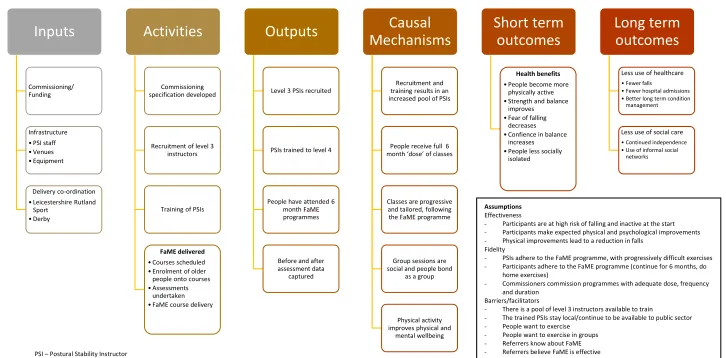
To help us understand what FaME is and how we needed to study it we developed a logic model for the programme (Figure 1). A logic model is an evaluation tool that enables the effective planning, implementation, and evaluation of a programme(22) and can be used by any person or organisation such as commissioners, policy makers or programme managers wanting to commission, implement and evaluate new or existing programmes. Logic models provide us with a visual representation of how a programme is supposed to work by documenting a series of assumptions and articulating the causal relationship between 5 key components; inputs, activities, outputs, outcomes (short/medium and long term) and causal mechanisms.(23, 24) A logic model presents the ‘theory of change’ that is assumed/theorised to occur in response to inputs and activities, which will then lead to the outcomes the programme is intending to achieve. They help users in a number of ways, including:
The assumptions about how the programme is supposed to work are made
visually explicit. These assumptions can be made more robust if they are supported by published research or evaluation literature.(25)
The development of a logic model enables users to ‘map out’ their programme
and be explicit about what their intervention is. It helps to identify resources, challenges and uncover gaps in the programme logic. This allows for resources and activities to be modified as necessary.(22)
Logic models provide planners with a baseline theory and structure of how a
programme should work, which can then be refined in response to performance and evaluation data to make programmes more efficient and effective in
achieving outcomes.(17)
DEVELOPMENT OF THE FaME LOGIC MODEL
To facilitate our research, a logic model was developed by the study team to study the implementation of FaME. The multidisciplinary team benefited from the expertise of a number of collaborators and advisors with a special interest in falls management including directors and consultants in public health, geriatricians, and professors in the fields of primary care research, medicine for older people, rehabilitation research, public health, healthcare innovation and medical statistics.
The inputs, activities and outputs were identified from a range of sources including
previous clinical trials (26)(27) and academics that had developed the FaME programme
The long term outcomes identified for FaME were again based on the research literature and were to result in improvements in physical activity levels, strength and balance, fear of falling, confidence in balance.(30) This in turn would result in fewer falls (including injurious falls) and therefore lessen the use of health and social care and potentially
increase social engagement and community participation.(26)(28)
For our research, an important stage of the logic model development was to then set out the assumptions made regarding the mechanisms of change. This can be done as a series of ‘if’ and ‘then’ statements as illustrated below:
1. If there is sufficient funding, infrastructure and delivery coordination, then a
commissioning specification can be developed, a pool of level 3 PSI’s can be recruited and trained to level 4, and FaME can be delivered.
o This assumes that there are enough level 3 PSIs to recruit and train, and
once trained, they can be retained in the public sector.
o It also assumes that there are suitable venues for FaME to be delivered in.
2. If FaME can be delivered, then people can attend the 6 month FaME programme.
o This assumes that older people want to exercise, want to exercise in
groups, and can access the courses.
o This assumes that referrers know about FaME and believe in the
effectiveness of FaME in order to enrol participants on to the course.
3. If people have attended the 6 month FaME programme, then they will
experience the health benefits.
o This assumes that PSIs deliver the FaME programme faithfully, using
progressively challenging exercises to ensure a training gain.
o This assumes participants enrolled are at high risk of falling and inactive at the start.
o This assumes that participants adhere to the FaME programme (continue
for 6 months, do home exercises).
o This assumes that PSIs have time to talk to participants to build a good
relationship, and also that people get on with each other during groups and there are opportunities for them to bond as a group.
Research methodology
After developing the logic model, we built the research questions and methodology around it to test assumptions and outcomes. We developed three main research questions and to answer them we are using a mixed methods approach using a triangulation, multi-level design as described by Tashakkori and Teddlie 1998.(31) In this design, both qualitative and quantitative data will be collected concurrently. Each dataset is then analysed, taking the other dataset into account to provide context. This will help us understand the characteristics of poor- and well- performing providers. This approach will allow us to gather the maximum amount of evidence to develop our understanding of FaME programme implementation. Our research questions are as follows:
p 5 To answer this question we will analyse the routinely-collected data on functional ability, physical activity, falls and patient reported outcomes such as fear of falling and
confidence and balance and specifically how these change over the duration of the classes and up to 12 months later. We will compare these measures from baseline to end of FaME and then 12 months after FaME to see what changes participants
experience. We will then compare this to the gains reported in the research literature from trials to see if they are comparable. We will also assess if the participants in the ‘real world’ programme are similar to those recruited through the clinical trials.
2.Is FaME fidelity maintained ‘in the real world’?
In order to explain if and why FaME works in the real world we also need to determine whether the FaME programme has been implemented as intended across multiple providers and settings. We will use Carroll et al’s 2007 framework (32) to measure adherence and moderators to help us evaluate the implementation fidelity of FaME.
Adherence
FaME has a number of essential components that must be delivered, therefore we will be examining the content of the FaME classes to determine if FaME is still FaME when delivered outside the control of a clinical trial. This will be achieved by observing PSIs during their delivery of up to two FaME classes. One key element of FaME is that PSIs provide participants with progressively difficult exercises, therefore we will arrange for anonymised exercise progression data to be shared with us. We will monitor adherence to the programme in terms of coverage, frequency and duration through anonymised attendance data that will be shared with the study team.
Moderators
There are factors that may have an impact on adherence to the FaME programme. These are intervention complexity, facilitation strategies, quality of delivery and participant responsiveness. Because interventions that are very detailed and specific are found to be implemented with higher fidelity than ones that are not,(32) we want to know how key stakeholders perceive the intervention in terms of its complexity. For example, how simple of multifaceted, specific or ambiguous they think the intervention is. We will achieve this by conducting semi structured interviews with commissioners, service providers (including PSIs), referrers and FaME programme users.
We will try to establish if implementation is consistent and uniform across the districts. We will use document analysis to look at adverts and training materials that have been used by the districts.
Commissioners of FaME in Leicestershire and Derbyshire will organise Community of Practice (CoP) events. These events are for anyone in the districts interested in physical activity for older people or in falls prevention and will provide a shared learning
that arise during the implementation of FaME and investigate the role communities of practice can play in programme implementation.
To determine the quality of the delivery, the fidelity observations will evaluate the content of the classes to see if FaME was actually delivered as intended. Interviews with service providers will determine what quality assurance methods were implemented, feasible and necessary. Interviews with programme users will help us assess whether they were satisfied with the delivery of the programme.
Participant responsiveness applies to programme users and those involved in delivering the programme. We will use participant, PSI and referrer interviews to explore
programme users views of FaME and the responsibilities required (home exercises, course completion). We will be able to address some of the assumptions in the logic model; people want to exercise, people want to exercise in groups, referrers know about FaME and referrers believe in FaME.
3. What are the barriers and facilitators to successful implementation?
We will use the Consolidated Framework for Implementation Research (33) to
understand what matters when implementing FaME. This framework sets out, from other implementation research, what is important when implementing programmes. We will explore this through interviews with commissioners, providers, referrers and participants of FaME classes.
CONCLUSION
We have set out how we have developed and used a logic model to inform the design of our implementation study. This study will test elements of the logic model and help us to understand the issues when implementing FaME as a sustainable, clinical service
p 7 Figure 1 – FaME logic model
Inputs
Commissioning/ Funding
Infrastructure • PSI staff • Venues • Equipment
Delivery co-ordination • Leicestershire Rutland
Sport • Derby
Activities
Commissioning specification developed
Recruitment of level 3 instructors
Training of PSIs
FaME delivered
• Courses scheduled • Enrolment of older
people onto courses • Assessments
undertaken • FaME course delivery
Outputs
Level 3 PSIs recruited
PSIs trained to level 4
People have attended 6 month FaME programmes
Before and after assessment data
captured
Causal
Mechanisms
Recruitment and training results in an increased pool of PSIs
People receive full 6 month ‘dose’ of classes
Classes are progressive and tailored, following the FaME programme
Group sessions are social and people bond
as a group
Physical activity improves physical and
mental wellbeing
Short term
outcomes
Health benefits
• People become more physically active • Strength and balance
improves • Fear of falling
decreases • Confience in balance
increases • People less socially
isolated
Long term
outcomes
Less use of healthcare
• Fewer falls
• Fewer hospital admissions • Better long term condition
management
Less use of social care
• Continued independence • Use of informal social
networks
Assumptions
Effectiveness
- Participants are at high risk of falling and inactive at the start
- Participants make expected physical and psychological improvements
- Physical improvements lead to a reduction in falls Fidelity
- PSIs adhere to the FaME programme, with progressively difficult exercises
- Participants adhere to the FaME programme (continue for 6 months, do home exercises)
- Commissioners commission programmes with adequate dose, frequency and duration
Barriers/facilitators
- There is a pool of level 3 instructors available to train
- The trained PSIs stay local/continue to be available to public sector
- People want to exercise
- People want to exercise in groups
- Referrers know about FaME
- Referrers believe FaME is effective
- People can get to the courses (transport, venue locations, cost)
- Suitable venues are available to deliver FaME in
- Instructors have time to talk to participants, building a good relationship
p 8
REFERENCES
1.
National Institute for Health and Care Excellence. Falls in older people: assessing risk and
prevention (CG161). 2013.
2.
Peel N, Kassulke, DJ., McClure, RJ. Population based study of hospitalised fall related injuries
in older people. Injury Prevention. 2002;8(4):280-3.
3.
Gillespie L, Robertson, MC., Gillespie, WJ., Sherrington, C., Gates, S., Clemson, LM., Lamb, SE.
Interventions for preventing falls in older people living in the community (Review). Cochrane
Database of Systematic Reviews. 2012(9).
4.
Campbell A, Borrie, MJ., Spears, GF., Jackson, SL., Brown, JS., Fitzgerald, JL. Circumstances
and consequences of falls experienced by a community population 70 years and over during a
prospective study. Age Ageing. 1990;19(2):136-41.
5.
Tinetti M, Speechley M, Ginter SF. Risk factors for falls among elderly persons living in the
community. New England Journal of Medicine. 1988;319:1701-7.
6.
Keene G, Parker M, Pryor GA. Mortality and morbidity after hip fractures. British Medical
Journal. 1993;307:1248-50.
7.
Help the Aged. Spotlight Report 2008: Spotlight on older people in the UK. 2008.
8.
Public Health England. Public Health Outcomes Framework [Internet] 2016 [Available from:
http://www.phoutcomes.info/search/falls.
9.
Pearson B, Horobin, S. East Midlands Clinical Senate Advisory Report: Commissioning
services for an ageing population and those living with frailty. East Midlands Clinical Senate; 2014.
10.
Office for National Statistics. National Population Projections: 2106-based statistical bulletin:
Office for National Statistics; 2017 [Available from:
https://www.ons.gov.uk/peoplepopulationandcommunity/populationandmigration/populationproje
ctions/bulletins/nationalpopulationprojections/2016basedstatisticalbulletin#a-growing-number-of-older-people.
11.
NHS Right Care. Falls and Fragility Fractures Pathway [Available from:
https://www.england.nhs.uk/rightcare/products/pathways/falls-and-fragility-fractures-pathway/.
12.
Bull F. C. and the Expert Working Groups. Physical Activity Guidelines in the UK: Review and
Recommendations. School of Sport, Exercise and Health Sciences, Loughborough University; 2010.
13.
Beaglehole R, Bonita R, Horton R, Adams C, Alleyne G, Asaria P, et al. Priority actions for the
non-communicable disease crisis. The Lancet. 2011;377(9775):1438-47.
14.
Bonita R, Magnusson R, Bovet P, Zhao D, Malta DC, Geneau R, et al. Country actions to meet
UN commitments on non-communicable diseases: a stepwise approach. The Lancet.
2013;381(9866):575-84.
15.
Yardley L, Beyer N, Hauer K, McKee K, Ballinger C, Todd C. Recommendations for promoting
the engagement of older people in activities to prevent falls. Quality and Safety in Health Care.
2007;16(3):230-4.
p 9
This work is licensed under the Creative Commons Attribution-NonCommercial-NoDerivs 3.0 Unported