Journal of Agriculture and Rural Development in the Tropics and Subtropics Volume 107, No. 2, 2006, pages 177–188
Food for Work Program and its Implications on Food Security: A
Critical Review with a Practical Example from the Amhara Region,
Ethiopia
Ashenafi Gedamu∗1
Abstract
A systematic evaluation of food-for-work (FFW) programs in Ethiopia is seriously lack-ing. Most of the few available reports indicate that these programs have reached very few achievements in terms of food security and reduction of poverty at large. As ex-pressed byHoldenet al. (2005), FFW programs are commonly aimed to produce or maintain potentially valuable public goods necessary to stimulate productivity and thus income growth. Natural resources management, like rural road construction, erosion control and afforestation of degraded lands can be mentioned as valuable measures which could stimulate productivity and agricultural growth. The poverty reduction and food security impact of food or cash for work activities are larger if they offer not only seasonal job opportunities to the rural community but also long term employment pos-sibilities. This is more likely if the projects are regionally dispersed and combined with basic education. In the Ethiopian context, it was always questionable if the continuous boom in food aid (regardless of cash or food for work purposes) was the solution for the long standing food insecurity and poverty crises in the country. The study discusses the efficiency of FFW programs that aimed to reduce rural poverty and ensure food security on the one hand, and the impact of the food aid on resource and time allocation of the participating households for own food production on the other. The study is based on a field research conducted at a FFW program project, in the Amhara region, Ethiopia run by the German Agency for Technical Cooperation (GTZ) with the view of improving food security in the Amhara region, Ethiopia. A household theoretical model is used to analyze the sample data, whether FFW program may indeed reduce household food insecurity and/or has some crowding-out effects on labour allocation of participating households for own field production.
Keywords: Ethiopia, Amhara, GTZ, food for work program, poverty, food security, malnutrition
∗corresponding author
1University of Kassel, International Agricultural Sciences, Development Economics and
1 Introduction
FFW programs have long been used to protect households against the decline in pur-chasing power that often accompanies seasonal unemployment, climate-induced famine, or other periodic disruptions by providing employment opportunities to the people (Subbarao, 2001). The FFW project, being undertaken by the German Technical Cooperation Agency (GTZ) was established in 1996 and provides funding for rural roads construction and some afforestation activities in the Amhara state. The funding was said to have been allotted almost entirely for the construction of rural roads, multiplica-tion and distribumultiplica-tion of multipurpose plant species likeAcaciasp., Pigeon pea (Cajanus cajan) and Vetiver grass1 (Vetiveria zizanioides). The vetiver grass is mainly used for the replacement of stone terraces as a hedge against water erosion. The varieties of multipurpose tree species are thought to provide animal forage, controlling soil erosion and at the same time improve soil fertility. Rural energy supply is another issue requir-ing attention. After large increases of fundrequir-ing in the second half of 1996, the program has diversified and includes investments in a much larger number of areas, including soil conservation, Triticale crop introduction and introduction of an improved ox-drawn cultivator to the Amhara farmers.
According to Holdenet al. (2005), food for work programs are essentially used both for short-term relief and long-term development purposes. From analysis based on data from FFW projects in early 1990s, it appears that villages with more favorable economic conditions with higher populations receive more FFW projects. Building a road or providing electricity in a remote and sparsely populated village, for example, would not be the most efficient use of poverty reduction funds. In the mid 1990s, more remote areas were said to be targeted for FFW projects, but results from these efforts have not yet been assessed.
Aas andMellemstrand(2002) stated that most of the FFW programs in Ethiopia had long-term development goals and were formally distinguished from the disaster relief FFW programs. Provision of public goods may be socially desirable because private investment in soil and water conservation and tree planting maybe well below socially optimal levels due to poverty and market imperfections (Holdenet al., 1998;Holden and Bekele Shiferaw, 2002). However, there is also a danger that FFW programs crowd out private investments (Gebremedhin andSwinton, 2000). It is therefore, appropriate to evaluate these programs based on their long-term goals and not only on the basis of short-term relief provisions. In a case study in Tigray state, Ethiopia,Aas and Mellemstrand (2002) found out that the FFW recipients considered the long-term benefits of FFW more important than the short-long-term benefits of food provision. Keeping this in mind, this study examines whether or not the FFW programs show a significant long term contribution in terms of increasing food security, calorie intake and marketed surplus effects for the participating rural households in Northwest Ethiopia. And, the study raises the question whether or not the FFW programs also show crowding
1Vetiver is a little known tropical grass with strong and deep root system suites to hold back
out effects on resource and time allocation of the participating households for own crop production. The analysis draws mainly on the findings of a recent FFW program study at the Integrated Food Security Project (IFSP), sponsored by the German Technical Cooperation Agency (GTZ) in the Amhara region.
The project site characteristics
Ethiopia is one of the poorest countries in the world in almost all measures of poverty. For example in terms of food consumption, it does not fulfil the minimum nutrition requirement of 2,200 calories per adult person per day, including non food consumption requirements. The Amhara region is one of the poorest regions in Ethiopia. It is characterized by undependable rainfall, very high land degradation, rapid population growth, high rate of poverty and malnutrition. Food security is also threatened by frequent droughts which as a result makes the majority of the population food recipient. The Ethiopian government has a policy of committing 80% of food aid resources to FFW programs (SanfordandHabtu, 2002). The FFW programs have been especially widespread in northern Ethiopia on government attempts to improve food security and promote sustainable rural development in this chronically poor and food insecure region (Holdenet al., 2005).
2 Materials and Methods
2.1 A simple basic model
The agricultural household model incorporating production and consumption in this section forms the basic structure of empirical equation estimated in this paper. Fol-lowing Becker(1965);Singhet al.(1986) andBehrmanandDeolalikar(1988), households obtain utility from the consumption of G-goods specified as:
U=U(G1, G2, G3, . . . , Gn) (1)
where theGs are consumable goods. Let us assume that there are two sets of goods: calories (G1) and other n-1 consumable goods. The production functions for the G-goods are:
Gi=Gi(Xm, Xa, Xl, F, R)i= 1,2, . . . n (2) whereXmis market-purchased goods,Xais agricultural staples produced by the house-holds, Xl is leisure, F is family labour endowments and R, a non-choice vector of variables, represents individual and household characteristics, such as ages, years of education, household size, dependency ratio and other environmental variables. The household utility function can therefore be specified as:
U =U(G1(Xm, Xa, Xs, F, R), G2(Xm, Xa, Xs, F, R), . . . , Gn(Xm, . . .)) (3)
The household picks the optimal consumption bundle, subject to its production tech-nology:
Qa=Qa(A, L, V, K) (4)
whereQais the household’s production of staple food,Ais land,Lis total labour input, V is a vector of variable inputs (fertilizer etc.),K is a vector of capital (drought and other animals). Model details can be seen at the appendix.
3 Results and Discussion
3.1 The effect of food for work program for food security
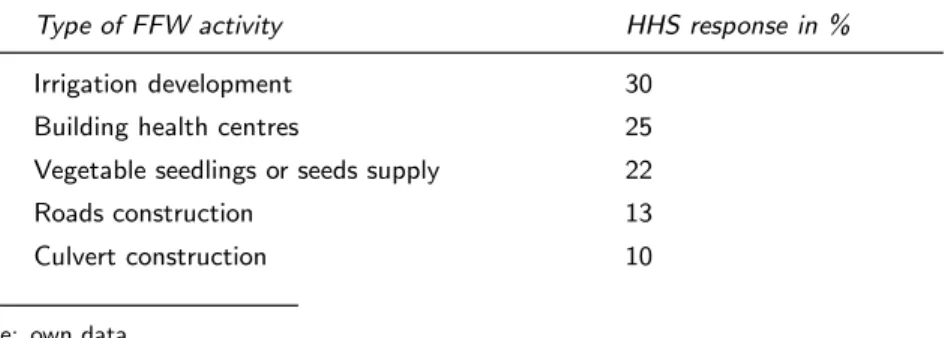
As a result, the survey sample suggests that the FFW program has indeed negatively effected to time and resource allocations for own production. Because the household labour was spent more on FFW activities than on own field works. In Table 1 is indicated the various FFW activities in which the sample hhs participated during the field surveys.
Table 1: Various FFW activities in which the sample hhs participated during the field surveys
Type of FFW activity Participation of hhs in %
Rural roads construction 30
Bio-physical soil and water conservation activities 25 Multiplication of multipurpose plants incl. vetiver grass 20
Gully erosion control 12
Check dam construction 8
Stone band and related metal works 5
Source: own data
As has been summarized in the table, much of the FFW program of the GTZ food secu-rity project in the Amhara region focused on road construction activities, multiplication of various plant species including vetiver grass that would be distributed back to the farmers themselves. Multiplication of various plant varieties were carried out on selected individual farmers’ fields who have also participated in the FFW programs. Gully erosion control both by bio-physical i.e., by planting trees in the gullies and using stone bund control measures were carried out in different worst affected communal lands. These new implements were used by the GTZ food security program with the view of improving food security and rural poverty by increasing food production for the mainly drought affected, degraded areas of the Amhara state.
Table 2: Various FFW activities which sample hhs consider most important
Type of FFW activity HHS response in %
Irrigation development 30
Building health centres 25
Vegetable seedlings or seeds supply 22
Roads construction 13
Culvert construction 10
Source: own data
was very high in the dry seasons infecting hundreds of people each year making many households unable to cultivate their fields on time and costing others their lives. 3.2 Calorie intake impacts of FFW program
Several studies have documented that technological change and commercialization of smallholder production improve the level of food consumption, hence the calorie intake of participating households (von BraunandKennedy, 1994). Changes in food con-sumption are generally associated with more readily available cash income. Meanwhile, increased commercialization may result in greater self sufficiency via increased produc-tivity of the land and labour inputs allocated to the commercial acproduc-tivity and changes in cropping patterns (von Braun, 1995). With a higher income a substitution of cheap calories for more expensive calories can take place and consequently, diets gain not only in quantity but also in quality and diversity. Consumption changes affected by techno-logical change and commercialization have been attributed to increased income rather than to higher food availability (Alderman, 1987; Binswangerand von Braun, 1991).
the households’ own field related activities especially at crucial times of cropping seasons. Highland Ethiopia, including the Amhara region has two main cropping seasons i.e., the Belg or short rainy season the Meher or long rainy season. Therefore, it needs to be mentioned that the FFW activities may effectively utilize households’ labour if targeting the programs at off-farm seasons and in accordance to priority areas selected by the communities themselves. FFW may then be more effective to enhance food security, improve daily calorie intake and resource conservation, provided that the programs are compatible with local priorities. A policy combining promotion of tree planting and conservation of cropland may achieve win-win long term benefits in terms of increased household incomes as well as more sustainable land use (Holdenet al., 2005). 4 Conclusion and Recommendations
Following the liberalization process in Ethiopia, the number of non-governmental organi-zations (NGOs) involved in the country has increased substantially. However, whatever numbers of NGOs do exist in the country and whatever programs are carried out by them, there is no significant change of life for the overwhelming majority of the rural community at all. With the current state of affairs, it is also clear that food for work projects are by no means the best alternative solutions to the worsening living conditions of millions of Ethiopians.
Though the FFW provision contribution to food security is negligible when compared with the large scale of destitution and high food deficiency prevalent in the Amhara region, maintaining the program to supply basic needs of Ethiopia’s most destitute population is indispensable. However, the choice of the programs need to be left to the local community, and must focus in long term rural development operations in order to shift the debate from whether poverty is dropping, and how best to improve the continued poverty and malnutrition in the Amhara region and Ethiopia at large. The types of investment, for instance, soil and water conservation (SWC), road con-struction, land use management and other food security and related programs also implemented by the regional and district authorities, require better coordination efforts between the different stakeholders involved in the region. As over 80% of Ethiopia’s pop-ulation said to live in rural areas, it is essential to resettle the sparsely distributed house-holds into small villages, which would enable both the government and non-governmental organizations (NGOs) to effectively utilize resources for execution of the FFW opera-tions. Operations include providing safe drinking water, electricity, telecommunication facilities and facilitating access to rural roads for better marketing of agricultural pro-duce. At this point, the resettlement program undertaken by the previous government or the failed Tanzanian Ujamaa movement may come in the minds of many, there is no doubt however, if the choice is provided to the households themselves and infrastruc-ture such as road, health, water and electricity availability is ensured, the resettlement program can be successfully implemented.
children in the region have been increasing from time to time, which might have been attributed by the rising frequency of food aid being distributed in the area that in turn created the so called a dependency syndrome among the small scale producers. How-ever, it should be stressed that the food aid had saved millions of lives in the region that resulted in due to drought or other crises. Given the number of undernourished people in Amhara and the increasingly complex risks to food security, local authorities together with partner NGOs need to put the FFW program at the top list of their agenda, not only as a relief provision in short terms but also with the view of reducing food aid dependency and increase food self sufficiency in longer terms. An improvement in the widespread under-nourishment due to FFW activity, was not conspicuously prevailed by the study, except the fact that a small increase in calorie intake was reported by sam-ple households b) In the second scenario, it was also revealed that the FFW program has some crowding-out effects on own field productivity and resource management by participating households. Time and labour allocation by farmers for own field works, especially during field cultivation and weeding periods, was limited due to the permanent involvement of the farmers in FFW activities.
Generally, the way in which “aid” decisions are made should be with reference to those whom they utilize it most. Coincidence of food aid import or distribution with harvesting seasons needs to be avoided in order not to destabilise market prices of home grown agricultural produce. In this regard, payments can also be made in cash that would allow the beneficiaries to purchase the food of their choice at times they are in need. The recent shift of FFW into Cash for Work (CFW) programs by the GTZ-IFSP is a very good move towards the right direction, that other aid organisation could follow suit. The workers of aid organizations in general should be ones who listen to the opinions of the supposed beneficiaries of the process of development and have a degree of access to what one observer has called “the rich and the detailed system of knowledge of the poor”.
In the opinion of the author, the overall food for work program could be improved by more explicit targeting of the poorest households, and by refocusing its work on the types of programs that bring the greatest benefits to the destitute in greater scale. The author strongly believes only direct investment (for e.g. in middle and big scale agricul-tural industries, investment in irrigated agriculture) both by national and international stakeholders is the best alternative to food aid, which we believe is a long lasting solution for Ethiopia’s recurrent food insecurity and poverty crises. After all, there is no single country in the world that is considered to be ’developed’ as a result of food aid. The author is by no means criticising the humanitarian assistance, which is meant to save lives effected by natural or manmade disasters.
Acknowledgement
The survey was conducted in Ethiopia with the kindly support of the Integrated Food Se-curity Program (IFSP) of the German Agency for Technical Cooperation agency (GTZ). I am grateful to the IFSP leadership for supporting me to undertake the study at their project. I express my deepest gratitude to KED (Kirchlicher Entwicklungs-Dienst) for granting me a financial support during the survey.
References
Aas, T. L. andMellemstrand, C.;Fighting for a Food Secure Future.
Food-for-Work programs in Tigray, Ethiopia; Master’s thesis; Agricultural University of Norway; 2002.
Alderman, H.; Co-operative dairy development in Karnataka, India: An assessment; Research Report No. 64. IFPRI (International Food Policy Research Institute), Wash-ington DC, USA; 1987.
Becker, G.; A theory of the allocation of time; Economic Journal; 75(299):493–517; 1965.
Behrman, J. R. andDeolalikar, A. B.; Health and nutrition; in: Handbook of
development economics, edited byChenery, H. B.andSrinivasan, T. N.; vol. 1; 631–711; Elsevier Science Publishing Company, Inc., New York, USA; 1988. Binswanger, H. P.andvon Braun, J.; Technological change and commercialization
in agriculture;The World Bank Research Observer; 6(1):57–80; 1991.
von Braun, J.; Agricultural commercialization: Impacts on income and nutrition and implication for policy;Food Policy; 20(3):187–202; 1995.
von Braun, J.and Kennedy, E., (Eds.)Agricultural commercialization, economic
development, and nutrition; Johns Hopkins University Press, Baltimore, Maryland, USA; 1994.
FAO/WFP; Can Ethiopia feed itself? Crop and food supply assessment mission: pro-posed travel itinerary; (retrieved from http://www.sas.upenn.edu on May 15, 2006); 1995.
Gebremedhin, B.andSwinton, S. M.; Reconciling Food-for-Work Project Feasibil-ity with Food Aid Targeting in Tigray, Ethiopia;Food Policy; 26(1):85–95; 2000. Holden, S.,Bekele ShiferawandPender, J.;Policy Analysis for Sustainable Land
Management and Food Security - A Bio-economic Model with Market Imperfections; no. 40 in Research Report; International Food Policy Research Institute, Washington, DC; 2005.
Holden, S. T.,Bekele ShiferawandWilk, M.; Poverty, Market Imperfections, and Time Preferences, Of Relevance for Environmental Policy?; Environment and Development Economics; 3(3):105–131; 1998.
Sanford, S.andHabtu, Y.; Emergency Response Interventions in Pastoral Areas of Ethiopia; Addis Ababa: DFID; 2002.
Singh, I.,Squire, L.andStrauss, J., (Eds.)Agricultural household models:
Exten-sions, applications, and policy; John Hopkins University, Baltimore, Maryland, USA; 1986.
Subbarao, K.; Systemic Shocks and Social Protection: Role and Effectiveness of Public Works Programs; (retrieved from http://www1.worldbank.org on May 14, 2006); 2001.
Appendix
A simple basic model
The agricultural household model incorporating production and consumption in this section forms the basic structure of empirical equation estimated in this paper. Fol-lowingBecker(1965);Singhet al.(1986) andBehrmanandDeolalikar(1988), households obtain utility from the consumption ofG-goods specified as:
U =U(G1, G2, G3, . . . , Gn) (1)
where theGs are consumable goods. Let us assume that there are two sets of goods: calories (G1) and other n-1 consumable goods. The production functions for the G-goods are:
Gi=Gi(Xm, Xa, Xl, F, R)i= 1,2, . . . n (2) whereXmis market-purchased goods,Xais agricultural staples produced by the house-holds, Xl is leisure, F is family labour endowments and R, a non-choice vector of variables, represents individual and household characteristics, such as ages, years of education, household size, dependency ratio and other environmental variables. The household utility function can therefore be specified as:
U=U(G1(Xm, Xa, Xs, F, R), G2(Xm, Xa, Xs, F, R), . . . , Gn(Xm, . . .)) (3)
The household picks the optimal consumption bundle, subject to its production tech-nology:
Qa=Qa(A, L, V, K) (4)
whereQais the household’s production of staple food,Ais land,Lis total labour input, V is a vector of variable inputs (fertilizer etc.),K is a vector of capital (drought and other animals).
The household also faces a budget constraint:
PmXm=Pa(Qa−Xa)−w(L−F) +E (5)
That is, given prices, Pm, the total market consumption, PmXm, cannot exceed the total income, that is the sum of non-labour income,E, labour earnings,w(L−F), and the value of food marketed surpluses,Pa(Qa−Xa). F is the family labour supply, such that(L−F)if positive it represents hired labour, and if negative it is off-farm labour supply. The household also faces a time constraint: that is the total time,T, available to the household cannot exceed the sum of time in leisureXsand time working on-farm or off-farm,F. In this case:
T =F+Xs (6)
Substituting the production constraint (4) for Qa and incorporating the time constraint (6) into the budget constraint (5) forF, yields the following constraint:
where, π =PaQa(A, L, V, K)−wLmeasures farm profit. The left-hand side of (7) represents total household expenditures on purchases of market commodities (PmXm), the household’s purchases of its own output (PaXa), and the household’s purchase of its own leisure time (wXs) The right-hand side represents the full income in which the value of the stock of time available to the householdwT, profitπand non-labour income (E) are explicitly recorded.
From equations (3) and (7), the household can choose (i) the consumption levels for the Z-goods through the consumption of Xm, Xa and Xs and (ii) the total labour input into agricultural production. The first order conditions (FOC) for maximizing the choice variables are explored in Tangka(2001). FOC for labour can be solved forL, as a function of prices (Pa and w), the technological parameter(s) of the production function and the fixed area of land (A)
L=L(w, Pa, K, A) (8)
Since production is not influenced by consumption choices, this form of the model is recursive.
The value of the full income, when profits have been maximized through the appropriate choice of labour input, can be obtained by substitutingLinto the right-hand side of the full income constraint (7), which could then be re-written as:
PmXm+PaXa+wXs=S (9)
Since production is not influenced by consumption choices, this form of the model is recursive.
Various elements of the basic model will be modified in the following sub-sections to address pertinent issues specific to the problem to be analyzed. This includes the impact of intensified dairying and market-orientation of small farmers on food consumption, per capita calorie intake and food marketed surplus for the harvesting and planting seasons. In this case if the household maximizes utility, where utility is a function of consumption (C) and leisure (Xl),
U=U(C, Xl) =PqQ(La, Lq) +WF F W, LF F W (T−La−LF F W) (10)