*Correspondence to Author:
Chirag Patel
Associate Professor, Parul Univer-sity
How to cite this article:
Jaimeel Shah and Chirag Patel.A Dynamic Resource Mapping Load Balancing Technique in Cloud puting.American Journal of Com-puter Engineering, 2019; 2:6.
eSciPub LLC, Houston, TX USA. Website: http://escipub.com/
Jaimeel Shah and Chirag Patel, AJCE, 2019; 2:6
American Journal of Computer Engineering
(D
OI
:10.2
8
9
33/
AJCE)
Research Article AJCE (2019) 2:6
A Dynamic Resource Mapping Load Balancing Technique in Cloud
Computing
Tremendous advantages of virtualization and cloud computing innovations have invigorated the Information and Communication Technology sector towards embracing cloud computing. Differ-ent ICT-empowered service providers additionally have either embraced cloud computing or began moving administrations to cloud framework. Be that as it may, the expanding interest for cloud based foundation has come about into extreme issue of managing the resources and load balancing for cloud specialist providers and customers. Specialists have recommended various different load balancing techniques for effective resource usage in cloud. An epic load balancing strategy speaking to migration of workload from over-loaded VM to daintily stacked VM in cloud computing condition is introduced in this paper. An endeavor is made to help the cloud partners to overcome the imbalanced re-source usage issue is displayed in this paper.
Keywords: Cloud computing, Load balancing , task scheduling, task migration.
Jaimeel Shah1, Dr. Chirag Patel2
1Research Scholar, Parul University,India;
2Associate Professor, Parul University;
ABSTRACT
Introduction
Since its origin in a decade ago, with assistance of unrests in information and communication advances, the cloud computing worldview has accomplished new statures and come about into one increasingly stable kind of distributed computing. Embracing cloud computing helps in keeping away from broad speculation on hardware equipments [4]. As per administration customers' necessities, the cloud environments are molded to provide different administration models, for example, Infrastructure services, Platform services and Software services. Aside from the advantages of cloud computing be that as it may, allocation of the resources and the management is testing assignment for cloud service providers. Interest for cloud assets is expanding step by step. Such increment popular for cloud assets make resource allocation task errand troublesome for the cloud service providers.
In like manner, the task of cloud resource management turns out to be progressively troublesome amid unexpected upsurge of on demand resources if there should be an occurrence of restricted accessibility of real physical resources at the cloud premises. Improper designation of cloud resources may result into either on-time resource inaccessibility to service consumers or poor utilization of cloud resources; which may lead towards infringement in Service Level Agreements (SLAs). SLA infringement may result into declination consequently on venture or then again contract end now and then. When all is said in done, 'steady accessibility' of foundation service has kept on being one of the most essential prerequisites of customers from the cloud service providers since the creation of cloud figuring [11]. Applications running on an accumulation of interconnected virtual machine examples in basic cloud figuring conditions may abandon a few occasions
heavily loaded while other virtual machine cases might be underlying loaded, causing degradation of performance and wastage of cloud processing resources and power. The test of effective resource utilization in the cloud computing environments can be tended to by spreading the workload among the organized virtual machines by methods for load balancing strategy. Effectiveness and performance degradation has remained a consuming issue in the cloud computing area. Imbalanced workload dispersion likewise may cause proficiency degradation of cloud virtual machines. Varying the strategy of entirety virtual machine migration, a novel strategy of relocating the tasks among virtual machines in cloud is recommended in this paper. The strategy helps in fathoming the load balancing issue of virtual machines. The issue of poor resource distribution and utilization in cloud can be settled by methods for load balancing strategy. In this paper, a novel load balancing system in cloud figuring condition is recommended for productive utilization of compute resources [14].Service availability is prerequisite in cloud environment. Notwithstanding, in some cases it might wind up troublesome for service provider to meet the prerequisite amid certain unavoidable reasons, for example, normal disasters, unavailability of power, unavailability of web. In such cases, the system proposed in this paper can be useful to service providers for moving undertakings to safe environment from hazardous cloud environment.
The rest of the paper is sorted out as pursues. In next section, learn about different existing cloud load balancing strategies is portrayed. A one of a kind load balancing component is introduced in section 3. Exploratory outcomes are talked about in section 4. Concluding comments are depicted in section 5.
Related Work
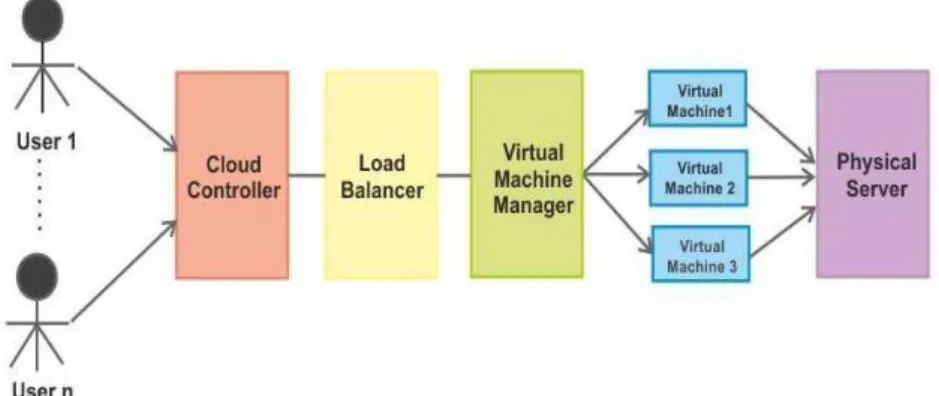
broadened components and partners, such as, networking, storage components, datacenters, process hubs, service suppliers, service buyers and Service Level Agreements. In literature survey different resource assignment and load balancing methods are available.Figure 1 describes the scenario about how load balancing works in cloud environment.At the point when client sends a request to the Cloud Controller, request will be sent to the load balancer for executing load balancing calculations. The load balancer will choose which virtual machine will deal with the specific request dependent on the accessibility of the virtual machines. Cloud controller handles the errand the board of the request send by the client [5]. Undertakings are submitted to the load balancer where load balancing technique comes to play for allotment of reasonable virtual machine for executing the errands. VM
manager will deal with every one of the obligations of the virtual machine. Virtualization is managing innovation in the cloud computing. The objective of virtualization is to share the resources, for example, sharing the equipment, memory among the virtual machines. As Virtual machine will be utilized to deal with the client's request, handling of request is a one of the testing issues in the cloud computing. In the event that a portion of the virtual machines are over-utilized and a portion of the virtual machines are under stacked which will result into the reduction in the execution and furthermore decline the quality of service [8]. A hypervisor or VMM will be utilized to deal with the virtual machines. A hypervisor will choose which virtual machine will deal with the specific request dependent on burden computation of the virtual machines and will fulfill the client's request.
Fig 1 Load Balancing Scenario
In literature survey analysis of different techniques related to resource allotments and load balancing have been discussed.Shu-Ching Wang et.al.,(2010) proposed a load balancing technique dependent on distributed computing system. It fundamentally chips away at two stages scheduling and load balancing. Proposed technique includes blend of two methodology which comprise of OLB(Opportunistic Load Balancing) and LBMM(Load Balancing Min-Min). Calculation essentially pursues the specialist based methodology. It essentially comprise of 3 levels
Aarti et.al.,(2015) have proposed a autonomous agent load balancing technique for dynamic load balancing in the distributed computing [21]. In proposed load balancing it essentially contains three sorts of operators 1) Load Specialist : The fundamental undertaking of the load specialist is to figure the load of each accessible VM in the wake of allotting another task to the data center. 2) Channel Operator : When CO will get the demand from the Load Specialist, it will start relocation specialists to other data center for looking through the VM relocation which comprise of similar configuration 3) Relocation Specialist.: It will move to the next data centers and will communicate with the load operator of the data center to know the status of VM.
Seyed Gafari et.al., (2013) proposed a novel methodology of power aware load balancing approach which is said to be called as Honey bee MMT calculation which is utilized for lessening the utilization of the power in distributed computing environments [17]. This methodology fundamentally comprise of 4 phases which are 1) Discovery of Overloaded Host 2) VM choosing approach 3) Location of Under loaded host 4) Violation of SLA.
The Ant Lion Optimizer calculation proposed by Aya SalahFarrag et al. depends on ant colony optimization. The calculation speaks to an endeavour to optimize response time and service quality parameters [2]. Haiying Shen has proposed a resource intensity load balancing technique [7]. For improving scalability, the system chooses destination machine in decentralized way. Ashkan Paya et al. have proposed energy aware load balancing technique. For energy aware load balancing, idle and under stacked servers are moved to rest state [1]. Yingchi Mao et al. have concentrated on elasticity in their calculation [18]. They have proposed Max-min task scheduling calculation for load balancing in elastic cloud. Michael Paul Dehann has recommended a strategy for modified development of cloud procedures to external
clouds. The proposed work tunes in for inner and outer observing agents. After gathering the states of the standards, the virtual machines are relocated to external [8]. O. Agesen et al. have displayed a method for reinforcement adaptation to non-critical failure over remote virtual machines in VMWare condition. The proposed work underpins finding reinforcement framework remotely [12].
After thorough literature study it is felt that a few calculations include clumpsy network topologies among virtual machines while a few calculations statically balance the workload by fixing predefined loads to different cloud assets causing execution declination. A few calculations are static in nature. A few methods are hard to execute as they are not open source. Though a few systems are compelled to explicit registering stage or innovation. It is likewise watched that however methods for relocating whole virtual machines on physical machines are accessible, there is need of a technique which encourages exchanging wanted assignment from over-loaded VM to under-loaded VM.
Proposed Mechanism.
From the literature review, limited work has been accomplished for load balancing in cloud computing environment and those current systems do have constraints that should be tended to. Along these lines there is need of a new technique which can offer most extreme resource utilization, maximum throughput, less response time, dynamic resource scheduling with scalability. This work proposes a Dynamic Resource Mapping technique for Load Balancing in cloud computing environment to address above issues. At whatever point a VM becomes overloaded, the service provider needs to disseminate the resource in such a way, that the available resources will be used in an appropriate way and load at all the virtual machines will remain balanced. The proposed dynamic resource mapping technique for load balancing is as follows.
the configuration such as CPU,RAM,Hard disk
VMn = VM1 + VM2 + VM3 + VM4 + ……….. +VMn
Step 2: Request handler will handle n request from the clients such that
Rn = R1+R2+R3 +R4 + ………+Rn
Step 3: Request Handler will check whether the request is valid or not and if the request is valid it will be forwarded to Load Balancer.
Step 4: Load Balancer consist of VM_Maintainance Table which maintain the all records of VM in VM’s table which consist of information such as memory utilization ratio, cpu utilization, fitness value and load status.
Step 5: Calculate Memory Utilization Ratio based on the memory usage
λavailable_memory = λtotal_memory – λused_memory
γ = λavailable_memory
λtotal_memory ∗ 100
Step 6: Every VM will maintain a Request queue to handle the incoming request from the users
ρ = current queue size of VM’s.
Q_L Threshold = Threshold limit of request queue.
𝛿ρ = service request queue size
Calculating the service request size
δρ = ρ δt
If (𝛿ρ > Q_L Threshold)
No new request can be handled by server.
Step 7: Set the threshold value of VM’s to indicate whether the VM is critical or not..
If( ζ >25 && ζ <75 )
{
Allocation_status = normal Update load_table of VMs
}
Else
{
Allocation_status = critical
Call VM_Load_Balancer()
}
Step 8: VM_Load_Balancer( )
{
For client’s request
Create analysis table based on response time which consist of Migration_id, Destination_id, Memory_Utilization_Ratio and response time.
Mapping of analysis_table and VM_maintanance_table to find out the suitable VM.
}
Step 9: Based on response time of different VM , forward the request to suitable VM.
Step 10: Once VM will be migrated, Check Resource utilization of VM.
4. Implementation and Results
Implementation of the proposed algorithm of Dynamic Resource mapping algorithm has been implemented on open source platform of OpenStack cloud in Redhat Linux. Hardware and Software specifications are describe here
A. Hardware Specifications:
System Name: Dell Inspiron 3543
Processor : Intel core i3 (7th
Generation), Quad Core
RAM: 12 GB (DDR 4) Hard Disk : 1TB
Cache : 4MB
Gigabit Ethernet
B. Software Specifications:
Base Operating System: CentOS Linux 7 (Core)
CentOS Release: centos-release7.3.centos.x86_64 (Core)
Cloud computing platform: OpenStack OpenStack version: 14.0.2-1.el7
Fedora Linux
C. Cloud Instance Specifications:
VCPUs: 1
RAM: 1 GB
Root Disk: 3 GB
Swap Disk: 500 MB
Image format: qcow2
Bootable: Yes
Volume Size: 4GB
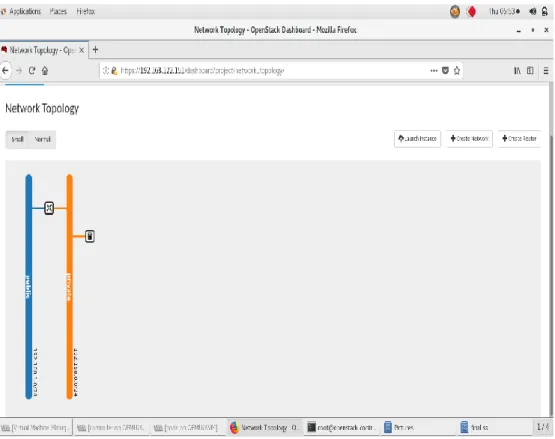
Network Topology: Fig 2 describes the topology
Fig 2 Creating Network Architecture in OpenStack Cloud
Fig 4 Load of Instances after applying Load Balancing Algorithm
The recommended load balancing algorithm has been investigated the cloud infrastructure which is assigned in past section. Workload situation before load balancing is appeared in Fig. 2. Before load balancing, the virtual machine having IP address [192.168.0.69] is overloaded, though the virtual machine having IP address [192.168.0.70] is under loaded. The load balancer chooses to adjust load among overloaded VM [192.168.0.69] and under loaded VM [192.168.0.70]. Workload balancing after load balancing is appeared in Fig. 3. After load balancing, presently the virtual machine having IP address [192.168.0.69] is working typically, which was prior intensely loaded before load balancing occurred.
5. Conclusion
In this research paper a new load balancing technique in cloud computing have been proposed and the suggested technique is helpful for the efficient resource utilization of the VM’s and improve the performance of the Virtual Machines. The mechanism implemented in open stack cloud computing environment helps to develop a dynamic resource mapping algorithm for cloud
computing environment where suitable VM need to be find based on the migration_id where cpu utilization of resources increase above the threshold value . Future work will be focused on implementing proposed work to get the better result by including the parameters such as scalability and fault tolerance.
Author’s contribution:
JS and CP carried out the survey of the literature, created the taxonomy, drafted the proposed algorithm. All authors read and approved the manuscript.
Competing interests:
The author declare that they have no competing interests.
Acknowledgments: The authors
acknowledge financial support of the Government of Gujaratunder the Minor
Research Project Scheme(Ref
GUJCOST/MRP/2015-16/2642).
References
[2] Milani, AS. And Navimipour,NJ. (2016). Load balancing mechanisms and techniques in the cloud
environments: Systematic literature review and future trends. Journal of Network and Computer Applications, 71, 86–98.
[3] Farrag, AAS. and Mahmoud, SA. (2015). Intelligent Cloud Algorithms for Load Balancing problems: A Survey. IEEE Seventh International Conference on Intelligent Computing and Information Systems (ICICIS 'J 5), 210-216.
[4] Kanakala, VRT. and Reddy, VK. (2015). Performance Analysis of Load Balancing Techniques in Cloud Computing Environment. TELKOMNIKA Indonesian Journal of Electrical Engineering, 13(3), 568-573.
[5] Ivanisenko, IN. and Radivilova, TA. (2015). Survey of Major Load-balancing algorithms in Distributed System. Information Technologies in Innovation Business Conference (ITIB).
[6] Gutierrez-Garcia, JO. and Ramirez-Nafarrate, A. (2015). Agent-based load balancing in Cloud data centers. Cluster Computing, 18(3):1041–1062. [7] Mishra, NK. and Misha, N. (2015). Load Balancing Techniques: Need, Objectives and Major challenges in Cloud Computing: A Systematic Review. International Journal of Computer, 131(18).
[8] Dasgupta, K. and Mandalb, B., Duttac, P., Mondald, JK., and Dame, S. (2013). A Genetic Algorithm(GA) based Load-balancing strategy for Cloud Computing”, International Conference on Computational Intelligence: Modeling Techniques and Applications (CIMTA), 10, 340-347.
[9] Singha, A. and Juneja, D., and Malhotra, M. (2015). Autonomous Agent Based Load-balancing algorithm in Cloud Computing. International Conference on Advanced Computing Technologies and Applications (ICACTA), 45, 832–841
[10] Gautam, JV., Prajapati, HB., Dabhi, VK., and Chaudhary, S. (2015). A Survey on Job Scheduling Algorithms in Big Data Processing. IEEE International Conference on Electrical, Computer and Communication Technologies (ICECCT’ 15)
[11] Ghafari, S.M., et al. Bee-MMT (2013) A load balancing method for power consumption management in cloud computing. in Contemporary Computing (IC3), Sixth International Conference, IEEE.
[12] Yakhchi, M., Ghafari, SM., Yakhchi, S., Fazeliy, M., Patooghi, A. (2015). Proposing a Load Balancing Method Based on Cuckoo Optimization Algorithm for Energy Management in Cloud Computing Infrastructures. Published in: 6th International
Conference on Modeling, Simulation, and Applied Optimization (ICMSAO).
[13] Singh, P., Baaga, P., and Gupta, S. (2016). Assorted Load-balancing algorithms in Cloud Computing: A Survey”, International Journal of Computer Applications, 143(7).
[14]Khiyaita (2012), A., et al. Load balancing cloud computing: state of art. in Network Security and Systems (JNS2). IEEE.
[15]Ray, S. and A. De Sarkar (2012), EXECUTION ANALYSIS OF LOAD BALANCING ALGORITHMS IN CLOUD COMPUTING ENVIRONMENT. International Journal.
[16] Nishant, K., Sharma, P., Krishna, V., Gupta, C., Singh, KP., Nitin, N., and Rastogi,R. (2012). Load Balancing of Nodes in Cloud Using Ant Colony Optimization. 14th International Conference on Modelling and Simulation, 3-8.
[17] Nuaimi, K.A., et al(2012). A Survey of Load Balancing in Cloud Computing: Challenges and Algorithms. in Network Cloud Computing and Applications (NCCA), Second Symposium on. 2012. IEEE.
[18] Chien, NK., Son, NH., and HD. (2016). Load-balancing algorithm Based on Estimating Finish Time of Services in Cloud Computing, International Conference on Advanced Commutation Technology
(ICACT), 228-233.
[19] Gupta, P., M.K. Goyal, and P. Kumar et.al (2013). Trust and reliability based load balancing algorithm for cloud IaaS. in Advance Computing Conference (IACC),IEEE 3rd International. 2013. IEEE.
[20] Wang, S.-C., et al(2010). Towards a load balancing in a three-level cloud computing network. in Computer Science and Information Technology (ICCSIT), 3rd IEEE International Conference.
[21] Aarti Singha , Dimple Junejab , Manisha Malhotra et.al(2015) ,“ Autonomous Agent Based Load Balancing Algorithm in Cloud Computing”, 2015 International Conference on Advanced Computing Technologies and Applications (ICACTA- 2015)
[22] Keshvadi, S. and Faghih, B. (2016). A Multi-Agent based Load balancing System in IaaS Cloud Environment. International Robotics and Automation Journal, 1(1).
[23] Simjanoska, M., et al(2013). L3B: Low level load balancer in the cloud. in EUROCON, 2013 IEEE. 2013. IEEE.
Systems (CCIS), IEEE International Conference on. 2011. IEEE
[25] Wang, R., W. Le, and X. Zhang et.al(2010), Design and implementation of an efficient load-balancing method for virtual machine cluster based on cloud service.
[26] Kansal, NJ. and Inderveer Chana, I. (2012). Cloud Load Balancing Techniques: A Step Towards Green Computing. International Journal of Computer Science Issues, 9(1), 238-246.
[27] Rastogi, G. and Sushil, R. (2015). Analytical Literature Survey on Existing Load Balancing Schemes in Cloud Computing. International Conference on Green Computing and Internet of Things (ICGCloT).
[28] Einollah Jafarnejad Ghomi, Amir Masoud Rahmani, Nooruldeen Nasih Qader et.al(2016) Load-balancing Algorithms in Cloud Computing: A Survey. Journal of Network and Computer Applications Elsevier.
[29] Sandeep Negi (2013) An Improved Round Robin Approach using Dynamic Time Quantum for Improving Average Waiting Time: International journal of Computer Applications.
[30] Nishant, K., Sharma, P., Krishna, V., Gupta, C., Singh, KP., Nitin, N., and Rastogi,R. (2012). Load Balancing of Nodes in Cloud Using Ant Colony Optimization. 14th International Conference on Modelling and Simulation, 3-8.
[31] Babu, LDD. and Krishna, PV. (2013). Honey bee behavior inspired load balancing of tasks in cloud computing environments. Applied Soft Computing, 13 (5), 2292– 2303.
[32] Yakhchi, M., Ghafari, SM., Yakhchi, S., Fazeliy, M., Patooghi, A. (2015). Proposing a Load Balancing Method Based on Cuckoo Optimization Algorithm for Energy Management in Cloud Computing Infrastructures. Published in: 6th International Conference on Modeling, Simulation, and Applied Optimization (ICMSAO).
[33] Shadkam, E. and Bijari, M. (2014). Evaluation the Efficiency of Cuckoo Optimization Algorithm. International Journal on Computational Sciences & Applications (IJCSA), 4(2), 39-47.
[34] Rajabioun, R. (2011). Cuckoo Optimization Algorithm. Applied Soft Computing, 11, 5508-5518.
[35] Keshvadi, S. and Faghih, B. (2016). A Multi-Agent based Load balancing System in IaaS Cloud Environment. International Robotics and Automation Journal, 1(1).
[36] Sim, KM. (2011). Agent-based Cloud Computing. IEEE Transactions on Services Computing, 5(4), 564-577.
[37] Tasquier, L. (2015). Agent Based Load-balancer for Multi-Cloud Environments. Columbia International Publishing Journal of Cloud Computing Research, 1(1), 35-49.
[38] Singh, P., Baaga, P., and Gupta, S. (2016). Assorted Load-balancing algorithms in Cloud Computing: A Survey”, International Journal of Computer Applications, 143(7).
[39] Domanal, SG. and Reddy, GRM. (2015). Load Balancing in Cloud Environment using a Novel Hybrid Scheduling Algorithm. IEEE International Conference on Cloud Computing in Emerging
Markets, 37-42.
[40] Komarasamy, D. and Muthuswamy, V. (2016). A Novel Approach for Dynamic Load Balancing with Effective Bin Packing and VM Reconfiguration in Cloud. Indian Journal of Science and Technology,9(11), 1–6.