Re-qualification of the main steam line of a NPP with more detailed analysis of
seis c
loads and responses
Zsolt Revesz
Associated Consulting Engineers, P.O. Box 1126, CH-5401 Baden, Switzerland
ABSTRACT
The paper describes a case in which with more detailed analysis of the seismic loads and with more elaborated, more accurate model the Main Steam Line of a 1000 MWe class nuclear power plant with BWR has been redesigned. Re-design and re-qualification has resulted in a new piping configuration with significantly reduced number of installed snubbers, and in a more simple support system. The analysis of the piping system has been repeated over twenty years after the original work, whereas the main differences consisted of changes in the piping code and the use of the abundant computational resources available today - besides revision of the earthquake analysis of the buildings as well. Final recommendation consisted in two suggested configuration change packages. One with a significant reduction in the number of earthquake restraints (snubbers) with no need to further analyze elements of the support structure before implementation. A second one with an additional possibility to reduce the number of snubbers, but requiring analysis of piping support structures to see if the higher loads are still allowable or else if a reasonable hardware changes would reinforce structural elements to carry the new load.
INTRODUCTION
The paper presents the work done for a 1000 MWe class Nuclear Power Plant (NPP) equipped with a Boiling Water Reactor. Not to be burdened with getting all the permits for publication of details, to comply with details of confidentiality agreement signed and also because of results and procedures are typical and well applicable for any other NPP the name of the actual plant has not been referred to throughout this paper.
Re-design and re-qualification has resulted in a new piping configuration with significantly reduced number of installed snubbers, and in a more simple support system.
To be stated that the improved results are on the same basis on which the original design has been elaborated. That means all calculations have been performed according o the rules set forth by the corresponding codes [1 ]. Merely the analysis efforts have been made greater what is in light of the abundant computational capacity available today less costly than it used to be.
M E T H O D O L O G Y
The analysis of the piping system has been repeated over twenty years after the original work. The differences between the two analyzes have different origins.
(i) First, there are changes in the piping code [1 ]. The code became during this period more elaborate, the minimum model required became more accurate. For this delivers more precise results the prescribed safety margins became narrower.
(ii) Then, the abundant computational resources have allowed consequent and straightforward application of today's up-to-date analytical tools. The main point is that now no separation of individual piping section e.g. by fix-points so as to reduce the necessary analysis work is advantageous. Thus grater flexibility is allowed when d~fming the boundaries of the piping sections and of the support system modeled by the method of f'mite elements, than if model was limited by computer capacity.
(iii) Lastly, also due to advances in computer technology, also the model size has been increased - which has had positive effect on the results as in the seismic analysis part as in the Class 1 piping analysis with fatigue and dynamic loads. Obvious, that with the new design the same or higher safety level as the original one can be assured. The results are explained by the circumstance, that the time the investigated NPP was built computer time were measured and paid for by CPU seconds, thus figured as a major item in the budget. On the contrary, today engineering analysts have practically unlimited computing capacity at their disposal. As a consequence with some more invested time during the design process - sometimes with the same tools - improved design is the outcome of a repeated analysis, as is in the presented case.
SMiRT 16, Washington DC, August 2001 Paper # 1709
Earthquake Spectra Revision
This is not discussed here in detail, partly because earthquake data were used in the piping analysis as a black box. A glance at the results of the revised earthquake analysis allowed the conclusion that earthquake loads calculated on this basis would be lower Without going into details be stated here that this effect alone does not explain the extent of reduction of the necessary number of earthquake restraints. The other effects, because they constitutes the merits of the present work, be handled in individual sections below:
Full Multi Level Response Spectrum Analysis
Full multi level response specmzn analysis has been performed this time. The computer software used for piping analysis was PIPESTRESS [2]. Response spectrum analysis with component load cases to take into account the effect of the modes left out from the frequency analysis, is state-of the-art now. The so called rigid body modes, the left-out-forces in fact estimate a safety margin for the part of the solution which has not been covered by the frequency analysis. It is widely accepted by now, that the more modes are included in the frequency analysis, the more precise and reliable the results are, and that a fair number of modes allows computation of a reliable and also mathematically correct estimate [3]. Therefore, the left-out-force method delivers conservative results even if some modes where lost during frequency analysis.. To perform l~equency analysis of large and complex systems to higher modes is not always a routine task. During the work presented here care has been taken to calculate all natural vibration modes into the flexibility analysis. That flexible modes where omitted during the flexibility analysis earlier, that does not mean that earlier results are invalid, but implicate that they may be overly conservative. Dm~g the work presented here care has been taken to calculate all flexible modes up to 33 Hz for earthquake loads.
Consequent use oft he multi level approach also allowed to obtain more precise and less conservative computed stresses. In case oft he multi-level analysis technique can be said, and has to be said, that the use of envelope spectra does not always leads to conservative results - a fact surprising for those not familiar with the subject but known for quite a long time.
Fatigue Analysis
There have been calculations to assess the structural damage suffered by postulated malfunction of earthquake restraints. However, for a number of reasons no analysis of remaining lifetime of piping elements in such cases has been documented.
Analyzing Individual Systems on High-End PCs
Sophisticated piping analysis software has been made available for PCs quite early and has allowed a very efficient analysis procedure with the fast and direct response to analysts' question [4]. Taking advantage of the further development on the filed of computer hardware, personal computers tuned for this kind of analysis were used to perform analysis of a large number of system configurations when analyzing subsystems.
Assembling subsystem models into a Whole System for Final Analysis on a Mainframe
Assembling the optimized subsystem models for a final calculation on a mainframes was significant on one hand for reasons of quality assurance. On the other hand, further optimization became possible when scrutinizing the large assembled models.
Results
The paper conveys to the reader the conviction that on the same sound basis of state-of the-art engineering there is a space for improvement.
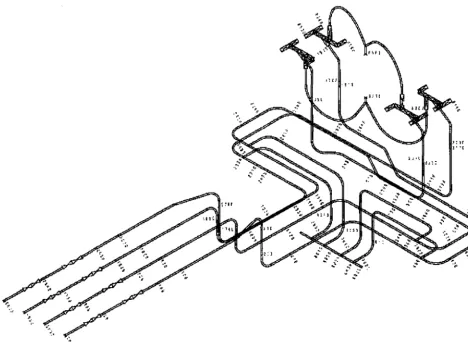
In Figure 1 the four Main Steam Lines as they form the complete piping system is shown as modeied by the piping analysis software PIPESTRESS [2].
The results have been displayed here on the example of the Main Steam Line, because this system are characteristic for the ref'mement in the technical and analytical background of the analysis done. It is safe to predict that the same principles - if used in another case - may lead to the same improved and more economic design. The paper documents that improvements may have such economic impact that the indicated hardware changes in an operating NPPs may well be justified.
÷
,it .%
~ ? E r
I17
: I r~ 4 ~ : ' ~ . ~ ~ ..~
~, ..~, • w
"-,.
Figure I Isometric view of the complete Main Steam Line piping
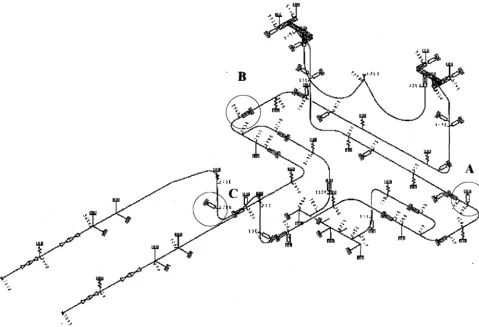
The plot in Figure 2 displays the support system of two of the four Main Steam Lines in Figure 1. The subsystem in Figure 2 was individually analyzed on a PC based workstations, before going to the mainframe with more or less completed concept for the new configuration. In the plot in Figure 2 some supports have been tagged and commented below to show what kind of suggested changes have been individually examined:
The support denoted with A has been replaced by a spring support.
The support denoted with B has been replaced by a restraint to linear translation. The support denoted with C has simply been released.
Final recommendation consisted in two suggested configuration change package. In the first one the changes did not require further structural analyzes of support structures. In the second package implementation of the chdanges has required analysis of piping support structures (to see if the higher loads are still allowable, and in some cases possibly hardware changes to reinforce those supports which would prove nor strong enough to carry the new load.
The first package resulted suggesting the release of total of 8 (eight) snubbers, with no need for further analysis of piping and support structure and with minor hardware changes.
The second package resulted in suggesting elimination of additional 12 (twelve) snubbers. In this case, however, at some locations where earlier snubbers restrained the pipe, the linear restraints are needed instead of the snubbers have calculated loads that much above earlier loading that the support structure needs to be reinforced.
B
tu
.e L
% j - - ~
¢
~" , - .
A
Figure 2 Isometric view of a subsystem indication the piping supports
Having performed an analysis to this detail, and having assembled such a complete model, the opportunity has presented itself to perform fatigue analyzes to determine incremental damages suffered during postulated or eventual malfunction (say temporarily blocked) snubbers. If the system is still fit for service during postulated events like earthquake, plus a series of other specified events like startups, shutdowns, load changes, etc., that can easily be determined if a large and complete computer model has been developed that far. However, no such steps beyond preliminary calculations have been take by the present authors in the present so far.
SUMMARY
A C K N O W L E D G M E N T
Such work represents the result of efforts of a large number of dedicated professionals. It is not always possible to divide into parts and to assign proper credit to individual contributions.
However, in an attempt to do so credit is to be given to the author of this paper for the concept of modeling of the systems on basis of earlier calculations and using additional sources of information, for assembling the model, for performing optimizations of subsystems, for evaluation of results obtained for the large assembled systems, for making suggestions for hardware changes on basis of the obtained computational results.
Data acquisition, so for the piping hardware as for the earthquake data, information exchange between the engineering analyst company and the power plant owner, evaluation of results and making useful suggestions on bases of the wealth of information obtained during the individual calculations performed for a large number of possible configurations must be credited to colleagues working with a third company.
Assembling the larger systems analyzing individual subsystems, building the subsystem models quality assurance has consisted of contribution of several other engineers working for the authors company. Contributions by their dedicated work has also to be acknowledged here.
The present publication and also part of the piping stress analysis has been performed with support of and in the premises of ACE Engineering AG, Wettingen, Switzerland, which company houses Associated Consulting Engineers' activities for some time.
REFERENCES
[ 1 ] ASME Boiler and Pressure Vessel Code, Section III, Rules for Construction of Nuclear Power Plant Components, ASME, New York, New York, 1995
[2] PIPESTRESS, DST Computer Services S.A., Geneva, Switzerland, 1995
[3] R6v6sz Zs., H. Eitschberger: Vibration Analysis of a Non-Accessible Piping Section under Unknown Loading, Trans, 8th Int. Conf. Structural Mechanics in Reactor Technology, Amsterdam, Elsevier Science Publishers, 1985, Vol. DFG, pp. 627-633