38
MICROBIAL INOCULANTS APPLIED AS SEED TREATMENTS
AND THEIR EFFECT ON COMMON WHEAT Triticum aestivum L.
BOIU-SICUIA OANA-ALINA, CONSTANTINESCU FLORICA, URSAN MIHAELA-DANIELA, CORNEA CĂLINA PETRUȚA
Keywords: microbial inoculants, wheat, plant ghowth-promotion
ABSTRACT
Wheat is considered the most wide spread culture in the world regarding the area harvested. In Romania, it is grown on approximately 25% of the arable land and 40% of the cereal grains. Improving wheat productivity and yield quality is a continuous concern. Therefore, plant growth promoting microorganisms with biocontrol potential are of great interest for the farmers. In the present, five beneficial microorganisms, bacteria and fungi, were analysed as agro-inoculants. Their effect on wheat germination and growth initiation
was evaluated in vitro. According to the biometric analysis best results were obtained
when using Azospirillum brassilense and Bacillus amyloliquefaciens strains, although
Trichoderma pseudokoningii and Bacillus endophyticus also improved wheat vigour
indexes, compared to the untreated control. However, B. endophyticus 1T2 strain delayed
the germination process. The dual culture assay performed against Fusarium
graminearum, revealed that three strains B.amyloliquefaciens OS17, BW, and
T.pseudokoningii Td85, have also biocontrol potential.
INTRODUCTION
Wheat is considered the most wide spread culture in the world regarding the area harvested, overlaying 218.5 mil ha in 2017. In Romania, it is grown on approx. 25% of the arable land and 40% of the cereal grains. According to the official data, the area harvested had 2 052 920 ha, with an average yield of 4.9 t/ha (www.fao.org). The interest for wheat growth is due to several factors: the grains are the raw material for a large variety of agrifood products, with a
balanced ratio between the
carbohydrates and protein substances, according to the needs of the human body. Wheat grains have a long shelf life and can be transported without the risk of high degradation. It can also be used as animal feed, either as grains or milled. Wheat straws can also be used as feed or as manure, or in the preparation of organic fertilizers, or as raw material for cellulose. Moreover, wheat can be grown in different climatic zones and at high altitude, due to its high ecological
plasticity. From the agro-technical point of view, this crop is fully mechanized, and it enters in almost all agricultural rotation systems, being considered a very good pre-plant.
Considering these, improving wheat growth promotion, productivity and yield quality is a continuous concern. Another important aspect is plant protection from pest and diseases. For the sustainable agriculture the eco-friendly methods that promote plant growth, improve crop productivity or ensure plant protection are a continuous quest (Ekin, 2019). Several natural resources can be used for these purposes, such as humic substances (Anwar et al., 2016), mineral rocks (Manning, 2010), composts and mulches, algae and vegetal extracts (Onofrei et al., 2017) as well as plant growth promoting microorganisms (Kumar et al., 2019).
The aim of this study is to evaluate
the influence of several microbial
inoculants, applied as seed treatments,
on wheat germination and growth
initiation. Likewise, we studied the
39
microorganisms against Fusarium sp., an
important wheat pathogen and mycotoxin contaminant.
MATERIAL AND METHOD
Vegetal material.
The study was carried out on wheat
kernel Triticum aestivum L. Seed
disinfection was carried out in two steps, 2-3 min in 70% ethanol and 25min in 5% sodium hypochlorite, followed by 5 rinses with sterile distilled water.
Beneficial microorganisms.
Five microbial strains were used in this study, four bacteria and one filamentous fungi (Table 1). Routinely, the bacteria were grown on Luria Bertani (LB) at 28°C, and the fungal strain was grown either on Malt Agar (MA), or Potato-Dextrose-Agar (PDA) at 26° to 28°C.
Microbial inoculum preparation.
To obtain the bacterial cell
suspension, 48h old broth cultures were centrifuged at 3700rpm, for 20minutes at 10ºC. The pellet was wasted with sterile phosphate saline buffer and resuspended
in the same buffer up to 108 cfu/ml.
Bacterial load was quantified by
spectrophotometric analysis at different length waves (620nm, and 600nm) depending on the strain. For the fungal
spores suspension, Trichoderma
pseudokonigii was grown for 10 days on MA, spores were washed in distilled water, supplemented with few drops of Tween 80 to avoid spore clumps. The fungal inoculum was quantified using a
Burker-Turk counting chamber, and
prepared at 107 spores/ml.
Seed treatments.
Disinfected wheat kernels were
surface treated with pure-culture
microbial-inoculants. Five treatment
variants were used in this study, one fungal and four bacterial treatments.To improve the attachment of the beneficial microorganisms on the kernel surface, the inoculum was supplemented with 2% corboxymethil cellulose, in 9:1 v/v ratio. Sterile distilled water was used for the control variant.
Germination assay.
Treated wheat kernels were placed in sterile Petri dishes on filter paper moistened with sterile distilled water, 25 seeds/plate, in four replicates. Plates were kept in complete darkness at room temperature. After 7 days of incubation, the germination percentage was analyzed to determine the effect of delayed germination. Biological parameters such as fresh and dry weight, seedling height (H), number of roots per plant and total length (L) of root system were analyzed.
Plant pathogen.
The phytopathogenic fungi used in this study (Table 1) was acquired from the German Collection of Microorganisms and Cell Cultures GmbH. Routinely, it was grown and maintained on PDA during the study.
Microbial antagonism study.
Direct interaction among the
biocontrol microorganisms and the plant
pathogenic fungi was studied in vitro by
dual cultures technique. Both
microorganisms, the phytopathogenic
fungi and the biocontrol microorganisms, were inoculated simultaneously, in the same plates, at 2cm distance from each other. The fungal inoculum was calibrated as plugs of 6mm in diameter. The beneficial strains were inoculated in spots or strakes, using two days old bacterial biomass. Microbial co-cultivation was performed on PDA medium. Plates were incubated at 28°C and periodically analyzed up to 14 days of co-cultivation.
RESULTS AND DISCUSSIONS
In order to evaluate the effect of different microbial inoculants on wheat
germination and growth initiation,
aqueous bacterial cells and spores suspensions were applied as seed
treatments, before wheat kernel
incubation in humid chambers. Tested microorganisms were selected due to their beneficial effects on different plant species, and biocontrol activity against
various fungal pathogens. Azospirillum
40
due to its plant growth promotion activity, atmospheric nitrogen fixation and root
colonization of wheat (Deaker &
Kennedy, 2001; Gulii et al., 2015).
Bacillus amyloliquefaciens OS17 and BW strains were used due to their antifungal
activity against Fusarium spp. pathogens
(Sicuia et al., 2012), plant stimulatory effect and plant protection potential against various phytopatogenic fungi
(Sicuia, 2013). Bacillus endophyticus 1T2
strain was selected due to the
bioavailability potential of soil phosphorus that can induce beneficial plant growth
effects (Boiu-Sicuia, 2017). Trichoderma
pseudokonigii strain Td85 (DSM 23661) was used due to its antagonistic activity towards different fungal pathogens, such as: Botrytis cinerea (Ștefan et al., 2015), Fusarium spp., Sclerotinia sp. (Ștefan et
al., 2013), and Rhizoctonia solani
(Petrișor et al., 2016). Moreover it revealed plant stimulating effect on tomato seedlings (Petrișor et al., 2019).
Results regarding microbial
inoculants effect on wheat are presented
in Table 2. Several biologic parameters
were analyzed, such as fresh and dry weight, seedling height (H), number of roots per plant and total root length (L). Based on these observations, the force indices (or Seed Vigor Index – SVI) were determined: SVI-I, calculated according to the size of the plant, respectively SVI-II, calculated according to the dry weight of the plants (Abdul-Baki & Anderson, 1973).
Regarding the germination process, most of the seed treatments applied to the wheat kernels generated a delayed germination compared to the untreated
control. Only A.brassilense Sp7 and
B.amyloliquefaciens BW rushed the germination process with one day.
All microbial treatments applied have increased the shoot and root growth in length, biomass quantity, as both fresh and dry weight.
Both seed vigor indexes were improved when the microbial treatments were applied. Best results were obtained with Sp7 and BW, which revealed more
than 50% seed vigor augmentation. Several studies reveal that high seed vigor triggers an increased growth and productivity in the agricultural production (Han et al., 2014; Wen et al., 2018).
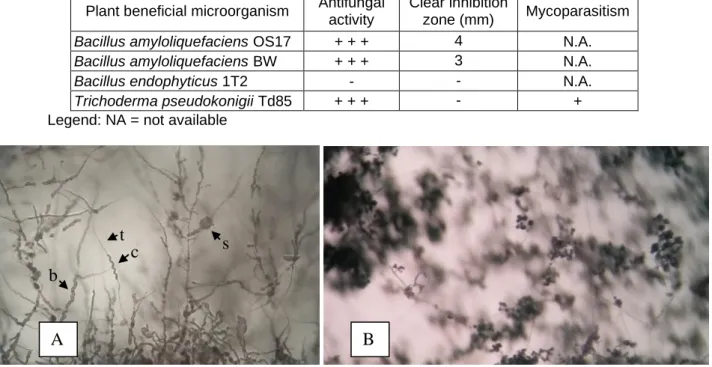
The antagonistic activity of the beneficial bacterial and fungal strains was evaluated by dual culture technique
against Fusarium graminearum 183
(Table 3). The antifungal activity was visually evaluated, and different symbols were attributed according to the inhibitory
action against F. graminearum as follows:
„–“ = no inhibition activity; „+“ = slightly inhibition of the pathogen growth, „+ +“ = moderate inhibition; „+ + +“ = good inhibition activity; „+ + + +“ = very good
inhibition activity against the
phytopathogen.
The biocontrol bacteria Bacillus
amyloliquefaciens OS17 and BW reduced
the pathogenic fungal growth and
maintained a clear inhibition zone around their colony. Shi et al. (2014) mentioned
other five B.amyloliquefaciens strains with
good potential of F.graminearum
inhibition. They obtained a mycelia inhibition rate of 41,4% to 51,5% in the dual culture technique, and 97,8% to 100% in the tip culture assay, associated with DON inhibition rate.
In our study, during the microscopic
analysis, fungal modifications were
observed in the pathogenic growth when
using Bacillus amyloliquefaciens OS17
and BW strains. The mycelia was curled, and the fungal cells were thickened, beaded or swollen (Fig. 1A). Baffoni et al. (2015) also mentioned damaged hyphae
and conidia in Fusarium sp. due to an
antagonistic strain of Bacillus
amyloliquefaciens.
No antagonistic activity was
observed for Bacillus endophyticus 1T2
against F.graminearum 183.
Regarding the interaction between
Trichoderma pseudokonigii Td85 and
41
The hyperparasitic activity in
Trichoderma species has been well-documented over time as a biocontrol
mechanism. Studies have revealed
different genes related to mycoparasitism (Elamathi et al., 2018), like the genes encoding for cell wall degrading enzymes:
chitinase (chit33), endochitinase
(endo42), β-1,3-glucanase (glu),
exochitinase 1 (exc1), exochitinase 2
(exc2), and the genes related with
proteases, such as alkaline proteinase
(prb1), trypsin-like protease (Pra1),
subtilin-like serine protease (ssp). Gomes
et al. (2015) mentioned the cerato-platanin protein Epl-1 as involved in the mycoparasitism mechanism expressed by
Trichoterma sp. Cytochrome p450 activity involved in secondary metabolites synthesis, related to mycoparasitism, was
also detected in Trichoderma sp.
(Ramírez-Valdespino et al., 2019).
Likewise, several other authors described
different fungal strains of Trichoderma
spp. with mycoparasitic activity against Fusarium Head Blight species complex, and other fusaria and plant pathogens (Ghazanfar et al., 2018).
CONCLUSIONS
Five plant beneficial
micro-organisms, bacteria and fungi, were analysed for their plant growth promoting effect on wheat and biocontrol potential
against Fusarium graminearum. All tested
microbial inoculants improved wheat root growth and vigour index. Best results
regarding germination and seedling
growth were obtained with A.brassilense
and B.amyloliquefaciens. However, the
bacterial strain B.endophyticus 1T2
delayed the germination process
compared to the untreated control. Beside plant growth stimulation, the
bacterial strains B.amyloliquefaciens
OS17, BW, and the fungal strain
T.pseudokoningii Td85 inhibited the
growth of F. graminearum, which is an
important wheat pathogen.
BIBLIOGRAPHY
Abdul-Baki, A.A., Anderson, J.D., 1973 - Vigor determination in soybean seed by multiple criteria. Crop Science, 13: 630-633.
Anwar, S., Iqbal,F., Khattak, W.A., Islam, M., Iqbal, B., Khan, S., 2016 -
Response of Wheat Crop to Humic Acid and Nitrogen Levels. EC Agriculture 3.1 (2016): 558-565.
Baffoni, L., Gaggia, F., Dalanaj, N., Prodi, A., Nipoti, P., Pisi, A., Biavati, B., Di Gioia, D., 2015 - Microbial inoculants for the biocontrol of Fusarium spp. in durum wheat. BMC Microbiology, 15: 242. DOI 10.1186/s12866-015-0573-7.
Boiu-Sicuia, O.A., Constantinescu, F., Cornea, C.P., 2017 - Selection and characterization of new endophytic bacterial strains isolated from potato tuber useful in biocontrol strategies.
Scientific Bulletin. Series F.
Biotechnologies, XXI: 23-28.
Deaker, R., Kennedy, I., 2001 -
Improved potential for nitrogen fixation in Azospirillum brasilense Sp7-S associated with wheat nifH expression as a function of oxygen pressure. Acta Biotechnologica, 21: 3-17. DOI: 10.1002/ 1521-3846(200102)21:13.3.CO;2-M.
Ekin, Z., 2019 - Integrated Use of Humic Acid and Plant Growth Promoting Rhizobacteria to Ensure Higher Potato Productivity in Sustainable Agriculture. Sustainability, 11: 3417; DOI: 10.3390/ su11123417.
Elamathi, E., Malathi, P., Viswanathan, R., Sundar, A.R., 2018 - Expression analysis on mycoparasitism related genes during antagonism of Trichoderma with Colletotrichum falcatum causing red rot in sugarcane. Journal of Plant Biochemistry and Biotechnology, 27(3): 351–361. DOI: 10.1007/s13562-018-0444-z
Ghazanfar, M.U., Raza, M., Raza, W., Qamar, M.I., 2018 - Trichoderma as potential biocontrol agent, its exploitation in agriculture: A review. Plant Protection, 2(3): 109-135.
42
Noronha, E.F., 2015 - The cerato-platanin protein Epl-1 from Trichoderma harzianum is involved in mycoparasitism, plant resistance induction and self wall protection. Scientific Reports 5: 17998. DOI: 10.1038/srep17998.
Gulii, O.I., Sokolova, M.K., Sokolov, O.I., Ignatov, O.V., 2015 - Changes in the morphology of the root system of wheat inoculated with Azospirillum brasilense Sp7 and bacteriophage
FAb-Sp7. Agricultural Biology, 50 (3): 315 -
322. DOI: 10.15389/agrobiology.2015.3.
315eng
Han, Z., Ku, L., Zhang, Z., Zhang, J., Guo, S., Liu, H., Zhao, R., Ren, Z., Zhang, L., Su, H., Dong, L., Chen, Y.,
2014 - QTLs for Seed Vigor-related traits
identified in maize seeds germinated under artificial aging conditions. PLoS One, 9(3): e92535. DOI: 10.1371/journal. pone.0092535.
Kumar, A., Singh, A.K., Kumar Choudhary K., 2019 - Role of Plant Growth Promoting Microorganisms in Sustainable Agriculture and Nanotechnology. 1st Edition. Woodhead
Publishing, 352pp, eBook ISBN:
9780128170052.
Manning, D., 2010 - Mineral sources of potassium for plant nutrition. A review.
Agronomy for Sustainable Development, Springer Verlag/EDP Sciences/INRA: 30
(2). DOI:
10.1051/agro/2009023.hal-00886529.
Onofrei, V., Teliban, G.C., Burducea, M., Lobiuc, A., Sandu, C.B., Tocai, M., Robu, T., 2017 - Organic foliar fertilization increases polyphenol content of Calendula officinalis L. Industrial Crops
& Products, 109: 509–513. DOI:
10.1016/j.indcrop.2017.08.055
Panțu, Z., 1912 - Contribuțiuni la flora
Bucureștilor și a împrejurimilor, vol II, București.
Petrișor, C., Paica, A., Burnichi, F.,
2019 - Physiological and growth response
of tomato plants after Trichoderma spp. seed treatments. Studia UBB Chemia, LXIV (2): 567-577, DOI: 10.24193/ subbchem.2019.2.49.
Petrișor, C., Paica, A., Constantinescu,
F., 2016 - Temperature and ph influence
on antagonistic potential of Trichoderma sp. strains against Rhizoctonia solani. Scientific Papers. Series B, Horticulture, LX: 275-278.
Ramírez-Valdespino, C.A., Casas-Flores, S., Olmedo-Monfil V., 2019 -
Trichoderma as a model to study effector-like molecules. Frontiers in Microbiology, 10:1030. DOI: 10.3389/fmicb.2019.01030
Shi, C., Yan, P., Li, J., Wu, H., Li, Q., Guan S., 2014 - Biocontrol of Fusarium graminearum growth and deoxynivalenol production in wheat kernels with bacterial antagonists. International Journal of Environmental Research and Public
Health, 11: 1094-1105. DOI: 10.3390/
ijerph110101094.
Sicuia, O.A., 2013 - Cercetări la nivel
molecular şi celular privind mecanisme de interacţiune între microorganisme din rizosferă şi plante de interes economic. PhD Thesis. Faculty of Biology, University of Bucharest. 230 pp.
Ştefan, A.L., Paica, A., Ene, C.I., 2013 -
Management of beneficial micro-organisms resources to sustainable agricultural production. Scientific Papers. Series A. Agronomy, LVI: 412-417.
Ştefan, A.L., Paica, A., Iacob, F., Iacomi
B.M., 2015 - Sustainable use of
fungicides and biocontrol agents for botrytis gray mold management in grapes. Scientific Papers. Series B, Horticulture, LIX: 159-162.
Wen, D., Hou, H., Meng, A., Meng, J., Xie, L., Zhang, C., 2018. Rapid evaluation of seed vigor by the absolute content of protein in seed within the same
crop. Scientific Reports, 8: 5569. DOI:
43
Table 1. Microorganisms used in this study
Microorganisms, species and strains Provenience Beneficial microorganisms
Azospirillum brasilense Sp7 (DSM 1690) DSMZ Collection, Germany
Bacillus amyloliquefaciens OS17 RDIPP – Bucharest collection
Bacillus amyloliquefaciens BW UASVM – Bucharest collection Faculty of Biotechnology,
Bacillus endophyticus 1T2 RDIPP – Bucharest collection
Trichoderma pseudokonigii Td85 RDIPP – Bucharest collection
Pathogenic microorganism
Fusarium graminearum 183 (DSM4527) DSMZ Collection, Germany
Table 2. Wheat germination and growth parameters
Experimental variant
Germination %
Fresh weight (g) Dry weight (g) Plant
H (cm) Root
no./ plant
Total root L/plant
(cm)
Vigor Index
root Shoot root Shoot SVI –I SVI-II
0 1 2 3 4 5 6 7 8 9 10
Untreated
control 88.3 0.0270
a 0.0231 a 0.0038 a 0.0032 a 3.42 a 3.95 21.01 a 301.99 282.56
Sp 7 92 0.0445 bc 0.0410 bc 0.0056 b 0.0049 b 5.47 b 4.06 27.34 b 503.24 450.80
OS17 80 0.0478 bc 0.0354 b 0.0059 b 0.0046 b 5.49 b 4.13 31.03 c 439.20 368.00
BW 92 0.0403 b 0.0416 c 0.0053 b 0.0047 b 5.64 b 4.15 24.98 ab 518.88 432.40
1T2 77.5 NA 0.0401 bc NA 0.0047 b 5.51 b 3.92 32.63c 427.03 364.25
Td85 86.3 0.0420 b 0.0340 b 0.0054 b 0.0041 b 5.10 b 4.30 26.45 b 440.13 353.83
Legend: NA = value not available. The values corresponding to columns 1÷8 were statistically processed (Duncan test, p <0.05), the letters highlight the significant differences between the treatment variants.
Table 3. Antagonistic activity against Fusarium graminearum 183 plant pathogen
Plant beneficial microorganism Antifungal
activity
Clear inhibition
zone (mm) Mycoparasitism
Bacillus amyloliquefaciens OS17 + + + 4 N.A.
Bacillus amyloliquefaciens BW + + + 3 N.A.
Bacillus endophyticus 1T2 - - N.A.
Trichoderma pseudokonigii Td85 + + + - +
Legend: NA = not available
Figure 1. Microscopic aspects captured from the microbial interaction zone. A. B.amyloliquefaciens OS17 effect on Fusarium graminearum, s = swelling, c = curling, and t= thining of the fungal cells, b=
beaded fungal cells; B. Mycoparasite mycelia, conidiophores and conidia of T. pseudokonigii Td85 grown on top of Fusarium graminearum
t
c s
b