1035
Removal of Direct red 12B Dye in an Integrated Fixed Film Activated Sludge
Reactor (IFAS): Performance Evaluation and Kinetics Study
1
, Amir Hesam Hasani
1
, Amir Hossain Javid
1
Zahra Goodarzvand Chegini*
1) Environmental Engineering Department, Faculty of Environment, Islamic Azad University, Science and Research Branch, Tehran, Iran
*Author for Correspondence: [email protected]
Received: 24 Feb. 2017, Revised: 25 June 2017, Accepted: 07 July 2017
ABSTRACT
The application of biological treatment has been promising in recent years for the main advantage of biological treatment in COD and dye removal. The novelty of this study is capabilities of integrated fixed film system (IFAS) with a different arrangement of media to removal the dye and COD. The experiments were done with a survey of variables like SRT, MLSS/MLVSS, the initial concentration of dye and COD. In order to analyze data was used the first and second-order models. The result showed that the IFAS was effective even at high concentration of the dye (200mg L-1). COD reduction and dye removal efficiency were higher than 70% and 88-95%, respectively. For the biological treatment, an increase in SRT to 48hr. increased the dye and COD concentration reduction. Kinetics of COD reduction and dye removal was fitted with the second-order reaction by coefficient correlation of 0.95 and 0.97, respectively. Finally, the integration of fixed film media into the biological reactors affected performances of the system for decolorization from colored wastewater
.
Key words:
Decolorization, Fixed-Film, Activated Sludge, Dye, KineticINTRODUCTION
Direct Red 12B (Direct red 31) is known to be a carcinogenic and mutagenic that can highly harmful to the environment [1], so the presence of low dyes concentrations in water bodies, cause to unpleasant landscapes and indisputable as well as associated to problems like light penetration reduction and photosynthesis [2]. Accordingly to the annual statistics, more than 0.7 million tons dye is used in the world which is released from different industrial effluents [3]. Dye-containing effluents because of recalcitrant residues of dyes structure and high concentration are hardly treated by different methods treatment [4]. Therefore, using of methods for removal of dye (Direct Red 12B) before discharge in the environment is inevitable [5]. Several methods like: physicochemical techniques, membrane adsorption, Electrocoagulation and etc. have been used for the removal of dye. The mentions methods are difficult, expensive and produce large sludge or toxic substances as well as fouling of the membrane [6]. With respect to other techniques, microbial biodegradation of dye is taken into consideration, recently [7]. Due to environmental implications, microbial biodegradation as ecofriendly technique with operation easy and cost-effective have been widely used in water and wastewater treatment [8].
1036 on the COD input concentration[9]. The main purpose of this study is removal of color of textile Direct Red 12B dye and COD by different configuration of integrated fixed film activated sludge (IFAS) system, arrangement of media and evaluation of factors affected on removal efficiency by biological process.
MATERIALS AND METHODS
Materials and reagents
For experiments, Direct Red 12B (DR12B - C32H21N5Na2O8S2) with 98% purity – (ALVAN SABET) was used to prepare the stock solution, with the DR12B chemical structure shown in Fig. 1. Other materials and reagents were ordered from Merck Company, Germany and used as received.
Fig. 1: Anionic direct Red 12B chemical structure. (Molecular Weight: 713.65 gr mol-1, Solubility: 45 g L-1 in 80 0C and Maximum Wavelength=523 nm)
IFAS Design
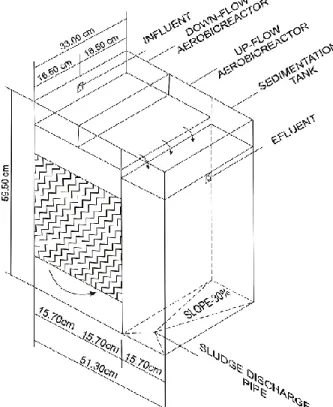
IFAS reactor was made of Plexiglas, with dimensions of 51.7 (height), 47.1 (length) and 31 (width) cm and volume of 0.0784m3. The reactor included three parts; down-flow aerobic part, up-flow aerobic part (volume of the IFAS is 0.061 m3) and sedimentation tank (volume of 0.03m3). Specifications of the reactor are shown in Fig. 2. The support material used for immobilization of the biomass consists of pieces of P.V.C (number of 21, ENEXIO water technologies GmbH, Germany) that was placed in the reactor with media to 30% of the working volume. The media in the reactor was arranged in 2 rows of 10. Also, height, length, and width of each media were 12.5, 28 and 20.75, respectively with total volume of 6100.5cm3.
Specific surface area of the media was 81.34 m2 m-3 to support beds with many holes for higher biomass accumulation and enhancement of them [2].
Design of experiments
Activated sludge flows were inoculated from a sewage treatment plant situated in West Town, Tehran. Synthetic wastewater was fed to the reactor with the composition: Sucrose (C12H22O11-600mgL-1) as the carbon source with COD of 530 ± 0.89mg L-1, NH
4Cl as the nitrogen source and NaH2PO4.2H2O as the phosphorus sources. Trace elements for addition into the feeding solution was provided following: 1ml L-1 of a stock solution (Ethylene diamine tetra acetic acid (EDTA) [10ml L-1], ZnSO
4.7H2O [2.3ml L-1], MgSO4 [60ml L-1], CoCl
2.6H2O [3.2ml L-1], MnCl2.4H2O
[1.04ml L-1], CuSO
4.5H2O [0.25mlL-1], (NH4)6Mo7O24·4H2O [2.4mlL-1], CaCl2.2H2O [1.2ml L-1], FeSO
4.7H2O [1.02 ml L-1], H3BO3 [0.33ml L-1]
and NiSO4.6H2O10 ml L-1). For the operation of IFAS system, influent wastewater primary from feed tank was pumped with the flow rate of 0.12m3 d-1 in the reactor. The reactors were aerated at room temperature during the whole experiment, in order to avoid microbial growth. pH in the reactor was monitored daily to ensure between 6 and 8. Experiments were performed with controllable factors namely the initial concentration of dye (C0), hydraulic retention time (HRT) and solid retention time (SRT). The levels of factors have been adjusted based on dye concentration (0.1, 1, 5, 10, 25, 50, 100, 150 and 200mg L-1), HRT (6, 8, and 10 hours) and SRT (24, 48 and 72 hours) and responses were dye removal, COD reduction, and pH variations. In the first phase of the study, the reactor was operated with a suspended biomass solids retention time of 7 days. After approximately 3 months of steady state operation by adjusting the amount of sludge wasted daily, the suspended phase SRT was changed to 24hr. for the second phase of the study. After acclimation for the second phase, the desired concentration of DR12B solution from stock solution by successive dilutions was prepared.
Fig. 2: Schematic diagrams of the IFAS system
Analytical methods
1037 5220B method with a spectrophotometer (HACH DR 5000™ UV-Vis Spectrophotometer). Determination of dye concentration was based on the Lambert-Beer law, so that by the calibration curve, i.e. the graph of a solution of a known in λ=582 nm versus absorbance by spectrophotometer [9].
RESULTS AND DISCUSSION
The whole experimental period based on process performance of IFAS system was divided into two periods (acclimation and operation stability of reactor periods).
Acclimation period
The acclimation of the reactors was subjected to the growth and adaptation of the microbial community, and the effects of the IFAS process on the COD removal were examined. Acclimation of bacteria using organic carbon source (sucrose) was performed in this study. To start up, the reactors with 4gL-1 MLSS and 3.3gL-1 MLVSS were inoculated, which by return-back biomass or take-out sludge were maintained for achieving an SRT = 24 days. Adequate time was provided to the bacteria community for the removal of input COD and adaptation, at the first stage of experimental works [13]. COD utilization trends with mean of 530 ± 0.89 mg L-1 was observed as shown in Fig. 3. Fig. 3 also indicate the results of the MLSS/MLVSS ratios variation during acclimation period, in which the bacteria used COD preferentially. Sufficient time resulted in increased MLVSS rate of approximately 10000mg L-1. The results demonstrate that COD removal from 13% by correct operation improved the performance of the IFAS, and high removal efficiency occurred with time to 93.5% in steady state mode. These results regard to biomass rate in IFAS reactor were corresponded with other research [14, 15].
Fig. 3: COD reduction and MLSS variation versus time during acclimation of IFAS system
Operation stability of reactor
Removal efficiency of COD and dye in IFSA
system
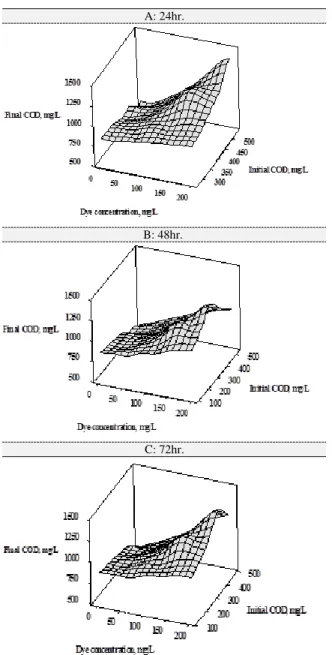
Biomass re-distributions in the IFAS lead to biomass growth in the reactor. Indeed, IFAS reactor affected both the concentrations and amounts of biomass in the reactor and the total amounts of biomass maintained in the system. Integration of fixed film media in the IFAS system increased biomass maintained in the system. The COD and dye concentrations in the reactor, including its removal efficiencies observed at steady state during the experimental phases, are shown in Fig. 4. The results show that the experimental operating conditions had appropriate effect on the stimulation COD and dye removal efficiencies, and high effects on the dye removal efficiencies. The total system dye removal efficiencies were approximately 88% when they were operated at 48hr MCRT, regardless of influent flow split and IFAS media installation. The COD removal decreased in the system when the mean cellular retention time (MCRT) was decreased to 24hr, i.e. to about 82% in SRT 72hr., 88% in SRT 48hr., and 62% in SRT 24 hr. Dye removals improved slightly when the system was operated at the much higher SRT, but less than expected. As shown in Fig. 4, after the retention time was increased from 24hr. to 48hr. in the reactor, average removal of dye and COD significantly increased in IFAS system (p<0.04). So that, The dye removal for initial dye concentrations of 0.1, 25 and 200mgL-1, where the formation of intermediates in the SRT of 24hr. results to lower dye removal percentage (Fig. 4-A). However, with a longer SRT there is a greater reduction in the COD and dye concentration through biological treatment. It was obtained concerning the dye removal for longer SRTs (48hr. rather than 72hr. for COD of 800mg L-1 and dye concentration of 50mg L-1); effluent COD concentration was lower than 100mgL-1, while for a shorter SRTs concentrations reached to 300mgL-1. It can be verified that SRT rising to 48hr. can increases the dye removal efficiency, and in higher SRT (e.g.72hr.) because of microorganisms entry to decay phase, dye removal efficiencies decreases. These increases in removal efficiency were consistent with increases in biomass content production after the retention time change (Fig. 4). Increases in biomass content with the time change (SRT) were significant for the system (p<0.04), similar to the trends in biomass content. Increasing biomass content with increasing SRT is expected; because of lower SRTs are correlated lower reactor biomass concentrations, since the loading of influent dye for removal was unchanged and existence fixed film in the reactor as warp and woof taken for maintain and increase biomass concentration (Fig. 4). Malovanyy et al.
1038 wastewater treatment caused by the fact that it allows for a short SRT in the suspended growth, which favors for biomass accumulation [16]. While dye concentration in the reactor increased after the SRT was decreased, effluent COD concentrations increased, (Fig. 4). This may have been caused by this fact that a greater capacity to withstand the presence of more toxic materials than the former. Increases in dye concentration; that is, approaching maximum COD rate in reactor may have limited dye removal percentage, which could have deteriorated IFAS performance
.
A: 24hr.
B: 48hr.
C: 72hr.
Fig. 4: Surface plot of remaining COD and final dye in different concentrations (A: 24hr., B: 48hr. and C: 72hr.) This performance in IFAS systems was also reported by Sriwiriyarat, who evaluated the performance of IFAS systems at high mean cell residence time and
low temperature [17]. Also, the result sets at the 72hr and 24hr SRTs indicated a more or less continuous linear relationship between MLSS/MLVSS and density (Fig. 5), as well as the MLSS/MLVSS rate versus relationships at these SRTS, were nearly parallel.
500 400 300 200
260 240 220 200
200 170 140 110 80 50 20 500 400 300 200
M
L
V
S
S
_
2
4
h
r
M
L
V
S
S
_
4
8
h
r
Dye concentration, mg/L
M
L
V
S
S
_
7
2
h
r
Fig. 5: Matrix Plot of MLVSS variations in different SRT and dye concentration
Changes in MLVSS variations with the SRT increase dominated effects on MLVSS density, while changes in MLVSS resulting to other SRT-influenced factors, like VSS endogenous decay, had less of an effect on MLVSS rate. This may be attributed to the fact that the effects of IFAS on settling biomass that several authors have yielded mixed results Stricker et al.
(2007); Sriwiriyar et al. (2008); Sriwiriyarat et al.
(2005) [18-20]. On the contrary, increase in SVI value in this system is small but significant. Furthermore, previous studies have mentioned that change in the SRT in IFAS system can be approximately reduced solids loading rate to the secondary clarifiers of about 33% [21]. Indeed, any improvements in dye removal may have been counteracted due to the lower density of the biomass in the IFAS. Regardless, the maximum removal rate of dye and COD were between 88-95% and 72%, respectively. So, by analyzing data obtained in the IFAS systems, removal percentage of dye was good in all samples in this study.
Kinetics study of direct red 12Band COD
removal
1039 removal better fitted to second-order kinetic model by R2=0.95. This indicates that Direct Red 12 B removal is controlled by metabolic reactions. So that in a co-metabolic reaction, a compound transforms by microorganism enzymatically which it cannot utilize as an energy source or of one of the constituent elements in the substrates. The same behavior for dye removal was reported by McKay et al. and Huwang [23, 24]. In addition, Table 1 demonstrates that K2 (13.7) is high for dye removal in an IFAS reactor. In other hands, regarding COD removal by IFAS system, data fitted to a second-orderkinetic model (R2=0.97) as
well as the corresponding constants tabulated in Table 1. The results indicated that the metabolic reactions corresponded for COD removal with the highest COD removal, K=2.1. Increases in COD constants relate to increasing MLSS concentration due to presences of fixed film in the reactor and arrangement of them toward SRT. Based on the above results, SRT equal 48hr was suitable option to achieve the highest efficiency in COD and dye removal
.
Table 1: Kinetic models (First and second order equations) Constants
First-Order Second- Order
) 1 -(h 1
K R2 (L mg-1.h-1)
2
K R2
Decolorization 0.15 0.67 13.7 0.95
COD removal 0.66 0.54 2.1 0.97
The results show that the higher rate constants, k2, for the decolorization rate could be explained the fact that relatively short-term SRT contact of mixed bacterial culture during the experiment period, indicate that the raising reaction of the DR 12B as catalyzed intracellular process by enzymes produced in the bacterial community. Also the high concentration of COD is unlikely to optimize reduction and so lead to the reduction K1 for COD removal.
CONCLUSION
Treatment of colored wastewater in an integrated fixed-film activated sludge reactor (IFAS)using different bacterial community was an economic and suitable process that is capable of removing a high percentage of COD (higher than 70%) and color between 88-95%. IFAS with a biofilm leads to increases in biomass content, because of correlated higher reactor biomass concentrations, since existence fixed film in the reactor as warp and woof took for maintaining and increase biomass concentration maintains because of preventing biomass washing. Although biological treatment was as curtained as a suitable process for decolonization, it is also necessary to combine methods for enhanced COD reduction and dye removal from wastewater containing Direct Red 12B. This work suggests that inhibitors’ factors system should be taken into consideration for performance evaluation of IFAS system. Also, the analysis of toxicity for determination compounds in effluent should be the subject of future study.
ETHICAL ISSUES
The ethical issues were considered during the conduct of this study.
CONFLICT OF INTEREST
We affirm that this article is the original work of the authors and have no conflict of interest to declare
.
AUTHORS’ CONTRIBUTION
All authors participated in all stages of the research.
FUNDING/ SUPPORTS
The authors would like to thank the facility supported by Islamic Azad University, Science and Research Branch.
REFERENCES
[1] Asfarama A , Fathib M.R, Khodadoustc S, Naraki M. Removal of Direct Red 12B by garlic peel as a cheap adsorbent: Kinetics, thermodynamic and equilibrium isotherms study of removal. Spectrochimica Acta Part A: Molecular and Biomolecular Spectroscopy. 2014; 127(5): 415-21. [2] Huang C, Shi Y, El-Din M.G, Liu Y. Performance of flocs and biofilms in integrated fixed-film activated sludge (IFAS) systems for the treatment of oil sands
process-affected water (OSPW).Chemical
Engineering Journal. 2016; (In press).
[3] Gao S, Su J, Wang M, Wei X, Zheng X, Jiang T. Electrochemical oxidation degradation of azobenzene dye self-powered by multilayer-linkage triboelectric nanogenerator.Nano Energy. 2016; 30(1): 52-58. [4] Ansari J. N, Roy A.S. Sorption of Monoazo Dyes on Wool Fibers for Textile.Journal of Advanced Physics.2017; 6(1):142-47.
1040 of crystal violet dye from waste water by adsorption onto TLAC/Chitosan composite: A novel low cost adsorbent.International Journal of Biological Macromolecules.2017;96(2): 324-33.
[6] Stawiński W, Węgrzyn A, Freitas O, Chmielarz L, Mordarski G, Figueiredo S. Simultaneous removal of dyes and metal cations using an acid, acid-base and base modified vermiculite as a sustainable and recyclable adsorbent.Science of the Total Environment. 2017; 576(2): 398-08.
[7] Chen B.Y, Ma C.M, Han K, Yueh P.L, Qin L.J, Hsueh C.C. Influence of textile dye and decolorized metabolites on microbial fuel cell-assisted bioremediation.Bioresource technology.2016; 200 (2):1033-38.
[8] Jayaprakash J, Parthasarathy A, Viraraghavan R. Decolorization and degradation of monoazo and diazo dyes in Pseudomonas catalyzed microbial fuel cell.Environmental Progress & Sustainable Energy. 2016; 35(6): 1623-28.
[9] Gu J, Xu G, Liu Y. An integrated AMBBR and IFAS-SBR process for municipal wastewater treatment towards enhanced energy recovery, reduced energy consumption and sludge production.Water Research. 2017; 110 (2): 262-69.
[10] Singh N.K, Kazmi A.A, Starkl M. Treatment performance and microbial diversity under dissolved oxygen stress conditions: Insights from a single stage IFAS reactor treating municipal wastewater.Journal of the Taiwan Institute of Chemical Engineers.2016; 65(2): 197-03.
[11] Bai Y, Zhang Y, Quan X, Chen S. Enhancing nitrogen removal efficiency and reducing nitrate liquor recirculation ratio by improving simultaneous nitrification and denitrification in integrated fixed-film activated sludge (IFAS) process.Water Science and Technology.2016; 73(4): 827-34.
[12] FederationW. E & APH Association. Standard methods for the examination of water and wastewater. American Public Health Association (APHA): Washington, DC, USA 2005.
[13] Khalili A, Mohebi M.R, Mohebi M, Ashouri F. A new method of biological start-up in Arak activated sludge wastewater treatment plant. Water Practice and Technology. 2013; 8(2): 13-25.
[14] Kim H.S, Schuler A.J, Gunsch C.K, Pei R, Gellner J, Boltz J.P, Dodson R. Comparison of conventional and integrated fixed-film activated sludge systems: attached-and suspended-growth functions and quantitative polymerase chain reaction measurements. Water Environment Research. 2011; 83(7): 627-35.
[15] Kim H.S, Gellner J.W, Boltz J.P, Freudenberg R.G, Gunsch C.K, Schuler A.J. Effects of integrated fixed film activated sludge media on activated sludge
settling in biological nutrient removal systems. Water research. 2010; 44(5): 1553-61.
[16] Malovanyy A, Trela J, Plaza E. Mainstream wastewater treatment in integrated fixed film activated sludge (IFAS) reactor by partial nitritation/anammox process. Bioresource technology. 2015; 198(1): 478-87.
[17] Sriwiriyarat T, Pittayakool K, Fongsatitkul P, Chinwetkitvanich S. Stability and capacity enhancements of activated sludge process by IFAS technology. Journal of Environmental Science and Health Part A. 2008; 43(11): 1318-24.
[18] Sriwiriyarat T, Randall C.W. Evaluation of integrated fixed film activated sludge wastewater treatment processes at high mean cells residence time and low temperatures. Journal of environmental engineering. 2005; 131(11): 1550-56.
[19] Sriwiriyarat T, Ungkurarate W, Fongsatitkul P, Chinwetkitvanich S. Effects of dissolved oxygen on biological nitrogen removal in integrated fixed film activated sludge (IFAS) wastewater treatment process. Journal of Environmental Science and Health Part A. 2008; 43(5): 518-27.
[20] Stricker A.E, Barrie A, Maas C.L, Fernandes W, Lishman L. Side-by-side comparison of IFAS and CAS processes at demonstration scale at the Lakeview WWTP. Proceedings of the Water Environment Federation. 2007; 23(19): 155-83.
[21] McQuarrie N. Crustal scale geometry of the Zagros fold–thrust belt, Iran. Journal of Structural Geology. 2004; 26(3): 519-35.
[22] Sponza D.T, Işık M. Decolorization and inhibition kinetic of Direct Black 38 azo dye with granulated anaerobic sludge. Enzyme and Microbial Technology. 2004; 34(2): 147-58.