Dynamic Systems Modeling with
Stochastic Cellular Automata
(Evolutionary versus Stochastic
Correlation Approach)
Andrej Dobnikar, Simon Vavpoti
c and Andrej Likar
ˇ
Faculty of Computer and Information Science, University of Ljubljana, Slovenia Faculty of Mathematics and Physics, University of Ljubljana, Slovenia
A new approach to dynamic systems modeling is given. Stochastic Cellular Automata (SCA) are used as the
basic computational module. The dynamic systems are considered as time and space dependent, where time dependencies are supposed to be given with some differential equations(DE), while space influences are
not known. The basic idea of our approach is to use heuristics for the design of SCA and some stochastic search algorithm to optimize free model parameters. Two non-gradient optimization algorithms are used and evaluated on the two case studies: diffusion and mi-gration of Cs in soil and forest fire spread problem. They are Evolutionary Algorithm(EA) and Stochastic
Correlation Algorithm(ALOPEX). We show that with
some modifications, both algorithms are capable to solve the two case problems, though there are some important differences between them.
Keywords: modeling, cellular automata, heuristics, stochastic optimization.
1. Introduction
The modeling of unknown systems dynamics is still one of the biggest challenges of modern science. Finding the model, for example, of a natural phenomenon enables one to gain deeper insight into the observed appearance on the one hand and to enable one to forecast its activity on the other. Although well known phenomena already have some reasonable physical inter-pretations, this does not usually allow us to use them for prediction purposes. The reason for this is that such dynamical systems are time and space dependent, where the time dependencies
are normally given with some differential equa-tions, while the space influences are captured within unknown space-dependent parameters. We believe that the model should provide us with a tool to acquire these values.
This paper describes dynamic systems model-ing with evolvmodel-ing cellular automata. The basic idea is to use stochastic cellular automata and heuristics for their design and some stochastic search algorithms to optimize free model pa-rameters. We compare this approach with more traditional mathematical modeling. Within this paper we follow 2], where the contribution of a heuristic method should either results in: high-quality solutions, produce faster, higher-high-quality solutions, easier implementation or a broader range of applicability, in relation to other ap-proaches. We believe that the heuristics we use fulfill at least some of the above criteria and we intend to prove it through our experimental work. Two non-gradient optimization(search) algorithms are used and evaluated on two real world problems: diffusion and migration of Cs in soil(1D problem)and forest fire spread(2D problem). The first is based on Evolutionary Algorithm(EA) and the second on Stochastic Correlation Algorithm(ALOPEX).
after a brief description of a more traditional
(mathematical) modeling, through a descrip-tion of our experimental work. We conclude with some comments and plans for our future work.
2. Stochastic Cellular Automata (SCA)
’Cellular automata are discrete dynamical sys-tems whose behavior is completely specified in terms of a local relation, much as is the case for the large class of continuous dynamical systems defined by partial differential equations. In this sense, cellular automata are the computer sci-entist’s counterpart to the physicist’s concept of “field”,’ 13].
We want to follow this basic idea. Therefore, our goal is to implement a physical model of a dynamical system with the help ofSCA. We chose to use an evolution-based procedure in or-der to optimize the space-dependent parameters. This approach differs from the one described in 11] significantly. Instead of searching for the most appropriate non-homogeneous and deter-ministic structure of the Cellular Automata, we look for a stochastic and homogeneous version of CA, which we call SCA. Stochasticity is due to the frequent feature of natural phenomenon
(like diffusion or fire spread)and homogeneous structure of CA because of its usual location-invariant dynamics.
SCA is n-D array (n = 1 2 :::) of finite au-tomata (cells). Each automaton (cell) is de-scribed with:
SCA(~r)=hS ~p L fi (1) where:
~r —n-D vector, indicating the cell
S — set of all possible states of the cell
~p — probability vector, describing state transitions for each neighboring combination
L — set of local parameters f — fitting value of a cell
~pandLare parameters of unknown values. In the approach proposed in this paper a heuris-tic method is used to design the state transi-tion diagram of SCA and an evolutransi-tion-based search procedure to optimize the corresponding
free parameters, in order to achieve the greatest possible fitting with the measured data of the investigated phenomenon.
3. Evolutionary Algorithm (EA)
An evolutionary algorithm was developed by J. Holland and his students in 1960, 4]. Origi-nally, it was designed as a formal system for adaptation rather than an optimization system. Its basic features are the strong emphasis on recombination(crossover), use of a probabilis-tic selection operator (proportional selection) and the interpretation of mutation as a back-ground operator. Due to the nature of the oper-ators, this algorithm is also called genetic algo-rithm. Later, several methods of simulating evo-lution were developed. Certain historical sub-sets of evolutionary algorithms include evolu-tion strategies, evoluevolu-tionary programming and genetic algorithms, 1]. We used only two meth-ods within our experimental work. The first is a population-based procedure that relies on a ran-dom variation (with crossover and mutation) and selection and is indicated as genetic algo-rithm(GA). The second relies on evolution of individual, again with the help of genetic oper-ators crossover and mutation. We mark it with CPA (cellular programming algorithm), 11], because it was developed for the purpose of the cellular automata synthesis. The modifications within CPA and GA, in relation to the original algorithms, are due to the stochastic feature of the SCA. Crossover calculates new probabilities for the state transitions from the two individu-als(parents)or from the two neighboring cells, by considering probability rules. Mutation re-places the chosen probability values with new ones, again within the limits 0,1]. We apply a variant of GA in the case of 1 D problem( mi-gration of Cs in soil)and a modified version of CPA in case of 2D problem(forest fire spread).
4. Stochastic-Correlation Optimization Algorithm (ALOPEX)
(i j)cellP
k
ijis changed according to the
expres-sion:
Pkij(n)=P
k
ij(n;1)+δ
k
ij(n) (2)
where:
δk ij(n)=
;δ with p
k ij(n)
+δ with 1;p
k ij(n)
where:
pkij(n)=
1 1+e
;C k ij(n)=T(n)
(Boltzman distribution) Ckij=∆P
k
ij(n)∆E(n)
∆Pkij(n)=P
k
ij(n;1);P
k
ij(n;2)
∆E(n)=E(n;1);E(n;2)
δ is a fixed step of parameter change and T is a ’temperature’ which is high at the beginning and low at the end of the ’learning’ procedure — it gives a stochastic feature to the algorithm. If it is too high, the probability is close to 0.5 and if it is too low, the probability is close to 1:
T(n)= 1 NM X i X j X k n;1 X
n0 =n;N
jhC
k ij(n
0 )ij
(3) ifnis a multiple ofN, otherwise it remains un-changed. N denotes the number of iterations when T is updated. M is the total number of parameters in the system that we want to opti-mize. jhC
k
ij(n)ijis equal to the average absolute value ofCk
ij(n)over the intervalN. When corre-lations are small(near minima of error surface), T is reduced and vice versa. There are several similarities with simulated annealing, but also some important differences. In ALOPEX, cor-relations are used instead of changes in error, all parameters are changed at every iteration, and all parameters are updated at the same time.
5. Modeling of Dynamic Systems
We are surrounded by a number of different natural phenomena that can be classified as dy-namic systems. It is of vital interest to know their dynamics in order to be able to analyze them from different points of view, in particu-lar to predict their actions in future. There is
a traditional mathematical modeling, that uses differential equations in order to describe the time dependencies of such dynamic systems. However, space influences and stochastic na-ture of the phenomena make such modeling very complicated so that the solution, if there is any, is barely feasible. In such cases we need an alternative and here we suggest a heuristic modeling in combination with SCA, together with two non-gradient optimization algorithms, evolutionary-based (GA, CPA) and stochastic correlation algorithm(ALOPEX), to search all free model parameters. In the rest of the pa-per we shall demonstrate this alternative mod-eling approach on two case studies from the real world, migration of Cs in soil and forest fire spread.
5.1. 1D Case Study: Diffusion of Cs in Soil
Careful measurement of specific activity of Cs in soil samples taken layer by layer in autumn 1999 in Slovenia(near the nuclear power plant Krˇsko) is confronted with the results of two types of modeling: traditional mathematical modeling and heuristic modeling with evolving SCA. The deposit that influences the content of Cs in undisturbed soil is due to the nuclear weapon tests (from 1952 to 1972) as well as to the Chernobyl accident in 1986(short term deposit). The main purpose of modeling this phenomenon is to predict the Cs migration in future.
A.) Mathematical modeling
Several mathematical models of diffusion and migration processes have been published so far 5, 6, 12]. They all use the diffusion-convection differential equation: D@ 2u @z 2 = @u @t +v @u @z
(4)
where D is the diffusion constant and v is the migration speed.
Different forms of the Green function which obey the diffusion-convection equation are used. Recently, a solution was published, 7], which also considers the boundary condition(no leak current of the activity across the soil surface):
(D @u
@z
;vu)jz =0
This boundary condition alters the previously-used Green function considerably. It leads to the form:
G(z t) =
e2vD(z; vt 2)
p
πDt "
e; z2 4Dt ;
v 2
r
πt De
v 2D(z;
vt 2)
1;Φ
z+vt p
4Dt (6)
whereΦ(x)is the error function defined as:
Φ(x)= 2 p
2π
Z x
0 e ;t
2
dt
With the help of G(z t), the solution for the depth profile was obtained from:
u(z t)= Z
1
0 G
(z t;t 0
)f(t 0
)e t;t
0
τ dt0 (7)
The fallout function f(t 0
)was taken 7]as: f(t
0
)=αδ(t 0
;tC)+βF(t 0
) (8) where:
α β- are scaling factors for nuclear test weapons fallout depositF(t
0
)(7 7 kBq=m 2
)and the Cher-nobyl accident depositδ (19 1 kBq=m
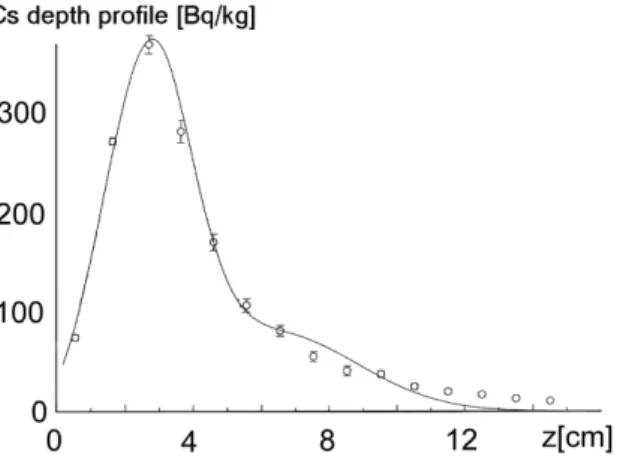
2 ). Free parameters(α β D v)are optimized with Marquardt method 8]by controllingu(z t)with experimental data (near NPP Krˇsko, 99). The result is very good, except for the greater depths
(Fig. 1).
Fig. 1.The measured profile of Cs(circles)and the
theoretical fit using the diffusion — convection model
(solid line).
The mathematical modeling is obviously very demanding. An alternative approach is there-fore beneficial. In the following, the SCA ap-proach is described.
B.) SCA modeling
1D SCA is suggested, where each cell( automa-ton) is responsible for the description of the depth profile(value of Cs concentration)within a range of 1cm(Fig. 2).
Fig. 2.Cellular automata structure.
The following heuristics is used: concentration of cell i (i = 1 2 ::: N) is increased if the neighboring concentrations are higher and is de-creased otherwise. The changes also depend on diffusion constant and migration speed. The concentration is described with the digital value of the corresponding cell’s state. The state of cell i is changed according to the equation:
ui(t+1)=ui(t)+Pi∆ +
;(1;Pi)∆ ;
(9)
where: ∆+ ∆;
— are step factors proportional topiand
qi, respectively, and:
Pi= pi
pi+qi
Qi=(1;Pi)= qi
pi+qi (10)
pi = D
(1+sgn(ui ;1
;ui)) (ui
;1 ;ui) 2
v +
+D
(1+sgn(ui +1
;ui)) (ui
+1 ;ui) 2
qi = D
(1+sgn(ui;ui ;1
)) (ui;ui
;1 ) 2
v +
+D
(1+sgn(ui;ui +1
)) (ui;ui
+1 ) 2
where D and v are again estimates of diffu-sion constant and migration speed, Pi and Qi
are probabilities of i’th cell concentration incre-ment and decreincre-ment, respectively, andsgn(x)is the sign function ofx, being +1 ifx > 0, 0 if x = 0 and;1 ifx < 0. Note the influence of bothD andv on piand qiin the direction of
the migration, and the influence of onlyD onpi
andqiin the opposite direction. The equations
above, therefore, clearly indicate nonlinear de-pendence, which would not be the case with the discrete version of the diffusion-convection differential equation.
The deposit(fallout of Cs)at the surface is the same as before. This is shown in Figure 3 with the values, real up to the scaling factorsα and
β .
Fig. 3.Nuclear experiment deposits of radioactive Cs between 1952 and 1977 and the Chernobyl deposit of Cs
in 1986 in arbitrary units.
With this input data we made two simulation runs, one with evolution-based algorithm(GA) and another with stochastic correlation algo-rithm(ALOPEX)in order to optimize the free parameters of the SCA model(α β D v ), so that it would fit best with the experimental data. We first considered the above parameters as global parameters. For each search method
(GA, ALOPEX)we tested several variants and for each variant we made ten tests. For the eval-uation we took the average tests of the best vari-ants. Two variants of GA were tried, one with discrete (GA d) and another with real (GA r) parameter values. We also tested two versions
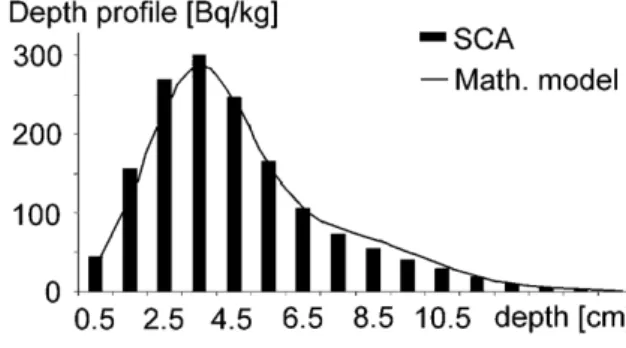
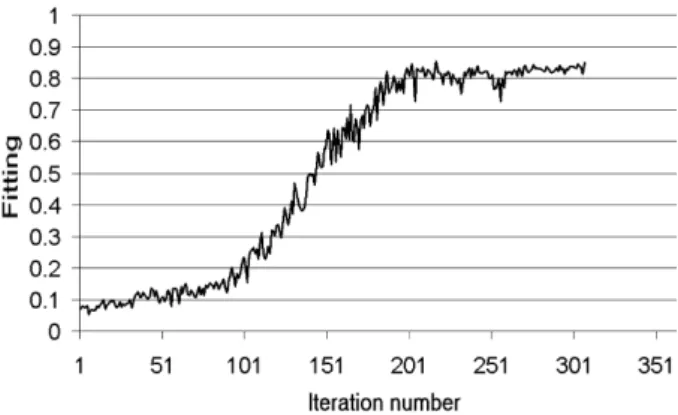
of ALOPEX, one with fixed amounts(AL f)of parameter changes and the other with change-able steps(AL c), following the general princi-ple of Rechenberg’s 1/5 success rule, 1]. Table 1 gives the average number of simulation runs needed to reach the error obtained by mathe-matical modeling(50 Bq/kg, 7]), for the four mentioned methods, where the error is calcu-lated as the square root of the sum of squared differences between the measured and calcu-lated concentrations. Timing of the best result
(AL f)is shown in Fig. 4.
Fig. 4.Timing of the fixed step Alopex method.
Method Av. no. of steps( 1000)
GA d 35.9
GA r 27.5
AL f 21.9
AL c 32.7
Table 1.Average number of simulation runs
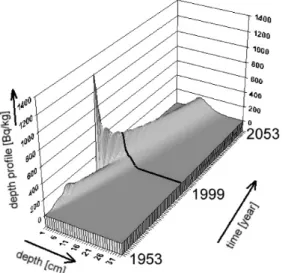
An interesting result was obtained by combin-ing GA r and AL f(GAAX), which means that we used the evolution-based procedure together with the learning algorithm(the approach that gained the name Lamarckism, 1], opposite to Darwinism). The average number of simula-tion runs to reach an error of 50Bq/kg was 20.5, which indicates that the combining meth-ods are compatible. We also tried to improve the above results (decrease the error) by con-sideringD andv as local parameters. In this case, we reached an error of 2.7 Bq/kg in 11,000 generations(11 million simulation runs). This exceptional result was obtained with the GA r method. Finally, it is interesting to look at the forecasting of our results. The global parame-ters, obtained with mathematical and SCA mod-eling, were used and some further simulations were performed in order to obtain predictions of the Cs migration for the year 2003 with the two methods(Fig. 5). Time-space diagram for AL c is further given in Fig. 6. It was not possi-ble to get a similar diagram with mathematical modeling, which is due to the numerical algo-rithms that were used within the mathematical modeling.
Fig. 6.Time-space diagram of Cs migration in soil obtained by SCA(AL c)modeling .
5.2. 2D case study: Forest Fire Spread
Forest fire spread is a well known and a very serious problem in Mediterranean countries and elsewhere. Modeling the dynamics of fire spread would enable prevention of huge damage and many human casualties.
A.) Mathematical modeling:
The traditional mathematical modeling for fire spread is based on the fundamental equation of energy law:
@h
@t
=-div ~j
+σ (11)
h — specific enthalpy of medium
~j — energy flux density
σ — specific power of heat generation
where:
~j =;α
(~r
)grad(T)+ρcpT ~
ω
α — conductivity field
~r —n-D vector, indicating the cell T — temperature
ρ — air density
cp— specific heat of air at const. pressure
~
ω— wind velocity
The temperature spread is then:
@T
@t =
1
ρcp
@h
@t =
= 1
ρcp div
(α(~r) grad(T);div (~ωT
)+
σ ρcp
=β div(α(~r) grad(T);div (~ωT
)+Ω (12) where:
α,β,Ω— are unknown local parameters that depend on geographical and meteorological data. The above equation represents the diffusion model of the forest fire spread. We shall omit its direct implementation, it is detailed elsewhere 3, 9]. The model is used for reference ( mea-sured) sequence generation within our experi-ments. The reason for this is the fact that we had no real data at our disposal.
B.) SCA modeling
therefore follows the heuristics applied to this problem.
Fig. 7.Stochastic cellular automaton model for fire spread research.
SCA model of a forest fire spread can be in-terpreted also with the array (’forest’)of cells
(’trees’), where each cell has only three pos-sible states (due to the fact that we are inter-ested in the fire spread only): 0: unaffected tree
(low temp., fuel available), 1: burning tree( ris-ing temp., fuel beris-ing burned). 2: burned tree
(falling temp., no fuel left). The fire from one cell within the diffusion model ignites a cell in its vicinity with some probabilityv(~r
). In SCA approach the other probabilityP(
~r
)is in order, describing the fire spread to cell~r because of its neighboring cells, considering also the wind and the structure (fuel) of the cell itself. As we have some knowledge about it(structure of terrain, meteorological data, for example), we distinguish between initial and unknown data. We designate the former withp0(
~r
)and the lat-ter with p(~r
).
Total ignition probability is now:
P(~r )= p0
(~r )+p
(~r
) (13)
p( ~r
)is not known in advance. It depends on the state of all relevant neighboring cells. We want to optimize it for all cells in order to fit the SCA dynamics to the measured data.
The state transition diagram for all the cells in SCA is very simple due to the straightforward heuristics(Fig. 8).
The two non-gradient procedures are again used to optimize local parameters p(~r) for all the
Fig. 8.State diagram of cellular automaton cell for fire spread research.
cells in SCA. We applied Al f(ALOPEX with fixed steps)and modified CPA. In both cases we evaluated the procedures by comparing the er-rors at different evolution steps, where the error
(sum of state differences between the equivalent cells from measured(reference)and the gener-ated configurations within the two sequences) is taken over the area of observation(cells in the “fire” state)and during the teaching sequence. Figure 9 shows the fitting increase of(1 – Error) during the evolution of SCA with the modified
Fig. 9.Fitting(1 – Error)of SCA to the reference
sequence of the cells in “fire” state with modified CPA algorithm.
Fig. 10. Fitting(1 – Error)of SCA to the reference
Al f and Figure 10 with the modified CPA. Al f is used here for each cell separately but with a local exchange of the parameters when this increases the fitting of a cell. Without this mod-ification, Al f procedure is too slow to be com-parable with modified CPA algorithm. Though they both show the effect of incremental fit-ting, the modified Al f outperforms CPA in both speed and accuracy. It is difficult to say what the reasons are, however we speculate that one of them is the fact that we partition the problem into subproblems with simpler dynamics within Al f, which makes fitting easier.
6. Conclusion
SCA modeling was tested against more tradi-tional mathematical modeling. For non-trivial dynamical systems it is difficult to find the proper analytical model. With the help of modern heuristics and a simple model of pro-cessing (array of stochastic automata), we are able to build models for relatively complex dy-namical systems. Non-gradient optimization methods are essential for successful modeling with SCA. Both of the methods used, evolu-tionary algorithm EA (with two variants GA and CPA) and stochastic correlation algorithm
(ALOPEX), proved to be successful. Each method has positive and negative features. Our general experience is that ALOPEX is easier to implement then EA, but it is also very sen-sitive to the values of the parameters, such as step size, N(number of steps for updating T), etc. On the other hand, EA is more robust, but usually slow, particularly if the search space is large. As they are, due to their features, compat-ible, we found combining them to be attractive. If, after each generation, the individuals are up-dated for a certain number of steps according to ALOPEX, then the convergence speed is con-siderably increased.
In our future work we want to extend the ap-proach to other models like cellular neural net-works and to prepare transformations of heuris-tics for different dynamics to cellular structures.
References
1] T. BACK, D. B. FOGEL, T. MICHALEWICZ, Evolu-tionary Computation 1, 2, Inst. Of Physics Publ., 2000.
2] R. S. BARR, B. L. GOLDEN, J. K. KELLY, M. G.
C. RESENDE, W. S. STEWART (1995): Designing
and Reporting on Computational Experiments with Heuristic methods, in Proceedings of the Interna-tional Conference on Metaheuristics for Optimiza-tion, Kluwer Publishing, Norwell, MA, pp. 1–17
3] A. DOBNIKAR, S. VAVPOTIC, A. LIKAR,ˇ Dynamic Systems Modeling with Evolving Cellular Automata, in A. Dobnikar etal.,Artificial Neural Nets and Ge-netic Algorithms, Springer, 1999.
4] J. H. HOLLAND,Outline for logical theory of adap-tive systems, J. ACM 3(1962).
5] O. V. KONSHIN, Mathematical model of
137Cs migration in soil: Analysis of observation follow-ing the Chernobyl accident, Health Physics 63(3) (1992), 301–306.
6] M. KORUN, A. LIKAR, M. LIPOGLEVSEK, R. MAR-ˇ
TINCIˇC, B. PUCELJ,ˇ In-situ measurements of 137Cs distribution in the soil, Nulear. Instrumental Meth. B 93(1994), 485–491.
7] A. LIKAR, G. OMAHEN, M. LIPOGLAVSEK, T. VID-ˇ
MAR, Diffusion and migration of 137Cs in soil, to
appear inJ. Environ. Radioactivity, 2000.
8] W. H. PRESS, S. A. TEULKOSKY, W. T. VETTERLING,
B. P. FLANNERY, Numerical Recipes in Fortran, Cambridge Univ. Press,(1994)
9] D. D. RICHARDS,Int. J. Wildland Fire, 5(2):(1995),
63–72.
10] E. SANCHEZ, M. TOMASSINI, Towards Evolvable Hardware, Springer, 1996.
11] M. SIPPER,Evolution of Parallel Cellular Machines,
Springer, 1997.
12] P. SZERBIN, E. BOKORI, L. KOBLINGER, L.
VERGVARI, A. UGRON, Cesium-137 migration in Hungarian soils, Sci. Tot. Eviron.(1999), 215–227.
13] T. TOFFOLI, N. MARGOLUS,Cellular Automata Ma-chines, MIT Press, 1988.
14] K. P. UNNIKRISHNAN, K. P. VENUGOPAL, Alopex: A Correlation-Based Learning Algorithm for Feed-forward and Recurrent Neural Networks, Neural Computations 6,(1994), 469–490(1994).
15] R. O. WEBER,Int. J. Wildland Fire, 1(4): (1991),
245–248.
Received:January, 2002 Revised:September, 2002 Accepted:September, 2002
Simon Vavpoticˇ
Faculty of Computer and Information Science University of Ljubljana Trˇzaˇska 25 1000 Ljubljana Slovenia e-mail:[email protected]
Andrej Likar Faculty of Mathematics and Physics University of Ljubljana Jadranska 19 1000 Ljubljana Slovenia e-mail:[email protected]
ANDREJDOBNIKARwas born on 26 October 1946 in Ljubljana, Slove-nia. He received his B.Sc.(1971)and M.Sc.(1973)degrees in electrical
engineering and Ph.D. degree(1984)in computer science, all from the
University of Ljubljana. He became assistant professor of computer science in 1986, associate professor in 1991 and full professor in 1996. His research interests are neural networks, soft computing, parallel pro-cessing and adaptive systems. Andrej Dobnikar is a member of IEEE and ISNN.
SIMONVAVPOTICˇwas born in 1972 in Ljubljana, Slovenia. He received a B.Sc. degree(1996)and M.Sc. degree(2001)from the University
of Ljubljana and is working towards a Ph.D. in computer science. His research interests are neural networks, parallel processing and adaptive systems.
ANDREJLIKARwas born on 1st of June 1948 in Ljubljana, Slovenia. He received his B.Sc.(1971)and M.Sc.(1974)degrees in physics and
Ph.D. degree(1978)in physics, all from the University of Ljubljana.