A Role-Based Coordination Model and its Realization
Nianen Chen, Yue Yu, Shangping Ren and Mattox Beckman Department of Computer Science,
Illinois Institute of Technology, USA E-mail:{nchen3,yyu8,ren,beckman}@iit.edu
Keywords:coordination models, actors, roles, coordinators, open distributed and embedded systems
Received:February 1, 2008
This paper presents a framework to support Open Distributed and Embedded (ODE) application develop-ment based on the Actor-Role-Coordinator (ARC) model. The ARC model is a role-based coordination model developed to address three main concerns inherent in an ODE system: dynamicity, scalability, and stringent QoS requirements. It treats an ODE system as a composition of concurrent computation and coerced coordination. In particular, the ARC model uses concurrent objects that communicate with each other through asynchronous messages, i.e., actors, to model the concurrent computation of an ODE sys-tem, while the system’s QoS requirements are mapped to coordination constraints. Coordination entities, i.e., roles and coordinators, impose coordination constraints on concurrent actors transparently through message interceptions and manipulations. In the ARC model, roles provide actor behavior abstractions for coordinators and coordinators are responsible for coordinating roles. In addition, a role also has local coordination responsibilities among actors belonging to that role. This coordination is called intra-role co-ordination which complements the inter-role coco-ordination performed by the coordinators. In other words, under the ARC model, an ODE application is modeled by three orthogonal layers: computation, intra-role coordination and inter-intra-role coordination. This separation not only improves software modularity and reusability, but also allows different levels of compositions. Our experiments show that the model scales well as the number of entities involved in the system increases, and that the performance overhead intro-duced by the external coordination layers is limited.
Povzetek: Opisano je ogrodje za model aktor-vloga-koordinator (ARC).
1 Introduction
Unlike most traditional software systems, open, dis-tributed, and embedded (ODE) systems must be concerned with the environment in which they are executed. Such sys-tems usually have rigid requirements on both the accuracy of the delivered functionality and the punctuality of its de-livery. These requirements are manifested through Quality of Service (QoS) constraints, such as real-time, fault tol-erance, energy consumption, and others. Another aspect of the environment is its extent. There can be many com-putational entities involved, and these entities are free to join or leave (intentionally or because of failures) at any time, introducing dynamicity into the system. The dynam-icity and stringent QoS constraints add complexity to ODE systems, and distinguish them from traditional concurrent distributed systems.
Concurrent distributed computation models have been well studied over the past decades. CSP [21], π -calculus [33], and the actor model [1, 2] are good exam-ples. These models are still widely used today as they pro-vide a uniform way to model diversified applications. For instance, the Actor model treats "actors" as universal prim-itives: in response to a message an actor receives, the actor
may make local decisions and decide how to respond to the next message received, create more actors, and/or send more messages. It is often used as a framework for mod-eling, understanding, and reasoning about a wide range of modern concurrent systems. For instance, Web Services with SOAP endpoints can be modeled as actors [20, 19]; an agent-based system can be modeled as an actor sys-tem, where (mobile) agents are modeled as (mobile) ac-tors [28, 24]; and Sensor and Actor Network (SAN) is re-cently proposed to use the Actor model as the theoretical basis for sensor networks [26, 12, 7].
any guarantees about such QoS promises. What we need is a model to study QoS aware interaction, or coordination, among distributed computational entities in ODE systems. This model should accurately exhibit an ODE application’s functional behaviors, and also precisely reflect the applica-tion’s context, taking into account the dynamicity and strin-gent QoS requirements.
In order to conquer the complexity and dynamicity in-herent to ODE systems, we may decompose these systems into different concerns. Separation of concerns as a soft-ware engineering principle is not new [18, 3]. However, how a concern is delineated plays a critical role in the qual-ity of the delivered software models. A concern should be logically self-contained and, ideally, orthogonal and trans-parent to the other concerns in order to minimize the inter-ference among them.
For instance, an open embedded real-time application, such as an environmental monitoring system, will send data from wide-area sensors to data processing entities on the Internet. The results are fed back into the physical world for actuation. In order to interact with the physical world in real time, open embedded applications must be able to fulfill a fundamental requirement, that fresh data be avail-able at the right computation site at the right time. How-ever, as Kang et. al [23] pointed out, current computing and communication-oriented paradigms face a huge obstacle in achieving this vision of open embedded real-time systems. Therefore, instead of interacting directly with a number of distributed data sources or actuators, it is important to have high level abstractions that federate distributed entities, co-ordinating them to abide by QoS requirements.
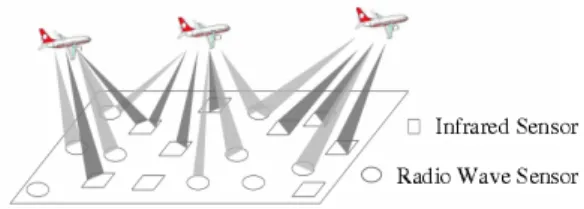
Consider the following simplified scenario as an exam-ple of the problem our research addresses. Suppose we have deployed infrared and radio wave sensors in an open space to detecting foreign objects. As shown in Figure 1, depending on the exact location of the foreign object, dif-ferent groups of sensors will be active and generate data. In order for a control center to take appropriate action, data from the two types of sensors must be semantically consis-tent (i.e., indicating the same type of object) and they must arrive at the center within a specified time range.
Figure 1: Open Space Surveillance
Clearly, it is amustthat the infrared and radio wave sen-sors becoordinated in atimed fashion, but the nature of the problem prohibits us from statically pairing them up. The key technical challenge is that coordination is neces-sary, and that coordination itself is subject to QoS con-straints. Furthermore, the coordinatees constitute a large and dynamically changing set. Integrating the
coordina-tion requirements into the basic computacoordina-tion descripcoordina-tion is not a viable solution; it only complicates an already hard problem. Unfortunately, existing research has not ap-proached ODE applications from the coordination angle, neither have earlier coordination models addressed coor-dination under QoS constraints in depth. Therefore, new research is needed to support the development of ODE ap-plications.
In this paper, we present a framework for developing ODE applications based on a role-based distributed coordi-nation model, the Actor, Role and Coordinator (ARC) [44] model. The focus of this ARC model is to separate the QoS or non-functional requirements from the embedded appli-cations’ functional logic, and at the same time to address the dynamicity and scalability issues inherent to ODE sys-tems. In particular, the actor layer models the concurrent computational part of an ODE system, while an indepen-dent coordination model is developed to address the fed-eration of distributed entities to satisfy the system’s QoS requirements. The coordination model contains both the coordinator layer and the role layer; the role layer provides a level of abstraction to mask the dynamicity of the actor layer from the coordinators, and each role coordinates the local group of actors that share that role. This further re-duces the complexity of coordinators and improves coor-dination scalability. We present in detail a CORBA based implementation of ARC that provides architectural support for transparent application of QoS constraints on concur-rent computations. The design criteria of the framework are performance, scalability, and flexibility.
The rest of the paper is organized as follows: Section 2 discusses related work. Section 3 presents the ARC model and the composition of three autonomous entities, i.e., ac-tors, roles, and coordinators. Section 4 presents an ARC framework and preliminary evaluation results. Finally, we conclude in Section 5.
2 Related work
Recent research has yielded significant results on coordina-tion models and languages. In their landmark survey [41], Papadopoulos et. al. conclude that coordination models can be classified into two categories, namely data-driven and control-driven. The tuple space model (Linda) [10] represents the data-driven category, and has been extended with such systems as Lime[42], Klaim[36], and related extensions [37]. Systems such as the Ideal Worker Ideal Manager (IWIM) model [4] presents a control-driven or “exogenous” category. Recently, tuple center and Re-SpecT [40, 38] provide a hybrid view.
com-ponents as composable Abstract Behavior Types. Like IWIM, ABT is a two-level control-driven coordination model where computation and coordination concerns are achieved in separate and independent levels. The Reo model uses a circuit-like network of composable channels to provide communication between components. Compo-nents send messages across these channels, and the geome-try of the channels determine the destination or destinations of the messages. The Orc model uses “site calls” to model computation [43]. Unlike Reo channels, Orc’s site calls are not expected to be persistent.
The concept of role is seen in object-oriented systems when a set of common behaviors is abstracted and can be assigned to an object [15, 25]. Roles are an important tech-nique in a variety of computing systems. For example, in the computer security area, the Role Based Access Con-trol (RBAC) [14] model uses roles to separate users from security policies in order to achieve scalability and flex-ibility. In object-oriented programming [27] and in de-sign patterns [17], roles are used to represent solutions and experiences. There are control-driven models, such as ROAD, CoLaS, TuCSoN with Agent Coordination Con-texts (ACC) [39] and Finesse [8], to name a few, that try to mitigate the scalability issues of open distributed sys-tems by adopting role concepts. Most current role-based coordination models are based on organizational concepts, where roles abstract coordination behaviors among par-ticipants who play the roles. Cabri presents a survey of role-based coordination models in [9]. Additionally, quite a few coordination models take decentralization into ac-count. TuCSoN [40] distributes communication abstrac-tions (tuple centers) to Internet nodes. Every tuple center produces and maintains its own local coordination rules. CoLaS divides the whole distributed system into multi-ple coordination groups. Each coordination group takes care of an independent set of coordination policies. ROAD provides a recursive structure that composes fine-grained, small coordination groups into coarse-grained, large ones. LGI follows a controller metaphor and provides a con-troller for every object in the system, and hence implements a full-fledged decentralization.
The ARC [44] model differs from these models by sep-arating inter-role coordination and intra-role coordination and distributing the coordination activities to coordinators and roles respectively. Roles are active entities with coor-dination ability instead of merely abstract interfaces. The distribution of coordination responsibility is based on the functionalities of the roles and is therefore more logical and customizable. The emphasis on active roles and the corresponding separation of inter-role and intra-role coor-dination distinguishes the ARC model from previous role-based coordination models.
A similar actor oriented model is advocated by Lee et al. [30, 31]. In this model, actor executions and commu-nications are under the guidance of a “model of compu-tation,” which gives operational rules to determine when and how actors can perform their computations, update
their states, or send messages to other actors. The model of computation separates the communication mechanisms and work flows of actors from their computational designs, such that reusability is possible and compositions of com-ponents are more robust.
Though the above actor-based models, like ARC, sep-arate coordination from the functional core of a system based on concurrent actors, the focus of ARC is to address the dynamicity and scalability issues in coordinating large set of autonomous and asynchronous entities. The em-phasis on role-based coordination distinguishes the ARC model from previous multi-level actor-based coordination architectures.
A set of coordination models has been proposed to ad-dress the coordination issues based on the Actor model [1, 2], such as Frølund’sSynchronizer[16], Venkatasubrama-niam’sTLAM (Two-Level-Actor-Model)[50], and Varela’s director[49]. One common theme of these models is the use of reflection with actors. This can be seen is sys-tems such as ActorNet [29], and Reflective Russian Dolls (RRD) [32]. ActorNet provides a platform designed for small, heterogeneous systems. It provides a uniform en-vironment for the actors, and makes use ofcall/ccto allow actors to migrate themselves to other nodes in the system. RRD is similar to ARC in that there are levels of coordination. Both achieve coordination by using reflec-tion to modify the delivery of messages.
ARC, however, is a three-layer system, with functional behavior confined to the lowest level, and coordination to the upper two levels. The formal semantics of the ARC model is given in [44]. The RRD is a multi-level sys-tem; each level encapsulating the levels below it. The for-mal comparison between the ARC model two other co-ordination models, i.e. the and Reflective Russian Dolls (RRD) [47] and Reo [6], is given in [46]. Yu and et al. used Maude to further verify safety properties that can be imposed through the ARC model [51].
3 The Actor, Role, and Coordinator
(ARC) model
In this section, we discuss in detail the Actor-Role-Coordinator model.
3.1 The actor model
eliminates this impediment by introducing exogenous co-ordination objects, i.e., roles and coordinators.
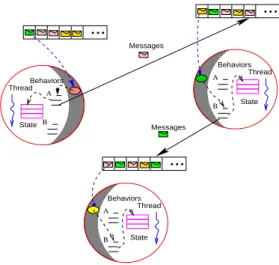
Actors are autonomous, active entities that communicate with each other through asynchronous messages. Each ac-tor has a unique mail address and a mailbox to receive mes-sages. Unprocessed messages are buffered at the receiving actor’s mailbox. Within each actor, there is a single thread of control that processes messages sequentially. Each ac-tor has its own states and state dependent behaviors. The states are encapsulated and can only be changed by the ac-tors themselves while processing messages. Different actor states may decide different behaviors that in turn affect how messages are processed. While processing a message, an actor may perform three primitive operations: send asyn-chronous messages to other actors, create new actors, or change its own states (become) and then become ready to retrieve the next available message in the mailbox. Figure 2 pictures the internal structure of the actors.
Here is a simple example to demonstrate the actor model. Assume an operation can be performed by a computational entity (namely, an actor) called an “executor” once and only once. Any actor that is not an executor is called a “for-warder.” We distinguish an executor from a forwarder by looking at its internal stateexecuted. Ifexecutedis false, then this actor is an executor, otherwise it is a forwarder. The behavior of an executor is as follows: when it receives a message requesting the service, it performs the service, and sets its stateexecutedto be true, which triggers the ac-tor to become a forwarder. Finally, the former execuac-tor cre-ates another actor with the same behavior (i.e., perform the same operation) and with its stateexecutedset to be false. In other words, this actor becomes a forwarder and cre-ates a new executor. After becoming a forwarder, this actor changes its behavior. When the same message arrives at the forwarder, instead of executing the operation, it forwards the message to the executor that it created. This behavior is recursive; the “executor” to which it forwards the mes-sage may also have become a forwarder, and will in turn continue forwarding the message to successive forwarders until the current executor is located. This example explains the basic concepts of an actor and its three primitives:send, create, andbecome. All actor based computations can be implemented by these three primitives.
3.2 The abstraction levels of ARC
In the ARC model, a role is a static abstraction for be-haviors shared by a set of underlying computational ac-tors. This abstraction decouples behaviors from their im-plementors and eliminates static binding among computa-tional actors. It also shares coordination responsibilities. More specifically, there are two types ofactive coordina-tion objects in the model:rolesandcoordinators. The ordination is partitioned into intra-role and inter-role co-ordinations and distributed among roles and coordinators, respectively. The coordinators (i.e., inter-role coordination objects) coordinate behaviors while the roles (i.e.,intra-role
...
...
...
Thread
State Thread Behaviors
A
B
Messages
State Thread
B A
Behaviors Messages Behaviors
State
A
B
Figure 2: The Actors
coordination objects) coordinate members that share the same behavior.
Coordinators constrain the coordination behavior of roles. This eventually affects a message’s dispatch time and location (target) in a computation. However, com-putational actors and coordinators are transparent to each other. Hence, the dynamicity inherent in the computation is hidden from the coordinators. Compared to the number of actors involved in an ODE application, the number of behaviors (and therefore the number of roles) contributed by these actors is usually order(s) of magnitude smaller. Therefore, the model is not only stable, but also scalable.
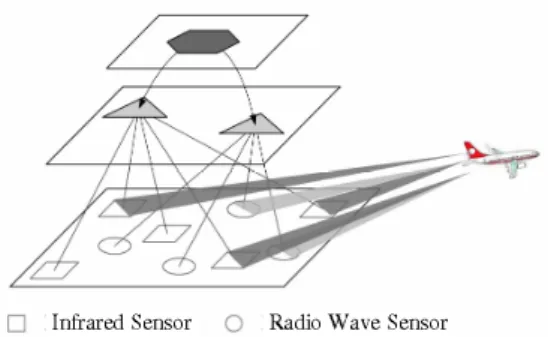
Under the ARC model, the open space surveillance sys-tem introduced in Section 1 (Figure 1) can be mapped to a set of sensoractors, tworolesfor the infrared sensors and radio wave sensors, respectively, and a coordinator (Fig-ure 4). The inter-role constraint is on the time relation of the data coming from the infrared sensor role and the radio wave sensor role. Each role can have different intra-role coordination policies. For instance, the infrared role may ensure synchrony by waiting for data from all its members, while the radio wave role only waits for data from a major-ity of its members.
Figure 4: The ARC View of an Open Space Surveillance System
The separation ofcomputation,intra-role, andinter-role coordination advocated by the ARC model is clean and orthogonal. This separation mitigates the complexity of each individual type — coordinators only concern them-selves with coordinating asmall scaleof roles while roles careonlyabout actors of thesame behavior. This provides grounds for independent modeling and compositional rea-soning.
Separation and transparency are the results of the follow-ing properties of the ARC model:
1. The actor layer does not depend on the coordination layer. The actors fulfill their functional behaviors independently by exchanging messages without any knowledge that the coordination entities even exist.
2. The coordination layer intercepts messages among ac-tors and applies coordination constraints on the mes-sages. Coordination does not require direct message interactions between actors and coordination entities.
Computation actors carry out their logical computations by reacting to messages received. As a result, if the roles or coordinators do not send any computational messages to the computation actors, the underlying computation will retain its computational properties.
The role layer bridges the actor and the coordinator lay-ers and may therefore be viewed from two play-erspectives. From the perspective of a coordinator, a role enables the coordination of a set of actors that share the same static de-scription of behaviors without requiring the coordinator to be aware of the individual actors in the set. From the per-spective of an actor, the role is a coordinator that actively imposes coordination constraints on messages sent and re-ceived by the actor.
Though actors, roles, and coordinators have different re-sponsibilities, we uniformly model their behaviors using actors. To comply with the separation of concern princi-ple, we categorize these actors into two types: computation actors that capture system computation concerns, and coor-dination actors that abstract system coorcoor-dination concerns. More specifically, roles and coordinators are coordination actors, whereas actors in the actor layer are computation actors. Thus, coordination actors are actors which satisfy the basic actor semantics by providing the actor operational
primitives. However, they are special actors that are able to handle specific types of messages, namely, events.
In our model, actors communicate with each other via messages, which are defined as a three-tuple < rcver−
actor, op, par >. Herercver−actoris the name of the recipient actor, opis the behavior name that the recipient actor is required to apply, andparcontains the parameters that the recipient needs to perform its behavior.
Events are special messages that are atomically dis-patched on coordination actors. Unlike computation mes-sages, the recipient of an event is not an individual dination actor, instead, events are broadcast to all coor-dination actors in the system. Thus, an event is defined as < All, op, par >whereAllindicates that the event is broadcast. Though events are broadcast to all roles, we may instead use an intermediate “default” role as a medi-ator to receive and forward events between actors. This optimization can convert the broadcast into a two-element group-cast, reducing the communication overhead and syn-chronization complexity.
Another important characteristic of events is that an event is instantaneous and atomic. In other words, the gen-eration of an event and the consumption of an event are atomic, and no actor computation messages can be pro-cessed during this period of time. This requirement guar-antees that coordination constraints are applied on related messages before these messages are dispatched on compu-tation actors.
To maintain coordination transparency and avoid inter-fering with the computation actors’ functionalities, coordi-nation actors are not allowed to generate or send messages to computation actors. The computation level and coordi-nation level are connected throughevents. While messages are used between computation actors to carry out compu-tations, events represent state changes in the system and trigger coordination related behaviors on coordination ac-tors.
There are three events defined in an actor layer: send(a message is sent by an actor),new(creation of a new actor), andready (change actor behavior if necessary and ready for next available message). All these events from com-putation actors are observable by roles. Upon observing the events, the roles cooperate with coordinators through inter-roleandintra-roleconstraints to coordinatewhenand wheremessages should be dispatched among computation actors.
3.3 Roles and their responsibilities
abstractions for these system behaviors; this enables us to conceal the dynamicity and scale of the ODE environment. In addition to representing abstractions for the proper-ties of the system behaviors, roles also are responsible for actively coordinating their players to achieve coordination requirements. Roles serve as an abstraction by specify-ing membership criteria, i.e., a static specification of func-tional behaviors that computation actors belonging to the role must have. The role is responsible for managing the integrity of its membership. Roles also actively coordi-nate their member actors in order to satisfy coordination requirements. Theintra-rolecoordination coerced by roles realizes and complements the inter-role coordination en-acted by coordinators.
Membership management behavior Before a role can perform its membership management activities, the behav-ior abstraction, i.e. the role membership criteria, must be specified. We use logic expressions of actor states and op-erations to describe the criteria. More specifically, the role membership criteria are represented by a tuple< O, A >, whereOis a set of message types (operations) that an ac-tor must be able to process, andAis a set of attributes that actors need to display for joining the role. Any actor that is controllable by coordination rules must declare its own functional behavior, using the same tuple format.
Upon observing a new event or a ready event from a computation actor, the role acquires the newly updated be-havior from the computation actor and compares it against its membership criteria. It then determines whether the ac-tor should be added to the membership list (the acac-tor be-havior matches the role criteria), ignored (the actor was not a member and its behavior does not match the role criteria), or removed from the role (the actor was a member but its new behavior does not match the role criteria). More pre-cisely, a role’s management behavior is a mapping from a set of actor events to membership updates. Note that ac-cording to the semantics of the actor model, actors are free to reject exposing their internal states to the roles. This allows an actor to reject coordination. Such actors will be-long to a “default” role that performs no coordination.
Each role has a distinct purpose. This requirement disal-lows overlapping criteria among roles, eliminating the pos-sibility that conflicting constraints will be imposed on an actor by multiple roles simultaneously. This requirement has its basis in the underlying actor model: each actor has only a single thread of control and therefore may play only one role at any given time. More precisely, let C(γ) de-note the role membership criteria declared by roleγ, and let B(α) denote the functional behaviors provided by an actorα. As we have discussed, the actor functional behav-iors and the membership criteria are both represented as a comparable tuple< O, A >. To be added to a role, the ac-tor functional behaviors have to match the role’s member-ship criteria. AandΓdenote the set of actors and roles in the system, respectively, andF :A→Γis a function that assigns an actor to a role. At any given time, well-defined
roles and actors in a system must satisfy the following re-quirements:
1. Roles are exclusive: role declared behaviors do not overlap, i.e.,
∀γ, γ0∈Γ :C(γ)∩C(γ0) =φ
2. Roles are exhaustive: every actor belongs to one of the roles, i.e.,
(
n
[
i
B(αi) = m
[
j
C(γj)), and
(∀α∈A,∃γ∈Γ :B(α) =C(γ))
3. Roles are repetitive: repeated actor behaviors replicate the assignment of the actor to the same role, i.e.,
∀αi, αj ∈A:B(αi) =B(αj)⇒F(αi) =F(αj)
4. Each actor only plays one role at a given time, i.e.,
∀i, j, j6=i:B(α) =C(γi)⇒B(α)6=C(γj)
Coordination Behavior As roles are abstractions of functional behaviors, it is possible that more than one ac-tor may belong to a specific role at any given time. Acac-tors playing the same role may need to coordinate with each other to satisfy certain QoS constraints. Such constraints are calledintra-rolecoordination constraints.
A role’s coordination behavior thus has two aspects: (1) it retrieves inter-role constraints specified by the co-ordinators; (2) it is responsible for enforcing both the inter-role and intra-role coordination constraints on ac-tors. Since roles are coordination actors and are not al-lowed to send/receive messages to/from computation ac-tors, message interception and manipulation is the only fea-sible means to apply the constraints. Furthermore, all these behaviors are triggered by observed events on computation actors. Therefore, the coordination behavior of a role can be given the following interpretation: upon observing an event from a computation actor, and based on its current states, the role may manipulate messages, generate events (which are observable by coordinators), or change its own states.
The coordination rules are enforced on actors without their awareness. The involvement of roles in the coordina-tion process causes coordinacoordina-tion in the ARC model to be decentralized. Active roles cause our coordination model itself to become a distributed subsystem, inheriting the full benefits that a distributed system may offer.
may have different requirements, which need to be met by receiving different services from servers. We there-fore separate the client actors into different roles depend-ing on their level of service attributes, i.e. a VOD client ac-tor has aRegular_VOD_Client Roleif itslevel_of_service attribute is set to regular; while a VoD client has a VIP_VoD_Clientrole if itslevel_of_serviceattribute is set tovery_important. Therefore, when an actor is created or moves into the system, the roles will check its operations and attributes. For example, if aVIP_VoD_Clientrole finds that the new actor has a behavior tuple<<request_video>,
<level_of_service:regular>>, which matches its role cri-teria, it will then help the actor join its group by performing its member management behavior.
To explain the role’s coordination behavior, we assume that there are multiple VoD server actors in the environ-ment, each of which has different resources (CPU speed, workload, memory, reserved network throughput, and so on). Based on the requests from different types of VoD clients, the VoD_Server role decides which server actor shall be assigned to process the current request. For exam-ple, if the request is from an actor with aVIP_VoD_Client role, this request will be forwarded to aVoD_Serveractor with the highest available resources. This coordination rule is applied on the actors directly within a role, but not among roles, therefore it belongs tointra-rolecoordination.
3.4 Inter-role coordination — coordinators
In contrast tointra-rolecoordination, coordination among high-level coarse-grained roles are called inter-role coor-dination. We define another type of coordination actor, thecoordinator, to specifyinter-rolecoordination policies. These policies are written in terms of roles. A policy is a set of constraints over a set of properties. Values asso-ciated with a property are drawn from an enumerable do-main. A constraint specifies a boolean relation involving a set of properties.
Similar to roles, coordinators are also active objects and impose coordination constraints based on their states. However, in our model the actor layer and the coordinator layer are mutually transparent. Coordinators do not directly apply coordination constraints on computation actors, nei-ther do actors know of the existence of coordinators. Co-ordinators specify and impose policies based on abstract actor functionalities, but not on individual actors.
The role layer bridges the coordinator and actor layers. Roles propagate the events observed from the actors to the coordinators. Upon receiving such events, the coordinator locates constraints in its constraint store based on current states, and propagates the constraints to roles where these constraints are imposed on computation actors.
Consider an example in which multiple producers and multiple consumers share the same buffer. We use a pro-ducer role and a consumer role to capture the propro-ducers and consumers, respectively. The two roles must coordinate to respect the causal order (an item must be produced before it
can be consumed) and buffer size. Instead of specifying the coordination among each pair of producer and consumer, we impose the coordination upon the roles which will in turn propagate the constraints to the role players.
3.5 Composition of concurrent computation
and coerced coordination
Based on the ARC model, an ODE system can be speci-fied in three steps. First, establishing the underlying func-tional computations (modeled by computation actors). Sec-ond, implementing the computational actors to carry out the computation. Finally, embedding the functional ob-jects in an environment constrained by coordination actors. Here we focus on QoS constraints that can be achieved by manipulating the messages in the time and actor space dimensions. Example manipulations on the time-axis in-clude moving messages to the beginning of the actor’s mail queue, blocking them, or postponing them to later time. Manipulations on the actor space domain include tak-ing messages sent to one particular actor and duplicattak-ing, rerouting, or broadcasting them to other actors to satisfy fault tolerance, security and other QoS requirements.
Coordination actors observe events occurring at the com-putation actor layer, and perform coordination behaviors accordingly. However, coordination actors are partitioned into roles and coordinators, and these two types of coordi-nation actors also need to collaborate with each other. Their collaborations are achieved through event exchanges. The events that are observable in the ARC model are presented in Table 1.
Note that the events specified in Table 1 do not exactly follow those defined in the traditional actor model [1, 2]. In Agha’s actor model, there are only three primitive events, send,new, andready, wherereadyactually represents two behaviors of an actor: become a new actor and ready for next available message. After processing a message, even if an actor does not change its behavior, it still has to per-formbecometo become itself. However, in the ARC model the change of behavior triggers the roles’ membership man-agement behaviors. If we performbecomeeach time a mes-sage is finished processing, we will continuously trigger the member management actions in roles, which in most cases will be unnecessary. For this reason, in the ARC model we separate the ready event into two events, namely the becomeevent andreadyfor next available message event, wherebecomeexplicitly specifies that an actor changes its behavior and triggers membership management actions.
After a message has been sent out to a recipient compu-tation actor, and before it can be processed, asend(msg) event is broadcast and needs to be handled by the coor-dination actors. The argument msg is the message that has been sent. After processing the current message, the actor will enter a state in which it is ready to process the next available message in the mail queue. This will cause a
Location Event Triggered By
Actor send(msg) A computation actor performs asend(msg)operation.
new(beh) A computation actor performs acreate(beh)operation.
become(beh) A computation actor performs abecome(beh)operation, wherebehrepresents a behavior that is different from the actor’s current behavior.
ready(msg) A new message in the actor’s mailbox is dispatched at the actor.
Role propSend(msg) Asend(msg)event from a computation actor is observed.
propReady(msg) A ready(msg) event from a computation actor is ob-served.
Coordinator tell(inter−roleconstraints) ApropSend()orpropReady()event is observed.
Table 1: Events Observable in the ARC Model
observe and handle events atomically. Message deliveries, on the other hand, always take time. The dispatch of a message will always happen at a later time than when the message was sent. Therefore, it is guaranteed that coordi-nation actors can perform their coordicoordi-nation behaviors on messages in the recipient actors’ mailboxes before those messages are processed.
The new(beh) or become(beh) events are triggered when a new actor is created or when an actor changes its behavior. The argumentbehis the behavior of the new ac-tor to be created, or the new behavior an acac-tor obtains. All roles in the system are able to observe such an event and compare the behavior with their membership criteria. The role whose membership criteria matches the computation actor’s behavior adds the computation actor into its group. For completeness of the roles in our system, we also intro-duce adefaultrole. If the actor’s behavior does not match any membership criteria of all the existing roles, the actor is added to thedefaultrole.
Upon observing thesendorreadyevent from a compu-tation actor belonging to a role group, the role propagates these events to coordinators to inquire about corresponding inter-role constraints. Unlike the original messages sent from actors, the message parameters in these events may contain extra information, such as the names of the sender and receiver actors, and their currently attached roles. This information helps the coordinator to determine what con-straints need to be propagated to which role.
After observing the propSend or propReady event propagated from the roles, a coordinator checks its con-straint store and locates the corresponding concon-straints, which may depend on both the message parameters and the coordinator’s own states. The coordinator then enacts these constraints by sending atellevent to the roles.
The formal operational semantics of the ARC model is given in [44].
4 Framework
In this section, we briefly describe several critical design is-sues of the framework, and then present the design in detail, along with a prototype implementation of the ARC model. Finally, we show the results of experiments demonstrating the scalability and performance overhead of the framework.
4.1 Design issues
The main design and implementation concern of the ARC framework is to provide the abstractions that implement the Actor, Role and Coordinator semantics, and at the same time provide good performance, scalability and flexibility for different applications. Based on this goal, there are sev-eral design issues we need to consider:
Implement coordination actors and events.
According to the definition of the ARC model, roles and coordinators are “coordination actors” communicating through event broadcasts. Therefore, we need to explicitly distinguish events and messages in the implementation.
As defined in [1, 2], computation actors are autonomous and active entities that communicate with each other through asynchronous messages, as are coordination ac-tors. However, unlike computation messages that commu-nicate among actors in a point-to-point fashion, events are broadcast to all coordination actors. Furthermore, events have a higher priority than computation messages. This en-sures that messages that need to be coordinated will be ma-nipulated by coordination actors before they are dispatched on computation actors. In both our model and implementa-tion framework, the generaimplementa-tion and consumpimplementa-tion of events are treated as atomic behaviors and are enforced by using synchronization protocols.
Maintain scalability and performance as the number of entities increases.
mit-igate the scalability issues in coordination management by allowing coordinators to only coordinate roles, while roles only coordinator actors that share the same behaviors.
Because coordination in the ARC model is enforced transparently on the underlying actors, two problems may occur when the number of actors increases. First, every co-ordinated message triggers at least one event that must be handled by remote coordination actors. This may bring ad-ditional communication overhead. Second, roles and coor-dinators become potential bottlenecks, which may degrade performance and make systems hard to scale.
To alleviate these problems, we have developed a decen-tralized architecture to further distribute coordination be-haviors and states to local physical nodes, thus avoiding bottlenecks and communication overhead. Because both roles and coordinators are active and stateful entities, mul-tiple update and query operations may concurrently be ap-plied to the states of those distributed replicas. Therefore, a synchronization protocol must be in place to ensure the consistency of the states among different nodes. If such synchronizations occur very frequently, the overhead of achieving synchronizations may exceed the benefit of dis-tributing roles and coordinators to local platforms. Hence, tradeoffs need to be made to balance the communication and synchronization costs. Whether distributing the coor-dinator/role states will have performance gains is applica-tion dependent.
Avoid re-inventing the wheel to solve common prob-lems.
Instead of developing our framework from scratch, we take advantage of existing technologies and tools to support distributed communication, i.e., distributed naming, syn-chronous and asynsyn-chronous communication, and locking schemes.
In the next section, we give the details of our frame-work’s design, taking into account the above issues and providing our solutions to them.
4.2 An ARC framework
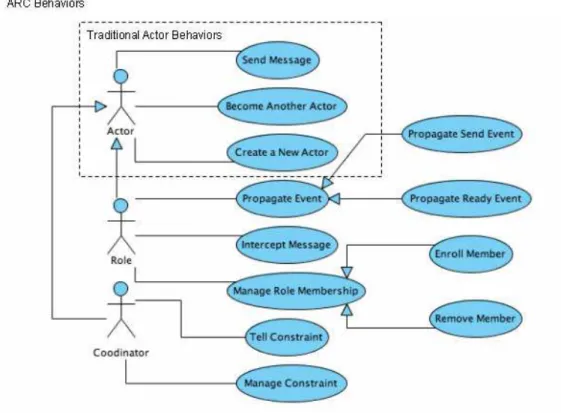
Figure 5 gives an overview use case diagram depicting the functional requirement from three categories of users in the system, i.e. the actors, roles, and coordinators. From this figure, the part within the dashed line box represent the functionality of traditional Actor system. By importing the concepts of role and coordinator, the use cases in ARC system become richer. The purpose of the framework is therefore to fulfill the functional requirements indicated in this use case diagram, while taking into account the design issues presented in Section 4.1.
The ARC framework is built on top of TAO (v1.4.1) [45], an implementation of the CORBA 3.x specification. To minimize the overhead and footprint of the ARC frame-work, we only use a small subset of services provided by TAO. Actors in the ARC framework are built as CORBA objects. They register themselves and locate other actors
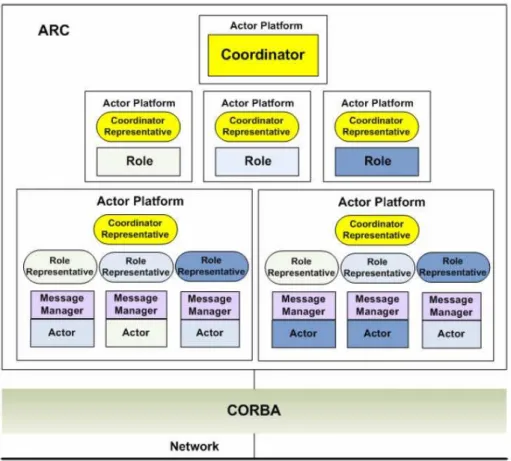
through the CORBA naming service, and communicate with each other through the TAO asynchronous message service. Figure 6 outlines the architecture of the frame-work. The Role Representative and Coordinator Represen-tative objects localize the functionalities of coordination-actors to further increase scalability of the system. These concepts will be discussed in detail in a later in this section.
4.2.1 Actor platform and message manager
In the framework, anActor Platformis installed on every physical node. It provides a uniform way to create actors and register actors as CORBA services. An Actor Plat-form is implemented as a “system actor” that creates ac-tors, roles, and coordinaac-tors, initializes their states and be-haviors, sends messages, and generates events.
With each actor creation, the Actor Platform also creates a Message Manager object for each actor (including both computation and coordination actors) to handle actor com-munication tasks. When an actor tries to send a message to another actor, it delegates the message to its Message Man-ager. For the sending actor, the Message Manager acts as a CORBA client object to send the message asynchronously to the destination actor’s message manager, which acts as a CORBA server object. The receiving message manager then forwards the message to the receiving actor for pro-cessing. Thus, the CORBA middleware details are encap-sulated in the implementation of the message manager and are transparent to application developers who use actors.
4.2.2 Modes
In our framework, users have the option to have logically remote coordinators and roles physically distributed to lo-cal Actor Platforms to reduce the communication overhead. Therefore, we provide three modes:
Fully Centralized Mode (FCM) In this mode, every co-ordination message has to go through potentially re-mote roles and rere-mote coordinators. This mode is suitable for applications that require very frequent state updates in both coordinators and roles.
Partially Distributed Mode (PDM) The coordinator is distributed to the nodes where the coordinated roles are located, but roles are not distributed to the actor platforms. Therefore coordination requests from lo-cal nodes have to go through possibly remote roles, but these roles use local coordinator representatives instead of remote coordinators. Applications that do not anticipate frequent state updates in coordinators will benefit by using this mode.
Figure 5: ARC Use Case Diagram
In the framework, we define two supporting entities: Co-ordinator Representative and Role Representative. As their names suggest, they represent coordinators and roles and perform coordination behaviors in local Actor Platforms. To facilitate deploying different modes, these representa-tives are implemented as coordination-actors. According to the definitions of coordination actors, they are able to communicate with each other through event communica-tions. Based on the currently applied mode, different Coor-dinator Representative and Role Representative instances are bound to these interfaces during runtime and have dif-ferent responsibilities. The relationship among Message Manager, Role, Coordinator, representative interfaces and their instances is depicted in Figure 7.
4.2.3 State synchronization
In situations when synchronization is required among rep-resentatives, we apply the primary-backup and two-phase locking (2PL) protocol. The coordinators and roles are re-sponsible for synchronizing the updates with their repre-sentatives distributed among other actor platforms. In the primary-backup protocol, these coordinators or roles act as primary objects and the representatives are backups. The Concurrency Service provided by TAO enables the primary objects to obtain and release locks in the 2PL algorithm.
Figure 7: Multi-mode Class Diagram
4.2.4 Fully distributed mode implementation
In this paper we focus on the implementation of the Fully Distributed Mode (FDM). The implementations of the Par-tially Distributed Mode and Fully Centralized Mode are very similar and can be easily inferred from the current in-troduction.
ful-Figure 6: The Architecture of the ARC Framework
fill both its membership management behavior and coor-dination behavior. In the ARC model, it is the roles, but not the actors, that manage group membership. Whenever a new actor is created or an actor changes its behavior, the roles apply their bindandunbind operations to maintain the consistency of the membership. Figure 8 demonstrates the procedure of a Role Representative performing mem-bership management and implementing the binding mech-anism.
In the ARC model, coordination constraints are transpar-ently applied to actors. This is achieved by (1) buffering the messages in receiver actors’ mailboxes via Message Man-agers, (2) obtaining coordination constraints by forwarding events to the corresponding role representatives and coordi-nator representative for constraint checks, and (3) applying the coordination constraints by manipulating the messages in the mailboxes. The communication between two actors is shown in Figure 9.
If a constraint is found in its local store, the Role Repre-sentative requires the corresponding Message Manager to enact the constraint on the actor. As all these operations
are performed locally and no remote communication is re-quired, the constraint propagations do not introduce much performance overhead.
4.3 Evaluation
We have developed a prototype of the ARC framework. The experimental settings are as following: We have two Intel x86 machines. The first machine is a Pentium IV 1.7 GHz with 512MB RAM and the second is a Pentium IV 3.06GHz with 1GB RAM. Both of them are running Win-dows XP and connect with each other through a 100M eth-ernet switch. In our experiments, we developed a simple Ping-Pong application, that asks two actors, the Ping actor and the Pong actor, in different machines to continuously send and reply to a specific number of messages to each other.
applica-Figure 8: Actor-Role Binding Mechanism
Figure 9: Communication between Coordinated Actors in FDM
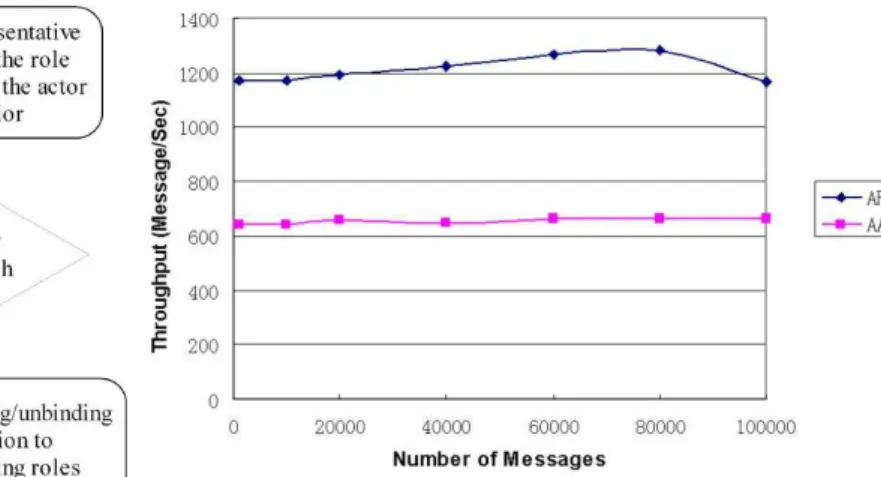
tion features, such as the Naming Service. The ARC frame-work is implemented in C++ and utilizes CORBA services. In this test we use AA and ARC to send messages (with a size of 100 bytes) between two actors on different ma-chines. From figure 13, we can see that ARC outperforms AA in actor communications. The average throughput by using ARC is 85% higher than using AA. This is mainly because the Java Virtual Machine brings heavy overhead to AA. In addition, the optimized naming and communi-cation services provided by TAO also improve the ARC framework’s communication performance.
Figure 11 demonstrates the situation when multiple ac-tor pairs run and send messages concurrently. We ran up to 100 actors on each machine. These pairs of actors sent messages and replied to them concurrently. As the figure shows, increasing the number of actors had little impact on the performance of the ARC. However, the figure also shows an ‘unintuitive’ result: the performance of the 40 actor case is better than the 20 and 10 actor cases. This happened because the larger number of actors increases the odds that messages will share transportation connections.
Figure 10: ARC vs. AA on actor communication
This reduced the overhead of opening and closing connec-tions. Once the number of actors is greater than 40, the con-nections are saturated and the performance becomes stable.
Figure 11: Performance of ARC when the number of actors increases
In the previous experiments, we performed actor com-munications without considering coordination constraints. When coordination requirements are taken into account, actors need to collaborate with each other to achieve sys-tem requirements. For example, in the Ping-Pong applica-tion, we could have an extra mutual exclusion requirement that at any time only one pair of Ping and Pong actors can send messages to each other. To satisfy this requirement, the Ping and Pong actors that want to send messages have to communicate with each other to make sure that there are no other actors competing for the permission to send a mes-sage. If there is more than one actor seeking permission, a decision needs to be made about which one gets permis-sion first. This will require communications to be sent, and some kind of election protocol to be followed.
environ-ments. An obvious solution is to use an explicit coordi-nator to synchronize the “sending message” requirements among actors. To achieve the same synchronization with an explicit coordinator requires most 3n [48] extra com-munication messages. Thus, in an ODE system or simi-lar environment where the number of actors is simi-large and coordination among them is frequent, an explicit coordina-tor can drastically reduce communication overhead and im-prove scalability. Figure 12 depicts the difference between the solution using a coordinator, which is represented by a star topology, and the one without an explicit coordinator, which is represented by a mesh topology.
Figure 12: With or Without Coordinator - a Topology View
From the above analysis, it is clear that adding an ex-tra coordinator layer actually increases performance when the number of actors is large and coordination among them is unavoidable. The next question to ask is if adding an extra layer (the role layer) will seriously degrade the per-formance of the system with a single coordinator layer. We test this by introducing role coordination entities to achieve intra-role coordination constraints. The current test case is under FDM and follows the procedure demonstrated in Figure 9.
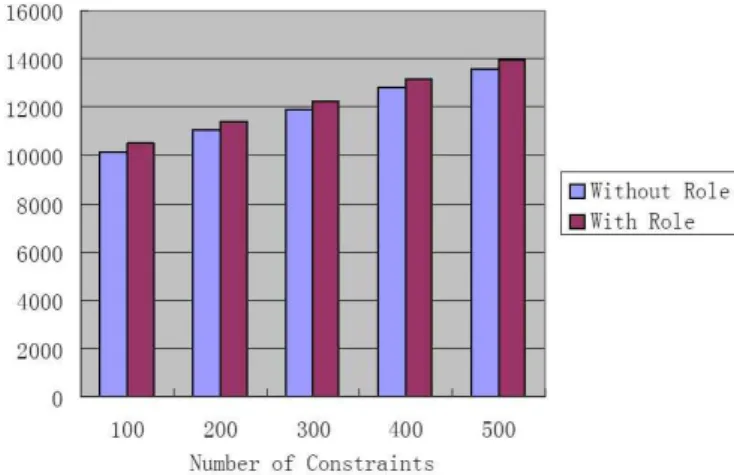
In this experiment, we arranged for10,000messages to be sent between two actors on different machines. We also provided bothinter-role andintra-role constraints. After introducing two roles, the PingRole and the PongRole, we divided the constraints into three categories: 20% became inter-role constraints stored in a coordinator, 40% became intra-roleconstraints stored in PingRole, and the remaining 40% wereintra-roleconstraints stored in PongRole. Con-straint checks were simulated using simple string compar-isons. Figure 13 gives the measurements.
As shown in Figure 13, when there are 100 constraints in a single coordinator, the overhead of introducing two ex-tra role entities is about 3.5%; when there are 500 con-straints, the overhead is about 2.7%. The main overhead comes from the two extra communications between the sender and receiver actors and their attached roles. This number is fixed no matter how many constraints need to be checked. The total number of constraints is the same in two situations. When there are no roles, a coordinator has to check all these constraints; in contrast, when there are two extra roles, the coordinator only handles 20% of the constraints, and rest of the constraints are handled by the two roles concurrently. As a result, the overhead actually
Figure 13: Overhead of introducing role layer
decreases when the number of constraints increases. Though these tests have not conducted on FCM and PDM, we can expect by looking at their descriptions that because roles and actors live in different nodes, the com-munication overhead will be larger than in the current FDM test. However, in such modes, synchronization overhead will become the focus of the application and trade-offs are made to satisfy that.
Finally, we look at the modularity brought by separating the coordination layers from the underlying computational logic in the ARC framework. We demonstrate this by intro-ducing an extra requirement for the Ping-Pong application: after a Pong actor receives a message in its mailbox from the Ping actor, it has to wait for a specific period of time
t1 before it sends back a response. The following gives the pseudo-code that enforces this timing constraint in the Pong actor:
HandleMsg(String message, Int waitTime){ Message msg = parse(message);
String responseMsg = getResponse(); if (msg.SenderTypeName == "Ping") {
wait(waitTime);} send(Ping, responseMsg); }
If we have multiple Pong actors in the system, then we will have to add this code to every Pong actor to maintain the timing constraint. Furthermore, if in the future we want to modify the time period, for example fromt1tot2, we have to update the codes for all the Pong actors, change the constraints and re-compile them. But if we have an explicit coordination actor, we can use it to specify these timing constraints.
the timing constraint. The timing constraint is further en-forced by a role that reroutes a message in the Pong actor’s mailbox to a sink for a period of timewaitTimebefore dispatching it for processing. This coordination operation is transparent to the actor computation, and we can modify such constraints without affecting the underlying computa-tional logic.
HandleMsg(String message){ Message msg = parse(message);
String responseMsg = getResponse(); send(Ping, responseMsg);
}
HandleEvt(String event, Int waitTime){ Event evt = parse(event);
if (evt.eventTypeName == "PropSendMsg") if (evt.senderRoleTypeName ==
"PingRole") tell(PongRole,
"reroute, sink, waitTime"); }
5 Conclusion
In this paper, we presented a framework based on the ARC model to support the development of ODE applications. The ARC model is a role-based and decentralized coordi-nation model. Under this model, a system’s QoS require-ments are treated as coordination concerns and are sepa-rated from concurrent computation logic. The coordination constraints are imposed on computations through message manipulations that are transparent to the computation itself. In addition, to address the dynamicity and the openness in-herent in an ODE system, we introduced active roles that not only provide abstractions for actor functional behav-iors, but also take part in the coordination activities. Hence, the coordination subsystem itself becomes distributed and thus inherits all the benefits a distributed system may offer. The framework provides an interface to allow users to create actors, roles and coordinators. Based on detailed ap-plication requirements, the framework distributes the co-ordinators and roles and collocates them with local ac-tors so that both performance and scalability can be im-proved. In addition, the framework also provides efficient mechanisms to support automatic and runtime role group management, and message management. Our prototyping and empirical experiments have shown that we are able to achieve role-based coordination with limited performance overhead. The experiments also indicate that the frame-work scales well when the number of entities involved in the system increases.
Our future work is to apply the ARC model and its real-ization to help mitigate the difficulties in developing practi-cal QoS aware applications in ODE systems. Such systems may have multiple dimensions of QoS requirements such
as real-time, fault tolerance, energy consumption, and se-curity constraints, etc. To be more specific, we want to extend our framework to combine resource management, real-time features and fault tolerance mechanisms, so that multiple non-orthogonal QoS requirements can be studied and supported based on a uniform coordination model. To achieve this, we plan to use classic ODE applications, such as a simulation of a simplified Air Traffic Control (ATC) system, as cases studies to demonstrate and evaluate the advantages of the model and the framework.
Acknowledgement
This work is supported by NSF under grant CNS 0746643.
References
[1] G. Agha.Actors: A model of concurrent computation in distributed systems. MIT Press, 1986.
[2] G. Agha, I. A. Mason, S. F. Smith, and C. L. Talcott. A foundation for actor computation.Journal of Func-tional Programming, 7(1):1–72, 1997.
[3] M. Aksit, B. Tekinerdogan, and L. Bergmans. The six concerns for separation of concerns. InWorkshop on Advanced Separation of concerns, 2001.
[4] F. Arbab. IWIM: A communication model for coop-erative systems. InThe 2nd International Conference on the Design of Cooperative Systems, pages 567– 585, 1996.
[5] F. Arbab. A foundation model for components and their composition. Technical report, CWI, Amster-dam, Netherlands, 2004.
[6] F. Arbab. Reo: a channel-based coordination model for component composition.Mathematical Structures in Computer Science, 14(3):329–366, 2004.
[7] Barbaran, Diaz, Esteve, Garrido, Llopis, and Rubio. A real-time component-oriented middleware for wire-less sensor and actor networks.cisis, 00:3–10, 2007.
[8] A. Berry and S. Kaplan. Open, distributed coordina-tion with finesse. InThe 1998 ACM Symposium on Applied Computing, pages 178–184, 1998.
[9] G. Cabri, L. Ferrari, and L. Leonardi. Brain: a frame-work for flexible role-based interactions in multiagent systems. 2888:145–161, 2003.
[10] N. Carriero and D. Gelernter. Linda in context. Com-munications of the ACM, 32(4):444´lC458, 1989.
[12] Riccardo Crepaldi, Albert Harris III, Rob Kooper, Robin Kravets, Gaia Maselli, Chiara Petrioli, and Michele Zorzi. Managing heterogeneous sensors and actuators in ubiquitous computing environments. In First ACM Workshop on Sensor Actor Networks, 2007.
[13] J. C. Cruz. Opencolas: A coordination framework for colas dialects. 2315:231–247, 2002.
[14] D.F. Ferraiolo and D.R. Kuhn. Role based access con-trol. InThe 15th National Computer Security Confer-ence, 1992.
[15] M. Fowler. Dealing with roles. InEuropean Confer-ence on Pattern Language of Programs, 1997.
[16] S. Frølund. Coordinating Distributed Objects: An Actor-Based Approach to Synchronization. MIT Press, 1996.
[17] E. Gamma, R. Helm, R. Johnson, and J.Vlissides. De-sign Patterns: Elements of Reusable Object-Oriented Software. Addison-Wesley Professional Computing Series, 1995.
[18] W. Harsch and C. V. Lopes. Separation of concerns. Technical report, Northeastern University technical report NU-CCS-95-03, Boston, 1995.
[19] Carl Hewitt. large-scale organizational computing re-quires unstratified paraconsistency and reflection. In International Conference on Autonomous Agents and Multiagent Systems, 2007.
[20] Carl Hewitt. What is commitment? physical, organi-zational, and social.LNAI, 4386, 2007.
[21] C.A.R. Hoare.Communicating Sequential Processes. Computer Science. Prentice Hall International, 1985.
[22] M. W. JANG. The actor architecture manual, 2004.
[23] Woochul Kang and Sang H. Son. The design of an open data service architecture for cyber-physical sys-tems.AC SIGBED Review, 5(1), 2008.
[24] Rajesh K Karmani and Gul Agha. Debugging wire-less sensor networks using mobile actors. InRTAS Poster Session, 2008.
[25] E. A. Kendall. Role modeling for agent system anal-ysis, design and implementation.IEEE Concurrency, 8(2):34–41, 2000.
[26] Ozcan Koc, Chaiporn Jaikaeo, and Chien-Chung Shen. Navigating actors in mobile sensor actor net-works. InFirst ACM Workshop on Sensor Actor Net-works, 2007.
[27] B. Kristensen and K. Osterbye. Roles: conceptual ab-straction theory and practical language issues.Theory and Practice of Object System, 3(2):143–160, 1996.
[28] YoungMin Kwon, Sameer Sundresh, Kirill Mechi-tov, and Gul Agha. Actornet: An actor platform for wireless sensor networks. InFifth International Joint Conference on Autonomous Agents and Multiagent Systems (AAMAS), pages 1297-1300, 2006.
[29] Youngmin Kwon, Sameer Sundresh, Kirill Mechitov, and Gul Agha. Actornet: An actor platform for wire-less sensor networks. InIn Proc. of the 5th Intl. Joint Conf. on Autonomous Agents and Multiagent Systems (AAMAS). AAMAS, 2006.
[30] E. A. LEE. What’s ahead for embedded software. IEEE Computer, 33(9):18–26, 2000.
[31] J. LIU, J. EKER, J. W. JANNECK, X. LIU, and E. A. LEE. Actor-oriented control system design: A re-sponsible framework perspective.IEEE Transactions on Control System Technology, 12(2):250–262, 2004.
[32] José Meseguer and Carolyn Talcot. Semantic mod-els for distributed object reflection. In Euro-pean Conference on Object-Oriented Programming, ECOOP’2002, LNCS 2374, pages 1–36, 2002.
[33] R. Milner. Communicating and Mobile Systems: the Pi-Calculus.Cambridge University Press, 1999.
[34] N. H. Minsky and V. Ungureanu. Law-governed inter-action: a coordination and control mechanism for het-erogeneous distributed systems. ACM Transactions on Software Engineering Methodology, 9(3):273– 305, 2000.
[35] Jayadev Misra and William R. Cook. Computation orchestration: A basis for wide-area computing. Jour-nal of Software and Systems Modeling, May 2006.
[36] Rocco De Nicola, Gianluigi Ferrari, and Rosario Pugliese. Klaim: a kernel language for agents inter-action and mobility. IEEE Transactions on Software Engineering, 24:315–330, 1998.
[37] R. Nicola de, J.P. Katoen, D. Latella, and M. Massink. Towards a logic for performance and mobility. 2005.
[38] A. Omicini and E. Denti. Formal respect. Electronic Notes in Theoretical Computer Science, 48:179–196, 2001.
[39] A. Omicini, A. Ricci, and M. Viroli. Agent coordina-tion contexts for the formal specificacoordina-tion and enact-ment of coordination and security policies.Science of Computer Programming, 63(1):88–107, 2006.
[40] A. Omicini and F. Zambonelli. Tuple centres for the coordination of internet agents. InThe ACM Sympo-sium on Applied Computing, pages 183–190, 1999.
[42] Gian Pietro Picco, Amy L. Murphy, and Gruia catalin Roman. Lime: Linda meets mobility. In 21st In-ternation Conference on Software Engineering, pages 368–377. ACM Press, 1999.
[43] José Proença and Dave Clarke. Coordination models orc and reo compared. Electronic Notes in Theoreti-cal Computer Science, 194(4):57–76, 2008.
[44] S. Ren, N. Chen, Y. Yu, P.-E. Poirot, L. Shen, and K. Marth. Actors, roles and coordinators a coordi-nation model for open distributed embedded systems. 4038:247–265, 2006.
[45] D. C. Schmidt. The design of the tao real-time object request broker. InComputer Communications, 1998.
[46] Carolyn Talcott, Marjan Sirjani, and Shangping Ren. Ccoordinating asynchronous and open distributed systems under semiring-based timing constraints. Electronic Notes in Theoretical Computer Science, 2008.
[47] Carolyn L. Talcott. Coordination models based on a formal model of distributed object reflection. Electronic Notes in Theoretical Computer Science, 150:143–157, 2006.
[48] A. S. Tanenbaum and M. V. Steen. Distributed Sys-tems - Principles and Paradigms. Prentice Hall. Up-per Saddle River, New Jersey, 2002.
[49] C. A. Varela and G. A. Agha. Towards a discipline of real-time programming. Communications of the ACM, 20(8):577–583, 1977.
[50] N. Venkatasubramanian, G. A. Agha, and C. Talcott. A metaobject framework for qos-based distributed re-source management. InThe Third International Sym-posium on Computing in Object-Oriented Parallel Environments, 1999.