AN EFFECTIVE SCHEDULING OF MULTIPLE SOURCE
NODES IN MANET USING DEMPSTER-SHAFTER
HYPOTHESIS
R.M.CHAMUNDEESWARI1, DR P SUMATHI2
1Assistant Professor, Department Of Computer Application, Asan Memorial College Of Arts & Science, Chennai ,
2Assistant Professor, PG and Research Department of Computer Science ,Govt Arts College ,Coimbatore E-mail: [email protected]
,
2[email protected]ABSTRACT
A Mobile Ad-hoc network (MANET) is built without any central control point such as a base station. Partially observable Markov decision process (POMDP) multi-armed bandit problem solved continuous user authentication and intrusion detection systems (IDs) for large network with different nodes. But POMDP did not deal with higher number of nodes’ states for performing the scheduling process in MANET. Maximum-Residual Multicast Protocol (MRMP) based on the independent choice of transitional nodes provided loop-free tree and was theoretically optimal in minimizing the residual energy. However, multiple sources were not considered simultaneously for scheduling process using MRMP. To effectively schedule multiple source information in MANET, Distributed Scheduling Decision (DSD) scheme is proposed in this paper. In DSD scheme, the source node to be broadcasted is dynamically selected to handle higher level of security while transferring data packets with minimal residual energy consumption states. DSD Scheme uses the Dempster-Shafter Hypothesis for multiple source node scheduling process. The DSD scheme with Dempster-Shafter Hypothesis derives the rule for multiple sources, with the confidence value, thereby ignoring the contradictory values using the normalization factor. The normalization factor in DSD scheme detects the intruded nodes with the aid of contradictory values. The normalization factor improves the scheduling efficiency in the distributed mobile network and increases the decision accuracy in MANET. Simulation work is carried out on analyzing the DSD scheme performance on the factors such as false positive rate, time taken on scheduling the packets and decision control overhead.
Keywords: Distributed Scheduling Decision, Confidence Value, Dempster-Shafter Hypothesis, Mobile
Ad-Hoc Network, Normalization Factor, Residual Energy
1. INTRODUCTION
Mobile Ad hoc Networks (MANET) does not include any pre-defined infrastructure but forms a network in order to communicate between themselves. With the increasing applications of MANET in different scenarios including rescue operations, war zones emergency situations and so on, efficient way of scheduling becomes the need of the hour provided with no infrastructure.
One of the important issues to be solved in mobile ad hoc network is security. Two types of methods can be presented for security, namely, based on prevention and based on detection. Partially Observable Markov Decision Process (POMDP) [1] multi-armed bandit problem took into considerations both the authentication of user
in continuous manner and detection of intrusions in MANET to determine and observe the malicious types of activities. But scheduling
of higher number of nodes’ states using POMDP was unaddressed in MANET.
were not considered simultaneously for scheduling process using MRMP.
A bandwidth allocation algorithm designed in hierarchical [11] was presented called as the hClock that scheduled the packet in an efficient manner providing quality of service. Hierarchical packet scheduler was designed for multiple sources using networking stack by increasing the average throughput and efficient allocation of bandwidth for dynamic workloads. Providing end-to-end QoS solution remains unaddressed.
In most mobile ad hoc networks, backhaul capacity becomes a great concern. Due to the multi-hop nature in mobile ad hoc networks with an increasing amount of overhead for designing the underlying protocols, channel efficiencies might be less. Therefore, in a mobile ad hoc network scenario where only a smaller amount of access points (APs) are connected, the backhaul links causes congestion. In [4], a scheduler that integrates smaller amount of packets into extreme large frames designed using parallel channels is addressed using an efficient channel selection algorithm. In addition to the enhancements in the level of capacity, delay constraints for the scheduler was also selected but with static channel condition.
In [12], focus was made for improving the accuracy of the bandwidth with different channel conditions during the discovery of route in mobile ad hoc network. In addition, the energy consumption of the mobile nodes was minimized using probability based overhearing method during packet transmission. Arbitrary ergodic mobility pattern [16] was followed to classify the channel of a mobile ad hoc network. An integrated routing and scheduling policy was also designed to achieve maximum throughput using an associated contact graph. Though throughput was increased and delay was reduced to certain extent, but cannot be applied for delay tolerant networks.
One of the important parameters to be addressed while designing mobile ad hoc networks is the Quality of Service (QoS) due to the rapid changing topology and availability of resources in a limited manner in MANETs. Scheduling algorithms [9] was designed that classified and gave preferences to real-time traffic with the objective of enhancing the performance of the real-time applications. Though minimum delay and maximum throughput was attained, but was not addressed for dynamic traffic conditions. However, a dense mobile ad hoc network has the limitations
of interference with the mobile nodes resulting in serious issues like minimizing the level of throughput and increasing the consumptions of energy.
In [10], a Clique-Based WBAN Scheduling (CBWS) algorithm was constructed in such a way that the single or multiple WBAN clustered according to the number of mobile nodes in the groups to minimize the level of interference. Multiple constraints algorithm [15] was designed for multicast traffic in mobile ad hoc networks (MANET) based on genetic algorithm (MQMGA). The application of MQMGA resulted in increasing the utilization of link, computation cost of multicast tree and minimizing the delay. Though multicast scheduling was addressed, the complexity involved was high.
In most of the above mentioned schemes, either complexity gets increased or minimizes the throughput level by using most of the energy of the nodes. In this proposed work, based on the aforementioned methods and techniques, an effective scheduling mechanism is provided for multiple source nodes in MANET using Distributed Scheduling Decision (DSD) scheme.
Two values called confidence and contradictory values are taken into consideration where multiple sources obtain the rule using confidence value and with the help of contradictory values intruded nodes are detected using a normalization factor. Higher the normalization factor, lower is the residual energy consumption, the better the packet delivery ratio. Compared with the previous scheduling approaches, with a cost of slight degradation with higher number of nodes and avoiding multiple sources, the proposed scheme can significantly improve the packet delivery ratio and therefore improving scheduling efficiency.
2. DESIGN OF DISTRIBUTED SCHEDULING DECISION SCHEME IN MANET
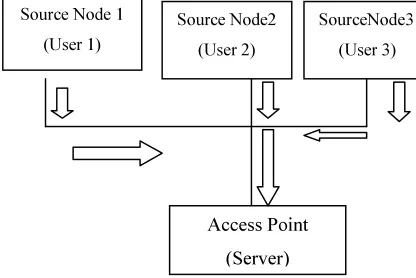
[image:3.595.142.524.73.270.2]The advancement in MANET is becoming more attractive for performing effective scheduling process. The main goal of the proposed DSD scheme is to schedule the packets from multiple source nodes with minimal residual energy consumption. The DSD scheme also attains higher accuracy rate on decision process using the Dempster-Shafter Hypothesis. The multiple source node information to the destination is depicted in Figure 1.
Figure 1 Representation of Multiple Source node Packets to Access Point
Figure 1 describes the transferring of packets from multiple source node (i.e.,) user packets to the destination (i.e.,) access point. The packets from multiple users are scheduled using the DSD scheme with enhanced security level and minimal consumption of residual energy during packet scheduling. The DSD Scheme defines the Dempster-Shafter Hypothesis to improve the scheduling efficiency in MANET. The Dempster-Shafter Hypothesis degree is represented diagrammatically in Figure 2.
Figure 2 Representation of Dempster-Shafter Hypothesis Degree
As illustrated in Figure 2, the Dempster-Shafter Hypothesis obtains two degree of values such as the confidence value and contradictory values. The confidence value in DSD scheme depends primarily on the correct answer probability level from the source nodes. The correct answer probability level is measured using the Bayesian probability distribution in DSD scheme. The privileged ratio of correct result provides improved confidence level.
On the other hand, the contradictory value in the DSD scheme with Dempster-Shafter Hypothesis denotes the minimal correct result for the query set. The incorrect answer from the source node is predicted as the intruded node using the normalization factor in MANET. The normalization factor in MANET obtains the incorrect answer from the users and measures the different scale of result to obtain the intruded nodes. The normalization factor in DSD scheme provides the quantile measure (i.e.,) different incorrect answered nodes are detected for the effective scheduling of packets. The architecture diagram of DSD Scheme with Dempster-Shafter Hypothesis is depicted in Figure 3.
Source Node 1
(User 1)
Source Node2
(User 2)
SourceNode3
(User 3)
Access Point
(Server)
Dempster-Shafter Hypothesis
Incorrect answer
level Correct answer
probability level
Improved Confidence
Level
Detects Intruded
node using
[image:3.595.97.305.317.456.2]Figure 3 Architecture Diagram Of Dsd Scheme With Dempster-Shafter Hypothesis
As illustrated in Figure 3, the DSD Scheme is carried out in the mobile ad-hoc network to schedule the multiple source node information (i.e.,) packets with the higher decision accuracy. The Distributed scheduling decision scheme takes the Dempster-Shafter Hypothesis degree values to measure the confidence and contradictory value. The confidence and contradictory value measure is very supportive for scheduling and decision process in MANET.
2.1DSD on Multiple Source Packet
Transmission
The source node packets are scheduled in MANET based on the time slot in a distributed manner. The DSD scheme is developed in MANET on tasking the security factor and residual energy into consideration. The decision making in the proposed scheme is carried out based on the events and remarks under varying environmental uncertainties. The entire probability space is measured with the Dempster-Shafter Hypothesis to schedule the process. Dempster-Shafter Hypothesis is briefly explained in section 1.2.
The source node packet generated at time t is briefly noted in randomly movable MANET. To reduce the residual energy on scheduling multiple source node packets, the generated packets at varying time are stored in the index table. The randomly movable nodes with vector points is denoted as,
……… Eqn (1)
Eqn (1) clearly describes ‘K’ iteration vector points ‘v’ on varying time slot ‘t’ in MANET. The remark probability matrix on vector points R (n) is used in DSD Scheme
……… Eqn
(2)
DSD Scheme on Eqn (2) describes the matrix form with the multiple node packet transmission in MANET. In Eqn (2), ‘1’, ‘2’, ‘3’ and ‘4’ denotes
the count of source node count whereas ‘0.1’, ‘0.3’, ‘0.5’ and ‘0.2’ represent the time slot on which the packet transmitted from multiple sources.
At time k, DSD scheme takes each nodes information and is stored in the index for effective
decision process. The remark probability matrix based source packet representation reduces the residual energy consumption. The indexing table for the packet storage on time slot t’ improves the
security factor in MANET.
2.2 Design considerations of Dempster-Shafter Hypothesis using DSD
In DSD Scheme, to identify the degree of confidence value and contradictory value for the multiple source node packets scheduling, Dempster-Shafter Hypothesis is used. In MANET, the confidence degree represents the associated proposition’s probabilities of packets. Dempster-Shafter Hypothesis offers an effective scheduling system for the multiple source packet transmission to the destination point in MANET. The step wise description of Dempster-Shafter Hypothesis in DSD Scheme is explained as,
Begin
// Generalized Distributed Scheduling Algorithm
Step 1: On each trial with set of nodes in MANET
Step 2: Randomly generated nodes with vector
points ‘v’ time‘t’ Mobile Ad-hoc Network
S
S
S
Dest
Schedule Multiple Source Information
DSD Scheme
Dempster-Shafter Hypothesis
Confidence Value
Improves Scheduling Rate IncreasesDecision Accuracy
Contradictory Value
Uses Normalization Factor
Step2.1:Compute
for each iteration ‘K’
Step 3: Pick multiple source node packets ‘p’
Step 4: Construct index table to store packet
information and to mark time period‘t’
Step 4.1: Remark probability matrix on vector
points R (n) is constructed
For Every R (n) matrix
Step 5: Associated proposition probabilities is
analyzed on Dempster-Shafter Hypothesis
Step 6: Confidence value measured on distributed
scheduling scheme
Step 6.1: Using Bayesian Probability Model
Step 7: Contradictory value point computed
Step 7.1: Normalization factor used to detect the
Intruded nodes
End For
End
The above algorithmic steps of DSD Scheme compute the vector points on ‘K’ iterations. The indexing table is used to store the packet information of multiple source nodes for varying time slot with a relatively higher degree of confidence value and lesser contradictory value points in DSD Scheme. The lesser contradictory value denotes the negligible or lesser intruded nodes in the distributed mobile network structure. DSD Scheme with Dempster-Shafter Hypothesis provides a statistical procedure for scheduling and decision processing of multiple source node packets.
2.2.1 Confidence Assessment of Dempster-Shafter Hypothesis using DSD
In DSD Scheme, Dempster–Shafer hypothesis assess the confidence value using the Bayesian Probability model. The Bayesian probability provides the probability of query result to assess the confidence value. The degree of confidence in a DSD proposition depends heavily upon the amount of correct answers from the source
node packet proposition. A degree of confidence is represented in Bayesian probability using DSD as,
… Eqn (3)
In Dempster–Shafer hypothesis ‘H’, the Bayesian probability judges the relative true answer from the source node points. The probability of higher confidence value denotes improved scheduling rate and decision accuracy.
……. Eqn (4)
The DSD scheme with
is the
confidence function evaluated for scheduling of packets in MANET. The remark arises in the Dempster–Shafer hypothesis is also noted to identify the contradictory value.
2.2.2 Contradictory Assessment in Dempster-Shafter Hypothesis using DSD
In DSD Scheme, to assess the contradictory value normalization factor is used. The normalization factor is estimated as,
……. Eqn (5)
The incorrect answered probability
is computed for multiple source packet transmission nodes. The incorrect answered nodes are the intruded nodes in MANET. DSD Scheme clearly assesses the contradictory level and removes the intruded nodes from the set of ‘n’ nodes in distributed mobile environment.
3 EXPERIMENTAL EVALUATION
the network range of 1000*1000 mm size. The simulation of 25 milliseconds is taken to carry out the single process. In the Random Way Point (RWM) model, each mobile node moves to an irregularly chosen location. The RWM uses standard number of mobile nodes for scheduling the nodes. The chosen location with an arbitrarily selected speed contains a predefined amount and speed count. Destination Sequence Based Distance Vector (DSDV) routing protocol is performed in MANET with predefined information.
The minimum moving speed of DSD scheme is about 3.0 m/s of each mobile node. The DSD Scheme is compared against the existing partially observable Markov decision process (POMDP) and Maximum-Residual Multicast Protocol (MRMP) to analyze the result percentage. DSD scheme is experimented on the factors such as packet delivery ratio, false positive rate, time taken on scheduling the packets, residual energy consumption.
Packet delivery ratio in DSD
scheme defines the ratio of number of multiple source node information broadcasted to the access point or to the server.
False positive rate measures the incorrect identification of intruder nodes. With the application of confidence and contradictory value as in Eqn (4) and (5), the false positive rate is measured in DSD. Time taken on scheduling the packets using DSD scheme is the average time taken to schedule the packets obtained from multiple source node expressed in terms of milliseconds.
Residual energy consumption using DSD scheme measures the average energy consumption made by multiple source node for sending the packets to the access point.
4 RESULT ANALYSIS OF DSD SCHEME
The Distributed Scheduling Decision (DSD) scheme is compared against the existing
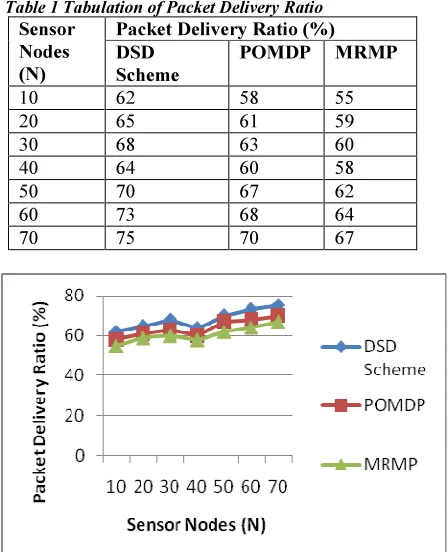
Partially Observable Markov decision process (POMDP) [1] and Maximum-Residual Multicast Protocol (MRMP) [2]. The simulation results are performed using NS2 simulation tool and are compared and analyzed with the help of table and graph given below. Table 1 tabulates the packet delivery ratio obtained using the proposed DSD scheme and compared elaborately with the existing two works POMP [1] and MRMP [2] respectively.
Table 1 Tabulation of Packet Delivery Ratio
Sensor Nodes (N)
Packet Delivery Ratio (%) DSD
Scheme
POMDP MRMP
10 62 58 55
20 65 61 59
30 68 63 60
40 64 60 58
50 70 67 62
60 73 68 64
[image:6.595.305.529.263.539.2]70 75 70 67
Figure 4 Packet Delivery Ratio Comparison between the two methods POMDP and MRMP
confidence value improves the packet delivery ratio by 9 – 12 % when compared with the MRMP [2].
Table 2 Tabulation Of False Positive Rate Move
Speed (m/s)
False Positive Rate (%) DSD
Scheme
POMDP MRMP
1 35 41 44
2 38 49 52
3 42 44 47
4 41 42 49
5 47 51 54
6 50 53 59
7 49 56 62
[image:7.595.310.515.201.342.2]In the experimental setup, the movement of speed ranges from 1 to 7 m/s. The results of 7 different speed placed by the mobile services are listed in table 2. As listed in table 2, the DSD scheme measures the false positive rate while providing multiple source node information to the access point which is measured in terms of percentage (%). The false positive rate consumed using our scheme DSD offer comparable values than the state-of-the-art methods.
Figure 5 False Positive Rate Comparison With Differing Moving Speed
The targeting results of false positive rate using DSD scheme with two state-of-the-art methods POMDP [1] and MRMP [2] in figure 5 is presented for visual comparison based on the different moving speed in MANET. Our method differs from the POMDP [1] and MRMP [2] in that we have incorporated Dempster-Shafter Hypothesis to easily extent multiple-source nodes that efficiently derives the rules for multiple sources and therefore reduce the false positive rate by providing effective scheduling mechanism. For the most different number of speed, the DSD scheme achieves comparable performance to POMDP and MRMP. As a result, the false positive rate is 6 – 28 % better when compared with the POMDP [1].
Furthermore, by ignoring the contradictory values using the normalization factor, the false positive rate is reduced by 14 – 26 % when compared to the MRMP [2].
Table 3 Tabulation Of Time Taken On Scheduling Packets
Sensor Nodes (N)
Time taken on scheduling packets (ms)
DSD Scheme
POMDP MRMP
10 25 32 35
20 28 35 40
30 32 39 42
40 35 44 47
50 30 40 43
60 41 48 51
70 44 52 55
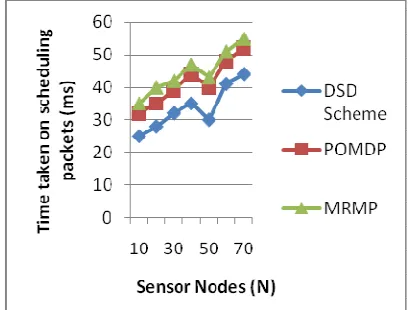
[image:7.595.303.507.421.576.2]In table 3 we further compare the mapping of time taken on scheduling packets of the proposed method using the generalized distributed scheduling algorithm. The experiments were conducted using the sensor nodes in the range of 10 to 70 that measures the time taken on scheduling packets which is measured in terms of milliseconds (ms).
Figure 6 Time Taken On Scheduling Packets Comparison With Different Number Of Sensor Nodes
[image:7.595.88.294.422.543.2]the time taken on scheduling by 17 – 33 % when compared to POMDP [1]. As a result, the DSD scheme results in reasonable measure that reduces the time taken on scheduling. The intruded node is predicted in an efficient manner by obtaining the incorrect answer from the source node using the normalization factor in MANET by reducing the time taken on scheduling packets by 25 -43 % when compared to MRMP [2].
Table 4 Tabulation Of Residual Energy Consumption Sensor
Nodes (N)
Residual energy consumption (J) DSD
Scheme
POMDP MRMP
10 0.325 0.375 0.385
20 0.375 0.395 0.415
30 0.415 0.405 0.425
40 0.395 0.414 0.435
50 0.412 0.428 0.435
60 0.433 0.439 0.445
70 0.452 0.460 0.465
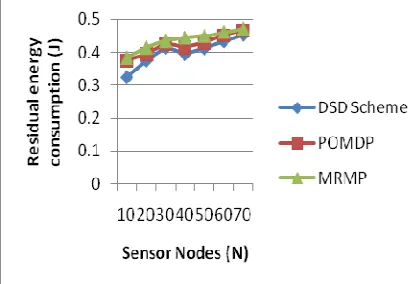
In table 4 we show the analysis of residual energy consumption with respect to sensor nodes ranging between 10 and 70 that measures the amount of residual energy being consumed to perform the scheduling of multiple source nodes in MANET measured in terms of Joules (J).
Figure 7 Residual Energy Consumption Comparison With Different Number Of Sensor Nodes
Lastly the residual energy consumption is measured via different number of sensor nodes of size 10 to 70 taken for simulation purpose. From the figure 7 it is illustrative that the proposed DFD scheme potentially yields better results than the existing POMDP [1] and MRMP [2]. The significant results achieved using the DFD scheme is because of the fact that the source node to be broadcasted is dynamically selected to obtain higher security level during data packets transfer
with minimal residual energy consumption by 3 – 15 % when compared to POMDP. As a result, the residual energy consumption is minimized to a coarser construction, because the packets generated at different time are stored in the index table by minimizing the residual energy consumption by 9 – 18 % when compared to MRMP [2].
5 5. RELATED WORKS
With recent advancements in wireless communication medium and the small sizing of computers have resulted to a new concept referred to as the mobile ad hoc network (MANET). In MANET, two or more mobile nodes structure a network without the requirement of any pre-defined infrastructure. In [3], the influences of mobility on the availability of data were quantified from different angles without any specific applications or specific protocols but designed a method that in a way highly affected the availability of data based on node-centric and data diffusion. Though this method was addressed for different mobility models, but the impact of mobility remain unaddressed. Multi packet reception for spatially distributed networks was addressed in [5] using alternative backoff mechanisms to improve the throughput and fairness. But issues related to power, congestion control remained unaddressed.
With the advantage of multi-hop and transmission based on infrastructure-less environment, mobile ad hoc networks (MANETs) have gained popularity. In [6], Position-based Opportunistic Routing (POR) protocol was designed which exploits two properties namely, information about geographic routing and the broadcast nature of mobile ad hoc network. In POR, a data packet is not sent directly to the destination node, but with the help of forwarding nodes whichever node sense it within a stipulated period of time, the packet was sent to the other end increasing the packet delivery ratio.
[image:8.595.89.297.457.599.2]nodes that are idle. Initially, adjacency matrix was formed and the information regarding the available nodes was broadcasted to the other nodes which belong to the similar cluster.
Energy efficient scheduling for heavy traffic condition remains unaddressed. Community aware scheduling algorithm [18] concentrated on optimized scheduling for overall grid instead of single nodes using a decentralized dynamic scheduling method. RandomCast [19] was presented that exploited the communication mechanism that made a tradeoff between energy and routing performance. Moreover, with the effective communication mechanism, redundancy related to rebroadcast nature of packet was addressed by minimizing the energy. RandomCast with other routing protocols remain unaddressed.
Identification of topology and clustering of nodes [13] were concentrated which was further proceeds by an aggregation phase where the main objective remained to cluster the mobile nodes with similar energy level that was grouped into the same region. Furthermore, the tree was clustered and monitored in a periodical manner that helped to minimize the impact of the monitoring and increase the lifetime of the mobile nodes in the network. Though lifetime of the mobile nodes was increased at a reasonable rate, the energy-efficient monitoring remained unaddressed.
An enhanced Markovian model [14] was introduced with the capability of effective transmission made by the sender with acknowledgements received from the side of the receiver. Effective transmission schedule was followed on the acknowledgements relative to other mobile nodes in the network resulting in optimal performance by decreasing the level of distortion.
The most basic question to be answered in mobile ad hoc networks (MANETs) is the optimal path identification between two sensor nodes. The design consideration should be made in such a way that routing efficiency can be increased by minimizing the latency while selecting optimal path between two sensor nodes. In [7], two factors namely the availability and the sustainable factor of duration was taken into consideration by minimizing the link failures for route stability. But the time taken to reduce the overhead was compromised.
In [8], a novel routing protocol was designed called as the Ad hoc On-Demand
Multipath Distance Vector (AOMDV) routing protocol that provided solutions to route stability by means of channel fading to reduce the overhead. Channel-Aware AOMDV (CA-AOMDV) used a parameter called as the channel average duration to identify stable links during the discovery of path by applying a strategy called as the preemptive handoff strategy. But with the increase in the number of nodes, the computational complexity gets increased.
6 6. CONCLUSION
In this paper, an effective scheduling mechanism for multiple source nodes in MANET is presented using Dempster-Shafter Hypothesis. This hypothesis derives efficiently the ruels for multiple sources using the confidence value and ignores the contradictory values with the help of normalization factor in MANET. As the method uses distributed scheduling decision scheme, scheduling process is made in an efficient way thereby reducing the false positive rate. As a result, the proposed generalized distributed scheduling algorithm achieves comparable services reducing the residual energy consumption in MANET. Moreover, as the source node is dynamically selected, higher level of security is provided while transferring the data packets from multiple source nodes using the normalization factor. The normalization factor effectively detects the intruder node by avoiding the contradictory values in mobile ad hoc network. A series of simulations result are performed to test the residual energy consumption rate, time taken on scheduling packets, false positive rate using DSD scheme. The residual energy consumption rate is reduced to 18 % when compared with the state-of-the art methods. Efficient scheduling of multiple source nodes across MANE enable false positive rate with 28 % improved result when compared with the existing system.
REFERENCES
[1] Shengrong Bu., F. Richard Yu., Xiaoping P. Liu., and Helen Tang., “Structural Results for Combined Continuous User Authentication and Intrusion Detection in High Security Mobile Ad-Hoc Networks,” IEEE TRANSACTIONS ON WIRELESS COMMUNICATIONS, VOL. 10, NO. 9, SEPTEMBER 2011
TRANSACTIONS ON MOBILE COMPUTING, VOL. 8, NO. 11, NOVEMBER 2009
[3] Takahiro Hara,” Quantifying Impact of Mobility on Data Availability in Mobile Ad Hoc Networks”,IEEE TRANSACTIONS ON MOBILE COMPUTING, VOL. 9, NO. 2, FEBRUARY 2010
[4] Wei-Chih Hong, and Zsehong Tsai,” A Multichannel Scheduler for High-Speed Wireless Backhaul Links with Packet Concatenation”,IEEE TRANSACTIONS ON MOBILE COMPUTING, VOL. 9, NO. 2, FEBRUARY 2010
[5] Guner D. Celik, Gil Zussman, Wajahat F. Khan, Member, IEEE, and Eytan Modiano,” MAC for Networks with Multipacket Reception Capability and Spatially Distributed Nodes”,IEEE TRANSACTIONS ON MOBILE COMPUTING, VOL. 9, NO. 2, FEBRUARY 2010
[6] Shengbo Yang, Chai Kiat Yeo, and Bu Sung Lee,” Toward Reliable Data Delivery for Highly
Dynamic Mobile Ad Hoc Networks”,IEEE
TRANSACTIONS ON MOBILE
COMPUTING, VOL. 11, NO. 1, JANUARY 2012
[7] Giovanna Carofiglio, Carla-Fabiana Chiasserini, Michele Garetto, and Emilio Leonardi,” Route Stability in MANETs under the Random Direction Mobility Model”,IEEE
TRANSACTIONS ON MOBILE
COMPUTING, VOL. 8, NO. 9, SEPTEMBER 2009
[8]Xiaoqin Chen, Haley M. Jones, and Dhammika Jayalath,” Channel-Aware Routing in MANETs with Route Handoff”,IEEE
TRANSACTIONS ON MOBILE
COMPUTING, VOL. 10, NO. 1, JANUARY 2011
[9] P.Rukmani, R.Ganesan,” Scheduling algorithm for real time applications in mobile ad hoc network with opnet modeler”, Proceding Engineering, Elsevier, 2013
[10] Zhijun Xie, Guangyan Huang, Jing He, Yanchun Zhang,” A Clique-Based WBAN Scheduling for Mobile Wireless Body Area Networks”, Proceeding Computer Science, Elsevier, 2014
[11] Jean-Pascal Billaud, Ajay Gulati,” hClock: Hierarchical QoS for Packet Scheduling in a Hypervisor”, Eurosys’13 April 15-17, 2013, Prague, Czech Republic Copyright, ACM, Jan 2013
[12] N.Sumathi and Dr.C.P.Sumathi,” Energy and Bandwidth Constrained QoS Enabled Routing for MANETs”, International Journal of Computer Networks & Communications (IJCNC) Vol.5, No.2, March 2013
[13] EDWARD CHAN1 and SONG HAN,” Energy Efficient Residual Energy Monitoring in Wireless Sensor Networks”, International Journal of Distributed Sensor Networks, 5: 1– 23, 2009
[14] Christophe De Vleeschouwer and Pascal Frossard,” Dependent Packet Transmission Policies in Rate-Distortion Optimized Media Scheduling”,IEEE TRANSACTIONS ON MULTIMEDIA, VOL. 9, NO. 6, OCTOBER 2007
[15] Baolin Sun, Shangchao Pi, Chao Gui, Yue Zeng, Bing Yan, Wenxiang Wang, Qianqing Qin,” Multiple constraints QoS multicast routing optimization algorithm in MANET based on GA”, Progress in Natural Science, Elsevier, 2008
[16] Michele Garetto, Paolo Giaccone, and Emilio Leonardi,” On the Capacity Region of MANET: Scheduling and Routing Strategy”, IEEE TRANSACTIONS ON VEHICULAR TECHNOLOGY, VOL. 58, NO. 4, MAY 2009 [17] Shweta Singh and Ravindara Bhatt,”
ADJACENCY MATRIX BASED ENERGY EFFICIENT SCHEDULING USING S-MAC
PROTOCOL IN WIRELESS SENSOR
NETWORKS”, International Journal of Computer Networks & Communications (IJCNC) Vol.4, No.2, March 2012
[18] Ye Huanga, Nik Bessis, Peter Norrington, Pierre Kuonend, Beat Hirsbrunner,” Exploring decentralized dynamic scheduling for grids and clouds using the community-aware scheduling algorithm”, Future Generation Computer Systems, Elsevier, May 2011
[19] Sunho Lim, Chansu Yu, and Chita R. Das,” RandomCast: An Energy-Efficient Communication Scheme for Mobile Ad Hoc Networks”, IEEE TRANSACTIONS ON MOBILE COMPUTING, VOL. 8, NO. 8, AUGUST 2009
[20] Hassan Artail, and Khaleel Mershad,” MDPF: Minimum Distance Packet Forwarding for Search Applications in Mobile Ad Hoc Networks”, IEEE TRANSACTIONS ON MOBILE COMPUTING, VOL. 8, NO. 10, OCTOBER 2009