Ciolac R./Scientific Papers: Animal Science and Biotechnologies, 2016, 49 (1)
260
Agrotourism-Representative Issues And Pro Arguments
Ramona Ciolac
Banat`s University of Agricultural Sciences and Veterinary Medicine, Faculty of Agricultural Management, Calea Aradului,119, Timisoara, Romania
Abstract
Many governments from European Union recognize the fact that agrotourism and rural tourism represents one way that can save the agriculture in that in the coming year’s rural tourism and agrotourism will become representative elements for rural area, the arguments of this representativity being the purpose of this paper.
The rural area offers great opportunities for development of agrotourism, practicing of its being necessary in the current period. At the majority of rural settlements, the defining emblematic is multiple: the quality of landscape and warmth of the inhabitants, works of art and popular technique, traditional occupations, costumes, customs, traditions, cuisine, resources, etc. To these is added also the awareness, by small farmers, of the need to diversify agricultural activity, both in and outside the farm, by engaging in other activities, with non-agricultural character, from which agrotourism is one of the most circulated.
Keywords: agrotourism; representative issues; arguments
1. Introduction
*The popularity of rural tourism forms has
increased in recent years [1], and from these forms
agrotourism is one that enjoys the greatest
recognition. Therefore, the studies conducted on it
are numerous. Summarizing some of these studies,
results that in agrotourism case, the agricultural
and tourism activity are always related, ultimately
being an activity that supplements the income of
farmers [2-18].
This includes providing for the tourists of the
opportunity to experience a wide range of
agricultural products and services: from simple
stalls for sale agricultural products - vegetables
and fruit for example - to visit the vineyards,
orchards; from the accommodation in the farm to
the harvest festivals.
The appearance of agrotourism has on base the
necessity to find solutions for rural households to
increase revenues through recovery their
economic potential, developing the hosting
services and capitalization their own or local
products. From this basic need can be formulated
* Corresponding author:Ramona Ciolac, [email protected]
various concepts or derived definitions to
characterize agrotourism by segments of
specialization [19].
2. Materials and methods
The authors of the paper were used as methods of
work: data collection, processing, analysis,
observation and their interpretation.
3. Results and discussion
Distinguishing agrotourism from other forms of
tourism developed in rural areas can be carried out
through the fact that this is an economic activity in
an agricultural holding/farms, activity carried out
in order to produce some benefits and rewards to
the visitors and generate additional income for
farmers.
Figure 1. Relationship between rural tourism-agrotourism
Agrotourism is bound of the agricultural
household/ farm peasant who gives it the distinct
characteristics both in terms of space, activities
developed and the types of incomes: [21]
1.
in terms of accommodation space
, to ensure
the material base, agrotourism can be defined as
an activity able to capitalize the existing
accommodation excess from farm, being ready
and equipped specifically for receiving tourists;
2.
in terms of developed activities
, agrotourism
can be as a set of goods and services offered by
the farm, through the consume of the people,
witch, on a determined period of time, come in
rural areas for relaxation, recreation and leisure,
therapeutic cures or business for satisfying
hobbies, art initiation in traditional crafts for
studies and documentation etc;
3.
in terms of entertainment
, agrotourism is a
form of tourism with much variety and uniqueness
in achieving service that are offered to people who
love nature, culture and art peasant [22].
4.
in economic terms
agrotourism may be defined
as an activity
whose incomes
have
a
complementary nature, the household or farm
making the principal incomes from farming or
other basic types of activities (agro-food
processing).
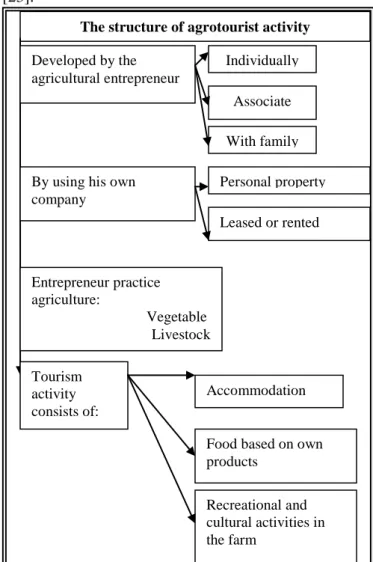
The development forms of agrotourism (fig.2) is
from simple hosting to profiling the entire
agro-livestock production system in agrotourist
purpose. Three components are essential in
agrotourism, namely: territory is "the raw
material" for agrotourism; agrotourist products
must be authentic and of quality; people
responsible for carrying out this activity-farmers
[23].
Figure 2. The structure of agrotourist activity The structure of agrotourist activity
Developed by the agricultural entrepreneur
Individually
Associate
With family
By using his own company
Personal property
Leased or rented
Entrepreneur practice agriculture:
Vegetable Livestock
Accommodation Tourism
activity consists of:
Food based on own products
Recreational and cultural activities in the farm
Rural tourism includes all forms of tourism developed in rural areas.
Agrotourism is located in the countryside, so it fits in rural tourism.
Both forms of tourism seek direct contact with rural area (village, farm).
Both forms of tourism represent not only a tourist alternative but also an essential factor
of economic development for rural area as a whole and farm
Ciolac R./ Scientific Papers: Animal Science and Biotechnologies, 2016, 49 (1)
262
Figure 3. Specific aspects of agrotourism
With the decline registered in many traditional
rural industries from rural area, agrotourism is
perceived both by agricultural community and the
decision makers as a diversification option for
maintaining viability of the agribusinesses.
However the benefits are far greater. Agrotourism
has advantages for all involved in its
implementation (fig.3).
Specific aspects of agrotourism
Agrotourism-agriculture connection
Agrotourism-rural communities
unites elements of two complex sectors-agriculture and tourism
may play a considerable role in supporting many farms
source of growth and diversification of the rural economy
diversification option to maintain the viability of the agribusinesses
Advantages for farmers
Advantages for rural communities
Advantages for tourism industry
development of new market niches
increased interest for local agricultural products
continued use of agricultural land
create jobs
market for local businesses
diversification of mix of tourism products and services
4. Conclusions
Through the fact that are exploited local resources
and products, and combines two activities, on the
one hand the agricultural one and on the other
hand the tourist one as complementary activity,
the profitability of agrotourism is high, being a
chance for alternative incomes for rural areas. So
therefore, it requires agrotourism, which in
addition to being fashionable, presents an
important social side through lower prices and its
specificity, in most part family tourism, camping
tourism and youth tourism.
By providing the conditions of practicing some
profitable activities in villages it is followed
stopping labor migration from urban areas to areas
of origin, increased stability of the active
population, improve living conditions, protection
and conservation of the environment as a factor of
recreation and restoration creative potential of the
individual, creating the conditions for carrying out
other economic activities, industrial, agricultural,
commercial in rural areas.
References
1. Ciolac Ramona, Ioan Csosz, Ciprian Rujescu, Simona Nita, Alina Ilie, Nicoleta Bogdan, Managerıal
approach of rural tourısm through holiday village-realıtıes and profıtabılıty, "Journal of Biotechnology" of the Eurobiotech2012 Agriculture Syposium – April 12-14th, Kayseri, Turkey,2012, publicat in Abstract Book Volume 161, Supplement, November 2012, Page 21, ISSN 0168-1656
2. Csosz I., Agroturism şi Turism Rural, Editura Mirton, Timişoara, 2007
3. Petroman, I., Stan, Andreea, Petroman, Cornelia, Marin, Diana, Statie, C., Dumitrescu, A, Şucan, Moisina, Impact of tourism on rural development, Lucrări Ştiinţifice Zootehnie şi Biotehnologii (Scientific Papers: Animal Science and Biotechnologies), vol. 45 (1), 2012 pag. 454-455
4. Marin, Diana, Importance of business plan for stimulating entrepreneurship from rural tourism activities, Lucrări ştiinţifice USAMV Iasi, seria
Agronomie ,,Proceedings of the 51th international scientific conference „Romanian agriculture in EU – opportunities and perspectives” USAMVB Iaşi, 2009 5. Ghereş Marinela, Agroturism, de la tradiţie la ofertă comercială, Editura Risoprint, Cluj-Napoca, 2003 6. Henche Blanca Garcia, Marketing în turism rural, Editura Irecson, Bucureşti, 2003
7. Iancu Tiberiu, Hurmuzache Tabita, Economie rurală,
Editura Agroprint, Timisoara, 2012
8. Petroman, Cornelia, Petroman, I., Benk, A., Popescu, M., Negruţ, Lucia, Marin, Diana, Ciolac, Ramona, Lozici, Ana, Maximize business in agro-tourism on farm by creating tourist brands, Lucrări ştiinţifice Management Agricol, Seria 1, vol. XV (4) „Dezvoltarea rurală durabilă”, 2013, Pg. 40-42
9. Dincu, Ana Mariana, Brad I., Ciolac Ramona, Gherman R. Studies regarding the identification of new projects for Caras Valley area for rural tourism development, Revista Agrobuletin AGIR nr.14/2012, pg.119-126
10. Martin Simona Cristina, Research regarding the purchase consumer behavior of tourism services, Lucrări Ştiinţifice Zootehnie şi Biotehnologii (Scientific Papers: Animal Science and Biotechnologies), ISSN 1221-5287, Editura Agroprint Timişoara, vol.47(1), pag.320-326, 2014
11. Stanciu S., The impact of EU accession on the
development of administrative capacities in the Central and Eastern European states, Lucrări Ştiinţifice „Managementul
dezvoltării rurale durabile” , Seria I, Vol X (3), ISSN:
1453-1410, Pag. 359 – 364, 2008
12. Martin Simona Cristina, Inginerie și servicii în agroturism, Editura Eurostampa Timișoara, ISBN 978-606-569-927-4, 2014
13. Pirvulescu Luminita, Bordean Despina-Maria, Petroman I., Petroman Cornelia, Rujescu C., Radu Steluta, Sirbulescu Claudia, Study on Banat’s traditional gastronomy, Proceedings of the 51st international scientific conference “Durable Agriculture in the context of environmental changes”, I.I. de la Brad University of Agricultural Sciences and Veterinary Medicine Iasi, ISSN 1454-7414, 2009. 14. Adamov Tabita Cornelia, Iancu T., Nişu Silviu, Toader Cosmina-Simona, Agroturism implications in the economic refreshment of rural area, Analele universităţii din Craiova, Simpozion omagial “60 ani de învăţământ superior agronomic în Oltenia” ISSN: 1841-8317, Vol. XXXVII/B, p. 389-392
15. Stanciu S. Land fusion – a priority in the Romanian
agrarian policy action, Lucrări Ştiinţifice „Managementul
dezvoltării rurale durabile” , Seria I, Vol XI (3), ISSN:
1453-1410, Pag. 437-444, 2009
16. Volloncs Elena, Challenges for romanian financial markets, The second edition of Scientific Conference with international participation Durable agriculture - Agriculture of the future, Facultatea de Agricultură, Craiova, 2006
17. Merce Iuliana Ioana, Milin Anda Ioana, Ciolac Ramona Mariana, Radac Bianca Alina, Study regarding ecotourism development in Parang Mountainms Group,
Buletin USAMV Horticulture, 69(2)2012, Print: ISSN 1843-5254, Electronic: ISSN 1843-5394, pag.181-185 18. Lile Ramona, Băra Eva, Bîja M., 2009, Tehnologie
Ciolac R./ Scientific Papers: Animal Science and Biotechnologies, 2016, 49 (1)
264
19. Brezuleanu S., Management agroturistic, material studiu ID., Iaşi, 2006, p.7
20. Nistoreanu P., Turismul rural, Editura Didactică şi
Pedagogică, Bucureşti, 1999
21. Fintineru Gina, Curs Economia Agroturismului, format electronic, p.18-19
22. Brezuleanu S., Management agroturistic, material studiu ID., Iaşi, 2006, p.8