www.ijtes.net
Instructional Methods in STEM and
English Subjects: a Validation Study
Andreas Zendler, Dieter Klaudt, Cornelia Seitz
University of Education Ludwigsburg
To cite this article:
Zendler, A., Klaudt, D., & Seitz, C. (2017). Instructional methods in STEM and English
subjects: A validation study
. International Journal of Technology in Education and Science
(IJTES), 1
(1), 1-17.
This article may be used for research, teaching, and private study purposes.
Any substantial or systematic reproduction, redistribution, reselling, loan, sub-licensing,
systematic supply, or distribution in any form to anyone is expressly forbidden.
Authors alone are responsible for the contents of their articles. The journal owns the
copyright of the articles.
Volume 1, Issue 1, Winter 2017
Instructional Methods in STEM and English Subjects: A Validation Study
Andreas Zendler, Dieter Klaudt, Cornelia Seitz
Abstract
This study contributes on instructional methods from a validation technical point of view. The focus is on the assessment of instructional methods in relation to knowledge processes in the act of learning. By using questionnaires, computer science teachers, mathematics teachers, and English teachers assessed 20 instructional methods in terms of knowledge processes (build, process, apply, transfer, evaluate, and integrate). The findings show that computer science teachers and mathematics teachers differ compared to English teachers on the assessment of instructional methods with respect to knowledge processes. The findings represent important contributions for teacher education programs and theory construction concerning effectiveness of instructional methods.
Keywords: Computer science education, mathematics education, English classroom, instructional methods, knowledge processes, cross-contextual re-search, comparative method.
Introduction
The Center for Teaching and Learning (2017) cites 150 instructional methods, Gugel (2011) more than 2,000 methods including their variations. There are well-prepared monographs of instructional methods available (e.g. Ginnis, 2001; Petrina, 2006; Joyce & Weil, 2008; Davis, 2009; Petty, 2009; Brenner & Brenner, 2011; Cruickshank et al., 2011). The monograph from Joyce and Weil (2008) is helpful in bringing order to the variety of concepts, with classifications of the instructional methods for teaching families (social interaction family, information processing family, personal family, behavioral modification family).
Meyer (2002) is a source of a very general definition stating that instructional methods are the forms and procedures with which teachers and school pupils perceive the natural and social reality surrounding them while observing the institutional framework conditions of the school. A stricter definition of method (than the one formulated above) which also represents the conceptual starting point for this study comes from Huber and Hader-Popp (2007): “The word method is understood to mean a clearly defined, conceptually perceivable and independent, if also integrated, component of teaching.” (Huber & Hader-Popp, 2007, p. 3).
Hattie (2009, chapters 9 and 10) informs about empirical results on the effectiveness of instructional methods in general. High effect sizes (d > .50) were demonstrated for microteaching (d = .88), reciprocal teaching (d = .74), feedback (d = .73), problem solving (d = .61), direct instruction (d = .59), mastery learning (d = .58), case study (d = .57), concept mapping (d = .57), peer tutoring (d = .55), cooperative (vs. competitive) learning (d = .54), and interactive instructional videos (d = .52).
The educational literature knows numerous variations relating teaching to learning as an act spread over time and to phases which can be distinguished during the act of learning (Bruner 1966; Collins, Brown, Newman, 1989; Petrina 2006; Olson 2007; Davis 2009). What all of the variations have in common is that learning (1) has a starting point, (2) a sequential form and (3) a (generally tentative) end point. Educational literature describes this as the classic three-step pattern divided into the steps labeled entry, work phase and graduation. These three steps have particularly large distinctions in their educational functions and in the knowledge processes of the act of learning. Particularly in the work phase, important knowledge processes (Bruner 1966; Merriam & Caffarella, 2006; Gowda 2010) can be distinguished in the act of learning. This indicates the processes in the acquisition of knowledge (build, process), in the transformation of knowledge (apply, transfer) and in the evaluation of knowledge (assess, integrate) (see Appendix A-2 Knowledge processes).
STEM (Science, Technology, Engineering, Mathematics) subjects, STEM programs (see Committee on Integrated STEM Education, 2014, p. 145) propose to favor the instructional methods of problem-based learning and project work: “One implication of this finding is that practices such as engineering design and science inquiry, and instructional approaches like problem- and project-based learning, may offer special opportunities to support STEM integration when sufficient and intentional instructional support is provided.”
Recently, there are two empirical studies (Zendler & Klaudt, 2015; Zendler, Seitz, & Klaudt, 2016) for two STEM subjects (computer science and mathematics), which allow a common view of instructional methods by computer science and mathematics teachers with respect to the knowledge processes of build, process, apply, transfer, asses, and integrate. The results of these studies showed problem-based teaching is top rated by computer science and mathematics teachers, high similarities were apparent for the instructional methods direct instruction, learning stations, learning tasks, project method, and presentation (see Figure 1). An ANOVA (see Appendix A-4) showed that computer science and mathematics teachers do not differ statistically in their ratings for these seven instructional methods.
instructional methods
b12 = learning at stations b3 = direct instruction
b16= project method b15= problem-based learning
b11= learning tasks
b17= Referat
knowledge processes c1 = a p p ly c3 = a p p ly c2 = p ro ce ss c4 = t ra n sf er c5 = a ss es s c6 = in te gr at e
b5 = experiment method
instructional methods
a1 = computer science teachers a2 = mathematics teachers 2.95 2.36 2.33 2.93 3.85 3.01 3.01 3.08 3.02 2.53 2.49 3.42 3.02
2.53 b12 = learning at stations
b3 = direct instruction
b16= project method b15= problem-based learning
b11= learning tasks
b17= Referat
b5 = experiment method
m ea n m ea n 1.51-2.00 2.01-2.50 2.51-3.00 3.01-3.50 4.01-4.50 3.51-4.00 scale 1.01-1.50 4.51-5.00 knowledge processes c1 = a p p ly c3 = a p p ly c2 = p ro ce ss c4 = t ra n sf er c5 = a ss es s c6 = in te gr at e
Figure 1. Mean ratings by computer science and mathematics teachers
A robust theory to instructional methods is missing, which would give answers to the questions: (1) which instructional methods should be used in education, (2) which instructional methods should be used in which subjects, and (3) which instructional methods are particularly suitable for knowledge processes (build, process, apply, transfer, evaluate, and integrate). For the construction of such a theory, it is necessary that instructional methods are investigated in similar but also very different subjects to be able to investigate, test, compare, find, reject, and validate causes of their learning effectiveness (for theory construction, see. Bunge, 1967, chapter 8).
This research project is designed as a validation study. The research question aims at investigating whether different groups of teachers (computer science, mathematics, and English teachers) differ in the assessment of instructional methods. For the validation, the comparative method is used which is a methodological approach that explicitly contrasts two or more cases (for example, studies, projects, contexts). The aim is to work out parallels and differences. In this respect, the comparative method in this research study is used (1) to extend the view of instructional methods and (2) to explain differences of the instructional methods in the act of learning. Using the comparative method (Ragin, 2014), which is also used in connection with theory construction (Azarin, 2011), the study intends to validate the results concerning instructional methods in computer science education (Zendler & Klaudt, 2015) and in mathematics education (Zendler, Seitz, & Klaudt, 2016). When using the comparative method, the selection of cases plays a central role to maximize the variance of the independent variable (here: school subjects), as emphasized by Peters 1998, p. 30): “Maximise experimental variance, minimise error variance, and control extraneous variance”. From the point of maximizing variance English as a contrasting subject is selected; English is a central subject in the range of subjects, but has little in common with STEM subjects.
In the next section, we present the methods applied, describing the study design and procedures and the data analysis strategy. Then, we give a detailed account of our findings. In the last section, we discuss those findings and, finally, draw implications for the construction of a tentative theory of instruction methods.
Method
Research Design
Selection of instructional methods. The review of a series of instructional methods manuals (Ginnis 2001; Petrina 2006; Davis 2009; Joyce & Weil 2008; Peterßen 2009; Petty 2009; Brenner & Brenner 2011; Wiechmann 2011; Cruickshank et al. 2011) revealed more than 50 instructional methods to choose from. The review was characterized by the requirement that instructional methods had to pass the muster as being capable of being understood as clearly defined, conceptually perceivable and independent components of the instruction. The following criteria were applied for the final selection of the instructional methods: (1) The actual application of the instructional methods in computer science, mathematics education, and English classroom, (2) usage of instructional methods in STEM subjects, (3) empirically examined instructional methods. The following 20 instructional methods (in alphabetical order) were able to be selected on the basis of these criteria: Case study, computer simulation, concept mapping, direct instruction, discovery learning, experiment, jigsaw method, learning at stations, learning by teaching, learning tasks, Leittext method, models method, portfolio method, presentation, problem-based learning, programmed instruction, project work, reciprocal teaching, role-play, and web quest (see Appendix A-1 Instructional Methods).
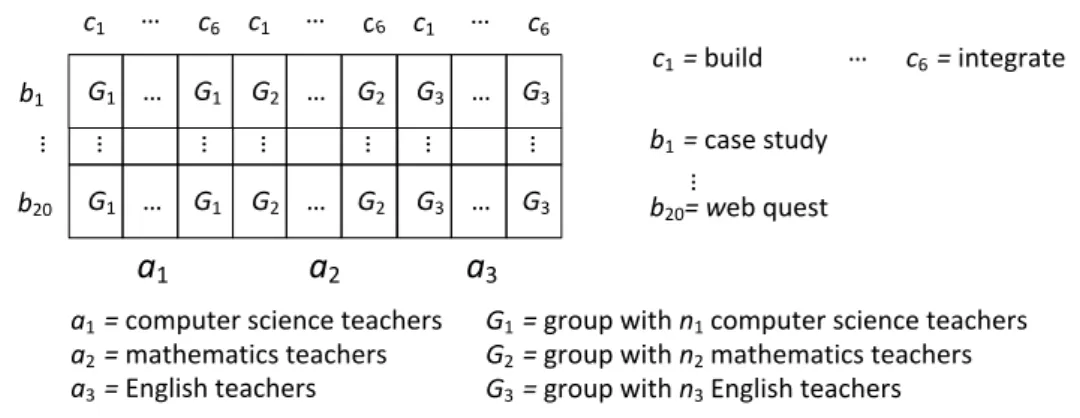
Experimental design. To test the research hypothesis, an experimental design with three factors is used. Factor A
represents the groups of teachers, factor B represents the instructional methods, and factor C represents the knowledge processes. Factors B and C are repeated measures, because several measurements are taken by one person. In the relevant literature, such a design is called a SPF-pq×r design (Split-Plot-Factorial, Winer, Brown, & Michels, 1991; Kirk, 2012).
Independent variables. Factor A comprised the p = 3 groups surveyed, with factor level a1 representing group G1 of n1 computer science teachers, factor level a2 representing group G2 of n2 mathematics teachers, and factor level a3 representing group G3 of n3 English teachers. Factor B represented the q = 20 instructional methods
b1, ..., b20: case study, computer simulation, concept mapping, direct instruction, discovery learning, experiment, jigsaw method, learning at stations, learning by teaching, learning tasks, Leittext method, portfolio method, presentation, problem-based learning, programmed instruction, project work, reciprocal teaching, role-play, and web quest. Factor C represents the q = 6 knowledge processes with factor levels c1, ..., c6: build, process, apply,
transfer, assess, and integrate.
c1 = build … c6 = integrate
b1 = case study
b20= web quest
…
a1 = computer science teachers
a2 = mathematics teachers
G1 = group with n1 computer science teachers
G2 = group with n2 mathematics teachers
a3 = English teachers G3 = group with n3 English teachers
G1
a
1b1
c1 c6
… …
G1
b20
a
2G1 … G1
… …
…
a
3G2 … G2
G2 … G2
… …
G3 … G3
G3 … G3
… …
c1 … c6 c1 … c6
Figure 2. Layout of the used SPF-320×6 experimental design
Dependent variables. The dependent variable was the respondents’ assessment of the instructional methods with respect to the six knowledge processes. Ratings were given on a six-point scale with ratings ranging from 0 (“not significant”) to 5 (“very significant”).
Power analysis. Performing power analysis and sample size estimation is an important aspect of experimental
is too large, time and resources will be wasted, often for minimal gain. In particular, two techniques of power analysis are distinguished: type I power analysis and type II power analysis. The type I power analysis calculates the power (1-) as a function of the significance level (), sample size (N), and effects (). More important in the context of a research design is type I power analysis: it calculates N as a function of power
(1-), and .
The sample size for the SPF-320×6 experimental design (Mueller & Barton 1989; Mueller et al. 1992) is determined with a type II power analysis. The desired power (1-) is 0.80, and only large effects ( = 0.80) in relation to the dependent variable are classified as significant; the significance level is = 0.05. Then a total sample of approximately *
N = 45 is needed ( * 1
n = 15 computer science teachers, n*2= 15 mathematics teachers,
*
3
n = 15 English teachers), based on the power calculations by Mueller and Barton (1989), respectively, by Mueller, LaVange, Ramey and Ramey (1992) for ε-corrected F-Tests.
Operational test hypothesis. Given the study design and the above specification of the independent and dependent variables, the operational hypothesis of the study can be formulated as follows:
“Computer science teachers and mathematics teachers differ from English teachers in their assessments of instructional methods (case study, computer simulation, concept mapping, direct instruction, discovery learning, experiment, jigsaw method, learning at stations, learning by teaching, learning tasks, Leittext method, models method, portfolio method, presentation, problem-based learning, programmed instruction, project work, reciprocal teaching, role-play, web quest) in supporting the act of learning operationalized by computer science, mathematics and English teachers’ ratings on a six-point scale of the knowledge processes build, process, apply, transfer, assess and integrate.”
Procedure
Sample. For the empirical study, 120 computer science teachers in 2014, 120 mathematics teachers in 2015, and 120 English teachers in 2016 at German high schools in the Federal state of Baden-Württemberg were contacted and invited to complete a questionnaire on the usage of instructional methods in computer science, mathematics education, and English classroom, respectively. The computer science teachers who sent back the questionnaire, taught computer science in grades 11 and 12/13. On average, they taught about 7.5 years computer science; in addition to the lessons in computer science all computer science teachers taught mathematics. Almost all mathematics teachers who sent back the questionnaire, taught mathematics grades 5 to 12/13. 20 mathematics teachers taught mathematics more than 10 years; in addition to the lessons in mathematics almost all mathematics teachers taught another STEM subject. The English teachers, who sent back the questionnaire, taught English in grades 5-7 (n = 25), 8-10 (n = 22), and 11-12 / 13 (n = 25). On average they taught more than 10 years of English; in addition to the lessons in English they taught German (n = 10), another foreign language (n = 8), or history (n = 7).
Questionnaire. The questionnaire consisted of a short introduction listing the 20 instructional methods and the 6 knowledge processes. The questionnaire was accompanied by a booklet (Zendler & Klaudt, 2014; Zendler, Seitz, & Klaudt, 2015, Zendler, Seitz, & Klaudt, 2016) describing the 20 instructional methods in accordance with a uniform scheme containing (1) a brief description and explanation, (2) concrete execution steps, and (3) examples from the relevant literature verifying the application of the instructional method in computer science education, mathematics education, and in English classrooms.
Tasks. The p =20 instructional methods and the q = 6 knowledge processes were then presented in alphabetical order in a matrix with the instructional methods in rows and the knowledge processes in columns. Participants were asked to indicate the relevance of each of the 20 × 6 = 120 matrix cells: Each cell represents a combination of an instructional method and a knowledge process and requires an integer from 0 (“not significant”) to 5 (“very significant”) indicating the relevance of the combination (see Appendix A-3 Questionnaire).
returned questionnaires), and the return rate for the English teachers was 23.33 % (n2 = 28 valid questionnaires of 31 returned questionnaires).
Data Analysis
In analyzing our empirical data, we followed recommended procedures for cross-contextual research (van de Vijver & Leung, 1997; Harkness, van de Vijver, & Mohler, 2003): (1) First, we analyze the data descriptively. (2) Then, we conduct a three-factor analysis of variance with repeated measures in accordance with the 320×6 design (see Winer, Brown, & Michels, 1991, chapter 7). Data analyses were conducted using SPSS 23.0; the power analysis was computed with PASS 13.
Results
Descriptive Findings
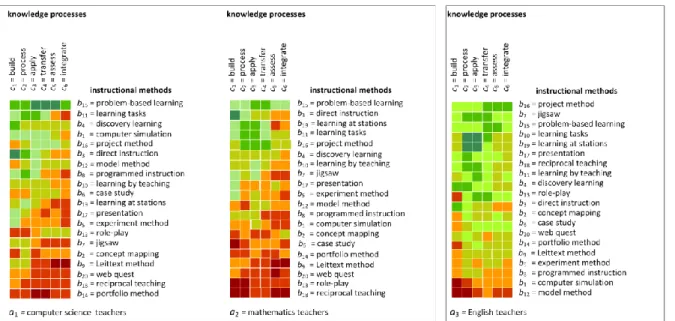
Figure 3 visualizes the mean ratings (see also Appendix A-5 Data) obtained from the computer science teachers (a1), the mathematics teachers (a2), and the English teachers (a3) for each of the 20 × 6 combinations of instructional methods × knowledge processes (repeated measures factors are B and C).
Figure 3. Mean ratings by computer science, mathematics, and English teachers (sorted according to means)
From Figure 3 it can be inferred that computer science, mathematics, and English teachers have rated the instructional methods differently. First, it should be noticed that the English teachers rated the instructional methods in relation to the knowledge processes generally better. For the computer science and mathematics teachers, agreement is obtained concerning the instructional methods of problem-oriented learning, direct instruction, learning at stations, learning tasks, project method, presentation, and experiment in terms of almost all knowledge processes.
The English teachers have rated reciprocal teachings rated much better than the computer science and mathematics teachers, much worse the models method and computer simulation, also slightly worse direct instruction.
Analyses of Variance
High Rated Instructional Methods
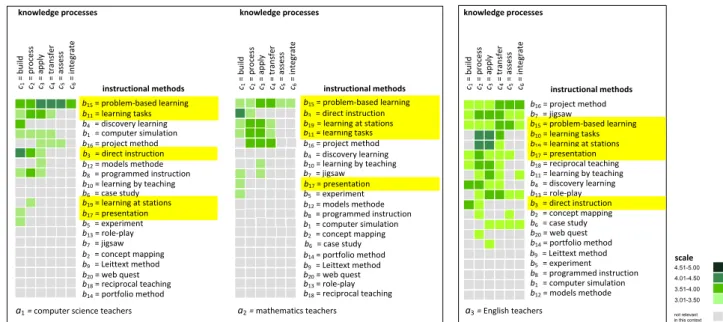
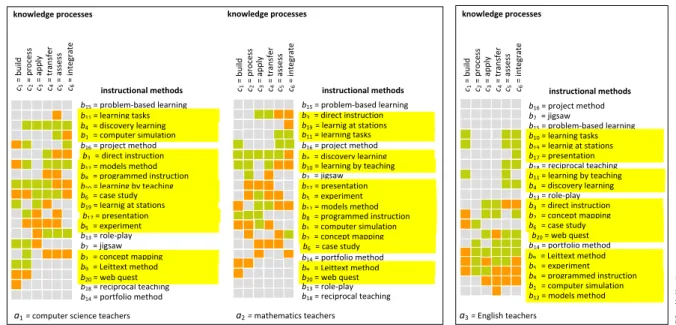
Figure 4 shows that the English teachers rated instructional methods as high much more than the computer science and mathematics teachers. Also, the English teachers rated instructional methods better with respect to knowledge processes, in particular transfer, assess, and integrate. For computer science and mathematics teachers only problem-based learning was relevant for the knowledge processes of assess and integrate.
instructional methods
b1 = computer simulation
b2 = concept mapping b3 = direct instruction
b7 = jigsaw
b9 = Leittext method
b14= portfolio method b16= project method
b17= presentation
b18= reciprocal teaching b20= web quest b11= learning tasks b4 = discovery learning
b5 = experiment b12= models methode knowledge processes c1 = b u ild c3 = a p p ly c2 = p ro ce ss c4 = t ra n sf er c5 = a ss es s c6 = in te gr at e
b8 = programmed instruction b10= learning by teaching
b13= role-play b19= learning at stations b6 = case study
instructional methods knowledge processes
b16= project method
b4 = discovery learning
b2 = concept mapping
b14= portfolio method
b12= models methode b9 = Leittext method b20= web quest b18= reciprocal teaching
b3 = direct instruction b19= learning at stations
b11= learning by teaching
b6 = case study b17= presentation
b13= role-play
b5 = experiment b10= learning tasks
b8 = programmed instruction b1 = computer simulation instructional methods
b1 = computer simulation b2 = concept mapping b3 = direct instruction
b7 = jigsaw
b9 = Leittext method b14= portfolio method b16= project method
b17= presentation
b18= reciprocal teaching b20= web quest b11= learning tasks
b4 = discovery learning
b5 = experiment b12= models methode b8 = programmed instruction b10= learning by teaching
b13= role-play b19 = learning at stations
b6 = case study
a1 = computer science teachers a2 = mathematics teachers a3 = English teachers
c1 = b u ild c3 = a p p ly c2 = p ro ce ss c4 = t ra n sf er c5 = a ss es s c6 = in te gr at e c1 = b u ild c3 = a p p ly c2 = p ro ce ss c4 = t ra n sf er c5 = a ss es s c6 = in te gr at e knowledge processes 3.01-3.50 4.01-4.50 3.51-4.00 scale 4.51-5.00 not relevant in this context b15= problem-based learning
b7 = jigsaw b15= problem-based learning
b15= problem-based learning
4.23 4.00 4.0
0 3.50
Figure 4. High rated instructional methods by computer science, mathematics, and English teachers (sorted according to means)
For the following ANOVA only those instructional methods are included, which were evaluated by the three groups of teachers as high. Therefore, the quasi-experimental SPF 3•20×6 experimental design reduces to an SPF-2•5×6 experimental design. The data of the computer science and mathematics teachers were pooled. The five instructional methods are: problem-oriented learning, learning tasks, direct instruction, learning stations, and presentation (see Figure 4, shown in yellow).
To examine whether the combinations of instructional methods and knowledge processes identified in the computer science education and the mathematics context towards the English classroom context differ, we formulated three statistical hypotheses, which were tested at the significance level of α = 0.05.
i) the means of the instructional methods µ1pooled2 under a1pooled2 (computer science and mathematics teachers) and µ3 under a3 (English teachers) are equal, i.e.:
H0: µ1pooled2 = µ3 (H1: µ1pooled2 ≠ µ3);
ii) the means of the instructional methods µ1pooled2•1, µ1pooled2•2, ..., µ3•5 under the 2 • 5 levels of the factor combinations A • B are equal, i.e.:
H0: µ1pooled2•1 = µ1pooled2•2 = ... = µ3•5 (H1: µ1pooled2•1 ≠ µ1pooled2•2 ≠ ... ≠ µ3•5);
iii) the means of the instructional methods µ1pooled21, µ1pooled22, ..., µ36 under the 2 • 6 levels of the factor combinations A • C are equal, i.e.:
H0: µ1pooled2•1 = µ1pooled2•2 = ... = µ3•6 (H1: µ1pooled2•1 ≠ µ1pooled2•2 ≠ ... ≠ µ3•6).
Testing the statistical assumptions.For an analysis of variance of a split-plot design, the data must satisfy the condition of sphericity. This assumption was tested using Mauchly’s W test for sphericity, with the test statistic W being compared to a chi-square distribution to assess the adequacy of the sphericity assumption. The assumption of sphericity was not met for either the instructional methods (W=0.62, χ29 = 37.31, p < 0.01), the knowledge processes (W=0.25, χ214 = 105.86, p < 0.01), and the interaction instructional method × knowledge process (W<0.01, χ2209 = 570.41, p < 0.01) at the α level of 0.05. In the further analyses, we therefore applied the ε correction of degrees of freedom proposed by Huynh and Feldt (1976).
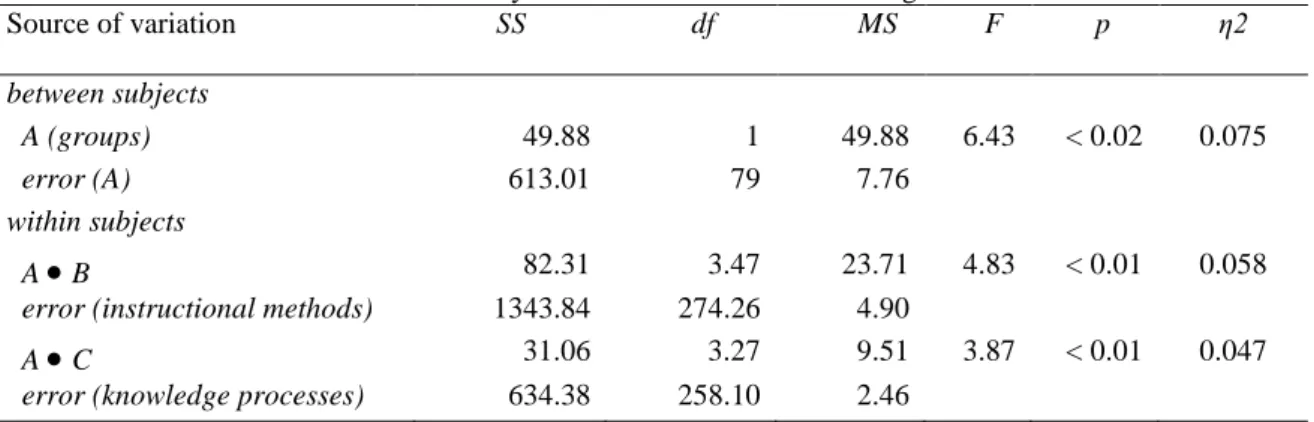
Table 1. ANOVA with Huynh-Feldt ε-corrections of the degrees of freedom
Source of variation SS df MS F p η2
between subjects
A (groups) 49.88 1 49.88 6.43 < 0.02 0.075
error (A) 613.01 79 7.76
within subjects
A
B 82.31 3.47 23.71 4.83 < 0.01 0.058error (instructional methods) 1343.84 274.26 4.90
A
C 31.06 3.27 9.51 3.87 < 0.01 0.047error (knowledge processes) 634.38 258.10 2.46
The main effect A (computer science teachers and mathematics teachers vs. English teachers) was significant at the α level of 0.05 (F1, 79= 6.43, p < 0.02). The corresponding H0 was rejected: computer science teachers and mathematics teachers vs. English teachers differ in their global assessments of the instructional methods.
The interaction effect A • B (group • instructional methods) was significant at the α level of 0.05 (F3.47, 274.26 = 4.83, p < 0.01). The corresponding H0 was therefore rejected: computer science teachers and mathematics teachers vs. English teachers differ in their assessments of individual instructional methods.
The interaction effect A • C (group • knowledge processes) was significant at the α level of 0.05 (F3.27, 258.10 = 3.87, p < 0.01). The corresponding H0 was therefore rejected: computer science teachers and mathematics teachers differ towards English teachers in their assessments of individual knowledge processes.
Intermediate Rated Instructional Methods
Figure 5 shows that computer science, mathematics, and English teachers rated many instructional methods as intermediate in regards of their support of knowledge processes. From the Figure, in addition, in can be inferred that more instructional methods have been rated as intermediate by the computer science and mathematics teachers than by the English teachers.
For the following ANOVA only those instructional methods are included, which were evaluated by the three groups of teachers as intermediate. Thus, the quasi-experimental SPF-3•20×6 experimental design reduces to an SPF-2•14×6 experimental design. The data of the computer science and mathematics teachers were pooled. The 14 instructional methods include learning tasks, discovery learning, computer simulation, direct instruction, models method, programmed instruction, learning by teaching, case study, learning stations, presentation, experiment method, concept mapping, Leittext method, web quest (see Figure 5, shown in yellow).
To examine whether the combinations of instructional methods and knowledge processes identified in the computer science education and the mathematics context differ towards the English classroom context, we formulated three statistical hypotheses, which were tested at the significance level of α = 0.05:
i) the means of the instructional methods µ1pooled2 under a1pooled2 (computer science and mathematics teachers) and µ3 under a3 (English teachers) are equal, i.e.:
H0: µ1pooled2 = µ3 (H1: µ1pooled2 ≠ µ3);
ii) the means of the instructional methods µ1pooled2•1, µ1pooled2•2, ..., µ3•5 under the 2 • 14 levels of the factor combinations A • B are equal, i.e.:
H0: µ1pooled2•1 = µ1pooled2•2 = ... = µ3•14 (H1: µ1pooled2•1 ≠ µ1pooled2•2 ≠ ... ≠ µ3•14);
iii) the means of the instructional methods µ1pooled21, µ1pooled22, ..., µ36 under the 2 • 6 levels of the factor combinations A • C are equal, i.e.:
instructional methods
b1 = computer simulation
b2 = concept mapping b3 = direct instruction
b7 = jigsaw
b9 = Leittext method
b14= portfolio method b16= project method
b17= presentation
b18= reciprocal teaching b20= web quest b15= problem-based learning b11= learning tasks b4 = discovery learning
b5 = experiment b12= models method knowledge processes c1 = b u ild c3 = a p p ly c2 = p ro ce ss c4 = t ra n sf er c5 = a ss es s c6 = in te gr at e
b8 = programmed instruction b10= learning by teaching
b13= role-play b19= learnig at stations b6 = case study
b15= problem-based learning instructional methods knowledge processes
b16= project method b7 = jigsaw
b4 = discovery learning
b2 = concept mapping
b14= portfolio method
b12= models method b9 = Leittext method
b20= web quest b18= reciprocal teaching
b3 = direct instruction b19= learnig at stations
b11= learning by teaching
b6 = case study b17= presentation
b13= role-play
b5 = experiment b10= learning tasks
b8 = programmed instruction b1 = computer simulation instructional methods
b1 = computer simulation b2 = concept mapping b3 = direct instruction
b7 = jigsaw
b9 = Leittext method b14= portfolio method b16= project method
b17= presentation
b18= reciprocal teaching b20= web quest b15= problem-based learning
b11= learning tasks
b4 = discovery learning
b5 = experiment b12= models method b8 = programmed instruction b10= learning by teaching
b13= role-play b19 = learnig at stations
b6 = case study
a1 = computer science teachers a2 = mathematics teachers a3 = English teachers
c1 = b u ild c3 = a p p ly c2 = p ro ce ss c4 = t ra n sf er c5 = a ss es s c6 = in te gr at e c1 = b u ild c3 = a p p ly c2 = p ro ce ss c4 = t ra n sf er c5 = a ss es s c6 = in te gr at e knowledge processes 2 5 5 1 5 3 0 2.01-2.50 2.51-3.00 scale 2 4 8 2 4 8 1 3 9 1.29 not relevant in this context
4.23 4.00 4.00 3.50
1.90
Figure 5. Intermediate rated instructional methods by computer science, mathematics, and English teachers (sorted according to means)
Testing the statistical assumptions.For an analysis of variance of a split-plot design, the data must satisfy the condition of sphericity. This assumption was tested using Mauchly’s W test for sphericity, with the test statistic W being compared to a chi-square distribution to assess the adequacy of the sphericity assumption. The assumption of sphericity was not met for either the instructional methods (W=0.05, χ290 = 218.63, p < 0.01), the knowledge processes (W=0.28, χ214 = 99.15, p < 0.01), and the interaction instructional method × knowledge process (W<0.01, χ22144 = 4088.09, p < 0.01) at the α level of 0.05. In the further analyses, we therefore applied the ε correction of degrees of freedom proposed by Huynh and Feldt (1976).
The Table 2 contains the ANOVA results to evaluate the intermediated rated instructional methods by computer science and mathematics teachers towards the English teachers.
Table 2. ANOVA with Huynh-Feldt ε-corrections of the degrees of freedom
Source of variation SS df MS F p η2
between subjects
A (groups) 124.39 1 124.39 4.45 < 0.04 0.053
error (A) 2209.51 79 27.97
within subjects
A
B 419.58 10.54 39.80 5.29 < 0.01 0.063error (instructional methods) 6266.54 832.93 7.52
A
C 112.72 3.40 33.11 8.79 < 0.01 0.101error (knowledge processes) 1013.54 268.95 3.77
The main effect A (computer science teachers and mathematics teachers vs. English teachers) was significant at the α level of 0.05 (F1, 79= 4.45, p < 0.04). The corresponding H0 was rejected: computer science teachers and mathematics teachers vs. English teachers differ in their global assessments of the instructional methods.
The interaction effect A • B (group • instructional methods) was significant at the α level of 0.05 (F10.54, 832.93 = 5.29, p < 0.01), The corresponding H0 was therefore rejected: computer science teachers and mathematics teachers vs. English teachers differ in their assessments of individual instructional methods.
Low Rated Instructional Methods
Figure 6 shows that the English teachers rated as low only very few instructional methods compared to the computer science and mathematics teachers. The English teachers rated the instructional methods in relation to the knowledge processes not as bad as the computer science and mathematics teachers. Only the models method was unsuitable for almost all knowledge processes.
instructional methods
b1 = computer simulation
b2 = concept mapping b3 = direct instruction
b7 = jigsaw
b9 = Leittext method
b14= portfolio method b16= project method
b17= presentation
b18= reciprocal teaching b20= web quest b15= problem-based learning b11= learning tasks b4 = discovery learning
b5 = experimente b12= models lmethod knowledge processes c1 = b u ild c3 = a p p ly c2 = p ro ce ss c4 = t ra n sf er c5 = a ss es s c6 = in te gr at e
b8 = programmed instruction b10= learning by teaching
b13= role-play b19= learning stations b6 = case study
b15= problem-based learning Instructional methods knowledge processes
b16= project method b7 = jigsaw
b4 = discovery learning
b2 =concept mapping
b14= portfolio method
b12= models lmethod b9 = Leittext method b20= web quest b18= reciprocal teaching
b3 = direct instruction b19= learning stations
b11= learning by teaching
b6 = case study b17= presentation
b13= role-play
b5 = experimente b10= learning tasks
b8 = programmed instruction b1 = computer simulation Instructional methods
b1 = computer simulation b2 = concept mapping b3 = direct instruction
b7 = jigsaw
b9 = Leittext method b14= portfolio method b16= project method
b17= presentation
b18= reciprocal teaching b20= web quest b15= problem-based learning
b11= learning tasks
b4 = discovery learning
b5 = experimente b12= models lmethod b8 = programmed instruction b10= learning by teaching
b13= role-play b19 = learning stations
b6 = case study
a1 = computer science teachers a2 = mathematics teachers a3 = English teachers
c1 = b u ild c3 = a p p ly c2 = p ro ce ss c4 = t ra n sf er c5 = a ss es s c6 = in te gr at e c1 = b u ild c3 = a p p ly c2 = p ro ce ss c4 = t ra n sf er c5 = a ss es s c6 = in te gr at e knowledge processes 1.51-2.00 scale 1.01-1.50 not relevant in this context
Figure 6. Low rated instructional methods by computer science, mathematics, and English teachers (sorted according to means)
Again, for the following ANOVA only those instructional methods are included, which were evaluated by the three groups of teachers as high. Therefore, the quasi-experimental SPF 3•20×6 experimental design reduces to an SPF-2•2×6 experimental design. The data of the computer science and mathematics teachers were pooled. The two instructional methods are: role-play and the portfolio method (see Figure 6, shown in yellow).
To examine whether the combinations of instructional methods and knowledge processes identified in the computer science education and the mathematics context towards the English classroom context differ, we formulated three statistical hypotheses, which were tested at the significance level of α = 0.05:
i) the means of the instructional methods µ1pooled2 under a1pooled2 (computer science and mathematics teachers) and µ3 under a3 (English teachers) are equal, i.e.:
H0: µ1pooled2 = µ3 (H1: µ1pooled2 ≠ µ3);
ii) the means of the instructional methods µ1pooled2•1, µ1pooled2•2, ..., µ3•5 under the 2 • 2 levels of the factor combinations A • B are equal, i.e.:
H0: µ1pooled2•1 = µ1pooled2•2 = ... = µ3•2 (H1: µ1pooled2•1 ≠ µ1pooled2•2 ≠ ... ≠ µ3•2);
iii) the means of the instructional methods µ1pooled21, µ1pooled22, ..., µ36 under the 2 • 6 levels of the factor combinations A • C are equal, i.e.:
H0: µ1pooled2•1 = µ1pooled2•2 = ... = µ3•6 (H1: µ1pooled2•1 ≠ µ1pooled2•2 ≠ ... ≠ µ3•6).
Testing the statistical assumptions.For an analysis of variance of a split-plot design, the data must satisfy the condition of sphericity. This assumption was tested using Mauchly’s W test for sphericity, with the test statistic W being compared to a chi-square distribution to assess the adequacy of the sphericity assumption. The assumption of sphericity was not met for either the instructional methods (W=1.00, N/A), the knowledge processes (W=0.28, χ214 = 98.35, p < 0.01), and the interaction instructional method × knowledge process (W=0.32, χ214 = 87.112, p < 0.01) at the α level of 0.05. In the further analyses, we therefore applied the ε correction of degrees of freedom proposed by Huynh and Feldt (1976).
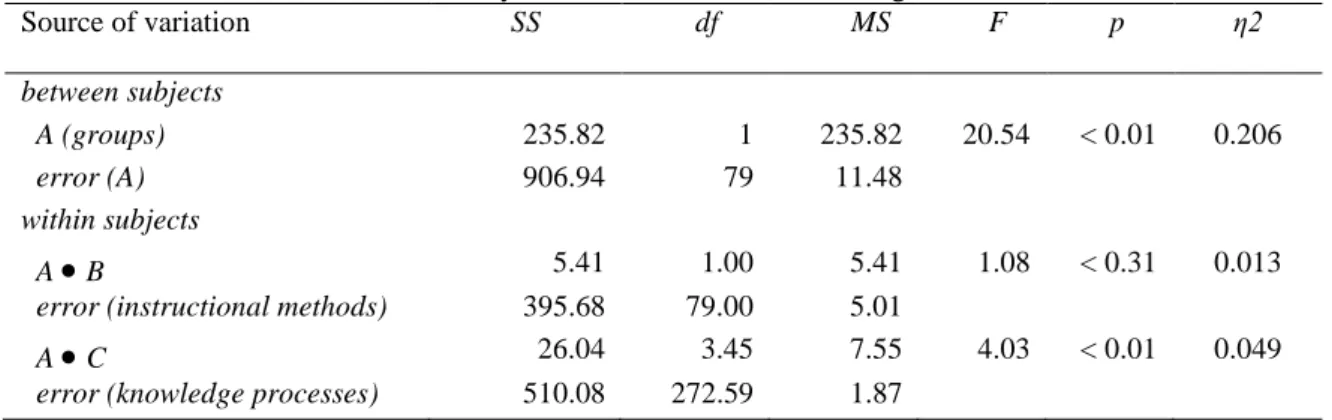
Table 3. ANOVA with Huynh-Feldt ε-corrections of the degrees of freedom
Source of variation SS df MS F p η2
between subjects
A (groups) 235.82 1 235.82 20.54 < 0.01 0.206
error (A) 906.94 79 11.48
within subjects
A
B 5.41 1.00 5.41 1.08 < 0.31 0.013error (instructional methods) 395.68 79.00 5.01
A
C 26.04 3.45 7.55 4.03 < 0.01 0.049error (knowledge processes) 510.08 272.59 1.87
The main effect A (computer science teachers and mathematics teachers vs. English teachers) was significant at the α level of 0.05 (F1, 79= 20.54, p < 0.01). The corresponding H0 was not rejected: computer science teachers and mathematics teachers vs. English teachers differ not in their global assessments of the instructional methods.
The interaction effect A • B (group • instructional methods) was not significant at the α level of 0.05 (F1.00, 79.00 = 1.08, p < 0.31). The corresponding H0 was therefore not rejected: computer science teachers and mathematics teachers vs. English teachers do not differ in their assessments of individual instructional methods. The interaction effect A • C (group • knowledge processes) was significant at the α level of 0.05 (F3.45, 272.59 = 4.03, p < 0.01). The corresponding H0 was therefore rejected: computer science teachers and mathematics teachers towards English teachers differ in their assessments of individual knowledge processes.
Discussion
The findings support the research hypothesis described in the introduction that computer science teachers and mathematics teachers differ from English teachers in their assessments of instructional methods in supporting knowledge processes in the act of learning. It is remarkable that the English teachers favor other instructional methods as the computer science and mathematics teachers. Moreover, it is noteworthy that more instructional methods with respect to the knowledge processes are important for the English teachers than for the computer science mathematics. Apparently, the English teachers use a larger pool of instructional methods as the computer science and mathematics teachers. Also, the impression arises that English teachers favor more cooperative instructional methods (such as project method, jigsaw, learning stations, role-play) than the computer science and mathematics teachers.
The ANOVAs showed that computer science and mathematics teachers differ from English teachers in their ratings of individual instructional methods with respect to individual knowledge processes. The greatest differences were found in the assessments of computer simulation, models method, and reciprocal teaching. Differences were also found in the ratings of role-play, concept mapping, and portfolio method.
The present study showed similarities between computer science and mathematics teachers in their assessment of instructional methods. The two groups are very different from the English teachers in their assessments. From the point of view of the comparative method, this means that parallels can be assumed in the assessment of the instructional methods by the computer science and mathematics teachers, which are in contrast to the assessments of the English teachers. Implications for teacher education programs are that courses in instructional methods for pre-service teachers can be optimized and qualified from didactic, economic, and curricular reasons.
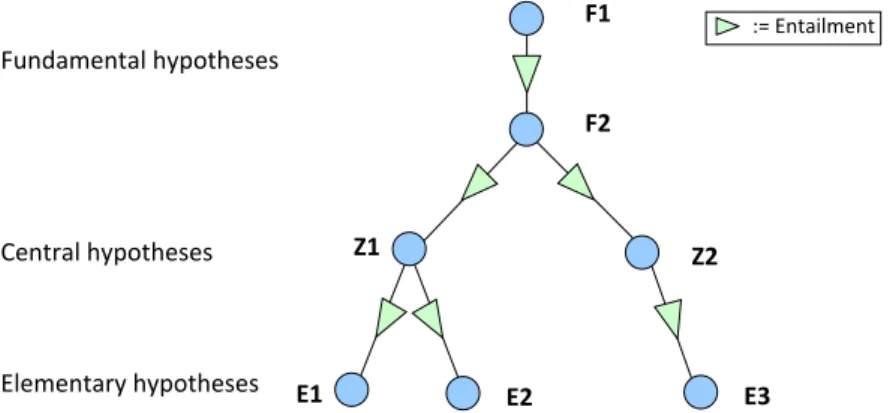
Moreover, the obtained results, together with the results known from the literature allow to construct a tentative theory (understood as a system of hypotheses) concerning the effectiveness of instructional methods. Figure 7 illustrates this tentative theory in which fundamental, central and elementary educational hypotheses are distinguished to make statements about instructional methods, knowledge processes and school subjects. The hypotheses are connected by an "entailment" relation (see Bunge, 1967, S. 403), that is, fundamental hypotheses include central hypotheses and central hypotheses include elementary hypotheses.
The fundamental hypotheses are: F1 = "Instructional methods differ in their support of knowledge processes in the act of learning" and F2 = "Instructional methods are suitable for different subjects."
The central hypotheses are: Z1 = "The appropriate instructional methods for computer science and mathematics teaching are: Problem-oriented learning, direct instruction, learning stations, learning tasks, project method, presentation, experiment method" and Z2 = "The appropriate instructional methods for teaching English are: project method, jigsaw, problem-oriented learning, learning tasks, learning stations, presentation, reciprocal teaching, learning by teaching, discovery learning, role-play".
The elementary hypotheses are: E1 = "Individual knowledge processes are supported in computer science education by different instructional methods", E2 = "Individual knowledge processes are supported in mathematics education by different instructional methods", and E3 = "Individual knowledge processes are supported in English classroom by different instructional methods". The elementary hypotheses could be further detailed with respect to the individual knowledge processes of build, process, apply, transfer, assess, and
integrate. This, however, is omitted unless comprehensive empirical results are available for learning outcomes from authentic teaching / learning scenarios that compare two or more instructional methods.
F1
Fundamental hypotheses
Central hypotheses
Elementary hypotheses
F2
Z1 Z2
E1 E2 E3
:= Entailment
Figure 7. Construction of a tentative theory of instructional methods
The illustrated tentative theory on the learning effectiveness of instructional methods is a first attempt to systemize propositions about instructional methods, knowledge processes in the act of learning, and school subjects. In the tentative theory, of course, many propositions are still missing, e.g. the inclusion of learning objects. Yet, from the tentative theory a variety of new problems can be derived whose answers will extend and improve the theory. Questions include: Are the results obtained from computer science and mathematics generally transferable to STEM subjects? Are the findings obtained from English classroom generally transferable to foreign language teaching? Do the results obtained for the learning effectiveness of instructional methods depend on learning objects of the individual subjects?
account. For this, the data were analyzed; statistical tests were conducted according to the necessary requirements.
The data from computer science, mathematics, and English teachers who teach at secondary schools were able to be included in the study. In order to verify and validate the results of these findings examinations should take place in authentic teaching and learning settings, and should not soley be based on subjective opinions.
Acknowledgments
We thank Natascha Treter and Sarah Leopold for their support with preparing the survey. The project was funded by Ludwigsburg University of Education.
References
Abell, S. K., & Lederman, N. G. (2007). Handbook of research on science education. New York: Lawrence Erlbaum.
Agneli, C., Kadijevich, D., & Schulte, C. (2013). Improving computer science education. London: Routledge Chapman & Hall.
Aldrich, C. (2009). Simulations & serios games. San Francisco: Pfeiffer. Aronson, E. (1978). The jigsaw classroom. Beverly Hills: Sage Publications.
Azarin, R. (2011). Potentials and limitations of comparative method in social science. International Journal of Humanities and Social Science, 1(1), 113–125.
Barzel, B., Büchter, A., & Leuders, T. (2011). Mathematik. Methodik. Handbuch für die Sekundarstufe I und II.
Berlin: Cornelsen Scriptor.
Biswas, G., Leelawong, K., Schwartz, D., Vye, N., & the Teachable Agents Group at Vanderbilt (2005). Learning by teaching: a new agent paradigm for educational software. Applied Artificial Intelligence, 18, 365–392.
Branom, M. E. (1918) The project method in education. London: BiblioBazaar (Reprinted 2008). Brenner, G., & Brenner, K. (2011). Methoden für alle Fälle. Berlin: Cornelsen.
Bruner, J. S. (1966). The process of education. Cambridge: Harvard University Press. Bunge, M. (1967). Scientific research (Vol. I: The search for system). New York: Springer. Canton, R. K. (2007). Programmed instruction in online learning. Boston: Cambia Press.
Collins, A., Brown, & Newman, S. E. (1989). Cognitive apprenticeship. Teaching the crafts of reading, writing. In L. B. Resnick (Ed.), Knowing, learning and instruction (pp. 453–494). Hillsdale: Erlbaum.
Committee on Integrated STEM Education (2014). STEM Integration in K-12 Education. Washington: The National Academies Press.
Cruickshank, D. R., Jenkins, D. B., & Metcalf, K. K. (2011). The act of teaching. Boston: McGraw Hill. Davis, Gross B. (2009). Tools for teaching. San Francisco: Jossey-Bass.
Dillman, D. A. (2000). Mail and Internet surveys: the tailored design method. New York: Wiley.
Flewelling, G., & Higginson, W. (2003). Teaching with rich learning tasks: A handbook. Sydney: Australian Association of Mathematics Teachers.
Gartner, A., Kohler, M. C., & Riessman, F. (1971). Children teach children. Learning by teaching. New York: Harper & Row.
Ginnis, P. (2001). The teacher's toolkit. Classroom achievement. Carmarthen: Crown House Publishing.
Gowda, N. S.(2010). Learning and the learner: Insights into the processes of learning and teaching. Delhi: PHI Learning.
Grieser-Kindel, C., Henseler, R., & Möller, S. (2006). Method guide (5-10). Paderborn: Schöningh. Grieser-Kindel, C., Henseler, R., & Möller, S. (2009). Method guide (5-12). Paderborn: Schöningh. Gugel, G. (2011). 2000 Methoden für Schule und Lehrebildung. Weinheim: Beltz.
Harkness, J., van de Vijver, F. J . R., & Mohler, P. (2003). Cross-cultural survey methods. New York: Wiley. Hartmann, W., Näf, M., & Reichert, R. (2006). Informatikunterricht planen und durchführen. Berlin: Springer. Hattie, J. (2009). Visible learning. New York: Routledge.
Hazzan, O., Lapidot, T., & Ragonis, N. (2011). Guide to teaching computer science: an activity-based approach. New York: Springer.
Heddens, J. W., Speer, W. R., & Brahier, D. J. (2008). Today's mathematics: Concepts, methods, and classroom activities. New York: Wiley.
Huber, S.G., & Hader-Popp, S. (2007). Unterrichtsentwicklung durch Methodenvielfalt im Unterricht fördern: das Methodenatelier als schulinterne Fortbildung. In A. Bartz,. J. Fabian, S.G. Huber, Kloft, C. H. Rosenbusch, H. Sassenscheidt (Eds.), PraxisWissen Schulleitung (30.31). München: Wolters Kluwer. Hubwieser, P. (2007). Didaktik der Informatik: Grundlagen, Konzepte, Beispiele. Berlin: Springer.
Huynh, H., & Feldt, L. S. (1976) Estimation of the Box correction for degrees of freedom from sample data in randomised block and split-plot designs. Journal of Educational Statistics, 1, 69–82.
Iron, S., Alexander, S., & Alexander, S. (2004). Improving computer science education. London: Routledge Chapman & Hall.
Joyce, B. R., & Weil, M. (2008). Models of teaching. New York: Prentice-Hall.
Kidwell, P. A., & Ackerberg-Hastings, A. (2008). Tools of American mathematics teaching, 1800-2000. Baltimore: Johns Hopkins University Press
Kirk, E. (2012). Experimental design. Belmont, CA: Wadsworth.
Koffmann, E., & Brinda, T. (2003). Teaching programming and problems solving. In L. Cassel, & R.A. Reis (2003). Informatics curricula and instructional methods. (pp. 125-130). Amsterdam: Kluwer Academic Publishers.
Li, Y., Silver, E.A., & Li, S. (2014). Transforming mathematics instruction: Multiple approaches and practices. Berlin: Springer.
Merriam, S. B., & Caffarella, R. S. (2006). Learning in adulthood: A comprehensive guide. New York: Jossey Bass.
Meyer, H. (2002). Unterrichtsmethoden. In H. Kiper, H. Meyer, & W. Topsch (Eds.), Einführung in die
Schulpädagogik (pp. 109-121). Berlin: Cornelsen.
Mueller, K. E., & Barton, C. N. (1989). Approximate power for repeated-measures ANOVA lacking sphericity.
Journal of the American Statistical Association, 84(406), 549–555.
Mueller, K. E., LaVange, L. E., Ramey, S. L., & Ramey, C. T. (1992). Power calculations for general linear multivariate models including repeated measures applications. Journal of the American Statistical Association, 87(420), 1209–1226.
Müller-Hartmann, A., & Schocker-von-Ditfurth, M. (2011). Teaching English: Task-supported language learning. Berlin: Schöningh.
Novak, J. D. (1990). Concept mapping: A useful tool for science education. Journal of Research in Science Teaching, 27, 10, 937–949.
Olson, D. R. (2007). Jerome Bruner: The cognitive revolution in educational theory. New York: Continuum. Palincsar, A. S., & Brown, A. L. (1984). Reciprocal teaching of comprehension, fostering and monitoring
activities. Cognition and Instruction, 1, 117–175.
Peters, G. (1998). Comparative politics:Theory and methods. New York: University Press. Peterßen, W. H. (2009). Kleines Methoden-Lexikon. München: Oldenbourg.
Petrina, S. (2006). Advanced teaching methods for the technology classroom. New York: Information Science Publishing.
Petty, G. (2009). Teaching today: a practical guide. Cheltenham: Nelson Thornes. Ragin, C. (2014). The comparative method. Oakland: University of California Press.
Reiss, K. & Hammer, C. (2013). Grundlagen der Mathematikdidaktik: Eine Einführung für den Unterricht in
der Sekundarstufe. München: Birkhäuser.
Schubert, S., & Schwill, A. (2012). Didaktik der Informatik. Heidelberg: Spektrum.
Scrivener, J. (2011). Learning teaching. The essential guide to English language teaching. London: Macmillan. Thaler, E. (2012). Englisch unterrichten: Grundlagen - Kompetenzen – Methoden. Berlin: Cornelsen.
The Center for Teaching and Learning (2017, April 10). 150 teaching methods. Retrieved from http://teaching.uncc.edu/learning-resources/articles-books/best-practice/instructional-methods/150-teaching-methods
Timm, J.-G. (2005) Englisch lernen und lehren. Berlin. Cornelsen.
Tomlinson, C. A. (1999). The differentiated classroom: Responding to the need of all learners. Alexandria, VA: Association for Supervision and Curriculum Development.
Treagust, D. (2007). General instructional methods and strategies. In S. K. Abell & N. G. Lederman (Eds.),
Handbook of Research on Science Education (pp. 373–441). Mahwah, NJ: Lawrence Erlbaum
Associates.
Treagust, D., & Tsui, C.-Y. (2014). General instructional methods and strategies. In N. G. Lederman & S. K. Abell (Eds.), Handbook of Research of Research on Science Education II (pp. 303–320). Mahwah, NJ: Lawrence Erlbaum Associates.
van de Vijver, F., & Leung, K. (1997). Methods and data analysis for cross-cultural research. Thousand Oaks, CA: Sage.
Vaux, A., & Briggs, C. S. (2005). Conducting mail and Internet surveys. In F. T. L. Leong, & J. T. Austin, The
Wankel, C., & Blessinger, P. (2012). Increasing student engagement and retention using online learning activities: Wikis, blogs and webquests. London: Emerald Group.
Wiechmann, J. (Ed.) (2011). Zwölf Unterrichtsmethoden. Weinheim: Beltz.
Winer, B. J., Brown, D. R., & Michels, K. M. (1991). Statistical principles in experimental design. Boston, MA: McGraw-Hill.
Zech, F. (1998). Grundkurs Mathematikdidaktik: Theoretische und praktische Anleitungen für das Lehren und
Lernen von Mathematik. Berlin: Beltz.
Zendler, A., & Klaudt, D. (2014). Booklet I: Instructional methods to computer science education. Berlin: epubli.
Zendler, A. & Klaudt, D. (2015). Instructional methods to computer science education as investigated by computer science teachers. Journal of Computer Science, 11(8), 915–927.
Zendler, A., Seitz, C., & Klaudt, D. (2015). Booklet II: Instructional methods to mathematics education. Berlin: epubli.
Zendler, A., Seitz, C., & Klaudt, D. (2016). Booklet III: Instructional methods for the English classroom. Berlin: epubli.
Zendler, A. & Klaudt, D. (2015). Instructional methods to computer science education as investigated by computer science teachers. Journal of Computer Science, 11(8), 915–927.
Zendler, A., Seitz, C., & Klaudt, D. (2016). Instructional methods to mathematics education as investigated by mathematics teachers (in review).
Author Information
Andreas ZendlerUniversity of Education Ludwigsburg Reuteallee 46, 71634 Ludwigsburg Germany
Contact e-mail: [email protected]
Dieter Klaudt
University of Education Ludwigsburg Reuteallee 46, 71634 Ludwigsburg Germany
Cornelia Seitz
Appendix
A-1 Instructional methods
1 Case study. Case study (Davis, 2009) is an instructional method aimed at the development of independent problem-solving skills by including realistic cases and tasks in the instruction.
2Computer simulation. Computer simulation (Aldrich, 2009) comprises the application of simulation software
for the virtual solution of (time-related) problems.
3 Concept mapping. Concept mapping (Novak, 1990) is an instructional method for the structuring and depiction of concepts and their relationships.
4 Direct instruction. Direct instruction (Petty, 2009) is an instructional method with a central focus on the teacher. The teacher assumes the central role in directing the activities associated with the instruction and does not relinquish this role until the end of the learning process.
5 Discovery learning. Discovery learning (Petty, 2009) is an instructional method with a central focus on the pupils in which learning recommendations are the focal point in order to motivate self-learning.
6 Experiment. The experiment (Abell & Lederman, 2007) as an instructional method serves in the conveyance of knowledge by making the effects of dependent variables observable through the planned variation of independent variables.
7 Jigsaw. The jigsaw method (Aronson, 1978) is a cooperative learning instructional method in which pupils instruct their co-pupils by becoming experts on a particular topic and taking on instructional activities.
8 Learning at stations. Learning at stations (Tomlinson, 1999) is a student-oriented instructional method in which pupils learn independently on the basis of prepared materials provided at workstations.
9 Learning by teaching. Learning by teaching (Gartner et al., 1971; Biswas et al., 2005) is an activity-oriented instructional method in which pupils learn by teaching one another.
10 Learning tasks. Learning tasks (Flewelling & Higginson, 2003) as an instructional method serve in initiating and guiding learning and thinking processes.
11 Leittext method. The Leittext method (Höpfner et al., 1997) is an instructional method with which learners
are guided in regard to content and methodology in such a manner that they can acquire knowledge with prepared materials.
12 Models method. The models method (Abell & Lederman, 2007) is an instructional method comprised of forming models and applying models in a particular field.
13 Portfolio method. The portfolio method (Davis, 2009) is an instructional method which allows the persons learning to be aware of their own learning progress (with the help of a folder) in which they individually develop a conscientious approach to the quality and to their responsibility for their own learning process.
14 Presentation. Presentation (Petty, 2009) as an instructional method serves as verification that learners can gather, process and present information in an organized manner.
15 Problem-based learning. Problem-based learning (Abell & Lederman, 2007) is an instructional method enabling learners to acquire skills in the resolution of an exemplary problem which can then be transferred to other applicable problem areas.
16 Programmed instruction. Programmed instruction is an instructional method (Canton, 2007) focusing on individualized material for the person learning to study on their own.
17 Project work. The project work method (Branom, 2008) is an activities-oriented instructional method allowing learners to work on a defined objective in an organized, independent manner.
18 Reciprocal teaching. Reciprocal teaching (Palinscar & Brown, 1984) is a dialogical instructional method between teachers and learners which serves as a tool in grasping the meaning of texts. There are few teaching examples cited in the relevant literature applying reciprocal teaching as an instructional method. Sims-Knight and Upchurch (1993) documented a teaching unit on object-oriented design.
19 Role-play. The role-play method (Petty, 2009) is an activities-oriented instructional method designed to promote the understanding of simple and complex activity sequences related to technology.
20 Web quest. Web quest (Wankel & Blessinger, 2012) is a research-oriented instructional method which includes Internet-based services (e.g. Wikipedia, portals, literature databases) and Internet technologies (e.g. E-Learning platforms, Cloud computing, E-communication) in the learning process.
A-2 Knowledge processes
1 Build. Acquiring knowledge, new practical and cognitive abilities as well as attitudes.
2 Process. Establishing, deepening, structuring and connecting what has been learned.
4 Transfer. Using what has been learned in new situations in which the framework conditions differ from those of the learning situation.
5 Assess. Classifying what has been learned in regard to its usefulness, scope, benefits and limits.
6 Integrate. Integrating what has been learned outside of the actual learning situation in connection with one’s own knowledge.
A-3 Questionnaire for computer science teachers, mathematics teachers, and English teacher
Please evaluate:
The act of learning through instructional methods.
Please rate each cell on a scale of 0 to 5 (only whole numbers. It is important that you provide 6 ratings per row.
Knowledge processes
(Explanations, see Booklet)
Instructional
methods
(Explanations, see Booklet)
1. buil
d
2. proc
ess
3. apply
4. tra
nsfer
5. assess
6. int
egrat
e
1
Case study
2
Computer simulation
3
Concept mapping
4
Direct instruction
5
Discovery learning
6
Experiment
7
Jigsaw
8
Learning at stations
9
Learning by teaching
10 Learning tasks
11 Leittext method
12 Models method
13 Portfolio method
14 Presentation
15 Problem-based learning
16 Programmed instruction
17 Project work
18 Reciprocal teaching
19 Role-play
A-4 ANOVA for the instructional methods by computer science and mathematics teachers
Table A-1. ANOVA with Huynh-Feldt ε-corrections of the degrees of freedom
Source of variation SS Df MS F p η2
between subjects
A (groups) 3.76 1 3.76 0.28 < 0.61 0.005
error (A) 688.70 51 13.50
within subjects
A
B 35.89 4.95 7.26 1.32 < 0.27 0.025error (instructional methods) 1384.25 252.27 5.49
A
C 5.27 3.72 1.14 0.66 < 0.61 0.013error (knowledge processes) 406.94 190.17 2.14
A-5 Data
grand mean 2.78 2.75 2.65 2.50 2.34 2.16
g ra n d m ea n 2.53
a1 = computer science teachers a2 = mathematics teachers
Knowledge processes a1 c1 = b u ild c6 = in te gr at e c2 = p ro ce ss c4 = t ra n sf er c3 = a p p ly c5 = a ss es s
2.62 2.51 2 64 2.42 2.12 2.13 2.41
instructional methods
b19 = learning at stations
b12 = models method
b10 = learning by teaching
b17 = presentation
b15 = problem-based laerning
b18 = reciprocal teaching
b16 = project methode
b13 = role-play
b20 = web quest
b14 = portfolio method
b1 = case study
b2 = computer simulation
b3 = concept mapping
b4 = direct instruction
b5 = experiment
b5 = discovery learning
b9 = Leittext method
b7 = jigsaw
b8 = programmd instrcution
b11 = learning tasks
2.57 2.94 2.09 2.94 2.99 2.33 2.20 2.72 1.95 2.61 3.01 2.76 2.32 1.67 3.86 2.94 2.35 1.87 2.54 1.93
1.41 1.62 2.38 2.28 2.17 1.90 2.41 2.03 2.55 2.45 2.00 1.52 1.59 2.07 1.52 1.72 2.41 2.83 4.31 3.52 2.97 2.97 2.21 2.48 3.83 3.00 2.90 2.76 2.66 2.55 3.48 2.31 2.76 2.38 2.14 1.86 3.24 2.93 3.07 2.31 1.93 2.00 2.59 2.72 2.59 2.00 1.59 1.59 2.34 2.24 1.97 1.83 1.38 1.28 2.83 2.93 3.38 2.72 2.28 2.14 3.17 3.86 3.66 2.72 2.28 2.38 2.03 2.00 2.55 2.86 2.28 2.45 1.21 1.31 1.93 1.76 1.86 1.66 1.69 1.97 2.14 1.90 1.90 2.07 3.48 3.03 3.62 3.90 3.17 3.31 2.83 3.10 3.28 3.10 2.97 2.79 3.14 2.45 2.38 2.28 2.52 2.45 1.38 1.45 1.69 1.66 1.38 1.28 3.07 3.62 3.76 3.21 1.97 2.48 2.38 1.93 1.79 1.69 1.34 1.62 2.25 2.21 2.83 2.83 2.88 2.42
3.21 3.00 3.13 3.17 2.75 2.38 1.92 2.33 1.71 2.08 2.29 2.21 4.29 3.58 3.08 2.58 2.00 2.08 3.71 2.67 2.83 2.92 2.92 2.92 3.29 2.13 2.50 2.04 2.08 1.92 2.96 2.92 2.25 1.71 1.79 1.58 3.42 3.63 3.13 2.42 2.04 1.71 2.83 2.63 1.92 1.83 1.25 1.25 2.75 2.83 2.88 2.67 2.38 2.17 3.00 3.92 3.67 3.38 2.17 1.96 2.13 2.67 3.00 2.96 2.92 2.88 1.67 1.79 2.29 2.79 2.79 2.58 1.71 1.92 1.42 1.38 1.92 1.67 3.67 3.75 4.21 4.00 4.00 3.54 2.25 2.92 3.33 3.29 3.13 2.75 3.08 2.83 2.33 1.92 2.00 1.96 2.08 1.96 1.79 1.83 1.79 1.75 2.96 3.17 2.96 2.42 1.88 1.88 2.33 2.17 1.67 1.79 1.92 1.71
1.96 2.16 2.02 3.07 2.95 2.49 2.58 2.18 1.84 2.71 3.01 2.36 1.62 1.94 3.42 3.01 2.53 1.47 3.02 1.79
2.85 3.12 2.77 2.42 2.62 2.51 2.92
2.11 2.78 3.04 3.11 3.15 3.07 0.84 1.80 2.44 2.36 2.04 2.13 2.44 3.15 2.93 2.81 3.22 2.74 3.64 3.25 2.79 2.75 2.43 2.46 3.64 3.71 3.18 3.14 2.68 2.79 2.37 2.52 2.44 2.56 2.52 2.19 3.11 3.54 3.93 3.71 3.29 3.29 2.04 2.96 2.88 2.27 2.12 2.08 2.15 2.81 2.85 2.63 2.52 2.56 2.96 3.32 3.64 3.29 2.93 3.11 2.86 4.18 4.18 3.54 2.96 2.75 1.12 1.48 1.96 2.12 1.68 1.60 2.00 3.04 3.56 3.70 3.37 3.11 1.89 2.96 3.07 2.89 2.79 2.57 3.37 3.30 3.42 3.70 3.70 3.26 3.00 3.46 3.46 3.96 3.57 3.50 3.43 3.54 3.39 3.25 3.29 2.75 3.32 3.79 3.64 3.21 2.79 2.75 2.93 4.29 4.11 3.18 2.86 2.89 2.85 3.12 2.77 2.42 2.62 2.51
2.88 1.94 2.88 2.89 3.19 2.43 3.48 2.39 2.59 3.21 3.41 1.66 3.13 2.70 3.46 3.49 3.27 3.25 3.38 2.71
a3 = English teachers
g ra n d m ea n c1 = b u ild c6 = in te gr at e c2 = p ro ce ss c4 = t ra n sf er c3 = a p p ly c5 = a ss es s g ra n d m ea n c1 = b u ild c6 = in te gr at e c2 = p ro ce ss c4 = t ra n sf er c3 = a p p ly c5 = a ss es s