IOS Press
Extracting common sense knowledge via
triple ranking using supervised and
unsupervised distributional models
Editor(s):Claudia d’Amato, University of Bari, Italy; Agnieszka Lawrynowicz, Poznan University of Technology, Poland; Jens Lehmann, University of Bonn and Fraunhofer IAIS, Germany
Solicited review(s):Dagmar Groman, TU Dresden, Germany; Ziqi Zhang, University of Sheffield, United Kingdom; Jedrzej Potoniec, Poznan University of Technology, Poland
Soufian Jebbara
a,∗, Valerio Basile
b,∗∗, Elena Cabrio
b, and Philipp Cimiano
aaCITEC, Bielefeld University, Inspiration 1, 33619, Bielefeld, Germany
E-mail: {sjebbara,cimiano}@cit-ec.uni-bielefeld.de
bUniversité Côte d’Azur, Inria, CNRS, I3S, Sophia Antipolis, France
E-mail: [email protected]; [email protected]
Abstract.
In this paper we are concerned with developing information extraction models that support the extraction of common sense knowledge from a combination of unstructured and semi-structured datasets. Our motivation is to extract manipulation-relevant knowledge that can support robots’ action planning. We frame the task as a relation extraction task and, as proof-of-concept, validate our method on the task of extracting two types of relations: locative and instrumental relations. The locative relation relates objects to the prototypical places where the given object is found or stored. The second instrumental relation relates objects to their prototypical purpose of use. While we extract these relations from text, our goal is not to extract specific textual mentions, but rather, given an object as input, extract a ranked list of locations and uses ranked by ‘prototypicality’. We use distributional methods in embedding space, relying on the well-known skip-gram model to embed words into a low-dimensional distributional space, using cosine similarity to rank the various candidates. In addition, we also present experiments that rely on the vector space model NASARI, which compute embeddings for disambiguated concepts and are thus semantically aware. While this distributional approach has been published before, we extend our framework by additional methods relying on neural networks that learn a score to judge whether a given candidate pair actually expresses a desired relation. The network thus learns a scoring function using a supervised approach. While we use a ranking-based evaluation, the supervised model is trained using a binary classification task. The resulting score from the neural network and the cosine similarity in the case of the distributional approach are both used to compute a ranking.
We compare the different approaches and parameterizations thereof on the task of extracting the above mentioned relations. We show that the distributional similarity approach performs very well on the task. The best performing parameterization achieves an NDCG of 0.913, a Precision@1 of 0.400 and a Precision@3 of 0.423. The performance of the supervised learning approach, in spite of having being trained on positive and negative examples of the relation in question, is not as good as expected and achieves an NCDG of 0.908, a Precision@1 of 0.454 and a Precision@3 of 0.387, respectively.
Keywords: Relation Extraction, Distributional Semantics, Supervised Learning, Commonsense Knowledge
*Corresponding author. E-mail: [email protected] **Corresponding author. E-mail: [email protected]
1. Introduction
Embodied intelligent systems such as robots require world knowledge to reason on top of their perception
of the world in order to decide which actions to take. Consider the example of a robot having the task to tidy up an apartment by storing all objects in their appropri-ate place. In order to perform this task, a robot would need to understand where the “correct” or at least the “prototypical” location for each object is in order to come up with an overall plan on which actions to per-form to reach the goal of having each object stored in its corresponding location.
In general, in manipulating objects, robots might have questions such as the following:
– Where should a certain object typically be stored? – What is this object typically used for?
– Do I need to manipulate a certain object with care?
The answers to these questions require common sense knowledge about objects, in particular prototyp-ical knowledge about objects that, in absence of ab-normal situations or specific contextual conditions or preferences, can be assumed to hold.
In this article, we are concerned with extracting such common sense knowledge from a combination of un-structured and semi-un-structured data. We are in partic-ular interested in extracting default knowledge, that is prototypical knowledge comprising relations that typically hold in ‘normal’ conditions [42]. For exam-ple, given no other knowledge, in a normal situation, we could assume that milk is typically stored in the kitchen, or more specifically in the fridge. However, if a person is currently having breakfast and eating corn-flakes at the table in the living room, then the milk might also be temporarily located in the living room. In this sense, inferences about the location of an ob-ject are to be regarded as non-monotonic inferences that can be retracted given some additional knowledge about the particular situation. We model such default, or prototypical, knowledge through a degree of pro-totypicality, that is, we do not claim that the kitchen is ‘the prototypical location’ for the milk, but instead we model that the degree of prototypicality for the kitchen being the default location for the milk is very high. This leads naturally to the attempt to computa-tionally model this degree of prototypicality and rank locations or uses for each object according to this de-gree of prototypicality. We attempt to do so follow-ing two approaches. On the one hand, we follow a distributional approach and approximate the degree of prototypicality by the cosine similarity measure in a space into which entities and locations are embedded. We experiment with different distributional spaces and
show that both semantic vector spaces as considered within the NASARI approach as well as embedded word representations computed on unstructured texts as produced by predictive language models such as skip-grams provide already a reasonable performance on the task. A linear combination of both approaches has the potential to improve upon both approaches in isolation. We have presented this approach before in-cluding empirical results for thelocatedAtrelation mentioned above in previous work [5]. As a second approach to approximate the degree of prototypicality, we use a machine learning approach trained on posi-tive and negaposi-tive examples using a binary classifica-tion scheme. The machine learning approach is trained to produce a score that measures the compatibility of a given pair of object and location/use in terms of their prototypicality. We compare these two approaches in this paper, showing that the machine learning approach does not perform as well as expected. Contrary to our intuitions, the unsupervised approach relying on co-sine similarity in embedding space represents a very strong baseline difficult to beat.
The prototypical knowledge we use to train and evaluate the different methods is on the one hand based on a crowdsourcing experiment in which users had to explicitly rate the prototypicality of a certain location for a given object. On the other hand, we also use extracted relations from ConceptNet and the SUN database [70]. Objects as well as candidate loca-tions, or candidate uses in the case of the instrumen-tal relation, are taken from DBpedia. While we apply our models to known objects, locations and uses, our model could also be applied to candidate objects, loca-tions and uses extracted from raw text.
We have different motivations for developing such an approach to extract common sense knowledge from unstructured and semi-structured data.
trans-mission of knowledge via communication rather than self-experience. With our approach we are simulating such a cultural transmission of knowledge by allowing cognitive systems, or machines in our case, to acquire knowledge by ‘reading’ texts. Work along these lines has, for instance, tried to derive plans on how to pre-pare a certain dish by machine reading descriptions of household tasks written for humans that are available on the Web [67]. Other work has addressed the acqui-sition of scripts from the Web [55].
Second, while there has been a lot of work in the field of information extraction on extracting relations, the considered relations differ from the ones we in-vestigate in this work. Standard relations considered in relation extraction are:is-a, part-of, succession,
re-action, production [53,11] or relation, parent/child,
founders, directedBy, area_served, containedBy,
ar-chitect, etc.[57], oralbumBy, bornInYear, currencyOf,
headquarteredIn, locatedIn, productOf, teamOf [6].
The literature so far has focused on relations that are of a factual nature and explicitly mentioned in the text. In contrast, we are concerned with relations that arei) typically not mentioned explicitly in text, andii)they are not of a factual nature, but rather represent default or prototypical knowledge. These are thus quite differ-ent tasks.
We present and compare different approaches to collect manipulation-relevant knowledge by leverag-ing textual corpora and semi-automatically extracted entity pairs. The extracted knowledge is of sym-bolic form and represented as a set of (Subject, Relation, Object) triples. While this knowl-edge is not physically grounded [24], this model can still help robots or other intelligent systems to decide on how to act, support planning and select the appro-priate actions to manipulate a certain object.
The paper is structured as follows: In Section 2, we discuss related work from the fields of relation extrac-tion, knowledge base population and knowledge bases for robotics. In Section 3, we describe our approach to relation extraction in general and continue by intro-ducing two models based on semantic relatedness as a ranking measure. These two models have been de-scribed in earlier work [5] and are dede-scribed here again for the sake of completeness and due to the fact that we compare this previous work to a novel approach we introduce in Section 3.3. The model introduced in Section 3.3 is a supervised model that is trained to ex-tract arbitrary relations. Afterwards, in Section 4, we present our datasets that are used for training and eval-uating the proposed models. We evaluate and compare
all models in Section 5, showing that both unsuper-vised approaches and their combination perform very well on the task, outperforming two naive baselines. The supervised approach, while being superior with re-spect to Precision@1, does not show any clear benefit compared to the unsupervised approach, a surprising result.
In Section 6, we exploit insights gained from the evaluation to populate a knowledge base of manipula-tion-relevant data using the presented semi-automatic methods. Finally, in Section 7, we summarize our re-sults and discuss directions for future work.
2. Related Work
Our work relates to the four research lines discussed below, namely:i)machine reading,ii) supervised re-lation extraction,iii)encoding common sense edge in domain-independent ontologies and knowl-edge bases, andiv)grounding of knowledge from the perspective of cognitive linguistics.
The machine reading paradigm. In the field of
Supervised Relation Extraction. While machine read-ing attempts to acquire general knowledge by readread-ing texts, other works attempt to extract specific relations using classifiers trained in a supervised approach us-ing labeled data. A trainus-ing corpus in which the rela-tion of interest is annotated is typically assumed (e.g. [11]). Another possibility is to rely on the so called
dis-tant supervisionapproach and use an existing
knowl-edge base to bootstrap the process by relying on triples or facts in the knowledge base to label examples in a corpus (e.g. [28,29,28,64]). Some researchers have modeled relation extraction as a matrix decomposi-tion problem [57]. Other researchers have attempted to train relation extraction approaches in a bootstrapping fashion, relying on knowledge available on the Web, e.g. [7].
Recently, scholars have tried to build models that can learn to extract generic relations from the data, rather than a set of pre-defined relations (see [38] and [8]). Related to these models are techniques to pre-dict triples in knowledge graphs by relying on the em-bedding of entities (as vectors) and relations (as matri-ces) in the same distributional space (e.g. TransE [10] and TransH [69]). Similar ideas were tested in com-putational linguistics in the past years, where relations and modifiers are represented as tensors in the distri-butional space [3,18].
Ontologies and KB of common sense knowledge. DBpedia1 [36] is a large-scale knowledge base auto-matically extracted from the infoboxes of Wikipedia. Besides its sheer size, it is attractive for the purpose of collecting general knowledge given the one-to-one mapping with Wikipedia (allowing us to exploit the textual and structural information contained in there) and its position as the central hub of the Linked Open Data cloud.
YAGO [63] is an ontology automatically extracted from WordNet and Wikipedia. YAGO extracts facts from the category system and the infoboxes of Wiki-pedia, and combines these facts with taxonomic rela-tions derived from WordNet. Despite its high cover-age, for our goals, YAGO suffers from the same draw-backs as DBpedia, i.e., a lack of knowledge about com-mon objects, that is, about their purpose, functionality, shape, prototypical location, etc.
ConceptNet2[39] is a semantic network containing lots of things computers should know about the world.
1http://dbpedia.org
2http://conceptnet5.media.mit.edu/
However, we cannot integrate ConceptNet directly in our pipeline because of the low coverage of the map-ping with DBpedia— of the 120 DBpedia entities in our gold standard (see Section 4) only 23 have a corre-spondent node in ConceptNet.
NELL (Never Ending Language Learning) is the product of a continuously-refined process of knowl-edge extraction from text [49]. Although NELL is a large-scale and quite fine-grained resource, there are some drawbacks that prevent it to be effectively used as a commonsense knowledge base. The inventory of predicates and relations is very sparse, and categories (including many objects) have no predicates.
OpenCyC3[37] attempts to assemble a comprehen-sive ontology and knowledge base of everyday com-mon sense knowledge, with the goal of enabling AI applications to perform human-like reasoning.
Several projects worldwide have attempted to de-velop knowledge bases for robots through which knowledge, e.g. about how to manipulate certain ob-jects, can be shared among many robots. Examples of such platforms are the RoboEarth project [68], Robo-Brain [59] or KnowRob [66].
While the above resources are without doubt very useful, we are interested in developing an approach that can extract new knowledge leveraging text cor-pora, complementing the knowledge contained in on-tologies and knowledge bases such as the ones de-scribed above.
Grounded Knowledge and Cognitive Linguistics Many
scholars have argued that, from a cognitive perspec-tive, knowledge needs to be grounded [24] as well as modality-specific to support simulation, a mental ac-tivity that is regarded as ubiquitous in cognitive intel-ligent systems [4]. Other seminal work has argued that cognition is categorical [25,26] and that perceptual and cognitive reasoning rely on schematic knowledge. In particular, there has been substantial work on describ-ing the schemas by which we perceive and understand spatial knowledge [65].
The knowledge we have gathered is neither grounded nor schematic, nor modality-specific in the above senses, but rather amodal and symbolic. This type of knowledge is arguably useful in high-level planning but clearly is not sufficient to support simulation or event action execution. Developing models by which natural language can be grounded in action has been
3http://www.opencyc.org/ as RDF representations:
the concern of other authors, e.g. Misra et al. [47] as well as Bollini et al. [9]. Some work has considered ex-tracting spatial relations in natural language input [33]. Differently from the above mentioned works, we are neither interested in interpreting natural language with respect to grounded action representations nor in ex-tracting spatial relations from a given sentence. Rather, our goal is to extract prototypical common sense back-ground knowledge from large corpora.
3. Extraction of Relations by a Ranking Approach based on Distributional Representations
This section presents our framework to extract re-lations between pairs of entities for the population of a knowledge base of manipulation-relevant data. We frame the task of relation extraction between entities as a ranking problem as it gives us great flexibility in gen-erating a knowledge base that balances between cov-erage and confidence. Given a set of triples (s,r,o), wheresis the subject entity,rthe relation (or predi-cate) andothe object entity4, we want to obtain a
rank-ing of these triples. The produced rankrank-ing of triples should reflect the degree of prototypicality of the ob-jects with respect to the respective subob-jects and rela-tions.
Our general approach to produce these rankings is to design a scoring function f(s,r,o)that assigns a score to each triple, depending ons,r, ando. The scoring function is designed in such a way that prototypical triples are assigned a higher score than less prototypi-cal triples. Sorting all triples by their respective scores produces the desired ranking. With a properly chosen functionf(s,r,o), it is possible to extract relations be-tween entities to populate a knowledge base. This is achieved by scoring candidate triples and inserting or rejecting them based on their respective scores, e.g. if the score is above a certain threshold.
In this work, we present different scoring functions and evaluate them in the context of building a knowl-edge base of common sense triples. All of our pro-posed approaches rely on distributional representa-tions of entities (and words). We investigate different vector representations and scoring functions, all with different strengths and weaknesses. In the following, for the sake of making the article self-contained, we
4Here we use the terminologysubjectandobjectfrom the Semantic Web literature instead of the terminologyheadandtail
that is typically found in relation extraction literature.
give a short introduction to distributional representa-tions.
Word space models(or distributional space models,
or word vector spaces) are abstract representations of the meaning of words, encoded as vectors in a high-dimensional space. Traditionally, a word vector space is constructed by counting cooccurrencesof pairs of words in a text corpus, building a large squaren-by-n matrix wheren is the size of the vocabulary and the celli,jcontains the number of times the word ihas been observed in cooccurrence with the word j. The i-th row in a cooccurrence matrix is ann-dimensional vector that acts as adistributionalrepresentation of the i-th word in the vocabulary. The similarity between two words is geometrically measurable with a metric such as the cosine similarity, defined as the cosine of the angle between two vectors:
similarity(~x,~y)cos=
~ x·~y
k~xkk~yk
This is the key point to linking the vector represen-tation to the idea of semantic relatedness, as the
dis-tributional hypothesisstates that “words that occur in
the same contexts tend to have similar meaning” [27]. Several techniques can be applied to reduce the di-mensionality of the cooccurrence matrix. Latent Se-mantic Analysis [34], for instance, uses Singular Value Decomposition to prune the less informative elements while preserving most of the topology of the vector space, and reducing the number of dimensions to 100-500.
Recently, neural network based models have re-ceived increasing attention for their ability to com-pute dense, low-dimensional representations of words. To compute such representation, calledword
embed-dings, several models rely on huge amounts of natural
language texts from which a vector representation for each word is learned by a neural network. Their repre-sentations of the words are therefore based on predic-tionas opposed tocounting[2].
Vector spaces created on word distributional rep-resentations have been successfully proven to encode word similarity and relatedness relations [54,56,15], and word embeddings have proven to be a useful fea-ture in many natural language processing tasks [16,35, 19] in that they often encode semantically meaningful information of a word.
vectors and the cosine similarity since the domain and range of the considered relations are sufficiently nar-row. In these cases, the semantic relatedness might be a good indicator for a relation.
3.1. Ranking by Cosine Similarity and Word Embeddings
In the beginning of this section, we motivated the use of distributional representations for the extraction of relations in order to populate a database of common sense knowledge. As outlined, we frame the relation extraction task as a ranking problem of triples(s,r,o)
and score them based on a corresponding set of vector representationsVfor subject and object entities.
In this section, we propose a neural network-based word embedding model to obtain distributional repre-sentations of entities. By using the relation-agnostic cosine similarity5as our scoring function f(s,r,o) =
similaritycos(~vs,~vo), with~vs,~vo ∈V, we can interpret
the vector similarity as a measure of semantic related-ness and thus as an indicator for a relation between the two entities.
Many word embedding methods encode useful se-mantic and syntactic properties [32,48,44] that we leverage for the extraction of prototypical knowledge. In this work, we restrict our experiments to the skip-gram method [43]. The objective of the skip-skip-gram method is to learn word representations that are useful for predicting context words. As a result, the learned embeddings often display a desirable linear structure [48,44]. In particular, word representations of the skip-gram model often produce meaningful results using simple vector addition [44]. For this work, we trained the skip-gram model on a corpus of roughly 83 million Amazon reviews [41].
Motivated by the compositionality of word vectors, we derive vector representations for the entities as fol-lows: considering a DBpedia entity6such asPublic_ toilet, we obtain the corresponding label and clean it by removing parts in parenthesis, if any, convert it to lower case, and split it into its individual words. We retrieve the respective word vectors from our pre-trained word embeddings and sum them to obtain a single vector, namely, the vector representation of the entity:~vPublic_toilet = ~vpublic +~vtoilet. The generation
5We also experimented with APSyn [58] as an alternative similar-ity measure which, unfortunately, did not work well in our scenario. 6For simplicity, we only use the local parts of the entity URI, ne-glecting the namespacehttp://dbpedia.org/resource/
of entity vectors is trivial for “single-word” entities, such asCutleryorKitchen, that are already con-tained in our word vector vocabulary. In this case, the entity vector is simply the corresponding word vec-tor. By following this procedure for every entity in our dataset, we obtain a set of entity vectorsVsg, derived
from the original skip-gram word embeddings. With this derived set of entity vector representations, we can compute a score between pairs of entities based on the chosen scoring function, the cosine vector similarity7. Using the example oflocatedAt-pairs, this score is an indicator of how typical the location is for the ob-ject. Given an object, we can create a ranking of loca-tions with the most prototypical location candidates at the top of the list (see Table 1). We refer to this model
henceforth asSkipGram/Cosine.
Table 1
Locations for a sample object, extracted by computing cosine simi-larity on skip-gram-based vectors.
Object Location Cos. Similarity
Dishwasher Kitchen .636
Laundry_room .531
Pantry .525
Wine_cellar .519
3.2. Ranking by Cosine Similarity and
Semantically-Aware Entity Representations
Vector representations of words (Section 3.1) are at-tractive since they only require a sufficiently large text corpus with no manual annotation. However, the draw-back of focusing on words is that a series of linguis-tic phenomena may affect the vector representation. For instance, a polysemous word asrock(stone, musi-cal genre, metaphorimusi-cally strong person, etc.) is repre-sented by a single vector where all the senses are con-flated.
NASARI [12], a resource containing vector rep-resentations of most of DBpedia entities, solves this problem by building a vector space of concepts. The NASARI vectors are actually distributional represen-tations of the entities in BabelNet [52], a large mul-tilingual lexical resource linked to WordNet, DBpe-dia, Wiktionary and other resources. The NASARI ap-proach collects cooccurrence information of concepts
from Wikipedia and then applies a cluster-based di-mensionality reduction. The context of a concept is based on the set of Wikipedia pages where a mention of it is found. As shown by Camacho-Collados et al. [12], the vector representations of entities encode some form of semantic relatedness, with tests on a sense clustering task showing positive results. Table 2 shows a sample of pairs of NASARI vectors together with their pairwise cosine similarity ranging from -1 (oppo-site direction, i.e. unrelated) to 1 (same direction, i.e. related).
Table 2
Examples of cosine similarity computed on NASARI vectors.
Cherry Microsoft
Apple .917 .325
Apple_Inc. .475 .778
Following the hypothesis put forward in the begin-ning of this section, we focus on the extraction of interaction-relevant relations by computing the cosine similarities of entities. We exploit the alignment of BabelNet with DBpedia, thus generating a similarity score for pairs of DBpedia entities. For example, the
DBpedia entity Dishwasher has a cosine
similar-ity of .803 to the entsimilar-ityKitchen, but only .279 with
Classroom, suggesting that the prototypical location for a generic dishwasher is the kitchen rather than a classroom. Since cosine similarity is a graded value on a scale from -1 to 1, we can generate, for a given ob-ject, a ranking of candidate locations, e.g. the rooms of a house. Table 3 shows a sample of object-location pairs of DBpedia labels, ordered by the cosine sim-ilarity of their respective vectors in NASARI. Proto-typical locations for the objects show up at the top of the list as expected, indicating a relationship be-tween the semantic relatedness expressed by the co-sine similarity of vector representations and the actual locative relation of entities. We refer to this model as
NASARI/Cosine.
3.3. Ranking by a Trained Scoring Function
In the previous sections, we presented models of se-mantic relatedness for the extraction of relations. The employed cosine similarity function of these models is relation-agnostic, that is, it only measures whether there is a relation between two entities but not which relation in particular. The question that naturally arises
is:Instead of using a single model that is agnostic to
the relation, can we train a separate model for each
re-Table 3
Locations for a sample object, extracted by computing cosine simi-larity on NASARI vectors.
Object Location Cos. Similarity
Dishwasher Kitchen .803
Air_shower_(room) .788
Utility_room .763
Bathroom .758
Furnace_room .749
Paper_towel Air_shower_(room) .671
Public_toilet .634
Bathroom .632
Mizuya .597
Kitchen .589
Sump_pump Furnace_room .699
Air_shower_(room) .683
Basement .680
Mechanical_room .676
lation in order to improve the extraction performance? In this section we try to answer this question by intro-ducing a new model, based on supervised learning.
To extend the proposed approach to any kind of re-lation we modify the model presented in Section 3.1 by introducing a parameterized scoring function. This scoring function replaces the cosine similarity which was previously employed to score pairs of entities (e.g. Object-Location). By tuning the parameters of this new scoring function in a data-driven way, we are able to predict scores with respect to arbitrary relations.
We define the new scoring function f(s,r,o)as a bilinear form:
f(s,r,o) =tanh(~v>s Mr~vo+br) (1)
where~vs,~vo ∈ V ⊆ Rd are the corresponding em-bedding vectors for the subject and object entities s ando, respectively,bris a bias term, andMr ∈Rd×d is the scoring matrix corresponding to the relationr. Our scoring function is closely related to the ones pro-posed by Jenatton et al. [30] as well as Yang et al. [71], however, we make use of the tanh activation func-tion to map the scores to the interval(−1,1). In part, this relates to the Neural Tensor Network proposed by Socher et al. [60]. By initializing Mr as the identity
matrix and br with 0, the inner term of the scoring
function corresponds initially to the dot product of~vs
and~vo which is closely related to the originally
em-ployed cosine similarity.
In order to learn the parameters Mr andbr of the
Noise Contrastive Estimation [50] and Negative Sam-pling [44] which is also used in the training of the skip-gram embeddings. This method uses “positive” and “negative” triples,T+
trainandT −
train, to iteratively adapt
the parameters. The positive triples T+
train are triples
that truly express the respective relation. In our case, these triples are obtained by crowdsourcing and lever-aging other resources (see Section 4). Given these pos-itive triples, the set of corrupted negative triplesTtrain− is generated in the following way: We generate nega-tive triples(s0,r,o)and(s,r,o0)for each positive triple
(s,r,o)∈ T+by selecting negative subject and object entitiess0 ando0randomly from the set of all possible subjects and objects, respectively. The exact number of negative triples that we generate per positive triple is a hyper-parameter of the model which we set to 10 triples8for all our experiments.
The training of the scoring function is framed as a classification where we try to assign scores of1to all positive triples and scores of−1to (randomly genated) negative triples. We employ the mean squared er-ror (MSE) as the training objective:
L= 1
N
X
(s,r,o)∈T+
train
(1− f(s,r,o))2
+ X
(s,r,o)∈Ttrain−
(−1−f(s,r,o))2
(2)
whereN = |T+
train|+|T −
train| is the size of the
com-plete training set. During training, we keep the embed-ding vectorsV fixed and only consider Mr andbr as
trainable parameters to measure the effect of the scor-ing function in isolation. Presumably, this allows for a better generalization to previously unseen entities.
Due to the moderate size of our training data, we regularize our model by applying Dropout [62] to the embedding vectors of the head and tail entity. We set the dropout fraction to 0.1, thus only dropping a small portion of the 100 dimensional input vectors.
The supervised model differs from the unsupervised approaches in that the scoring function is tuned to a particular relation, e.g. thelocatedAtrelation from Section 4. In the following, we denote this model as
SkipGram/Supervised.
85 triples(s0,r,o)where we corrupt the subject entity and 5 triples (s,r,o0)where the object entity is replaced.
4. Datasets
The following section introduces the datasets that we use for this work. We consider three types of datasets: i) a crowdsourced set of triples
express-ing thelocatedAtrelation with human judgments,
ii) a semi-automatically extracted set of triples ex-pressing the locatedAt relation, and iii) a semi-automatically extracted set ofusedFortriples. 4.1. Crowdsourcing of Object-Location Rankings
In order to acquire valid pairs for thelocatedAt
relation we rely on a crowdsourcing approach. In par-ticular, given a certain object, we used crowdsourcing to collect judgments about the likelihood to find this object at a set of predefined locations.
To select the objects and locations for this exper-iment, every DBpedia entity that falls under the
cat-egory Domestic_implements, or under one of
thenarrowercategories than Domestic_imple-mentsaccording to SKOS9, is considered an object. The SPARQL query is given as:
select distinct ?object where { {
?object
<http://purl.org/dc/terms/subject> dbc:Domestic_implements
} UNION { ?object
<http://purl.org/dc/terms/subject> ?category .
?category
<http://www.w3.org/2004/02/skos/core#broader> dbc:Domestic_implements .
} }
Every DBpedia entity that falls under the category
Roomsis considered a location. The respective query is:
select distinct ?room where { ?room
<http://purl.org/dc/terms/subject> dbc:Rooms
}
These steps result in 336 objects and 199 locations (as of September 2016). To select suitable pairs ex-pressing thelocatedAtrelation for the creation of the gold standard, we filter out odd or uncommon
examples of objects or locations like Ghodiyu or
Fainting_room. We do this by ordering the objects by the number of incoming links to their respective Wikipedia page10 in descending order and select the
9Simple Knowledge Organization System:https://www.w3.
org/2004/02/skos/
100 top ranking objects for our gold standard. We pro-ceed analogously for the locations, selecting 20 com-mon locations and thus obtain 2,000 object-location pairs in total.
In order to collect the judgments, we set up a crowd-sourcing experiment on the CrowdFlower platform11. For each of the 2,000 object-location pairs, contribu-tors were asked to rate the likelihood of the object to be in that location on a four-point scale:
– -2(unexpected): finding the object in the room would cause surprise, e.g. it is unexpected to find a bathtub in a cafeteria.
– -1 (unusual): finding the object in the room would be odd, the object feels out of place, e.g. it is unusual to find a mug in a garage.
– 1 (plausible): finding the object in the room would not cause any surprise, it is seen as a nor-mal occurrence, e.g. it is plausible to find a funnel in a dining room.
– 2 (usual): the room is the place where the ob-ject is typically found, e.g, the kitchen is the usual place to find a spoon.
Contributors were shown ten examples per page, in-structions, a short description of the entities (the first sentence from the Wikipedia abstract), a picture (from Wikimedia Commons, when available12), and the list
of possible answers as labeled radio buttons.
After running the crowdsourcing experiment for a few hours, we collected 12,767 valid judgments, whereas 455 judgments were deemed “untrusted” by CrowdFlower’s quality filtering system. The quality control was based on 57 test questions that we pro-vided and a required minimum accuracy of 60% on these questions for a contributor to be considered trust-worthy. In total, 440 contributors participated in the experiment.
The pairs received on average 8.59 judgments. Most of the pairs received at least 5 separate judgments, with some outliers collecting more than one hundred judg-ments each. The average agreement, i.e. the percent-age of contributors that answered the most common answer for a given question, is 64.74%. The judgments are skewed towards the negative end of the spectrum, as expected, with 37% pairs rated unexpected, 30% un-usual, 24% plausible and 9% usual. The cost of the ex-periment was 86 USD.
11http://www.crowdflower.com/ 12Pictures were available for 94 out of 100 objects.
To use this manually labeled data in later experi-ments, we normalize, filter and rearrange the scored pairs and obtain three gold standard datasets:
For the first gold standard dataset, we reduce mul-tiple human judgments for each Object-Location pair to a single score by assigning the average of the nu-meric values. For instance, if the pair (Wallet, Ballroom) has been rated -2 (unexpected) six times, -1 (unusual) three times, and never 1 (plausible) or 2 (usual), its score will be about -1.6,
indicat-ing that a Wallet is not very likely to be found
in a Ballroom. For each object, we then produce a ranking of all 20 locations by ordering them by their averaged score for the given object. We refer to this dataset of human-labeled rankings as
locatedAt-Human-rankings.
The second and third gold standard datasets are pro-duced as follows: The contributors’ answers are ag-gregated using relative majority, that is, each object-location pair has exactly one judgment assigned to it, corresponding to the most popular judgment among all the contributors that answered that question. We ex-tract two sets of relations from this dataset to be used as a gold standard for experimental tests: one list of the 156 pairs rated 2 (usual) by the majority of con-tributors, and a larger list of the 496 pairs rated either
1 (plausible) or 2 (usual). The aggregated judgments
in the gold standard have a confidence score assigned to them by CrowdFlower, based on a measure of inter-rater agreement. Pairs that score low on this confidence measure (60.5) were filtered out, leaving 118 and 496 pairs, respectively. We refer to these two gold standard sets aslocatedAt-usualandlocatedAt-usual/plausible.
4.2. Semi-Supervised Extraction of Object-Location Triples
The SUN database [70] is a large-scale resource for computer vision and object recognition in images. It comprises 131,067 single images, each of them anno-tated with a label for the type of scene, and labels for each object identified in the scene. The images are an-notated with 908 categories based on the type of scene (bedroom, garden, airway, ...). Moreover, 313,884 ob-jects were recognized and annotated with one out of 4,479 category labels.
Table 4
Most frequent pairs of object-scene in the SUN database. Frequency Object Scene
1041 wall b/bedroom
1011 bed b/bedroom
949 floor b/bedroom
663 desk_lamp b/bedroom 650 night_table b/bedroom 575 ceiling b/bedroom
566 window b/bedroom
473 pillow b/bedroom
463 wall b/bathroom
460 curtain b/bedroom 406 painting b/bedroom
396 floor b/bathroom
393 cushion b/bedroom
380 wall k/kitchen
370 wall d/dining_room
364 chair d/dining_room 355 table d/dining_room 351 floor d/dining_room 349 cabinet k/kitchen
344 sky s/skyscraper
such as objects and locations (scenes, using the lexical conventions of the SUN database).
Objects are observed at particular scenes, and this relational information is retained in the database. In to-tal, we extracted 31,407 object-scene pairs from SUN, together with the number of occurrences of each pair. The twenty most occurring pairs are shown in Table 4. According to its documentation, the labels of the SUN database are lemmas from WordNet. However, they are not disambiguated and thus they could refer to any meaning of the lemma. Most importantly for our goals, the labels in their current state are not directly linked to any LOD resource. Faced with the problem of mapping the SUN database completely to a resource like DBpedia, we adopted a safe strategy for the sake of the gold standard creation. We took all the object and scene labels from the SUN pairs for which a re-source in DBpedia with matching label exists. In order to limit the noise and obtain a dataset of “typical” lo-cation relations, we also removed those pairs that only occur once in the SUN database. This process resulted in 2,961 pairs of entities. We manually checked them and corrected 118 object labels and 44 location labels. In some cases the correct label was already present, so we eliminated the duplicates resulting in a new dataset
of 2,935 object-location pairs13. The collected triples are used in Sections 5.1 and 5.2 as training data. We refer to this dataset aslocatedAt-Extracted-triples.
4.3. Semi-Supervised Extraction of Object-Action Triples
While the methods we propose for relation ex-tractions are by design independent of the particu-lar relations they are applied to, we have focused most of our experimental effort towards one kind of relation between objects and locations, namely the typical location where given objects are found. As a first step to assess the generalizability of our ap-proaches to other kinds of relations, we created an alternative dataset revolving around a relation with the same domain as the location relation, i.e., objects, but a very different range, that is, actions. The rela-tion under considerarela-tion will be referred to in the rest of the article as usedFor, for example the predi-cateusedFor(soap, bath)states that the soap is used for (or, during, in the process of) taking a bath.
We built a dataset of object-action pairs in a used-Forrelation starting from ConceptNet 5 [39], a large semantic network of automatically collected common-sense facts (see also Section 2). From the entire Con-ceptNet, we extracted 46,522 links labeledusedFor. Although ConceptNet is partly linked to LOD re-sources, we found the coverage of such linking to be quite low, especially with respect to non-named enti-ties such as objects. Therefore, we devised a strategy to link as many of the labels involved inusedFor re-lations to DBpedia, without risking to compromise the accuracy of such linking. The strategy is quite simple and it starts from the observation of the data: for the first argument of the relation, we search DBpedia for an entity whose label matches the ConceptNet labels. For the second argument, we search DBpedia for an entity label that matches the gerund form of the Con-ceptNet label, e.g. Bath→Bathing. We perform this step because we noticed how actions are usually re-ferred to with nouns in ConceptNet, but with verbs in the gerund form in DBpedia. We used the morphology generation tool for English morphg [46] to generate the correct gerund forms also for irregular verbs. The application of this linking strategy resulted in a dataset of 1,674 pairs of DBpedia entities. Table 5 shows a few examples of pairs in the dataset.
Table 5
Examples of DBpedia entities in ausedForrelation, according to ConceptNet and our DBpedia linking strategy.
Object Action
Machine Drying
Dictionary Looking
Ban Saving
Cake Jumping
Moon Lighting
Tourniquet Saving
Dollar Saving
Rainbow Finding
Fast_food_restaurant Meeting
Clipboard Keeping
To use this data as training and test data for the pro-posed models, we randomly divide the complete set of
positive (Object, usedFor, Action) triples
in a training portion (527 triples) and a test portion (58 triples). We combine each object entity in the test por-tion with each acpor-tion entity to generate a complete test set, comprised of positive and negative triples14. To
ac-count for variations in the performance due to this ran-dom partitioning, we repeat each experiment 100 times and report the averaged results in the experiments in Section 5.3. The average size of the test set is≈2059. We refer to this dataset asusedFor-Extracted-triples.
5. Evaluation
This section presents the evaluation of the pro-posed framework for relation extraction (Sections 3.1, 3.2 and 3.3). We apply our models to the data de-scribed in Section 4, consisting of sets of (Object,
locatedAt,Location) and (Object,usedFor,
Action) triples. These experiments verify the feasi-bility of our approach for the population of a knowl-edge base of manipulation relevant data.
We start our experiments by evaluating how well
the produced rankings of (Object, locatedAt,
Location) triples match the ground truth rank-ings obtained from human judgments. For this, we i) present the evaluations for the unsupervised meth-ods SkipGram/Cosine and NASARI/Cosine (Section 5.1.1), ii) show the performance of combinations thereof (Section 5.1.2) and iii) evaluate the newly pro-posed SkipGram/Supervised method (Section 5.1.3).
14We filter out all generated triples that are falsely labeled as neg-ative in this process.
The second part of our experiments evaluates how well each proposed method performs in extracting a knowledge base. The evaluation is performed for (Object,locatedAt,Location) and (Object,
usedFor,Action) triples (Sections 5.2 and 5.3, re-spectively).
5.1. Ranking Evaluation
With the proposed methods from previous sections, we are able to produce a ranking of e.g. locations for a given object that expresses how prototypical the loca-tion is for that object. To test the validity of our meth-ods, we compare their output against the gold standard rankingslocatedAt-Human-rankingsthat we obtained from the crowdsourced pairs (see Section 4.1).
As a first evaluation, we investigate how well the unsupervised baseline methods perform in creating object-location rankings. Secondly, we show how to improve these results by combining different ap-proaches. Thirdly, we evaluate the supervised model in comparison to our baselines.
5.1.1. Unsupervised Object-Location Ranking Evaluation
Apart from the NASARI-based method (Section 3.2) and the skip-gram-based method (Section 3.1) we employ two simple baselines for comparison: For the
location frequencybaseline, the object-location pairs
are ranked according to the frequency of the location. The ranking is thus the same for each object, since the score of a pair is only computed based on the location. This method makes sense in absence of any further in-formation on the object: e.g. a robot tasked to find an unknown object should inspect “common” rooms such as a kitchen or a studio first, rather than “uncommon” rooms such as a pantry.
The second baseline, the link frequency, is based on counting how often every object appears on the Wikipedia page of every location and vice versa. A ranking is produced based on these counts. An issue with this baseline is that the collected counts could be sparse, i.e., most object-location pairs have a count of 0, thus sometimes producing no value for the ranking for an object. This is the case for rather “unusual” ob-jects and locations.
Table 6
Average Precision@k fork= 1andk= 3and average NDCG of the produced rankings against the gold standard rankings.
Method NDCG P@1 P@3
Location frequency baseline .851 .000 .008 Link frequency baseline .875 .280 .260
NASARI/Cosine .903 .390 .380
SkipGram/Cosine .912 .350 .400
The NDCG is a measure of rank correlation used in information retrieval that gives more weight to the re-sults at the top of the list than at its bottom. It is defined as follows:
NDCG(R) = DCG(R)
DCG(R∗)
DCG(R) =R1+
|R|
X
i=2 Ri
log2(i+ 1)
whereRis the produced ranking, Ri is the true
rele-vance of the element at positioniandR∗ is the ideal ranking of the elements inR.R∗ can be obtained by sorting the elements by their true relevance scores. This choice of evaluation metric follows from the idea that it is more important to accurately predict which locations are likely for a given object than to decide which are unlikely candidates.
While the NDCG measure gives a complete account of the quality of the produced rankings, it is not easy to interpret apart from comparisons of different outputs. To gain a better insight into our results, we provide an alternative evaluation, thePrecision@k. The Preci-sion@k measures the number of locations among the firstkpositions of the produced rankings that are also among the top-klocations in the gold standard rank-ing. It follows that, withk = 1, precision at 1 is 1 if the top returned location is the top location in the gold standard, and 0 otherwise. We compute the average of Precision@k fork= 1andk= 3across all the objects. Table 6 shows the average NDCG and Precision@k across all objects: methods NASARI/Cosine (Sec-tion 3.2) and SkipGram/Cosine (Sec(Sec-tion 3.1), plus the two baselines introduced above.
Both our methods that are based on semantic relat-edness outperform the simple baselines with respect to the gold standard rankings. The location frequency baseline performs very poorly, due to an idiosyncrasy in the frequency data, that is, the most “frequent” lo-cation in the dataset isAisle. This behavior reflects the difficulty in evaluating this task using only automatic
metrics, since automatically extracted scores and rank-ings may not correspond to common sense judgment.
The NASARI-based similarities outperform the skip-gram-based method when it comes to guessing the most likely location for an object (Precision@1), as opposed to the better performance of SkipGram/Co-sine in terms of Precision@3 and rank correlation.
We explored the results and found that for 19 ob-jects out of 100, NASARI/Cosine correctly guesses the top ranking location where SkipGram/Cosine fails, while the opposite happens 15 out of 100 times. We also found that the NASARI-based method has a lower coverage than the skip-gram method, due to the cov-erage of the original resource (NASARI), where not every entity in DBpedia is assigned a vector15. The
skip-gram-based method also suffers from this prlem, however, only for very rare or uncommon ob-jects and locations (asTricliniumorJamonera). These findings suggest that the two methods could have different strengths and weaknesses. In the follow-ing section we show two strategies to combine them.
5.1.2. Hybrid Methods: Fallback Pipeline and Linear Combination
The results from the previous sections highlight that the performance of our two main methods may differ qualitatively. In an effort to overcome the coverage is-sue of NASARI/Cosine, and at the same time experi-ment with hybrid methods to extract location relations, we devised two simple ways of combining the Skip-Gram/Cosine and NASARI/Cosine methods. The first method is based on a fallback strategy: given an ob-ject, we consider the pair similarity of the object to the top ranking location according to NASARI/Cosine as a measure of confidence. If the top ranked loca-tion among the NASARI/Cosine ranking is exceeding a certain threshold, we consider the ranking returned by NASARI/Cosine as reliable. Otherwise, if the sim-ilarity is below the threshold, we deem the result un-reliable and we adopt the ranking returned by Skip-Gram/Cosine instead. The second method produces object-location similarity scores by linear combination of the NASARI and skip-gram similarities. The simi-larity score for the generic pairs,ois thus given by:
simα(s,o) = α·simNAS ARI(s,o)
+ (1−α)·simS kipGram(s,o), (3)
Table 7
Rank correlation and precision atkfor the method based on fallback strategy.
Method NDCG P@1 P@3
Fallback strategy (threshold=.4) .907 .410 .393 Fallback strategy (threshold=.5) .906 .400 .393 Fallback strategy (threshold=.6) .908 .410 .406 Fallback strategy (threshold=.7) .909 .370 .396 Fallback strategy (threshold=.8) .911 .360 .403 Linear combination (α=.0) .912 .350 .400 Linear combination (α=.2) .911 .380 .407 Linear combination (α=.4) .913 .400 .423 Linear combination (α=.6) .911 .390 .417 Linear combination (α=.8) .910 .390 .410 Linear combination (α=1.0) .903 .390 .380
where parameterαcontrols the weight of one method with respect to the other.
Table 7 shows the obtained results, with varying values of the parametersthreshold andα. While the NDCG is only moderately affected, both Precision@1 and Precision@3 show an increase in performance with Precision@3 showing the highest score of all in-vestigated methods.
5.1.3. Supervised Object-Location Ranking
In the previous experiments, we investigated how well our (unsupervised) baseline methods perform when extracting thelocatedAtrelation. In the fol-lowing, we compare the earlier results to the per-formance of a scoring function trained in a super-vised fashion. For this experiment we train the scor-ing function in Eq. (1) to extract thelocatedAt re-lation between objects and locations. The underlying
embeddings V on which the scoring function
com-putes its scores are fixed to the skip-gram embed-dings Vsg (see Section 3.1). We train the supervised
method on the semi-automatically extracted triples
locatedAt-Extracted-triples described in Section 4.2.
These triples act as the positive triples Ttrain+ in the training procedure, from which we also generate the negative examples Ttrain− following the procedure in Section 3.3. As described in Section 3.3, we train the model by generating 10 negative triples per positive triple and minimizing the mean squared error from Eq. (2). We initializeMrwith the identity matrix,brwith
0, and train the model parameter using stochastic gra-dient descent (SGD) using a learning rate of 0.001. SGD is performed in mini batches of size 100 with 300 epochs of training. The training procedure is realized
withKeras[13].
Table 8
Average precision atkfork = 1andk = 3and average NDCG of the produced rankings against the crowdsourced gold standard rankings.SkipGram/Superviseddenotes the supervised model based on skip-gram embeddings trained for thelocatedAtrelation.
Method NDCG P@1 P@3
Location frequency baseline .851 .000 .008 Link frequency baseline .875 .280 .260
NASARI/Cosine .903 .390 .380
SkipGram/Cosine .912 .350 .400
Linear combination (α=.4) .913 .400 .423
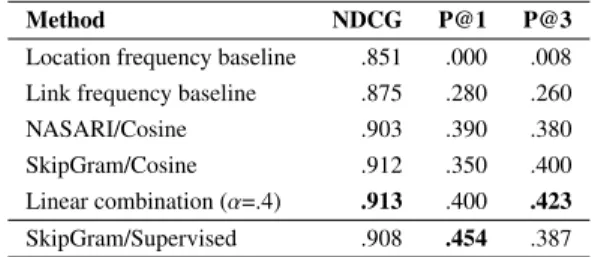
SkipGram/Supervised .908 .454 .387
As before, we test the model on the human-rated set of objects and locations locatedAt-Human-rankings described in Section 4.1 and produce a ranking of lo-cations for each object. Table 8 shows the performance of the extended model (SkipGram/Supervised) in com-parison to the previous approaches.
Overall, we can observe mixed results. All of our proposed models (supervised and unsupervised) im-prove upon the baseline methods with respect to all evaluation metrics. Compared to the SkipGram/Co-sine model, the SkipGram/Supervised model decreases slightly in performance with respect to the NDCG and more so for the Precision@3 score. Most striking, however, is the increase in Precision@1 of SkipGram/-Supervised, showing a relative improvement of 30% to the SkipGram/Cosine model and constituting the high-est overall Precision@1 score by a large margin. How-ever, the linear combination (α=.4) still scores higher with respect to Precision@3 and NDCG.
While the presented results do not point to a clear preference for one particular model, Section 5.2 will investigate the above methods more closely in the con-text of the generation of a knowledge base.
5.2. Retrieval Evaluation
In the previous section, we tested how the proposed methods perform in determining a ranking of locations given an object. For the purpose of evaluation, the tests have been conducted on a closed set of entities. In this section we return to the original motivation of this work, that is, to collect manipulation-relevant informa-tion about objects in an automated fashion in the form of a knowledge base.
0 200 400 600 800 1000 k
0.0 0.2 0.4 0.6 0.8 1.0
Precision
SkipGram/Cosine avrg. SkipGram/Supervised linear combination NASARI/Cosine
(a) Precision
0 200 400 600 800 1000 k
0.0 0.2 0.4 0.6 0.8 1.0
Recall
SkipGram/Cosine avrg. SkipGram/Supervised linear combination NASARI/Cosine
(b) Recall
0 200 400 600 800 1000 k
0.0 0.2 0.4 0.6 0.8 1.0
F-score
SkipGram/Cosine avrg. SkipGram/Supervised linear combination NASARI/Cosine
(c) F-score
Fig. 1. Evaluation on automatically created knowledge bases (“usual” locations).
0 200 400 600 800 1000 k
0.0 0.2 0.4 0.6 0.8 1.0
Precision
SkipGram/Cosine avrg. SkipGram/Supervised linear combination NASARI/Cosine
(a) Precision
0 200 400 600 800 1000 k
0.0 0.2 0.4 0.6 0.8 1.0
Recall
SkipGram/Cosine avrg. SkipGram/Supervised linear combination NASARI/Cosine
(b) Recall
0 200 400 600 800 1000 k
0.0 0.2 0.4 0.6 0.8 1.0
F-score
SkipGram/Cosine avrg. SkipGram/Supervised linear combination NASARI/Cosine
(c) F-score
Fig. 2. Evaluation on automatically created knowledge bases (“plausible” and “usual” locations).
Therefore, by imposing a threshold on the similar-ity scores and selecting only the object-location pairs that score above said threshold, we can extract a high-confidence set of object-location relations to build a new knowledge base from scratch. Moreover, by using different values for the threshold, we are able to control the quality and the coverage of the produced relations. We test this approach on:
– thelocatedAt-usualandlocatedAt-usual/plausible
datasets (Section 4.1) for thelocatedAt rela-tion between objects and locarela-tions, and
– the usedFor-Extracted-triples dataset (Section
4.3) for theusedFor relation between objects and actions.
We introduce theusedForrelation in order to assess the generalizability of our supervised scoring function. In general, we extract a knowledge base of triples by scoring each possible candidate triple, thus producing an overall ranking. We then select the topktriples from the ranking, withkbeing a parameter. This gives us the triples that are considered the most prototypical. We evaluate the retrieved set in terms of Precision, Recall
and F-score against the gold standard sets with varying values ofk. Here, the precision is the fraction of cor-rectly retrieved triples in the set of all retrieved triples, while the recall is the fraction of retrieved triples that also occur in the gold standard set. The F-score is the harmonic mean of precision and recall:
Precision=|G ∩ Rk|
|Rk|
Recall=|G ∩ Rk|
|G|
F1=
2·Precision·Recall
Precision+Recall
withGdenoting the set of gold standard triples andRk
the set of retrieved triples up to rankk.
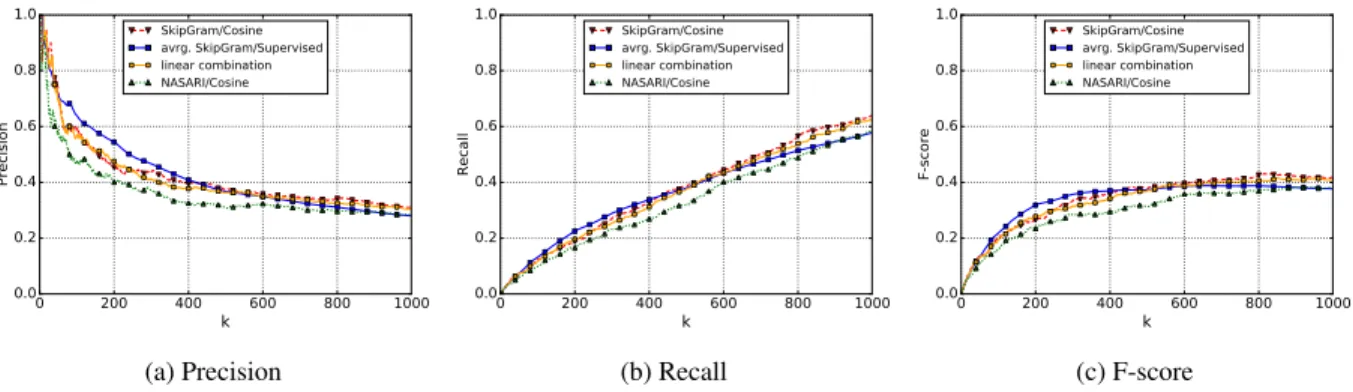
Figures 1 and 2 show the evaluation of the four methods evaluated against the two aggregated gold
standard datasets for the locatedAt relation
de-scribed above. Figures 1c and 2c, in particular, show F-score plots for a direct comparison of the perfor-mance. The SkipGram/Supervised model achieves the highest F-score on thelocatedAt-usualdataset, peak-ing atk = 132 with an F-score of 0.415. The Skip-Gram/Cosine model and the linear combination out-perform both the NASARI/Cosine and the SkipGram/-Supervised in terms of recall, especially for higher k. This also holds for the locatedAt-usual/plausible dataset. Here, the SkipGram/Supervised model stands out by achieving high precision values for small val-ues ofk. Overall, SkipGram/Supervised performs bet-ter for smallk(50 – 400) whereas SkipGram/Cosine and the linear combination obtain better results with increasing k. This seems to be in line with the re-sults from previous experiments in Table 8 that show a high Precision@1 for the SkipGram/Supervised model but higher scores for SkipGram/Cosine and the linear combination in terms of Precision@3.
5.3. Evaluation of Object-Action pairs extraction
One of the reasons to introduce a novel technique for relation extraction based on a supervised statis-tical method, as stated previously, is to be able to scale the extraction across different types of rela-tions. To test the validity of this statement, we ap-ply the same evaluation procedure introduced in the previous part of this section to the usedFor rela-tion. For the training and evaluation sets we use the datasetusedFor-Extracted-triplescomprising of semi-automatically extracted triples from ConceptNet (Sec-tion 4.3).
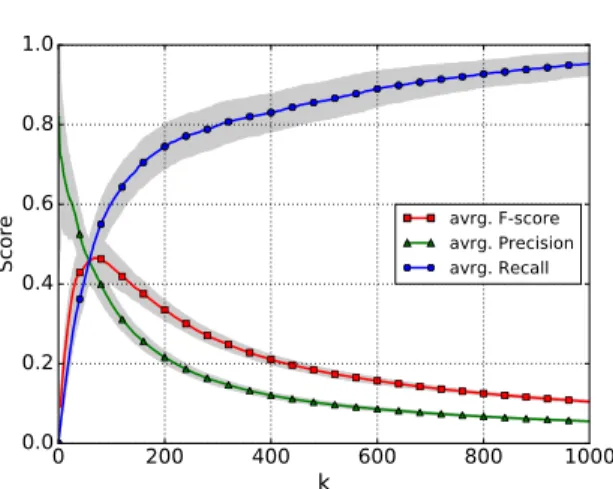
Figure 3 displays precision, recall and F-score for retrieving the topk results. The results are averaged scores over 100 experiments to account for variations in performance due to the random partitioning in train-ing and evaluation triples and the generation of nega-tive samples. The standard deviation for precision, re-call and F-score for allkis visualized along the mean scores.
The supervised model achieves on average a max-imum F-score of about 0.465 when extracting 70 triples. This is comparable to the achieved F-scores when training the scoring function for thelocatedAt
relation. To give an insight into the produced false pos-itives, Table 9 shows the top 30 extracted triples for
0
200
400
600
800
1000
k
0.0
0.2
0.4
0.6
0.8
1.0
Score
avrg. F-score avrg. Precision avrg. Recall
Fig. 3. Evaluation of knowledge base generation for theusedFor
relation between objects and actions. Precision, Recall and F-score are given with respect to extracting the tokscored triples.
theusedFor relation of one trained instance of the supervised model.
6. Building a Knowledge Base of Object Locations
Given these results, we can aim for a high-confidence knowledge base by selecting the threshold on object-location similarity scores that produces a reason-ably high precision knowledge base in the evalua-tion. For instance, the knowledge base made by the top 50 object-location pairs extracted with the lin-ear combination method (α = 0.4) has 0.52 preci-sion and 0.22 recall on thelocatedAt-usualgold stan-dard (0.70 and 0.07 respectively on the
locatedAt-usual/plausibleset, see Figures 1a and 2a). The
simi-larity scores in this knowledge base range from 0.570 to 0.866. Following the same methodology that we used to construct the gold standard set of objects and locations (Section 4.1), we extract all the 336
Domestic_implements and 199 Rooms from DBpedia, for a total of 66,864 object-location pairs. Selecting only the pairs whose similarity score is higher than 0.570, according to the linear combina-tion method, yields 931 high confidence locacombina-tion rela-tions. Of these, only 52 were in the gold standard set of pairs (45 were rated “usual” or “plausible” locations), while the remaining 879 are new, such as (Trivet,
Table 9
A list of the top 30 extracted triples for theusedForrelation. The gray highlighted rows mark the entity pairs that are part of the gold standard dataset (Section 4.3).
Score Object Action
1.00000 Snack Snacking
0.99896 Snack Eating
0.99831 Curry Seasoning 0.99773 Drink Drinking 0.98675 Garlic Seasoning 0.98165 Oatmeal Snacking
0.98120 Food Eating
0.96440 Pistol Shooting 0.95218 Drink Snacking 0.94988 Bagel Snacking 0.94926 Wheat Snacking 0.93778 Laser Printing
0.92760 Food Snacking
0.91946 Typewriter Typing 0.91932 Oatmeal Eating
0.91310 Wok Cooking
0.89493 Camera Shooting 0.85415 Coconut Seasoning
0.85091 Stove Frying
0.85039 Oatmeal Seasoning
0.84038 Bagel Eating
0.83405 Cash Gambling
0.81985 Oatmeal Baking 0.80975 Lantern Lighting 0.80129 Calculator Typing 0.78279 Laser Shooting 0.77411 Camera Recording
0.75712 Book Writing
0.72924 Stove Cooking
0.72280 Coconut Snacking
location with 89 relations, while 15 out of 107 loca-tions are associated with one single object.16
The knowledge base created with this method is the result of one among many possible configurations of a number of methods and parameters. In particular, the creator of a knowledge base involving the extraction of relations is given the choice to prefer precision over re-call, or vice-versa. This is done, in our method, by ad-justing the threshold on the similarity scores. Employ-ing different algorithms for the computation of the ac-tual similarities (word embeddings vs. entity vectors,
16The full automatically created knowledge base and used resources are available at https://project.inria.fr/ aloof/data/.
supervised vs. unsupervised models) is also expected to result in different knowledge bases. A qualitative as-sessment of such impact is left for future work.
7. Conclusion and Future Work
We have presented a framework for extracting manipulation-relevant knowledge about objects in the form of (binary) relations. The framework relies on a ranking measure that, given an object, ranks all enti-ties that potentially stand in the relation in question to the given object. We rely on a representational ap-proach that exploits distributional spaces to embed en-tities into low-dimensional spaces in which the rank-ing measure can be evaluated. We have presented re-sults on two relations: the relation between an object and its prototypical location (locatedAt) as well as the relation between an object and one of its intended uses (usedFor).
We have shown that both an approach relying on standard word embeddings computed by a skip-gram model as well as an approach using embeddings com-puted for disambiguated concepts rather than lemmas perform very well compared to two rather naive base-lines. Both approaches were presented already in pre-vious work. As main contribution of this paper, we have presented a supervised approach based on a neu-ral network that, instead of using the cosine similarity as measure of semantic relatedness, uses positive and negative examples to train a scoring function in a su-pervised fashion. In contrast to the other two unsuper-vised approaches, the latter learns a model that is spe-cific for a particular relation while the other two ap-proaches implement a general notion of semantic re-latedness in distributional space.
We have shown that the improvements of the super-vised model are not always clear compared to the two unsupervised approaches. This might be attributable to the fact that the types of both relations (usedForand
locatedAt) are specific enough to predict the rela-tion in quesrela-tion. Whether the unsupervised approach would generalize to relations with a less specific type signature remains to be seen.
5 [61] such asMadeOf,Causes,CausesDesire,
CapableOf, and more that all help a robot to interact with humans and objects in its environment.
We also plan to employretrofitting [22] to enrich our pretrained word embeddings with concept knowl-edge from a semantic network such as ConceptNet or WordNet [45] in a post-processing step. With this tech-nique, we might be able to combine the benefits of the concept-level and word-level semantics in a more so-phisticated way to bootstrap the creation of an object-location knowledge base. We believe that this method is a more appropriate tool than the simple linear com-bination of scores. By specializing our skip-gram em-beddings for relatedness instead of similarity [31] even better results could be achieved.
In the presented work, we used the frequency of en-tity mentions in Wikipedia as a measure of common-ality to drive the creation of a gold standard set for evaluation. This information, or equivalent measures, could be integrated directly into our relation extrac-tion framework, for example in the form of a weighting scheme or hand-crafted features, to improve its predic-tion accuracy.
Acknowledgments The authors wish to thank the
anonymous reviewers of EKAW, who provided use-ful feedback to make this extended version of the pa-per. The work in this paper is partially funded by the ALOOF project (CHIST-ERA program) and by the Cluster of Excellence Cognitive Interaction Technol-ogy ’CITEC’ (EXC 277), Bielefeld University.
References
[1] Ken Barker, Bhalchandra Agashe, Shaw Yi Chaw, James Fan, Noah S. Friedland, Michael Robert Glass, Jerry R. Hobbs, Ed-uard H. Hovy, David J. Israel, Doo Soon Kim, Rutu Mulkar-Mehta, Sourabh Patwardhan, Bruce W. Porter, Dan Tecuci, and Peter Z. Yeh. Learning by reading: A prototype system, performance baseline and lessons learned. InProceedings of the Twenty-Second AAAI Conference on Artificial Intelligence, July 22-26, 2007, Vancouver, British Columbia, Canada, pages 280–286, 2007.
[2] Marco Baroni, Georgiana Dinu, and Germán Kruszewski. Don’t count, predict! A systematic comparison of context-counting vs. context-predicting semantic vectors. In Proceed-ings of the 52nd Annual Meeting of the Association for Com-putational Linguistics (ACL), pages 238–247, June 2014. DOI:
10.3115/v1/P14-1023.
[3] Marco Baroni and Roberto Zamparelli. Nouns are vectors, adjectives are matrices: Representing adjective-noun construc-tions in semantic space. InProceedings of the 2010 Con-ference on Empirical Methods in Natural Language
Process-ing (EMNLP), pages 1183–1193, Stroudsburg, PA, USA, 2010. Association for Computational Linguistics.
[4] Lawrence W. Barsalou. Simulation, situated conceptualization, and prediction.Philosophical Transactions of the Royal Soci-ety B: Biological Sciences, 364(1521):1281–1289, 2009. DOI:
10.1098/rstb.2008.0319.
[5] Valerio Basile, Soufian Jebbara, Elena Cabrio, and Philipp Cimiano. Populating a Knowledge Base with Object-Location Relations Using Distributional Semantics. In20th Interna-tional Conference on Knowledge Engineering and Knowledge Management (EKAW 2016), pages 34 – 50, Bologna, Italy, November 2016. DOI:10.1007/978-3-319-49004-5_ 3.
[6] Sebastian Blohm and Philipp Cimiano. Using the web to re-duce data sparseness in pattern-based information extraction. InKnowledge Discovery in Databases: PKDD 2007, 11th Eu-ropean Conference on Principles and Practice of Knowledge Discovery in Databases, Warsaw, Poland, September 17-21, 2007, Proceedings, pages 18–29, 2007. DOI:10.1007/ 978-3-540-74976-9_6.
[7] Sebastian Blohm, Philipp Cimiano, and Egon Stemle. Harvest-ing relations from the web -quantifiyHarvest-ing the impact of filterHarvest-ing functions. InProceedings of the 22nd Conference on Artificial Intelligence (AAAI-07), pages 1316–1323. Association for the Advancement of Artificial Intelligence (AAAI), Juli 2007. [8] Kurt Bollacker, Colin Evans, Praveen Paritosh, Tim Sturge,
and Jamie Taylor. Freebase: A collaboratively created graph database for structuring human knowledge. InProceedings of the 2008 ACM SIGMOD International Conference on Manage-ment of Data, SIGMOD ’08, pages 1247–1250, New York, NY, USA, 2008. ACM. DOI:10.1145/1376616.1376746. [9] Mario Bollini, Stefanie Tellex, Tyler Thompson, Nicholas Roy,
and Daniela Rus. Interpreting and executing recipes with a cooking robot. InExperimental Robotics - The 13th Inter-national Symposium on Experimental Robotics, ISER 2012, June 18-21, 2012, Québec City, Canada, pages 481–495. 2012. DOI:10.1007/978-3-319-00065-7_33.
[10] Antoine Bordes, Nicolas Usunier, Alberto Garcia-Duran, Jason Weston, and Oksana Yakhnenko. Translating embeddings for modeling multi-relational data. InAdvances in Neural Infor-mation Processing Systems 26, pages 2787–2795. Curran As-sociates, Inc., 2013.
[11] Razvan C. Bunescu and Raymond J. Mooney. Subsequence kernels for relation extraction. InProceedings of the 18th In-ternational Conference on Neural Information Processing Sys-tems, NIPS’05, pages 171–178, Cambridge, MA, USA, 2005. MIT Press.
[12] José Camacho-Collados, Mohammad Taher Pilehvar, and Roberto Navigli. NASARI: A novel approach to a semantically-aware representation of items. InProceedings of the 2015 Conference of the North American Chapter of the Association for Computational Linguistics: Human Language Technologies, pages 567–577, 2015. DOI:10.3115/v1/ N15-1059.
[13] François Chollet. Keras. https://github.com/ fchollet/keras, 2015.