Abstract— Vehicular ad-hoc networks (VANETs) are the special application of infrastructure-less wireless Mobile ad-hoc network (MANET). Vehicular ad-hoc networks (VANET) allow envisaging a new way to access contents based on epidemic data dissemination, and increasing system scalability. In this paper, we present a collaborative system for content diffusion and retrieval among vehicles. This system also relies on multicast epidemic dissemination of messages over an adhoc network and exploits vehicles mobility and their local storage capabilities. Develop a mobility model based on collaborative system and also present the epidemic and SPAWN Algorithm for disseminating data includes road intersection, number of participating vehicles and number of packets sent per second by each vehicle. In this system, contents stored into a node are made available and eventually transferred to other vehicles that are wishing to retrieve them. Mobility models play an important role in VANET simulations. The simulation shows that our developed mobility model is realistic and can adapt well with proposed Algorithm The paper work defines general communication requirements of future data dissemination applications and investigates various wireless carriers that are important to achieve communication in between vehicles and between vehicles and nearby infrastructure. Analyze several future applications related to the MDDV field and describe their communication requirements.The end result of this work is guidelines to help application developers to epidemic algorithms and SPAWN Algorithm to application performance requirements.
Index Terms— Epidemic data dissemination, inter vehicle
communication, reliability, vehicular ad hoc network.
INTRODUCTION
Vehicular Ad-Hoc Network (VANET) communication has recently become an increasingly popular topic in the area of wireless networking.
Manuscript received June 20, 2012.
Snehal H. Kuche, Research Scholar, Department of Computer Science & Engineering, Email:[email protected], G.H.Raisoni College of Engineering, Nagpur-440016, India.
A. R. Deshmukh, Assistant Professor, Department of Electronics & Telecommunication Engineering, Email:[email protected], G.H.Raisoni College of Engineering, Nagpur-440016, India,
S. S. Dorle, Professor, Department of Electronics Engineering, Email: [email protected], G.H.Raisoni College of Engineering, Nagpur-440016, India
The goal of VANET research is to develop a vehicular communication system to enable quick and cost efficient distribution of data. A key component for VANET simulations is a realistic vehicular mobility model that ensures that to real deployments. In VANETs the high node mobility causes frequent topology change which greatly affects the network performance. The movement of the nodes and its position in the topology is represented by Mobility Models which is key components of simulation for both MANETs and VANETs routing protocol. Vehicular ad-hoc networks (VANETs) are considered to be the special application of infrastructure-less wireless Mobile ad-hoc network (MANET). Vehicular ad-hoc networks (VANET) [1] allow envisaging a new way to access contents based on epidemic data dissemination, costs for both the user and the content publisher, and also increasing system scalability. In ad hoc network the VANET not only Maintain but also update information on routing between all nodes of a given network at all times [3]. One of the most important parameters in simulating ad-hoc networks is the node mobility. It is important to use a realistic mobility model so that results from the simulation correctly reflect the real-world performance of a VANET. A realistic mobility model [2] should consist of a realistic topological map which reflects different densities of roads and different categories of streets with various speed limits.
Fig.1 Structure of Vehicular Ad-Hoc Network
Fig.1 shows Vehicular Ad-Hoc Network is a form of Mobile ad-hoc network, to provide communications among nearby vehicles and between vehicles and nearby fixed equipment,
usually described as roadside unit (RSU) equipment. Collaborative system refers to working jointly with others
in groups especially in an intellectual endeavor to put
Mobility in Vehicular Ad-Hoc Network Based
On Collaborative System
International Journal of Advanced Research in Computer Science and Electronics Engineering
Volume 1, Issue 4, June 2012
together content. The key feature of collaborative content isthat it is created, reviewed, refined, enhanced and shared by interactions and contributions of a number of people. Collaborative content applications are providing new means for self-expression, individual creativity and development [4]. A collaborative system for content diffusion and retrieval among vehicles that relies on multicast epidemic dissemination of messages over an adhoc network and exploits vehicles mobility and their local storage capabilities. Use content-based predictor to complete collaborative data [5]. In this system, contents stored into a node are made available and eventually transferred to other vehicles that are wishing to retrieve them. Data dissemination concerns the transport of information to intended receivers. Vehicles exchange information with other vehicles within their short radio range, and ad hoc wireless networks which are used to propagate information. Collaborative content is impacting the social fabric of society; it has resulted in significant changes in information provision and has provided new participation possibilities affecting the different roles. Collaborative content also brings many challenges and problems, which arise from the openness of participation. These challenges need to be addressed before the benefits arising from the potential of collaborative content approaches can be realized.
II.LITURATUREREVIEW
There is a rich literature available on mobility models and the analysis of routing protocols on mobility models. The opportunities for VANET are growing rapidly with many vehicle manufacturers and their suppliers actively supporting research and development. Vehicular ad-hoc networks (VANET) allow envisaging a new way to access contents based on epidemic data dissemination, as well as tearing down the costs for both the user and the content publisher, and increasing system scalability. The system is not only feasible, reliable but also it can be used as a peer-to-peer download accelerator for improving client-server access. In [2], the design and the evaluation of a collaborative system for content diffusion and retrieval among traveling vehicles. This system relies on multicast epidemic dissemination of messages and exploits vehicles mobility and their local storage capabilities. Necessary requirements and key components for the generation of mobility models for VANETs have been given in [3]. The framework presented covers most of the required entities and their characteristics for the generation of realistic mobility models for VANETs. The impact of different mobility models on the performance of MANETs routing protocols is given in [4].
In [6], the authors propose SPAWN, a cooperative system for content delivery and sharing in VANETs. In this cooperative system the presence of infrastructure nodes placed at regular intervals along the freeway that provides connectivity to the Internet. The cooperative system based vehicle structure stored data as per requirement and properly save data inside the vehicle Data storage memory. When a vehicle wants to download a particular file, it requests the content to the nearest gateway and starts to download pieces. After getting out of range, the vehicle starts gossiping the availability of the content and exchanges pieces of the file.
Once the gossiping starts between vehicles so the downloaded files scattered. In SPAWN, UDP gossip messages are used to disseminate content availability, while data packets are sent using TCP. The system propose, all messages are sent using UDP multicast packets, allow all the nodes in the neighborhood to observe and cache the exchanged data.
Urban Multi-hop Broadcast (UMB) supports directional broadcast in VANETs [3]. UMB tries to improve reliability of broadcast by alleviating a hidden terminal problem through an RTS/CTS-style handshake, and broadcast storms through black-burst signals to select a forwarding node that is farthest from the sender using location information.
In [8] Epidemic algorithms follow the paradigm of nature by applying simple rules to spread information by just having a local view of the environment. Epidemic algorithm refers to network protocols that allow rapid dissemination of information from a source through purely local interactions. [7] A class of algorithms, called epidemic algorithms, have been successfully used in disseminating information in the context of various other systems. These systems are usually decentralized and distributed systems such as replicated databases. Messages initiated from the source are rebroadcast by neighboring nodes. Extending outward hop by hop until the entire network is reached.
Multihop ad hoc vehicle-to-vehicle communication, together with communication between vehicles and fixed wireless infostations (so called roadside units), will enable both public safety and commercial applications. The data traffic that will drive these mobile ad hoc vehicular networks range from short but critical public safety data with very tight latency constraints, to large amounts of bulk ―download‖ data with relatively lenient latency constraints, to moderate amounts of near real-time data with somewhat tight latency constraints. Allowable latency is especially important in safety applications where it must be very short (milliseconds); since a safety message is useful only for a short period of time and any large delay might not allow the vehicle to respond in time. In order to allow a moving vehicle to establish a connection with other/s vehicles, a certain amount of time is needed and that is called connection set up time.
re-transmissions can be used to reduce the packet loss rate.
Summary: From the literature survey, it is observed that a collaborative system for content diffusion and retrieval in vehicular network. Vehicular adhoc network that is based on a data oriented protocol that offers a mechanism for downloading contents in a peer-to-peer fashion over short-range ad-hoc networks. This system delivers good performance when used to disseminate contents from road-side stations. This system gives good result while vehicles are communicating with each other and share data as per the requirement. Vehicular adhoc network allow data dissemination which helps to increasing system scalability.
III.SYSTEMARCHITECTURE
Mobility models are used for simulation of routing Protocols so, it is very important to use a mobility model that has most of the required components of the real world scenarios.
Fig.2 Single Infostation sending data to all vehicles Fig.2 shows that where a single infostation is sending data to all vehicles traveling in the different direction along a city area. Here efficiently disseminating information from a
roadside infostation to a dense unidirectional linear highway network, as shown in Figure 2.Therefore both the throughput and latency that can be achieved using efficient multihop vehicle-to-vehicle collaboration. In the case of the vehicular network, the implementation of random linear network coding is particularly straightforward. Each packet in the network consists of simply a linear combination of all of the source packets. Every vehicle maintains a buffer containing all of the linearly independent packets that it has received. When a vehicle chooses to transmit, it generates a set of random mixing coefficients, uses those coefficients to combine the packets in its buffer, and transmits the result over the channel.
Road is the main entity for the development of mobility traces or maps for any mobility model used for VANETs. The roads may have single lane or multiple lanes. In single lane roads there is usually one lane for one direction of traffic. On the other hand, in multiple lane roads there are multiple paths for vehicles to move on. The number of streets and intersections in a road also affects the speed of vehicles. The velocity of a vehicle also affects the motion of other nearby vehicles moving in same lane or moving in side-by lane. The velocities of the vehicles are high and normally each lane is assigned a pre defined velocity limits.
Fig.3. System Implementation Architecture
System implementation has been split into three concurrent activities (Fig.3): the local agent, the receiver agent and the broadcast agent [9].
The local agent is in charge of managing the GUI and reacts to user’s interactions, searching the local database for requested contents and inserting wish and request packets into the broadcast queue until the desired data are retrieved. The receiver agent processes incoming packets. Wish requests are matched against the local database: for each matching manifest file, an offer message is inserted into the broadcast queue. If a request message, belonging to a known manifest file, has been received and a compatible set of fragments is available, some of them (randomly picked) are added to the broadcast queue, e.g. depending on its number of empty slots. When a data message is received, the contained fragment is temporarily quarantined.
The broadcast agent is in charge of sending packets to the neighborhood. In order to guarantee a fair access to the medium to all the vehicles in range, a credit system is employed. A one second timer periodically awakes the broadcast agent that estimates the available number of credits.
IVPROPOSEDSCHEME Objectives of study:
International Journal of Advanced Research in Computer Science and Electronics Engineering
Volume 1, Issue 4, June 2012
dissemination of messages over an adhoc network andexploits vehicles mobility and their local storage capabilities. In this system, contents stored into a node are made available and eventually transferred to other vehicles that are wishing to retrieve them. This system can reduce costs both for the content publisher, by cutting down infrastructure needs, and for the user, by avoiding or limiting connectivity expenses.
Data delivery mechanisms define for moving information through the network. Messages are stored and forwarded as opportunities present themselves. When a message is forwarded to another node, a copy may remain with the original and be forwarded again later to improve reliability. Some simple implementations, e.g., two nodes exchange data whenever they can communicate and also work well if the data needs to be propagated to everybody. A message holder in the active state runs the full protocol to actively propagate the message while a message holder in the passive state only transmits the message if it hears some older message version. The active propagation can help populate the message, move the message closer to the destination region or update dissemination status. The passive updating serves to eliminate false/obsolete information only. Every vehicle stores whatever it overhears since this is almost free except occupying memory buffers. A vehicle drops a message when the vehicle leaves the passive state during the forwarding phase, leaves the active state during the propagation phase or the message expiration time elapses.
To provide a retrieving multimedia content available either on publicly accessible Internet servers or shared by nearby vehicles. Therefore each vehicle will maintain a buffer of all of the packets that it has received. When a vehicle chooses to transmit, it will randomly select one of those packets. Since coordination among vehicles is undesirable, each vehicle will select a packet to transmit. A message holder can be in either one of two dissemination states: the active state and passive state or not eligible to transmit at all.
MDDV (Mobility-Centric Data Dissemination Algorithm for Vehicular Networks) is a diffusion algorithm which considers that vehicles do not have the positions of their surrounding vehicles, contrary to other geographical algorithms. The road system is modeled as a directed graph where nodes represent intersections, and connections road segments. A weight is associated with each connection to reflect corresponding traffic density and distance. MDDV uses a forwarding path specified as the route with the smallest sum of weights from a source to a ―destination region‖ in the directed graph.
Epidemic Dissemination Parameters
Epidemic algorithm refers to network protocols that allow rapid dissemination of information from a source through purely local interactions [8].
Fig.4: Message delivery from node S to D
When a host S wants to send a message to another host D. S passes the message to its neighbor hosts and they do the same until the message reaches D. If there is a partition of the network on the way to D. The message is passed throughout the network and will eventual received by D with high probability shows in fig.4. Each host stores messages in a buffer (hash table), indexed by the unique ID of each message.
In an epidemic algorithm, all system processes are potentially involved in information dissemination. Basically, every process buffers every message it receives up to a certain buffer capacity b and forwards that message a limited number of times t. Messages initiated from the source are rebroadcast by neighboring nodes, extending outward hop by hop until the entire network is reached. The process forwards the message each time to a randomly selected set of processes of limited size f, the fan-out of the dissemination. Many variants of epidemic algorithms exist and are typically distinguished by the values of b, t, and f. These parameters may be fixed independently of the number n of processes in the system, in which case the load imposed on every process remains bounded [10].
Data Generation Phase:
1. Vehicle will pass through the area for the first time. 2. The area server will give the information to the routes. 3. The vehicle will store all the information inside its memory.
Data Evaluation Phase:
1. Vehicle will pass through the area.
2. It will give the area code & compare the code with its internal memory.
3. If data is available then depending upon routing table to route the vehicle properly.
SPAWN Algorithm
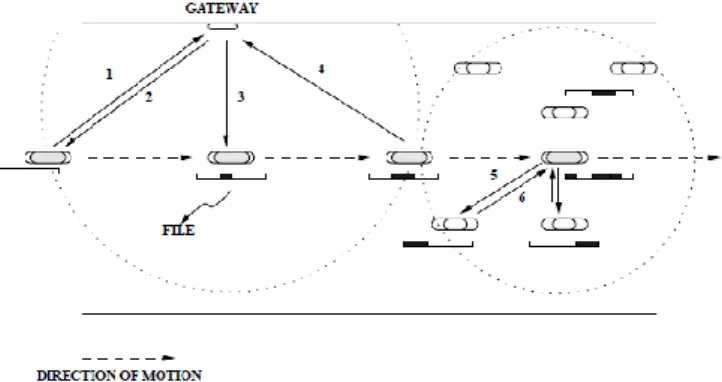
The goal of this protocol is to design and build a data-centric software infrastructure. Simplify the structuring and implementation of robust and efficient autonomous applications across multiple heterogeneous networks. Protocol includes quality-based source and alternative model selection and complex event detection. SPAWN has the same generic structure of any swarming protocol [7].
Fig.5: Evolution of a file in a node using the SPAWN Algorithm
Fig5.shows that (1) A car arrives in the range of a gateway, (2) initiates a download (3) downloads a piece of the file.(4) After getting out of range,(5) starts to gossip with its neighbors about content availability (6) exchanges pieces of the file, thereby getting a larger portion of the file as opposed to waiting for the next gateway to resume the download.
SIMULATIONRESULT
Fig. 6(a)
Fig. 6(b)
Fig. 6(a) and 6(b) shows the different parameters such as acceleration, velocity, power dissipation and speed are using in collaborative system. We considered the following parameters: number of participating vehicles, number of packets per second sent by each vehicle, number of available contents, and average size of contents.
Fig.7 (a)
Fig.7(b) Simulation Result.
Fig.7 (a) and Fig.(b) shows simulation result where the server node broadcast the message to the vehicles. Server disseminates information about the particular area. The vehicles (node) receive the information from server and then simultaneously transmit the data to the server. One centralized and other sub server is created for data dissemination.
Fig.8 Delay output
International Journal of Advanced Research in Computer Science and Electronics Engineering
Volume 1, Issue 4, June 2012
Fig.9 power dissipation in between vehicles
Fig.9 shows the simulation result that power dissipation in between vehicles and time of completion of each wave at the farthest node in the network and time of transmission of the first packet of each wave for the Network. Therefore a collaborative system for content diffusion and retrieval among vehicles and contents stored into a node are made available and eventually transferred to other vehicles that are wishing to retrieve them.
Fig.10 sending a variable number of packets per second.
Fig.10 Shows the simulation result assuming that all circulating vehicles participates to the system and adapt the number of messages sent each second to their neighborhood. Adapting the packet transmission rate makes the system almost independent of the mobility model used.
CONCLUSION
Vehicular ad-hoc networks (VANETs) are considered to be the special application of infrastructure-less wireless Mobile ad-hoc network (MANET). As mobility model is an important tool for simulation and analysis so, Vehicular Ad-Hoc Network (VANET) is surging in popularity, in which vehicles constitute the mobile nodes in the network. Due to the prohibitive cost of deploying and implementing such a system, most research in VANET relies on simulations for evaluation. Using spawn algorithm,some parameters are using like Velocity, Coordinates,Packet receiving, Flooding and power dissipation. These Parameters are use for the vehicle, when vehicle will start to finding the neighbour node and then send data to its neighbour node.Then all data dessiminate and receiving packet fom the servser node. All
circulating vehicles participate to the system and adapt the number of messages sent each second to their neighborhood. This strategy improves a lot the overall results, smoothing down the differences induced by the mobility model. This system can be useful for reducing costs both for the content publisher, by cutting down infrastructure needs, and for the user.
Since content is useful only if it has been totally received, content size influences the dissemination much more than the number of available contents. Examine that how vehicles that want different data flows should cooperate with one another .In future we use the Security using Encryption and Routing protocol.
References
[1]P. Hong, H. Park, and C. Kang, ―A data forwarding Scheme Based on
Predictable Parameters in VANET,‖ in Proc. KICS, pp. 231, Feb. 2010.
[2]Kun-chan Lan and Chien-Ming Chou ―Realistic Mobility Models for
Vehicular Ad hoc Network (VANET) Simulations‖
978-1-4244-2858-8/08/$25.00 ©2008 IEEE.
[3]Muhammad Alam, Muhammad Sher S.Afaq Husain ―VANETs
Mobility Model Entities and Its Impact‖ IEEE-ICET 2008 Rawalpindi, Pakistan, 18-19 October, 2008.
[4]Mark Johnson, Luca De Nardis, and Kannan Ramchandran
―Collaborative Content Distribution for Vehicular Ad Hoc
Networks‖ National Science Foundation under grants
ANI-0326503 and CCR-0330514.
[5]Ajazur Rahman ―Collaborative Content Development‖ 7th
International CALIBER-2009, Pondicherry University,
Puducherry, February 25-27,© INFLIBNET Centre, Ahmedabad.
[6]Shirshanka Das, Alok Nandan, Giovanni Pau―SPAWN: A Swarming
Protocol for Vehicular Ad-Hoc Wireless Networks‖ VANET’04, October 1, 2004, Philadelphia, Pennsylvania, USA. ACM 1-58113-922-5/04/0010
[7]P. Hong, H. Park, and C. Kang, ―A data forwarding Scheme Based on
Predictable Parameters in VANET,‖ in Proc. KICS, pp. 231, Feb. 2010
[8]Tim Daniel Hollerung Peter Bleckmann ― Epidemic Algorithms‖
August, 4th, 2004 Organizer: Christian Schindelhauer.
[9]Mert Akdere et al., ―A comparison of epidemic algorithms in wireless
sensor networks‖, Elsevier Computer Communications, vol. 29,
no. 13, August 2006, pp. 2450-2557.
[10]Paul Tennent, Malcolm Hall, Barry Brown, Matthew Chalmers, Scott
Sherwood ―Three Applications for Mobile Epidemic Algorithms ‖ MobileHCI’05, September 19–22, 2005, Salzburg, Austria.
[11]C. Barberis and G. Malnati: ―Design and Evaluation of a Collaborative
System for Content Diffusion and Retrieval in Vehicular Networks‖ IEEE Transactions on Consumer Electronics, Vol. 57, No. 1, February 2011
[12]T. Leinm¨uller, E. Schoch, and F. Kargl, ―Position Verficiation