
DEVELOPMENT AND VALIDATION OF
UV-SPECTROPHOTOMETRIC METHODS FOR ESTIMATION OF
VALSARTAN IN BULK AND TABLET DOSAGE FORM
Bangaruthalli J.*, R. Urmila, M. Ram Murthi, S. Asha, S. K. Jainabi and Bhavani Prasad
Department of Pharmaceutical Analysis and Quality Assurance, A.U. College of Pharmaceutical Sciences, Andhra University, Visakhapatnam, India.
ABSTRACT
Valsartan is an Angiotensin II receptor blocker drug used in hypertension and other cardiac diseases. Various methods for analysis of the same are available but are time consuming and expensive. Here we have developed two new, precise and simple UV spectrophotometric methods for estimation of Valsartan from bulk and tablet formulation. The drug obeyed the Beer’s law with correlation coefficient 0.99 and 0.99 respectively for Method I and Method II. It showed absorption maxima at 250 nm and 220 nm respectively for method I and Method II. The linearity was observed between 5 – 30 µg/ml. The results of analysis were validated by recovery studies, accuracy, precision, LOD, LOQ and ruggedness. The method was found to be simple, accurate, precise, economical and robust.
KEYWORDS: Valsartan, Zero order spectra, second order spectra, validation, UV-Visible Spectrophotometer.
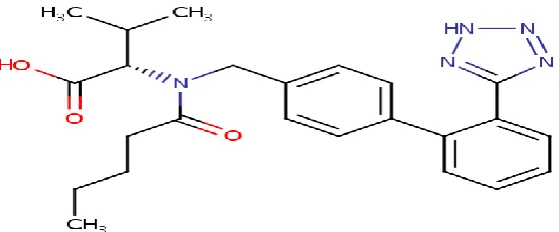
Valsartan
It is belongs to the class of organic compounds known as biphenyltetrazoles and derivatives. These are organic compounds containing a biphenyl attached to a tetrazole. A carbon atom of the biphenyl moiety is boned to a carbon or the nitrogen atom of the tetrazole moiety.
Valsartan is an ARB that selectively inhibits the binding of angiotensin II to AT1, which is found in many tissues such as vascular smooth muscle and the adrenal glands. This
Volume 8, Issue 2, 900-908. Research Article ISSN 2277– 7105
Article Received on 13 Dec. 2018,
Revised on 03 Jan. 2019, Accepted on 24 Jan. 2019
DOI: 10.20959/wjpr20192-14047
*Corresponding Author
Bangaruthalli J.
Department of
Pharmaceutical Analysis
and Quality Assurance, A.U.
College of Pharmaceutical
Sciences, Andhra
University, Visakhapatnam,
effectively inhibits the AT1-mediated vasoconstrictive and aldosterone-secreting effects of angiotensin II and results in a decrease in vascular resistance and blood pressure. Valsartan is selective for AT1 and has virtually no affinity for AT2. Inhibition of aldosterone secretion may inhibit sodium and water reabsorption in the kidneys while decreasing potassium excretion. The primary metabolite of valsartan, valeryl 4-hydroxy valsartan, has no pharmacological activity.
Fig. 1: Structure of Valsartan.
METHODS AND MATERIALS Instruments and reagents
Agilent Cary UV -60 Spectrophotometer with 1cm matched Quartz cells were used for the estimation. Ultrasonicator (ANM -USC 100) and electronic balance (Infra 201 LEC) used for the experiment. Valsartan pure drug was obtained as a gift sample from spectra laboratories Hyderabad. Two brands of valsartan tablets manufactured by Torrent pharmaceuticals (Valzaar) and Novartis (Diovan) were procured from local pharmacy. All the reagents were of analytical grade. Double distilled water was used throughout the experiment.
Solubility studies
Solubility by using water: Taking 1gm of sample in test tube and added 5ml of water and shaken the test tube and the sample was insoluble in water.
and the sample was insoluble in water, nitric acid and hydrochloric acid so finally we done the ash method.
Ash method
Standard preparation: standard pb(lead) solution (NIST) 2ml of standard lead solution taken and transferred into the 20ml volumetric flask and made upto 20ml by using distilled water (100ppm).
From this above solution we done the dilutions
0.5ml into 100ml volumetric flask and make up to 100ml by using distilled water 1.0ml into 100ml volumetric flask and make up to 100ml by using distilled water 1.5ml into 100ml volumetric flask and make up to 100ml by using distilled water 2.0ml into 100ml volumetric flask and make up to 100ml by using distilled water 2.5 ml into 100ml volumetric flask and make up to 100ml by using distilled water 3.0ml into 100ml volumetric flask and make up to 100ml by using distilled water
Sample preparation: First we take the 6 crucibles and added the 2gm of sample into each crucible and done the ash method by using Mufler funnel this will be done at 800⁰c for 1hr then total organic compounds are evoporated and inorganic substances should be remains. And then take 6 crucibles cool to the room temperature and then add the 2ml of nitric acid to each crucible, and again done the digestion process for to evaporate remaining organic substances in the sample.
After 10min again take the each crucible and cool into the room temperature. and then add 5ml of distilled water to each crucible and make the sample upto 10ml in volumetric flask by using distilled water. This process done to the each sample.
RESULTS AND DISCUSSION System Suitability
Linearity
2ml of standard lead solution taken and transferred into the 20ml volumetric flask and made upto 20ml by using distilled water .0.5 ml into 100ml volumetric flask and make up to 100ml by using distilled water (100ppm).from this solution prepared the below dilutions
Method precision
Intermediate precision
The next day Prepared the standard solution and inject the solution for 6 replicants.
Accuracy
Preparation of 50% sample solution
LOD & LOQ
From the standard solution prepare the below dilutions.
REFERENCES
1. Gorsuch, T.T., `The Destruction of Organic Matter', Pergamon Press, 1970.
2. Ramirez-Munoz, J. `Atomic Absorption Spectroscopy and Analysis by Atomic Absorption Flame Photometry', Elsevier Publishing Company, 1968.
3. Tsalev, D.L., Zaprianov, Z. K., `Atomic Absorption Spectrometry in Occupational and Environmental Health Practice', Vol.I., CRC Press, 1983.
4. Tsalev, D.L., `Atomic Absorption Spectrometry in Occupational and Environmental Health Practice', Vol.II., D.L. CRC Press, 1984.
5. Smith, G.F., `Mixed Perchloric, Sulphuric and Phosphoric Acids and Their. 6. Applications in Analysis', G. Frederick Smith Chemical Co., 1942.
7. Pinta, M., `Atomic Absorption Spectrometry', Adam Hilger, 1975.
8. Dean, J.A., `Flame Photometry', McGraw Hill Book Company Inc., 1960.
9. Metcalfe, E., `Atomic Absorption and Emission Spectroscopy', John Wiley & Sons, 1987. 10.Varma, A., `Handbook of Furnace Atomic Absorption Spectroscopy', CRC Press Inc.,
1990.
11.Christian, G. D., Feldman, F. J., `Atomic Absorption Spectroscopy Applications in Agriculture, Biology and Medicine', John Wiley & Sons, Inc., 1970.
12.Bock, R., `A Handbook of Decomposition Methods in Analytical Chemistry', translated by Dr. Iain L. Marr, International Textbook Company Limited A member of the Blackie Group, 1979.
13.Mueller, W., Smith, D.L., `Compilation of EPA's Sampling and Analysis Methods', Keith, L.H., Ed., Lewis Publishers, Inc., 1991.
14.Valcarcel, M. Luque de Castro, M. D., `Flow-Injection Analysis principles an applications', Ellis Horwood Ltd., Halsted Press a division of John Wiley & Sons, 1987. Thompson, M., Walsh, J.N., `Handbook of Inductively Coupled Plasma Spectrometry', 2nd ed., Blackie & Son Ltd., 1989.
15.Potts, P.J., `A Handbook of Silicate Rock Analysis', Blackie Group, 1987.
16.Barium, Calcium, Magnesium and Zinc in unused Lubricating Oils by Atomic Absorption Spectroscopy. Standard Methods for Analysis and Testing of Petroleum and Related Products 1990. Vol. 2. Institute of Petroleum, London 1990. Designation IP 308/85 (Reapproved 1990).
18.Mohit Basotra, Sachin Kumar Singh, and Monica Gulati, Development and Validation of a Simple and Sensitive Spectrometric Method for Estimation of Cisplatin Hydrochloride in Tablet Dosage Forms: Application to Dissolution Studies. ISRN Analytical Chemistry
Volume 2013 (2013), Article ID 936254, 8 pages.
19.Eka, N., Astuti, Retno, S. and Rohman, A, Validation and quantitative analysis of
cadmium and lead in snake fruit by flame atomic absorption spectrophotometer,
International Food Research Journal, 2012; 19(3): 937-940.
20.Tiberiu Frentiu, Michaela Ponta and Raluca Hategan, Validation of an analytical method based on the high-resolution continuum source flame atomic absorption spectrometry for the fast-sequential determination of several hazardous/priority hazardous metals in soil.
Chemistry Central Journal, 2013; 7: 43.
21.Abourriche Abdelmjid, Development and validation of an analytical method for atomic absorption spectrometry analysis of Pb in bivalve molluscs. Analytical
Chemistry. 03/2015; 1(6): 213-218.
22.Trajče Stafilov, Irina Karadjova, Atomic absorption spectrometry in wine analysis,
![Crystal structure, Hirshfeld surface analysis and DFT studies of 1 [r 2,c 6 diphenyl t 3 (propan 2 yl)piperidin 1 yl]ethan 1 one](data:image/gif;base64,R0lGODlhAQABAIAAAP///wAAACH5BAEAAAAALAAAAAABAAEAAAICRAEAOw==)