Lucrări ştiinţifice Zootehnie şi Biotehnologii, vol. 40(2), (2007), Timişoara
STUDY REGARDING THE OPERATING SPEED
OF FORAGE HARVESTING MACHINERY IN ORDER
TO OPTIMIZE THE WORKING CAPACITY
AND FUEL CONSUME
STUDIU PRIVIND VITEZA DE LUCRU
A AGREGATELOR DE COSIT FURAJE ÎN CONTEXTUL
OPTIMIZ
Ă
RII CAPACIT
ĂŢ
II DE LUCRU
Ş
I A CONSUMULUI DE COMBUSTIBIL
MOISE V.
Faculty of Environmental Engineering and Biotechnologies, Valahia University of Târgovişte, Romania
The efficiency of forage production machinery system is partially reflected in some classical economical indices, because the real efficiency of mechanical tillage utilization at forage harvesting and preparation must be reflected in the forage quality increasing and feed superior valorization by the farm livestock. An area of 7.8 alfalfa ha was harvested with U-650M tractor and ROTO 165 rotary mower and with U-650M tractor and Zakaz rotary mower at different speeds in field work. Average values of the speed in parcel work, work effective capacity, work capacity during shift, specific work capacity on cutter width, fuel consume per land unit, and specific fuel consume per mass unit were determined for each speed in field work. Power matching between the tractor and the mower do not always meet the requirements when forming harvesting mechanized systems. Classical mowers with common cutting units do not sufficiently load the U-650M tractor existing in many Romanian farms, which determines an unfavorable functioning regime of the tractor engine correlated with increased fuel consumes.
Keywords: forage mechanized harvesting, work capacity, fuel consume.
Introduction
mechanical tillage utilization at forage harvesting and preparation must be reflected in the forage quality increasing and feed superior valorization by the farm livestock reducing feed quantity per livestock product or increasing animal production per feed unit. Forage harvesting operations necessary to obtain proper hay and haylage detain several steps as follows: cutting, hay windrow turning, hay raking, baling and stocking.
The aim of this paper is to present the average values of the speed in parcel work, work effective capacity, work capacity during shift, specific work capacity on cutter width, fuel consume per land unit, and specific fuel consume per mass unit determined for each speed in field work at alfalfa harvesting for hay. Such parameters might be considered in the optimization plan of the field operations lowering fuel consume at alfalfa harvesting.
Materials and Methods
Fuel consume at forage harvesting operation was determined for several machinery systems in different land conditions and crop characteristics. An area of 7.8 alfalfa ha fulfilled the requirements for mechanized harvesting. Two systems were used at different speeds in fieldwork, as follows: U-650M tractor and ROTO 165 rotary mower, and U-650M tractor and Zakaz rotary mower.
Field and machine preparations were especially important for proper operation on each field work. Some preliminary steps for accurately assessing the diesel fuel consume were as follows: remove stumps, stones and foreign objects, or mark them clearly; locate any dangerous ditches and inspect banks for undercutting; plan harvesting; check and tune each equipment for correct operation. Several parameters were estimated: We – work effective capacity
(ha/h); Wsc - work capacity during shift (ha/h); Wl - specific work capacity on
cutterbar width (ha/h.m.); Cha - fuel consume per land unit (l/ha); Cs - specific
fuel consume per green forage tonne unit (l/t).
Results and Discussions
For a succesful mechanized harvesting, plant density must be higher than 300 plants/m2 with minimum canopy heights of 50 cm. A key factor for adequate
measurements was the choice of optimal moving scheme in field work. The covering moving scheme was selected according to parcel dimensions, crop characteristics and machine specifications.
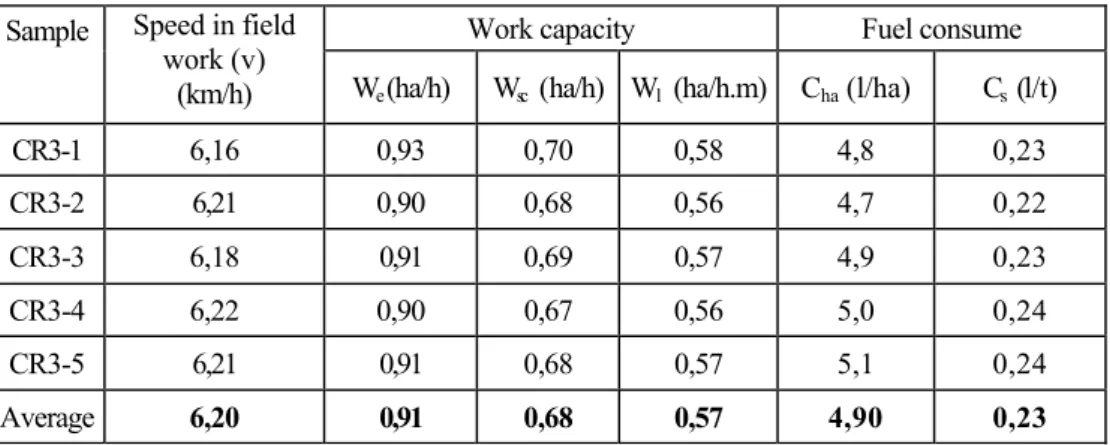
Table 1, 2 and 3 present experimental results concerning work capacity and fuel consume at forage cutting with U-650M tractor and ROTO 165 rotary mower for different forward speed in field work (< 4; < 7 and < 9 km/h).
Table 1 Working indices and fuel consume for alfalfa cutting operation at < 4 km/h
Sample Speed in field work (v)
(km/h)
Work capacity Fuel consume
We (ha/h) Wsc (ha/h) Wl (ha/h.m) Cha (l/ha) Cs (l/t)
CR1-1 3,79 0,56 0,40 0,350 6,67 0,31
CR1-2 3,81 0,57 0,41 0,356 6,75 0,32
CR1-3 3,80 0,57 0,40 0,356 6,71 0,32
CR1-4 3,78 0,55 0,38 0,343 6,66 0,31
CR1-5 3,83 0,54 0,39 0,337 6,68 0,32
Average 3,8 0,56 0,40 0,350 6,70 0,32
Forage crop: alfalfa/lucern; Production: 21.2 t green forage/ha; Mechanized system: U-650M tractor + ROTO 165 rotary mower.
Table 2 Working indices and fuel consume for alfalfa cutting operation at < 7 km/h
Sample Speed in field work (v)
(km/h)
Work capacity Fuel consume
We (ha/h) Wsc (ha/h) Wl (ha/h.m) Cha (l/ha) Cs (l/t)
CR3-1 6,16 0,93 0,70 0,58 4,8 0,23
CR3-2 6,21 0,90 0,68 0,56 4,7 0,22
CR3-3 6,18 0,91 0,69 0,57 4,9 0,23
CR3-4 6,22 0,90 0,67 0,56 5,0 0,24
CR3-5 6,21 0,91 0,68 0,57 5,1 0,24
Average 6,20 0,91 0,68 0,57 4,90 0,23
Forage crop: alfalfa/lucern; Production: 21.2 t green forage/ha; Mechanized system: U-650M tractor + ROTO 165 rotary mower.
were: v = 4,90 km/h; v = 7,00 km/h; v = 8,90 km/h. Work capacities and fuel consume were estimated for this regime (table 4).
Table 3 Working indices and fuel consume for alfalfa cutting operation at < 9 km/h
Sample Speed in field work (v)
(km/h)
Work capacity Fuel consume
We (ha/h) Wsc (ha/h) Wl (ha/h.m) Cha (l/ha) Cs (l/t)
CR5-1 8,51 1,25 0,94 0.78 4,05 0,19
CR5-2 8,55 1,30 9,96 0.81 4,30 0,20
CR5-3 8,42 1,27 0,93 0.79 4,10 0,19
CR5-4 8,57 1,22 0,95 0.76 4,20 0,20
CR5-5 8,54 1,26 0,97 0.79 4,35 0,20
Average 8,50 1,26 0,95 0.79 4,20 0,20
Forage crop: alfalfa/lucern; Production: 21.2 t green forage/ha; Mechanized system: U-650M tractor + ROTO 165 rotary mower.
Table 4 Work effective capacity and fuel consume for different forward speeds
Experiment ID
Speed in field work (v)
(km/h)
Work effective capacity (We)
(ha/h)
Work capacity during shift (Wsc)
Fuel Consume
Ch (l/ha)
CR-b2 4,9 0,74 0,53 5,5
CR-b4 7,0 0,95 0,68 4,6
CR-b6 8,9 1,38 0,99 4,0
Forage crop: alfalfa/lucern; Production: 19.3 t green forage/ha; Mechanized system: U-650M tractor + ROTO 165 rotary mower.
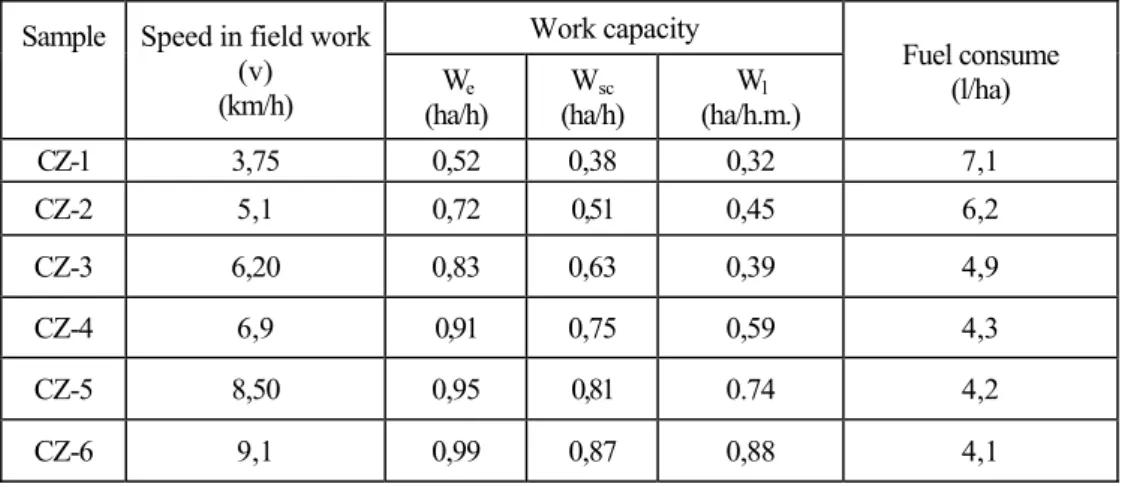
Table 5. Work effective capacity and fuel consume with U-650M tractor and Zakaz rotary mower at
alfalfa harvesting Sample Speed in field work
(v) (km/h)
Work capacity
Fuel consume (l/ha) We
(ha/h) (ha/h) Wsc (ha/h.m.) Wl
CZ-1 3,75 0,52 0,38 0,32 7,1
CZ-2 5,1 0,72 0,51 0,45 6,2
CZ-3 6,20 0,83 0,63 0,39 4,9
CZ-4 6,9 0,91 0,75 0,59 4,3
CZ-5 8,50 0,95 0,81 0.74 4,2
Forage crop: alfalfa/lucern; Production: 19.7 t green forage/ha; Mechanized system: U-650M tractor + Zakaz rotary mower.
Experiments performed with U-650M tractor and Zakaz rotary mower showed similar work indices and fuel consume (table 5).
Conclusions
At forage harvesting, the energetic estimation of the mechanized work operations relies on total fuel consume and specific consume measurements. Energy consumes necessary to perform field operations by a forage harvesting mechanized system primarily depend on fabrication performances of the tillage.
High power requirements for tractor moving in the field might increase the necessary total power of the harvesting system and consequently to the increasing of the specific fuel consume for performing field operation.
Power matching between the tractor and the mower do not always meet the requirements when forming harvesting mechanized systems. Classical mowers with common cutting units do not sufficiently load the U-650M tractor existing in many Romanian farms, which determines an unfavorable functioning regime of the tractor engine correlated with increased fuel consumes.
Bibliography
1. Ciurel, G. et al, (2001) – Avantajele utilizării cositorilor cu elemente rotative în cadrul tehnologiilor de recoltare a plantelor furajere. Lucrări ştiinţifice INMATEH, INMA Bucureşti, Vol. I,.
2. Hermenean, I. (1997) – Contribuţii privind dinamica şi energetica agregatelor tractor-maşini agricole de recoltat furaje pe terenuri în pantă. Teză de doctorat, Univ. Transilvania Braşov.
3. Mocanu, V. (1997) – Optimizarea dinamică şi energetică a agregatelor formate din tractoare monoax şi maşini agricole de recoltat şi transport. Teză de doctorat. Univ. Transilvania Braşov.
4. Moise, V. (2006) – Cercetări privind consumurile de energie şi fiabilitatea utilajelor pentru recoltarea furajelor, Teză de doctorat. U.S.A.M.V. Bucureşti. 5. Mitroi, A., A. Udroiu, M. Caraveteanu: (2003) – The decreasing of specific energy consumption for forage production. Proceedings of the 32nd annual sesion of scientific communications of the Bukarest Fakulty of Animal Science. Bucharest, 15-17
STUDIU PRIVIND VITEZA DE LUCRU
A AGREGATELOR DE COSIT FURAJE IN CONTEXTUL
OPTIMIZARII CAPACITATII DE LUCRU
SI A CONSUMULUI DE COMBUSTIBIL
MOISE V.
Facultatea de Ingineria Mediului şi Biotehnologii, Universitatea Valahia din Târgovişte, România